
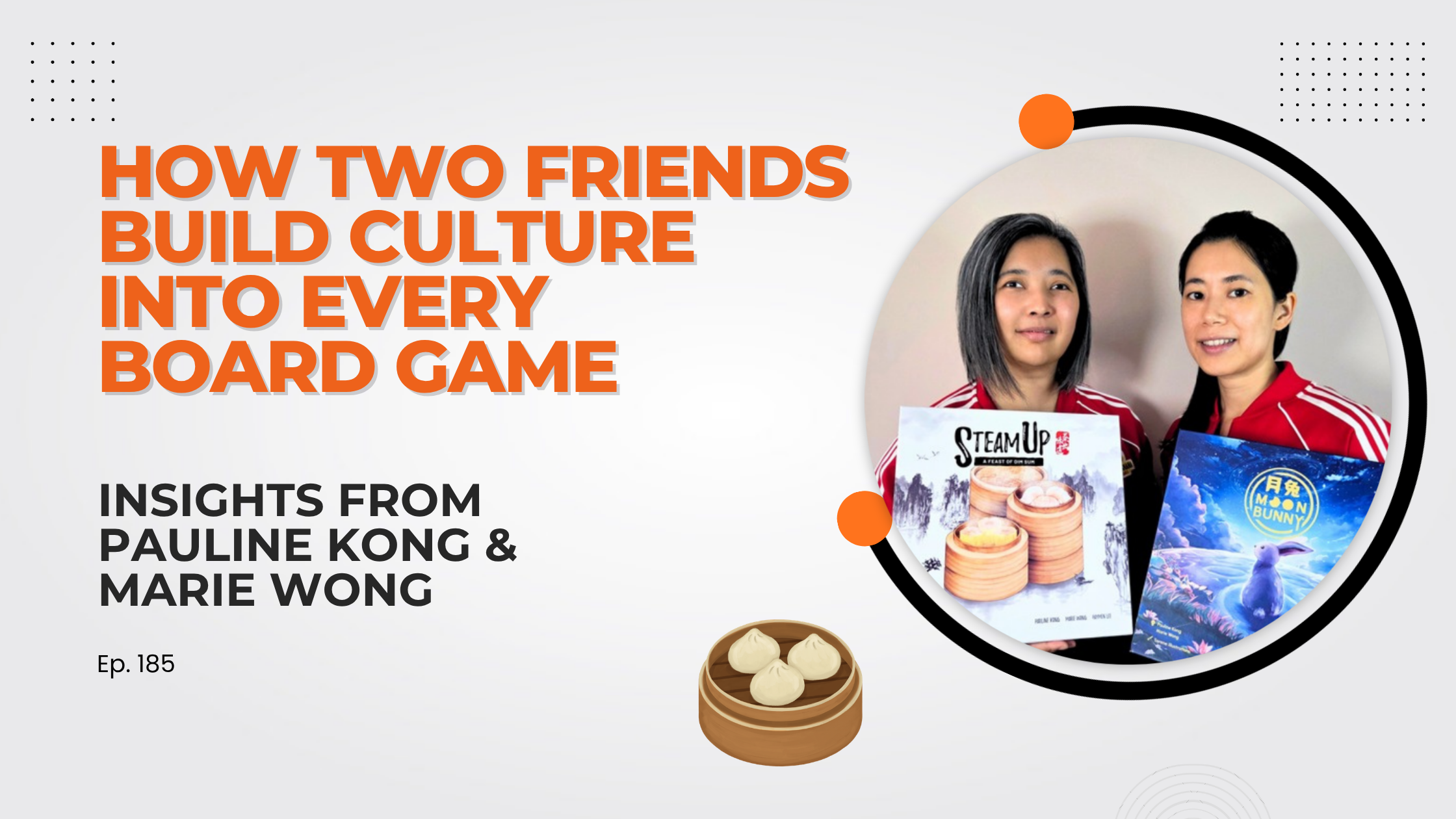
Welcome to another episode of the Toy Business Unboxed Podcast, where we sit down with Pauline Kong and Marie Wong, co-founders of Hot Banana Games. Hot Banana Games is a board game company built around one simple goal, telling authentic Asian stories through play. Pauline and Marie have brought that mission to life with games like Steam Up and Moon Bunny, and they are currently running a Kickstarter for their newest release, Lion Dancer. In this conversation, they walk through how a shared love of board games turned into a business, and what it takes to design games that teach culture without losing the fun.

#185: Making Asian Culture the Star of Your Board Game Night – Toy Business Unboxed
Episode Highlight
- 00:42 Introducing Hot Banana Games
- 01:32 How Pauline and Marie met
- 02:53 Nursing, magic, and creativity
- 05:07 Inside the Lion Dancer Kickstarter
- 06:16 Steam Up’s two year design
- 07:25 When dim sum becomes sushi
- 09:32 Zodiac stories woven into gameplay
- 11:56 What made Steam Up succeed
- 21:23 Pauline and Marie’s best advice
From Badminton Courts to Board Game Founders
Pauline Kong and Marie Wong did not meet through board games at all. They first connected through a badminton group and later bonded over magic shows that Pauline used to perform. After they both stepped away from performing, the two turned their attention to board games and quickly became what Marie calls board game geeks. Their shelves filled up with games until they had the same idea at the same time, why not design one of their own. That question became the starting point for Hot Banana Games.
Designing Steam Up From a Childhood Drawing
The idea for their first game, Steam Up, started with a drawing Pauline made in elementary school of her favorite food, dim sum. Dim sum was a weekly tradition growing up, a time to sit down with friends and family, and Pauline and Marie wanted to recreate that feeling on the table. It took roughly two and a half years to go from concept to publish, with constant playtesting and rounds of fixes along the way. Whenever players hit a confusing rule, Pauline and Marie went back to the drawing board until the experience felt right. That patience paid off, Steam Up became the foundation of their entire company.
Teaching Culture Through Every Roll and Card
Hot Banana Games weaves cultural detail into gameplay without slowing it down. In Steam Up, players choose from characters based on the 12 Chinese zodiac animals, and the back of each player board carries a short story tied to that animal, like the tale of the Monkey King behind the monkey character. Even small design choices carry meaning, the game’s dice are missing the number four because four is a homophone for death in Chinese culture. None of these details are required to play the game, but they reward players who want to dig deeper. It is a quiet way of teaching history and folklore alongside a fun night of gaming.
When Dim Sum Gets Mistaken for Sushi
One of the biggest challenges Pauline and Marie ran into was cultural unfamiliarity among Western players. When they first brought Steam Up to conventions, they repeatedly heard players confuse dim sum with sushi simply because it was the closest reference point they had. Rather than being discouraged, Pauline and Marie saw it as an opportunity to introduce players to Hong Kong and Chinese culture specifically, not just a general idea of Asian food. The same thing happened with Moon Bunny, where players unfamiliar with the folklore asked why the bunny on the moon was not wearing a space helmet. Each of these moments pushed Hot Banana Games to build more story and context directly into their rule books.
Marketing a Kickstarter Without an Agency
When Steam Up launched on Kickstarter, Pauline and Marie did not hire an outside marketing company, they figured it out themselves. Marie handled digital marketing, running Facebook and Instagram ads, while Pauline focused on organic outreach through Facebook groups, Discord communities, and tabletop simulator platforms. That grassroots approach, combined with launching during the pandemic when people were craving connection, helped Steam Up raise nearly 600,000 dollars from more than 8,000 backers. It remains one of the most successful debut campaigns in the space, and neither of them expected that kind of response from their first game.
Choosing Passion Over a Paycheck
For years, Hot Banana Games was a side project for both founders. Pauline and Marie kept their full time jobs and treated board game design as a passion project rather than a source of income. Marie has since gone full time with the company for about two years, while Pauline continues to balance it as a part time pursuit alongside her nursing background. That slow build reflects a broader pattern in the toy and game industry, where high effort and low early margins mean most founders scale gradually rather than overnight.
Bringing More Asian Cultures to the Tabletop
Looking ahead, Pauline and Marie want to publish about one new game a year, starting with more releases after Lion Dancer. Their bigger goal is to move beyond their own Chinese background and bring in designers from other Asian cultures, including Japan and Korea, so Hot Banana Games is not limited to telling only one type of story. They are considering attending Tokyo Game Market to connect with designers overseas and explore what authentic collaboration could look like. The goal is to keep introducing North American audiences to a wider range of Asian culture through games, one release at a time.
Advice for Newcomers in the Toy and Game Industry
Pauline’s advice centers on what she calls the four Cs, creativity, critical thinking, communication, and commitment. She points to staying flexible with feedback, communicating clearly with partners and manufacturers, and following through all the way to fulfillment as the traits that keep a project moving. Marie’s advice is simpler, remember your passion. She admits it is easy to lose sight of why you started once the business side takes over, and staying connected to that original passion is what keeps founders going through the harder stretches.
Conclusion
Pauline Kong and Marie Wong built Hot Banana Games on a simple belief, that board games can carry real culture without sacrificing fun. From a childhood drawing of dim sum to a Kickstarter campaign for Lion Dancer, their story shows what happens when personal history and careful design come together. As they look toward bringing in more Asian cultures and designers, Hot Banana Games is positioning itself as more than a board game company, it is becoming a bridge for cultural storytelling on the tabletop.
Connect with Pauline Kong and Marie Wong
If you’re interested in learning more about Hot Banana Games or connecting with Pauline Kong and Marie Wong you can reach out through the following channels:
- Website: Visit Hot Banana Games’ official website for the latest news, game updates, and more
- Linktree: Visit Hot Banana Games’ Linktree Page to see more of their social platforms.
- Instagram: Follow Hot Banana Games on Instagram for visual updates, game previews, and creative inspiration
- Facebook: Follow Hot Banana Games on Facebook for updates, discussions, and behind-the-scenes content.
- X: Follow Hot Banana Games on X for quick updates, industry news, and community engagement:
Transcript
Jason Hsieh (00:42)
Welcome back to another episode of Toy Business Unboxed podcast. Today, our guest, a co-founder of a company called Hot Banana Games, a company that’s committed to create authentic Asian-themed board games. And both co-founder have really brought the culture story to life with games like Moon Bunnies and Steam Bob, and really aiming to both provide entertainment education for the player. So thank you so much for joining us on today’s episode.
Marie Wong (01:09)
Hi everyone. Thank you for inviting us, Jason.
Jason Hsieh (01:11)
Yeah, and I think you have very, very interesting product and being Asian myself, I kind of have to interview fellow Asian entrepreneur, correct? So I guess let me go ahead and first start out with the story behind Hot Banana Games. What inspired you to start the game together? Well, first of all, how do you two even met?
Pauline Kong (01:32)
So Maria and I we met a long time ago playing badminton groups and then through one of the meetups that’s how we met. I started magic shows back then and then I asked her if she can help me with magic shows and then after we retired and we moved on to playing board games and then
We became basically like board game geeks and then eventually our shelves are full of board games and then we were like, wouldn’t it be nice if actually if our own board game we designed our own and put it up on the shelf as well? And we were like, Hey, that’s not a bad idea, but what would we start with? And then so on my board game table is actually a drawing that I did as in elementary school, which was my favorite food that I like to eat, which was dim sum.
And we were like, hey, dim sum is something that we have grown up eating, you know, very familiar with because you know, every weekend we will go out with our friends and family and then eat it and spend time together and we were like this would be a great opportunity to start designing a game about dim sum, which is called Steam Up.
Jason Hsieh (02:29)
I see. Okay. Thank you for sharing that. And since you have background in magic, how come you didn’t create a game for magic instead? Like magical games or like…
Pauline Kong (02:39)
That’s true, maybe in the future.
Jason Hsieh (02:41)
Okay. Okay. I see. Very, very interesting. If you don’t mind sharing a little bit about creating a game from scratch is definitely quite a bit of work. Have you done any other similar type of design in your previous career?
Pauline Kong (02:53)
Well for myself, my completely background was actually nursing. I don’t really create stuff, but like as my side hobby to alleviate from nursing, then I made origamis or crafting and of course magic coming up with my own things. So I guess the creativity started from there and then moved on to designing. And then how about you, Marie?
Marie Wong (03:14)
I think for myself I come from a background with a design background. So I was in UX and UI design. So it’s very easy for me to transition from UX UI to board game publishing because the design process from ideation to the actual product is very similar. I actually have the technical skill set to create board games as well. So that’s why it’s very easy for me to transition.
Jason Hsieh (03:30)
Okay.
You did? Okay, okay.
Marie Wong (03:37)
And that’s why we need to partner up together. I have the technical skills, Pauline has the you know, public speaking and you know the other skill set that I potentially don’t have and that’s why we make a great team.
Jason Hsieh (03:50)
Hmm, I see, see, I see. So what kind of UX design were you doing? Is it for app or for website?
Marie Wong (03:55)
For any digital product really. I do websites, I do applications, anything really. Just mainly on digital.
Jason Hsieh (04:00)
I see, I see. How do you
Focus more on digital? And can you give us like, I guess, example for our audience of a few things that you learned from other design that you’re applying to board games? And because a lot of board game designers actually don’t have your background of designing for other digital media.
Marie Wong (04:18)
I think the first step is pretty much just learning the process of what are the steps necessary to make a board game before you actually dig into it. Like it’s easier to come up with an idea. Yeah. But then putting it into action is a lot harder than it sounds. Like you have to understand like from having an idea, creating like a prototype and then to
Testing and then to iteration, changing it up to improve on the games and how the game is manufacturing and how afterwards doing marketing with Jason, you know. Everything on work it’s a lot to take, right? So I think you need to understand it before you’re actually digging into it and to decide if you actually want to go for it.
Jason Hsieh (04:59)
Hmm, I see. See. I see. And do you have a sample of your game with you today, either Pauline or Marie
Okay. Okay. Okay. Yeah. Can we talk about the newest game then that you have, like you’re currently working on? How does it work? Is it already published? Where you about to do a Kickstarter?
Marie Wong (05:07)
I have our newest game here.
Pauline Kong (05:08)
There you go.
Currently we have it live on Kickstarter from February 10th to March 4th. We have raised over a 130,000 dollars now. Thank you. And so basically a quick summary of the game is where you are representing one of the four lion dancers and you’re going around the board jumping or moving around jongs and collecting festive items and eventually the
Jason Hsieh (05:26)
Congrats. Okay.
Pauline Kong (05:41)
Cards that you use will be passed on to the next player. And then when you feel like you have collected enough festive items, then it’s for you to go and what we call Choy Cheng, meaning collect the lettuce and bring it home so you can spread your wealth and prosperity and count on your points. And then whoever has the most point wins.
Jason Hsieh (05:58)
I see and I think do you guys launch it around Chinese New Year because it’s kind of seen around Chinese New Year?
Marie Wong (06:04)
Yeah you got
It. Yeah, exactly. Yeah. It’s ’cause it’s a game about Chinese New Year or Lunar New Year and so that’s why we launch at this time, yeah.
Jason Hsieh (06:10)
I see, I see. And how long does this game take for you guys to design my fun concept to prototype?
Pauline Kong (06:16)
It’s approximately two and a half years.
Because we keep having to do playtesting and fixing things and improving on it. Sometimes there might be like a barrier and people are not clear on a certain rules, then we will have to resolve it and then bring it back and then test it again. So on and off it’ll be like two and a half years and finally we confidently can say that we can publish this game.
Jason Hsieh (06:36)
I see. Looking back, what are some of the major challenges that you encounter when you try to create culturally authentic game for Western audience?
Pauline Kong (06:44)
We find that like those who are familiar, you know, it’ll bring back nostalgia. But then for those who are not familiar, they will probably mix it with the culture that they’re closest that they know of. So for example, when we first designed Steam Up, as you know it’s for dim sum. And for those who don’t know what dim sum is basically small, little small bite-sized dishes that served on a steamer or on a lazy Susan and share among people during morning and breakfast and lunch.
But anyway, so those people who are not familiar with it will think dim sum is sushi and they’ll, you know, mix it with Japanese, right? And it’s not just one time. We heard it many times. So then we think this is a great opportunity to be able to teach them that, you know, there’s more than Japanese. There’s like, you know, Hong Kong culture, Chinese culture and there’s other cuisines out there as well.
Jason Hsieh (07:25)
I see. That’s a very interesting point. I mean, being Asian myself, I have never confused dim sum with sushi, but I guess for Westerners that have never actually been to a dim sum restaurant, they might get a little bit confused, I guess.
Marie Wong (07:38)
And which is understandable too, right? Because a lot of places don’t really have accessible dim sum restaurants, maybe. You might be just familiar with like food court Chinese food, right?
Jason Hsieh (07:44)
True.
True true what you mean the fake Chinese food
Pauline Kong (07:52)
Yeah.
Jason Hsieh (07:53)
Yeah, there’s a lot of fake Chinese food for sure.
Pauline Kong (07:55)
And then another example is like for Moon Bunny, when we, you know, presented to like different competition or different playtesting groups who are not familiar with it. You know, Moon Bunny is in the Asian folklore, right? Where the bunny goes up to the moon, either creating elixirs or making moon cakes, but to them they were like, Why is a moon bunny out on the moon and it’s not an astronaut? Or why is it not wearing a helmet, right?
Jason Hsieh (08:19)
Yeah, you kind of need to understand the story behind it to kind of understand the cultural, I guess, context. That’s kind of interesting. Have you think about writing story that go alongside the board game? Maybe inside the board game, does it also come with a story explanation?
Marie Wong (08:36)
Yeah, there is actually it’s so in Steam Up. The stories that in integrated doesn’t really affect the gameplay itself. It’s more like, if you’re interested, you can read about it. So we incorporate stories and all the background information in the rule book itself. So as you read how to learn the game, you can also learn about like what is this game about and how it got inspired. And at the same time, for example, in Steam Up we have different characters, so they’re all
The 12 Chinese Zodiac animals you can play as one of them and then in the back of the player board we actually have stories related to the zodiac so the story about the monkey is actually inspired by the story behind Monkey King. Like we say that the monkey loved to reside near waterfall and then you know
Jason Hsieh (09:08)
Okay, okay.
Marie Wong (09:19)
It’s just a small reference to the Monkey King, the background story itself.
Jason Hsieh (09:24)
Okay, okay, okay. I didn’t know this also included in that. Okay, that’s pretty cool. And maybe that could be a whole separate game in the future. Especially with the 12 Zodiac character. And how do you see board game as a tool for education and also cultural exchanges, especially for children or younger players that have never get exposure to Asian culture or Asian kind of story?
Marie Wong (09:32)
Yeah, exactly.
Pauline Kong (09:48)
So we’d say it’s a great opportunity to be able to play with the children, but not only that, also our parents as well. So being able to bring cross generations together through a fun and an immersive way. It’s just like kind of like dim sum, you know how everybody sits down and you know eat together. Same with the board game. You can have everybody sit down and then be able to communicate with a similar topic, right? so that the grandparents are not kind of like feeling left out because it’s now they’re playing a game that they’re familiar with.
And then for those like such as my friend who they’re trying to find ways to be able to, you know, teach their children, the next generation, about the culture that they grew up with. So like for example, like again, like dim sum, they were, you know, in they were able to teach them, you know, this is Hakaw, this is shrimp dumpling. And be able to teach them and then saying like, in our game we have like a dice that has six sides, but one of number is missing, which is a four. Well, why don’t we have four? because it’s
A homophone pronunciation of like death in the Asian culture. Yeah, yeah so and again like you know as Marie saying you know the 12 zodiacs being able to tell them, you know, you’re born the year of this and you are the year of the horse, for example, if you were born in 2026. Yeah. So then we try to incorporate it into the gameplay so that it’s easier for them to understand why we’re doing what we’re doing.
Jason Hsieh (10:43)
With
I see.
Pauline Kong (11:02)
And then also sprinkle all these information throughout the game. So like not just the rule book but also maybe the player board or also the cards that you play. So it’ll be like kind of reinforcement for them.
Jason Hsieh (11:11)
I see, I see, I see. Yeah, that’s very important. I know the Steam Up is the first one, right, that you created, but was also highly successful on Kickstarter as well. Is there anything you did particular that make it so successful since it was your first one?
Marie Wong (11:26)
I think everything together back then it just works well, especially during the time of COVID. It’s kind of around that time and everybody’s stuck indoors and you know, like I think for Asian people they kind of miss going out and gathering together, especially for dim sum, right? and dim sum is actually a very
Popular thing amounts not just Asian culture but also like a lot of Caucasians or other culture people from other culture they know about it right? and it’s also a theme that is very new in the board game industry incorporate into the game. So I think everything all together kind of make it a successful product.
Jason Hsieh (11:56)
In the board game industry, yeah.
When I was, getting ready for the podcast. I seen you got 8,250 backer and raised almost 600,000 for the first campaign. It’s incredibly successful campaign for the first one since you have never done other Kickstarter in the past. So then do you also hire like marketing company to get all the pre-launch and all the other things before the company launch? What was your strategy before the campaign?
Marie Wong (12:28)
We didn’t hire anybody. We actually do our marketing ourselves back then. Because it were completely new, right? We were a new company, new games. And so back then we didn’t really allocate any budget or expect such a good reactions out of this game. And so we just do everything we can and everything that we learn to do marketing. I was responsible for digital marketing like
Jason Hsieh (12:31)
Okay, okay.
Marie Wong (12:51)
Doing ads on Facebook or Instagram back then. Pauline, you are more responsible for spreading out the game organically, in a more organic way.
Jason Hsieh (12:53)
All right.
Pauline Kong (13:01)
Yeah, so basically going on Facebook groups or Discord or like joining different tabletop simulator or any platform that has people playing games. And then also like connecting with content creators and passing the prototypes there. So I was more on the public side. Yeah. Because I myself I’m not very good at digitally. That’s why Marie is like a professional at doing this.
Jason Hsieh (13:22)
Okay. Well, it’s good partnership, right? So I see. Well, thank you so much for sharing that. And after the Kickstarter campaign, did both of you decide to go full time or back then, were you still doing this part-time or kind of walk us through on the business side and how do you handle the workload and everything?
Marie Wong (13:37)
We were both doing it as a hobby actually back then. We still have our full time job and then so this is a board game is a side hustle for us. Doing this we actually didn’t expect to have like any income from it or anything like that. It’s more based on passion. And now after a few years, how many ha years has it been, like
Six, seven years now. Yeah. So like I am full time now. So I’ve been full time about two years now.
Jason Hsieh (14:03)
Two years. Congratulations. Okay. How about you Pauline? Are you also full time?
Pauline Kong (14:06)
I’m still part
Time.
Jason Hsieh (14:09)
We need to get you full time too.
Marie Wong (14:11)
Getting there. We hope so.
Jason Hsieh (14:12)
Yeah,
I can relate to that. That’s very, very common within the toys and game industry because myself included, started back in 2016 with my own toy brand. I was doing it part-time for the first six years. And then my sister joined me a few years after I started, but she also kind of helped me on the part-time basis. Because it is a hard business model to scale.
Marie Wong (14:33)
Yeah, especially like products like board games. I don’t know about other toys. The poverty margin is really it’s not that.
Jason Hsieh (14:39)
Same with toys, Toys and games is similar. It’s about high velocity, low margin. You just need to know a lot.
Marie Wong (14:46)
Yeah, yeah, like you don’t expect someone to buy a toy for 200 dollars, right?
Jason Hsieh (14:50)
Exactly.
Exactly. It’s not like some kind of sexy IT, like a tech gadget. Yeah. Yeah. Yeah. So yeah, I can totally relate to that. And I think you guys have done an excellent job on the storytelling aspect of the games as well. When I was reviewing the Kickstarter campaign, I really like how it is being presented. And also definitely I can tell just by the design, both of you put…
Marie Wong (14:56)
Yeah, exactly.
Jason Hsieh (15:14)
A lot of effort and attention to detail on the way it’s putting together and I mean, out of all the dim sum dishes that you can choose from, you choose like five, like most iconic one that out of all the different things that could actually eat on the dim sum table as well.
Marie Wong (15:29)
Yeah, thank you
Jason Hsieh (15:30)
Yeah, so and as you are looking ahead in the next few years, what is the, goal for the company? Like, are you trying to maybe publishing one more games per year? Or what is the pace and what is the vision that both of you have for the company ahead?
Pauline Kong (15:45)
We hope to be able to at least launch a game one game per year. So we do have a couple more games that’s coming up after the Lion Dancer. And then along the side we also want to be able to publish other Asian themed games. So for example, if like we want to bring in publish or designs from like Japan or like Korea, so anything that’s Asian into the North America
Place it so then that people can be able to learn all the different types of Asian culture.
Jason Hsieh (16:12)
Okay,
Okay, okay, okay, you should definitely visit the Tokyo game show then that’s a Tokyo that’s a Conference and thinking about attending in Japan this year to later in this year. Tokyo Game Market. Yeah, that’s the name
Marie Wong (16:23)
Yeah, Tokyo Game Market.
Yeah. Yeah, we do want to bring other culture games to our pipelines. We both have a Chinese background, right? So if we design anything that is related to a culture, we’re kind of restricted to only design things that is related to the Chinese culture. That is why we want to bring in designers from other culture.
And other games so we can introduce their culture authentically to different players around the world basically.
Jason Hsieh (16:52)
Hmm, okay, okay, okay. Yeah, that’s something that maybe I can contribute. I know a lot of people in the industry, not just in US, but also globally as well. So yeah, if I run into any interesting game, I’ll make sure I help you make that connection.
Marie Wong (17:07)
Yeah
Please do. I’d love to hear about it.
Jason Hsieh (17:09)
And what was some of the most rewarding experience for both of you while developing all the different wonderful games that you are publishing so far?
Pauline Kong (17:16)
For me is being able to make a impact on someone’s life. For example, when we were first selling Steam Up in one of the conventions, one of the clients came up to us and said, you know, thank you so much for creating this game. It brings back so much memories. When I was a kid, when my dad brought me to dim sum and then he starts crying and I felt really like you know because you know, because his dad is no longer there and
Jason Hsieh (17:38)
Right.
Pauline Kong (17:42)
It brought back the memories that you know as a kid, right? And then so that one is very like, you know, imprinted in my mind because of what he said. And then another one, this grandma came and said, I want one of everything. Don’t need to pitch, right? And I was like, okay. And then she said to us, We need more of you and bring honor to our culture. And I was like, I feel so cool.
Jason Hsieh (18:04)
Okay, that’s a really, really cool feedback. And also very touching as well.
Marie Wong (18:08)
Yeah, I think for me it’s more personal. I actually through board games, because I’m working in this industry now, I gotta connect back with my parents actually. So as a little kid I play board games and card games with my parents, but you know, when I grow up I start growing out of it just focus on other hobbies. Yeah. And now back to my age, I’m in my thirties now, almost 40 And
I got to connect back to where my parents with board games now. So now every family gathering we’ll pull a game and just play and introduce them to different games and we all have fun. So it’s a way for me to gather the family and just have fun together.
Jason Hsieh (18:44)
Yeah, full circle, right? Yeah.
Marie Wong (18:47)
Exactly. So the back then they teach me games, my parents teach me games now, I need to teach them to play games.
Jason Hsieh (18:52)
Mm-hmm.
Pauline Kong (18:53)
And
They’re super competitive.
Jason Hsieh (18:56)
Yeah,
For sure, for sure, for sure. And I think the interesting about, I guess, both of you is as a board game designer with background in obviously nursing and also magic, how are those experiences influenced the way both of you approach the game design? And obviously, like if there’s anything that you were able to take from your previous career into the current business, feel free to share a few things that you were able to apply to.
Pauline Kong (19:23)
For me, nursing and magic has been able to teach me to critically think, adapting to changes and being flexible because things are always going to be changing. Like you may take one step, but then it might affect something else. So same thing in board game, right? You may put your work let’s say you play a meeple and place it onto a spot, but then it might affect everything else. So someone will ruin your plan. So you need to adapt and be flexible. So
Kind of like, you know, nursing as well, when someone is like crashing you that you weren’t expecting, then boom, you have to do things right away. So being able to be adaptive that has helped me with the design. So in a way like I will always have to think, okay, if plan A doesn’t work, plan B. Plan B doesn’t work, let’s go back to plan C or something like that, right?
Exactly. Keep making Plan A B C D because the same thing in real life, there’s always gonna be ever changing, right? It’s never always gonna run smooth.
Jason Hsieh (20:11)
For sure. Sure. For sure. That’s yeah, always going to be some of them problem for sure. How about for you, Mary?
Marie Wong (20:17)
I think for me, ’cause I more have a technical background and when I design something, I always have in mind, is this a good product to market it out there or is it a good product that the design like the market itself would like? Right. So every design decision or like how the game works, I kind of have to think about that. So
Jason Hsieh (20:38)
Okay
Marie Wong (20:40)
I would still want to keep it fun or like it’s culturally authentic to whatever we’re trying to design. But there’s s something like that always goes into mind when I do certain changes and do certain mechanics incorporate certain mechanics into the board game. So yeah, for me, like
Board game itself is a passion, but it’s also to me like on the other side I need to see if it’s good for our business, right? So yeah, that’s how I feel it.
Jason Hsieh (21:04)
For sure, for sure, for sure. And I think looking back, obviously, the company that you both of you created has been extremely successful since the very beginning. So looking back, if you have to share just one piece of advice with someone else that’s also getting started within the table and tabletop board game industry, would that be?
Pauline Kong (21:23)
So for me the one is actually split into ABC days. Well but it’s actually called the four Cs that I kind of came up with as C for creativity, critical thinking, communication, and commitment. So being creative, you know, be passionate about what you want to bring and then critically think, like being flexible with your mindset, so taking someone’s feedback and thinking of other ways that can help you achieve your goal.
Jason Hsieh (21:35)
Okay.
Pauline Kong (21:48)
In the communication, being able to communicate, you know, to your partner like Marie, talking to like marketing company or the manufacturer, be able to continue the next process. And last one is commitment, being able to follow through from your project from the time you design all the way to manufacturing fulfilling to your backers.
Jason Hsieh (22:05)
Hmm. I see. See. How about for you, Marie?
Marie Wong (22:08)
I think remember your passion. It’s very important, especially as your first project, as you go on, sometimes you kind of forget that kind of passion. So it’s very important for you to remember why you begin and be passionate about it. And that’s how you can become successful.
In a way in this industry anyway, in the toy industry itself. It’s really important.
Jason Hsieh (22:30)
Yeah. Yeah. I think that’s a very good piece of advice and something I’m also guilty of because there’s so many different things when you run a business because it’s really a business. So there’s so many different aspects. There’s tariff, there’s like tax, there’s marketing, there’s a logistic, there’s operation. Sometimes you get lost in the weeds. Sometimes I forgot like, why do you even started a company to begin with? So that’s a very, very good reminder.
So as we are kind of wrapping up today’s interview here for those our audience that would love to learn a little bit more about you, your product and your brand. Where is the best place for people to find you online?
Pauline Kong (23:03)
Through any of our social media like Facebook or like Instagram at Hot Banana Game or on our website HotbananaGames.com and or Link Tree through Hot Banana so
Marie Wong (23:13)
Well, most importantly, you feel free to check out our Kickstarter right now, which is Lion Dancer. Just go to Kickstarter dot com and search for Lion Dancer and you’ll find our game. And yeah, check it out.
Jason Hsieh (23:22)
Okay, sounds good. Thank you so much. We’ll make sure we put that all in the show note. And thank you for both of you for your time and sharing your experiences and sharing your journey so far within the Toys and Games industry.
Pauline Kong (23:33)
Thank you.
Jason Hsieh (23:34)
And thank you our audience for tuning in for this episode of Toy Business Unboxed podcast. We hope today’s conversation give you some practical insight and fresh inspiration for growing your own toys for game brands. This podcast is proudly brought to by Toy Launch, a leading marketing and growth partner for toys and game company. At Toy Launch, we help brands scale on Amazon and beyond through full service account management, advertising, SEO, creative catalog optimization, influencer marketing, and more.
If you are looking for a proven team that understands both the toys and game industry and e-commerce marketing, we’re here to help. If you’d a personalized breakdown of your brand, your opportunity, and your best next step, you can schedule a free consultation session with us. Simply visit toy-launch.com/schedule. If you’d to connect with other toys and game founder, feel free to join our free community, toys and games launch pad at toy-launch.com/group.
For more resource update and industry insight, visit us at anytime at toy-launch.com. Until next time, keep innovating, keep creating, keep bringing joy through toys. This is Jason Hsieh signing off on the Toy Business Unboxed podcast. We’ll see you in the next episode. Thank you so much, everyone.
Grow your toy brand’s content reach
From SEO blog content to influencer outreach — we handle the full content engine for toy and game brands.