
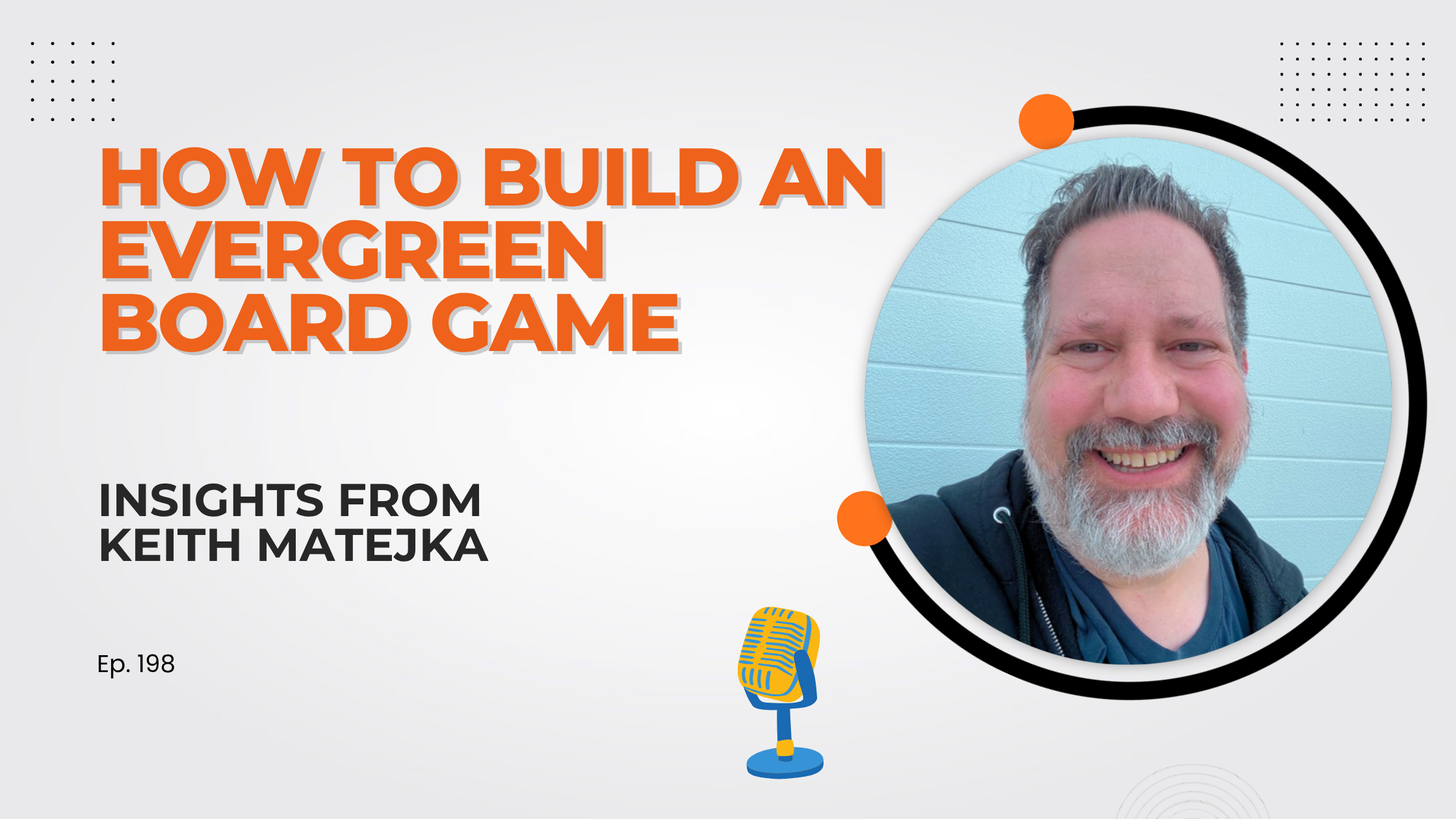
Welcome to another episode of Toy Business Unboxed Podcast. This week’s guest is Keith Matejka, founder of Thunderworks Games and the designer behind Roll Player and Cartographers, two of the board game industry’s most enduring hits. Keith spent 15 years in video games before he ever touched a Kickstarter campaign, and he has since built a five person company that has published 14 original games and sold over 800,000 copies worldwide. In this conversation, he breaks down what makes a game evergreen, how crowdfunding has changed, and why localization quietly powers a third of his business.

#198: What It Really Takes to Build an Evergreen Game – Toy Business Unboxed
Episode Highlight
- 00:42 Meet Keith Matejka
- 01:29 From QA tester to producer
- 04:33 Building his first game
- 05:34 Bullfrogs, his first Kickstarter
- 08:09 How crowdfunding has changed
- 10:12 Stonespine Architects expansion news
- 13:47 Choosing the right sales channel
- 20:16 The Cartographers award nomination
- 26:37 Localization drives 30 percent
- 29:44 Keith’s advice for newcomers
From Video Game QA to Board Game Founder
Keith started his career as a QA tester in the video game industry, eventually moving into production and working on the publishing side at Konami before joining Raven Software in Middleton, Wisconsin. While at Raven, which was owned by Activision, he watched Kickstarter grow and got pulled deeper into the board game hobby by playing with friends over lunch. Activision allowed employees to run side projects with approval, so Keith designed a game with a few coworkers and eventually put it up on Kickstarter. The campaign found enough success that Keith kept building board games nights and weekends until the income justified going full time in 2017.
Learning to Start Small: The Bullfrogs Lesson
Keith’s first board game idea was an elaborate combat game with many moving pieces, and after nine months of development he split with his graphic designer and had to decide whether to start over. Instead of rebuilding the big game, he pivoted to something smaller and simpler, a card game called Bullfrogs about warring frog factions fighting for control of a pond. That smaller, more manageable project became his first Kickstarter campaign in 2014, funding with a box of cards and a few wooden pieces. The lesson stuck with him, it is better to learn the ropes of manufacturing and fulfillment on a smaller, lower risk project than to gamble everything on something overly complicated.
How Crowdfunding Has Changed in a Decade
When Keith started on Kickstarter in 2014, it was a place where people could pitch a raw idea and still find backers willing to take a chance. Today creators need a finished, polished looking product and a genuine hard sell to succeed, since backers have been burned by campaigns that never delivered and have grown more careful with their money. The field has also fractured, with Gamefound and BackerKit now competing with Kickstarter for the same crowdfunding audience. Keith still leans on Kickstarter because that is where his audience already lives, but he keeps an eye on the other platforms in case the timing ever makes sense to switch.
Picking the Right Sales Channel for Every Game
Thunderworks sells through nearly every channel available, including direct to consumer, retail, conventions, and Amazon, but Keith says Kickstarter still gets the most attention because it fits certain products so well. Higher priced games with lots of deluxe components tend to do best on Kickstarter, since that audience is drawn to special, elevated versions of a game that a retailer might not want to give shelf space to. Smaller, more family friendly games like FlipToons belong on a store shelf, whether that is a local game shop, Target, or Walmart. Amazon matters too, but for Thunderworks it ranks behind Kickstarter and retail rather than leading the strategy.
Running Thunderworks with Just Five People
With a team of five, including himself, Keith says every decision ultimately lands on his desk, which gives him control but also means there is nobody else to hand work to when things pile up. He built the team by figuring out which parts of the job he liked least and finding someone who wanted to own that piece, starting with his wife as his second hire. The company still does an annual check in with the team to talk through what everyone wants to do more or less of. Today the roles split cleanly, Keith owns finances, operations, and art direction, while a graphic designer, a developer, a marketing lead, and a salesperson cover the rest.
The Making of an Evergreen Board Game
Thunderworks has two long running evergreen titles in Cartographers and Roll Player, plus a third they are watching closely after four print runs. Cartographers landed at the peak of a wave of map drawing games, and Keith credits its staying power to a simple, flexible design that works with any number of players and does not demand an expensive box. The game was also nominated for the Kennerspiel des Jahres, a German award that Keith says moves real sales, especially in Europe, where some buyers pick up whichever game wins that year and stick with it. Roll Player has lasted because it sits at the intersection of board gamers and tabletop roleplaying fans, a combination Keith says rarely comes together in one product.
Why Localization Is 30 Percent of the Business
Localization makes up about 30 percent of Thunderworks’ income every year, and Keith licenses the company’s games to publishers in non English speaking territories rather than managing translation and distribution himself. Some deals involve a down payment followed by a per unit royalty once a partner translates and manufactures the game for their market, while others have Thunderworks manage manufacturing and the partner picks up finished copies from the factory. Some Thunderworks titles are now available in over 22 languages, and Keith meets many of these partners in person at international conventions. He is honest that sales, marketing, and localization are not the parts of the job he loves most, but he treats them as essential to keep funding the games he actually wants to make.
A Bigger Box and a New Kickstarter for Stonespine Architects
Thunderworks has a Kickstarter launching June 16 for an expansion to Stonespine Architects, a drafting game where players build a dungeon by passing cards to their neighbors. The expansion adds a new twist where players take on the role of dungeon owners managing monsters that defend against invading heroes. Keith describes it as a sizable addition that turns the game into something close to a 2.0 version, backed by a lot of development work. The campaign will also offer a bigger box option so backers can store the base game and the expansion together, something Keith says board gamers care about a great deal.
Advice for Newcomers in the Toy and Game Industry
Keith’s advice for anyone starting out is simple, network relentlessly. He encourages new creators to meet as many people as possible, ask lots of questions, stay curious, and reach out for help when they need it. He also stresses offering help to others without expecting anything immediate in return, since so many opportunities come from being in the right place at the right time with the right relationships already built. For Keith, being useful to other people in the industry today is what pays off in unexpected ways down the road.
Conclusion
Keith Matejka’s path from video game QA tester to founder of Thunderworks Games shows how skills built in one industry can carry directly into another, from budgeting and scheduling to managing creative teams. His focus on evergreen design, smart channel choices, and steady localization deals has helped Thunderworks sell over 800,000 games worldwide. As the company gears up for its next Kickstarter, Keith’s story is a reminder that starting small and staying curious can build something that lasts for over a decade.
Connect with Keith Matejka
If you’re interested in learning more about Thunderworks Games or connecting with Keith Matejka you can reach out through the following channels:
- Website: Visit Thunderworks Games’ official website for the latest news, game updates, and more
- Instagram: Follow Thunderworks Games on Instagram for visual updates, game previews, and more links to their socials.
- Facebook: Follow Thunderworks Games on Facebook for updates, discussions, and behind-the-scenes content.
Transcript
Jason Hsieh (00:42)
Welcome back to another episode of Toy Business Unboxed Podcast. I’m your host Jason Hsieh. For today’s episode, we have Keith, the founder of Thunderworks Games, joining our show. Keith has been spending 15 years in the video game industry before he got into the board game industry. And what started out as a single Kickstarter campaign have been building into a full, fleshed out, very successful company with 14 original games, seven expansion and over 800,000 copies sold worldwide since
He started. So thank you so much for joining us on the show and sharing your journey with our audience today.
Keith Matejka (01:17)
Yeah, happy to be here.
Jason Hsieh (01:18)
So like I say in the intro, you spend a lot of time in the video game industry. Can you kind of share with our audience and your experience in the video game industry and how do
Keith Matejka (01:26)
Yeah, sure.
Jason Hsieh (01:27)
You get into the board game industry at the end?
Keith Matejka (01:29)
Yeah, sure. I started in the video game industry as a QA tester, like a QA engineer. So
Jason Hsieh (01:35)
Thank
Keith Matejka (01:36)
I was just looking for a job in a career that I had some passion for after getting burnt out on the career I had before that.
Jason Hsieh (01:46)
Mm-hmm.
Keith Matejka (01:46)
So I was in QA for many years and I ended up moving into production. So kind project management and
Kind of overseeing different groups of teams. Worked on the publishing side at Konami and then ended
Jason Hsieh (01:59)
Mm-hmm.
Keith Matejka (02:00)
Up moving to Raven Software in Middleton, Wisconsin on
Jason Hsieh (02:06)
Mm-hmm.
Keith Matejka (02:06)
The development side. So then once I was in development, were working with designers and artists and animators more directly, whereas on the publishing side, I was working more with marketing and sales folks.
Jason Hsieh (02:19)
Mm-hmm.
Keith Matejka (02:19)
But while I was at Raven, Kickstarter was kind of starting to become a thing. And I was watching that space and I was getting involved in the board game hobby. I was starting to play lots of board games and meeting lots of people that played board games. And I saw guys like Jamie Stegmeier and some of the other folks at the time having a lot of success there. And they were kind of…
Doing tell-all blogs of how they were doing, what they were doing online. And I was ignorant and foolish enough to say, that doesn’t look so hard. I could probably do that. And me
Jason Hsieh (02:48)
Okay, yeah.
Keith Matejka (02:51)
And a few fellow folks in the video game world started designing board games on the side. We had been playing games over lunch.
Jason Hsieh (02:55)
Mm-hmm.
Keith Matejka (02:58)
We decided that we were going to try to design some of our own. And I kind of took it to what I considered a near final product.
Decided to throw it up on Kickstarter. And Raven Software is owned by Activision. And they had a program where they allowed people to do side projects and side hustles if you wanted to, as long as you got approval. Yeah, it was pretty nice.
Jason Hsieh (03:16)
Really? didn’t know that. Okay.
Keith Matejka (03:19)
And so I was allowed to do that. And it had some mild success.
Jason Hsieh (03:22)
Huh. Yeah.
Keith Matejka (03:24)
And so I was kind of doing my video game job during the day and then kind of
Pushing hard on my board game job in the evenings. Eventually,
Jason Hsieh (03:32)
Yeah, I see.
Keith Matejka (03:34)
I had done a few campaigns and was successful enough in which there was enough money coming in that I could kind of say, you know, I could probably do this full time. I clearly had
Jason Hsieh (03:42)
Hmm.
Keith Matejka (03:43)
A lot of passion for it. Yeah,
So in 2017, I started the company in 2013, maybe 2017, I quit my job at
Video game developer.
Jason Hsieh (03:52)
Yeah,
Keith Matejka (03:53)
And started
Jason Hsieh (03:53)
I see.
Keith Matejka (03:54)
Doing games full time. And I worked
Jason Hsieh (03:56)
See you.
Keith Matejka (03:57)
As a one man show in my basement for a few years and kind of was successful enough over the years to kind of bring out some more people and grow the thing.
Jason Hsieh (04:04)
That’s actually a common story I also face in the toys and game industry, especially me, myself. I also started out in my tiny apartment
Keith Matejka (04:14)
Yeah.
Jason Hsieh (04:14)
And doing it on the weekend. When I first started my own toy company, like 10 years ago, when I first started, I think it started even earlier than I did. So,
Keith Matejka (04:21)
Yeah.
Jason Hsieh (04:22)
But going back, can you share with the audience, like as much as you remember of the first product that you work on?
What
Was that journey look like? How long does that took you and some of the lesson you learned when you create your first app.
Keith Matejka (04:33)
Yeah, so the first
Game, I went into designing board games with like really big eyes. I had like this grand plan of this like really elaborate product I was going to make. And I had tested it for, you know, developed it and tested it for, I don’t know, maybe six to nine months. And
I was kind of getting ready to get on that onboarding ramp onto Kickstarter. And
I ran into some roadblocks with kind of funny heads with my graphic designer and kind of
Jason Hsieh (04:59)
I see.
Keith Matejka (05:00)
Trying to figure out how to do some of this stuff.
Jason Hsieh (05:03)
Yeah.
Keith Matejka (05:04)
And my graphic designer and I ended up kind of splitting ways. So I was at this crossroads where I was like, okay, do I start over? Like is this
Jason Hsieh (05:11)
Hmm.
Keith Matejka (05:11)
Part of the process? Or I decided to kind of make an immediate turn.
And say, let’s take this big game that has all these different pieces and it’s fairly complicated and let’s
Jason Hsieh (05:20)
Yeah.
Keith Matejka (05:21)
Focus on a product that is smaller, that’s more manageable, that has a smaller scale. So that original game that I worked on was this robot combat game that I actually have never gotten around to publishing, but someday I probably will. But I switched
Jason Hsieh (05:34)
Yeah.
Keith Matejka (05:34)
To a smaller game that was just a box with some cards and a few, it’s called Bullfrogs is the name of that game. Yeah.
Jason Hsieh (05:39)
What is the call? What is the first game? Bullfrog. That’s the first
Game. Okay. Okay.
Keith Matejka (05:43)
And
So that was the first game put on Kickstarter and published a small box, stack of cards, a few wooden pieces. And so there was definitely kind taking the advice of like, maybe don’t start to make the biggest, complicated thing you can imagine. Like start small and grow because there’s a lot of lessons to learn and
Jason Hsieh (05:56)
Too big. Yeah, for sure. Over complicated yet. Yeah. I see.
Keith Matejka (06:05)
Might as well learn them on a smaller project that’s not as risky.
Has a higher chance of actually coming out someday.
Jason Hsieh (06:10)
That’s also less moving pieces that you need to figure out as well. Especially
Keith Matejka (06:14)
Exactly.
Jason Hsieh (06:16)
For the Kickstarter itself, that’s already a lot of moving pieces you need to figure out.
Keith Matejka (06:19)
Yeah, I mean, not
Only like building a Kickstarter page and building an audience for it, but then afterwards the process of manufacturing and fulfillment is much more complicated, the more kind of different SKUs and the bigger the project.
Jason Hsieh (06:30)
Yeah. So that campaign
Was back in 2014. That
Keith Matejka (06:36)
Yeah, yeah.
Jason Hsieh (06:37)
Was very, very different back then, Kickstarter, you know, this year you experience back then that’s like 12 years ago. So yeah.
Keith Matejka (06:42)
Yeah. So yeah, when I
Started on Kickstarter, it was like a place where people could go with an idea.
Jason Hsieh (06:49)
Yeah.
Keith Matejka (06:50)
Now you have to kind of have a finished product that looks amazing and really
Jason Hsieh (06:53)
Hmm.
Keith Matejka (06:54)
Do a hard sell to be successful. Back then it was more of like a, it was more of an optimistic time for creative, for, people on there. And
Jason Hsieh (07:00)
I see.
Keith Matejka (07:02)
People were just excited to be part of like a Kickstarter process. And
Jason Hsieh (07:05)
Yeah.
Keith Matejka (07:06)
Things are different now for sure.
Jason Hsieh (07:07)
Yeah.
Keith Matejka (07:08)
For People who are kind of getting into Kickstarter or Game Found or any other crowdfunding platform, now I think it’s a lot harder than it was 10, 15 years ago. More competition.
Jason Hsieh (07:19)
I agree.
I think people’s expectation is also higher and people have been burned a couple of times on the platform where it never delivered. So the expectations keep on going higher and higher before they back.
Keith Matejka (07:30)
Yeah. People are
Getting more, yeah, like you said, people have been burned. So I think people are more,
Jason Hsieh (07:35)
Hmm.
Keith Matejka (07:35)
Careful and more conservative about what they’re putting their money towards on Kickstarter. And as,
Jason Hsieh (07:37)
Yeah. Yeah.
Keith Matejka (07:40)
A creator, every time I hear a story about somebody who had a bad experience on Kickstarter or a creator that kind
Jason Hsieh (07:46)
Yeah.
Keith Matejka (07:46)
Of ghosted a project, like all that does is
Jason Hsieh (07:49)
Yeah.
Keith Matejka (07:49)
Create potential, like it creates more reservation for people who
Jason Hsieh (07:52)
Yeah.
Keith Matejka (07:53)
Might be interested in backing like a more like a legitimate project.
Jason Hsieh (07:56)
It’s
Different projects Yeah, for sure.
Keith Matejka (07:57)
Like ours.
Jason Hsieh (07:58)
For sure. For sure. Yeah. That’s definitely more difficult over the years,
Keith Matejka (08:02)
Yeah.
Jason Hsieh (08:02)
But I mean, you have been in the industry for more than a decade now. What other changes have you noticed in the last decade?
Keith Matejka (08:09)
I mean, definitely board games was a big space on Kickstarter. But then in the last, you know, five years or so, there’s been competitors that have shown up, you know, game found is another, crowdfunding platform specifically for board games. So that’s kind of,
Jason Hsieh (08:19)
Yeah
Keith Matejka (08:23)
Fractured the audience a little bit. So there used to be like, if you
Jason Hsieh (08:25)
Hmm.
Keith Matejka (08:26)
Were a crowdfunding project, you were on Kickstarter now, you know, you
Jason Hsieh (08:28)
Yeah.
Keith Matejka (08:29)
Could be on.
You
Backer kits or you could be on a game found or you could be on Kickstarter. So there’s more options. So there’s more competition, but that also means like, there are, there’s, don’t think this is much kind of organic traffic of, let’s see what the new board games are. I’m going to go to Kickstarter. It’s like, now you’ve got three different options to go to.
Jason Hsieh (08:44)
Yeah. Also
Last year, GameFound actually acquired Indiegogo last year too. So that
Keith Matejka (08:49)
Right, right.
Jason Hsieh (08:50)
Also made the whole marketplace a little bit different.
Keith Matejka (08:52)
Yeah.
Jason Hsieh (08:53)
Now Indiegogo is really trying to go really hard against the Kickstarter community because they are trying to go head in head against Kickstarter.
Keith Matejka (08:59)
Yeah, mean, in
General, competition is good. Like those platforms should improve as a result of that competition, but it definitely
Jason Hsieh (09:05)
Mm-hmm.
Keith Matejka (09:07)
Kind of fractures the audience and it creates this, you know, we’ve always used Kickstarter. So I tend
Jason Hsieh (09:12)
Yeah.
Keith Matejka (09:13)
To want to continue to use Kickstarter because that’s where my audience has been. But I’m always looking
Jason Hsieh (09:16)
I see.
Keith Matejka (09:17)
At the other platforms saying, you know, is it time to switch? Does it make sense to try these other platforms?
Jason Hsieh (09:21)
Have you tried to launch
A campaign on Gamefound? If so, how was your success compared to Kickstarter? You have not, okay. I see, I see.
Keith Matejka (09:26)
I have not, but I’ve been tempted to.
Maybe someday, we’ll see.
Jason Hsieh (09:30)
Yeah, because you already have a lot of pre-existing audience with all the campaign you already did over the years. It’s a
Keith Matejka (09:36)
Right.
Jason Hsieh (09:37)
Little bit harder to migrate them into a different platform.
Keith Matejka (09:40)
And I think some people, I think it’s possible to do a campaign on multiple platforms, either
Jason Hsieh (09:46)
Yeah.
Keith Matejka (09:48)
Subsequently or simultaneously.
Jason Hsieh (09:51)
Yeah.
Keith Matejka (09:51)
I’ve always thought about maybe trying that as well, but running a crowdfunding campaign is a ton of work. And the idea doing it at two places at the same time is kind of like, man, I just want to get back to making cool games and less about finding ways to sell them. So
Jason Hsieh (09:56)
Yes. Yeah.
Keith Matejka (10:05)
We’ll see.
Jason Hsieh (10:06)
100%. For sure. For sure. And what are some of the projects you have for the rest of the year? Are you doing more Kickstarter campaign for the rest of the years?
Keith Matejka (10:12)
Yeah.
So, we have a Kickstarter coming up, in June 16th, Tuesday, June
Jason Hsieh (10:17)
Okay.
Keith Matejka (10:17)
16Th. So that’s less than a month away.
Jason Hsieh (10:20)
Yeah.
Keith Matejka (10:20)
That is for an expansion for one of our existing titles called stone spine architects, which is a drafting game where you’re building a dungeon in front of you and you’re passing cards to your neighbors. The expansion
Jason Hsieh (10:30)
Yeah.
Keith Matejka (10:30)
Now as a new element where you’re the dungeon owners. So you’re like managing monsters that are
Defending the heroes that are trying to get in and steal your treasure and stuff.
Jason Hsieh (10:39)
Okay.
Keith Matejka (10:40)
A pretty sizeable expansion and it kind of turns the game into kind of a 2.0 version. We put a
Jason Hsieh (10:46)
Mm-hmm.
Keith Matejka (10:46)
Lot of work into it, so we’re excited about that coming. And that’s gonna include the option to have like a bigger box so that you can fit the base game and the expansion in there as well.
Jason Hsieh (10:55)
Hmm.
Keith Matejka (10:55)
Board gamers
Love storage. Like having a box that’s really well thought out to store their games in, that’s really important to board gamers. And so we’re going to offer like a really nice, you know, multi,
You know, plastic answer.
Jason Hsieh (11:07)
I I want to
Also dive into your background in the video game kind of industry. Which of some of the skill that you feel like is transferred really well directly into board game publishing based on what you do currently and what
Keith Matejka (11:19)
Yeah.
Jason Hsieh (11:20)
You kind of learned from this experience between the two industry?
Keith Matejka (11:22)
There’s actually surprisingly a lot of skills that transfer, right? So when I was in video games, I was managing a creative team. Was managing illustrators and 3D artists. And
Jason Hsieh (11:33)
Okay.
Keith Matejka (11:33)
I was worried about budgets and schedules and meetings and communication and removing roadblocks from workflows and like all that stuff transfers 100%.
Jason Hsieh (11:43)
Mm-hmm.
Keith Matejka (11:44)
Into
Jason Hsieh (11:44)
Mm-hmm.
Keith Matejka (11:45)
Managing a board game as well, right? So I’m still working with creative
Jason Hsieh (11:47)
Yeah.
Keith Matejka (11:48)
People. Sometimes that creative person is me, but a lot of times it’s others, you know, managing a schedule, worrying about, know, budgets, doing lots of, you know, kind of thinking about how we’re going to market these things and what the best way to place them are. I mean, when I was at Raven, which was owned by Activision, I was kind of
Jason Hsieh (12:05)
Yeah.
Keith Matejka (12:05)
One small cog in a very big machine.
Jason Hsieh (12:09)
Yeah, yeah.
Keith Matejka (12:09)
At ThunderWorks,
We have, including myself, five employees and
Jason Hsieh (12:12)
Yeah. Yeah.
Keith Matejka (12:15)
All the bucks stop with me. So I make a lot of the decisions, which is
Jason Hsieh (12:18)
Yeah.
Keith Matejka (12:19)
Nice because I have a lot of control, but it also means that there’s nobody to like pass work to…
Jason Hsieh (12:23)
Yeah, and you also
Are in charge of all the wrong decisions that you make too. Yes, of course.
Keith Matejka (12:29)
The mistakes are mine as well as the brilliant decisions. So, and
I like having that level of control. But
Jason Hsieh (12:36)
Mm-hmm.
Keith Matejka (12:37)
Every once in a while I miss like just being one of the cogs in the machine and not having so much responsibility. But it offers a lot of freedom and a lot of ownership over the things that I do. So
Jason Hsieh (12:49)
Yeah.
Keith Matejka (12:49)
Any product that we put out, like I had my hand.
To some degree on everything about it. Whereas
Jason Hsieh (12:53)
Yeah.
Keith Matejka (12:54)
When I worked on a Call of Duty game, and it’s like, I can’t like point at the screen and be like, I made that. Like I was part of the process,
Jason Hsieh (13:01)
Yeah.
Keith Matejka (13:01)
But there’s nothing that I can really kind of feel like I own. Whereas then the
Jason Hsieh (13:05)
Hmm.
Keith Matejka (13:05)
Opposite is true with these board games.
Jason Hsieh (13:07)
For sure, for sure, for sure. That’s the main difference between an entrepreneur versus an employee mindset, right? So
Keith Matejka (13:13)
Yeah.
Jason Hsieh (13:14)
Very different mindset. And I also want to kind of dive into, because obviously you have a lot of success over the years, like growing and scaling your brand. One of the most common questions as a game or toy and game company scale is like what channel to focus on? Because…
There’s online channel, there’s Kickstarter, there’s retail, there’s Amazon, there’s faire, there’s international expansion. Like with a small team like yours, well, a lot of people in industry with small team. How do you decide which channel to really prioritize and spend a lot of your time and energy on to really grow the business as a whole?
Keith Matejka (13:47)
So we’re in all those channels, right? We sell direct
Jason Hsieh (13:49)
Mm-hmm.
Keith Matejka (13:50)
To retailers, direct to consumers, direct to consumers via Kickstarter. We sell on fare.
Jason Hsieh (13:55)
Yeah.
Keith Matejka (13:57)
We try to find as many different sales channels that could potentially generate sales as we can. Our
Jason Hsieh (14:03)
Hmm.
Keith Matejka (14:05)
Main focus, it’s tough to say. I would say at the end of the day, the Kickstarter channel is probably where we spend the most time.
Jason Hsieh (14:12)
Okay. Kickstarter
Is good, I guess.
Keith Matejka (14:13)
But it really depends
On the product, right? So like something like Kickstarter isn’t
Jason Hsieh (14:16)
True, true.
Keith Matejka (14:17)
Always a great fit for like a small $20 game because the audience there is usually looking for like deluxe-ified or like really fancy special versions of things. So if we have
Jason Hsieh (14:27)
Mm-hmm.
Keith Matejka (14:28)
A really more expensive game that has like lots of really fancy pieces that isn’t something that a retailer is particularly excited about eating up a bunch of their shelf space with, then
Jason Hsieh (14:38)
True.
Keith Matejka (14:38)
Kickstarter is clearly the best channel for that.
We have other
Jason Hsieh (14:40)
Yeah
Keith Matejka (14:42)
Games. We released a game last year called Fliptoons that is a much smaller game,
Jason Hsieh (14:45)
Okay.
Keith Matejka (14:46)
Much more kind of family friendly that really belongs on a store shelf, whether it be a friendly local game store or a Target or a Walmart or whatever. Then we’ll kind of focus more on pushing our efforts for that title onto those channels. Amazon is always a big deal, right? We sell
Jason Hsieh (15:07)
Yeah.
Keith Matejka (15:08)
Quite
A bit on Amazon, but it’s not our number one focus. I would say Kickstarter,
Jason Hsieh (15:12)
Yeah.
Keith Matejka (15:13)
Then retailer, then Amazon, and then kind of everything else.
Jason Hsieh (15:16)
I see, I see, I see. And with a very lean team, obviously you managing manufacturing, art direction, design, distribution with like five people. How do you delegate? Like who is in charge of what in your team? Just for other like team out there? Like how do
You, how do you kind of make it efficient?
Keith Matejka (15:32)
I mean, this is probably common. I started
Out as me doing everything. So then I figure out
Jason Hsieh (15:37)
Yeah.
Keith Matejka (15:39)
What part do I like the least? And then I try to find somebody that can do that. And then I give them that part of it. Or
Jason Hsieh (15:42)
Yeah. Okay. Okay.
Keith Matejka (15:47)
If it’s somebody that, like my second employee was my wife, I just say, which part of this do you want to do? And then I can kind of give that stuff to her.
Jason Hsieh (15:55)
I see, okay.
Keith Matejka (15:57)
We still do like annual evaluation of like,
Looking at all the different things that need to be done to continue to function as a company and figure out what
Jason Hsieh (16:03)
And
Keith Matejka (16:05)
People like, what people wish they were doing more of, what they wish they were doing less of and kind of, kind of throw some things around. But the way that we currently divide it is that, I mean, as the owner and we don’t currently have like a finance guy we have in the past, but we don’t currently. So like that kind of ends up falling on me. So
Jason Hsieh (16:18)
Yeah. Okay. Okay.
Keith Matejka (16:23)
All the finances and then all the
Operations ends up kind of falling on me. And I love
Jason Hsieh (16:28)
With the operation.
Keith Matejka (16:31)
Art direction, so that’s like, I’m never going to give that up. And
Jason Hsieh (16:34)
Okay.
Keith Matejka (16:36)
All my experience in video games, I was in QA for many years, gave me like a
Jason Hsieh (16:39)
Yeah.
Keith Matejka (16:39)
Really pretty sharpened attention to detail. And
Jason Hsieh (16:42)
Hmm.
Keith Matejka (16:43)
Like when you’re manufacturing a product, like really kind of locking in.
Especially
When it comes to writing a rule book or making sure all
Jason Hsieh (16:50)
Yeah.
Keith Matejka (16:51)
The manufacturing details are spot on before you print 10,000 of these things.
Jason Hsieh (16:55)
Yeah,
You can get very expensive if there’s a mistake.
Keith Matejka (16:58)
Right, so
I’ve learned, unfortunately, that I can’t trust anybody but myself to kind of do the final check on some of these things. So I end up doing all the manufacturing as well. But in terms of other people, I’ve got a graphic designer who’s making board games. A lot of the work is graphic design. So he has a
Jason Hsieh (17:14)
Yeah, grab it this night. Yeah.
Keith Matejka (17:16)
Lot on his plate. And then I’ve got a developer who does kind of creative play testing and
He does kind of the work that I started doing and I kind of given it to him. I still need like the final sign off, but developing a game and getting lots of play tests and taking notes and making changes and trying new things and physically building prototypes. That takes a lot of work and a lot of time.
Jason Hsieh (17:37)
You can
Also come up with a new idea, or I use the other ones coming up with new ideas for new games.
Keith Matejka (17:42)
Usually it’s a mix. Sometimes.
Jason Hsieh (17:44)
Yeah.
Keith Matejka (17:45)
Usually it’s stuff coming from outside of the company. Like a game designer will pitch us a game. Sometimes
Jason Hsieh (17:50)
I see.
Keith Matejka (17:50)
They’re my games that I come up with.
Jason Hsieh (17:53)
Yeah.
Keith Matejka (17:54)
But we haven’t published a game that my developer came up with from like the beginning, but he has like
Jason Hsieh (17:59)
Okay.
Keith Matejka (18:00)
Done like, well, he’s going to design how it works for a single player, the solo mode, or he’s going to like
Jason Hsieh (18:05)
Mm-hmm.
Keith Matejka (18:05)
Make.
Some big massive change. He has made some massive changes for the better,
Jason Hsieh (18:09)
Thank
Keith Matejka (18:09)
But we haven’t had anything that was ground zero his idea. But for me personally,
Jason Hsieh (18:14)
I see, I see, Yeah.
Keith Matejka (18:16)
Where the idea comes from is not really that important. It’s really about the execution. The number
Jason Hsieh (18:20)
True, Execution, yes, yes, yes, that’s correct.
Keith Matejka (18:24)
Of great ideas I hear on a daily basis can be overwhelming. So it’s like…
There’s so many good ideas that could be made into something amazing, but you just got to
Jason Hsieh (18:32)
Mm-hmm.
Keith Matejka (18:33)
Pick and choose and like, just try to ignore everything else or like take note of it later. Cause if you chase every great idea, you’re
Jason Hsieh (18:36)
Yeah.
Keith Matejka (18:40)
Never going to get anything done. So it’s
Jason Hsieh (18:41)
Yeah.
Keith Matejka (18:42)
All about the execution. And I would like to think that even if an idea is good, but not great, like my team is talented enough that we can make it great through development
Jason Hsieh (18:51)
Mm.
Keith Matejka (18:52)
And additional work.
Jason Hsieh (18:54)
Mm-hmm.
Keith Matejka (18:55)
Just to finish the docket, I’ve got a marketing person who does,
Jason Hsieh (18:58)
Yeah.
Keith Matejka (18:59)
She also manages our website and she also does
Jason Hsieh (19:02)
OK.
Keith Matejka (19:02)
All the Amazon stuff and she
Jason Hsieh (19:03)
I’m going hang up.
Keith Matejka (19:04)
Does all the web stuff and manages ads and stuff like that. And then I’ve got
Jason Hsieh (19:08)
Hmm.
Keith Matejka (19:09)
My salesperson that works with retailers and distributors and
Jason Hsieh (19:13)
Hmm.
Keith Matejka (19:13)
Kind of does some of the, she writes contracts and
Jason Hsieh (19:17)
Mm-hmm.
Keith Matejka (19:18)
You know.
Sends
Invoices and that kind of stuff. So she does parts of the financial part that I don’t do. So that’s the breakdown.
Jason Hsieh (19:23)
Got it.
Keith Matejka (19:24)
As any entrepreneur, I assume as an entrepreneur, as your
Jason Hsieh (19:27)
Mm.
Keith Matejka (19:27)
Company grows, it’s nice to be able to kind of push things off and make a little bit more breathing room for yourself so that you can do a better job
Jason Hsieh (19:34)
Yeah.
Keith Matejka (19:35)
With the things that you are doing instead of doing kind of half of the things horribly and half of them like everything.
Jason Hsieh (19:41)
I can relate to that myself,
Keith Matejka (19:44)
So that’s
Been a fun process to kind of see, get to more like an equilibrium and like, of like one person doing five jobs, it’s like, well, now everybody’s doing a job. Yeah, they’re wearing multiple hats, but they’re not like, nobody’s putting in like 80 hours a week or anything like I used to when I was starting.
Jason Hsieh (20:03)
Yeah, yeah, yeah, yeah, yeah, for sure, for sure. And I also want to congratulate you for being nominated and I think won one of the international award for one of your board game. You want to kind of talk about the game a little bit for our
Audience?
Keith Matejka (20:16)
Yeah, so
There’s a game called Cartographers. It’s our best selling game. It’s a fantasy map drawing game where everyone is sitting around the table drawing a fantasy map and trying to get points for the right shapes and terrain next to each other. And so that has
Jason Hsieh (20:30)
Hmm.
Keith Matejka (20:31)
Been our best selling title. It was nominated for the Kenner Spiel. So the Spiel des Jahres
Jason Hsieh (20:36)
Hmm.
Keith Matejka (20:37)
Which is German for game of the year, is the biggest award in board games.
Jason Hsieh (20:41)
Okay, yes,
Yes,
Keith Matejka (20:42)
It comes out once a year and there’s three categories. There’s the game of the year.
Jason Hsieh (20:45)
Yeah.
Keith Matejka (20:46)
There’s the gamers game of the year. And then there’s like,
Jason Hsieh (20:49)
Okay.
Keith Matejka (20:49)
There’s like the family game of the year. So the,
Jason Hsieh (20:51)
Our family came to help you. Okay.
Keith Matejka (20:53)
Yeah, like, yeah, the big overall, kind of the more complicated one. And then like the, kid one.
Jason Hsieh (20:59)
Yeah.
Keith Matejka (21:00)
I think three to five games that are nominated.
And Cartographers
Jason Hsieh (21:02)
Okay.
Keith Matejka (21:03)
Was nominated for Kennerspiel, which is the gamer’s game. And
Jason Hsieh (21:07)
I see.
Keith Matejka (21:08)
There’s a lot of different organizations that give awards for toys and games in the US,
Jason Hsieh (21:14)
Yeah.
Keith Matejka (21:14)
Like Mensa Select, and there’s a bunch of other ones.
Jason Hsieh (21:17)
Yeah.
Keith Matejka (21:18)
But in comparison, this German award, it makes a huge difference
Jason Hsieh (21:23)
Yeah.
Keith Matejka (21:24)
In the sales of a game. So like,
There’s a lot of people, especially in Europe, that they buy one game a year, and it’s whatever won that award. And that’s just what they do. They don’t care what it is. It’s like, this organization says this is the best game. That’s the one I’m going to buy, and we’re going to play it for a year. So because
Jason Hsieh (21:34)
Okay. Yeah. I see.
Keith Matejka (21:40)
It was nominated, the game sold very, well, especially in Europe.
Jason Hsieh (21:44)
Hmm.
Keith Matejka (21:45)
The German board game market is very, very big. The European market is
Jason Hsieh (21:48)
Yes.
Keith Matejka (21:49)
Very big, too, but the German market is very big.
And there’s some other larger markets. Poland is pretty big. UK is big. And
Jason Hsieh (21:56)
Mm-hmm.
Keith Matejka (21:56)
There’s other kind of medium and smaller size markets.
Jason Hsieh (22:00)
Mm-hmm.
Keith Matejka (22:00)
Being nominated for that award was fantastic. And we sold a lot of copies. And that game continues to sell, right? board games are a little bit like movies in which like, when they come out for like three to six months, they’re kind of a hot thing. And then maybe even less, maybe a couple months, then
People are on to the new big thing, right? Because
Jason Hsieh (22:19)
Yeah, yeah, yeah.
Keith Matejka (22:20)
We’ve got, I mean, depending on who you talk to, three to 5,000 games come out every year.
Jason Hsieh (22:26)
Yeah.
Keith Matejka (22:27)
And there’s only 52 weeks in a year. So that means there’s a lot of games coming out every week for people who are fans of these. So
Jason Hsieh (22:31)
Yeah, they can find it. Yeah.
Keith Matejka (22:36)
There’s a lot of games that will sell three, four, five, six, seven, 8,000 copies, and then they’re kind of done.
Jason Hsieh (22:42)
Hmm.
Keith Matejka (22:43)
But then there’s…
Other
Things where they, you know, they sell well and they continue to sell well. And those, we call an evergreen title.
Jason Hsieh (22:50)
Yeah.
Keith Matejka (22:50)
Thunderworks has been lucky enough to have two of those. One is
Jason Hsieh (22:53)
Thank
Keith Matejka (22:53)
Cartographers that we were just talking about, and another one is called Role-player, which is a dice drafting game. So
Jason Hsieh (22:57)
I see.
Keith Matejka (22:59)
The success of those games, you know, Role-player came out in 2016. We continue to sell well on it, you know, a decade later.
Cartographers came
Jason Hsieh (23:06)
Hmm.
Keith Matejka (23:07)
Out, I want to say ’18, and that THAT is still our best selling game and continues to do well. So we’re always looking
Jason Hsieh (23:12)
Yeah.
Keith Matejka (23:13)
To find that next evergreen that can kind of keep our finances more stable so we can take risks on kind of more different games, looking for those home runs or those evergreen titles.
Jason Hsieh (23:24)
Yeah, actually that’s actually a lot of the publishing company also want to create those evergreen title, but based on our experience of what make those title particularly evergreen.
Keith Matejka (23:35)
I mean,
If there was like a recipe of what an evergreen was, then everybody would have an evergreen, right?
Jason Hsieh (23:41)
Yeah, true, true.
Keith Matejka (23:43)
What do I think it is? Well, I can tell you why I think the we have a, what I think is, actually we have a third evergreen that we published last year.
We’ve printed
Jason Hsieh (23:51)
Thank you.
Keith Matejka (23:52)
It four times now, but I
Don’t want to call it an evergreen yet until I get another year behind me.
Cartographers is an evergreen because it hit in a time in which that style of game was suddenly very popular.
Jason Hsieh (24:06)
Okay.
Keith Matejka (24:07)
It’s complicated enough to keep gamers interested.
But it’s simple enough that kind of more casual players can enjoy it. It also can
Jason Hsieh (24:14)
Mm-hmm.
Keith Matejka (24:14)
Play any number of players. So can play literally as long as you’ve got a piece of paper and a pen, you can play
Jason Hsieh (24:19)
Mm-hmm.
Keith Matejka (24:20)
With everybody else. The player count is pretty important in that one. It’s small. It’s a smaller box and it’s not crazy expensive. So I think all those things contributed. There was a big flood of these types of games are called either rolling rights or flipping rights. They’re kind of drawing games.
Jason Hsieh (24:36)
Okay, okay, okay.
Keith Matejka (24:36)
There was a bunch of them that kind
Of all hit the market at the same time because it was getting really popular and kind
Jason Hsieh (24:39)
Yeah. Yeah.
Keith Matejka (24:40)
Of coming out of that Cartographers was like one of the one or two that continued to be well regarded and kind of rose to the top of the best of those kinds of games. That’s that’s kind of
Jason Hsieh (24:50)
I see.
Keith Matejka (24:51)
The gameplay is a big part of it. Role-player
Jason Hsieh (24:53)
Yeah.
Keith Matejka (24:54)
I think continues to be popular because it’s a real nice intersection of a Venn diagram of people who like role playing games.
And people who like board games. And lot of times
Jason Hsieh (25:03)
Okay.
Keith Matejka (25:03)
Those two worlds don’t live that close together, but this
Jason Hsieh (25:06)
I see.
Keith Matejka (25:07)
Game is kind of the marriage of those two ideas of like, it takes someone
Jason Hsieh (25:10)
I see.
Keith Matejka (25:10)
Who plays role-playing games, and like if I play Dungeons and Dragons or something, and I get together with
Jason Hsieh (25:14)
Thank
Keith Matejka (25:15)
My friends and I create my character, it kind of takes that experience of role-playing and turns that into a card or board game. So it attracts not
Jason Hsieh (25:23)
In
Keith Matejka (25:25)
Only board gamers, but also role-playing fans.
Kind of that
Jason Hsieh (25:27)
Real thing.
Keith Matejka (25:28)
Creates an audience for this to live for a long time. And it also
Jason Hsieh (25:31)
I see.
Keith Matejka (25:32)
Is relatively unique. People
Jason Hsieh (25:34)
Mm-hmm.
Keith Matejka (25:35)
Are always looking for innovation, right? So
Leaned on some things that had been done previously, but not in this configuration by any stretch of the imagination. So, it’s
Jason Hsieh (25:43)
I see.
Keith Matejka (25:43)
Kind of, that’s continued to do well because of those both board games and RPGs continue to be popular. And the people have
Jason Hsieh (25:50)
Mm-hmm.
Keith Matejka (25:50)
Lot of nostalgia and love for
Dungeons and Dragons and stuff like that. So our latest one,
Jason Hsieh (25:56)
I see, I see, see.
Keith Matejka (25:58)
Fliptoons, kind of leans on nostalgia a little bit as well. It has artwork
Jason Hsieh (26:02)
Okay.
Keith Matejka (26:03)
That reminds people of Sunday morning cartoons when they were kids in the 80s and that has a really unique look to it. And I think that is one of the reasons why it’s done well. It also
Jason Hsieh (26:14)
Mm-hmm.
Keith Matejka (26:15)
Has a feeling like…
You’re playing a slot machine. So people like gambling and it has a little bit of a like gambling
Jason Hsieh (26:20)
Thank you.
Keith Matejka (26:21)
Kind of feel to it. So I think that’s another reason why.
Jason Hsieh (26:23)
I see, I see. And during the pre-interview, you also mentioned localization is also a key part of your business model. How does it work from your perspective? Do you license IP to other international partner? is the logistic behind it?
Keith Matejka (26:37)
Yes, I mean, localization
Is about, 30 % of our income every year. Yeah,
Jason Hsieh (26:42)
That’s big piece.
Keith Matejka (26:44)
And usually what we do is we license our products to other publishers in non-English speaking territories. You
Jason Hsieh (26:52)
Yeah.
Keith Matejka (26:53)
Know, depending on the partner, the deal is structured a little bit differently, but it’s
Jason Hsieh (26:58)
Mm-hmm.
Keith Matejka (26:58)
Either we license them the product and they pay
A down payment and then they have it translated and manufactured for their territory and then they pay us a royalty per unit manufactured or
Jason Hsieh (27:10)
Hmm.
Keith Matejka (27:12)
We will manage the manufacturing for them in which we sign a deal and they send us the translated files and we have it manufactured and then our partners will, know, once they’ve paid their bill, they can pick it up and
From the factory and take it to their home
Jason Hsieh (27:27)
Mm-hmm.
Keith Matejka (27:27)
Territory and sell it however they wish. You
Jason Hsieh (27:30)
Yeah, yeah,
Keith Matejka (27:31)
Know, some of our games are in over 22 languages and
Jason Hsieh (27:34)
Mmm, yeah.
Keith Matejka (27:36)
We’re always kind of looking for opportunities in that way.
Jason Hsieh (27:39)
Yeah.
Keith Matejka (27:40)
At the end of the day, the part that I like most about running this business is making new games and
Jason Hsieh (27:45)
Yeah.
Keith Matejka (27:46)
Interacting with my customers. So like when it comes to the kind of sales and marketing,
And localization, these are like areas that I don’t have a lot of passion for, but I understand are kind of essential for the success of the business.
Jason Hsieh (27:58)
Yeah, of course.
Keith Matejka (28:00)
But yeah, no matter what I’m doing, I always am going to be wishing I was working on the next game. But unfortunately,
Jason Hsieh (28:06)
Yeah.
Keith Matejka (28:08)
Sell the games to be able to continue making new ones.
Jason Hsieh (28:10)
Yes, Of course,
Of course, of course. Yeah, so thank you so much for sharing that. Yeah, it’s definitely a lot of work as well for localization and not just finding them, but also vetting the right partner because you want to make sure they actually represent your game well for their local region or market.
Keith Matejka (28:28)
Yeah. And
To facilitate that, you know, we go to international conventions and
Jason Hsieh (28:33)
Mm-hmm.
Keith Matejka (28:34)
Meet with different partners.
Jason Hsieh (28:35)
Hmm.
Keith Matejka (28:36)
We have never like, imported a game from a different company before. Like if there was a game that was a Japanese game, and they’re like, Hey, do you want to publish this in the US and English? Some US publishers will do that.
It’s not something that we’ve done before, but I’ve been tempted
Jason Hsieh (28:48)
Okay.
Keith Matejka (28:49)
To like, if it was the right game, I would do it. But
Jason Hsieh (28:52)
I see, I see.
Keith Matejka (28:53)
I always, my desire for creative control, like I’ve never, I’m always going to want changes or I’m going to want things to, you know, things to be changed to fit the Thunderworks brand. And that’s usually not how those deals work. It’s like, here’s the game, do you want it or not? Versus like, here’s an idea. Are you interested in developing it further for the US market? Like that’s the kind of thing I would be looking for. But that
Jason Hsieh (29:12)
Yeah. Yeah.
Keith Matejka (29:13)
Would be more work too. So,
Jason Hsieh (29:15)
True.
Keith Matejka (29:16)
And, and I’m always interested in.
Like working on my own stuff more than importing somebody else’s thing, just because
Jason Hsieh (29:22)
Okay.
Keith Matejka (29:22)
That’s what I’m passionate about. But there are
Jason Hsieh (29:24)
Hmm.
Keith Matejka (29:25)
US publishers that do a lot of that, where they find great games from other countries and they translate them into English and release them here. That’s not something we did.
Jason Hsieh (29:33)
I see, I see, of course. So thank you for sharing that. So as we’re wrapping up today’s interview, if you have to share just one piece of advice with someone that’s getting started within the toys and game industry, what would that be?
Keith Matejka (29:44)
It’s
All about networking. Just meet everybody you can and ask lots of questions and be as curious as you can and reach out when you need help and offer help for people who need it. So I mean, it’s like anything in life. A lot of opportunities come just from being in the right place at the right time and knowing the right person. So just focus on.
And as much as you can and get to know as many people as you can and be an asset to them so that maybe someday, I mean, someday they might be an asset for you.
Jason Hsieh (30:12)
Yeah, of course. Well, thank you again for being here on our show, sharing your experience, your wisdom, and also journey with our audience today.
Keith Matejka (30:20)
Sure, thanks for having me.
Jason Hsieh (30:21)
For our audience, we’d like to learn more about you and your business. Where is the best place for people to find you online?
Keith Matejka (30:26)
Sure, www.Thunderworksgames.Com is our website. All kinds of information about us and our products. You can also find us on all the other places like Instagram and Facebook and that stuff. But our main website, thunderworksgames.Com is probably the best way to get started on that.
Jason Hsieh (30:41)
I see. Yeah. Well, make sure we put that in the show note. And thank you again for your time. And for our audience, thank you for tuning into this particular episode of Toy Business Unboxed podcast. I hope today’s conversation give you some practical insight and also fresh inspiration for growing your own toys for game brands. This podcast is proudly sponsored by Toy Launch, a leading marketing and growth partner for toys and game company. At Toy Launch, we help brands scale on Amazon and beyond through full service account management, advertising, SEO, creative,
Catalog optimization, influencer marketing, and more. If you are looking for a proven team that really understand the toys and game industry and digital marketing, we’re here to help. If you’d like a personalized breakdown of your brand opportunity and your best next step, you can always schedule a free consultation session with us. Just visit toy-launch.com/schedule. If you also want to connect with other toys and game founder, feel free to join our free community, Toys and Game Launchpad, to connect with other founder in the community as well.
For more resource, update and industry insight, visit us at any time at toy-launch.com. Until next time, keep innovating, keep creating, keep bringing joy through toys. This is Jason Hsieh signing off on the Toy Business Unboxed podcast. We’ll see you in the next episode. Thank you so much, everyone. Have a good one.
Grow your toy brand’s content reach
From SEO blog content to influencer outreach — we handle the full content engine for toy and game brands.