
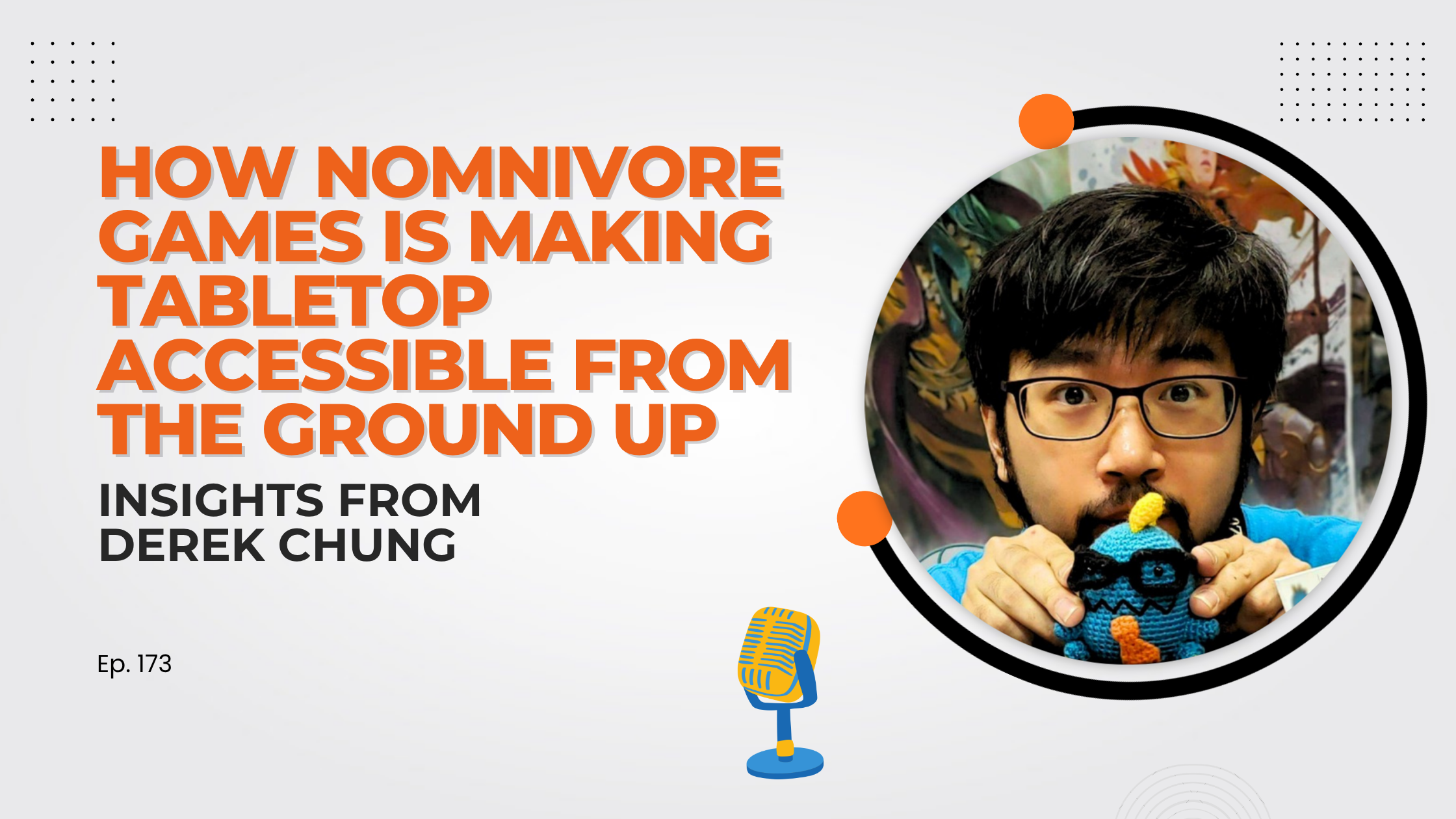
Welcome to the Toy Business Unboxed Podcast, where we sit down with the creators, founders, and innovators shaping the toys and games industry. In this episode, host Jason Hsieh is joined by Derek Chung, founder of Nomnivore Games and a college professor whose background in psychotherapy informs everything he builds. Derek is not just making games. He is redefining what it means for a game to be truly accessible, therapeutic, and fun all at once. From a TTRPG that fits on a single sheet of paper to dyslexia-friendly card games designed for kids as young as one, his work challenges the way the entire industry thinks about inclusion.

#173: Games as Therapy: One Designer’s Mission to Include Every Player – Toy Business Unboxed
Episode Highlight
- 00:00 Introduction to the World of Toy Design
- 01:36 Derek’s Multifaceted Journey
- 02:28 The Therapeutic Power of Games
- 05:01 Accessibility in Game Design
- 09:19 Innovative Game Mechanics
- 10:40 Supporting Neurodiversity in Gaming
- 13:08 Education Through Gameplay
- 15:23 Therapeutic Experiences in Tabletop Games
- 17:31 The Challenges of Game Development
- 20:17 Future of Accessibility in Gaming
- 22:16 Advice for Aspiring Game Designers
From Therapy to Tabletop: How Derek Chung Is Designing Games for Absolutely Everyone
Welcome to the Toy Business Unboxed Podcast, where we sit down with the creators, founders, and innovators shaping the toys and games industry. In this episode, host Jason Hsieh is joined by Derek Chung, founder of Nomnivore Games and a college professor whose background in psychotherapy informs everything he builds. Derek is not just making games — he is redefining what it means for a game to be truly accessible, therapeutic, and fun all at once. From a TTRPG that fits on a single sheet of paper to dyslexia-friendly card games designed for kids as young as one, his work challenges the way the entire industry thinks about inclusion.
From Psychotherapy to Play: The Origin Story Behind Nomnivore Games
Derek did not arrive at game design the conventional way. Before founding Nomnivore Games, he worked as a psychotherapist specializing in existential phenomenological therapy, a modality built around a single, powerful question: why have we not given up yet? That philosophy, that there is always room for positive change, became the foundation of his entire approach to games. Games, Derek explains, are not just entertainment; they are therapeutic experiences in their own right, offering players the kind of support and growth that professional therapy is designed to build. When he realized that gaming could serve as the nourishing support network a good therapist sends their clients into the world with, Nomnivore Games was born.
Lifting Everyone Up Instead of Lowering the Bar
Most accessibility in games follows the same pattern: build the experience first, then add accessibility features afterward as toggles. Derek sees this approach as fundamentally flawed. That model draws a line, he argues, effectively declaring that some players are too expensive or too difficult to include from the start. Nomnivore Games flips the model entirely, building from the bottom up so that the most accessible version of a game is its foundation, not an afterthought. The goal is never to lower the bar; it is to lift every player up to engage however they want.
Emberwind and the Kernel X Modular Approach
Emberwind is Nomnivore’s flagship TTRPG, and it delivers the depth of Dungeons and Dragons without the three-hundred-page rulebook. The entire core game fits on a single sheet of paper, what Derek calls the kernel: the smallest, most efficient version of the game possible. From that kernel, players layer on modular rule sets to create exactly the experience they want, whether that means adding dice, replacing them with cards, or running the game without a dungeon master entirely. This system, borrowed from video game development and called kernel X modular design, means no two players need to play the same way. It is how Emberwind can serve a first-time role-player and a seasoned D&D veteran sitting at the exact same table.
Dungeons and Dinos and the Nomnosaur Line
For players looking for something lighter, Nomnivore’s Nomnosaur line, led by Dungeons and Dinos, applies the same philosophy to casual card games. Each game in the line uses the kernel approach, where the core rules fit on a single card, and players can stack expansion modules to add complexity as they grow. The games are structured to tutor players the way video games do, where you learn by playing rather than by reading a rulebook. What makes the Nomnosaur line especially powerful is how each title connects narratively to the next, building a progression path that encourages players to develop their skills across the whole lineup.
Designing for Dyslexia and Neurodivergent Players
Every element of the Nomnivore lineup has been designed with neurodivergent players in mind, including those with dyslexia. Early titles in the lineup contain no words at all, while others use dyslexia-friendly fonts and heavy iconography so that reading never becomes a barrier to play. Tutorial videos replace rulebooks entirely for players who learn better visually. One of the most intentional examples is a game that uses color-coded text, blue for consonants, red for vowels, to help players learn alongside Noam Chomsky, a dyslexic wizard character who needs help spelling magic words to complete his adventure. Even font choices shift across the product lineup intentionally, gradually removing the dyslexia-friendly font as players progress to build reading confidence over time.
Games as Therapeutic Experiences
Derek is careful to draw a distinction between therapy and therapeutic experiences. Therapy is professional and finite; a good therapist works to make themselves unnecessary. What replaces that professional relationship when therapy ends is what Derek calls therapeutic experiences: the support of friends, shared activities, and connections that sustain wellbeing long-term. Games are extraordinarily well-suited to generate those moments, from watching another player try something new to feeling safe enough to step outside your comfort zone for the first time. Derek grounds this in educational psychology, specifically John Dewey’s concept of educational scaffolding, where learning is a collective exchange rather than a top-down transfer of knowledge.
The Endless Refinement: Why Every Nomnivore Release Is a Work in Progress
Creating a Nomnivore game is fast; refining it takes much longer. Derek uses the word refining deliberately, since it goes beyond play testing for bugs. It means continually revisiting design decisions to account for needs that were not visible at launch, since no two people with the same diagnosis share the same lived experience. He points to Braille dice as an example: adding Braille nubs is simple, but making them functional means solving for font size, orientation, and weight balance all at once. That is why Nomnivore treats every release as iterative and commits to lifetime digital updates for anyone who owns an RPG or book-format title.
Building the First Tabletop Accessibility Standard
One of Derek’s most significant upcoming projects is helping develop the first-ever accessibility standard for tabletop games. While the video game industry has established guidelines for accessible design, no equivalent exists for tabletop, and the challenges are meaningfully different. A digital toggle-on feature cannot simply translate into a physical game experience, and the considerations are deeper and more human. Derek has been invited to contribute to guidelines that would define what accessible tabletop design looks like across the entire industry. It is work he describes as both exciting and genuinely difficult, since no single framework can account for the full spectrum of human ability and experience.
Advice for Newcomers in the Toy and Game Industry
Derek’s advice to anyone entering the toys and games industry is direct: don’t quit your day job. The industry runs on passion, which means the financial reality rarely matches the enthusiasm people bring to it. He tells his own game design students that the money saved by leaving a degree program early might serve them better as seed funding for their own work. The dream in this industry is not early retirement; it is simply the chance to work on games full time, and that milestone alone is a long road. His test: if hearing all of that still does not scare you away, you probably have what it takes to last.
Conclusion
Derek Chung’s work at Nomnivore Games is a reminder that the most ambitious design challenges are often the most human ones. By building from the bottom up, treating accessibility as a foundation rather than a feature, and drawing on his background in psychotherapy to understand what players truly need, Derek is creating games that serve everyone. His upcoming work on the tabletop accessibility standard could shape the way the entire industry approaches inclusive design for years to come. For anyone building in the toys and games space, this conversation is a blueprint for what it means to build with real intention.
Connect with Derek Chung
If you’re interested in learning more about Nomnivore Games or connecting with Derek Chung you can reach out through the following channels:
- Website: Visit Nomnivore Games’ official website for the latest news, game updates, and more
- Instagram: Follow Nomnivore Games on Instagram for visual updates, game previews, and creative inspiration
- Facebook: Follow Nomnivore Games on Facebook for updates, discussions, and behind-the-scenes content.
Transcript
Jason Hsieh (00:00)
Welcome back to another episode of Toy Business Unboxed Podcast. Today we have Derek, a daytime college professor and also a award-winning game designer by night. And he has so many other roles that he also does. I’m gonna have let him explain himself. But as a founder of Nomnivore Games, Derek have dedicated his work to create tabletop experiences that are both accessible, inclusive, and also filled with heart.
And his very unique background in mental health and storytelling really shaped a lot of the thing he does with his company and all the wonderful game that he’s bringing into the tabletop community. So thank you so much for joining us on the podcast today, Derek.
Derek Chung (00:38)
Thank you so much for having me, Jason.
Jason Hsieh (00:40)
So first of all, before the interview we were talking wearing so many different hats. So can we kind of just go through all the different hats you’re currently wearing? You’re a college professor, obviously running this game design company. What else are you currently doing that I haven’t listed yet?
Derek Chung (00:53)
Yeah. I also travel around kind of talking academically about like the purpose of gaming in like therapeutic as well as educational environments. I will sometimes peer review research papers, I do some grant underwriting, I secure and help with like the construction of like nursing homes and low income housing and so forth.
Yeah. Basically anything like tied to any sort of like goodwill related stuff is stuff that I’ve done. In fact prior to becoming a college professor I used to even be a psychotherapist. But then I realized that like my head wasn’t big enough to wear that many hats. Where I’d like specifically like travel the world providing mental health work and support to people free of charge.
Jason Hsieh (01:33)
I see. So how do you journey from like being a psychotherapist before into tabletop gaming designs? I guess can you walk us through your journey? What was the story behind all that when you first started?
Derek Chung (01:45)
Sure, yeah. I guess the best place to start is just by explaining like probably everyone listening in on this right now that I am a massive nerd and I really like games. Which helps. But you know, joking aside, I’ve always been somebody who’s been interested in the power of positive change for people. Right. Like I come from a very specific modality in psychotherapy called and it’s a mouthful.
Existential phenomenological psychotherapy and all translates to, and I’ll put it very crudely, in fact, anyone from the therapy background might even laugh at me for saying this, but it roughly translates to a single question. And that particular question is just why have we not killed ourselves yet? Right? Yeah, okay. Which is a little harsh, but it frames in a really good way. Right. Like it doesn’t matter if you are somebody who is struggling with some of the worst stuff. You could be super depressed. You could be whatever it is.
There’s some reason why you haven’t given up yet. Right. True. Okay. And if you haven’t given up yet, then there is room. There there’s something, there’s hope, right? That you can move towards some sort of positive change. And the change can happen a bunch of different ways. And a lot of the times, especially in modern society, we look at it from this perspective of therapy being one of the best and first responses that we have, right? You should go seek professional help. And for a lot of people, that’s wonderful. It’s great.
And going to see that professional help is going to help you change. But it’s also not something that we’ve always had previously, like in history, right? And there’s also something that I would think is arguably much more important than therapy, which is simply therapeutic experiences, right? Therapy and therapeutic is not the same thing. And you can even see that with how professional therapy ends. Like ultimately as like a therapist, you don’t want
To see your client forever and ever and ever. You want them to never need you again. Right. So eventually you need to terminate that relationship. And when you send your client off into the world, what you ultimately want is for them to have replaced you with something that’s very important to them. A support network of friends and family. Right. Something that can be therapeutic that can listen to you kind of go through whatever you’re discussing and talking about, whatever you’re feeling that particular moment, the goods and the bads, right? Okay. And those support groups
Are not only really, really easy to create through things as awesome and as fun as games, but games themselves offer a really amazing opportunity to test you, to help you learn, to have you experience things that you may not necessarily be able to, for whatever reason, including just simply being like too intimidated in like real life to being able to work through all that. So
In a lot of ways, games are very ripe for these therapeutic moments, both while you’re playing and beyond it. Hence my you know, deep fascination with them.
Jason Hsieh (04:18)
I see. And I think a lot of your game is also known for accessibilities. What does accessible game design mean to you in particular, like the way you are coming up with design?
Derek Chung (04:28)
Yeah. So we actually started with my fascination in creating kind of therapeutic games, or at least games that can generate these therapeutic experiences, and then realized like if for example, we believe every single person in the world deserves mental health, right? Yeah. That means that we have the impossible task of trying to make games accessible to everybody because everyone needs to be able to play. Right? Yes, yes. But how do you create a game?
That fits, let’s say, an eight year old and like an eighty year old veteran like it’s very difficult. In fact, most people tell you straight up the best way to make your game have no audience is if you can’t pick an audience to target. So because of that we had to really think about accessibility through a different way. Okay And the typical way like you’ll need to kind of come along with me for this post year thought experiment for a second.
Jason Hsieh (05:04)
It’s yeah, yeah, yeah, yeah.
Derek Chung (05:15)
But the typical way I view accessibility being handled is where you create an experience, this game, right? This thing that should be played in a particular way, and then you find out that you need to lower the bar. A technique that’s practiced a lot in video games, where like you’ll create a game experience and then all the accessibility features afterward, right? You can toggle them on or off. Okay.
Tabletop is a little bit different. And not only is tabletop a little bit different, I think accessibility built like that is incorrect. Because you’re ultimately drawing a line somewhere. You’re saying these particular people are too expensive. They’re too disabled, there’s something like that to be something that we can include into our audience. Okay. So our approach towards accessibility and what we mean by that is specifically a reversal of it. Rather than building it top down, we build bottom up. We create something that
Everyone can play or as close to everyone as we can at the beginning and then start building up from that particular point to create that game experience. Okay. Okay. The best way to put it is like rather than lowering the bar, what we want to do is we want to lift everyone up to play however they want to.
Jason Hsieh (06:18)
I see. I guess the best way to explain that is like I think you have one of your game next to you. You wanna like show like how it translates in real life in the action.
Derek Chung (06:28)
Yes, I mean I can, but I also can’t quite, because it’s hard to kind of capture. But one of our games is this one here. Right. This is our epic TTRPG Emberwind. Okay. Okay. Yep. And the way that this is designed is supposed to deliver the same type of experience that you get from playing things like fifth edition, Dungeons and Dragons, Pathfinder, like the typical TTRPG experience. Okay. But we built it completely differently.
Jason Hsieh (06:38)
And blue? Okay.
Derek Chung (06:52)
Where your typical TTRPG delivers a, you know, three hundred page rule book that you have to read through and learn. Yeah. And then you need like eight hours to make a character before like you find a DM to run it, right? Yeah. What we decided to do was we took the entire game system and we compressed it down to a single sheet of paper. That is all you need to play the game. But there’s a problem with this too. Yeah. If you oversimplify a game, what happens is you lose that top end of player who wants like a lot of crunch, right? Who’s very used to TTRPG
Jason Hsieh (07:10)
Okay.
Derek Chung (07:19)
So we practice a very unique style of game design called kernel X modular development, which is a term that’s borrowed from video games. And what that is you take the core game and you compress it down to the tiniest nugget possible, a kernel. And the better that kernel is, the more things it can handle, despite it being that simple. You never fluff it and make it bigger. You just leave it in its most critical, efficient form.
Jason Hsieh (07:28)
Okay.
Derek Chung (07:43)
Okay. And then what you do is you start adding all these cool, powerful modules that you can layer on like an onion to create the exact way you want to play. Right, so Emberwind is a kernel system where it’s a one page rule set, whereas you get better at the game, you can stack additional rule sets to create the exact play experience you want to. If for example you want to play it as a dice game, you can. If I don’t like dice, I can play it as a card game and we can still play it together.
Jason Hsieh (08:07)
Really? Okay, that’s very unique. Okay.
Derek Chung (08:09)
Yeah. If we don’t have a DM this week, the game can run without a DM too. They turn on or off to make sure that everyone, no matter who they are, whatever they’re interested in, whatever their disabilities might be, whatever neurodivergences they have, they can always play together and you don’t have to compromise on your system meet everyone where they’re at. You play the way you want to.
Jason Hsieh (08:28)
I see, I see, I see, I see. And I really like the design for the game line that you have, the Dungeons and Dinos. Dinos. Do you have one of those with you?
Derek Chung (08:36)
I’ve got one right here. This is Dungeons and Dinos.
Jason Hsieh (08:38)
Can you explain the rule really quick on how this works?
Derek Chung (08:41)
Yeah. So any of our Dungeons and Dinos or well, Nomnosaur line, it’s where these little like baby blue dinosaurs show up. Yeah. These games are designed through the same type of philosophy that Emberwind has built, but it’s built for a different type of audience. Emberwind being a RPG is going to cater towards RPG type players, right? People like narrative. These are designed more for the casual audience where we do that same kernel X modular development where the kernel is
Always a one card or if it’s like a bigger box game like this one here, it’s one sheet of paper. Okay. And that’s all there is to it. It’s very quick, easy to play, and you learn off of that very quickly. And we tutorialize in the same way that video games are structured where you play to learn rather than you just reading the rules. And but once you’ve like mastered it, there’s also that
Modular system where you can stack additional layers. You can add different expansion rule sets to it that change how the games work. For example, you can add like a pet system to Dungeons and Dinos. You can create your own content. You can kind of do whatever. Yeah.
Jason Hsieh (09:39)
Mm-hmm. And one thing I think of unique with your game, I don’t know how many other gaming companies is also doing it, is to support like people with different neural diverse needs like dyslexia, you know, ADHD and other can you also talk about that aspect of the game design and the way you incorporate it into the games?
Derek Chung (09:57)
Yeah, of course. Though like before I get into that, I really want to do a shout out to you too, Jason, because I know you do a bunch of that as well. Yeah. Nice to be able to jam with somebody who’s from that area. Yeah. So we do it from a bunch of different ways. The best place to start is describing the fact that our games are standalone and are not. They’re built in a way where you can progress from one game to another. Okay. And it helps
Teach you kind of like life skills and different like adaptations to things. Like a quick example is like this little game here is one of our starting games, Snack Tech. It is a dyslexic friendly game where it’s dyslexic friendly because there are no words on it. Right? the one rule card that I said, the rule text is written in a dyslexic friendly font. And if you don’t even want to read that, don’t worry about it. You can just go online and watch an animated video that teaches you how to play instead.
Jason Hsieh (10:46)
I see. Okay. Okay. Okay.
Derek Chung (10:48)
But this game narratively connects to this one. Right? and in this game you do have text. Yeah. The text is all in that dyslexic friendly font, but it’s also written in a way where it’s interspersed with a lot of iconography. So you don’t have to read all that much. Right? And it’s also written a little bit like computer code, so if you can recognize patterns, you’ll actually get better at reading this until you don’t even have to read at all. Which is kind of cool, right? Now you take this and then you level up to something like this, Emberwood.
Jason Hsieh (11:10)
Yeah, that’s pretty cool. Okay.
Derek Chung (11:15)
Yeah and you have the same type of structure for writing. It’s written the same way. It features a lot of additional tricks to make it easier for people with dyslexia to read. But the one thing it does is it removes that dyslexic friendly font. Right. And the hope and goal is as you kind of progress through everything, it’s supposed to encourage and build up your ability to read just a little bit better.
Jason Hsieh (11:35)
Hm. Okay, okay. Well that’s very intentional the way you kind of design and especially different product line kind of try to help and teach the player to also progress as they tried many different games inside your product line as well. So
Derek Chung (11:50)
Yeah, well the goal is actually go beyond our product line too. Like I want people to enjoy or like if they’re interested in playing D and D, I want them to be able to play D and D. And Emberwind is supposed to be built in a way where it’s like a stepping stone where once you’ve learned the basics of how you play role playing games from Emberwind, you can progress to D and D if that’s what you want to do. Like ultimately our goal is to make sure that you can play what you want that isn’t necessarily our suite.
Jason Hsieh (12:13)
Okay, okay, okay. Interesting. And I think a lot of your game you say you also try to blend a lot of education in like component to the entertainment component and how do you usually do that for some of your games?
Derek Chung (12:25)
There’s a lot of different ways that we can kind of discuss that. One of the products that I don’t have physically in front of me because that’s stuck in tariff hell currently is Nomventure, which is like baby’s first TTRPG. It’s built on like a simplified version of the Emberwind rule set. It’s built for kids five and up where it works off of that same single one sheet of paper rule set. And
The modules for that one are a little unique in that every gameplay module is also coded in a way that teaches you about a particular neurodivergence and makes that neurodivergence fun and engaging. There’s a bunch of different ways to do that, but like if we’re going off just the dyslexia example here, that is a product that is then supported with another product, which is a dyslexia friendly alpha book that you can start with like kids as young as like one or two. We can teach them like
They’re A, B,’s and C’s, right? Yeah. And there is a little adventure that we’ve written called Learn to Spell with Noam Chomsky, our dyslexic wizard in the Dungeons and Dinos universe, who goes around trying to gather ingredients to create a secret potion, which is really just a bunch of ingredients so that like mom can make them an apple pie. Yeah. Where they go around town, the woods, and go visit a farm and so forth. But
As they run up to all these different challenges, there are magical words. Words that Noam Chomsky, because they’re dyslexic, don’t know how to spell, and you need to spell along with Noam Chomsky to help improve your odds at your particular challenges. All of those magic words are written in a different color. Blue for constants, red for vowels, and Y is like split in half. Yeah where
Jason Hsieh (13:47)
Yeah, that’s interesting. Okay.
Derek Chung (13:58)
They’ll come up in the story and you’ll have a chance to like use that little alphabet, right? Your spell book where you’re literally spelling the letters so that you can figure out kind of what’s going on and learn how to read along with Noam Chomsky, even if you’re dyslexic. And all this stuff is is written like not only along with myself, but like we reach out to different professionals. We had a full SLP from SLP Literacy Corner, Brianna, come and write the specific alphabet book.
Jason Hsieh (14:22)
I see. Well, you definitely spend a lot of time on the education component of it as well. And since you also have, you know, the therapist background, like how do you see the crossover between like you mentioned, using the tabletop game experience as a therapeutic experience? Like how do you incorporate that in some of your game design?
Derek Chung (14:41)
Yeah. So a large part of what makes games therapeutic is in believing in the group around the table itself. Right. Like ultimately the fun isn’t necessarily the game you’re playing so much as the fun that you’re finding in the people that you’re playing with, those organic moments that emerge. Okay. So we create a lot of those moments both implicitly and explicitly in our games. Okay.
Right, like an implicit way that we do that is in for example, the rule sets in Emberwind where because you don’t have to play a particular way and your rules don’t have to match with anyone else, you can actually sit there and watch somebody else try something. Like let’s say you’ve never role played before and the idea of role playing is super scary to you. Well, having a chance to see somebody else role play using a different system makes you go, well that looks kind of interesting and fun, it’s different than what I’m doing. Maybe I’ll give that a try.
Right. And if you try it and go, this is too intimidating, this is too much for me, like I don’t want this right now. There’s no requirement to play that way. You can stop, you can switch back to your own system, and you can try it again later if you want to. Right. And if that doesn’t work, there are alternative systems, including tutorial systems that are built for people who’ve never role played before but want to learn that we’ve structured. The whole point is rather than holding you hostage to play in a particular way, you’re invited to
Not only consider the like reference book, right? The place where you learn things from, but you look at everyone else around you at the table as a font of knowledge, something that you’ve never had a chance to interact with before. You become curious hopefully about that particular individual, not just about kind of what they’re doing in the game as well. Through kind of all these organic means. And it’s built off of an educational psychology principle from John Dewey called educational scaffolding.
Where the entire concept is that it’s not so much an instructor disseminating knowledge to an entire class of students. That rigidity is lost where it’s about everyone having something really beneficial teach each other if you’re willing to listen.
Jason Hsieh (16:32)
Hmm, okay, okay, okay, okay. Yeah. Because you’re trying to include a lot of different elements, a lot of different educational concept and also accessibility into your game design. Based on your experience, does it take usually longer for you to build and develop a game compared to other traditional publishers?
Derek Chung (16:48)
No. Making the games is incredibly quick and easy, for me, at least. And I don’t know if that’s just because of how I design stuff. I don’t know really. But the hard part isn’t the making of the game, it’s the refining of it. Yeah. And I use the term refining very specifically because it’s not quite the same thing as like quality assurance and so forth where you’re constantly play testing.
Jason Hsieh (17:01)
Refining, yeah.
Derek Chung (17:09)
Earlier I was talking about how there’s a difference between games and tabletop games when it comes to accessibility. Yes. And one of the major challenges with tabletop games is it’s not just simply a toggle on or off. Right? Yeah. And because it isn’t just a simple toggle on or off, it’s about constantly revisiting and working on things in ways where you might not have known about something before. It’s about understanding that
Even if one person has, let’s say, an autism diagnosis and someone else has an autism diagnosis, that they’re not the same thing. Yeah, not the same thing. It’s a spectrum. And the important part is respecting people’s lived experiences, which is why it takes a incredibly long time to come up with the in quotes right design, because it’s an endless chase. You’re always improving towards it. Like a good example of this is a friend of mine has worked on for years
The development of Braille dice. And if you think about that, anyone can easily design Braille dice by just going, well let’s just add Braille nubs to like a die. The hard part is making sure that people actually understand that. So like do you know Braille has to be in a specific font size? Right? Probably nobody does. Right, exactly. So that takes Q C now here’s the thing, when you roll the die and pick it up, how do you know which side is facing up? So you know which way the font is being read.
Jason Hsieh (18:22)
That’s true. Yeah, that’s tricky.
Derek Chung (18:23)
Yeah. And then how do you design it in a way that makes sure that the die is still balanced and leveled if the dye is like the little nubs are sticking out, right? What about weight and balance? So like you can see how there’s a lot of QC that you have to do after you do something. And that’s one of the reasons why like our company philosophy is straight up, hey, like if you like our stuff, great. But what’s more important is telling us how much our stuff sucks constantly, because I can’t make it better otherwise. And like don’t think of any of our releases as a final product.
These are all things that are iterative. We’re always going to be improving it. And for anything that is in like a RPG or like a book format, we will always provide people with digital that update for life. Because we want to make sure that you have the best version that we can provide you.
Jason Hsieh (19:03)
I see, I see, I see. Yeah, that definitely takes a lot of energy to maintain all that as well. Yep.
Derek Chung (19:09)
Yeah. Which is why I’m often very tired when you see me at like a convention or something.
Jason Hsieh (19:14)
Yeah, for sure, for sure. And you’re title’s really from very different genre, like from TTRPG to like more friendly, friendly games as well. And like when you first create a company, do you already know those are some of the main product line you want to create? Or as you create some over time you just want to add more? Or like how far ahead do you usually see in your product development process?
Derek Chung (19:35)
It’s a bit of column A and column B. Like I’m very focused on very specific things. Like I made this entire company because I really just want to make this game. Okay. But like all the other stuff is stuff that is really important to me too. And like did I necessarily think I was gonna start making a ton of different card games? Not necessarily, right? From the get go, but it was always something that existed as a option. Right?
Jason Hsieh (19:42)
Okay.
Derek Chung (19:57)
And like what I had was a vague idea going, well, if I want to make games that were accessible, therapeutic and also most importantly, because we haven’t talked about this at all, fun, We need to make sure that people are able to have fun however they want to. So like it was kind of like a matter of time before I branched out to do other things that weren’t TTRPG related. But like the other non TTRPG related stuff, I didn’t quite know which direction it was gonna go. Like it could go card games, it could go board games, it could go a bunch of different ways.
Yeah, it was just a matter of time, but I didn’t know if it was gonna go like toward the card game route, a board game route, if it was gonna go towards like Zine based like more nuanced TTRPG. Like there was a bunch of different ways so that we could have gone. Sure. We
Ultimately ended up going the card game route because and I should have realized this right from the get go, they are much cheaper to make. Right. And price is an incredibly important part of accessibility as well. So we wanted to make sure that we could produce things as cheaply as possible people who couldn’t afford the more like premium price point that Emberwind required. And also the other really nice advantages that these are pocket size. So like your pocket making a lot easier for
Well specifically we actually got a lot of requests when we first launched Emberwind from US veterans and soldiers saying, Hey, we have to go on deployment. I’d love to have a game that fits in our pocket. Right. And I’m like, well, cool, we can do that too. Or like from schools going, Hey, we’d love like if there were things that would fit into like the students’ like backpacks or cargo pans or something.
Jason Hsieh (21:19)
I see, I see, I see. Got it, got it, got it. So but looking ahead, what excites you the most about the future of both accessibilities and also just industry in general and what other some of the game you’re planning to design in the next few years?
Derek Chung (21:34)
So many things. I’m excited for like from the perspective of accessibility, I’m really excited for the fact that people seem to care about that now. Like when I first started on this kind of like war path to try and make gaming for everybody, right? Because fun should be something everyone has. I feel like I was like one of the only people doing it. Like I was very much the only person on like the convention show floors being like, Hello, this is important, guys. Right? In fact
Like I spent so much time trying to think about whether or not I even wanted to advertise that in the first place. Right? Like I wanted to make sure games were enjoyable by everybody and you didn’t need to know or they didn’t need to be specially marketed towards people who let’s say were neurodivergent. But yeah. Like that internal debate ultimately fell to the side of me going, Yeah, I should talk about this because people should know that they’re represented in some way and that this is important and is something to challenge and push.
Other companies, especially companies with way more budget than just me here, right? And there has been a lot more of that dialogue. For example, like the PAC shows now have accessibility spaces like the Access Forward Lounge. They have a quieter gaming lounge and so forth for people that need a specific type of sensory input. It’s all really good stuff in the direction of trying to truly make gaming for everybody. Mm-hmm.
Jason Hsieh (22:44)
Yeah, that’s definitely very important work you are doing, not just for your own company, but for the industry as a whole as well.
Derek Chung (22:51)
Well, I mean I don’t necessarily think it’s just me, right? Like I was saying earlier, Jason, like you also care about this and do a lot of neurodivergent friendly stuff too. So like I’m just glad that there’s enough of it happening that’s coalescing into something where there is hopefully potentially like an industry standard. That’s actually probably the most exciting project that I’m working on for next year. There’s a lot of them, some that I can’t even talk about ’cause of NDAs and everything, but
One thing that we’re looking at doing is in video games there is a standard of accessibility that you should follow to make your game accessible. Yeah. No such standard exists in tabletop yet. And I’ve been invited to help work on that particular guideline, which would be a lot of fun, right? Yeah but the problem with that though is that
Uniquely tabletop games have a specific accessibility challenge, the video games don’t. So how do you write a once vest fits all guidebook? Does it even exist, right? so there’s gonna be a lot of exploring that specifically that’s coming next year, which yeah I’m thrilled to be a part of. Mm-hmm.
Jason Hsieh (23:51)
I see. Okay. Thank you for sharing that project. And as well, kind of winding down in today’s interview here, if you had to share just one piece of advice with someone that’s just getting started in the toys and game industry, what would that be?
Derek Chung (24:03)
Don’t. That’s probably what I’d say. Well, I’ll phrase it differently. This is an industry for better or worse that is fueled by passion. Right? There’s tons of people who like all of us here, love fun. They love games, and they fell in in love with that from a probably a very early age. And unfortunately, because of that.
Jason Hsieh (24:06)
Like though. Okay.
Derek Chung (24:25)
It ends up making this into an industry where there isn’t a whole lot of like financial gain from this. Like there’s a lot of people, and I say this specifically to all my students too in the game design programs that I teach. Like the best thing you can do is potentially just drop out of this program because you’re gonna get further, not from what’s being taught in these classes, but from the money that you’re saving on tuition. So you can use that as like an initial investment. And really you should be hedging your bets by
Doing what everyone else is doing, which is having like a proper full time job elsewhere, and then putting kind of your spare time into creating games if that’s what your passion is. Yeah. Right. So specifically when I tell people who are looking to get into or are getting started in this industry, like don’t quit your day job. It’s not like during their day job, their dream is to retire early or even retire because haha, we’re all millennials and zoomers or something. But like the dream in
Specifically the games industry is just to be able to work full time, right? Like it’s so far removed from everything else. So like if everything I’ve just said there is enough to tell you to stay away and you still want to be part of the industry, then great. You’ve got the passion to last. Right. So that’s the one piece of advice I tell people. No, don’t do it. And if you won’t listen to me then awesome. You belong in this industry.
Jason Hsieh (25:34)
I love the advice and I think I can relate to that with my personal experience since I was doing it part time for the first six years before I go full time. It took me six years to scale to the level just to do it full time, obviously. So it’s not a like get rich quick kind of business for sure. It’s more like lose money quick business if you don’t know what you’re doing, actually. So yeah. But that’s a really good piece of advice. And
Derek Chung (25:54)
Yeah.
Jason Hsieh (25:58)
For our listener today that would love to learn a little bit more about you, your business and your companies, where is the best place for people to find you online?
Derek Chung (26:05)
Yeah, so the best place to find my company online would be at nomnivoregames.Com, which I’m certain people are gonna struggle trying to spell. So it’s the word omnivore with an N in front of it. Whereas for me personally, I don’t have very much in the way of personal social media, just for my own mental health. So the best way to find me is just literally at my company. Every message, every email, everything comes directly to me. I read everything and I
Do my best to try to respond to everything too. So yeah, if you’re looking for me that way, please feel free to hit me up at any point about whatever.
Jason Hsieh (26:35)
Got it, got it. We’ll make sure we put that in the show notes. And thank you so much for your time today, sharing your knowledge, your experience, your journey within the toys and game industry.
Derek Chung (26:43)
Yeah, no, thank you for having me here.
Jason Hsieh (26:45)
Yeah, you’re welcome. And thank you for our listeners for tuning in to this episode of Toy Business Unboxed Podcast. I hope today’s conversation gave you some practical insight and fresh inspiration for growing your own toys and game brands. This podcast is proudly brought to you by Toy Launch, a leading marketing and growth partner for Toys and Game companies. At Toy Launch, we help brands scale on Amazon and beyond through full service account management, PPC, SEO, creative, catalog optimizations, influencer marketing, and consulting.
If you are looking for a proven team that understands both the toy industry and digital marketing, we are really here to help. If you’d like a personal breakdown of your brand, your opportunity, and your best next step, you can schedule a free consultation with us. Just visit toy-launch.Com/schedule. And if you want to connect with other toys and game founders, join our free community Toys and Game Launchpad at toy-launch.Com/group. For more resource update and industry insight, visit us anytime at our homepage.
Until next time, keep innovating, keep creating, keep bringing joys through toys. This is Jason Hsieh signing off on the Toy Business Unboxed Podcast. We’ll see you in the next episode. Thank you so much, everyone.
Grow your toy brand’s content reach
From SEO blog content to influencer outreach — we handle the full content engine for toy and game brands.