
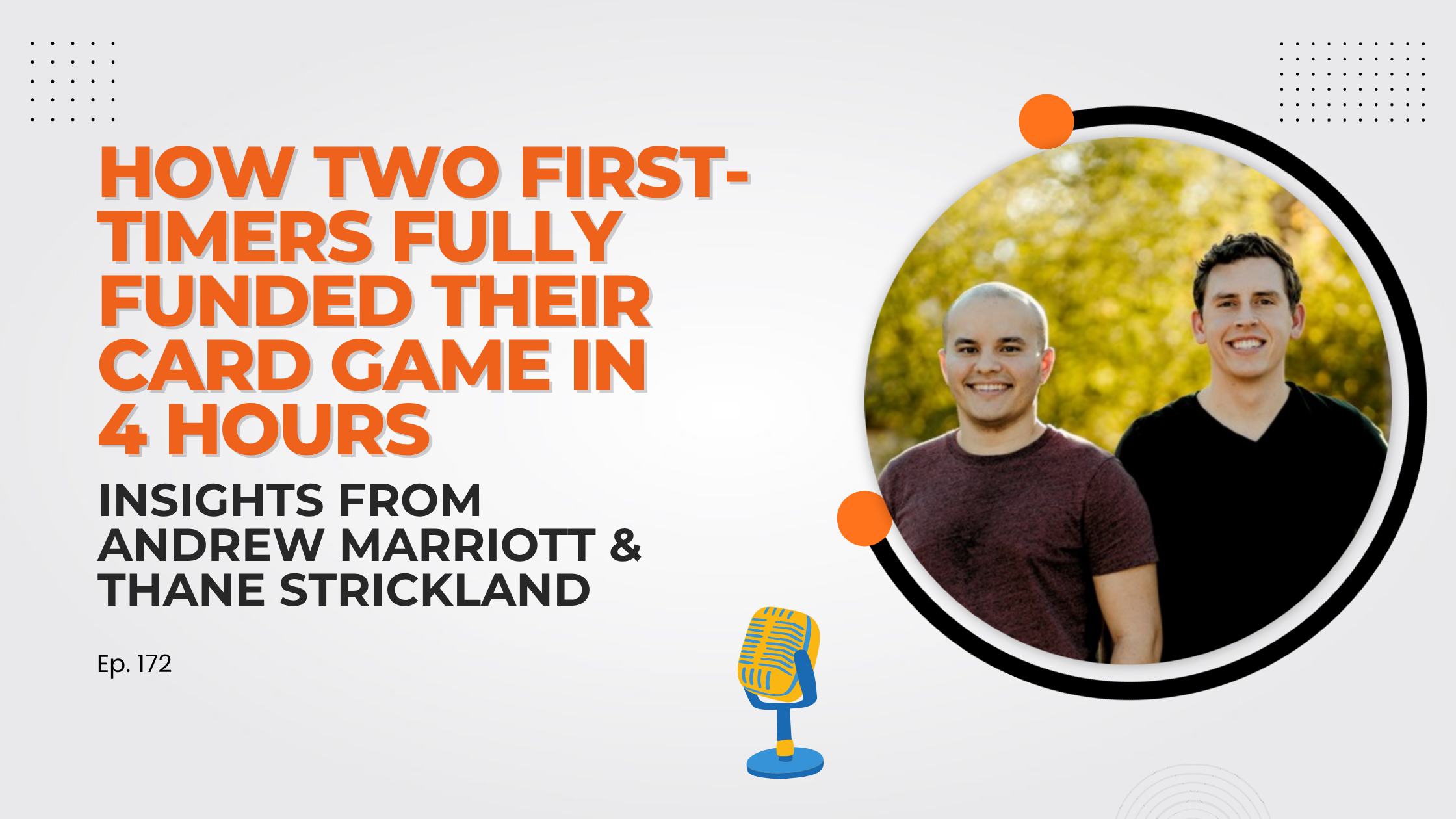
Welcome to Toy Business Unboxed, where we explore the stories behind the toys and games that make it from idea to shelf. In this episode, host Jason Hsieh sits down with Andrew Marriott and Thane Strickland, co-founders of Odd Family Games and creators of Herdvana, a family card game that began as a New Year’s Day dinner table experiment and grew into a Kickstarter campaign backed by nearly 600 supporters, fully funded in under four hours. This conversation covers Kickstarter strategy, pre-launch marketing, post-campaign momentum, and what it really means to self-publish a game from the ground up.

#172: Fully Funded in 4 Hours: The Herdvana Story – Toy Business Unboxed
Episode Highlight
- 00:00 Welcome and guest introductions
- 00:43 How Herdvana started on New Year’s Day
- 01:51 Three years from prototype to Kickstarter
- 03:29 Influencer prototype strategy pre-launch
- 04:32 Meta ads and email list results
- 06:35 What they would do differently
- 07:20 The $750 custom character backer tier
- 09:09 How to play Herdvana explained
- 11:42 Post-Kickstarter marketing challenges
- 17:19 Advice for new toy and game entrepreneurs
From Dinner Table to Game: The Origin of Herdvana
Every great product starts somewhere, and for Andrew Marriott and Thane Strickland, it started at a dinner table on New Year’s Day 2019. Playing games with family, they began riffing on house rules to improve the games they loved, and that playful improvisation turned into a more serious question: why not make their own game? That same night, they cut up printer paper and drew cards with Sharpies, creating the earliest prototype of what would become Herdvana. The idea had staying power, and both men kept refining it every time they gathered with family and friends, not an overnight business decision but an organic pull toward something they genuinely believed in.
Three Years in the Making: From Prototype to Kickstarter
While the concept sparked in 2019, Andrew and Thane didn’t launch their Kickstarter until 2023, giving themselves three years to develop and refine the game. Andrew went through multiple rounds of character art, scrapping versions that didn’t meet his standard before settling on final illustrations. Thane handled the operational side, spending four to six months before launch building out tiers, stretch goals, and pre-launch marketing. By the time they launched, they had a base game plus two full expansions, effectively launching three interconnected products at once. That long runway wasn’t a delay. It was the foundation that made a four-hour funding sprint possible.
Pre-Launch Strategy: Building Community Before the Campaign
One of the most effective pre-launch moves Andrew and Thane made was producing roughly fifty to one hundred prototype copies of Herdvana and sending them to smaller gaming influencers. These were not household names but micro-influencers who were open to receiving a free game and sharing it with their audiences in the weeks leading up to launch and during the campaign. The result was distributed word-of-mouth coverage across multiple niche communities right when it mattered most. On top of that, years of building the game with family and friends had created a network of supporters who were invested and ready to back on day one. Fully funded in under four hours, the community-first strategy clearly delivered the results they needed.
Meta Ads, Email Lists, and What Did Not Convert
Andrew and Thane also hired a third-party company to run Meta ads and build their email list before the campaign. It added names, but the conversion rate was lower than expected, making it a mixed result given the agency’s cost. They skipped the micro-deposit pre-launch strategy, where backers pay a dollar to reserve early access, which research suggests can triple conversion rates over a free opt-in. In hindsight, targeting qualified buyers rather than chasing list volume might have paid off better. The lesson: not all pre-launch marketing spend converts equally, and paid acquisition needs close measurement to be worth it.
Designing a Kickstarter Campaign That Stands Out
The Herdvana Kickstarter offered multiple backer tiers with extras like pins and a playmat, plus a $750 premium tier where Andrew would custom-illustrate the backer as a character in the game. Ten backers took that option, and those high-value pledges helped push the campaign past its goal within hours. Looking back, Andrew and Thane say the multiple custom variants made post-campaign manufacturing much harder, and next time they’d simplify to a single Kickstarter edition box, maybe with an exclusive sleeve to set it apart. What they’d keep: making backers feel genuinely invested in the outcome.
How Herdvana Is Played
Herdvana is a card game for two to ten players built around three card types: farmers, aliens, and animal herds. Players build herds in their own field by drawing or stealing from opponents, and collecting all eight animals of one type locks in “herdvana” with bonus points. Farmers protect your herds from theft, while aliens can abduct an opponent’s farmer to open a steal. The game plays two to six as individuals or six to ten in teams, where teammates read each other without communicating their hands, adding chaotic fun to every session.
The Post-Kickstarter Reality: Staying Relevant After Launch
After the campaign closed, Andrew and Thane ran into a challenge that Jason notes affects many indie game companies: the marketing energy that drove the campaign did not automatically carry over into steady ongoing sales. Influencer outreach slowed down, and breaking into local game shops proved harder than expected, since retail buyers typically prefer to work with distributors rather than individual publishers with a single title. The two are honest that this post-launch marketing phase is still something they are actively working to solve, with no clean playbook to follow. The gap between campaign success and sustainable commercial traction is a real one, and recognizing it early is what separates founders who course-correct from those who treat a funded Kickstarter as the finish line.
Building Brand Presence and Planning the Road Ahead
With the Kickstarter behind them, Andrew and Thane are back to building. They’re revamping their website, fixing marketplace listings, and growing their media presence, much like their pre-campaign prep. They’ve been hitting local gift and holiday markets and are planning their 2026 trade show schedule, including a standing invite to demo at San Diego Comic-Con. For now, their focus is stabilizing Herdvana’s market position before turning to the half dozen other game ideas in development. Getting this title steady comes first, before expanding the Odd Family Games catalog.
Advice for Newcomers in the Toy and Game Industry
When asked what advice they’d give someone just starting out, Andrew and Thane pointed to the same foundation: you have to believe in what you’re bringing to the table. There were points along the way when it would’ve been easy to quit on Herdvana, and only that belief kept them going. Andrew added that choosing to self-publish and own the whole process, partly ambition, partly to force themselves to learn the business, turned out to be an education they couldn’t have bought elsewhere. Both feel that understanding the full pipeline will pay off in future negotiations, licensing, and launches. Treating early setbacks like a crash course in the industry is what separates founders who build lasting companies from those who stop after one campaign.
Conclusion
Andrew Marriott and Thane Strickland’s story is a reminder that the toy and game industry rewards persistence more than it rewards polish, at least in the early stages. They built Herdvana over years, learned everything from manufacturing logistics to influencer outreach, and came out the other side with a funded product, a real community, and a clear picture of what to do differently next time. Their honesty about what did not work, from paid list building to overly complex production tiers, is as useful as their wins. For any entrepreneur sitting on a game idea right now, their message is simple: commit to the belief, do the work, and treat every misstep as a lesson you paid for and now own.
Connect with Andrew Marriott and Thane Strickland
If you’re interested in learning more about Herdvana or connecting with Andrew Marriott and Thane Strickland you can reach out through the following channels:
- Website: Visit Herdvana’s official website for the latest news, game updates, and more
- Instagram: Follow Herdvana on Instagram for visual updates, game previews, and creative inspiration
- Facebook: Follow Herdvana on Facebook for updates, discussions, and behind-the-scenes content.
Transcript
Jason Hsieh (00:00)
Welcome back to another episode of Toy Business Unboxed. I’m your host, Jason Hsieh. Today we’re joined by Andrew and Thane, the two behind Odd Family Games and the creator of Herdvana What have started as a housework rule and laughter around the dinner table really grow into a Kickstarter hit, fully founded on the day one and backed by nearly 600 supporters. Their journey has been very interesting. In today’s discussion, we’ll be kind of talking about how they get to where they are right now and some of the story behind it.
Thank you so much on joining us on the show today.
Andrew Marriott (00:30)
Yeah, thanks for having us, Jason. Thanks.
Thane Strickland (00:31)
For having us.
Jason Hsieh (00:32)
So can you take us kind of back to the origin? Like what kind of started everything of like creating the games and doing all the Kickstarter campaign and actually starting a publishing company?
Andrew Marriott (00:43)
Sure. I mean I’ll start from the very beginning, which is just, you know, family game night type things. It was like a New Year’s Day, I think it was New Year’s Day. I think in twenty nineteen, right before COVID. And our family likes to play a lot of games, especially around the holidays when we’re all gathered together. So we were just at the dinner table playing games together and started throwing around ideas for house rules that we could improve some of the games that we love.
And then it kind of just evolved quickly into well, why don’t we make our own game? We got out some printer paper, we cut it up, used Sharpies right then and there and started playing with it. And it’s not like that was the start of the business. But it had some kind of staying power and that we kept coming back to it and improving the game every time we were together and started playing with it more and
It eventually evolved into a business, but yeah.
Thane Strickland (01:30)
I think there was a long time there where it was literally just Sharpie on index cards. It was more vision than game for quite a while.
Jason Hsieh (01:38)
I see. And when did the Kickstarter actually happen? I guess let me go back a little bit. So from the idea to running the Kickstarter, how long did that took you? Because I think everyone have you know different journey.
Andrew Marriott (01:50)
It was a couple of years.
Thane Strickland (01:51)
Because I would say like we were kind of building it out in 2020, but we didn’t do a Kickstarter till 2023. So Yeah. It took a few years before we actually launched the Kickstarter from when we initially started working on things. But there were a couple rounds of edits that Andrew did to all the character art which obviously we think paid off. The game looks great in our opinion, but
Jason Hsieh (01:58)
Okay, okay, okay.
I see.
Andrew Marriott (02:14)
Yeah, it got to a point a couple of times where it was like, Okay, I think it’s like pretty good, maybe we could launch this soon and then it just decided wasn’t good enough to craft all the art.
Jason Hsieh (02:24)
I see,
Thane Strickland (02:26)
Yeah.
Jason Hsieh (02:28)
I see. Yeah, but I think you had a pretty successful Kickstarter. How many months were you preparing before you launched the campaign?
Thane Strickland (02:35)
We launched in April and I would say four to six months in advance of that. I mean we were obviously working on the game and the expansions before any of this, but like truly working on the Kickstarter campaign, it was like a solid four to six months in advance of that. And just trying to get everything kind of put together between like the tiers and what our stretch goals might be and trying to get any kind of marketing out in front of it that we possibly could.
Andrew Marriott (03:03)
Yeah, and like Thane said, we did launch with expansions. Yeah, the Kickstarter two expansions, and they were designed to really change the way the game is played. So it was almost like we were launching three games at once. So development did take a long time, but I think worth it.
Jason Hsieh (03:18)
Yeah. I see. Can you kind of also walk through the different strategy you tried marketing wise that was effective and which one wasn’t effective, so we can kind of learn from your experience.
Thane Strickland (03:29)
Yeah. So I think one of the things we did pre-Kickstarter campaign was we actually made like I forget if it was fifty or a hundred, prototype copies of the game. And played looked very similar to the finished product. It was just a prototype version that we could send out to influencers early on. Just smaller kind of gaming influencers that were open to getting a free game, trying it out. And
Got it to them and just had them mark it in like the month leading up to our campaign and then as well as during. Yeah. I feel like that was really helpful just to kind of get the word out there and a handful of different spaces from all the small influencers.
Jason Hsieh (04:06)
Mm, okay.
Thane Strickland (04:07)
Yeah. Another thing is like we said, we started working on it in like 2020. We definitely weren’t the fastest team to get to the Kickstarter. But because of that, we had a lot of family and friends that knew about it ahead of time and were almost so our little micro influencers for sure. Just helping get the word out. So
Jason Hsieh (04:28)
That’s helpful. Yeah. Were you also running meta ads leading up to the campaign?
Andrew Marriott (04:32)
We were and we had hired a third party company to help us with all of that and to gather emails to build our list leading up to it. And you know, we were just talking about this. I would classify that as a mixed success, really. It did build the number of names on our email list, but when we actually went through the data, not a lot of that converted.
And it was pretty expensive to hire them. So I don’t know how helpful it was or was not, to be honest with you.
Jason Hsieh (05:02)
Yeah. Yeah, I think that’s a common situation when I when I talk to so many people. And I also did a Kickstarter myself for one of my toy because I also own a toy company. After ever older does settle, the amount of marketing we put in is almost just a same amount of how much we raise. Like was it actually profitable or not? But it was a good learning experience. It’s still good to get the name out there.
But I think for some of the pre launch activity, like getting the list that you mentioned. I know this is kind of a controversial topic actually. I know some people like to actually get a small deposit, like one dollar deposit. Have you considered doing that? Because I know some company I talked to actually had a really successful pre launch campaign. The people that say they’re gonna back actually back because they paid this like it’s called like a microtransaction. So they actually pay one dollar just to
Join the early bird list. Was that part of the strategy or you were just a regular op in?
Andrew Marriott (05:59)
Yeah, just regular, regular. Honestly, we aren’t that sophisticated.
Thane Strickland (06:00)
Yeah.
Jason Hsieh (06:06)
I see,
I was actually speaking with Launch Boom because that’s what they specialize in. They specialize in Kickstarter and I have one of their directors on my show before he was saying that if you actually get like deposit from the backer, they are three times more likely to actually back the campaign instead of just saying that they’re gonna back it because even so it’s only one dollar, but they are kind of invested, you know, with one dollar. So
Thane Strickland (06:28)
That makes sense.
Jason Hsieh (06:28)
Hm. Okay. But looking back at the Kickstarter scenes, like how will you do it differently if you do it again?
Andrew Marriott (06:35)
That’s a really interesting question that I think we debate all the time because we did a lot of things that I think lent to our success. Yeah. But also made it really difficult after we were successful. ⁓ We had a lot of different tiers of backer option and we had a lot of products. We had, you know, the base game, two expansions, we had pins, playmat.
Jason Hsieh (06:48)
Okay.
Andrew Marriott (06:58)
All that kind of thing. And it was really hard to develop all of that and get it made after and maybe we would simplify in the future. But on the flip side, like one of the things we did that I think was really successful that I would do again, is we had like a very expensive top tier of backer in which I would custom illustrate
Jason Hsieh (07:04)
Yeah, yeah, yeah.
Andrew Marriott (07:20)
You or whatever you wanted as a character in the game. When it finally comes out. So that was great because it allowed ten people to actually get in the game for the final production and people were invested and wanted to be part of something cool. That was a
Jason Hsieh (07:25)
Okay. Okay.
I see.
Andrew Marriott (07:39)
Very expensive tier. It was seven hundred and fifty dollars. Okay. And that really helped us get to our goal like quickly because there were some people who wanted to do that.
Jason Hsieh (07:48)
I see. Okay. That’s actually a very interesting strategy to get, you know, the your audience and your customer more invest into the whole kind of a process. But that also like you mentioned, it requires a lot more work on your end as well to get that into the game. Yeah.
Thane Strickland (08:02)
Yeah. Yeah. Okay. And to touch on kind of what Andrew was talking about with simplifying a bit, we really liked the idea of having all the different versions of our game because we had just like the base version and then like he said, we have two expansions. And with each of those expansions, we made like a new box with custom artwork, and then like basically a new version with the expansions in it. And it was cool, it was fun, but it also ended up being
Decently more expensive to produce those because we weren’t producing quite as many of them as the base game. So it worked out in the end, but if we were gonna simplify in the future, we might just make one Kickstarter edition, even if the game has expansions and just kind of tie those in in different ways.
Andrew Marriott (08:43)
Yeah, okay. Or we we’ve seen other companies do you know, it’s the same standard box and then there’s like a sleeve that’s Kickstarter exclusive or something. I think we would simplify it in some way like that.
Jason Hsieh (08:54)
That’s a lot easier for productions and manufacturing as well. So and for those audience that did never seen your game before, I know you have a demo next to you. Can you also kind of explain how the game is being played, what is inside and like just a rule?
Thane Strickland (09:09)
Sure. So there’s three main card types in the game. There’s farmers, aliens, and then a variety of different animal herds. So the whole concept of the game is you’re kind of building animal herds throughout the game. They all have different point values. You’re either building them yourself or you’re stealing herds from your opponents. And yep, that’s a B right there. And
If you get all eight of an animal type, they achieve Herdvana. They’re then locked in your field for the rest of the game in their bonus points. Okay. And as you’re kind of building and stealing herds throughout the game, you can protect them with farmers to prevent other people from stealing them, or you can use it your own aliens to abduct your opponent’s farmer to try to steal their herds. I see. And that’s the general concept of the game. It’s pretty simple overall, but there’s definitely a little bit of strategy in there, but
Jason Hsieh (09:53)
Okay.
Thane Strickland (09:59)
Okay. Inevitable chaos as you’re kind of forced to use the cards that you’re dealt with.
Jason Hsieh (10:05)
Okay. And how many player you recommended?
Thane Strickland (10:07)
So two to ten, two to six individually and then six to ten in teams. And if you’re playing in teams you kind of play opposite your teammate and you can’t really tell each other what you’ve got in your hand. So it gets to be a little bit fun ’cause you kind of almost have to read your teammate’s mind in a way.
Jason Hsieh (10:22)
I see. So how do you win at the end? You need to collect ten to win?
Thane Strickland (10:25)
So you play until all cards are off the table and then whoever has the most points in their field at the end of the game, whether it’s from animals, achieving Herdvana, or having farmers on the table. They all have different point values assigned to all the
Jason Hsieh (10:36)
Okay, okay. So it’s different point value.
Point value. Okay. Okay. I see. I see. What would you say is some of the biggest struggle that you face running this business or starting this business together?
Andrew Marriott (10:48)
You don’t know what you don’t know. And we didn’t know this business at all. So kind of stumbling through it blind, but yeah, you know, we talked about it and that’s also kind of a benefit because you’re not tied down to the way things are typically done. You can kind of innovate a little bit, and while that you do make costly mistakes sometimes, you can also do things differently than they’ve been done in the past, which is
Kind of nice. I don’t know. It’s a double edged sword.
Thane Strickland (11:12)
Mm-hmm.
Jason Hsieh (11:13)
I see, I see, for sure. And one thing I noticed talking to so many different people in the industry is a lot of companies tend to lose traction after the Kickstarter campaign because they were so focusing on Kickstarter, they raised all this money, then nothing happened after that. I guess there’s no marketing activity anymore after the Kickstarter campaign. How do you guys tackle that as far as marketing-wise? Because I think marketing is always a challenge for all the small and mid-sized companies.
Like what approach are you still doing right now? What is working and what didn’t work?
Thane Strickland (11:42)
I would say that’s something we are definitely still struggling with at the moment. Yeah, we put a lot of effort behind the Kickstarter campaign and then yeah, the traction has definitely slipped since then. Yeah. We’re definitely still reaching out to smaller influencers, probably not as much as we did pre Kickstarter. And we’ve been going around to I mean, a good handful of local game shops, just trying to get through the door.
But even that has been a bit of a struggle too to get in touch with the people that are in charge of purchasing at the same
Jason Hsieh (12:13)
Retail is a whole different ball game. Yeah. If you also look at it from the retail store owner’s perspective, they prefer to work with distributor, that they can just purchase thirty, fifty, hundred different titles instead of working it with individual publisher, then I they can only buy one title at a time. It’s really hard to build a store that way.
Andrew Marriott (12:31)
Yeah.
Jason Hsieh (12:32)
And is there any moment during the campaign or production where you feel like that was like the project might not be successful? is any learning moment that you would like to share?
Andrew Marriott (12:41)
I don’t think during the campaign or production, like Thane said, we had a pretty good community base built up before the Kickstarter. So we felt it was gonna be successful and we were fully funded in less than four hours. So we knew pretty quickly that it was. And then production, we knew it was gonna happen because we had the funding from Kickstarter. So yeah it was just gonna be a matter of seeing it through.
I’d say it the struggle has come after where it’s everything like Thane has been talking about, figuring out how to do marketing, which neither of us have backgrounds in or skill sets in. Right. And it’s just the two of us, so we’re really figuring it out as we go. Yeah, it’s been more after the fact trying to figure out how to keep this thing going, you know? Mm-hmm.
Thane Strickland (13:21)
Yeah, plus it helps like we started four to six months in advance of the Kickstarter building the Kickstarter and then before that we had like two years basically of building the game. Yeah so I feel like we had such a long runway that the campaign wasn’t the biggest of our concerns when we went into it. I mean maybe call it overconfidence
Andrew Marriott (13:42)
Optimism.
Thane Strickland (13:43)
Yeah. Better word. Better word.
Andrew Marriott (13:46)
Yeah, I would say we’re like kind of almost in a similar pre campaign building phase right now for the company for like the long haul. We’re working on building all of our you know, our media presence, working on fixing our listings on different online marketplaces, revamping our website. We’re doing all of that kind of stuff right now, which yeah feels very, very similar to how it did leading up to launching on Kickstarter.
Jason Hsieh (14:11)
I see. And follow up question, how do you two divide a role? Who does what?
Thane Strickland (14:16)
It’s kind of wherever there’s availability. Andrew is obviously the visualization of the business in terms of like what the game looks like, what our website looks like, what our emails look like and all that. And just I guess to quickly touch on our backgrounds, I’m an analyst and Andrew’s an architect, so and an artist. So wherever it more naturally fits, that’s usually how we divide things up. But it’s also kind of you know, there’s only two of us. So if
I have to jump in on something more creatively focused, I will. And we’re both involved in making the games. So and then if Andrew has to jump in on something more technically focused that I don’t have time for, it just wherever it falls is kind of how it’s been going.
Jason Hsieh (14:56)
I see, I see, I see. Got it. Looking in the future in one, three and five year ahead, what is the vision for the company? Where do you want to take this company to? And are you like trying to publish more titles in the upcoming years or what are some of the things ahead?
Andrew Marriott (15:10)
Definitely we want to publish more titles in the future. We have, I don’t know, maybe a half dozen ideas that we think are pretty solid. But we really feel we need to get our legs under us with Herdvana first. So we’re focusing all of our energy on that. And as soon as we feel like that’s at a stable place, I think we’ll pursue launching other titles.
Jason Hsieh (15:30)
Mm-hmm. Okay, okay, okay. I see. And right now, are you also working on expansion for Herdvana right now? Like any additional expansion? That’s not part of the Kickstarter?
Andrew Marriott (15:40)
No, and I don’t know if we’re gonna do any more expansions for Herdvana to be honest, outside of just additional cards with, you know interesting artwork. But we designed our expansions to be playable together, like you can build on each other. And it’s already to a point where it’s sufficiently complex with the two expansions and don’t really wanna go further than that. So
Jason Hsieh (16:01)
Yeah, I see.
Thane Strickland (16:02)
Yeah, I think anything else we do with Herdvana would be maybe more merch based if we ended up doing any kind of like sticker or shirt or something. Yeah.
Jason Hsieh (16:11)
Mm. Okay. Okay. Got it. Got it. Got it. And are you going to any other trade shows? What is the marketing strategy going forward?
Thane Strickland (16:18)
Yeah, so we’ve actually been going to a handful of local just markets, kind of just generic ones, gift ones now that we’re around the holidays and stuff. And we’ve actually got a couple coming up in the next week and a half that we’ll be at. And then in terms of trade shows like bigger ones, we’re still trying to map that out for 2026 to see which ones we’re gonna be at, but we definitely have plans to be at some. ⁓
Andrew Marriott (16:40)
Yeah.
Okay. I will say we did get invited based off of our Kickstarter to the San Diego Comic Con to demo our game, which was really like incredible and awesome opportunity. Okay. So we did go and do that the year directly following. Yeah. And we haven’t been able to make it back since. Okay. Even you know, with them supplying tickets for us. It’s quite the expense to get out there and bring a team and
Jason Hsieh (16:50)
Nice.
⁓
Andrew Marriott (17:06)
Bring all your materials and everything like that. So Yeah. We’re still figuring that out. We will be back at some point. We still have a good relationship with them. So yeah.
Jason Hsieh (17:14)
Hm, I see, I see. Yeah, I mean going to trade show is never gonna be cheap. It involves getting the things over there, getting you there, traveling and all that. But okay. We’re kind of wrapping up today’s interview here, if you have to share one piece of advice with someone that’s just getting started within the toys and game industry, what would that be?
Thane Strickland (17:19)
Right.
I mean, more than anything, you have to believe in what you’re bringing to the table. I kind of joked about overconfidence before our Kickstarter campaign. Me and Andrew have been working on Herdvana for years at this point, and we would have never gotten to where we are today if neither one of us believed that we had something great beforehand. And there have been multiple times where it’s like, it’d be so easy to just stop working on this. But
The only thing that keeps us going is the fact that we think we have a fantastic game and we really do believe in it and we want people to be able to play it. So that’s what I would say.
Andrew Marriott (18:08)
I see Yeah, definitely. I mean that was like a key foundational principle, I guess, of us even forming a business and legitimizing this. It was like, you know, an honors conversation where we sat at a table across from each other and was like, Okay, how far are you willing to go on this? Like you’re not gonna give up, right? Like you’re in. And you know, we both said, Yep. And so we’re still trying, we’re still going at it.
Thane Strickland (18:31)
Yeah.
Jason Hsieh (18:31)
Mm-hmm. Yeah, yeah. And actually I have one follow-up question on that. In the early part of your journey, I know a lot of the designer or entrepreneur I talk to, there’s a decision you need to make on whether or not you’re gonna go self-publishing or you pitch your idea to a bigger publisher. Have you considered the other options? If so, what make you decide to go a self-publishing route?
Andrew Marriott (18:52)
I don’t think we ever really considered publishing under anyone else. We wanted to do this the entrepreneurial way and start our own company and do our own thing. And that’s not to say that we would not consider selling to somebody in the future, possibly. That’s always, you know, part of the discussion. It just depends how things work out. But we wanted to start this and run this on our own from the start.
Jason Hsieh (19:16)
Okay, okay, okay, okay.
Thane Strickland (19:17)
Yeah. I see. And I mean just to tack on to that, I think that was also us just wanting to understand the business to the fullest too of like if we have to publish this ourselves, we have to go through the entire process ourselves. So you know, maybe there’s the opportunity for that in the future with another game that we make, but having to own the entire process for Herdvana forced us to learn as much as we could along the way.
Andrew Marriott (19:41)
Yeah. I mean, like Thane said, we believed in this and wanted this to work, but it was also kind of like well, if it doesn’t work, you know, we’re gonna get a master’s degree in figuring out how to do this. We’ll get it on the next one type thing. So we definitely went into it thinking, let’s learn everything we can. Yeah.
Jason Hsieh (19:51)
Mm-hmm.
For sure. I think that is the best way to learn. And actually it will help you if you do want to license your product in the future because you understand kind of the logistic, it’ll be a lot easier to negotiate too. Yeah. Okay. So for our audience that’s interested to learn a little bit about your company, where is the best place for people to find you online?
Andrew Marriott (20:10)
Yeah.
Thane Strickland (20:11)
Right.
So that’s just gonna be at our website, so Herdvana.com. And then just Herdvana’s our tagline for any of our social media as well.
Jason Hsieh (20:28)
I see. Okay. Thank you so much.
Andrew Marriott (20:29)
Spell it for you because a lot of times our D is silent, but it’s H-E-R-D-V-A-N-A, Herdvana.
Jason Hsieh (20:38)
Okay,
Yeah. Thank you for the clarification. We’ll make sure we put that in the show notes. And thank you again, thank for both of your time today, this morning to share your journey with our audience and hopefully wish you for all the upcoming success for the business.
Andrew Marriott (20:51)
Yeah, thank you.
Thane Strickland (20:52)
Thanks for having us on.
Jason Hsieh (20:53)
And for our audience, thank you for tuning in for this episode of Toy Business Unboxed Podcast. We hope you have enjoyed today’s conversation and find it insightful and inspiring. If you like what you have heard, be sure to subscribe on your favorite podcast platform so you never miss an episode. We’ll also love it if you can leave us a review and share the podcast with your friend and colleague. It really helps us to grow and reach more toys and game creators like yourself. Want to keep the conversation going? Please also join our free Facebook community, Toys and Games Launchpad.
Where toys and game entrepreneurs can connect, share ideas, and get exclusive resources. Feel free to check that out at toy-launch.com/group. For more tips, resources, and the latest update within the toys and game industry, feel free to visit our website at toy-launch.com. Until next time, keep innovating, keep creating, keep bringing toys through toys. This is Jason Hsieh signing off from the Toy Business Unboxed podcast. We’ll see you in the next episode. Thank you so much, everyone. Thank you.
Grow your toy brand’s content reach
From SEO blog content to influencer outreach — we handle the full content engine for toy and game brands.