
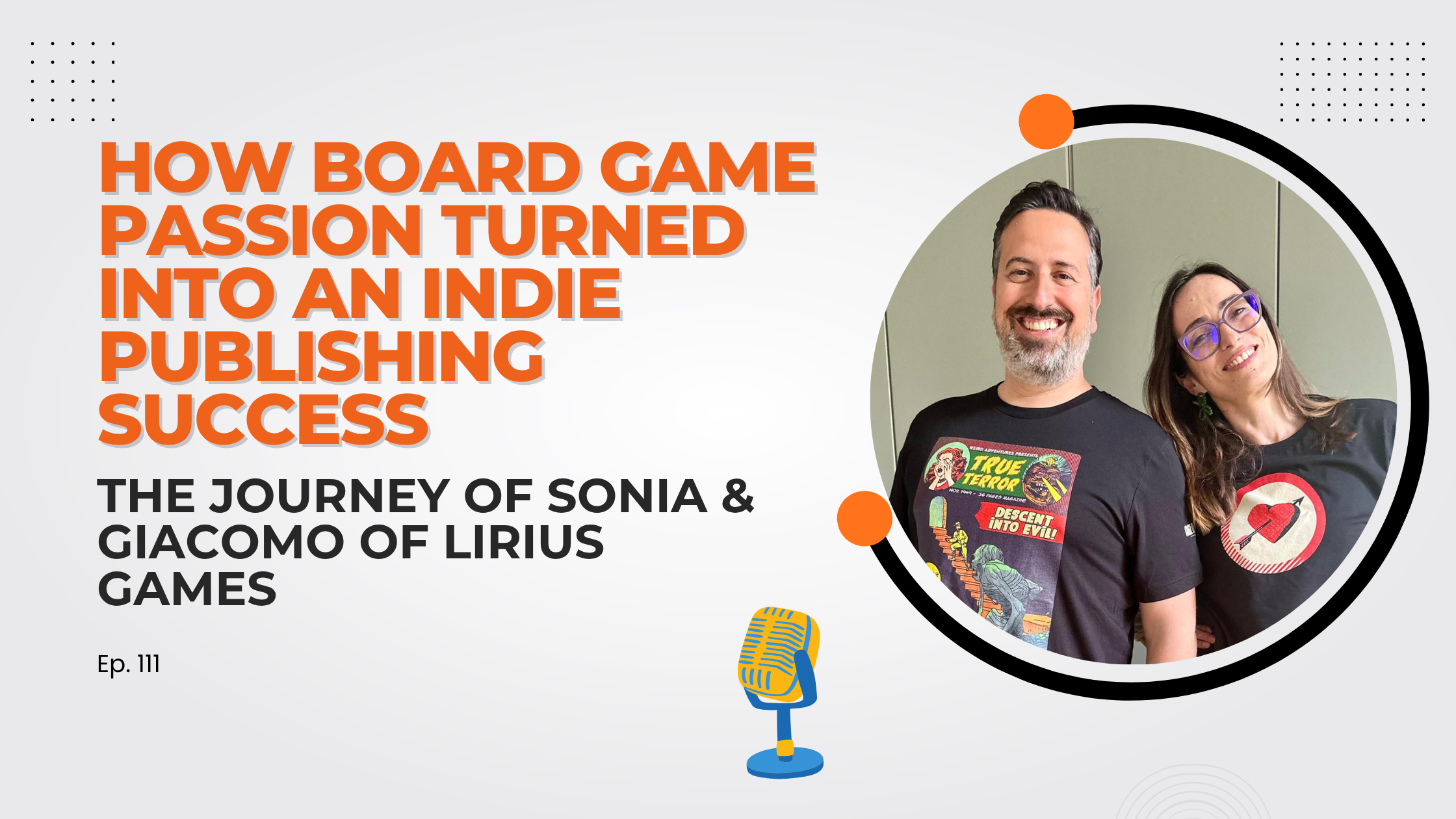
Welcome to the world of indie board game publishing, where passion, creativity, and strategy come together to build something truly unique. In this post, we explore the journey of Sonia Goncalves and Giacomo Cimini, founders of Lirius Games, and how a love for board games evolved into a successful Kickstarter-backed business. Join us as we dive into the insights, challenges, and key lessons behind crowdfunding, marketing, and turning a passion project into a sustainable indie publishing brand.

#111: Inside Indie Games: Passion to Profit – Toy Business Unboxed
Episode Highlight
- 00:42 – Intro: Welcome to Toy Business Unboxed.
- 01:22 – Inspiration: Lirius Games’ COVID origin.
- 03:08 – Community: Building a community.
- 03:28 – Kickstarter: Launching the campaign.
- 04:56 – Lessons: Early prep and marketing.
- 05:49 – Readiness: Importance of polish.
- 06:22 – Relaunch: Campaign cancellation.
- 13:20 – Marketing: Audience segmentation.
- 15:04 – Amazon: Launching Age of Comics.
- 26:17 – Advice: Be careful what you wish for.
The Power of Niche and Thematic Uniqueness
Creating a unique, standout theme can drive success. Giacomo’s game, inspired by the golden age of comics, tapped into nostalgia and carved out a clear niche, helping it connect with a specific audience. This shows that a distinct theme builds emotional connection and demand, and can be a powerful advantage when entering a competitive market. Applying this means drawing from personal interests and stories to create more engaging marketing and a stronger, more relatable product.
Preparing for Crowdfunding: Timing and Community Engagement
Preparation should start early—often a year ahead—but marketing efforts should peak in the final months before launch. This includes ads, content, and active community engagement. Building trust is key. Regular updates, conversations, and presence in forums or events help turn followers into loyal backers. Early testing through smaller campaigns also helps refine the product and messaging before a bigger launch.
Product Quality and Presentation: The Crowded Crowdfunding Scene
Crowdfunding is more competitive than ever, and backers expect polished, near-complete products. A strong presentation can make or break a campaign. Giacomo stresses the importance of launching with a refined product while also planning for post-campaign challenges like production, shipping, and communication. Success depends on balancing product quality with realistic execution.
From Kickstarter to Market: Post-Campaign Strategies
Kickstarter is now just the beginning. Many creators use it as a launchpad before expanding to platforms like Amazon and online stores. Managing multiple sales channels requires tailored marketing, including SEO and ads. At the same time, costs—especially platform fees—must be carefully managed to maintain healthy profit margins.
Learning from Mistakes and the Path Forward
Setbacks are part of the process. Giacomo shares lessons from canceling campaigns, adjusting designs, and improving coordination between marketing efforts. Growth comes from patience and steady progress—testing ideas, learning from feedback, and scaling gradually. Passion can become a business, but it requires adaptability and persistence.
The Biggest Takeaway: Passion Requires Patience and Care
Giacomo’s closing advice? “Be careful what you wish for.” Passion can turn into a demanding job—one that involves managing logistics, manufacturing, marketing, and customer relations. His message: approach the industry with respect and awareness of its challenges. For aspiring indie publishers, nurturing your passion while understanding industry complexities ensures longevity. As Giacomo notes, running your own game company is “like running any other real business,” with the same risks—and rewards.
Final Thoughts and Next Steps for Aspiring Indie Publishers
Launching a successful crowdfunding campaign like Giacomo’s isn’t about luck; it’s about meticulous planning, authentic community building, and relentless refinement. Whether you’re starting small with prototypes or preparing a full product launch, these lessons highlight the importance of honesty, patience, and adaptability.
Conclusion
Success in indie board game publishing comes down to a few key principles: creating a unique and meaningful theme, building and engaging a community early, launching with a polished product, expanding beyond crowdfunding, and continuously learning from mistakes. Passion alone isn’t enough—but with the right strategy, it can grow into a thriving business. Ultimately, this highlights how indie publishers use strong storytelling, community engagement, and smart marketing to succeed on Kickstarter and beyond.
Connect with Sonia & Giacomo
If you’re interested in learning more about Lirius Games or connecting with Sonia & Giacomo, you can reach out through the following channels:
- Website: Visit Lirius Games’ official website for more information and updates.
- Facebook: Visit Lirius Games’ facebook page for inquiries or collaborations.
- LinkedIn: Follow Lirius Games on LinkedIn for professional updates.
Transcript
Jason Hsieh (00:44)
Welcome back to another episode of Toy Business Unboxed. Today we’re speaking with Giacomo the founder of Lirius Games, an indie board game publisher based in Rome. They turned their love for comic storytelling and strategy into a striving business. And they were also able to launch their first games on Kickstarter successfully, and they were able to hit their funding goal just within four hours and also brought in thousands of backers. So thank you so much for joining us on the podcast today.
Giacomo (01:10)
Thank you for having me.
Jason Hsieh (01:11)
Can you first off by starting to share your journey with our audience on like, what was the background story? How do you get to where you are and how do you got into designing board games that you currently also publishing right now?
Giacomo (01:23)
Yeah, so, Lirius Games is a little bit of byproduct of the, the COVID period, you know, lots of people find themselves with lots of time on their hand. And, we had this passion for board games, ⁓ in a very casual way, but we are like, we’re very passionate and we had this, ⁓ this idea we were toying around for quite a bit of a game about the comic book, thriving, industry in the
Forties and fifties in the U.S. like all the major publisher comic book publisher we know nowadays that creates like build empire where born in in in those years and we realize that we’re not like a worker placement is the kind of board games the game is the game is like now is here and his age of comics the golden years and we start to iterate the games and because of the specific of that time they were like
lot of people online and we managed to prototype the game and played so many times. And after a while, we noticed that people were coming back and asking for the game. And we thought that we had something on our hand. the owner of the company and the managing director of the company is also my wife that is Sonia. And she is an economist and I came from the ⁓
the movie industry world. And we try to join our strength together and we start to think and prototyping the board game. And once we realized that there was a market, we start to participate to conventions to get and meet the real people. And kind of like coming out of the lockdown period.
And we noticed that there was interest and enthusiasm. We started from Italy and then we start to do play testing online with the US, with the UK. And we start to essentially build a little community. And that I think is the core engine of any indie publisher or any kind of endeavor in this.
specific age and the most important thing. And when we thought that the moment was right, we start to build up our Kickstarter campaign. We manage everything from marketing, advertising, literally, was quite a ride. We had a fantastic artist that was working on the graphic of the game and we start to…
communicate a lot with our online communities and again meeting the same people at convention and we felt the momentum was growing and yeah so when we launched it, was not my first Kickstarter so I always suggest like a new publisher to test something
on Kickstarter before going with a bigger project. It was a completely different thing. was like a science fiction short film that I made a years ago. I knew some of the, you know, pro and cons of the campaign. I mean, like how you can turn your cons into pro and what you really need to rely on. And the huge amount of work there is behind it that many people, you know, audiences don’t see.
And it was like we were amazed by the passion and the enthusiasm that hit us and that was showing through the numbers.
Jason Hsieh (04:42)
Yeah, and I know for that particular campaign, you were able to hit the funding goal in just four hours. But I think it’s all the work that you do before the campaign launched that is critical. And how for this particular campaign, how many months in advance would you start the preparation process?
Giacomo (04:58)
We started softly one year before and we ramp up marketing effort two months before. We spent very little money, but they were like very targeted. We learn now to work around some of you know, the algorithm and the complexity of building a marketing campaign on the major social media. I must say the scenario now is very different.
very different since we launched the first campaign. Yeah, it drastically changed. When we launched Kickstarter was still just like doing like three years ago now. And it’s like, but it was still a platform for new creators. Right now, crowdfunding in general start to be very crowded. And it seems more and more
Jason Hsieh (05:45)
Yeah,
Giacomo (05:47)
that people are using it as a store. So the level of polishing that the project needs to have, it’s really, it’s paramount. And ⁓ there was a time in which you could go up, you could say, I’m gonna launch in Kickstarter and then I’m gonna refine the game with the audience. Now it’s competition is so fierce that people want,
the product done. so the participation now it’s in the previous phase, but it’s not after. When you arrive there, you’re already discussed, you’re already at like a certain stage. And that’s a little bit of a pitfall that we had in the last campaign that we decided to cancel after one day and we’re gonna relaunch in
Probably September this year.
Jason Hsieh (06:33)
I thank you for sharing that. I think a lot of the backers also looking for, because of just like you mentioned, of the competition, they are looking for a product that’s almost fully finished instead of like before that’s like still kind of in like changing and like kind of semi prototyping phase. Yeah. So, but most of the company right now on Kickstarter, they are really using it as like marketing platform instead of like, instead of like a crowd
funding raising platform.
Giacomo (07:00)
Absolutely. In fact, for Indie Publisher, for us as well, the biggest hurdle is that we are competing with giants of the industry. And that of course, cannibalize the marketing effort of a very small company. It’s the truth of the market, and that’s what we have to live with.
And, but again, it’s like the work in the community, it’s absolutely fundamental.
Jason Hsieh (07:28)
Yeah, for sure, for sure. But what do you think that makes your campaign so successful? additional advice or things you have learned that you’d to share with our listeners?
Giacomo (07:38)
It is like probably a core element of any business? there was a unique selling, you know, was with a unique product. There was nothing so specific regarding the comic book industry. In the game, you play the role of a publishing company and you need to use your workers to perform specific tasks that will allow you to create your comic book series.
And you can specialize in general, you can compete on the market, you can compete on the map of Manhattan, getting the best deals. And so it was highly thematic and very new. So it was a really unique selling proposition. And that, I think, strike a chord. we played with the nostalgia that I have for like, you know, that we prove for like…
certain kind of products that made our infancy special in a way. And also this thing that comic books are and superhero movies and a little bit at the center of the conversation that certainly in that moment helped. And also the fact that we were personally involved because we are the designer of the game itself.
So being the game designer, being the publisher, the way we were communicating, you know, the company’s game was also communicating ourselves. All things that in the last campaign is slightly we probably didn’t communicate as efficiently as we should have the level of involvement we had on the project and so on. But of course, like if you are a creator, there’s always an element of plus that you can get from
the excitement of the crowd.
Jason Hsieh (09:15)
Hmm, I see. Yeah. Thank you so much for sharing that. And I know you’re also going to be launched another Kickstarter campaign here as well.
Giacomo (09:23)
yeah, other one I have here like a first prototype and the Timeless Journeys is the campaign that I was mentioning before we cancel, we launch in end of October, beginning of November. I can kind of like list the mistake that we did and ⁓ we probably, we engage with the community, but we confuse communities. One important thing is that
⁓ Online communities and trade event communities are very different. And they do not respond at the same time, they do not respond in the same way to a commercial proposition. For example, we’ve been incredibly successful, we actually sold out Age of Comics in Europe. We have still a few copies in the US.
while we were attending trading events in Europe, we sold out every time we were there with Age of Comics. So the impression and the mounting enthusiasm in person and live people trying to play testing the prototype of Timeless Journeys, we got, know, one thing is presenting the product in person and getting genuine first, you know, face-to-face response. One thing is convert that level of enthusiasm from a live event into a digital one. Yeah, yeah, yeah.
Jason Hsieh (10:35)
Yeah.
Giacomo (10:36)
Audience are simply different. They want different things. The crowdfunding audience want a ready product that looks in a certain way and they are keen to wait for it. The event, trade show and convention audience wants the game right there, right now. So we probably would have sold out the new game as well, but that crowd that was very enthusiastic
didn’t necessarily follow through the Kickstarter. At the same time, we realized that we needed to change some things about, for example, the graphics and add the new, more exciting mechanics to the game. We’re going to announce soon the changes we made. So what we did when we canceled the campaign, we decided to…
send a survey to all our followers and we start to implement their feedback into the new game. So there’s gonna be a new board, there’s gonna be a new colors, there’s gonna be more drawing and hopefully that drive more excitement to the next campaign.
Jason Hsieh (11:45)
I see. see. Yeah. Thank you for sharing that. I think we all learn mistakes along the way and that’s part of being an entrepreneur and we learn from our mistakes and each time we do the campaign or the next project we get better by learning from our mistakes.
Giacomo (12:01)
Better is like maybe sometimes confidence. You know, again, we underestimate, we attended the Essen, that is the biggest board game convention and trade show that there is probably in the world. And that was literally 10 days before the Kickstarter campaign. And then we had like other issue because life gets in the way and we got like a medical scare before. So we arrive on the Kickstarter campaign. were literally…
depleted because when we participate to the convention is literally as me and my wife going there building the stand and selling the games and expanding the game all day. So we arrived at the time of the Kickstarter campaign that we were literally really tired. So do not mix the campaign with the convention, treat them separately. Don’t think that one
Jason Hsieh (12:44)
exhausted.
Giacomo (12:56)
response will lead into another one. Just focus on the digital element and see how that community is reacting and what it’s saying.
Jason Hsieh (13:05)
Yeah, and of course we have been spending a lot of time talking about Kickstarter, but outside of Kickstarter now I think some of the products in productions, what are some of the marketing strategy that you have been working or trying right now for getting the game out there post Kickstarter campaign?
Giacomo (13:22)
It’s pretty like… There’s nothing unique. You need to find a way to tailor and segment your audiences more and more to perform the ads. And this is more the technical side. On the other side, you need to engage. need to participate to forums. You need to share your work with your audience. You need to give…
custom, you need to get custom feedback and trying to get the sense of what capture the imagination of a a of backer. And that’s the main thing. So in terms of marketing is communicate , you know, pitfalls and success. And I think, yeah, honesty in a way it’s ⁓
It’s an important element because you need to build a community. So it’s not just like, you know, customers is a slightly different proposition. They need to trust you and believe you for a certain amount of time. They literally give you the money and then to expect something after a long time. we know that many crowdfunding projects just when it is busted or disappear is a big
It requires a lot of trust and you need to build a trust with being persistent and be considerate and understanding that they are sort of like angel investors and you need to relate to them as such with the utmost care and gratitude.
Jason Hsieh (14:50)
Yeah, for sure. And you mentioned about the trade show and other different events that you’re going to. Beyond the trade show, ⁓ what other platform, for example, ⁓ on the Amazon side, how is the Amazon marketing going for the brand so far?
Giacomo (15:05)
For the Age of Comics, we launching right now. We literally launch on Amazon and we are FBA partner right now. We are launching soft. The platform is very complex. We will start next week doing marketing there as well. It is a test and fail and eventual success.
with the kind of product that we’re selling is slightly different than, you know, regular plastic toys and he has other kind of, you know, thing to take in consideration. Board games are especially like these kind of like big box games are, you know, heavy. They occupy a lot of shelf space and they require extra care because the box per se
is part of the experience. And I think right now Amazon is taking care of it. But there were times in which it was considered just a box. But if a customer receive a damaged box of a board games, it’s going to complain. So it’s very different from other toy products in a way. And there are things that needs to be tested. So what we’re around now is tested comparing the price of self-distribution.
very well, especially in Europe. It’s more difficult pushing through the American market because marketing in the US is considerably more expensive than in other countries. But we managed to do some good sales online on our website where you can find the game. now we’re starting this new adventure with Amazon as well. And we’ll see where it will go.
how effective the marketing tools are in gathering new people interested in.
Jason Hsieh (16:50)
For sure. think Amazon is a totally different monster compared to the Kickstarter. And that’s something we have a lot of experience with. usually you really need like five different types of expertise in order to run the platform really well. The number one is search engine optimization because Amazon is a search engine. Second one is advertising. You need an advertising specialist on the team that know how to run all the different types of app placement, including sponsor products, sponsor brand, and sponsors display. And then you also need a creative team.
person, like a graphic designer on your side that can do the graphic design specifically for Amazon purposes. For the Amazon detail page, there’s hero images, secondary images, A plus content for product description. Then you need a fourth person that know how to deal with the compliance and the catalog. You need a catalog specialist know how to deal with all the compliance issue with Amazon. Then the last person you really need on your side, when we’re in your team is going to be an inventory specialist.
that know how to handle the inventory, make sure everything gets shipped in on time. And you don’t want to overstock in Amazon because they will charge a long term storage fee on the platform. So that’s definitely very different than Kickstarter. And ⁓ that’s something ⁓ I feel like a lot of people kind of overlook when they’re first starting on Amazon. They think it’s going to be similar to Kickstarter because that’s kind of their previous experience are, but it’s a totally different platform.
Giacomo (18:13)
We’ll
build up on the experience. We are selling through Shopify and we have fulfillment center in five countries. So in that sense, that experience kind of like set the bar and then we say, okay, we are proficient with this. We know how to it. We automatize the process of selling. Let’s see how we can perform and let’s see how more complicated and advantageous is being on ⁓ that big platform. So we are…
literally testing, we have a very few products. ⁓ The other thing you need to consider, margin and board games are really, really, really little. You need to rely on big numbers. Yeah, we have interesting numbers on Kickstarter, but we don’t have like in terms of the big world is like, the distribution, we are not even taking consideration being an indie publisher with just one game.
you need to work around these perks. And that’s why we are developing new games to get more presence, spread the brand around, and hopefully start to get picked. Because the way also the shipping on the products in games, a brick and mortar store will hardly get more than two, three, especially if you’re at the beginning and in the publisher.
Jason Hsieh (19:19)
Yeah.
Giacomo (19:29)
definitely get like two, three copies of your more than three copies of your game, but boxes that might give you a discount, might give discount to a brick and mortar store, like contain like six or more boxes. So you need to have more games. And now that’s what we’re trying to do is develop more games to give more offer and to ⁓ help like the store. And at the same time, create a sort of a funnel system of
products on Amazon. Also on Amazon, we have our store, we have our website on Amazon, we have our shop, but of course we are selling three products like the game and accessory for the game. We need to improve that storefront for like specific product and that is going to take some time.
Jason Hsieh (20:14)
Yeah, and you bring up a really good point because margin for the board game industry is, it depends on how big the game is, but it’s also very important. And Amazon take up so much different fee. There’s Amazon referral fee, Amazon FBA fee, Amazon storage fee, long-term storage fee, inbound storage fee. There’s a lot of fee on Amazon platform. And usually when we’re talking to the people in the industry, our recommendation is you want to make sure your profit margin is at least at 25 % or higher.
after you deduct all the Amazon fee and deducting your cost of good sell, before you even consider scaling on Amazon because Amazon is also a pay to play platform. You have to run ads if you want to see any kind of like ongoing success on the platform. have to run ads.
Giacomo (20:55)
I think that’s the industry. We notice also with our website, the moment we stop advertising for whatever reason, it’s just sales basically stop. And they start again when you start to advertise. It’s a complicated game full of pitfalls. we are trying to…
Jason Hsieh (21:06)
Yes, yes, yes.
We
Giacomo (21:18)
do baby steps. That’s what, that’s been always our approach and to, you know, around the risk to just, you know, burn cash because you can find yourself, you know, burning a lot of cash. bit by bit.
Jason Hsieh (21:32)
Yeah, for sure.
Yeah. And the other thing, I think a common decision the people in the industry is trying to make is like, ⁓ that’s maybe something I also want to ask you on your perspective. When you first making the decision on either to go self-publishing or licensing to a bigger publisher, when you’re making that decision, back then, what was going through your mind? What are some of the kind of the consideration you’re thinking?
Giacomo (21:58)
⁓ As an indie publisher, we wanted to really know the in and out of the industry. And we thought if we’re going to licensing, we won’t see 90 % of the business. Plus, even in that case, margins are like…
Jason Hsieh (22:12)
Even lower, yes.
Giacomo (22:13)
Really, really, really low. And we thought, look, what you know, we would have to sell, you know, three times to get the same margin. At this point, let’s, you know, let’s see how this industry work. And, and let’s see where we can get. And again, it’s like, it’s a precious learning phase. And ⁓ we are happy that we took that decision. Yeah, we could have
license some of the thing or find like some form of maybe distribution deal on some markets. Yeah, but it’s you never you never know, we would have missed part of the part of the experience. And I think that as an indie publisher, you need to see those things, you need to understand how complicated also to, you make your deal more confidently, knowing that you’re doing the right choice, because you would be
really difficult to get in there at the same yeah, you live and learn, you make mistakes and it’s again, part of the journey.
Jason Hsieh (23:09)
Of course, I 100 % agree. also you talk about because you actually go through the self-publishing route, now you understand even if you want to pitch to any publisher in the future, you know what is going through their mind because you already did all the steps yourself. So you understand what they were thinking when they are evaluating your particular board game and your particular design and what are some of the things they are considering as far as cost marketing and all the other things because you’ve done that yourself. And I think that’s a very important element that some people
will oversee, but it also could be kind of overwhelming as you know, initially, because you need to tackle so many different aspects, not just on the design. Now you have manufacturers, you have supply chain, you have testing, you have marketing, you have all kinds of different issues. So, but I think for me, being a toy entrepreneur myself, that’s also the fun part, you know, to really brainstorm on coming up with creative solution to tackle all the different problems that we encounter.
So, and that’s one thing I really enjoy as part of my role in my own company as well. So, what is next for your company in the next, what is your projection for the next few years? What do you want to work on?
Giacomo (24:20)
We are still pushing the age of comics. are trying to expand our communities in the US. We partner with companies that do that, that spread the knowledge of new games to conventions that are too far for us, too expensive for us to attend regularly. So we’re going to have like
our games at the GeekCon and Geekway, sorry GenCon, of course, it was in Geekway to the West, which just like the games was Dice Tower West. And yeah, we’re looking for like this, for the feedback from the player from this event. And hopefully they will enthusiastically get copies from the game and from our website or from…
from Amazon. so this is in the media next. But then I was mentioning, we’re going to relaunch Timeless Journeys, ⁓ the Italian Grand Tour. That is, as I was saying, the next game that we are revamping the graphics. And we’re going to, and we have already more games in development, pretty much advanced stage. I cannot say too much that are different from what we
We did so far, we want to try explore new ways of interact with games and approach them. We’re going with simpler games and with a very distinctive kind of lore in a way that we are building the lore with a special care to get the audience involved in the universe in which the games will take place. so we’re talking right now with, you know,
graphic artist and other game designer. We’ll see soon what will happen.
Jason Hsieh (26:07)
I see, I see, I see, got it. So as we’re wrapping up today’s interview, if you have to share just one piece of advice with someone that’s getting started within the tabletop board game industry, what would that be?
Giacomo (26:18)
Careful what you wish for. Many of the industry that start from a passion, you will turn a passion into a job. so be careful. It’s true. For me and Sonia the excitement and the careless joy that we have played board games, now every time we play something new, there’s a constant level of…
analyzing and breakdown things and thinking about it. And so it is like, changes the perception on your passion. So it’s like, it’s, it’s also great. You’re immersed in the, something that you love, but he, know, especially at the beginning, there’s a lot of accounting. There’s a lot of, ⁓ especially that there’s a lot of project management. There’s a lot of, ⁓
logistic and manufacturing. it’s like, this is the, know, making board games is not like exactly like, it’s very incredibly complicated, very, very, very complicated and you put your life on the board in a way.
Jason Hsieh (27:25)
Yeah, you put your life on the board. I like that. So yeah, it is just like running any other ⁓ real business.
Giacomo (27:32)
Exactly like any other real business.
Jason Hsieh (27:34)
Okay, so yes, and where is the best place for our audience to find you online?
Giacomo (27:39)
Yeah, we can find us on social media. So we have a group on Facebook, Instagram, and of course our website that is LiriusGames.com. And if you just Google search Age of Comics, the golden years, you will find us in a second. And as I was saying, you can purchase the game from our website or through Amazon.
We have a store there, there’s amazon.com slash leaders games as well. You can go check the product. If you don’t find easily, just drop us an email, talk to your retail store, brick and mortar, and they will definitely, get in contact with us. can get copies to them, in a very short amount of time. The other thing we enrolled the.
the Amazon program for selling in Mexico and in Brazil. And that’s going to be another channel that we are like opening that we’re going to test in the next week. So think listeners in Brazil and Mexico can actually get their copy of the game directly through Amazon very soon.
Jason Hsieh (28:37)
Got it. Thank you for sharing that. And for our listeners, thank you again for tuning into this episode of Toy Business Unboxed podcast. hope you have enjoyed today’s conversation and find it insightful and inspiring. If you like what you have heard, be sure to subscribe to our podcast on your favorite platform so you never miss an episode. We really appreciate your support and we love it. You can leave us a review and share the podcast with your friend and colleague. For more resource tips and the latest update within the toys and games industry, visit our website at toy-launch.com.
Join the conversation and connect with us on social media using #toybusinessunboxed and we’d love to hear your feedback and suggestions for future episodes. Until next time, keep innovating, keep creating, keep bringing joy to toys. This is Jason Hsieh signing off on the Toy Business Unboxed podcast and we’ll see you in the next episode. Thank you so much everyone.
Giacomo (29:24)
Thank you.