
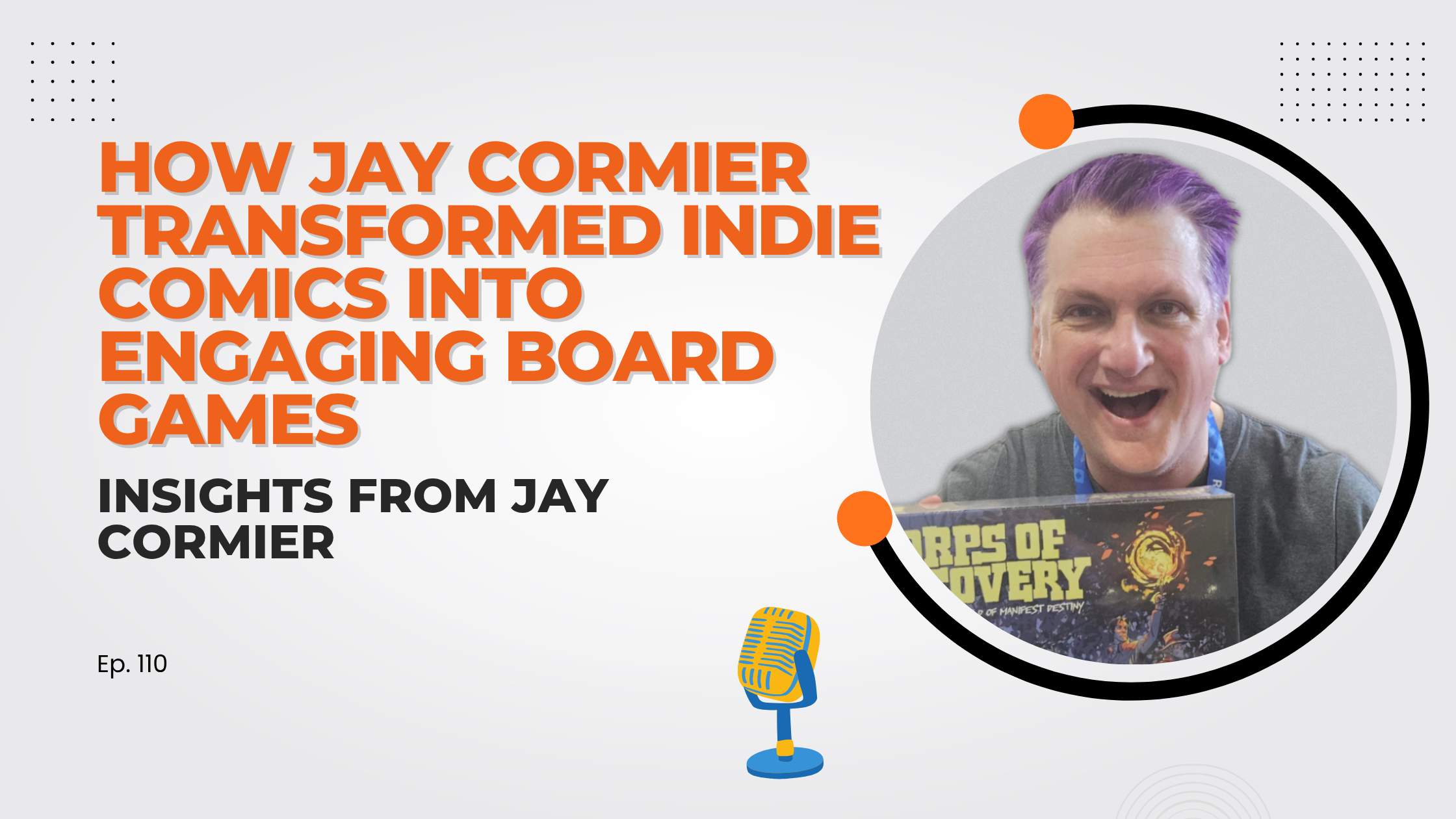
Welcome to the world where comics and board games collide to create unique and compelling experiences. In this post, we explore how Jay Cormier, a seasoned game designer and publisher, leverages indie comics to craft engaging board games—and what newcomers can learn from his journey. Whether you’re an aspiring designer or an experienced publisher, discover the strategies, challenges, and insights that highlight the power of storytelling in niche game publishing.

#110: Crafting Hit Games with Key Decisions – Toy Business Unboxed
Episode Highlight
- 00:00 – Introduction & Jay’s career
- 02:00 – From design to publishing
- 04:00 – Indie comics as a niche
- 06:30 – Launching a publishing company
- 08:45 – Creative components in success
- 10:20 – Self-publishing vs licensing
- 12:45 – Convention pitches & Kickstarter
- 15:00 – Community & content creators
- 17:15 – Teaching design & common mistakes
- 20:20 – Key elements in game design
- 22:45 – Marketing strategies & crowdfunding
- 26:00 – Upcoming projects & Kickstarter
The Art of Transition: From Game Design to Board Game Publishing
Jay’s journey began with a passion for creativity and games. Initially a game designer, he faced both successes and failures. A turning point came when the rights to his game Mind Management were returned, allowing him to publish it himself. This transition to publishing was intentional, as Jay aimed to create games with unique mechanics and themes. His game Harrod County, for instance, includes a cube tower for combat resolution, offering a memorable and tactile experience.
Tapping the Indie Comic Scene: A Niche Strategy with Big Rewards
Jay’s strategy focuses on collaborating with indie comic creators to bring fresh narratives and art into board games. By working closely with creators like Matt Kindt (Mind Management) and Cullen Bunn, he adapts their stories into games—like turning Manifest Destiny into an immersive exploration and monster-battling experience. Indie comics offer originality, unique art, and passionate fanbases, creating a synergy that draws both comic and game enthusiasts. The takeaway: using indie comics as IP gives your games a distinctive edge over mainstream offerings.
Crafting Games That Connect: Merging Story and Mechanics
Jay consistently aligns game mechanics with the story, ensuring players experience a narrative, not just a game. This approach deepens engagement and appeals to both fans and newcomers.
Core Discovery: Based on Manifest Destiny, it captures exploration and adventure through gameplay.
Grendel: A one-on-one versus many game, reflecting complex characters and themes from the comic.
Challenges and Lessons Learned in Niche Board Game Publishing
Jay shares the challenges of running a publishing company, including logistics, legalities, and market unpredictability. His insights include:
Distribution and Manufacturing: Managing overstock and costs demands strategic planning and meeting MOQs.
Control vs. Collaboration: Self-publishing offers control but risks altering themes based on publisher decisions.
Market Reception: Addressing issues like representation in games like Belfort requires transparent feedback handling.
Effective Marketing: Building Anticipation and Community Engagement
Jay stresses Kickstarter’s role in creating pre-launch buzz, advocating for early content creator partnerships, social media use, and compelling storytelling. He warns against aggressive tactics like “dollar pledges,” which can damage brand trust. Authentic engagement and respecting community sentiments are vital for fostering loyalty and growth.
Final Thoughts: Advice for Aspiring Board Game Creators and Publishers
Jay advises newcomers to stay involved through playtesting, conventions, and industry networking. Focus on creating games with meaningful decisions, innovative components, and strong themes. For self-publishing, master logistics or partner with aligned publishers. Success blends creativity, strategic marketing, operational skills, and community engagement.
Conclusion
Jay Cormier’s journey demonstrates the potential of niche strategies—particularly leveraging indie comics—to create memorable, story-rich board games. His emphasis on mechanics that serve the narrative, combined with strategic marketing and community engagement, provides a blueprint for future industry success. Whether you’re designing, publishing, or both, the key is to focus on creating games with a true story, inventive components, and an engaged audience. Through persistence, innovation, and smart partnerships, your journey in tabletop gaming can become as compelling as the stories you wish to tell.
Connect with Jay Cormier
If you’re interested in learning more about Off The Page Games or connecting with Jay Cormier, you can reach out through the following channels:
- Website: Visit Off The Page Games for more information and updates.
- LinkedIn: Follow Jay Cormier on LinkedIn for professional updates.
- Instagram: Follow Jay Cormier on Instagram for updates.
- Facebook: Visit Off The Page Games on Facebook.
Transcript
Jason Hsieh (00:00)
Hi, welcome back to another episode of Toy Business Unboxed podcast. Today we’ll be diving deep into board game publishing with Jay, industry veteran who went from designing game himself to running his own publishing companies, Off The Page Games. With a focus on adapting indie comic into board games and he also has successfully launched multiple games over his career. And he also teach game design at Vancouver Film School. So thank you so much for joining us on the podcast stage.
Jay Cormier (00:27)
My pleasure. Thanks for having me.
Jason Hsieh (00:29)
Yeah, so can you first off by sharing with our listener, how do you got into the industry?
Jay Cormier (00:34)
I’m a very creative person. I’ve done a lot of theater in my background. And I think just creative people, they like something, they want to create that as well. And so the thing I liked was board games. And so me and my friend Sen, who I co-designed a lot of these games with behind me, we eventually just said, you know, we could make a game. And so we started to try to actually make a game. because it was our first foray at it and we didn’t have the experience or skill set,
the game really sucked and it wasn’t good at all. We kind of stopped designing games as a friendship and we just kept playing games, we didn’t make any games. And wasn’t until I moved away from him across the country, I’m up in Canada, and where we decided we needed to stay in contact with each other some way. And we said, let’s use board games as a way to stay in contact Let’s try to make board games again, even though now we’re different cities, different provinces in Canada.
And so we did, and we started talking online and back and forth, coming up with ideas, and we had both play testing, and eventually we had like five or six games we designed. like, what do we do with it now? And that’s what started our whole journey.
Jason Hsieh (01:38)
I see, I see, I see. which one is the first game that you designed? ⁓
Jay Cormier (01:43)
Belfort was the first one that got published. Yeah, the first one that got signed. that and it ended up being a critical hit. Like people liked it when it first came out. I think it’s actually coming out again next year from another publisher.
Jason Hsieh (01:46)
⁓ okay.
I see. Okay. And I know your company have a very unique niche where you’re focusing on working with indie comic books. Can you kind of tell a little bit more about that approach and why you choose that route?
Jay Cormier (02:08)
So for about 15 years of my career, was all the freelance designer designing for other publishers. And then in 2019, I started my own publishing company because the mind management game that I designed with Sen was signed to a publisher, but they actually went under and we got the rights back to that game. And we were on a call with the owner of the IP, the creator of the comic.
And we’re all like, what do we do now? Who are we going to pitch this to? All this kind of stuff. And it was actually Matt Kindt, the creator of the comic, said, why don’t we just do it ourselves? He goes, I’ll all the graphic design, all the art. You publish it. So I talked over with Sen. And at the time, I had the bandwidth to be able to do it. And Sen had a full-time, still does have full-time job. And said, well, I’ll do it. I’ll be a publisher. And Sen’s like, great, let’s do it. So I started becoming a publisher. And at the time, I’m like, OK, now who am I? What am I going to be as a publisher?
And just because this was based on one of my favorite comics of all time, I decided, what if all my games I make are based off of cool indie comics? And I don’t have any in or anything in the industry. I don’t know anybody. I see. I’ve met. And so that’s what I said. That might have been my only game I ever published, But it ended up being a pretty big hit. And so it helped propel me. And then it was like, now I’ve got to figure out what my next game is.
Jason Hsieh (03:09)
I
I see. What was some of the biggest challenge that you’re facing when you first like launching your own publishing company?
Jay Cormier (03:30)
It’s like everything is a challenge because it’s a challenge, it’s a fun thing because learning to me is the fun part. was for the longest time when people ask like, why don’t you just become your own publisher? You’ll make a lot more money. I’m like, I was always not interested, not interested. I love being a designer. That’s let the publisher worry about all that stuff. So I was worried that it was going to be all minutiae “businessy” stuff and just boring, tedious stuff that would make my love for the hobby diminish. And fortunately it hasn’t. Fortunately it’s the opposite. It’s like,
being an owner of a company, publishing company of board games is still full of ton of creative ⁓ control and ideas. Like you’re now controlling the whole product, not just the game design but the product starts from it being even before being on a shelf, like, you know, marketing and all this stuff. It’s just, there’s a lot of, of creativity around creating the brand of your product. And that’s part of the fun parts about running a business. So they are challenging as you learn
all the legalities about how to legally get UPC codes so you’re not just unloading them off the internet for $10 or whatever. There’s a lot of like customs and all this duties and freight, all that’s a challenge. But my kind of internal motto has always been to emulate those who are doing well, like the six ones. And so I see other companies and other publishers in my bracket and see what they’re doing. And I just try to emulate what they’re doing. I like what you’re doing.
Who are you using for this service? Okay, I’ll use them too, because you’ve done your research and you’ve understood what’s good. I like what you’re doing.
Jason Hsieh (04:56)
I see. And I think that I talked to a lot of people in the toys and game industry and one of the major decision they need to make as like an early designer or someone that’s new to the industry is to either to go for self publishing or go license the product to a bigger publisher. Yeah. From your perspective, can you kind of walk, like kind of share some of the pros and cons on both?
Jay Cormier (05:16)
Yeah,
sure. Designing is a game and then pitching it to a publisher, licensing it to them is an easier, way easier way, even though it’s still like hard, it’s way easier way to get your game out in the market. You have to go to conventions or you have to maybe do virtual pitches, but you have to somehow connect with publishers. And conventions are the best way because then you get to meet them in person, get some face time with them, and you can verbally explain your game so they don’t misinterpret your game.
maybe even play it if they have enough time. that’s hard if you’ve got one game that you’re trying to pitch, that’s a really hard, the cost return is really hard. But every time I went to a convention, I had five, six, seven or eight games I was pitching. So I’d go up to a publisher and I’d go through them really quickly and they say, these two look interesting, tell me more about those two. So really efficiently able to use my time. And then there’s things called speed datings where you sit down with your game set up.
and then publishers come by every five minutes and they rotate. There’s really interesting things there. So that’s all great. But in the end, you don’t control the product. they’re going to develop it. Oftentimes, in my case, it’s always been for the better. I only had, think, one example where they developed it to a point where I didn’t like what they did with it. But most of the time, it’s good. But if they also want to change the theme, which I’ve never cared if they did or not. And I’m trying to think if they ever did change the theme.
I don’t think any of my games, did change the theme, but they could. You game about ponies and they want to make it about flowers, whatever, know, they change it if they want. And then the messaging and stuff like that. I know we had one issue in one game, it was an expansion for Belfort and it had a lot of the characters were male. And so there was a bit of like, how come there aren’t any female fantasy characters in this? we kind of, the publisher didn’t know how to handle that, right? And so they just kind of backed away and shut down.
And they were kind of, it was like, if I was running it, I’d be like, ⁓ this is great input. I’ll like, you know, engage with the audience who’s, who’s asking for this stuff. So that’s the downside of being a designer and not, you don’t have control over the whole messaging that’s going out. but as a, you know, self publisher, it’s a lot of people think it’s like, just put on Kickstarter, make a game, put it on Kickstarter. It’s easy. And it’s like, that’s not easy at all. Not easy at all. Like just the Kickstarter alone,
Jason Hsieh (07:20)
It’s not easy, yeah.
Jay Cormier (07:24)
You can have a hundred podcasts just about how to do the Kickstarter. But then, then you running a business like, like, what do do with all the rest of your, like, if you just print exactly what you need for Kickstarter, there are publishers that do that. They’re just Kickstarter publishers. They put a Kickstarter out. They make as many as they need. Plus a few more that can maybe sell online, but that’s it. Then they don’t have to worry about overstock and all this kind of stuff. As long as you can hit your minimum order quantity, your MOQ so that you’re, you know, whether it’s 500 or a thousand, as long you hit that, then you’re fine. But if.
If you only sold like 342 games on Kickstarter and you got to do 500, so where are the other ones going? In your garage? People don’t think about that, especially if you want to get more to get that per unit price down. I want to get up to a thousand, 2000 units so I can get my per unit price down. Where are those units going? Now you got to pay for storage somewhere. How are you getting them out to you? How are people going to know about it after the Kickstarter? Kickstarter is a great marketing tool, but now you have to get people to know your game exists and somehow give them a way to buy it.
They’re not just going to be flooding to your website to buy it. Are you going to Amazon? How are you going to do that? Like everything’s, now it’s a business you’re running. So you got to figure, you have to have those chops. If you’re not willing to have those chops, then I would recommend pitching your game to publishers, than self-publishing.
Jason Hsieh (08:33)
I see. Yeah. Thank you for sharing that. And I think you did both over your career. like right now, do you still pitch some of your design to publishers?
Jay Cormier (08:44)
I
guess I’m big enough that I get commissioned. people, some publishers ask me, hey, can you make this game? So I’m rarely pitching a game. But it still happens where I still have an idea just out of the blue and I have to pitch it. So sometimes I’ll use that for my own publishing company. Yeah. I can’t find a way to make it fit a comic book or doesn’t fit my brand. Then I’ll try to pitch it to another publisher.
Jason Hsieh (09:07)
okay. You kind of answered my follow up questions. Like how do you decide which one to pitch and which one to do the self publishing.
Jay Cormier (09:13)
Yeah, well, there’s like, it’s got to fit, I got to find a comic book for it. sometimes I have a game and I’m trying to find out what comic. For example, I just had Bruno Faidutti pitch me a game and it had some bluffing in it. And I’m like, oh, that’s pretty cool. And I was trying to think of a comic and I thought of a comic and I’m trying to contact the comic creator right now. It’s called the Department of Truth. And it’s like, it would just fit perfectly with the theme of bluffing because it’s all about.
truth and not truth and stuff like that. So now it’s just about chasing down their IP owners.
Jason Hsieh (09:44)
Okay, so I have a follow up question since you mentioned that. So a lot of the game that you designed, do you go after the comic first and based on the story to create the game or the other way around to create the game first
Jay Cormier (09:55)
Well, I’ll go through each one real quickly for my management. He asked us for a game. I looked like almost out of the blue. We’re like, oh my God, we’d love to make a mind management game, but it took us five years to find that game. because we couldn’t figure it out. We were like putting, we came at least five different, totally different versions starting from scratch and totally different versions. And none of them felt like it until we got to the mechanic where we, it was a hidden movement game that made us feel like we were really in a psychic espionage type of story. It was great. So then we got it.
Then I’m like, okay, what’s game number two? Once I got that published, I think game number two, I had a game that was called Skirmishes. And I’m like, this feels like a fun game. I didn’t know what comic to set it in. I set up a meeting with Cullen Bunn and Tyler Crook. And they wrote Harrow County. And that’s this one. And so I pitched it to them and they, through the success of my management, believed in me enough to say, yeah, let’s do it.
and the game changed so much. So we had a game, but it changed so much. It was very symmetrical before, and it turned into a very asymmetric game where everybody had different goals and how they played was different because of how the comic was. And the third one was Core of Discovery. And that one was, had another game that was surviving on a deserted island. And I’m like, that’ll be a cool game. But I’m like, I don’t know any comic books surviving on a deserted island. So we put it actually on social media. like, does anybody know any comics about
surviving a deserted island or on a planet or exploring an island or a planet or something. somebody from Skybound Comics said, Manifest Destiny. I hadn’t read that one. So I went, I read it and I’m like, this is amazing. And immediately I’m like, for sure this can work. This can work. And so we adapted that to, instead of surviving, it was more about exploring and in the story of Manifest Destiny, you’re also killing monsters. And then for Grendel, it was the fact that the creator of Grendel, Matt Wagner,
Grendel’s our next game that’s coming out this summer on Kickstarter. Yeah, they he emailed and just out of the blue said hey, can you make a game based on my comic? And it was just from the success of the other games. He just saw value in what we were doing. And so it was I was brainstorming with Sen my often co designer and said maybe you know would be a cool game would be a one versus one versus many which which doesn’t really exist, but that’s kind of a neat idea.
And he immediately was like, Oh, I have a game like that. was a lot of, and I designed a game. was aliens versus predator versus Marines. But the mechanics he thinks could work. And so he showed me the game and I’m like, yeah, maybe this could work. And so we’ve been working on it for over two years, trying to get it to come out to, to, to really make it fit with the Grendel IP. And now it does. It’s perfect. Yeah. So that’s a, that’s part of our whole brand is it’s gotta be so tied to the IP that
Jason Hsieh (12:15)
Okay.
Jay Cormier (12:35)
A, if you don’t know the brand, it’s going to be a fun game and you’re going to have a good time with the game. Even if you have no idea what it is, that’s a big goal of ours. It’s got to be a good game first. But then if you do know the brand and the IP, you’re going to get a lot more out of it. You’re like, ⁓ I see why this is this way. And I get this. this is a nice nod to that storyline and this beat. So it’s really cool.
Jason Hsieh (12:53)
OK, so does a lot of the customer, do they know the game first or do they know the comic first?
Jay Cormier (12:59)
Well, it’s starting to change a little bit because now I’m getting people mostly at the beginning, people had no idea. And I don’t, didn’t advertise that on purpose. didn’t say based on the hit comic on my marketing anywhere, because I just find, I personally find that when I’m walking in a convention and I see a big poster saying based on the hit comic and I looked down and I’ve never heard of that comic before, sometimes I’m like, I don’t know what that is. I’ll keep it. It’s not for me, I guess, cause I don’t use that as my marketing tactic. Um, but now.
Imagine I said, hey, pick your tell me your favorite game and you told me your favorite game board game. And I said, what if I told you there was an amazing comic book about that game and you could read you’d like, what about my favorite game? I want to read that. And so that’s what people who play the game and then learn that there’s a comic like really. And then I go read the comic. And so now I have people to come up and tell me, ask me, what’s your next game you’re going to make? Because I want to go read that comic.
Jason Hsieh (13:49)
That’s interesting. I see. Yeah. And I know there’s a lot, sounds like that’s a lot of back and forth and a lot of brainstorming, but how do you decide which game concept is worth pursuing as a publisher yourself?
Jay Cormier (14:00)
Yeah,
that’s a good question because I find as a designer and now especially as a publisher, I want to make games that deserve to exist. That’s not the best way to say that. That offers something unique and different, not just in its skin, but in its actual design. So every game that I’ve done has something really unique to it to have a hook. Like the Harrow County, for example.
on this game, has a cube tower built right into the box. So there’s an actual hole in the box and you drop cubes in here to resolve combat. Not all the cubes come out because there’s little ledges inside here. So some of the cubes get stuck
Jason Hsieh (14:37)
You get stuck intentionally. That’s a very interesting design.
Jay Cormier (14:41)
Every in Grendel, we have these towers and you put tokens in them and inside the towers are these seesaws. And once enough weight gets put on them, it’ll trigger and a mayhem phase will happen. So every game has a really cool, neat component or mechanic or thought to it with it’s that just people have never seen before. So I want to always create stuff that like I’ve never seen that. What is that? Gamers love that kind of stuff. Like I’m a gamer. I’m like, as soon as I see a cool component, I’m like, I want to
play that? How does that work? How’s that going to affect my decisions in a game? I can’t wait to see.
Jason Hsieh (15:11)
I see, I see, I see. Yeah, that’s actually a very unique magazine that you just showed me. So for the listener that’s listening, you can also watch our video on YouTube channel. see, yes. To see the mechanism. So out of all different games that you have launched, can you share some of the interesting or surprising story
Jay Cormier (15:29)
Yeah, there’s one time when we were making Core Discovery, Matthew Roberts is the illustrator for the comic. He did a cover for us and we asked him for some more art for the board of this forest scene. And it was kind of funny because I kept asking him and he was just so busy with some other comics he was doing and he kept delaying, kept delaying. Eventually I said, hey, it’s not amazing like character work and stuff like from the comic, it’s just a forest scene. Can I outsource this and ask some other person who can kind of mock your style to make it look like it fits in the world? Can I ask somebody else? He goes, yeah, totally fine. do it.
And so I went on this Discord channel that I was part of that had some comic creators in it. And I said, hey, anybody can mock Matthew Robert style and do a bird’s eye view of a forest? And one guy named Owen Jenny replies, like, he goes, yeah, I could easily do that. He goes, I was the ⁓ inker for the comic manifest destiny. I’m like, well, that’s great. So he is very familiar with Matthew Robert style because he inked all of Matthew Robert’s art. So he got to do that art for it.
And then it was kind of also funny when I eventually billed him for the work and paid him for his invoice. I see his invoice and he lives in the same city I live in. I’m like, So we went out and had lunch together. It was really great.
Jason Hsieh (16:34)
OK, OK, nice, nice, nice. Yeah, and one more thing I want to ask is because I know you also teach game design for years. Can you kind of talk about what do you teach in your course and also what are some of the common mistakes that new designers go through?
Jay Cormier (16:50)
Sure. So I do teach at Vancouver Film School, in person, but they teach game design for video game design as a But I teach board game design as one of the first classes that they take to understand the iterative aspect of game design. And they make it, you know, board games and they really understand they find a lot of value in this where they learn about mechanics and decisions and uncertainty and all these tools they have as designers. So it’s a very valuable course that I’m super glad that
VFS beliefs in the course and I’ve been doing it for 12 years. And then I also have converted my own lessons into a course through a site called failfaster.ca. And on failfaster, I teach a class on how to design your first board game. it’s a bunch of videos that you can partake in, but I also interview other popular game designers to get their input on all the different topics.
Jason Hsieh (17:19)
whoa, okay.
Okay
Jay Cormier (17:41)
A lot of times some early mistakes is just not understanding the value of how important meaningful decisions are. And that’s the crux of how we create really fun games is through meaningful decisions. And so sometimes the game is, you know, move on these face down tiles and flip the tiles up. That’s the entire game is exploring this dungeon or whatever, a haunted castle, and you’re moving and flipping tiles up. Eventually you just feel like this is everything is full of guessing. You have no idea what’s under any tile.
while there is some tension to be had about, I wonder what’s here. If the entire game is that, that’s an example of a not a very meaningful decision. Cause you just go to the closest tile. Doesn’t everything is, doesn’t matter. So that’s an example of like really not understanding the, how important meaningful decisions are and how can we turn that experience into something meaningful.
Jason Hsieh (18:29)
I see. OK, OK, OK. And what are some of the like the important component based on experience that all the games that in order for it to be successful that they should have.
Jay Cormier (18:38)
Meaningful decisions. Absolutely. That’s a huge. It’s the most important thing.
Jason Hsieh (18:41)
Okay, okay, okay, okay. I see, I see, I see. And also looking back, like what is one thing that you wish you have done differently in your journey as far as launching your publishing company?
Jay Cormier (18:50)
That’s a question. one way you might say, I wish I did it earlier because now I’m in one way, but my management was a perfect game to start a company off of because it ended up being a big hit. So it was great to have some financial success with that to give me some breathing room to make a company. But now for the last year, I’ve been doing this full time. So before that I was running the company on the side, you know, as a part-time job. This is now my full-time gig, which is exciting. And it’s been my dream.
Jason Hsieh (19:13)
Yeah
Jay Cormier (19:18)
for 20 years to work full time in the board game industry.
Jason Hsieh (19:21)
Yeah, congratulations
Jay Cormier (19:23)
I wish I could have gotten here sooner, but all of the success has led to why that’s a success.
Jason Hsieh (19:28)
Yeah, yeah, I just went full-time three years ago myself I know how it is like to work, you know Yeah, we’re and still try to go the business on the weekend and in the evenings and try to make it work and I want to transition to talk a little bit about like digital marketing based on your experience with the publishing company what are some of the marketing strategy or things that you have done that was very successful for all the different board game that you carry
Jay Cormier (19:53)
I mean, in a way the whole entire crowdfunding scene with Kickstarter is a marketing strategy. Just using that entirely, right? But obviously I do all the Facebook ads and a little bit on Google, but mostly face meta Facebook ads. But a partnered with other companies like Jell-Up and Launch Boom and Wayfinder, different companies to help, you know, for different aspects, whether it’s for a campaign or outside of a campaign and mixed results on those all the time.
My launch boom ended up being really good because they spent time teaching us, me, how to do a lot of the things. So I’m actually able to do some of the things that I couldn’t understand before. So that’s really nice.
Jason Hsieh (20:28)
Yes, Launch Boom was on our podcast recently as well.
Jay Cormier (20:31)
Yeah, yes. There was a big challenge with them when they first came into the board game scene. They had been working outside of the board game. Yeah, part of their strategy was asking customers put a dollar down and then they get like a free mini expansion or something like that. Yeah, and so I saw botany was the first board game to do it and they made over a million dollars like that sounds great. I’ll join this thing too. Yeah, and when I joined it and then another publisher joined it all of sudden the content creators in board game world.
started putting posts out about how they called it predatory and they didn’t like it. They was really up in arms against the entire dollar thing.
Jason Hsieh (21:08)
I
Jay Cormier (21:08)
So with Launch Boom, they didn’t start in the board game industry, but when they first came in the board game industry, Botany was their first example that they did. This $1, put it down now and you get a free mini expansion or something like that. And they did a million dollars or more. And so I was like, wow, this looks great. So I joined up and a couple others joined up, but then some content creators came out and started doing these podcasts and videos and whatnot, not liking this whole dollar pre-pledge thing.
Some call the predatory some call it anti consumerisms and they were very it was very up in arms They’ve got a lot of people very vocal and I even got some very angry emails from my customers backers saying I’m never gonna back a game of yours again and they were just they’re just so against this dollar concept which outside of board games is Like normal and fine. It’s like it’s like a coupon or whatever. But in the board games, they’re just tired of the
Okay, you’re asking me to put a dollar down for a game that I don’t know anything about because the Kickstarter campaign is not even out yet. So I don’t even know anything about it yet. I’m going to put a dollar down and give you my credit card information. Then when the Kickstarter comes out, I’ve got to give you my another pledge and give me a credit card information on this other platform. And then the pledge manager comes out and I got to pay for shipping and give you my credit card a third time. I think I have to pay and interact with you three times to make one sale. And it’s just a little too much and backers were not liking it. So I actually
Jason Hsieh (22:05)
Yeah.
Jay Cormier (22:26)
cancelled that and refunded everybody their $1 and change it. even still LaunchBoom learned a lot from that as well. they still offer it if you want to do it, but they have other options that if you want to partner with LaunchBoom and not do the dollar, they have options that they can still use their platform and messaging system effectively.
Jason Hsieh (22:45)
I see, yeah. Thank you for sharing the background story behind that. It’s just kind of interesting that the people was very angry because of the one reservation.
Jay Cormier (22:55)
surprised
me. I realized in the hindsight that it’s kind of like an early bird, right? Where if you hear about this, this ad saying, Hey, get a dollar you get, you get this, this thing that might be available later for $5. You got it for a dollar. So it’s effectively early bird. And in, in, in board game world, I actually don’t like early bird as a marketing tactic. find personally, when I see a game has an early bird, but I missed it. feel bad.
I’m like, ⁓ I could have got it for five bucks cheaper. miss it. I didn’t know about it back then. I know about it now. So it feels bad. It’s great for the people that got it and then everybody else, feels bad. So I don’t like early bird. So in hindsight, if I would have realized that that’s just like an early bird thing, I might not have done it.
Jason Hsieh (23:34)
I
see. Well, on the marketing, on the marketer perspective, actually the $1.00 campaign is brilliant because you have people that’s more committed because the problem was like running like pre-launch campaign is you get tons of tons of emails, people sign up, but they never bought anything. So you waste all the time chasing people that have like empty email that doesn’t do anything. So they say it’s
Jay Cormier (23:56)
We’re
30 times more likely to back your product when they already have a dollar committed.
Jason Hsieh (24:01)
Exactly, think it’s the commitment, even so it’s only $1.
Jay Cormier (24:05)
But I’m never going to do it because the Bergen community doesn’t like it. So I’m like, why would I do it? My brand is more important than how people think of my brand. Even if it’s a small vocal minority that don’t like it, even if that’s true, it’s like, why do I want to have my brand tarnished by those people? I don’t.
Jason Hsieh (24:21)
Yeah, that’s very interesting case study. yeah, thank you so much for sharing that as well. So I know, sorry again for the technical difficulty we’re having, but I think the interview was actually really great so far. And what is some of the scene that you’re working on in 2025 and beyond?
Jay Cormier (24:42)
Yeah, well the big one is Grendel, which is we’re getting ready for the Kickstarter right now. We’re just sent the files off to their manufacturer to get samples made so that we can send to content creators. ⁓ you were talking about marketing strategy. That’s a big part of my marketing strategy is, getting all the content creators as many, I want to as many as I can and get it out so they can preview it and talk about it and, to their people and their channels and their audiences and get them so that, because the biggest thing with Kickstarter is when you launch your Kickstarter, you don’t want anybody saying,
I’ve never heard of that before. Where’d this game come from? Yeah, you want people anticipating because well, I can’t wait for grand light I saw this video on these guys. You you want everyone to know about it so that’s a big belief and then I also believe in the content creators because then maybe a few months later or a year later they do another video saying Here’s the best board game covers ⁓ ever and maybe your game will be featured on that or here’s the best scary games for Halloween and maybe your game so you’re part of their consciousness and they’ve played your game so then
Jason Hsieh (25:13)
Yeah, yeah.
Jay Cormier (25:38)
your game is part of their list of games they know about. And it just might get free advertising in the future from other top 10 lists of things that they do or whatever.
Jason Hsieh (25:45)
I see, I see, I see. And will you say your core audience is more on the mature side? What would be the typical age group?
Jay Cormier (25:51)
Currently all of our games are very adult like mind manages psychic espionage, harrow county, gothic horror corps of discovery, Exploring America, full of monsters and Grendel. He’s the personification of aggression
Jason Hsieh (26:03)
I see, I see, see. Got it. And besides the trade show, and you also mentioned about sending out like different copy to potential influencer or other marketing, like strategy that has been working well.
Jay Cormier (26:14)
Yeah, besides content creators, mean, there’s conventions that are consumer facing, but then there’s also business facing trade shows like Gamma just happened, or like distributors have trade show like ACD or Alliance or Universal in Canada. They have trade shows that just retailers attend. There’s a lot of value in those because I just hired my second full-time person here working at Off The Page Games, and they’re going to be doing B2B sales.
Jason Hsieh (26:31)
Yeah
Jay Cormier (26:42)
they just started
last week. looking forward to getting you know, more direct sales to retailers off the ground.
Jason Hsieh (26:46)
Yeah, that’s a whole different ballgame. Definitely more, a lot more legwork. For sure. Thank you so much for sharing that. So as well wrapping up today’s interview, if you have to share just one piece of advice with someone that’s just getting started in the tabletop gaming industry, what would that be?
Jay Cormier (26:52)
Yeah, yeah.
If you’re a designer, then try to stick with the designing as much as possible and learn as much as you can from all the different avenues and being involved and engaged in your industry as possible. Whether that’s being engaged on social media, whether that’s going to in-person or virtual play testing events and helping other people play tests, let alone getting your games play tested and getting really ingratiated into the industry as much as possible. Go on a convention, maybe helping other publishers out at conventions at their booths.
So you’re in the industry as much as you can so you can learn and try to get your game published by other publishers so you learn as much as you can before you take the route of self-publishing, if that’s ever an interest you have.
Jason Hsieh (27:43)
Mm I see. Yeah, Yeah. I think networking is definitely very important. We need industry. So okay. And where is the best place for people to find online?
Jay Cormier (27:52)
Yeah, it’s offthepagegames.com and any social media is Off The Page Games.
Jason Hsieh (27:57)
Okay, got it. We’ll make sure we put that in the show note. And for our listeners, thank you so much for tuning in to today’s episode of Toy Business Unboxed podcast. We hope you enjoy the conversation and find it insightful and inspiring. If you like what you have heard, be sure to subscribe to our podcast and your favorite platform so you never miss an episode. We really appreciate your support and love it. You can leave us a review and share the podcast with your friend and colleague. For more resource tips and the latest update in the toys and game industry, visit our website at
Join the conversation and connect with us on social media using #toybusinessonboxed. We’d love to hear your feedback and suggestions for future episodes. Until next time, keep innovating, keep creating, keep bringing joy to toys. This is Jason Hsieh signing off on the Toy Business Unboxed podcast. We’ll see you in the next episode. Thank you so much, everyone. Bye bye.