
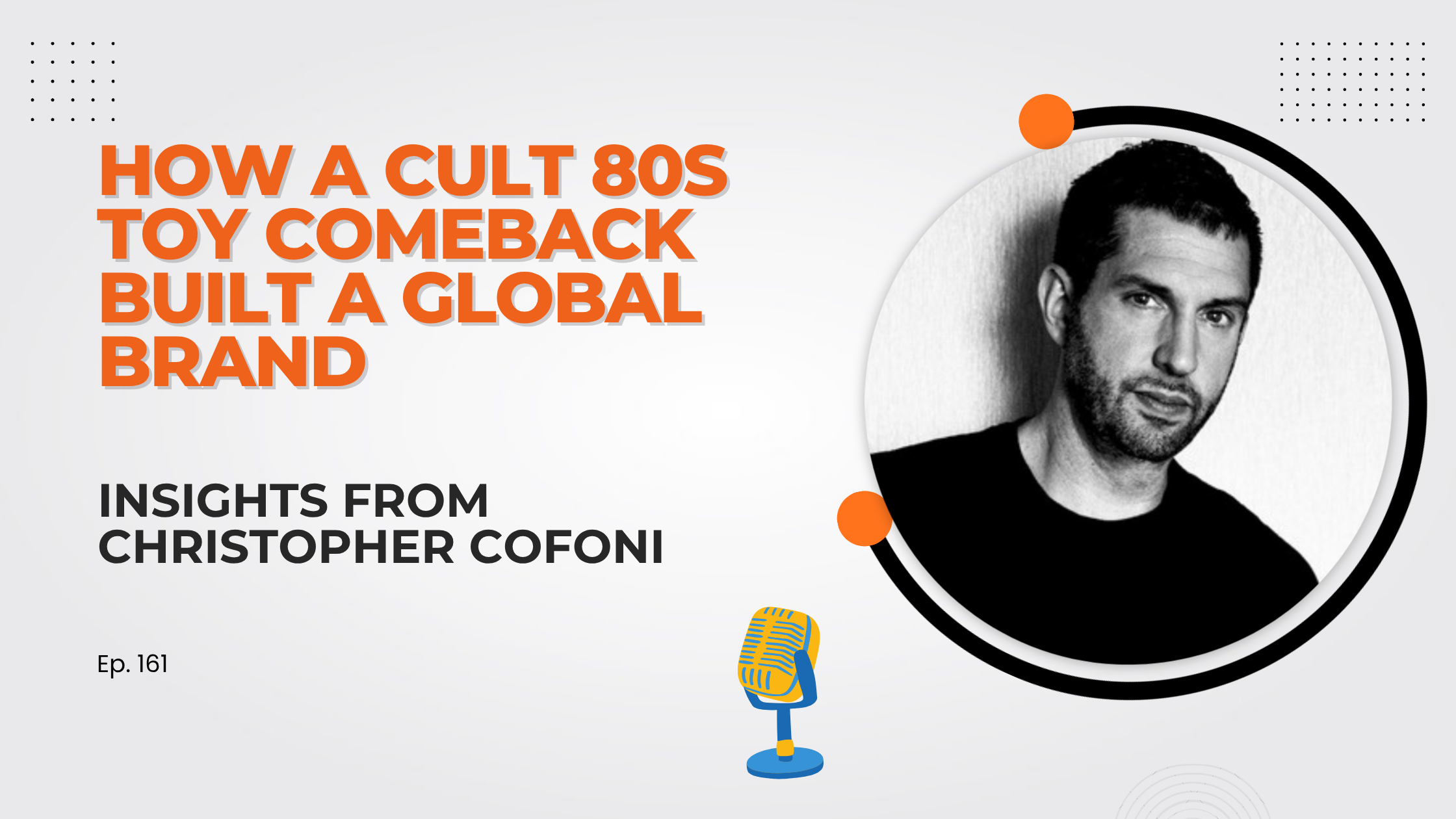
Welcome to the Toy Business Unboxed Podcast, where we sit down with the innovators, operators, and brand builders shaping the future of the toy and game industry. In this episode, we talk with Christopher Cofoni, founder of Triaction Toys and a 15-year industry veteran who has sold hundreds of millions of toys worldwide across specialty retail, mass market, and international distribution. His path to the toy industry runs through opera halls in Europe, music studios in New York, and the warehouse floor of a shipping container he unloaded himself. Chris brings hard-won perspective on pricing strategy, packaging decisions, retail relationships, and what the next chapter of the toy industry actually looks like.

#161: Hundreds of Millions Sold: Chris Cofoni's Toy Playbook – Toy Business Unboxed
Episode Highlight
- 00:00 Chris’s Journey in the Toy Industry
- 05:27 The Success of Boglins
- 08:15 Introducing Snooze Monsters
- 12:35 Exploring Half Toys
- 16:29 The Changing Landscape of the Toy Industry
- 19:48 Future Plans and Strategies
- 27:37 Advice for Aspiring Toy Entrepreneurs
From Opera Stage to the Toy Industry Floor
Before toys, he was an opera singer in Europe and a senior A&R coordinator at EMI Records, working with Norah Jones across Angel, Blue Note, and Manhattan labels. His first sales role came at 27 running sheet music distribution for Music Minus One, where he learned trade show selling and international distribution from the ground up. Melissa and Doug recruited him in 2008, a self-described magical moment where he learned how Doug built the sales floor alongside one of the most creative product teams in specialty toys. After eight and a half years and over 30 annual trips opening new markets, he moved to VP of Sales at Jazzworth, developing deep expertise in licensing.
The Boglins Kickstarter That Paid for Everything
His first major launch at Triaction was the revival of Boglins, the iconic 1980s creature toy licensed from designer Tim Clarke, a close friend since their Melissa and Doug days. He negotiated the license inexpensively by offering a higher royalty rate, set a $20,000 Kickstarter goal, and raised $247,000, driven almost entirely by Tim’s 11,000 loyal Instagram followers. The success meant unpacking a container a week and shipping to 31 countries simultaneously. The license eventually returned to Mattel, who had originally done over $100 million in Boglins sales. He takes pride, though, in the numbered limited run pieces now held by collectors, which he expects will appreciate significantly once Mattel’s planned Boglins film releases.
Snooze Monsters: Collectible Plush Paired With Original Bedtime Stories
Snooze Monsters is Christopher’s current flagship brand, developed with Tim Clarke, known for his work on Jim Henson productions including Fraggle Rock, the Muppets, and the Dark Crystal. The line features parent and child plush pairs sold together then separated upon purchase, each tagged with a QR code unlocking an original illustrated bedtime story. Series 1 launches in November with 12 characters, led by Coltrane and his son Washington Jr., with production numbers kept deliberately low to build long term collectibility. Christopher has already pre-sold the entire first batch to specialty retailers in quantities of two to six, covering wide geographic breadth rather than concentrating volume with a handful of accounts.
How HALFTOYS Found New Retail Life Through Packaging Redesign
He discovered HALFTOYS at the Nuremberg toy show, a magnetized puzzle toy where the animal body clicks together via nano-magnets and stores a separable skeleton inside, hitting fidget, magnet, and puzzle categories at once. Specialty retailers loved the concept but flagged the price point and oversized packaging. He worked with the HALFTOYS team to make it peggable, switched to recyclable cardboard with no plastic, and brought costs down enough to open new retail placements. Early reaction has been positive, and he is already in conversations with Tim Clarke about a potential HALFTOYS Halloween line.
Why Toy Stores Are Becoming Places of Discovery Again
The toy industry is heading back toward a 1980s-style retail discovery experience, where consumers visit specialty stores to find something unique and post about the moment they find it. The trend has shifted from seeking a specific product spotted on TikTok to wanting to be the person who discovers something first. This creates a real opportunity for specialty retailers carrying products not available at Walmart or Amazon, turning the store itself into a destination. The entire brand strategy is built around this idea — protecting the retailer network by keeping products off mass market and maintaining consistent pricing everywhere.
MSRP, Direct-to-Consumer, and Why Amazon Is Not the Future
His pricing rule is simple: full price every day, no exceptions. Products are gated online and his direct storefront at triactiontoys.com runs at full MSRP, earning full margin without putting retail partners in competition with him. He points to Tommy John as a model, where tight distribution and consistent pricing drives consumers back to owned channels rather than leaking margin to Amazon. Specialty retailers get the best wholesale tier, followed by mid and then mass. Domestic orders are also backed by a return guarantee on unsold product, a level of support he says almost no one in the industry still offers and one he sees as essential to building the kind of retailer trust that keeps shelf space long term.
Advice for Newcomers in the Toy and Game Industry
The advice for anyone entering the toy business is direct: work for people who know far more than you and absorb everything you can every single day for as long as it takes, because the learning never stops and the industry never stops changing. Drawing from books he studied early in his career, the right timeline to absorb and learn before attempting to build your own company is around 12 years — a roadmap he followed himself before launching Triaction. The journey includes a million walls, and when success finally arrives, people will call it luck without seeing the years of containers unloaded, markets opened, and relationships built. The patience to be a student first is, in his view, the most underrated asset a future toy brand founder can have.
Conclusion
Christopher Cofoni’s career is a case study in patience, relationship building, and protecting the specialty retail channel from the inside. From a $247,000 Kickstarter on a $20,000 goal to a company growing at 63% year over year, his success comes from a consistent set of principles: never undercut your retailers, maintain MSRP every day, build collectibility in from the start, and give specialty stores the support they need to keep carrying your line. He has proven that staying out of mass market and Amazon is not a limitation but a strategy, one that earns genuine retailer loyalty with a burn rate under one percent on over six million dollars in sales. For anyone building a toy brand who wants to understand what real retail trust looks like, this episode is a blueprint worth listening to more than once.
Connect with Christopher Cofoni
If you’re interested in learning more about Triaction Toys or connecting with Christopher Cofoniy ou can reach out through the following channels:
- Website: Visit TriAction Toy’s official website for the latest news, game updates, and more
- Instagram: Follow TriAction Toys on Instagram for visual updates, game previews, and creative inspiration
- Facebook: Follow TriAction Toys on Facebook for updates, discussions, and behind-the-scenes content.
Transcript
Jason Hsieh (00:00)
Welcome back to another episode of toy Business Unboxed. Today we have Chris, a 15 years toy industry veteran, a sales powerhouse, and also the founder of Triaction Toys. Chris has sold hundreds of millions of toys worldwide. And with his latest win, That’s all about really new product launches and strategy, which we’ll explore in today’s interview, where he decided to team up, with Team Clerk and brought Snooze Monsters to life and how rethinking packaging and pricing really turn into a lot of success. Thank you so much for joining us on the podcast today, Chris.
Christopher Cofoni (00:31)
Hey there. Happy to be here.
Jason Hsieh (00:33)
Yes, thank you for joining. So first before we dive in, can you kind of share your experience so far, like in the industry you have been in the industry for so long? What first like got you started like fifteen years ago?
Christopher Cofoni (00:44)
I was always a musician, just so we’re clear. I was an opera singer in Europe and I came back and I was blessed to have worked with Nora Jones on her first two records and a bunch of folks at EMI where I was the senior A and R coordinator for Angel Blue Note and Manhattan Records until I was about 26 years old. And then I went to sell sheet music.
For the guy who invented karaoke, his name’s Irv Kratka. He invented it with a company called Music Minus One. People musicians know that company. And I was blessed. He allowed me to run that company as of the age of 27 And he sent me around the world to get his sheet music distributed. And that’s how I learned how to sell and do trade shows and then Melissa and Doug recruited me in two 2008 And
Jason Hsieh (01:09)
Alright.
Christopher Cofoni (01:32)
they recruited pretty hard. They were they were pretty good at recruiting. And the minute I walked in there and saw what they were doing, I knew I wanted to be there and be a part of it. It was a magical place, especially then. I had the great fortune of learning and watching how Melissa and Doug the people had built their company. Yeah. And it was just extraordinary to see what they had built.
between the creative and really you know, I give Doug a lot of credit with how he built the sales floor and the sales techniques. I think both of them worked really hard on putting that together and I learned a tremendous amount working there and was there for eight and a half years. I was traveling like 30 times a year for them and opening markets and new customers. And then went to be VP of sales.
Over at Jazzworth for a few years where I had again I had the great fortune of just watching this machine of creativity and just watch it learned about the licensing process extensively. Yeah, which is new, of course, for me at that time. And but I knew by the time I started there, I knew I wanted to have my own company eventually. I see. you know, that when you’re creative and you love to sell.
it’s just matter of time. So, you know, I read a lot of books and it always said twelve years. Twelve years is the time length, more or less the amount of time, the time frame that you should try and absorb and learn as much as you possibly can before you try and enter into your own situation.
Jason Hsieh (02:56)
That’s interesting advice. Okay.
Christopher Cofoni (02:58)
Well,
That was in books. That’s not coming from me. So, I was just kind of following the roadmap and I had been in Europe a lot at Nuremberg in particular and seen lines that weren’t being distributed into the United States. and so the initial thought process was let’s bring these lines in just for specialty, deal with just specialty stores. Okay.
but within like six months of starting that and realizing wow, this is gonna be a really uphill battle of selling plush, you know, into these retailers. I had the opportunity to sign the license for Boglins with my great friend Tim Clarke. Okay. Tim and I had known each other since our days at Melissa and Doug. Tim designed a ton of products, all of my favorite products Tim had designed.
And one day, I found out that Tim was the guy who had brought Boglins out. And I’m a huge fan, I’m a fanboy of the all the 80s toys because I was that kid in the 80s that would go to the toy store, specialty store, and have that discovery and knew the toy store owners as a kid, and they would say, Hey Chris, check this out, you know, and I was passionate about.
that discovery process even as a kid. And so we brought Boglins back with a Kickstarter and I’d had a twenty thousand dollar goal because I literally got the Boglins license very inexpensively, let’s put it that way, because he was my friend and I put a higher royalty rate up. Yeah, I knew that if I put a higher higher royalty rate up that I would be able to get it in pretty cheap.
And I made a good deal for myself. Yeah. And we had a goal of I think twenty thousand on the Kickstarter and we did two hundred and forty-seven thousand dollars on the Kickstarter. And I did all the marketing myself on that. So I didn’t hire any outside companies or anything like that. So that was a surprise to be honest with you.
Jason Hsieh (04:33)
Congratulations, okay.
Nice.
I want to dive into that a little bit. So you say you did the whole campaign by yourself and able to raise a quarter million dollars. What do you did differently that all the other Kickstarter campaign that wasn’t doing?
Christopher Cofoni (04:55)
Well, I don’t give myself credit actually at all. You know, Tim had built a fan base of over eleven thousand Instagram followers. And so the minute I launched, it didn’t go crazy initially. thought it’d be easy to manage. And then you know, fast forward I think, you know, I was unpacking a container a week for a while. It went on for like a year like that.
Jason Hsieh (05:02)
Okay, okay. ⁓
wow.
Christopher Cofoni (05:19)
Where I was doing a container a week. And on top of that, I was shipping containers of FOB to 31 countries on Boglins. So it kind of went under the radar, you know, but we did a lot of damage on Boglins. It helped me pay off a lot of stuff and move the company forward. Boglins B-O-G-L-I-N-S. And if you don’t know about Boglins, I highly recommend you have Tim on.
And he’s just a fascinating character. And Boglins was a toy in the eighties that piggybacked all that gremlins kind of lore, that creepy lore. So Tim was known as the king of gross, believe it or not. If you look him up on the line, I think that’s what it they called him. And you know,
And I find out he did Boglins, we bring Boglins back and then I had to move because the volume was so much. I had to move back to the north where my family and my friends all live. Yeah. So I could get help. I didn’t have the bodies I needed. I couldn’t hire people. Nobody wanted to unload containers, not even for like twenty five dollars an hour. Nobody wanted to do it. Yeah. Okay. So I couldn’t get bodies on it.
then Boglins actually went back to Mattel. So Mattel had done like a hundred million dollars on Boglins in the eighties. Yeah. So what happened was the license expired. And I knew that if I did a good job that it was going back to Mattel, you know, I wouldn’t be able to compete. And so I’m happy for Tim and I’m happy for Seven Towns and all the folks involved. And you can see the New Yorker article yourself.
Jason Hsieh (06:31)
They bought it back or
Christopher Cofoni (06:50)
You know, I’m not the first to bring it up. so I’m not talking out of school. But there’s a movie being made by Mattel, and it’s like about this. So about Boglins. Yeah. So I’m really anxious to see. And you know, we limited the production on some of the boglins to like 500 units and we numbered them.
Jason Hsieh (06:59)
I didn’t know that. Okay.
Christopher Cofoni (07:08)
And so when this goes big and it will then all those collectors that stuck with us are gonna be beat the rewards because these are gonna be very, very valuable. And we really are excited to see where this goes with Mattel.
Jason Hsieh (07:22)
I see. So I guess I want to transition to your most recent project, which is I believe is a Snooze Monsters project that you’re working on. Can you kind of talk about that since you have one of the characters there as well?
Christopher Cofoni (07:32)
Sure, sure. Well, this is an iteration of Coltrane. Initially, we had created something called Monsters Brigade, Tim Clarke again. Tim Clarke of Jim Henson fame, Fraggle Rock Muppets, etc. Dark Crystal. He and I worked on a line of monsters. We were gonna make make your own monster puppets with snaps where you could take the snaps and move the parts around. We still intend to do this, by the way. put the leg on the arm, etc.
Jason Hsieh (07:58)
Okay, okay, okay.
Christopher Cofoni (07:59)
But it ended up kind of morphing into this bigger idea of what’s the biggest problem in society with young children and in my opinion it’s the internet telephones and lack of tactile, lack of experiential, lack of knowledge based learning based on going out and experiencing things instead of staring at a screen. So how do we get the conversation started?
How do we get parents reading to kids again? how do we introduce these characters? All these things kind of came to fruition. And you know, so we decided to create a line of father or mother with child plush. They all are packaged, they’re tagged together for in-store sale, and then they can be separated upon purchase. And you get a mom and a baby or a dad and a baby.
Jason Hsieh (08:32)
okay.
Christopher Cofoni (08:43)
And the cool thing about snooze monsters is we’re gonna release twelve every time we release a series. series one is set to release in November, and every time we do twelve, there’ll be one monster. So Coltrane this is Coltrane on my lap here. Coltrane will be released as the first monster in the group with his son Washington Jr. And all these other animals.
with babies, but the the difference is there’s a QR code sewn in on the mom or the dad and tag. So there’s two places the QR code appears that triggers an original online bedtime story from Tim Clarke and I that features the characters that we’ve created but beyond that they all intertwine in their own world sort of our own hundred acres woods if you would
And they all intertwine and interrelate and there’s lesson learning and they’re cute stories, they’re fun stories. And we’re having them illustrated by this fantastic illustrator named Vanessa, who we’re gonna introduce eventually here. And she’s doing it a fantastic job bringing our characters to life, the story to life through illustration. But the amazing part of this QR code concept is eventually it will grow. We can change the stories out.
We can offer a different story with different color variations. We can limit the amount of series one or two or three that we produce. so they become collectible plush. So that’s the other part of this. And so, you know, we’re not gonna make fifty thousand of one ever. So these are gonna be highly collectible. and you know, we know the stories will get out, but the idea is that the QR code travels with the animal.
The story travels with the animal. And eventually my goal is if it takes off the way I think it’s going to, it seems to be. I mean, I’ve pre-sold the whole first batch is pre-sold very much. And it’s sold, you know, to specialty retailers two and six at a time. we’re really excited to have wide breadth coverage on the line. And yeah, that’s where we’re headed. We’re very, very excited
Jason Hsieh (10:28)
congratulations. Okay.
Christopher Cofoni (10:41)
You know, Tim just went to a show with it for the first time and had a tremendous response to the characters. And people are very excited.
Jason Hsieh (10:48)
Nice, nice, nice, nice. So what are some of the marketing strategy you’re doing right now, getting the launch ready?
Christopher Cofoni (10:54)
Well, just pulling the stories together, you know, we over the years my constant contact emails campaigns go to like thirty thousand retailers, you know, B2B retailers. But I also now have a B2C you know, constant contact through this Boglins experience that they’re all gonna be so into the Tim thing. So I have thirty thousand consumers.
And once I put it out to those consumers, these are very active consumers. I don’t have to tell them to repost. You’ll see. They’re gonna repost on their own and it’ll go semi viral in this community on its own.
Jason Hsieh (11:29)
okay, okay, okay. Yeah, I think the audience is really the key to your success. That passionate audience about the creations that you and Tim have created over the years. So I want to next switch focus a little bit on today’s conversation because I know you have multiple projects going on. can we also talk about the other project you also run, which is HALFTOYS? Like what have you done with the HALFTOYS and kind of give the audience a little bit background about it too?
Christopher Cofoni (11:52)
Sure, sure. So okay, well let’s start at the very beginning. HALFTOYS is a product that is that 3D print style product but also it’s magnetized. So imagine a T Rex, you know, no articulation, right? So it’s just a solid frame but cut in half with magnets, like nanomagnets inside of it, in a you know, patented technology that is safe.
so this thing clicks shut. You have that fidget type experience with it. and inside is a skeleton that you can separate as a puzzle and put back together, which hits all the things for me. I mean you’ve got the fidget piece, you’ve got a magnet toy, and you’ve got a puzzle. Okay. And they’re safe for three up, you know, so it’s great puzzle.
Jason Hsieh (12:32)
Puzzle, okay.
Christopher Cofoni (12:36)
for young children, but it’s also a toy they can bring with them. The puzzle self-stores as the toy. So to get to your bigger question, I had no knowledge of HALFTOYS headed into Nuremberg this year. I’m not going to lie to you, tell you I knew the product. I did not know it. I saw it for the first time in this back hall in a lesser traveled hall of Nuremberg and I said, you know, I had that same type of
moment of discovery like when I was a child. I mean that’s what I do when I go to Nuremberg. I do three, four, five days on my feet playing with toys and trying to find something that would be unique and different and not here. Yeah. And then I bring that back to my 700 retailers, my key retailers. I have 700 retail partners that are my key retailers. And I bounce those off of them. And they say, Don’t do it. I’ve done it.
You know, listen, it sells, but we had to mark it down to sell. and so and the diorama does not add value well, at least there’s gonna be people that argue with that, of course. Yeah. But the retailers are saying if you could get the price point down, the package is too big. So we went back to the drawing board. I said, Well, we need something peggable and shelvable. Okay. Something with collectability inside of it, so that there’s a collector’s chart all over this thing now.
Yeah. And so they know what other characters are available. There’s 24 currently. Where there’s going to be a plethora of new ones next year. We’re very, very excited about. We’re actually, this is an exclusive for you. Here you go. Tim Clarkson talks with HALFTOYS about development of a potential Halloween line. That would drive the fans crazy. So we know that would drive sales. so we’ve got a lot of really great things planned.
With the the team at HALFTOYS, they’re really wonderful to work with. I have to say, we work with a lot of great companies. but they are so quick to email and they’re just on their game. And so we got it cheaper and we got it smaller, and we got it in in a more merchandisable package. I don’t like to sell plastic. I mean, if anyone visits the website, trIactiontoys.com, Tri Action Toys.com, if you go there, you’re gonna see
Almost no plastic. but what you will see is HALFTOYS are plastic. So we’ve made the packaging an open package, recyclable, with nothing but cardboard holding this product firmly in place. So that we make up for the carbon footprint where we can.
Jason Hsieh (14:50)
okay, okay, okay. Yeah, that’s very important for the for the planet, for sure. So
Christopher Cofoni (14:56)
Yeah. We try and stay away from plastic, but you know, this is a fantastic toy and it and we have an opportunity to at least save on the plastic within the packaging.
Jason Hsieh (15:05)
So I would say one sounds like one of the few major changes is definitely the packaging and also you’re able to get a product smaller and lower the price. How much additional success was that able to bring to that particular product line?
Christopher Cofoni (15:16)
Well, you know, we’re just getting it on shelves. I mean it just went out. Yeah, it just went out. I mean we just relaunched it. but initial reaction is very good.
Jason Hsieh (15:21)
yeah.
Okay, okay, okay. I see. I see. I see. So what would you say over the year, like how do you see the toy industry being changed, you know, especially now in the digital age? Just like you mentioned earlier, a lot of kids is not playing as with the toy as much as before anymore. Like we as a marketer and business owner, we in the industry, what would be some of your suggestion and some of the observation that you have.
Christopher Cofoni (15:47)
Yeah, I would say to you, I think that we’re going back to a really exciting place. I am very excited because well, let’s go back further. We started with movies, cartoons, television shows, really moving the needle. You know, I mean, let’s use Star Wars as an example, right? A license is huge, but it ebbs and flows.
Depending on what’s going on. Yes. I think retailers would say that they still sell a lot of licensed products from these types of drivers, but that that overall that’s less and less what the consumers are coming in looking for. They’re looking for things they’re seeing online. They’re looking for things that you know, so and so influencer may have brought to the table.
Jason Hsieh (16:09)
Yeah.
Christopher Cofoni (16:28)
I would say that you know a lot of more of it is influencer based, but why I’m excited is because I think toy stores are really a place of experience again. Think of it this way. we’ve gone from a place where mom and I really believe this too, that where mom goes from, hey, I see such and such product on TikTok, and I want to have that.
For my child. We’ve gone from that to they want to go to the toy store, they want to discover that product, they want to post about it, they want to be the influencer. That’s why I’m excited. So I think we’re back to the 1980s. I think they’re gonna be coming into toy stores saying, Show me what you’ve got. They’re gonna be looking through things more and more, then they’re gonna post all about it.
Jason Hsieh (17:00)
Mm-hmm.
Christopher Cofoni (17:11)
Because everybody wants to be famous, right? I mean I guess. I guess. Not me so much. I just want to sell some toys, but yeah. but I would say to you, I think it’s obvious. That’s where it’s headed. I mean, look at the internet.
Jason Hsieh (17:23)
Yeah, yeah, yeah. Like the success of the Ryan Toys. It’s a YouTube channel that started out with like just reviewing toys. But they be they have their own lines in Walmart at the end. So and they’re doing really, really well because of the content and that’s kind of the trend right now. Like just like you say, like kids nowadays my kids, I have two kids, they watch more YouTube than T V. They don’t we don’t watch T V at home. So yeah.
Christopher Cofoni (17:46)
But how long until your kids are gonna want to go to the toy store, find something no one else knows about it, and do their own videos?
Jason Hsieh (17:54)
Yeah, yeah, yeah. Hundred percent.
Christopher Cofoni (17:55)
That’s where it’s going. I mean, that’s where it’s going, you know, for sure. So that’s why these toy stores when I get on the phone with them and I explain that to them, I get passionate like you, you know, you’re so passionate. Having talked to you before this, I mean, yeah, wow. Like you’re really you got me energized, you know.
Jason Hsieh (18:12)
Thank you.
Christopher Cofoni (18:14)
yeah I mean I just think that it’s an exciting place to be when you tell this toy store, hey, if you give me a corner of your store, I’m gonna outperform everything else there. Watch. And it continues to happen. And it’s because they don’t see my stuff at Walmart. My stuff’s gated online at Amazon and everywhere else. So it never sells, not once under price. We maintain MSRP every day. And no one’s a showroom for Amazon. That’s not what we’re here to do.
Jason Hsieh (18:35)
That’s very important.
Yes, yes, yes. That’s very important. That’s a common concern with a lot of the retailers as well. So yeah, but I think branding and like audience building is really the key for I think for the industry, at least for the toys and brand that still wanna grow. Having your own audience, like a loyal following that you have with Tim, I think that’s the kind of the secret to your success as well. So but now looking ahead in into the future, what are some of your plans for the upcoming years? So
Christopher Cofoni (19:06)
Well, I mean based on the initial response of snooze monsters, we already are into series two and getting that up to speed. You know, we’re definitely elaborating on HALFTOYS and in Teddykompaniet, I can’t say enough about my Swedish partners. They’re just the most lovely people you’ll ever meet in your life. And you know, we just continue to expand our line with them. I mean
I went to them and said we need to do these two other ballerina styles. We just did cat ballerina and elephant ballerina for the first time with them. and they’re my best selling plush. Boom, right out the door. It became my number one and my number two, you know, like right out the gate. And so it’s just they’re wonderful to work with. I mean, you couldn’t go to most most other manufacturers and say, Hey, I know it’s not your idea necessarily, but can we do this? Yeah.
But in your style, can you be in charge of it? And you know, but we need this, you know. Can we elaborate on this line? Can we expand this line? So I would tell you we’re definitely gonna continue to expand the ballerino line like substantially, because they were the first ones to do it long before anyone else. they had this. They’ve been in business over twenty five years. I see. I see. And so we’ll continue to elaborate with and grow our line with Teddykompaniet.
And then, you know, I’ve got a lot of different conversations going with different folks. But I always at this point, I wait to Nuremberg, I meet with those folks, I see what else is there, and we’ll certainly be adding lines. I mean, we’re up 63% year over year. thank you very much. And so we are looking towards the future and adding more lines, and just expanding the ones that are working, you know, as we phase out some of the other things we’ve been doing.
Jason Hsieh (20:27)
Right. Okay.
Christopher Cofoni (20:37)
You know, like the Les D Glingos we had the Les Ptipotos, that’s gone away. so, you know, we’re learning what works and what doesn’t. You know, and that line is a wonderful line, but it was a very trend line, trend driven line. Okay. And so we’re looking for that next trend.
Jason Hsieh (20:52)
Got it, got it, got it. And your model sounds like you kind of have a licensing agreement. Is that how you typically work with the partner that you have? Or how do you structure the deal typically?
Christopher Cofoni (21:02)
With Boglins was licensed. Nothing else. Nothing else I’ve participated in at this time is a licensing agreement. I’m a either a distribution partner with some level of exclusivity within the market. Yeah. Or I’m manufacturing. Tim is a hundred great ideas. So I would say to you when you ask what’s on tap for next year, it’s gonna be high Tim Clarke content. Like he’s got a couple things that you know
Jason Hsieh (21:23)
Ha ha.
Christopher Cofoni (21:26)
We’ve got a couple of really great ones that I’ve got prototypes just sitting, but you know, you want to give everything its space. And if you try and put everything out at once, you know, nothing gets its due diligence. You know, I saw that at various places, especially early on. you know, it’s hard to give everything a spot.
Jason Hsieh (21:42)
Attention it deserves, yeah, for sure. For sure. And so okay, so it sounds like you do both then. You do distribution and you also manufacture your online.
Christopher Cofoni (21:51)
Yeah, with Tim, it’s all manufacturing. With Boglins, it was manufacturing. With Snooze Monsters, it’s manufacturing. but we love our distribution partners and you know, definitely look for expansion there too. You know, I refuse to fit it cleanly and neatly into one bucket. I want to be a one-stop solution for the specialty retailer that wants to stay in business because if they keep carrying the same products that’s on Amazon and Walmart, cheaper. If it’s in Walmart,
Or it’s in target, sorry, carry only what you need to carry because you are systematically driving down your dollars per square inch.
Jason Hsieh (22:26)
Mm, yeah, that’s definitely an issue for sure. For sure. So yeah, for your distribution strategy, do you only offer the product to the specialty store and don’t offer those same product online? Well, what is your strategy there?
Christopher Cofoni (22:38)
So I have key online players that have demonstrated over the years just total loyalty in terms of holding, you know, full value of the product and not dumping it, you know, never dumping and on top of that they they’re invested in me, like we’re friends, you know, and I’m invested in them. And if there’s a problem, I’m there. So I think the key to this online environment, and I really feel like this is part really, really key.
Yeah. I’ll use an example. Tommy John Underwear. I’m gonna go ahead and use this. It’s a great product if you have never heard about it. I have nothing invested, okay? But I kept hearing about it on on various radio programs and I tried it out. And then I went to go get it on Amazon, and Amazon didn’t have large, which is you know, standard size. and in two seconds later on my internet feed, you know, boom, Tommy John hits me with a direct consumer ad.
driving me back to their website where they make full margin. So the future is not Amazon. Mm-hmm. Let me say that again. No one’s gonna buy this, but the future’s not Amazon. Amazon is using everybody right now to get rich. Okay. They’re playing everyone. They’re the only ones making money. Look, the where it’s headed is direct to consumer via your own website, but at full price
Price every day. You got to maintain your full price. No retailer’s gonna get mad. But here’s the difference you’re making full margin. You’re making full margin. Like I do very well on triaction.com every day, triactiontoys.com every day, but it’s at full price. There’s never a sale. Like I don’t have to run sales, I just leave it there and they order and then it doesn’t compete with my retailers. You know, I don’t want my retailers to be a showroom.
If anything, I typically give my retailers 10% off invoice if they buy enough. You know? I also guarantee the sales. So if they’re domestic, they can send things back if it’s not working. See, no one else is doing that anymore. It’s a lot of mess. But if your stuff sells, it’s not a mess. You know? So we’re really careful about the curation process.
Jason Hsieh (24:37)
Yeah, that’s a very good piece of advice. I think going D2C is kind of the way to go, but it’s also a lot of moving pieces for D2C to work correctly. That’s SEO, that’s email, that’s like text marketing, there’s blog, content, social media. It’s just a lot more pieces that I think a lot of the traditional like business owner within the Toys and Games Space are not so familiar with because sometimes they are over relying on distribution and they don’t have the skill set or the team or the knowledge to do D2C marketing correctly.
I think that’s one of like the common threat like I see when I’m talking to people in the industry is like I want to do more D to C but I don’t know where to start. So that is like a common issue.
Christopher Cofoni (25:17)
They need to hire you. They need to hire you. But I have to say that I already know that. but I would say, you know, these big companies, let’s I’ll go ahead and say it. I haven’t worked there, so I can say this. I if I was at Mattel, I would absolutely be looking at what I’m saying to them, which is stop worrying about selling more units. Okay. You can sell less units.
Jason Hsieh (25:20)
We do offer that as a service.
Christopher Cofoni (25:41)
You can make a lot more EBITDA. You can make a lot more profit. You’ve got to think differently. You’ve got to bring this in-house. You have to have people like my friend here in-house, ideally, working just for you day in and day out to tackle this. And you have to do it in a way that’s cognizant of the fact that you are in an essence competing with your retailers. But if you keep at full price every day and you market the product hard.
online the correct way to build brand equity, you are gonna drive those sales to those retailers. They’re gonna love you for it. And you offer discounts to the retailers. And by the way, specialty gets the best price. Then mid tier gets a higher price. Yeah. Then mask gets the worst price. See, they won’t do it that way. These big companies, they’re backwards. The worst about the burn rate on the small stores. Yeah. My burn rate, and I this is true.
Jason Hsieh (26:26)
Yeah.
Christopher Cofoni (26:33)
My burn rate over six million dollars in sales, less than one percent because I have relationships with these specialty retailers and they don’t want to hurt me.
Jason Hsieh (26:41)
Yeah, that’s very important. Yeah. Thank you for sharing that. So as we’re wrapping up today’s conversation, for the interview, if you had to share just one piece of advice with someone that’s getting started within the toys and game industry, what would that be?
Christopher Cofoni (26:54)
Work for other people that know a lot more than you and learn as much as you can every day from those people. And there’s always more to learn and it’s always changing. So try not to get frustrated. I mean, you’re gonna hit a million walls, and then one day you’re gonna start making money and they’re gonna say, you’re so lucky. You’re so lucky.
Jason Hsieh (27:12)
Yeah, they only see the surface. They don’t see all the hard work behind the scenes, 100%.
Christopher Cofoni (27:16)
Yeah, they’re not there unloading the containers, I can tell ya. I lost forty pounds. Yeah, people always say, How’d you lose the weight? I say unloading containers.
Jason Hsieh (27:19)
For sure.
Yeah, that is definitely a workout by unloading containers, so
Christopher Cofoni (27:29)
That’s a good advice. Start by seeing if you can unload a container. You’re gonna do it on your own at least once.
Jason Hsieh (27:34)
Yeah, I see. So well, thank you so much for sharing that. And thank you again for your time for being on our show and sharing your experience and your journey within the toys and game industry.
Christopher Cofoni (27:43)
Thank you for having me. Your pleasure to speak with and I’m definitely gonna go back and watch all your previous episodes having spoken with you before this interview. Just I think there’s a lot I can learn just by listening. So thank you for having me on.
Jason Hsieh (27:55)
You’re welcome. A pleasure is all mine. Thank you for joining us. And for our audience, thank you so much for tuning in to this episode of toy Business Unboxed Podcast. We hope you have enjoyed today’s conversation and find it insightful and inspiring. If you like what you have heard, be sure to subscribe to our podcast on your favorite platform so you never miss an episode. We really appreciate your support and would love it if you can leave us a review and share the podcast with your friend and colleague. For more resource, tips, and the latest update within the toys and game industry, visit our website at toy-launch.com.
Join the conversation and connect with us on social media using #ToyBusinessUnboxed We’ll love to hear your feedback and suggestions for future episodes. Until next time, keep innovating, keep creating, keep bringing joys through toys. This is Jason Hsieh signing off on the Toy Business Unboxed Podcast. We’ll see you in the next episode. Thank you so much, everyone.
Grow your toy brand’s content reach
From SEO blog content to influencer outreach — we handle the full content engine for toy and game brands.