
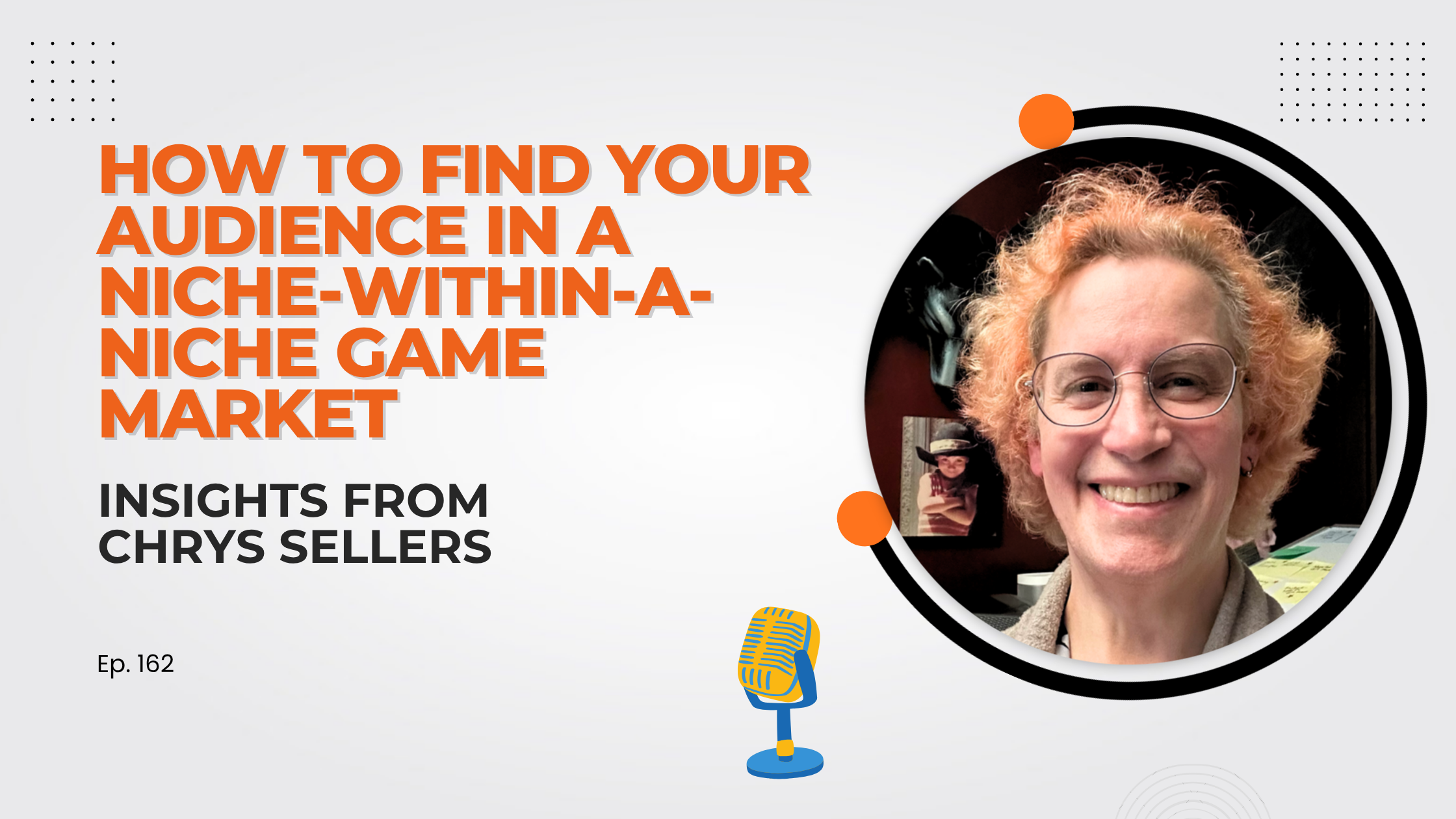
Welcome to the Toy Business Unboxed Podcast. Today’s guest is Chrys Sellers, an indie tabletop game designer based in Columbus, Ohio, known for the beloved GMless story game Raccoon Sky Pirates and the upcoming queer sword and sorcery RPG Defy the Gods. In this episode, Chrys shares what it really takes to build games that connect with niche audiences, including the decision to cancel a Kickstarter campaign mid-run and come back stronger four weeks later. The conversation covers platform strategy, realistic funding goals, and why centering the player experience is the most important thing any game designer can do.

#162: Roll the Dice: Quit Playing It Safe – Toy Business Unboxed
Episode Highlight
- 00:42 Intro – Chrys Sellers
- 01:23 How he got into game design
- 02:13 How Raccoon Sky Pirates works
- 03:43 Other published work
- 04:29 Cancelling and relaunching a Kickstarter
- 05:49 Why the $47k goal failed
- 09:09 Finding audience in a niche market
- 10:44 Tumblr outperformed Facebook ads
- 13:54 Biggest struggle: accepting the niche
- 15:24 What’s next + closing advice
A Game Design Mind Since the Beginning
Chrys Sellers grew up in a household where game design was a real career, not just a hobby. Their older brother Mike worked as a game designer and professor, showing Chrys firsthand that building games was something you could actually do for a living. That influence shaped how Chrys has always thought, not just about play, but about the systems and loops that make experiences feel alive. In 2020, Chrys turned that thinking into action and began working on what would become their first standalone game. By 2021, Raccoon Sky Pirates launched through Kickstarter’s Zine Quest III and found a devoted audience in the indie RPG community.
What Raccoon Sky Pirates Actually Is
Raccoon Sky Pirates is a GMless story game where every player at the table plays a raccoon. The group builds a flying ship out of junk using a pick list, flies it across town to a suburban house, and tries to steal everything before the lights come on. Mechanically, the game runs through four set scenes with prompts generated by dice rolls, so no player knows what they will do until the moment arrives. It plays in two to three hours, making it short for a role-playing game and long for a board game, with room for up to six players at the table. Chrys launched it through Kickstarter’s Zine Quest III in 2021 and describes it as the foundation everything else was built on.
When the Kickstarter Did Not Work
The first campaign for Defy the Gods launched in April with a $47,000 funding goal built on assumptions about US printing costs, excess inventory, and too many components. It was not going to hit, and Chrys knew it early. On the advice of a more experienced publisher and mentor, Chrys pulled the campaign rather than let it fail publicly and lose all momentum with existing backers. That decision was harder than it sounds, but it turned out to be the most strategic move of the entire project. A Kickstarter that fails, Chrys explains, gives you the most precise data you will ever have on your real audience size and true funding floor.
How the Relaunch Brought Every Backer Back
Four weeks after cancelling, Chrys came back with a new campaign built entirely around real numbers. The new funding goal was calculated by counting every backer from the first run and manufacturing enough for them plus a hundred percent more to sell after the campaign closed. Chrys also fixed a shipping setup error from the first run that had confused backers and required cancelling and rebuilding reward tiers mid-campaign. By the time the second campaign launched, consistent social media posting and outreach through industry contacts had kept interest alive. Every original backer returned, new backers joined, and Defy the Gods funded.
Finding the Right Audience for a Queer RPG
Facebook ads were a complete miss for Defy the Gods, but the reason was specific: the game’s queer romance dimension means its core audience lives on Tumblr, not Facebook or Instagram. Chrys used Tumblr’s blaze feature to boost a detailed blog post and saw strong engagement returns that no paid Facebook effort came close to matching. The experience with Launchboom, a crowdfunding launch platform and Toy Launch partner, also revealed that their model works best for boxed products with a higher price point, not standalone RPG books. Understanding where your audience actually spends its time, Chrys found, is not a detail to figure out later. It is the whole strategy.
Accepting the Ceiling and Building With It
The hardest part of this journey for Chrys was not the cancelled campaign or the ad spend that missed. It was coming to terms with the true size of the audience. The indie queer RPG space has had breakout successes, but Chrys is clear-eyed about what those represent: one or two giants in a niche of a niche industry, with years of invisible work behind them. Comparing a new launch to those outliers is survivorship bias, not strategy. Chrys went into the relaunch knowing the campaign might reach around four hundred backers, baked that into every decision, and built a project that succeeded on its own terms.
Advice for Newcomers in the Toy and Game Industry
Chrys’ advice for anyone getting started comes down to one principle: center the player experience in everything you make. That means connecting with players as empathetically as possible, staying close to their experience, and devoting the work of design, publishing, and marketing toward making that experience better. Chrys describes game design as the most empathetic of all arts because, at its core, it is the creation of an experience for someone else. Many designers come in drawn to the perspective of building systems and worlds, and that pull is real, but the work that pays off is the work done in service of the person playing. Know what your player feels. Build toward that.
Conclusion
Chrys Sellers is making games the way they were always meant to make them: with precision about the audience, honesty about the market, and total commitment to the player experience. Raccoon Sky Pirates Deluxe is coming next, a boxed version of the original with bottle caps and a jigsaw puzzle ship-building mechanic, designed to reach a broader audience while keeping the signature jankiness that made the first game beloved. After that, how Defy the Gods performs in the market will shape what comes next. For now, Chrys is building one project at a time, and building well.
Connect with Chrys Sellers
If you’re interested in learning more about Hectic Electron Games or connecting with Chrys Sellers you can reach out through the following channels:
- Website: Visit Hectic Electron Games’ official website for the latest news, game updates, and more.
- Instagram: Follow Hectic Electron Games on Instagram for visual updates, game previews, and creative inspiration.
- Facebook: Follow Hectic Electron Games on Facebook for updates, discussions, and behind-the-scenes content.
Transcript
Jason Hsieh (00:42)
Welcome back to another episode of Toy Business Unboxed. Today’s Chrys, is the creative force behind some of the most unusual and heartfelt RPG in the indie board game scene. From trash loving raccoon to store and sorcery romance, Chrys’ Games really makes chaos, identity, and wonder and we’ll explore what happened when you have to scrap a campaign and start over and why Facebook ad really deliver for TTRPGs and how to really grow a real audience in the niche market.
So thank you so much to being on our podcast today, Chrys.
Chrys Sellers (01:13)
Thanks. I’m really happy to be here.
Jason Hsieh (01:14)
So first of all, can you kind of share with our audience your journey so far? What led you to get into the industry and start creating games and like getting out there?
Chrys Sellers (01:23)
Brain is always thought in game design terms of the systems that the loops that the behaviors that we get into. And my older brother Mike was a a game designer and a professor of game design. He showed me that you could actually do it for a living. He was mostly into b video games, but like he also had a one foot in the role playing game world. I see. That was a big inspiration.
Jason Hsieh (01:45)
I see. And what year did you start it? this journey?
Chrys Sellers (01:47)
2020. Yeah, that’s when I decided to like that I needed to actually make a game for the public, you know. And so it hasn’t been very long in the grand scope of things. But that I mean, you know, I was I was working on stuff, but that’s when I got the idea for raccoon sky pirates and started working on that.
Jason Hsieh (01:49)
2020? okay, okay, okay.
Mm, I see, I see. Well, since you mentioned one of the games, can you kind of first explain what is a raccoon sky parrot? How do you play it? What is it about?
Chrys Sellers (02:13)
So it’s a story game, like a role playing game, but it has board game elements that keep things on track ’cause there’s no game master. So everybody plays a raccoon and you live in the junkyard where you make a flying ship out of trash from a bunch of pick lists, you fly it across town across this map to a suburban house, get in, steal everything you can before the lights come on, and then try to make it back home without your ship exploding. And things keep going wrong because you’re raccoons.
Mechanically the way it works is like there’s four set scenes, you know, getting to the house, getting in, stealing stuff from the house, and getting home. And for all those scenes, you don’t know what you’re gonna do until you do it. You roll to see what you’re gonna do. And then that gives you a prompt. Yeah, that gives you a prompt, and then you narrate your scene based on what went wrong or went right in your prompt.
Jason Hsieh (03:01)
Mm. I see, I see, I see. how do you win?
Chrys Sellers (03:04)
Well you win if you make it back home in one piece. Sometimes the ship blows up and sometimes it doesn’t.
Jason Hsieh (03:10)
I see, I see. And how long does it typically take to play? Like how many minutes?
Chrys Sellers (03:15)
Like about three hours.
Jason Hsieh (03:16)
Oh that long? okay. Take a quite a while. Yeah. How many players? Yeah.
Chrys Sellers (03:20)
Yeah,
I mean it could be two hours, it could be three hours, but so it’s like short for a role playing game, long for a board game.
Jason Hsieh (03:27)
Okay, okay, okay, okay. And usually how many players will you recommend?
Chrys Sellers (03:31)
It can have up to six players.
Jason Hsieh (03:32)
six four. Okay. I see, I see, I see. And like besides I think that was your first game, right? But you have developed other games over the years as well. How many different games you have developed so far?
Chrys Sellers (03:43)
Well, I mean I did a supplement, like an adventure for Dungeon Crawl Classics as a third party designer. I did a hack book for Pelgrane Press. Okay. Again, as a third party designer that took a game of theirs, Ashen Stars, and put my own spin on it, but it was still a supplementary material. Raccoon Sky Pirates was the first standalone game that I’ve published. really. Okay. Yeah. I mean, I have a lot of stuff
Jason Hsieh (04:04)
Okay.
Chrys Sellers (04:08)
like in the you know basically games that I have walked away from that I have not been able to finish but I finished Raccoon Sky Pirates you like I had a board game about Jupiter. But like I made Record Sky Pirates for Zine Quest III in 2021 and that was my first published like standalone game and I’m about to publish my second one.
So I really haven’t been doing it for very long and you know, scheme of things.
Jason Hsieh (04:29)
I see. And I also want to transition to talk about your experience with crowdfunding because you also tried a few times. Can you kind of share your experience? And I think in the pre-show you talk about you have to actually cancel and relaunch one of the campaigns as well. Can you kinda share like what you learned from that so our audience can learn from some of the lessons?
Chrys Sellers (04:48)
Yeah. So for Raccoon Sky Pirates you know, it was a Zine Quest game. The the barrier to entry was very low. I think it was like a two-week Kickstarter. And it went well. It was a very uncomplicated. I mean, it was complicated putting together all materials. and I didn’t account for shipping because I’d accounted for shipping flat, not shipping a box. So that’s an expensive lesson. But on the whole it was pretty straightforward.
and I just didn’t feel like I had a lot of expectations. So everything was an experiment, but it it felt like I couldn’t lose. And then for this next game, the Sword and Sorcery game that you were referring to in the intro, yeah, I launched the first
Kickstarter in April and it was not gonna make. It was just not gonna hit its numbers. And I was fortunately able to benefit from the advice of a more experienced games publisher who said, you know, don’t let it go to the bitter end. Cancel it and retool. So I did and I had, you know, the thing was I set the funding level way too high.
Like forty seven thousand dollars, I think.
Jason Hsieh (05:49)
that’s really high.
Chrys Sellers (05:50)
Really
high. I thought I was gonna print it in the US, yeah. Mainly for shorter production time. And I thought I was gonna have to print way more copies than I really needed to. and way more of everything, way more dice, pins, art. So I,
I just had a ridiculously inflated number. And so I brought that again to my mentor and she was like, No, no, no, no. But fortunately, running a Kickstarter that doesn’t make gives you very precise numbers of how many books you actually need to print, how many dice you actually need to get in. Well, because you just take all the people who did back, you know, and you’re like, Okay, I need to make
enough copies for them and then a hundred percent more than that yeah to sell after the Kickstarter. But I was just like, okay, yeah, no, all I will do is count on the backers that I already got and I took four weeks and came back with a much more humble funding goal, much more humble manufacturing partner. Well for me more humble, you know, a more realistic
set up with the manufacturing partners that were not gold plated but still very good. Okay. I mean I went with the best printer in China I could find, but I didn’t say it has to be in the US. And so I was like okay I will make enough for the people who I already know who were interested and I just tried to keep their interest until I launched the new one.
I’m sure it was confusing for people because now there are two projects on Kickstarter called Defy the Gods. That’s the name of the game. Well, one is Defy the Gods, and of course it has to be a unique name. So the next one’s Defy the Gods RPG. And fortunately, all the backers came back, more backers came in, and I also by that time I was just getting really good at posting social media every day.
Jason Hsieh (07:11)
And two okay. Okay.
Chrys Sellers (07:27)
I see. I contracted with a friend of mine who has a lot of contacts in the industry and he sent emails to tons of media people, you know, RPG media, small media. and we just kept working it. And also in the first campaign it was confusing because I had messed up shipping. I wanted to try shipping after the campaign was over, and I had
Jason Hsieh (07:36)
Nice. Okay.
Chrys Sellers (07:49)
set it up wrong. I had just misread the Kickstarter you know setup options. And so I had had to just cancel a whole bunch of reward tiers and make duplicates of them. Which I heard about firsthand from my family. Yeah. and so the second time, not only did I know exactly how many books and dice and pins I needed to make, yeah.
Or at least commit to making, you know. I knew a lot better how to set up for the whole project. And so so yeah, I got very accurate, very precise numbers for what my funding goal should be. and I just went for that.
Jason Hsieh (08:26)
I see. I thank you so much for sharing all the things that’s different. besides the book, does it also have a board games element to it?
Chrys Sellers (08:32)
This wasn’t actually. I am getting dice made. Okay. Yeah, I’m getting dice made and you know, and I encourage people to use them with the game, but you don’t have to. This one’s a straight up role playing game, like a book. You can get it Barnes and Noble. It’s a very conventional role playing game and a lot well for an indie role playing game. Yeah. But I am looking forward to getting back
to the interplay between role playing games and board games with the next version of Raccoon Sky Pirates. I wanna do that much big
Jason Hsieh (08:59)
Role-playing game is almost like a niche, we in the niche. It’s really hard to find people that’s really passionate about it. Like personally, I don’t have time for like three hours to play a role-playing game myself. So I usually just play a very simple board game or card game with my family. It’s not a yeah, three hour engagement.
Chrys Sellers (09:16)
So Yeah, no, it’s true. it’s a long time. I mean this is a big barrier to entry. It’s just how long it takes to play a complete sort of episode of your ongoing story. For the people who love it really love it. You know, for those of us who love it, it’s like there’s nothing. It’s just the best thing in the world.
Jason Hsieh (09:32)
I see, I see, I see. Do you find is it’s hard for you to find player that usually you can engage with? Because I know there’s a lot of D&D fans, but outside of D&D that’s like it’s hard to get tractions.
Chrys Sellers (09:43)
Yeah, it’s true. D just has so much market presence. and again, like fortunately, the internet makes it easy to find any community, no matter how atomized and tiny. so I’ve been very lucky to find a couple of good gaming groups here in Columbus and a ton of them online. you know, like the pandemic in a way made online gaming so much more mainstream. so
that means that I’m never short of people to play with.
Jason Hsieh (10:08)
So that’s good. I see. I see. So what other strategy have you tried so far for you to find your audience for your game?
Chrys Sellers (10:14)
To sell
to? yeah yeah so it’s true I did say that Facebook ads aren’t worth it for tabletop role playing games. but I’m not even sure if that’s true for all tabletop role playing games. It was true for my game because my game is a queer adventure romance. And that audience that sort of queer audience or audience who is
interested in queer romance turns out is really not on Facebook. Okay. they’re on Tumblr. They’re on Tumblr a lot.
Jason Hsieh (10:42)
Yeah.
Chrys Sellers (10:44)
So I started posting a Tumblr and I blazed my post on my I had made a big blog post on Tumblr and I blazed that. Okay. Okay. following the advice of another good friend in the industry who’s more experienced than I am. And that was fantastic. That had a lot of returns. But it’s because it’s got this queer romance dimension to it that you know the folks who are into sword and sorcery on Facebook are really into sort of old school.
gritty Conan Sword and Sorcery and not this kind of reinvention that I’m doing or writers are doing. So I see. yeah. Yeah. But also I have to say Facebook ads are incredibly expensive. It is the Instagram side of it.
Jason Hsieh (11:17)
Yeah.
Work
to get it to work. Yeah, yeah, yeah.
Chrys Sellers (11:27)
Yeah, yeah. And because they just run, suddenly you’re spending hundreds of dollars. And you know, I signed on with a sort of marketing-ish company I signed on with Launchboom.
Jason Hsieh (11:41)
They are all they are our partners, yes. Yeah. They do good work, yes.
Chrys Sellers (11:43)
Yeah.
They’re fantastic. They’re not so good for my book. Like partly I think it’s I’m not even sure that RPGs are good for them unless it’s a boxed RPG that comes with a lot of stuff and has a higher price point. But the price point of a just a stand a book by itself, I’m not sure is that good for launch boom start you know, the sort of turnkey solution they give you. Yeah. Or good for meta.
Facebook ads. I did get some traction on Instagram, but not enough to justify the spend. So, you know, it’s live and learn and everybody’s in experience is individual. and I think maybe Launchboom would work well for the next version of Raccoon Sky Pirates because that will be in a box
Jason Hsieh (12:26)
true, true. It also depends on the games too.
Chrys Sellers (12:28)
Yeah. It’ll have a lot of components, a higher price point. And a complete and it doesn’t have a queer romance angle, right? Like the much more mainstream.
Jason Hsieh (12:36)
Moment
stream, yeah, yeah, yeah, yeah, yeah, yeah, yeah. That might be better. So people can kind of get it easier.
Chrys Sellers (12:42)
Yeah, yeah. It just instantly appeals to people as soon as they hear the name and that swath of people that it appeals to is so much bigger. So it’s like it’s been a real learning experience. Like I loved making Raccoon Sky Pirates. I loved connecting with people over it. And then I had to make this much more niche game because I didn’t want to just be the Raccoon Sky Pirates person. You know, like I’m queer, I’m trans. I needed to have something that
Express that identity at least once. You know? Like Mark Diaz Truman is I think runs Magpie games, which did the Avatar, The Last Airbender, RPG, and Urban Shadows, a bunch of games. And he was like he made this one game called Cartel that is a powered by the apocalypse, which is like my game, you know, a story game about being part of a
Jason Hsieh (13:10)
Yeah, nothing.
Chrys Sellers (13:31)
drug business in Mexico. And yeah. From the color palette to everything else, it has a very Mexico feel. Yeah. But it’s also very niche. It’s a game about brutal people in ugly situations. And he just needed to make it. He was saying this to a bunch of us, like he just he just needed to make it and then he could go back to making games with a broader appeal. And that’s kind of how I feel about Defy the Gods. Yeah. Yeah.
Jason Hsieh (13:53)
Yeah.
I see. So what will you say is your biggest struggle in this journey so far?
Chrys Sellers (13:59)
I think the biggest has been realizing how niche that is and coming to terms with it, you know. Like a lot of people advised me not to foreground the queer elements. And that was smart business advice. and I still made a sort of authorial decision counter to my business hat, you know, put on the author hat instead of business hat.
and I’m glad I did it. I’m very, you know, I wouldn’t change a thing. But then I needed to strategize with that baked in, you know? And I needed to really be like, okay, all right, so you’re gonna reach 400 people with this Kickstarter or something like that, you know. and just you’re taking the hit and geared down and bake that into your strategy.
you know, because like again, you I think you were saying in the intro that like nobody sees the products that struggle. it’s easy for me to look at the successes, including the successes in the queer community, like yeah, indie RPG story games, story role playing games that are like all about queer themes and have a very queer vibe to them. Some of them do.
hundreds of thousands of dollars on Kickstarter and then become legends. But when I say some, I mean like one or two. And they’re by one or two giants in my niche of a niche of a niche industry. and so that’s survivorship bias, right? Like I can’t compare how I’m gonna do it to how they have done. I don’t see all the struggle that they put in to
Jason Hsieh (15:24)
To make it happen. Yeah, to get to that point. Exactly, exactly. That’s a hundred percent true. So I guess what is next? What is your plan for the next year and for the foreseeable future for your the company? What other games are you working on? Any interesting project you’d like to share?
Chrys Sellers (15:41)
Well, like definitely it’s gonna be Raccoon Sky Pirates Deluxe. Okay. With bottle caps and a ship you make with jigsaw puzzle pieces and really try to make this little janky game be janky on a bigger scale.
Jason Hsieh (15:55)
Okay.
Chrys Sellers (15:57)
I’m very excited for that. And then I’m sure. I’m not sure. I think it’ll depend on how Defy the Gods does. Okay. I mean I’ve a I have a ton of ideas. there’s a spy game I’ve been wanting to make for a long time. but I just know that
‘Cause it’s really just me here. There’s a bunch of contractors who come on when things ramp up. Yeah. But in addition to coming to terms with how niche some of you know this one game is, I’m coming to terms with how slow it is to make games when you’re just a one person shop. So I know that I’m gonna work on Raccoon Sky Pirates Deluxe and that’s gonna take months and then it’ll take months to sell it.
And I’m really looking forward to that. But it’ll change my market position a lot and I’ll know a lot more about what would be a good game to make next after Defy the Gods hits the market and after I start to get a sense for the support for the new Raccoon Sky Pirates.
Jason Hsieh (16:49)
I see, I see. Well, wish you the best with the upcoming launch. Hopefully this version will go extremely well for you as well. Thank you. And looking back, if you have to share just one piece of advice with someone that’s getting started in the toys and game industry, how would that be?
Chrys Sellers (17:05)
I think it would be to
Connect with the players as empathically as possible. Okay. Know what their experience is, stay very close to their experience and devote everything that you make in designing the game and publishing and marketing the game toward enhancing that player experience. I think game design is the most empathetic of all arts because you’re creating an experience. And a lot of us
got into it for the godlike perspective of making all these systems and worlds that people interact with. But I really, at least for me, it has really paid to think very much about to center the player and center their experience.
Jason Hsieh (17:48)
I see, I see, I see. That’s a very good piece of advice. So yeah. And thank you so much again for your time and sharing your stories so far in the industry.
Chrys Sellers (17:57)
thank you so much. This is really a real pleasure.
Jason Hsieh (17:59)
Yeah, and thank you for our audience for tuning in to this episode of Toy Business Unboxed Podcast. We hope you have enjoyed today’s conversation and find it insightful and inspiring.
If you like what you have heard, be sure to subscribe to our podcast on your favorite platform so you never miss an episode. We really appreciate your support and would love it if you can leave us a review and share the podcast with your friend and colleague. For more resource, tips, and the latest update within the toys and game industry, visit our website at toy-launch.com.
Join the conversation and connect with us on social media using #ToyBusinessUnboxed. We’ll love to hear your feedback and suggestions for a future episode. Until next time, keep innovating, keep creating, keep bringing joys through toys. This is Jason Hsieh signing off on the Toy Business Unboxed podcast. We’ll see you in the next episode. Thank you so much, everyone.
Grow your toy brand’s content reach
From SEO blog content to influencer outreach — we handle the full content engine for toy and game brands.