
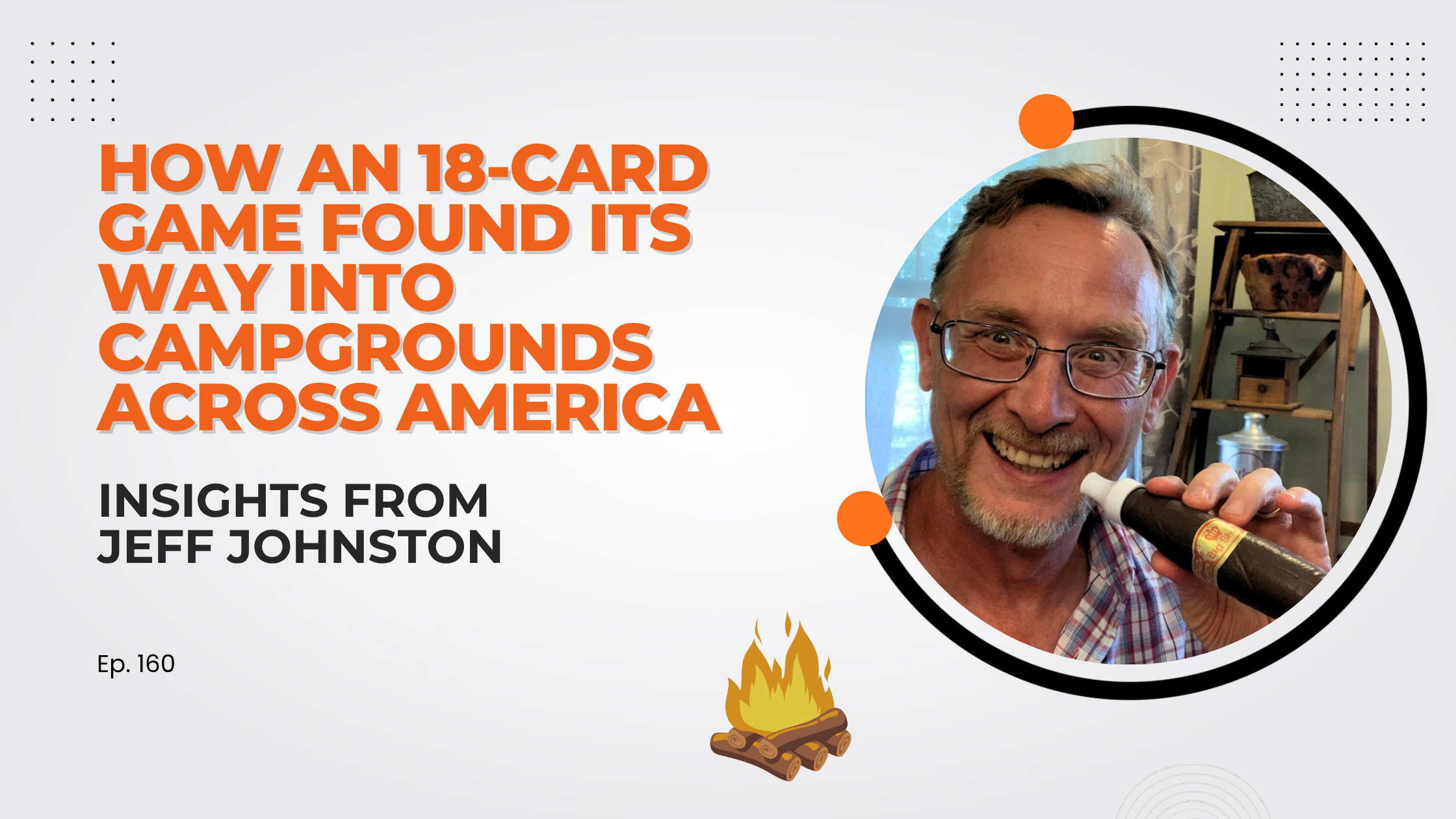
Welcome to the Toy Business Unboxed Podcast, where we explore the journeys of toy and game entrepreneurs navigating the challenges of bringing products to market. In this episode, host Jason Hsieh sits down with Jeff Johnston, a veteran game designer from Boston who has been creating family card and board games since 2006. Jeff shares how he made the decision to self-publish for the first time, what he discovered along the way, and how his latest game, Campfire Smokeout, found its way into campgrounds across America.

#160: The 18-Card Game That Landed in Campgrounds Across America – Toy Business Unboxed
Episode Highlight
- 00:00 Jeff Johnston’s background
- 00:41 Game design since 2006
- 02:43 Campfire Smokeout explained
- 04:11 Wind cards and smoke rules
- 06:34 Why Jeff self-published
- 09:59 Biggest self-publishing surprise
- 10:58 Tariffs and next steps
- 13:38 Licensing vs self-publishing
- 20:31 Advice for new designers
A Twenty-Year Journey in Board Game Design
Jeff Johnston’s path into the game industry started with a simple bucket list goal: walk into a toy store and see a game he made sitting on the shelf. That vision led him to create Toasted or Roasted, a campfire-themed card game that took five or six years to find a publisher but eventually launched through Education Outdoors. Since then, Jeff has become a recognized figure in Boston’s indie board game community, serving in a leadership role with a local game makers guild and mentoring new designers who are just beginning to turn their ideas into real products.
What Is Campfire Smokeout
Campfire Smokeout is an 18-card game built around one of the most universal campfire experiences: no matter where you sit, the smoke always seems to find you. The deck contains one smoke card and a set of wind cards, and each round players pass the smoke from player to player using wind cards until someone runs out and gets smoked out. A clever tie-breaking rule also penalizes the player who sends the final smoke to end a round, adding a layer of strategy that keeps even experienced players thinking before they act.
Designing for the Family at the Campsite
Jeff designed Campfire Smokeout with a specific setting in mind: a family that just picked up the game from the campground general store and sat down at a picnic table to play. The goal was a game that young kids and their favorite aunt and uncle could enjoy equally, with a rule set simple enough to open and learn on the spot but engaging enough to hold attention. He also built in subtle rules to prevent players from ganging up on each other, keeping the experience positive and fair even when younger children are at the table.
The Self-Publishing Decision
Jeff chose to self-publish Campfire Smokeout because he had a distribution vision that most publishers could not support: getting the game into campgrounds across America. Publishers he approached acknowledged they had no channel into the campground market, which made the project a hard fit for their existing distribution. One connection eventually led him to Dan Hundycz at DPH Games, who had a relationship with Wilcor, a major distributor for campground owners and national parks, and that partnership gave Jeff the path he had been looking for.
Surprises and Challenges in Self-Publishing
The biggest surprise Jeff encountered was how much effort went into pulling together the graphics and design work. As a designer who had previously only licensed concepts, he had never needed to take a product all the way through finished production on his own, and figuring out which parts to handle himself versus which to hire out was a steep learning curve. He worked with artist Emily Druid at Emily at Art on the card illustrations and handled layout and packaging design himself, working through unfamiliar tools until the product came together.
Tariffs, Pricing, and the Next Print Run
The first print run of Campfire Smokeout predated the tariff changes that hit the toy industry in 2025, but future production runs will face them directly. Jeff is now evaluating whether to raise the price point, add more perceived value to the package, or both, and one option he is actively exploring is a fully waterproof version using plastic cards and packaging. The waterproofing upgrade alone would roughly double the unit cost, and with tariffs added on top, the numbers require careful analysis before any decision can be made.
What Is Next for Jeff Johnston
Jeff is currently working on two projects that grew from his interest in seasonal themes. One, a fall-themed raking game originally called Leaf Me Alone, was pitched to a publisher who loved the concept but reimagined it with a new theme, and an announcement is expected through Paragex Games later in 2025. The other is a family game built around dogs burying bones with a 3D component, which Jeff refined after early pitch feedback and brought to Astra this year, where he had a promising new conversation with a publisher.
Advice for Newcomers in the Toy and Game Industry
Jeff’s advice for anyone getting started in the toy or game industry is direct: get your project out there. Not in the sense of rushing it to market, but in the sense of putting it in front of real people as early and as often as possible. Every time you share your game, you open the door to feedback, a new connection, or a piece of advice that takes your project somewhere you never expected.
Conclusion
Jeff Johnston’s story is a practical example of how a game designer can move between licensing and self-publishing depending on what a specific project needs. Campfire Smokeout succeeded because Jeff matched his distribution vision to the right manufacturing partner and stayed adaptable through challenges like tariffs and pricing decisions. His core message reaches beyond game design: sharing your project with others is not a risk, it is the fastest path to making it real.
Connect with Jeff Johnston
If you’re interested in learning more about Pair of Jacks Games LLC or connecting with Jeff Johnstonyou can reach out through the following channels:
- Website: Visit Pair of Jacks Games’ official website for the latest news, game updates, and more
- Website: Visit Pair of Jacks Games’ on DPH Games to purchase the game!
Transcript
Jason Hsieh (00:00)
Welcome back to another episode of Toy Business Unboxed. Today we’re joined by Jeff, a longtime game designer who has been creating fun, family-friendly cars and board games since 2006. And you might know some of his games like Toasted or Roasted, but today we are talking about something new that he has designed, the Campfire Smokeout, which is his first journey on self-publishing his own games. you so much and welcome to the show today, Jeff.
Jeff Johnston (00:25)
Well thanks Jason and I’m really happy to be here on your podcast.
Jason Hsieh (00:28)
So before we talk about your newest games, I want to kind of go into your background because you have been in the industry for so many years. Like I mentioned, since 2006, can you kind of just share your journey so far within the toys and game industry?
Jeff Johnston (00:41)
Yes, yes. Gladly. so when you say I’ve been involved in the game industry for that long, that certainly does sound like an impressive amount of time. In two thousand six was sort of the moment I got inspired to sort of like, you know, what was a bucket list thing I’d like to do? And, you know, walk into a toy store and see a game on the shelf that I made just sort of, you know, became that notion. And so I just started on a journey.
back then and we mentioned the game toasted or roasted. I sort of picked a fun theme that I liked, you know, toasting marshmallows around a campfire, developed a prototype, play tested it. But honestly, it took about five or six years before that project found a home. Since then I’ve been designing different game designs and things like My strategy is mostly to
license the game concept, you know, find a manufacturer, a publisher that really knows what they’re doing because I’ve learned very quickly that I’ve got a lot to learn. Yeah. And you know, and so it’s been a very fun side gig for me, you know, full time, you know, day job. but definitely have been engaged in the game making industry for a long time. I’m up here in the Boston area so
Yeah, we have a robust game design community. We call ourselves a game makers guild. So I’ve stepped into a leadership role in that group. We a big indie game festival up here. you know, so I volunteer on that staff to help with the sales, sponsorship sales, to help people’s dreams going forward. So yeah, so those are the things I enjoyed but also mentoring new game designers that are just trying to scratch the surface of
How do I make my dream, you know, my dream game be real, right? And so answering their questions and you know, giving guidance when possible. All things I very much enjoy this aspect of the toy and game industry.
Jason Hsieh (02:28)
I see. Thank you so much for sharing that. So let’s start off talking a little bit about this latest game that you designed. What is Campfire Smokeout all about? If you can explain kind of how to play and kind of the reason behind that as well.
Jeff Johnston (02:43)
All right, perfect. So Campfire kind of background as a product. I’d always been attracted to the 18 card format. There’s several, you know, really fun games that are just based around 18 cards, love letters and you know, there’s whole companies that are built around, you know, producing, you know, how clever can you be with 18 cards? Yeah. And at the beginning of COVID, always had the notion that
you know, sitting around a campfire and doesn’t it always seem that the smoke goes right where you’re sitting, right? and you know, so that was the notion, you know, that setting would be a game. And I thought in 18 card format, you know, keep it a simple set of components. And you know, some game designers with those 18 cards, you know, you can turn a card four ways, flip it over to the other side, combine it, you know, all sorts of things, right? So I started thinking about
you know, an audience, right? Who would be playing this game? And so I really thought of a family at the campsite. Maybe they just come from the general store at the campground, sitting at the picnic table. They could open up this game, and play it and have a great time, you know, even with the fairly young players, but their favorite aunt and uncle would still have just as much fun playing it with them. So Campfire Smokeout, it’s
an 18 card ⁓ game, there’s a this nice little package that holds the 18 cards. you know, and so it’s got some nice material on it, and we start understanding what the game is. And on the inside is just a very simple rule set. It just outlines, you know, how to set up the game, how to play it. A couple of examples. And for components, one card
Jason Hsieh (04:07)
Hmm.
Jeff Johnston (04:11)
represents the smoke and you just don’t want to get stuck in the smoke. That’s the role of the game. And then each of the remaining cards creates a deck. And those cards you’re gonna get dealt three of these every round and they are wind cards. So if the smoke comes to you, you’re gonna use one of your wind cards to in this case blow that smoke one player in this direction.
I see. Maybe they have a wind card that they can use that they can choose to blow it three in this way or turn it over two that way. Yeah. Or maybe they’ve got a third kind of a card which they can pick how far it goes in one direction. And so you just keep playing like that, moving the smoke from player to player until it comes to a player that has no more wind cards. That ends the round because that player’s been smoked out.
Campfire Smokeout, right? Yeah. So what we do is we’ll take the wind card that ended the round and we’ll put that face down in front of a player. That’s going to mark that they’ve been smoked out one time. That mean player that ended the round, they’re going to start with the smoke in front of them next round. And when we all get more cards again for the next round, they’re going to have to use one of theirs right away to move that smoke away. And we’ll just keep playing like that until someone’s smoked out three times, which ends the game. And whoever has the fewest smokeouts.
Is the winner. Yeah. So it’s a very simple kind of play structure, a little bit of a hot potato there, right? You don’t want the smoke is there. but you know, since I’m designing for a younger audience, I’m also kind of try be sensitive to, you know, like a group of kids picking on another kid or something like that, right? So, you know, worked in a couple of subtle rules that keep the kids from ganging up on each other.
Jason Hsieh (05:26)
I see, okay, okay.
Jeff Johnston (05:50)
and one of the most ⁓ you know clever is that if there’s a tie for the fewest smokeouts at the end of the game, yeah, all of the players are gonna share the victory unless one of those players was the one that sent the smoke to end the game. ⁓ And now you’ve added on just this one move removed back of that hot potato. It’s like you don’t want the smoke, but you don’t wanna be the one that sends the smoke. And so now you’ve got a fun
Jason Hsieh (06:05)
I see.
Jeff Johnston (06:16)
you know, little interaction there. And once the kids get that then then they really, you know, sort of have to think about that. So and that’s Campfire Smokeout
Jason Hsieh (06:23)
I see. Thank you so much for the overview. What inspired you to go with a self publishing route this time instead of like what you have been doing with previous games, which is licensing it to bigger publisher in the past. Right.
Jeff Johnston (06:34)
So I continue to develop game ideas and attempt to license them. And in fact, last year I have ⁓ a game that was licensed and it’s coming out this fall. I’m super excited about that. More about that when the company makes the announcement. it’s very competitive you know, convince a a publisher or manufacturer to, you know, put in the same amount of passion that you have for your project.
into a game. And it happens all the time. You know, you know, publishers are licensing and creating wonderful products. And during COVID, anecdotally I hear that everyone designed a game during COVID and you know, and with the bar being lowered on how you can communicate with a publisher, right, or a manufacturer, how you can pitch them, you know, like we’re talking here right now. We could
go online. I could switch to a camera right now and show my table and play the game right there in front of you, or maybe I have a digital version of it. It’s very easy to pull together. You don’t have to invest in anything. Lots of applications that are a sandbox that you can pull components together and represent your game. So all that makes it like all these really great ideas are out there. And so, you know, boy, I had this really fun idea about not only a game but
it as a product. Yeah. And you know, I said, well, to be honest, I said, it’s just 18 cards, right? 18 cards. And I and I put it into a, like a box of 12 of them that turns into a nice little, display package or something like that. It’s like I could probably afford to make a lot of mistakes with this project, right? I could afford to, you know, kind of walk down this route.
as the publisher, as the manufacturer. And ⁓ yeah, so I just started talking with other game publishers about advice. And ⁓ along the way I had shared my vision that I really wanted it in campgrounds across America. So that was sort of another reason why I decided to manufacture it. Like like a lot of game companies I would talk to
They’re like they have great distribution channels, but I would say like, well, what about how about campgrounds? And they’re like, I really don’t have a great channel into that, you know, and for that reason I’m not interested in doing this project, right? A little bit, you know, maybe too far out of a lane they wanted to be in. Yeah. But one of the publishers knew ⁓ another publisher that had a good relationship with ⁓ Wilcor.
which is a distributor of equipment for campground owners, RV repair places, national parks. Yeah. So a campground owner would go to Wilcor, you know, and buy their marshmallow sticks, you know, buy camping chairs, buy everything you would need for a campsite, you know, ⁓ folding chairs, tarps. There’s always rain. And so that was really part of my vision was to sell to Wilcor.
Also because the Toasted or Roasted product that Tim Paczesny at ⁓ Education Outdoors has just done a wonderful job of making this product available to that camping market. And so I also kind of looked towards you know, how Tim had built that up and you know, where he had done. So anyway, I got plugged into a publisher who had experience with Wilcor.
And ⁓ approached him with my idea, my game concept, sent him a copy to play and he said, Hey, let’s set up a meeting with Wilcor and he did that and landed the deal. And yeah, they’re the biggest buyer of Campfire Smoke out. very happy.
Jason Hsieh (09:51)
Nice. Congratulations on that partnership. So, in your journey, what would you say is your biggest surprise during this self-publishing process?
Jeff Johnston (09:59)
Interesting, biggest surprise. Part of it was how hard it is to pull together graphics, right? So you know, as like a game designer who’s trying to sell a game concept to a publisher, right? You can invest a bit of time into a prototype, but you can do a lot of like hand tweaking of it or whatever. You know, you’re really just trying to make the one sale.
And then you know they’re gonna do all of those other jobs. So just the notion of knowing when to hire help to make things come together. So definitely worked with a wonderful artist, Emily Druid, at Emily at Art. she did the
very simple but emphatical graphics of the game. But I decided, okay, I’m gonna do all the stuff in design and you know, whatever tools I could learn. So ⁓ hack through that. So I would just say that was the you know part of the surprise. I mean I knew I was gonna run into parts of the job that either I didn’t want to do or really I couldn’t do.
along the way.
Jason Hsieh (10:51)
I see. Were there any major hurdles or delays that you didn’t expect when you get into self-publishing?
Jeff Johnston (10:58)
No, in this case, because you know I sort of had the notion of a season, a selling season for these games. I know campgrounds like buy in the early spring and things like that. So yeah. So I had given myself enough, you know, ramp that would it be back in time from manufacturing in order to save
you know, be efficient in the actual physical manufacturing of it, combined the print run and shipping with some other games that that Dan Hundycz at DPH Games, who is the publisher I’ve paired with on this that has, you know, got our Wilcor set up. So, you know, kind of fell into his timeline.
But now we are coming to the sort of the end of this initial print run. And, couple of considerations are coming up that’ll probably be pretty important decisions to make that probably could result in some delays. you know, so obviously there’s the tariff issue. Yeah. Where you know the yeah, these were manufactured in China.
And then just another thing, you know, as I talk to folks and things, it’s a small package, right? Fits right in your pocket, you know, you can take it camping, all those things. There’s a lot of fun aspects for it being small and compact. But then, you know, when you put a price point on it, you know, does the consumer see or does the retailer see that that’s the price point they would have put on it? And doing some things like
So that’s the other sort of challenge looking at is you know, do we modify the price point a little bit or do we bring more impact into the small package? So one of the things I did with the manufacturer was could you send me a white copy of both the package and the cards in plastic. Now I’ve got a waterproof.
version of the game. Okay. Right now it’s small enough to fit in a plastic bag, so that’s how you would waterproof it. But if the whole package now was out of plastic, it’s a very modest price to generate a deck, that basically doubles the price of the game unit.
Jason Hsieh (12:48)
Does it double the manufacturer cost if you choose to make it waterproof?
Jeff Johnston (12:52)
In the limited number of quotes I’ve received. Roughly close. And then add on the tariffs. So the first print predated the tariffs. Yeah. So you know, it puts a lot of hard math on the process.
Jason Hsieh (12:55)
really?
Hmm, for sure it is. I think it’s definitely a learning process. And obviously the tariff is kind of, no one was expecting that to happen this year. So that’s something we all kind of have to deal with together as an industry. And I also run into a lot of tariff related issues myself. Yes. Because I own a company as well. So, and the next question I want to ask is, since you have also licensed several games in the past,
Jeff Johnston (13:21)
Yes.
Jason Hsieh (13:30)
What would you say is the major difference between licensing to a different bigger publisher versus just doing all the publishing yourself?
Jeff Johnston (13:38)
Yeah. I would say the biggest difference is well, I’ll say two differences. One that I just thought of and one I’m gonna think of. The first one is sort of the fire and forget aspect of licensing a concept, right? I mean you develop it to a point, you know, and depending, it could be very rough. I mean, really, honestly, some games can be pitched off the back of a napkin, right? But
Generally you know, you work a prototype up to a point, definitely playable, but where the publisher could see the product. Definitely one that’s conveyed the gameplay because you need to play test it with lots of different people in your target audience, you know, to understand that it’s really hitting on all things. But you only need to get it to a certain point. And once you license it, right, once you sign on the dotted line.
you’ve given them your baby carefully package it up and hand it to them and then they take care of everything. And then you just sit and wait patiently for the royalties to come rolling in. Very modest royalties. Yeah. But Campfire Smokeout, right? It really is if I’m not working on
moving the product forward, finding another foothold ⁓ you know in the community, in the marketplace, than maybe no one is, right? and so now Campfire Smokeout just becomes a continual joy me to you know continue to find clever ways to market it and continue to think about you know, what is its path for?
Jason Hsieh (14:59)
I see, see. So how do you currently balance between designing and I think you still work a full-time career on top of doing the design as well. How do you balance everything that’s going on right now?
Jeff Johnston (15:12)
Right. Yeah, I guess that’s a skill all we adults have to master. One of the parts of growing up, right? you know, I do come from the indie board game design community. And so most of the people I interact there, is a you know, a very big part of their life, but it is like a slice of their life.
Honestly, my wife is very supportive. So I always have to remember to be just as supportive and thoughtful. For when she asks me for a little time away. You know, I asked for time away to go to a gaming convention where I might be playing games or pitching my games or even playing other people’s ⁓ prototypes to give them feedback. You know.
So, you know, always balance the family first. And, the games for me, because it was kind of a side gig, right? I never had to make the income of it you know, be critical to running the household, paying the bills, keeping the lights on, so to speak.
So it kept a bit of pressure off and still lets it be fun for me. I know there’s a certain point where as truly a business, and this is certainly not a hobby for me, it is a business. But you know, I’ve been able to, keep the stakes being fairly low. And often in that case, right, you know.
The more you risk, the more there’s a reward. So as a result, bringing a Campfire Smokeout to the market has been a very kind of slow and deliberate process, right? Can you, get out to different venues, different conventions, ⁓ spending more money to be present. Would that significantly help people’s awareness of Campfire Smokeout? Get more feedback, get more tips, get more great advice.
Of which I’ve gotten a lot of great advice and some of which I’ve even tried to follow. But yeah, so you know, so that’s just the balance there for me is in those aspects.
Jason Hsieh (16:54)
I see. So what is next? Any more new ideas, new games coming?
Jeff Johnston (16:59)
A fun thing about designing games and sort of getting better at it as you go along is that, usually the next thing, the game you’ve just designed is like the best game ever. You enjoy it the most. It’s my favorite project ever. And then you get the next one you do is better than that one, right? I’m having more fun with it, right? So I really am having fun with two projects.
Your inspiration to design board games comes from many places, but I sort of said because I often do like this camping theme, you know, but I had this summertime game called Flashlights and Fireflies that GameWright licensed and produced. And I thought it would really be fun.
That just sort of inspired me to say, like, I really need to have a game about each season, you know, a winter game, a spring game, a summer game, a fall game. Okay. And I’d had a game about the fall that was about raking leaves. I called it Leaf Me Alone. And, and you were in kind of real time trying to clear out all the leaves from your yard in a fun, fun way using a fun little mechanism. And
Jason Hsieh (17:53)
Leave me alone, okay.
Jeff Johnston (18:02)
If you did it just right, maybe the leaves as they left your yard would land in someone else’s yard, frustrating them and everybody’s trying to do this to each other. And so I actually had an opportunity to pitch that to a company last summer and they really love the game concept. Now they decided they thought of an even more fun theme. And so
They worked with me on well, how could we make this fit into this world instead? And so that was actually a lot of fun. And so like I said, we’ll hear more about that. You can go to the Paradox Games website later this fall and probably see what the leaves turned into. And then I have another game, just a family fun game.
That’s about dogs bearing bones, and I’ve got a fun little 3D component. And I had pitched an early version of the game to a publisher, and they were like intrigued by the concept, but underwhelmed by the amount of fun that was there. Like it’s a little bit too complicated, for the fun that it delivers, and you know that complication doesn’t really aim at your target audience.
So took that feedback and a bunch of other feedback I’d received and worked on it. And so about 18 months later, I was able to pitch it again. And a fun thing about this particular pitch was I was at Astra this year. Yeah. Yeah. First time I was at Astra. And I was there sharing Campfire Smokeout and ⁓ you know, making some contacts and things like that. But I just had an opportunity to walk around and look at all the great products that are there at Astra and
Jason Hsieh (19:12)
okay.
Jeff Johnston (19:25)
How were people packaging them and presenting them? And, you know, I had this sort of 3D component in my concept for this game. And I was able to like get inspiration from some of the packaging I saw in Astra. So I’d mocked up a little box. And so during the pitch, I just kind of, you know, slid this little box with a see-through panel and the component in the background and how it all worked together with the artwork. And they were like, hey,
I can sort of see that, you know. And it was really fun because I went to Astra focused on one project, but you know, it’s just a kind of world that you can, you know, get in inspiration and advice and effort from you know a lot of different sources and angles.
I mean, it’s so tough to make a connection because everything has to just line up perfect. And you know, just the notion that someone could say yes, as long as that’s out there, that sort of keeps me going, to, you know, keep designing and sharing and all those things.
Jason Hsieh (20:20)
For sure. Yeah, thank you for sharing that. So as well kind of wrapping up today’s interview, if you have to share just one piece of advice with someone that’s getting started, we in the toys and game industry, what would that be?
Jeff Johnston (20:31)
So my advice, I don’t think it applies just to board and card game designers. There could be some subtle nuances in the toy industry and some of the you know patentable type of things like that. But in my game design group, if I find an opportunity
for you to share your game, right? Maybe it’s to pitch a publisher. Maybe it’s a game convention where you can share it with ⁓ other game players and get feedback, right? I always just sign off, the little message of, you know, get your game out there. And so that would be my advice is your project, get it out there. Not in the sense of like get it on the shelf, right? But get it in front of people. get people to give you comments on it.
Get people to provide feedback, right? All of these things are gonna build up. And through the act of sharing, you’re gonna get some advice or make a connection that you totally didn’t expect. And it’s gonna lead you somewhere you totally didn’t know where your wonderful fun project can lead you. In the board game community it’s not completely super small, but
A general rule of thumb is the best way to protect your game is to share it with as many people as possible, right? That way they’ll associate that game concept with you as you’re kind of bringing it through a process. So you know, some people sometimes you’re tempted to kind of shelter your idea. But in the proper circumstances, my recommendation is get your project out there so you can get
as much help on it as possible
Jason Hsieh (21:56)
Yeah, that’s a very good piece of advice. Thank you so much for sharing that. And for our audience that would love to learn a little bit more about you and your businesses, where is the best place for people to find you online?
Jeff Johnston (22:07)
All right. Well, like I said, my company, Pair of Jacks Games, family fun in 15 minutes is my motto. So you can go to website, and you know, I have a landing page up there for you know each of the game concepts that’ll direct you where you can buy it. You can go to DPH Games.
where you can buy a copy for yourself or if you’re a retailer, order from there. And then also at faire.com DPH Games a fair site where you can purchase for your retail location.
Jason Hsieh (22:36)
I see. Okay. Thank you so much for sharing that. And thank you so much for your time today, showing your journey and some of your experiences with our audience on the show.
Jeff Johnston (22:45)
Yeah, now if you’ll let me go back to the well, I do have one more piece of advice.
Jason Hsieh (22:48)
sure, go ahead.
Jeff Johnston (22:50)
And that’s book yourself some time and interview with Toy Launch and do an interview with Jason. You know, that’s an excellent bit of advice that I would pass along to.
Jason Hsieh (22:59)
thank you for sharing that. Yeah, for sure. For sure. I’d love always looking for interesting guests to interview and share their story.
Jeff Johnston (23:06)
I hope you find one next week.
Jason Hsieh (23:08)
course. For our listeners, thank you so much for tuning in to this episode of Toy Business Unboxed Podcast. We hope you have really enjoyed today’s conversation and find it insightful and inspiring. If you like what you have heard, be sure to subscribe to our podcast on your favorite platform so you never miss an episode. We really appreciate your support and would love it if you can leave us a review and share the podcast with your friend and colleague. For more resource, tips, and latest update within the toys and game industry, visit our website at toy-launch.com.
Join the conversation and connect with us on social media using #toybusinessunboxed. We’d love to hear your feedback and suggestions for future episodes. Until next time, keep innovating, keep creating, keep bringing joy through toys. This is Jason Hsieh, signing off on the Toy Business Unboxed Podcast. We’ll see you in the next episode. Thank you so much, everyone.
Grow your toy brand’s content reach
From SEO blog content to influencer outreach — we handle the full content engine for toy and game brands.