
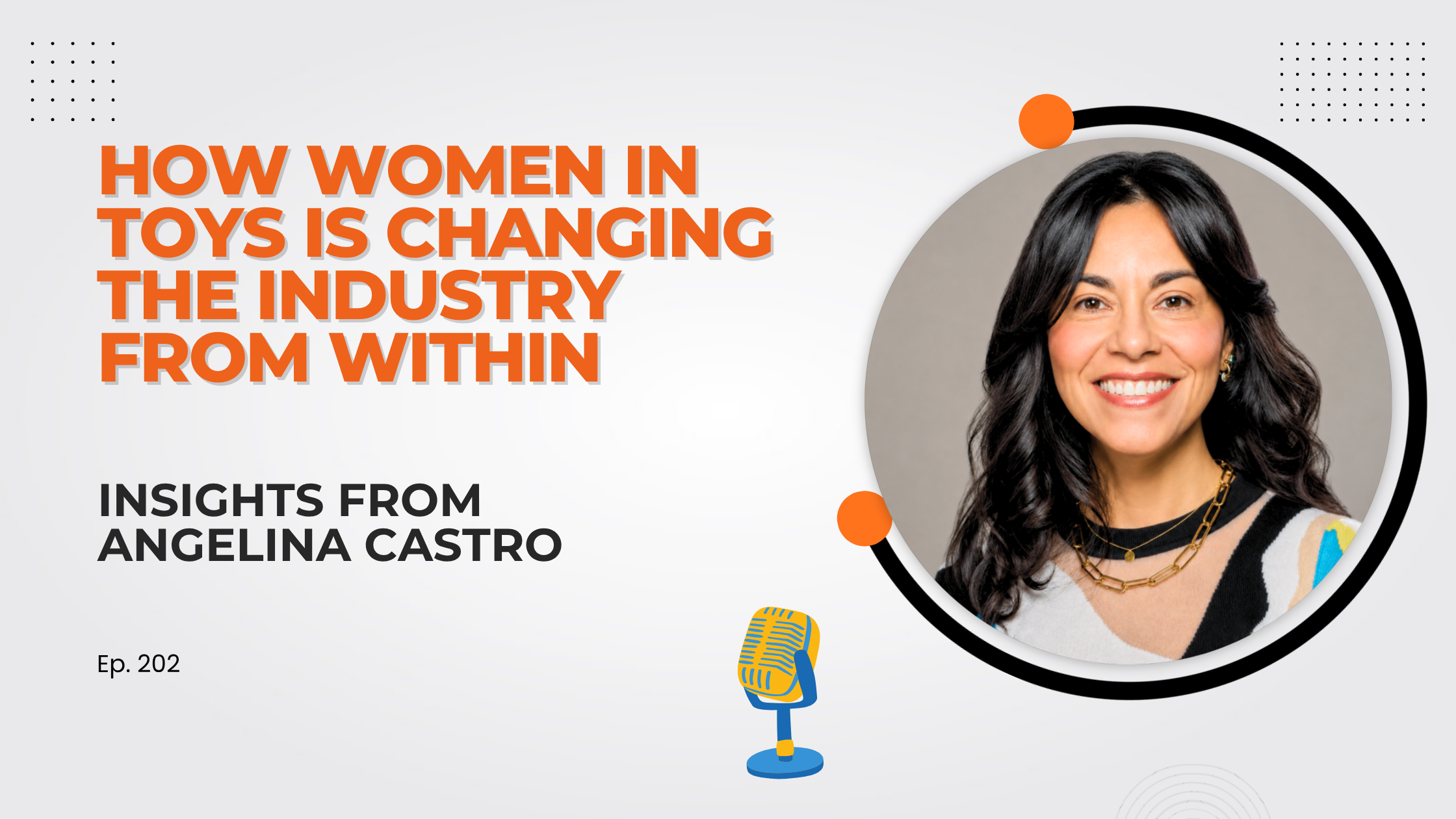
Welcome to another episode of the Toy Business Unboxed Podcast. Jason Hsieh sits down with Angelina Castro, executive director of Women in Toys, Licensing and Entertainment (WiT), a 35-year-old global nonprofit with more than 7,000 members. Angelina shares how her career across airlines, entertainment, and toy licensing led her to a role built entirely around lifting up an industry rather than one brand. Their conversation covers mentorship, representation, and how AI is already changing the way toy industry professionals work.

#202: The Women Uniting Toys' Biggest Voices – Toy Business Unboxed
Episode Highlight
- 00:00 Meet Angelina and WiT’s mission
- 00:59 WiT’s 35 year history explained
- 02:54 Angelina’s path into toys
- 06:05 How the mentorship program works
- 07:56 In person mentoring at shows
- 09:28 Membership breakdown across the industry
- 10:54 Small business and entrepreneur resources
- 15:01 AI’s growing impact on careers
- 23:14 What’s next for WiT
- 24:45 Angelina’s advice for newcomers
From Airline Marketing to Toy Industry Leadership
Angelina Castro’s career did not start in toys. She spent her early years in marketing for the airline industry, and looking back, she says the through line was not always obvious in the moment. What connected every role she has held since, in entertainment, consumer products, retail, and brand building, came down to two things: storytelling and relationships. Growing up in a Puerto Rican household where community was a way of life shaped how she leads professionally today.
Working With the Biggest Names in Toys
Before joining WiT, Angelina worked directly with some of the most recognized franchises in the industry, including Pokemon, Marvel, Star Wars, Care Bears, and Strawberry Shortcake. She says what made those brands resonate was never just the product on the shelf, it was the genuine emotional connection people felt toward them. When people feel something, she explains, they stay loyal and become advocates. That belief in emotional connection is what she carried with her into her current role leading WiT.
What Women in Toys Actually Does
Women in Toys, Licensing and Entertainment, known as WiT, turns 35 this year and has grown well beyond its original name. Angelina says the organization stays true to one mission: advancing women throughout their professional journeys across consumer products, entertainment, gaming, and toys. WiT now counts more than 7,000 members globally, including men who serve as allies, students, and people in career transition. For Angelina, the organization exists to create opportunities that did not always exist for women in this industry.
Inside the Ruth Handler Mentorship Program
WiT’s flagship mentorship program started as a virtual offering during COVID and is underwritten by Mattel. Called the Ruth Handler Mentorship Program, it runs four months and matches mentors and mentees based on the skills each person wants to build or already has. Pairs set their own cadence, with a minimum of one meeting a month for four months. This year, WiT also expanded mentorship into in-person settings, running small group sessions inside its booth at New York Toy Fair and Licensing Expo.
A Membership Built for Every Stage of a Career
WiT’s more than 7,000 members range from kitchen table inventors to C-suite executives. Students receive complimentary membership outright, and anyone navigating a job transition gets six months of free access. Angelina says the mix, students sitting next to inventors and executives at the same breakfast table, is what makes WiT’s community special. For her, the goal has always been belonging, not just transactional networking.
Support Built Specifically for Small Business Owners
Beyond membership tiers, WiT runs a small business resource center on its website and a dedicated Slack channel where entrepreneurs trade questions on everything from finding a 1P provider to hiring an IP attorney. Once a month, the organization hosts Casual Fridays, a drop-in session where small business owners and anyone in the community can learn from each other. Members connected to WiT’s tabletop learning community get another layer of peer support. Angelina notes that while WiT does not run a formal entrepreneurship program, these informal touchpoints fill much of that gap.
Where the Industry Is Headed, From Diversity to AI
Jason and Angelina also talked about how slowly the toy and game industry is diversifying, agreeing there has been real progress in women stepping into leadership even as executive and investment level roles still need more equitable pathways. Angelina says the conversation has shifted from asking for fairness to recognizing that diverse leadership drives stronger business outcomes. That same appetite for change is showing up around AI, where she believes professionals who keep learning will outpace those who do not. Jason shared how Toy Launch has approached that shift internally, requiring every team member to build at least one AI automation a month as part of their performance development and running weekly AI workshops across the company. Angelina’s response was direct: the hundreds of hours invested now will save thousands of hours later.
Growing WiT’s Global Reach and In-Person Community
Looking ahead, Angelina says WiT is focused on two things at once: expanding its global reach and going deeper on the value it provides existing members. That means growing local chapters and building out signature events like New York Toy Fair, Licensing Expo, and the Wonder Women Awards. She points to a renewed hunger for in-person connection, noting that no virtual tool can replace the feeling of meeting someone face to face. Strengthening programs like the Ruth Handler Mentorship Program and creating more concrete pathways for women’s advancement remain central to that plan.
Advice for Newcomers in the Toy and Game Industry
Angelina’s advice for anyone starting out is simple: build your relationships before you need them. She describes the toy and game industry as deeply relationship driven, where reputation, curiosity, and how you treat people matter as much as any resume line. That advice extends to WiT’s scholarship program, which selects six women each year from hundreds of applicants to connect with mentors and industry leaders. Her message to those scholarship recipients, and to anyone new to the industry, is to stop waiting for permission to lead.
Conclusion
Angelina Castro’s path from airline marketing to leading a 7,000-member global nonprofit shows how far storytelling and relationships can carry a career. Through WiT, she is working to make sure the next generation of women in toys, licensing, and entertainment does not have to build those opportunities from scratch. Whether it is mentorship, in-person community, or staying ahead of AI, her focus stays the same: lifting up the whole industry rather than just one brand. For Jason and the Toy Launch team, it is a reminder that community and adaptability go hand in hand.
Connect with Angelina Castro
If you’re interested in learning more about Women in Toys, Licensing and Entertainment or connecting with Angelina Castro you can reach out through the following channels:
- Website: Visit Women in Toys, Licensing and Entertainment’s official website to get involved, stay updated on the latest news, and more.
- Instagram: Follow Women in Toys, Licensing and Entertainment on Instagram for visual updates, announcements, and more.
- Facebook: Follow Women in Toys, Licensing and Entertainment on Facebook for updates, discussions, and behind-the-scenes content.
Transcript
Jason Hsieh (00:00)
Welcome back to another episode of Toy Business Unboxed Podcast. I’m your host, Jason Hsieh. Today’s guest is Angelina, executive director of Women in Toys, Licensing and Entertainment, also known as WIT. She spent the last over 15 years working with some of the biggest names in the toys and entertainment industry, from Pokémon to Marvels to Care Bears, any of the famous brands you have heard of. She probably has worked with them in the past. So and now she leads the global community of professional.
Dedicated to advancing women in this particular industry. So thank you so much for joining us on the podcast today and sharing with the audience your experiences and your expertise.
Angelina Castro (00:35)
Jason, so great to be here with you and so good to see you. It’s been a few months since we saw each other last. So I’m just so happy to
Jason Hsieh (00:41)
Yeah.
Angelina Castro (00:41)
Be chatting with you.
Jason Hsieh (00:42)
Thank you. And thank you for joining us. So I know Women in Toys as a association has been around for more than 30 years, but for those people that was like hiding behind a rock and they never heard of it before, how will you describe the association? Why does it exist?
Angelina Castro (00:59)
Yeah. Well, thanks for asking. And I appreciate Jason that you said Women in Toys Licensing and Entertainment. We’re actually 35 years old this year, if you can believe it. And we like to go by the short name WiT because the other name is a bit of a mouthful, but we
Jason Hsieh (01:15)
Yeah.
Angelina Castro (01:16)
Started 35 years ago as Women in Toys. So people who have been around the industry for a long time often refer to us to that. But as the industry
Jason Hsieh (01:22)
Yeah. Yeah.
Angelina Castro (01:25)
Was changing,
We changed along with it. And so we added
Jason Hsieh (01:26)
Mm-hmm. I see.
Angelina Castro (01:28)
On licensing and entertainment. It’s our mission still stays the same though. We’re a global nonprofit and we focus on advancing women throughout their professional journeys, whether that’s across consumer products, entertainment, gaming, toys.
Jason Hsieh (01:43)
Mm-hmm.
Angelina Castro (01:43)
And you know, we joke one day, Jason, that one day we’re just gonna name ourselves women with jobs because the industry.
Jason Hsieh (01:51)
That will be too big of
A market, isn’t it? Isn’t that 50% of population?
Angelina Castro (01:54)
I mean… We’re gonna take over the world, Jason. With the industry’s just changing
So much if you think about it. Like no one
Jason Hsieh (02:01)
True.
Angelina Castro (02:01)
Company’s just making dolls or board games. They’re multimedia organizations now. But the simplest
Jason Hsieh (02:07)
Shaw, if
You wanna be successful, that’s unfortunately the necessity that you have to do. So yeah.
Angelina Castro (02:12)
It is,
It is. And I think, you know, all that aside, really, wit exists to create opportunities that didn’t always exist for women.
Jason Hsieh (02:21)
Hmm, I see, I see. And we have previous members in our show before from Women in Toys Association. Can you kind of for our listener that didn’t catch the last episode, you can always go back to our previous episode but to kind of catch on that. But for this today’s discussion, I want for you to share a little bit about your personal experience in your career because your career is also very interesting, kind of work across toys entertainments and brand partnership.
Pretty much in all every single genre that your association currently represents, you done them all, it sounds like as well. Can you share
Angelina Castro (02:52)
Yeah.
Jason Hsieh (02:53)
A little bit about that experience?
Angelina Castro (02:54)
Yeah, absolutely. And actually I started my marketing career in the airline industry. So, you know Yeah, it’s funny. It’s funny because when
Jason Hsieh (03:01)
Okay. Airline, totally different. Yeah. Yeah.
Angelina Castro (03:05)
I look back, you know, the through line wasn’t always obvious in the moment. And, you know, if
Jason Hsieh (03:09)
Yeah. Mm-hmm.
Angelina Castro (03:12)
You look at my career now, someone might go, Well, that’s interesting how that all kind of came together. But I think
Really what connected everything that I did, whether it was entertainment, whether it was consumer products, whether it was retail or brand building, really it all came down to two core things for me. It was about the storytelling piece of it and it was about the relationships piece of it. And, and so
Jason Hsieh (03:35)
Okay, okay, okay.
Angelina Castro (03:36)
I think, you know, I grew up in a Puerto Rican household and community was really a way of life. And
Jason Hsieh (03:43)
Mm.
Angelina Castro (03:44)
So
There was sort of this unspoken understanding that we were stronger together. And I
Jason Hsieh (03:51)
Yeah, yeah.
Angelina Castro (03:51)
Don’t think that I realized at the time how much that would shape my career and how I led professionally.
Jason Hsieh (03:59)
I see.
Angelina Castro (04:00)
But I think what working with major franchises too, you mentioned some of the brands that I’ve had the opportunity to work with and on with
Jason Hsieh (04:09)
Yeah, yeah.
Angelina Castro (04:10)
Our major globe, I mean.
Pokémon, Marvel, Star Wars, I mean,
Jason Hsieh (04:13)
Yeah. Yeah.
Angelina Castro (04:14)
Huge, huge brands, Care Bears and Strawberry Shortcake. Really, I think what resonated or resonates still with those brands is the genuine emotional connection that people have with those brands. It’s I think when
Jason Hsieh (04:27)
Hmm. Yeah, yeah, yeah.
Angelina Castro (04:28)
People feel something, they stay loyal to those brands. They become advocates.
Jason Hsieh (04:33)
Yeah, that’s really true. And also I think that’s why a lot of the toy company is also trying to be an entertainment company at the same time because that’s how you create, I think, more of those relationships and also actually installing the real emotion behind the product. So it’s not just a product sitting on the shelf. That’s actually a story related to it. So I think that’s a
Angelina Castro (04:52)
Yeah.
Jason Hsieh (04:52)
Common trend for a successful toy brand nowadays. So
Angelina Castro (04:54)
Yeah. And
I think like coming into WiT, all of my experiences really felt like they were clicking into place because I
Jason Hsieh (05:03)
Mm.
Angelina Castro (05:03)
Was combining that community aspect that has been such a through line throughout my career, the leadership development, the creativity. But instead of building one brand, I’m helping elevate an entire industry.
Jason Hsieh (05:18)
Yeah,
Yeah, yeah, for sure, for sure, for sure. So I know there’s so many things that Women in Toys as association do, but for those of our listeners that’s not part of the member yet, how can they benefit by joining your nonprofits program?
Angelina Castro (05:33)
Yeah. I think you know, what looks like on a day-to-day basis is it’s not just networking. It’s again, like I talked about, it’s the community-driven aspect and really about belonging. And I think yes, you can get some of that like transactional networking. That’s a part of it, but
Jason Hsieh (05:52)
Yeah.
Angelina Castro (05:53)
We’re also creating
Educational programming opportunities. We’re creating mentorship opportunities, which is a huge piece of what we do, Jason. Giving the opportunity for women throughout their career.
Jason Hsieh (06:05)
Tell me more.
How does the mentorship program work? Is it one on one, one to many? what is the format?
Angelina Castro (06:11)
Well, thank you so much for asking that. So, what we have really done is evolve our mentorship program. And so it started really during COVID as a virtual program and it’s
Jason Hsieh (06:23)
Okay.
Angelina Castro (06:24)
Underwritten by Mattel, our friends at Mattel, and so it’s called the Ruth Handler Mentorship Program. It’s a really
Jason Hsieh (06:29)
Okay.
Angelina Castro (06:30)
Interesting virtual software program that is a four month program where
We have people on our team that work through matching professionals with mentees. And so
Jason Hsieh (06:42)
Yeah, yeah, yeah.
Angelina Castro (06:43)
They each go through a survey program and they go, okay, here are the skills that I’m looking to build. And the mentor
Jason Hsieh (06:49)
Yeah.
Angelina Castro (06:49)
Says, here are the skills that I’m really an expert in. And then we match those people up and they have four months of one-on-one mentorship that helps form.
Jason Hsieh (06:58)
Four months. Okay. That’s a very long
Mentorship program.
Angelina Castro (07:01)
That helps to
To build those professional skills that they’re looking for. But
Jason Hsieh (07:05)
How often are they meeting?
Angelina Castro (07:07)
It’s up to them. The cadence is up to them, but
The minimum requirement is at least once a month for four months. So it’s up to them though.
Jason Hsieh (07:13)
I see. I see. I see. That’s actually very,
Very valuable. I think that’s one thing for someone that’s coming into the industry kind of new. The best way to learn is talk to people that already been there and done that and already achieved what you are trying to achieve right now. So I think that’s true for any kind of career development or any kind of entrepreneurship if they want to start their own toy company as well. So
Angelina Castro (07:34)
I mean, people pay thousands and thousands of dollars for something like that, those kinds of opportunities. And so
Jason Hsieh (07:39)
Yes, yes, yes, yes, for sure. Yeah.
Angelina Castro (07:42)
You know, it’s a really nice thing that we’re able to provide in partnership with our friends at Mattel. But one thing that we’ve done this year as well, Jason, is we’ve really taken that mentorship into in-person opportunities because as you know.
Jason Hsieh (07:56)
Okay.
Okay. Okay. Yeah.
Angelina Castro (07:57)
Yeah, yeah. You know, a as
You know, you connected with us at New York Toy Fair a couple of years ago at New York Toy Fair for the first time.
Jason Hsieh (08:02)
Yes, yes, we did. Yes. Yeah.
Angelina Castro (08:06)
But this year, both at New York Toy Fair and then last week at Licensing Expo, we did programming within our booth. And so we did small
Jason Hsieh (08:14)
Yeah.
Angelina Castro (08:15)
Group mentoring. And so we had some
Jason Hsieh (08:18)
Yeah, I attended
One of those events at New York Toy Fair where you invite a guy from Amazon and I ask them I grill them with questions. So
Angelina Castro (08:24)
Yeah.
Jason Hsieh (08:28)
Yeah.
Angelina Castro (08:28)
You know,
Our partners are huge, they’re just that. They’re partners and they want to
Jason Hsieh (08:32)
Yeah, yeah.
Angelina Castro (08:33)
Provide these educational resources and these opportunities to the community as well. And so they take
Jason Hsieh (08:38)
Let’s see.
Angelina Castro (08:38)
Time out of their schedules and they come into our booth and provide the opportunity for small sit-down sessions with folks.
Jason Hsieh (08:45)
Yeah,
That’s extremely valuable as well. So yeah.
Angelina Castro (08:48)
Especially
When you’re trying to, you know, get to some of these companies and there’s just, you know, bots and emails and things you can’t find people to connect with. That’s right.
Jason Hsieh (08:55)
Yeah, emails, AI chat. You couldn’t talk to a real
Human anymore. It’s really hard to talk to a real human. So Yeah.
Angelina Castro (09:04)
Exactly. And so, you
Know, you’ve got people from our community, a board members of ours who are giving
Jason Hsieh (09:09)
Mm.
Angelina Castro (09:10)
Time to provide learning, mentorship and education to our members. So it’s really invaluable.
Jason Hsieh (09:14)
Membership. Hmm. I see,
I see, I see. For your membership makeup, will you say majority of are they working professional or is like how much of them are actually entrepreneur and actually try to start a toy company themselves? So
Angelina Castro (09:28)
That’s
That’s a great question too. We have over 7,000 members across the globe. And so it’s nothing to balk at. And we’ve
Jason Hsieh (09:33)
Whoa, that’s a land. Eagle. Okay. Yeah. Okay. Yeah.
Angelina Castro (09:37)
Got, they’re made up of both men and women.
Jason Hsieh (09:40)
Yeah, yeah.
Angelina Castro (09:41)
And so definitely we can’t do what we do without our allies.
Jason Hsieh (09:44)
Yeah.
Angelina Castro (09:45)
They’re definitely a part of the community. I mentioned that we have students who are a part of our community as well.
Jason Hsieh (09:52)
The student
Too. Okay. Okay. Okay.
Angelina Castro (09:53)
Students
Get complimentary membership. And also
Jason Hsieh (09:56)
Okay.
Angelina Castro (09:57)
People that are in transition get complimentary membership as well. So meaning
Jason Hsieh (10:01)
What do you
Mean by transition? Can you define it? okay.
Angelina Castro (10:03)
They’re in a job transition. And so
They might be looking for their next thing or unexpectedly you know on the job hunt again. And so we
Jason Hsieh (10:12)
Let’s see.
Angelina Castro (10:13)
Offer six month complimentary membership for people who are in transition. But yeah, you’ve got people who are also kitchen table inventors, and so you know working out the next big thing at their very own kitchen table.
All the way to C
Jason Hsieh (10:27)
Mm-hmm.
Angelina Castro (10:28)
Level executives who are a part of the community. So, you know, you’ve got a good diverse mix. And I think what I just genuinely appreciate about our community is you know, I know I keep talking about licensing expo, but I was just there last week for a week. And so I see these opportunities in real time. I see the special sauce of WiT, and you’re sitting next to a student, an inventor.
And a C suite executive all sitting at the table having breakfast together. And you don’t get those opportunities in your day life.
Jason Hsieh (10:54)
Mm-hmm. Yeah, yeah, yeah.
Do you also have like an entrepreneurship program inside WiT? Because I know other associations like Astra or GAMA, sometimes they have like a special program for upcoming new business owners in the industry. Do you have something like that as well?
Angelina Castro (11:12)
So we have a small business resource center that’s available via our website. We also have our Slack channel with a small business entrepreneur. We have folks in the Slack channel asking each other questions all the time, like, hey, I’m looking for a 1P provider. Hey, I’m trying to launch this product. What’s the best resource to find an IP attorney?
You know, it so those kinds of opportunities definitely exist. We have casual Fridays, which happens once a month, which is a drop-in session for small business owners, for anyone in the community to learn from each other. Whether
Jason Hsieh (11:50)
Yeah.
Angelina Castro (11:51)
They’re a part of the tabletop learning community is also another opportunity, again, to connect with folks. So
While we don’t have a formal entrepreneurship program, we do have
Jason Hsieh (12:01)
I see.
Angelina Castro (12:02)
Opportunities for folks to learn from each other.
Jason Hsieh (12:05)
Okay, okay, okay. Yeah, I see on your website you also have some educational webinar that you’re providing to the member for them to learn in different topics within the industry to either grow their own career or grow their own business too. So
Angelina Castro (12:16)
Yeah,
Absolutely. So we have a whole arsenal of webinars and educational programming. And you can just type in whatever the topic you’re looking for, whether that’s you know, financial acumen or digital marketing, and all of the content that we have related to that particular topic will surface.
Jason Hsieh (12:36)
Mm-hmm. I see, I see. And one interesting topic I want to kind of bring up because I attend a lot of toys and game events. I would say toys and game industry as a whole is still historically has been male dominated. If you look at all the CEO, 90% of them are guys, not females. Did you notice anything that changes over the years in your career and also in your involvement in Women in Toys?
Do
You feel like
Angelina Castro (13:00)
Yeah.
Jason Hsieh (13:00)
The industry is changing a little bit, hopefully?
Angelina Castro (13:03)
No, I
Think there’s absolutely been progress. So I
Jason Hsieh (13:06)
Yeah.
Angelina Castro (13:07)
Definitely want to acknowledge that. We see more women in leadership, more female founders, more
Jason Hsieh (13:12)
Mm-hmm. Mm-hmm.
Angelina Castro (13:14)
Intentional conversations around inclusion than we did
Jason Hsieh (13:17)
Okay. Okay.
Angelina Castro (13:19)
Maybe even 10 years ago, Jason.
Jason Hsieh (13:21)
Yeah, yeah, yeah, yeah.
Angelina Castro (13:22)
I still think that there’s significant work to be done. And I
Jason Hsieh (13:25)
Yeah.
Angelina Castro (13:26)
I think especially when we’re talking about
Executive level and investment levels. So I think
Jason Hsieh (13:32)
Yeah, yeah.
Angelina Castro (13:33)
That is still something to be shaped. We need equitable pathways for that advancement and we need diverse voices genuinely included in the decision making process. So not
Jason Hsieh (13:46)
Yeah. Yeah.
Angelina Castro (13:47)
To just be invited to the conversation but to be a part of those decisions. So I think
Jason Hsieh (13:51)
Yeah, yeah, yeah, yeah, yeah. Mm-hmm.
Angelina Castro (13:54)
You know, what gives me optimism is that the conversation has shifted. It’s no longer just about fairness. It should always be
Jason Hsieh (13:58)
I mean Yeah.
Angelina Castro (14:01)
Fair, right? but I think companies are increasingly recognizing that diverse leadership is providing real stronger innovation in their products and real business outcomes.
Jason Hsieh (14:12)
Mm-hmm.
Mm-hmm. Mm-hmm. Yeah, that’s very important to have different perspective or different voice
Angelina Castro (14:19)
Yeah.
Jason Hsieh (14:20)
In the industry as well. Like even for like Asian entrepreneurial, I don’t see a lot of us. That’s like a handful. I can count it with my fingers. It’s like very few. Like maybe Asian American like background founders in the industry as well. So
Obviously people that’s including women, African Americans and all the other minority, I guess, in the communities where the industry is still 90% like white males, as you know. So yeah.
Angelina Castro (14:43)
Yeah. Yeah.
Yeah. And I think, you know, like we’ve got the awareness about it, but now it’s about translating that into some real like structural change here. So that, you know, again, we can make sure that the products and the experiences that we’re creating are resonating with even more people.
Jason Hsieh (15:01)
Yeah. And I want to transition our next topic to talk a little bit about AI, since that is like a big topic for not just for toys industry, for almost all the industry. It’s really impacting and changing the way we work and the way we approach our career. From your perspective, because you talk to hundreds or thousands of professionals in the industry, how do you see them impacting their career with the
Advancements
Angelina Castro (15:26)
Yeah.
Jason Hsieh (15:27)
Of AI or how can we adapt?
So we don’t get replaced by AIs altogether. So
Angelina Castro (15:32)
Yeah.
I think it’s such a charged topic, Jason. It’s you
Jason Hsieh (15:37)
Yeah, it is.
Angelina Castro (15:40)
Know what I appreciate about our industry too is it’s moving so fast. And if you think about just since COVID days, how quickly we have accelerated the production process, you
Jason Hsieh (15:55)
Mm-hmm.
Angelina Castro (15:56)
Know, everything. And so what I think
Has become more clear to me with the adoption of AI is that if you’re not learning, you’re falling behind. And so
Jason Hsieh (16:06)
Yes, agree. Yeah, yeah, yeah. My my philosophy
Is like we are not being replaced by AI, we’re being replaced by people that know how to use AI better than us. Yeah.
Angelina Castro (16:16)
I
Think you’re right. I think you’re right. And I think it’s you know, I think it’s just about getting in and testing it and trying and learning. You’re not gonna break anything. And you know, I think there’s a bit of hesitancy, and I can understand in some major corporations who are still trying to figure out their AI policies, like employees are a little bit nervous about.
Jason Hsieh (16:37)
Yes, yes,
Angelina Castro (16:38)
How can I utilize
Jason Hsieh (16:38)
Yes, yes.
Angelina Castro (16:40)
This in a way that is adhering to policies? But I think also in addition to the learning piece, you can’t just have one session of learning and then that’s it, right? it needs
Jason Hsieh (16:51)
Yeah. Yeah.
Angelina Castro (16:53)
To be sort of a constant drumbeat. You should be spending a couple of hours a day
In all of your AI platforms and software systems to be
Jason Hsieh (17:01)
Mm-hmm. Yeah.
Angelina Castro (17:03)
Learning that. And I think.
Jason Hsieh (17:05)
Yeah.
Angelina Castro (17:05)
You know, leadership looks so different now than it did you know, even five years ago, Jason. So I think people need
Jason Hsieh (17:12)
Sure.
Angelina Castro (17:13)
Access to the education. And one of the things that I think I’m most proud of with regards to WiT is just not just helping
Our members keep up with the change, but helping them lead through the change. So
Jason Hsieh (17:27)
Leads to the
Change. That’s very important. Yeah. And the reason why I brought up this topic because this is the biggest project I’m doing this year for my own companies. At Toy Launch we have 20 employees. We’re a small team, but we are also trying to adapt AI company wise. So actually one of our monthly requirements is everyone is required to create an AI automation at least once per month. And it’s part of the like employee performance tracking as well.
We tie the AI implementation, the AI rollout as part of the career development for our team member. So we are also, I personally also host AI workshop for my entire company once a week as well, teaching the latest different concept. How do we use Claude Code? How do we use cowork? How do we create schedule tasks? How do we create database? How do we use AI scale to optimize streamlines and also save us time on the work that we used to do by hand?
So this is a huge project I’ve been spending hundreds of hours on this year. So myself as a CEO. So
Angelina Castro (18:24)
Well, I mean, hundreds of hours now will save you thousands of hours down the road.
Jason Hsieh (18:28)
Exactly,
Exactly. It’s a initial investment because I think that this is I think very common for a lot of company within the toys and game industry that’s trying to implement AI because initially the learning curve is steep. It’s a very steep learning curve. But once you start implementing it, that’s where you’re starting to finally see some return of your investment on the time that you save in maybe months three or months four, but it like the first couple months is going to be chaotic.
So yeah.
Angelina Castro (18:54)
Yeah. And Jason, I’m just curious,
With regards to how you’re approaching it as an organization, do you have like team members who are subject matter experts in a particular tool? Or is everyone kind of using all the tools? How are you approaching that as an organization?
Jason Hsieh (19:09)
So very
Good question. So our organization, we kind of almost force everyone to use Claude Code. It is a requirement. It doesn’t
Angelina Castro (19:16)
Okay.
Jason Hsieh (19:18)
Matter what your position is because there’s so many AI tools. If you try to ask them, just use whatever the tool you like, no one can be a master. Then we couldn’t help each other and we couldn’t really refine our workflow as a team. So first we standardize the platform. We only use Claude Code. That is a platform we’re going to be used.
I mean, we did a lot of research. We used to use ChatGPT before, but now everyone on the team only use Claude Code because Claude Code just have a lot more advanced capabilities as well. And then for the roll out, obviously each one’s position is different. We have graphic designer, we have digital marketer, we have HR. Everyone’s like usage of the AI is gonna be a little bit different. But as long as we’re in the same tool, I’m actually doing a webinar about how to build this out for the company because
I did it myself. I spent hundreds of hours on building it out. It’s called the AI operation system. So for my company, we have a shared database with thousands of files. It’s all marked down file that AI can easily read for everything about the company’s policy, our brands, our meetings, and it tied to my Google Calendar. It tied to my Gmail. It tied to my ClickUp project management system. It also tied to all the meetings I have. You will upload into the database.
So the AI have full context of every single thing I do on a daily basis, every single thing that my team is doing, and you also have awareness of everyone’s role. Because the service level use of AI is you talk to it like you’re using Google. That is the wrong way to use it. You are
Angelina Castro (20:47)
Yeah.
Jason Hsieh (20:47)
Not using it correctly if you’re only talking it like a Google. You need to let it to do the work for you. And that’s what we’re trying to do as a team.
So it is a lot of work initially to get it set up. But we have a dashboard to track how many hours it’s saving already. It’s already saving the team like almost a hundred hours a month on all the AI automation we have been able to implement since we started earlier this year. So
Angelina Castro (21:10)
Right. Well, Jason, we’re gonna have to have a part two of this conversation so we can talk more about AI.
Jason Hsieh (21:15)
I’m
Very passionate about it and I speak on this topic as well. So yeah, yeah, yeah. Yeah, but I think this is all what we are facing as an industry. We just need to adapt. I’m also trying my best to keep up with all the changes because those are always new tools, new development, not just in AI, but industry as a whole. I see the industry from my perspective is really become more and more of like a influencer led or like content driven, like
Angelina Castro (21:40)
Yes,
Yes.
Jason Hsieh (21:41)
A lot
Of the consumer behavior is all content driven. People
Angelina Castro (21:44)
Right.
Jason Hsieh (21:45)
No longer is really going to Amazon to do product discovery. They are trying to discover new product on Instagram or TikTok or other platform. So the
Angelina Castro (21:52)
Right. Right.
Jason Hsieh (21:53)
Whole industry is also shifting. It’s like how can we adapt and change to kind of align with that industry changes as well. So
Angelina Castro (22:01)
I
Agree with you, Jason. And I think that leads us back to the emotional resonance of it all, right? They because they want to have a feeling.
Jason Hsieh (22:06)
Yes, yes, yes, yes, yes.
Angelina Castro (22:08)
They want to watch somebody open something and go, my gosh, I feel like this. And
Jason Hsieh (22:13)
Yeah.
Angelina Castro (22:14)
So they’re looking for somebody to kind of tell them how they feel. And
Jason Hsieh (22:18)
Yeah.
Angelina Castro (22:18)
Then they go, Okay, now, now I understand.
Jason Hsieh (22:21)
Because if you
Look at some of the toy brands that blow up, there’s Labubu. There is also Needoh that just blow up, but why do they blow up? It’s really influencer led. There was something like influencer was using it, sharing it, and it’s just whole things just blow up. So that’s like the the the lot of success story you can see in our industry already in the past couple of years, like Labubu did like billions of dollars because it they went viral. It’s crazy. So yeah.
Angelina Castro (22:45)
Right. And it’s
About the feeling that people get. It’s the prestige. It’s the excitement.
Jason Hsieh (22:49)
Mm-hmm.
Angelina Castro (22:51)
It’s the surprise. You know, and it’s the comfort. So I think all of those kind of feelings that come up, just the chase of it all is the excitement of it.
Jason Hsieh (22:59)
For sure, for sure, for sure. So as we are kind of heading toward the end of today’s interview here, what is the next chapter for Women in Toys? where are you taking the organization to? What are some of the new excited programs you’re currently working on in the next couple of years?
Angelina Castro (23:14)
Yeah, well, we are focused on two things at once. And really it’s about expanding our global reach and going deeper on the value that we’re providing to our members. And I think, you know, Jason, we talked a little early on about the mentorship program. And I think what we’ve seen in the last year is just this real yearning for in-person connection. And so expanding.
That global reach through our local chapters and expanding that reach through those tent pole events that we do at New York Toy Fair, at Licensing Expo, at Wonder Women Awards.
Jason Hsieh (23:50)
Yeah. Yes.
Angelina Castro (23:52)
You know why while this virtual opportunity to connect day to day is wonderful, you know, there’s nothing that can match hugging somebody you know in person.
Jason Hsieh (24:04)
Yeah. Yeah. Yeah.
Yeah. Yeah. We’re still human at the
Angelina Castro (24:08)
And so
Jason Hsieh (24:08)
End of the day, so yeah.
Angelina Castro (24:10)
Yeah, that’s right. And I think just
Strengthening those programs that we have, like the mentorship program, like leadership development, more educational and concrete pathways for women and creating those opportunities and that community in person is
Jason Hsieh (24:26)
Mm-hmm.
Angelina Castro (24:26)
Really important. So we’re providing more value to our members through those in-person connections.
Jason Hsieh (24:31)
I see. And thank you so much for what you’re doing for the industry to really helping people to advance in your career. So my last question is if you have to share one piece of advice with someone that’s getting started within the toys and game industry, how would that be?
Angelina Castro (24:45)
I would say build your relationships before you need them. I know that sounds
Jason Hsieh (24:49)
Okay, okay, okay, okay. Yeah.
Angelina Castro (24:52)
Simple, but I mean it. The industry, and I’m sure Jason, as you’ve experienced, is deeply relationship driven. So I
Jason Hsieh (25:00)
Yeah, it is. Yeah.
Angelina Castro (25:01)
I think that you know, again, bringing it back to the feelings piece, people remember how you make them feel.
And so
Your reputation, your curiosity, how you treat people matter so much. And I think you know, building those relationships early and often
Jason Hsieh (25:19)
Okay.
Angelina Castro (25:19)
Is so important. And I think you know, I would say
No, last week again I had the opportunity to also meet with our student our scholarship recipients. They came to Las Vegas. And so they’re
Jason Hsieh (25:30)
I didn’t know
You also have a scholarship program. Tell me more. Okay.
Angelina Castro (25:33)
Yeah, yeah, we have a scholarship program. And
We picked six women and
Jason Hsieh (25:38)
Okay.
Angelina Castro (25:38)
They all are students learning in a variety of different capacities. This year we
Have someone who’s focused on AI and transformation is her major. Yep. We
Jason Hsieh (25:48)
I see. Okay.
Angelina Castro (25:50)
Have a toy designer, we have a marketer, we have a cognitive sciences student and
Jason Hsieh (25:55)
What okay,
Okay, okay.
Angelina Castro (25:57)
Really,
Really just incredible women who are just eager to learn. And so
Jason Hsieh (26:02)
Yeah.
Angelina Castro (26:03)
We connected them with so many of our partners, our board members. And it’s just, gosh, it’s just such an incredibly fulfilling thing that we do within the organization. And we have hundreds and hundreds of people who apply every year. And six women are just so incredible and deserving. And I think
One of the things that I continue to tell those young people is don’t wait for permission to lead. We need your perspective in the room. And so, you know, don’t wait for somebody to tap you on the shoulder and ask what you think. We need your perspective
Jason Hsieh (26:34)
Yeah, yeah, yeah, yeah, yeah. Yeah.
Angelina Castro (26:36)
That makes us better. So
Jason Hsieh (26:37)
Hmm,
Okay. Thank you so much for sharing that. And for our audience that’s interested to learn more about Women and Toy and your organization, where is the best place for people to find you guys online?
Angelina Castro (26:47)
So we’ve got a couple of ways to find us. The first way, and the place where you’re gonna find the most information is womenintoys.com. That’s our website. We have,
Jason Hsieh (26:55)
Yeah.
Angelina Castro (26:56)
As I mentioned, the webinars and all of our educational programming and resources, whether you’re a small business owner or a C suite executive, all
Jason Hsieh (27:05)
Mm.
Angelina Castro (27:06)
Of that lives within our website. That’s where you’ll also be able to link into our Slack and find information about
Our social media channels also. So you’re gonna get the most up-to-date
Jason Hsieh (27:15)
I see.
Angelina Castro (27:16)
Information via LinkedIn, Instagram, and Facebook.
Jason Hsieh (27:19)
Got it. Okay. Well sure we put that in the show notes. Okay. And again, thank you so much for your time today to share about the latest development in the organization, all the different amazing programs you are doing for the people within the industry as well. So thank you so much for your time.
Angelina Castro (27:36)
Jason, thank you. And I look forward to connecting again about some AI stuff here in the future.
Jason Hsieh (27:41)
For sure. And thank you for our audience for tuning in to this episode of Toy Business Unboxed Podcast. I hope today’s conversation gives you some practical insight and fresh inspiration for growing your own career or your businesses within the toys and game industry.
This podcast is sponsored by Toy Launch, a leading marketing and growth partner for Toys and Game Company. At Toy Launch, we help brand scale on Amazon and beyond through full service account management, advertising, SEO, creative, catalog optimization, influencer marketing, TikTok marketing, and more. If you are looking for a proven team that really understands the e-commerce, digital marketing, and the toys and game industry, we’re here to help. If you’d like a personal breakdown of your brand opportunities and your best marketing strategy you can implement,
Feel free to schedule a free consultation session with us. Just visit toy-launch.com/schedule. If you want to connect with other toys and game founders, join our free communities called Toys and Game Launchpad at toylaunch.com/group. For more resource, update, and industry insight, visit us anytime at toy-launch.com. Until next time, keep innovating, keep creating, keep bringing joys through toys. This is Jason Hsieh signing off on the Toy Business Unboxed podcast.
We’ll see you in the next episode. Thank you so much, everyone.
Grow your toy brand’s content reach
From SEO blog content to influencer outreach — we handle the full content engine for toy and game brands.