
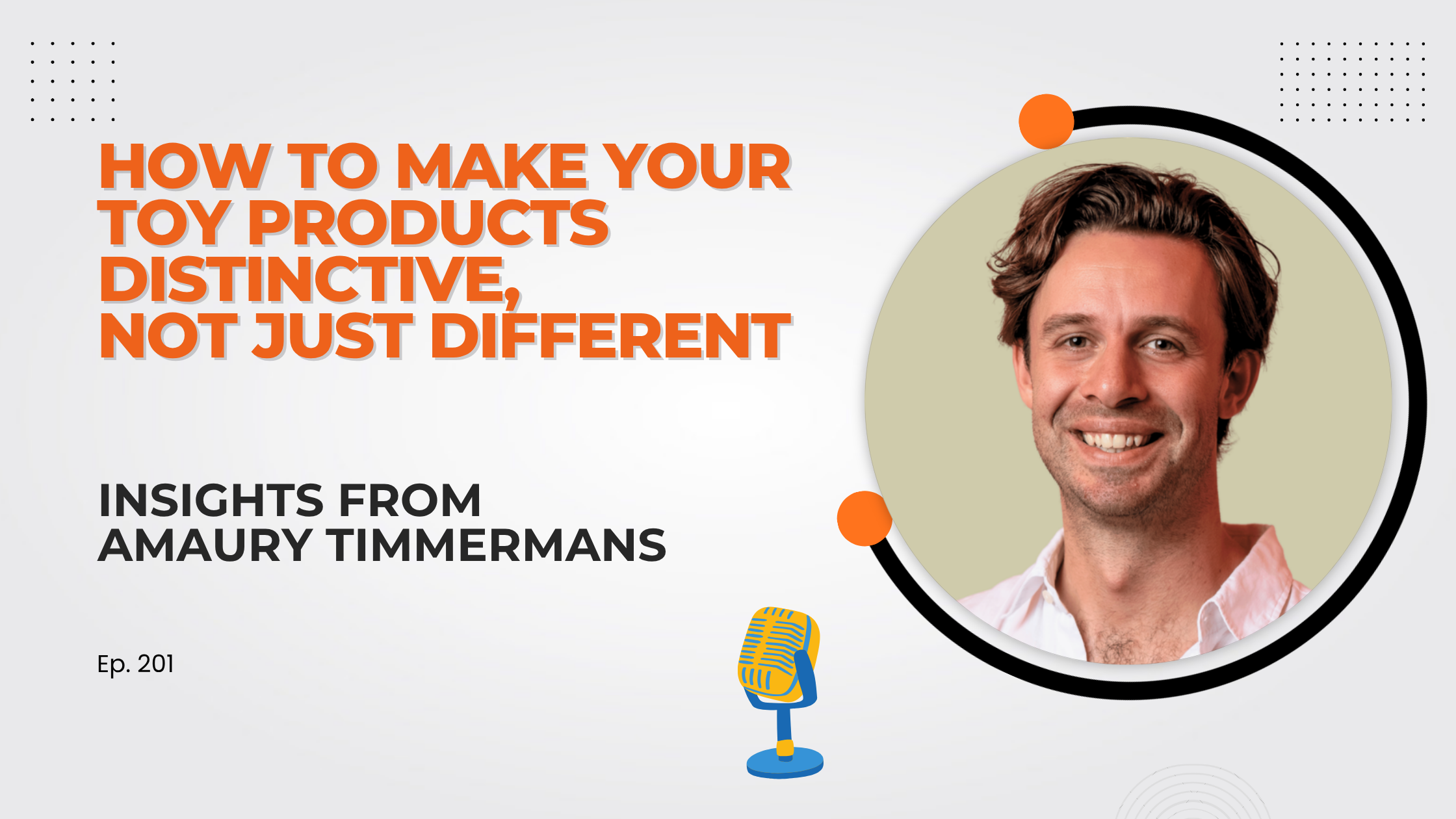
Welcome to this episode of the Toy Business Unboxed Podcast, where Jason sits down with Amaury Timmermans, owner of Egmont Toys. Amaury spent years in consumer goods and digital marketing before choosing to buy a toy brand rather than launch one from scratch. Since taking over Egmont Toys, a European toy company founded in 1994, he has been rebuilding its digital infrastructure, trimming its catalog, and repositioning the brand as a lifestyle company rather than a traditional toy maker. In this conversation, Amaury explains how his background at Procter & Gamble and in growth marketing shaped his playbook, and what it takes to bring a legacy brand into the digital age. It is a detailed look at buying, focusing, and modernizing an established brand instead of building one from zero.

#201: More Than Toys: This Brand Is Building a Lifestyle – Toy Business Unboxed
Episode Highlight
- 00:00 From P&G career to toys
- 00:44 Buying Egmont Toys, not launching
- 03:35 Instagram drives the most reach
- 04:33 The three core product lines
- 06:22 Becoming a lifestyle, not toys
- 07:15 Cutting SKUs by nearly half
- 12:23 Making the US the priority
- 15:19 Europe versus US trade shows
- 18:24 Building the next collections carefully
- 21:07 Advice for new brand owners
From Procter & Gamble to Buying a European Toy Brand
Amaury Timmermans did not start his career in toys. After business school, he worked at Procter & Gamble, learning account management and the retail industry from the inside. From there, he moved into a direct-to-consumer startup, then built and eventually sold his own growth marketing agency after COVID. Rather than launching a new brand from scratch, Amaury chose to buy one, and that search led him to Egmont Toys, a European toy company that was almost entirely a B2B business. His consumer packaged goods background turned out to be a natural fit for pushing Egmont Toys toward stronger online sales and digital brand building.
The Three Product Lines Behind Egmont Toys
Egmont Toys was founded in 1994 and built its identity around three main product lines. The most iconic is the mushroom nightlight, a design that has existed since the 1960s and that Egmont acquired the molds and rights to about ten years ago. Alongside that, the brand makes a range of plush and miniature plush toys, designed for cuddling and for imaginative play with their own miniature worlds. The third line is traditional wooden toys with a retro aesthetic, though Amaury is now being more selective about which wooden products stay in the catalog. Together, these three lines form the foundation Amaury is building the brand’s future around.
Positioning Egmont Toys as a Lifestyle Brand, Not Just a Toy Company
Amaury describes Egmont Toys as trending more toward a lifestyle brand than a traditional toy brand. Wooden toys became commoditized quickly once more competitors entered the space, since the barriers to entry were low, so Egmont leaned into visual appeal instead of competing purely on price. The products are designed to look good enough to stay out on display as part of a room’s decor, rather than being put away in a cupboard, which is why Instagram performs so well for the brand. That aesthetic focus also makes Egmont Toys’ products popular as gifts, since people buying for their own children may default to the cheapest option elsewhere, but gift buyers care more about how a product looks and feels.
Cutting the Catalog From 750 SKUs to 450
One of the biggest changes Amaury made after taking over was reducing the number of products Egmont Toys carries, going from 750 SKUs down to 450 in about eighteen months. He explains that retailers simply do not have the attention span to stock everything anymore, so a brand needs to be clearly linked to specific categories where it can be top of mind. The decision on what stays comes down to two factors: working capital, since rising interest rates make it harder to justify buying years of stock for a slow-moving product, and brand identity, meaning whether a product fits the illustrated universe created by Egmont’s in-house illustrator. A generic product with no illustration, like a plain wooden chessboard the brand used to sell, does not build brand recognition and was one of the first things cut.
Building the Content Egmont Toys Needs to Sell Online
Amaury says one of the biggest shifts in the digital age is how much content a brand actually needs to sell a product well. Ten years ago, one white-background product shot was enough for a catalog, but now Egmont Toys needs multiple angles, lifestyle photography, unboxing videos, ASMR-style videos, and testimonials for the same product. The team creates this content through a mix of in-house work, fixed freelancers and partners, and post-production tools to keep up with the volume needed across a large catalog. Amaury also points to search and chatbot visibility as part of the same infrastructure push, making sure Egmont Toys shows up when someone searches for a gift idea. All of this is part of moving a brand that was built entirely around B2B relationships into one that can also compete directly for consumer attention.
Making the US Egmont Toys’ Top Growth Market
Amaury calls the United States Egmont Toys’ number one focus market going forward. The plan includes investing in product availability and distribution, building a marketing engine around online advertising and content creators, and adapting products and pricing specifically for US buyers. Rather than hiring a dedicated internal US team, Egmont Toys splits responsibilities with its local US distributor, collaborating on trade shows and content instead of duplicating effort. Amaury also points to the past eighteen months of tariff uncertainty as one of the more difficult parts of planning an import strategy into the US. Even with that uncertainty, the US remains the market Egmont Toys is betting on most heavily for growth.
What Europe and the US Get Right Differently at Trade Shows
Amaury and Jason first met in person at Toy Fair in New York, which gave Amaury a close look at how differently the US and Europe approach trade shows. In Europe, toy shows and gift shows tend to blend together, with events like Nuremberg and Maison&Objet covering both toy stores and home goods stores under one roof. In the US, those two channels are much more separate, with distinct toy shows and gift shows depending on which type of retailer a brand wants to reach. Amaury also notes that Europe’s retail landscape leans more toward boutique and concept stores, while the US has larger toy retailers alongside a much bigger e-commerce and gifting channel. Understanding which type of show and channel fits a product is something Amaury sees as more important in the US than it typically is in Europe.
Growing the Universe Before Adding New Product Categories
Looking ahead, Amaury compares the toy industry to fashion, where new collections and staying on trend matter as much as the products themselves. Egmont Toys has doubled its budget for innovation and new product launches, but Amaury is intentionally keeping the next two collections narrower in focus, expanding the existing illustrated universe rather than chasing volume. Eventually, he expects to add entirely new product categories, possibly under a different brand name, to broaden Egmont’s footprint across more retail channels. The creative process itself has also shifted, moving away from starting with what suppliers can already build toward starting with the brand’s characters and story first, then designing products that fit that world. That story-first approach is what Amaury wants driving every future launch, rather than reacting to whatever is trending at the moment.
Advice for Newcomers in the Toy and Game Industry
Amaury’s advice for anyone starting out in the toy and game industry is to aim for distinctive rather than different. He says most people try to create something completely unique, but what actually works is taking one element or detail and making it stand out clearly. For Amaury, that means not trying to reinvent the wheel, but instead finding the one thing that makes a product recognizably yours. This is the same filter he applies at Egmont Toys, keeping products tied to the brand’s illustrated universe rather than chasing every trend that comes along. It is a simple piece of advice, but one he sees as a shortcut past a lot of wasted effort.
Conclusion
Amaury Timmermans’ path from Procter & Gamble to owning Egmont Toys shows how a background outside the toy industry can still translate into real advantages once applied with focus. By cutting the catalog, repositioning the brand as a lifestyle company, and investing in the US as its top growth market, Egmont Toys is working to modernize a 32-year-old brand without losing what makes it recognizable. Amaury’s emphasis on brand identity, from the illustrated universe to the products that are cut for not fitting it, runs through every decision he described. As Egmont Toys looks toward new collections and eventually new categories, the throughline stays the same: build the universe first, then decide what belongs in it.
Connect with Amaury Timmermans
If you’re interested in learning more about Egmont Toys or connecting with Amaury Timmermans you can reach out through the following channels:
- Website: Visit Egmont Toys’ official website for the latest news, game updates, and more
- Instagram: Follow Egmont Toys on Instagram for visual updates, game previews, and more links to their socials.
- Facebook: Follow Egmont Toys on Facebook for updates, discussions, and behind-the-scenes content.
Transcript
Jason Hsieh (00:00)
Welcome back to another episode of Toy Business Unbox Podcast. I’m your host, Jason Hsieh. Today, our guest, Amaury, had many years of experience in digital marketing with background in consumer goods. Right now he’s actually trying to revive old toy brand and transform them for a digital age with admin toys. So thank you so much for joining us on the podcast today and kind of sharing your experience within the toys and game industry so far.
Amaury Timmermans (00:23)
Thanks for having me, good to be here.
Jason Hsieh (00:25)
Yeah, so first of all, I know you have a very interesting journey in especially CPG industry. Since you transitioned into the toys and game industry, what are some of the I guess if you can kind of share your background in that industry and what make you want to start your own or at least working in the toys company and kind of the story behind that, that’d be great.
Amaury Timmermans (00:44)
Yeah, so after finishing business school, I started at Procter & Gamble. So we learned everything about account management, the retail industry, and after that ventured in a direct to consumer startup. So I saw a completely different distribution channel, much more marketing and paid marketing dependent, much more directly to marketing and sales as well. And
Then did an agency and then after we sold that, I wanted to buy a brand rather than launching one. And
That’s
Jason Hsieh (01:11)
Mm-hmm.
Amaury Timmermans (01:11)
How I came up
With Egmont Toys which
Jason Hsieh (01:14)
Mm.
Amaury Timmermans (01:14)
Is a 99 % B2B retail business so there’s
Jason Hsieh (01:18)
Mm.
Amaury Timmermans (01:18)
A couple there’s the CPG background comes in handy there and we really
Jason Hsieh (01:22)
Yeah.
Amaury Timmermans (01:22)
Want to put the turbo on our online sales and online brand creation as
Jason Hsieh (01:27)
Mm-hmm.
Amaury Timmermans (01:27)
Well.
Jason Hsieh (01:28)
And you also owned a digital marketing agency before, right? can you also share a little
Amaury Timmermans (01:32)
Yes, yes, yes.
Jason Hsieh (01:33)
Bit about what you did in the digital marketing space?
Amaury Timmermans (01:36)
I used to own a growth marketing agency. We sold that after COVID, where
We help brands grow online through digital channels. So it meant a
Jason Hsieh (01:46)
Yeah.
Amaury Timmermans (01:46)
Lot of storytelling on Instagram, creating a lot of content, landing pages, improving conversion, really trying to measure everything. Because with today’s digital tools, you can actually measure and see what drives results a lot more than what you could do 20 years ago, where you only had
The line marketing and you kind of prayed that some of the media buying actually worked.
Jason Hsieh (02:10)
I see, I see. And what kind of company do you usually work with, with your digital marketing agency?
Amaury Timmermans (02:15)
We have 50 % B2B brands, so they would get more lead
Generation and 50 % were B2C brands from where we had to drive app installs to where we had to drive appointments, subscriptions, but also just pure
E-commerce.
Jason Hsieh (02:27)
You also had handles on e commerce brand before, okay,
Amaury Timmermans (02:30)
Yeah, yeah, yeah, yeah, yeah, yeah.
Jason Hsieh (02:31)
Okay. How does some of those experiences kind of translate to the current brand that you own right now?
Amaury Timmermans (02:36)
Well, the industry changes rapidly, so also the digital channels are changing rapidly. I think the major
Jason Hsieh (02:43)
Mm-hmm.
Amaury Timmermans (02:44)
Change is the way the social media went from
Your audience, like people who followed you saw your posts to creative first, where actually every social media became more like TikTok and TikTok didn’t care about who followed you, they just showed your content to other people
Jason Hsieh (03:02)
Mm.
Amaury Timmermans (03:02)
That might be interested.
So that whole dynamic changed where first you had curated Instagram feed and then you were really trying to hack the media by. Now it’s much
Jason Hsieh (03:11)
Mm-hmm.
Amaury Timmermans (03:12)
More how much content can you make and is that content good enough to go viral to a larger audience? And that has been a game change that we advise clients on and we’re
Jason Hsieh (03:21)
Mm-hmm.
Amaury Timmermans (03:22)
Trying to take that new wave of creative first marketing at Egmont Toys as well.
Jason Hsieh (03:27)
Mm.
I see, I see, I see. What kind of what I guess strategy or channel that has been working well for your toy brand currently?
Amaury Timmermans (03:35)
Yeah, so we’re trending more towards a live sale brand than a toy brand. And
Jason Hsieh (03:39)
Okay.
Amaury Timmermans (03:40)
So the more Pinterest-worthy pictures, very aesthetically pleasing is something that we see the biggest results on. For
Jason Hsieh (03:47)
Mm-hmm.
Amaury Timmermans (03:48)
The past few months, everything behind the scenes, like the production process, also is a hook that worked quite well.
Jason Hsieh (03:52)
Hm. Okay. Yeah.
Amaury Timmermans (03:55)
And in terms of channel, Instagram is still our biggest channel in terms of reach. Just
Jason Hsieh (03:59)
Okay.
Amaury Timmermans (03:59)
Because of the aesthetically pleasing elements of a lifestyle brand, like to see how other people install their children’s rooms and so on.
Jason Hsieh (04:09)
Mm, I see, I see, I see. And that’s actually a very interesting angle where you’re trying to kind of portray like a lifestyle brand. And I guess it also makes sense with the type of product line that you have. Can you kind of for our audience that never heard of your brand in particular, can you kind of talk about a few different product lines that you currently have and what
Amaury Timmermans (04:26)
Yeah.
Jason Hsieh (04:27)
Are some of the best sellers and how is that gonna feed into the whole idea about the lifestyle brand that you’re trying to portray?
Amaury Timmermans (04:33)
Yeah,
So Egmont Toys has been created in 1994. So the brand is 32 years old and
Jason Hsieh (04:38)
Yeah.
Amaury Timmermans (04:40)
Our main product lines are threefold. One is the iconic mushroom nightlight. So we have a
Jason Hsieh (04:46)
Mm-hmm.
Amaury Timmermans (04:46)
Whole nightlight range, the mushroom nightlight. The
Jason Hsieh (04:49)
Mm-hmm.
Amaury Timmermans (04:49)
Nightlight has been around since the 60s. So Egmont purchased the molds and the brands I think 10 years ago. And
Jason Hsieh (04:55)
Mm-hmm. Okay.
Amaury Timmermans (04:57)
That’s the main nightlight you see on, you know.
We’ve seen those pictures in movies and so on. Then we have
Jason Hsieh (05:02)
Mm-hmm.
Amaury Timmermans (05:03)
A whole range of plush and miniature plush.
Jason Hsieh (05:06)
Okay.
Amaury Timmermans (05:07)
So soft toys, but not only to cuddle, also to play with. So different types of clothing. We also have whole miniature worlds we build around them. And then we have traditional toys, kind of with a retro aesthetic vibe. Wooden toys, bobble mongs, all those
Jason Hsieh (05:21)
Mm-hmm.
Amaury Timmermans (05:22)
Type of things. Why are we more a lifestyle brand? I think the…
The wooden toys were trending 10 years ago with the whole anti-plastic wave, but then they
Jason Hsieh (05:31)
Mm-hmm.
Amaury Timmermans (05:32)
Got commoditized real quickly. Some more brands are entering the market. The barriers to entry are actually really low. Whereas we would try to state, our products are actually…
Visually appealing so you don’t have to throw them away or in a cupboard when you have people over. They’re actually part of your interior, part of your decoration. And
Jason Hsieh (05:52)
Mm-hmm.
Amaury Timmermans (05:52)
That’s where we say, look, we’re more than just a toy, we’re more lifestyle, it becomes part of your decor. And that’s how also people portrayed on Instagram, look, this is my family room or this is my children’s room. And these are the toys that fit that image, which is
Jason Hsieh (06:06)
Mm-hmm.
Amaury Timmermans (06:06)
Why we’re really made for gifting.
So lot of people buy it as a gift to somebody else, whereas for
Jason Hsieh (06:11)
Mm-hmm.
Amaury Timmermans (06:12)
Their own children they might just go for the cheapest or easiest option on another channel.
Jason Hsieh (06:17)
Hmm, I see, I see, I see. And from your perspective, because you kind of take over this legacy brand that has been there for a long time, what are some of the major changes you’re trying to make within the company since you took over?
Amaury Timmermans (06:30)
I think it’s kind of the digital infrastructure and the digital hygiene. So first it’s changing all the systems behind the screens to be much more
Jason Hsieh (06:37)
I see. Yeah.
Amaury Timmermans (06:39)
Efficient and ready for
Jason Hsieh (06:40)
Yeah.
Amaury Timmermans (06:41)
Growth, ready to create content. And then what I
Jason Hsieh (06:43)
No.
Amaury Timmermans (06:44)
Call hygiene is, you know, working on the right content. What content do you need to sell online?
Because one back shot is not cutting it anymore. You need multiple back shots, back shots from all angles, lifestyle
Jason Hsieh (06:57)
Yeah.
Amaury Timmermans (06:58)
Pictures from all angles, video, ideally an unboxing video, an ASMR video, testimonial videos. So the
Jason Hsieh (07:05)
Mm-hmm.
Amaury Timmermans (07:06)
Whole content needs to be a lot richer than 10 years ago when people just said, okay, we need one back shot for the white background for the catalog and
Jason Hsieh (07:11)
Yeah, mm-hmm.
Amaury Timmermans (07:15)
We’ll just put that online.
Second is the assortment. We really try to reduce our number of SKUs. So we went from 750 to 450 in about 18 months.
Jason Hsieh (07:25)
Okay. Yeah.
Amaury Timmermans (07:26)
Just because the attention span of stores with all the brands out there is much smaller. So they really need to
Jason Hsieh (07:32)
Yeah. I see.
Amaury Timmermans (07:33)
Be able to link you to certain categories and products where you are top of mind.
Jason Hsieh (07:37)
Mm-hmm. Yeah.
Amaury Timmermans (07:39)
Whereas…
The days that you could do everything in bits and then one store would buy everything from you are completely over. There much more brands out there.
Jason Hsieh (07:45)
Mm-hmm.
Amaury Timmermans (07:47)
And then thirdly, part of the infrastructure is also the search SEO, making sure you’re visible on the chat bots. We pop up when people are looking for a gift for a three-year-old boy, for example. So those are really like the basic infrastructure things we’re doing to make the brand ready for the digital age.
Jason Hsieh (08:05)
Yeah.
Amaury Timmermans (08:05)
Whereas it was completely axed towards being a B2B brand.
Jason Hsieh (08:10)
Hmm. Yeah, that’s sound very, very good insight. I think a lot of the successful toys and game brands owners I speak with, they’re almost like a mini media company at the same time. Because it’s all about creating
Amaury Timmermans (08:20)
Yeah.
Jason Hsieh (08:21)
Media, creating attention. I think the attention now is kind of a new currency, right? Like how can we get more people’s attention, especially in the B2C space? B2B might be a little bit different, but for B2C it’s really about creating content just like you mentioned, to create images from different angles and all that.
Are you doing all that in house or how are you creating all the content since you have a massive catalogue as well?
Amaury Timmermans (08:42)
We’re doing a mix of in-house with fixed freelancers or partners and then some post-production through different tools.
Jason Hsieh (08:49)
Mm, I see, I see, I see. And do you notice any particular trend in your particular product line or the way like when you’re talking to people in the industry? like you mentioned, the wooden toy was hot many years ago. Like what are some of the trends you’re noticing for your particular category?
Amaury Timmermans (09:01)
Yeah.
So one trend I’m seeing is that a lot of brands start doing a lot more, like what we are trying to narrow down, a lot of brands are actually adding categories, maybe probably to offset the lower volume.
Jason Hsieh (09:16)
Mm-hmm.
Amaury Timmermans (09:17)
So every category becomes really crowded. Another
Jason Hsieh (09:20)
Hm.
Amaury Timmermans (09:21)
Trend that’s interesting, it’s actually the materials. So first
Jason Hsieh (09:24)
Okay.
Amaury Timmermans (09:24)
You had wood, and then everything had to be in wood, and then for cutlery and…
Plates and so on you had all the silicone and then had silicone night lights you silicone toys
Jason Hsieh (09:34)
Mm-hmm.
Amaury Timmermans (09:35)
Now you have the squishy trend where you know also different materials so
Jason Hsieh (09:39)
Yeah,
Yeah.
Amaury Timmermans (09:40)
Just having pastel colors on wood is not enough anymore. You actually see a really big differentiation in all types of material. And I think that’s a trend that we will continue on seeing. A mix of different material. So just everything tactile, so colors, smells, the material
Jason Hsieh (09:58)
Mm-hmm.
Amaury Timmermans (09:58)
It’s made with, I think we’ll see a lot more differentiation and innovation in that trend.
Jason Hsieh (10:03)
Mm, I see, I see. And I wanna go in in depth into one of the issues that you mentioned, since you talk about you are in the process of like a skill optimization for the catalog to kind of reduce in the product line. Like what are some of the criteria that you use to decide on which product is gonna stay and which product is gonna discontinue in the future?
Amaury Timmermans (10:22)
Yeah, yeah, so it’s mainly linked to two axes. One is your working capital.
Jason Hsieh (10:28)
Mm-hmm.
Amaury Timmermans (10:28)
Also with rising interest rates, we try to have a much higher rotation of our stock. So if we have to buy four years of stock or a certain product, we won’t do that anymore. And
Jason Hsieh (10:37)
Mm-hmm.
Amaury Timmermans (10:38)
Then the other one is…
Kind of your hedgehog concept, like what do you really want to be known for? And there
Jason Hsieh (10:44)
Okay.
Amaury Timmermans (10:44)
We took the choice, okay, we do the night lights, we do the plush and then we do traditional toys. But one of our key differentiators is our design style and drawing style. Like we have one in-house illustrator and she’s
Jason Hsieh (10:54)
Okay. Yeah.
Amaury Timmermans (10:57)
Drawing that universe of characters, of colors, of worlds. And so
Jason Hsieh (11:01)
Yeah.
Amaury Timmermans (11:01)
Everything that we can place in that universe.
Jason Hsieh (11:05)
Mm-hmm.
Amaury Timmermans (11:05)
With drawings
On, we’ll continue doing. Everything else we’ll start cutting much more just because we want people to recognize a product as Egmont toys
Jason Hsieh (11:13)
Mm-hmm.
Amaury Timmermans (11:14)
Even without being a label being attached. And so if it’s a
Jason Hsieh (11:16)
I see.
Amaury Timmermans (11:17)
Generic product and there’s no illustration on it whatsoever, we will probably now refrain from producing those because you’re just
Jason Hsieh (11:25)
Hmm.
Amaury Timmermans (11:26)
Interchangeable with any other product. So one of the SKUs we cut,
Jason Hsieh (11:28)
I see.
Amaury Timmermans (11:30)
We had a chess board.
Jason Hsieh (11:31)
Mm-hmm.
Amaury Timmermans (11:31)
Just
Generic wooden chessboard.
Jason Hsieh (11:33)
Yeah.
Amaury Timmermans (11:34)
We stopped producing that just because you can’t build a brand around chessboard.
Jason Hsieh (11:38)
I see, I see, I see. So try to stick with your kind of core identity and your product differentiation and try to, you know, me keep the product that really can stand out in a crowded market is really important.
Amaury Timmermans (11:43)
Yeah, yeah, Yeah, exactly. So the first step was
To define what is our identity, what are our different brand assets that we want to create, that we want to build. And then using that as a filter together with the rotation speed of a product to say we’re doing that and not that anymore.
Jason Hsieh (12:05)
Hm, I see, I see. And I know the brand is mostly like the traditional presence mostly in Europe. You have some US distributor, but like what are the strategy for US market going forward? Are you gonna spend more marketing resources, trying to expand the US present, doing more digital marketing here in US? Well what are some of the things you’re trying to do for
The US market?
Amaury Timmermans (12:23)
Yeah, no, the
US is our number one focus market. So we’ll invest a lot more in product availability, improving distribution, and then we’ll set up.
Yeah, a marketing engine as well, which is mainly online advertisements combined with content creators specifically for the US market, adapting
Jason Hsieh (12:40)
Mm-hmm.
Amaury Timmermans (12:41)
Some products to the US market, making sure the prices are right for the US markets. But it’s been a tricky past 18 months for importing brands in the US market. So we’re trying to
Jason Hsieh (12:49)
Yeah, yeah.
Amaury Timmermans (12:52)
Adapt as good as we can.
Jason Hsieh (12:54)
Yeah, including the tariff last year has been quite chaotic. It’s really hard to
Amaury Timmermans (12:57)
Exactly, Yeah.
Jason Hsieh (13:00)
Plan when you don’t know how much is gonna the tariff is gonna be. So I see. And like you’ve mentioned about the digital transformation process you are trying to do with your brand right now. What are some of the biggest challenges that you are still facing this year?
Amaury Timmermans (13:14)
One challenge is the data maturity. Like is your data correct? Do you have all the data available?
So that’s a big job to make sure all of that is correct. Then the other one is change management within.
Your team and your stakeholders, like are they on board? Can they use new tools and so on? And thirdly, it’s the change management with your partners, like your B2B partners. How are they ordering? Are they using all the content you’re creating? Because if
Jason Hsieh (13:40)
Mm-hmm.
Amaury Timmermans (13:40)
You just create content and nobody’s using it, then it doesn’t make lot of sense. So it’s kind of
Jason Hsieh (13:44)
Hmm.
Amaury Timmermans (13:45)
Making sure the basics are right and then making sure your stakeholders are involved in the change.
Jason Hsieh (13:52)
Yeah. Well for our audience context, how big is the team right now and how do you kind of divide up the role in your company right now?
Amaury Timmermans (13:59)
So we have a core team of three people,
Jason Hsieh (14:02)
Okay.
Amaury Timmermans (14:02)
So where one person is focused on products, the other is also on finance and I’m mostly focused on
Growth, so revenue and marketing and everything else.
Jason Hsieh (14:10)
Mm-hmm. Yeah.
Amaury Timmermans (14:12)
Such a core team of three people. And then we have our illustrator who’s linked to us with somebody doing creating video and content. Somebody’s
Jason Hsieh (14:20)
Mm-hmm.
Amaury Timmermans (14:20)
Handling help for customer support and influencer management. So a core team of three people, but then an extended team of seven people actually.
Jason Hsieh (14:28)
Okay, okay, okay. So extended team more is more like freelancer that’s working part time then? okay. Some of them work full time as well. Okay, okay. I
Amaury Timmermans (14:33)
Not necessarily, some of them work full time as well.
Jason Hsieh (14:39)
See, I see, I see. Do you have like a dedicated team member just for the US market or is it kind of mix where they kind of do both?
Amaury Timmermans (14:45)
No,
Because we split our responsibilities with our local distributor. So
Jason Hsieh (14:49)
Okay.
Amaury Timmermans (14:50)
It’s mainly their team and our team collaborating, going to fairs together, creating content together, rather than having one person who’s going to US only. And because there would be too much overlap with the operations of our distributor.
Jason Hsieh (15:03)
I see. Okay. Okay. That makes sense. That makes sense. And you mentioned that you are also coming to some of the US show. I think we met in person earlier this year in New York Toy
Fair.
Amaury Timmermans (15:11)
Yeah.
Jason Hsieh (15:12)
Like of your personal experience of attending shows in here in US versus some of the toys and game shows or gift shows
Amaury Timmermans (15:18)
Mm-hmm.
Jason Hsieh (15:19)
In Europe, what are some of the industry differences that you notice between the continents?
Amaury Timmermans (15:24)
It’s tricky, I think Europe has a background of much more boutique stores, whereas
Jason Hsieh (15:30)
Mm-hmm.
Amaury Timmermans (15:30)
The US is large toy shops, but e-commerce is much bigger and then you have a gifting channel. So
Jason Hsieh (15:35)
Hm, yes, yeah.
Amaury Timmermans (15:36)
The gift…
Channel is something in between our boutique stores and concept stores in Europe.
Jason Hsieh (15:42)
Mm-hmm.
Amaury Timmermans (15:42)
So it’s quite a specific type of store. And I think the shows are much more aligned to, is it a toy show or is it a gifting gift channel show? Whereas
Jason Hsieh (15:50)
Yeah, yeah. Yes, yes, yes.
Amaury Timmermans (15:52)
In Europe, those are mostly combined. Like in Nuremberg,
Jason Hsieh (15:55)
Okay. I didn’t
Know that. Okay.
Amaury Timmermans (15:57)
You’ll find products for both, whereas in Maison & Objet you also have
Jason Hsieh (16:01)
Difference.
Amaury Timmermans (16:01)
Things for the house, but also things for toy stores.
Jason Hsieh (16:04)
Yeah.
Amaury Timmermans (16:05)
So it’s much more heterogeneous, whereas in the US, it’s much more linked to a specific channel. Is it a gift show or a toy show?
Jason Hsieh (16:11)
Mm-hmm.
Amaury Timmermans (16:12)
Depending on where you go.
Jason Hsieh (16:13)
I see. Okay. That’s a very interesting observation. I didn’t notice that. I haven’t been to any I guess there’s no concept of like a gift trade show in Europe as much then.
Amaury Timmermans (16:23)
No, no, no,
No, it’s much more all around toy.
Jason Hsieh (16:27)
I see.
And I know you also have a lot of experience in the B2B side of business, obviously. So I know in US, at least my understanding, since I know the US market a lot better, is usually you use a lot of different sales rep group or self-rep trying to kind
Amaury Timmermans (16:40)
Mm-hmm.
Jason Hsieh (16:41)
Of represent your brand and talking to retailers.
Amaury Timmermans (16:43)
Yeah.
Jason Hsieh (16:44)
Is that also the same in Europe? How does it work in the B2B space?
Amaury Timmermans (16:47)
So in Europe we have two models, so all we work with distributors and represent your brands and then they buy stock and they own the commercial relationships. Or you work with rep groups,
Jason Hsieh (16:56)
Yeah.
Amaury Timmermans (16:58)
Like individual reps, and they take the orders and then you do the fulfillment. It’s a mix of both depending on the markets and the quality of the partners.
Jason Hsieh (17:04)
Okay, okay.
Amaury Timmermans (17:07)
Overall, the sector is in big change.
A lot of stores are closing, some new ones are opening, but the new ones have a more often digital approach, so they want to place orders on your B2B channel.
Jason Hsieh (17:18)
Yeah.
Amaury Timmermans (17:19)
They don’t necessarily want visits all the time, they want much more content to help them rather than
Jason Hsieh (17:24)
Yeah.
Amaury Timmermans (17:25)
Scanning through a catalogue.
Jason Hsieh (17:27)
Hm. Okay.
Amaury Timmermans (17:28)
So, and I think that the ones that stores that will survive will be the more mature ones. You can’t just open a store in the city center anymore and pray for the best. You need to understand
Jason Hsieh (17:38)
Yeah.
Amaury Timmermans (17:39)
Your margins. You need to understand what drives category value. You need to be able to…
You know, trade up consumers in your store. So we have our best collaborations with partners where we co-create with, like, let’s co-create your sales window, let’s co-create your shelf, let’s build the shelving plan, all the inputting, all products all over the place. So
Jason Hsieh (18:00)
So
Amaury Timmermans (18:01)
That’s a bit, big evolution we see.
For stores they need to adapt, need to professionalize a lot. So all the best reps, are the ones helping stores to do that.
Jason Hsieh (18:10)
Hmm, I see, I see, I see. Yeah, that’s a very interesting observation. And looking ahead here in the next few years, are you planning to launch more product or what are some of the things that you have in plan or your vision for the companies going forward?
Amaury Timmermans (18:24)
Yes, so novelties are the toy industry is much more like a fashion industry. People think the collections
Jason Hsieh (18:30)
Yeah.
Amaury Timmermans (18:31)
Is very, very important and it needs to be on trend. Now
Jason Hsieh (18:33)
Yeah. Yeah.
Amaury Timmermans (18:34)
Innovation will still be a big driver of what we do. I think we doubled the budget in terms of resources, innovation and launching new products.
Jason Hsieh (18:42)
Mm-hmm.
Amaury Timmermans (18:42)
So we will continue expanding our existing universe first and then down
Jason Hsieh (18:46)
Okay.
Amaury Timmermans (18:47)
The line we’re gonna add
Some new categories maybe in a different brand in one day to really try to expand our footprint and have a better mix of categories for the channel we operate in.
Jason Hsieh (18:57)
Hmm, I see, I see, I see. Do you have like a goal on how many new product you’re trying to kind of launch every e like every physical year?
Amaury Timmermans (19:04)
No, depends on the…
The season mainly, but also the quality that we get. Like it used to be a volume game, like the more novelties you launched,
Jason Hsieh (19:14)
Yeah.
Amaury Timmermans (19:15)
Better selling you have. Then again, you don’t want to dilute that brand identity anymore.
Jason Hsieh (19:20)
Yeah.
Amaury Timmermans (19:20)
So I think for the coming two collections, it will be much narrower focusing on building that universe. And then once that we add a fully new product category, then we’ll have a peek in new products again.
Jason Hsieh (19:32)
Hmm, I see. I see. Okay. Thank you so much for sharing that. And I know creativity is definitely a key in our toys and game industry. Like how how do you encourage your designer or your design team to come up with the creative idea for the new product that’s also aligning to your brand messagings? Like is it any specific maybe a magazine or a source, or do you just look at comparative product line or what are some of the methodology that your team used to come up with like the the a great idea?
That can actually stand out and be different in the market.
Amaury Timmermans (20:01)
Yeah. Yeah.
So we used to start from what can our partners build and then we try to make some of the products our own. And now I’m pushing the team much more to start from a sheet of paper first and build our universe. Like what
Jason Hsieh (20:17)
Mm.
Amaury Timmermans (20:18)
Are the characters, what do they do, what do they live in? And then
Jason Hsieh (20:21)
Mm-hmm.
Amaury Timmermans (20:22)
Based on that picture, like imagine a really large.
Painting of a world based
Jason Hsieh (20:28)
Yeah.
Amaury Timmermans (20:29)
On that what products can we actually create that fit that universe rather than the other way around to see what is available and let’s stick our colors to that. So the creative becomes much more story driven like what’s a universe,
Jason Hsieh (20:42)
Okay.
Amaury Timmermans (20:43)
What are the characters, what products can we invent in that universe rather than product driven, what’s trending and let’s make a version of that.
Jason Hsieh (20:50)
Hmm, I see, I see. Okay. Thank you so much for sharing that. So as we’re kind of wrapping up today’s interview, the last question I usually like to ask my guests is if you have to share one piece of advice with someone else that’s getting started within the toys and game industry, how would that be based on your experience?
Amaury Timmermans (21:07)
Mainly it’s being distinctive versus different. Everybody
Jason Hsieh (21:11)
Mm-hmm.
Amaury Timmermans (21:11)
Always tries to make something super unique, whereas it’s much more important for a product to be distinctive. Just take one element, one detail, make it different, make sure it stands out, and don’t try to reinvent the wheel.
Jason Hsieh (21:25)
Okay. Don’t try to reinvent the wheel that’s the message. Okay, got it. And for our audience I would love to learn a little bit more about you and your business. Where’s the best place for people to find online?
Amaury Timmermans (21:35)
So it’s Egmont Toys on Instagram, egmonttoys.com on the website. Those are our main channels that we respond to. Just slide in our DMs, ask any questions you want and I’ll be happy to get in touch.
Jason Hsieh (21:48)
Okay. We’ll make sure we also put that in the show notes. Thank you so much for your time today to share your journey and your wisdom within the industry so far.
Amaury Timmermans (21:56)
You’re welcome. Thanks for having me. Really appreciate it.
Jason Hsieh (21:58)
Yeah, and thank you for our audience for tuning in to this episode of Toy Business Unboxed Podcast. I hope today’s conversation gives you some practical insight and fresh inspiration for growing your own Toys for Game brands. This podcast is probably sponsored by Toy Launch, a leading marketing and growth partner for Toys and Game companies. At Toy Launch, we help brands scale on Amazon and beyond through full service account management, advertising, SEO, creative catalog optimization, and influencer marketing and more. If you
Are looking for a proven team that both understand the e-commerce space and the toys and games industry. We’re here to help. If you like a personal breakdown of your brand opportunity and the best next step, you can schedule a free consultation session with us. Just visit our website at toy-launch.com/schedule. If you want to connect with other toys and game founders, you can feel free to join our free communities. It’s called Toy and Game Launchpad. You can find more information also on our website as well.
And for more resource, update and industry insight, we also post a regular newsletter on our homepage. Until next time, keep innovating, keep creating, keep bringing joys through toys. This is Jason Hsieh signing off on the Toy Business Unboxed podcast. We’ll see you in the next episode. Thank you so much, everyone. Have a good one.
Grow your toy brand’s content reach
From SEO blog content to influencer outreach — we handle the full content engine for toy and game brands.