
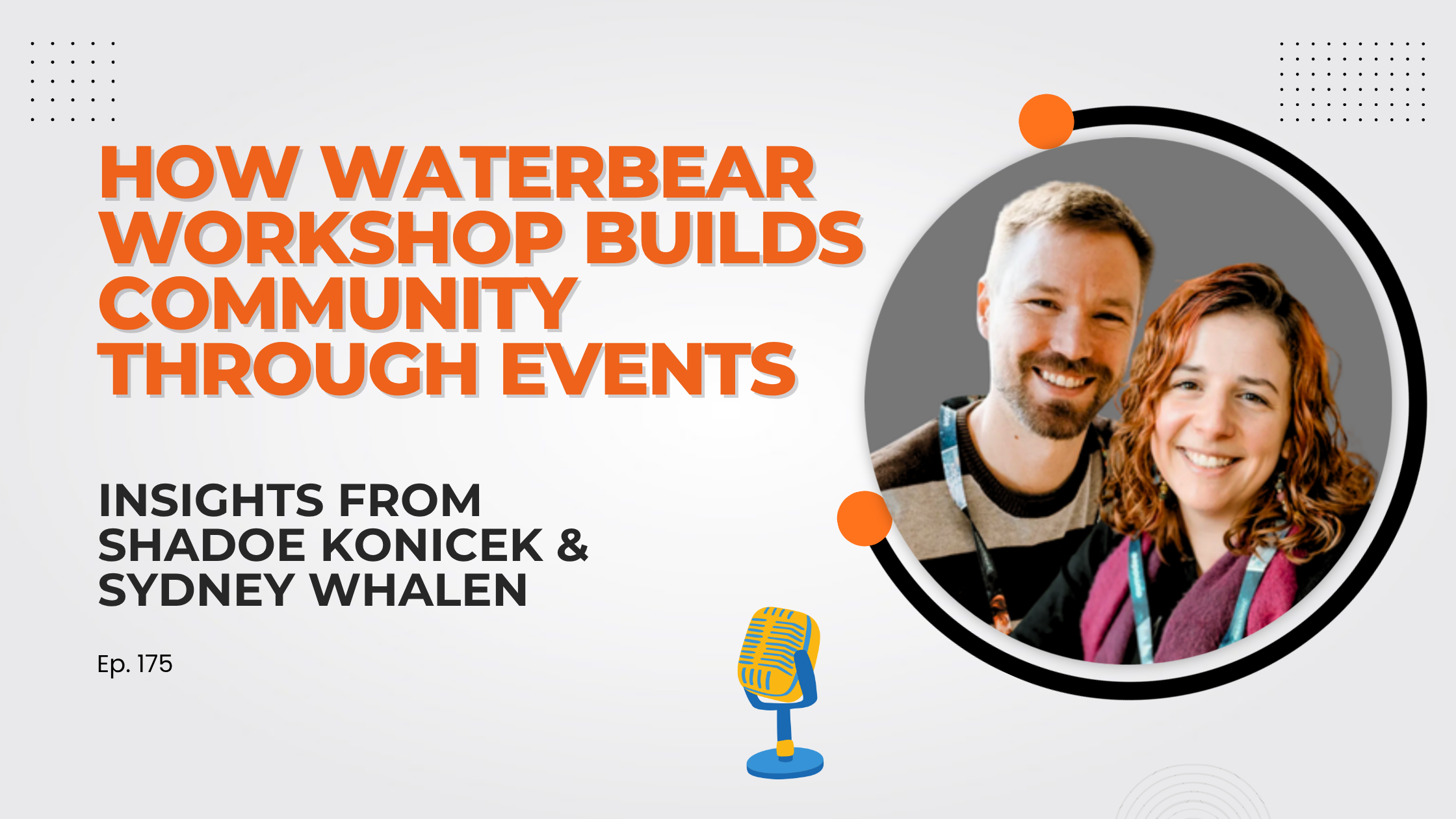
Welcome to another episode of the Toy Business Unboxed Podcast, where we sit down with Shadoe Konicek and Sydney Whalen, the husband-and-wife team behind Waterbear Workshop. Waterbear Workshop is a family-owned board game design and publishing company built on the idea that games can support education, creativity, and community. Shadoe and Sydney walk us through how a pandemic layoff turned into a self-funded debut game, and how that single decision grew into a growing catalog, a teacher resource library, and a full calendar of community events. They also share what it is really like to build a company together while raising a son who has become their most dedicated playtester.

#175: Waterbear Workshop: Building Community One Game at a Time – Toy Business Unboxed
Episode Highlight
- 00:42 Welcome and guest introduction
- 01:20 A layoff sparks a business
- 02:20 Self-funding their first game
- 02:59 Designing games with education
- 06:03 Building the Indie Game Bazaar
- 12:56 A look at The Mire
- 15:26 Biggest surprises running the business
- 18:31 Three games launching this year
- 21:11 His one piece of advice
A Layoff That Turned Into a Business
Shadoe had spent years working in the service industry, managing a jazz club and a nightclub, until COVID shut both jobs down. With unexpected time on his hands, he went back to a habit of designing games between jobs, and this time he kept going. He and Sydney started pitching finished games to publishers, but most publishers already had full pipelines and little room for new submissions. Eventually they landed on a concept that felt simple enough to publish themselves.
Choosing to Self-Fund Their First Game
Their debut title, The Mire, became the test case for publishing on their own terms. They chose it specifically because its component costs were low enough to self-fund without outside investors. That decision let them learn manufacturing and distribution firsthand instead of handing that process to a publisher. Sydney said the plan going forward is still to self-fund whenever possible, even as they start exploring crowdfunding for future titles.
Building Tardigrade School for Teachers
Both Shadoe and Sydney came from education backgrounds, and that shaped how they think about game design from the start. They noticed how games can reinforce reading, math, and both inductive and deductive reasoning skills in ways that feel natural to kids. That observation led to Tardigrade School, a pay-what-you-can print-and-play library aimed at teachers who often spend their own money on classroom resources. The store costs them little to maintain and gives teachers a free way to bring skill-building games into their classrooms.
Launching the Indie Game Bazaar
Waterbear Workshop also runs the Indie Game Bazaar, a marketplace event for local designers and self-publishers that debuted on December 14th. The event grew out of regular playtesting nights the couple had already been hosting at a supportive local brewery. Around ten vendors sold more than seventy indie games to a crowd of close to two hundred attendees. The event also partnered with Extra Life for Kids, a gaming-focused fundraising arm of Children’s Miracle Network Hospitals, raising about three hundred and thirty dollars for the cause.
Turning Playtests Into a Local Design Community
Shadoe and Sydney host roughly three events a month across different venues, mixing structured playtesting with casual free play. Those regular gatherings have pulled other local designers out of the woodwork, including people who had never designed a game before trying it themselves. One regular attendee is designing a game that simulates the experience of playing board games while legally blind. Sydney said the goal behind all of it is building genuine local community, not just selling more games.
What The Mire Taught Them About Design
The Mire is an abstract strategy game played on a six-by-six grid of thirty-six tiles, each carrying a mix of three symbols and three backgrounds. Players can only interact with tiles that share a symbol or background with their own held tile, and tiles sink into the mire as the game progresses. The goal is to keep your own movement open while cutting off your opponent’s options until they can no longer move. Shadoe and Sydney designed it to be small enough to fit in a bag and specifically built for two players, since so many games treat the two-player mode as an afterthought.
Three Games, Two Conventions, and a Growing Fellowship
Waterbear Workshop’s second game is already in manufacturing and expected to release around April, and their third game launches its crowdfunding campaign the same month. Once all three titles are out, Shadoe and Sydney plan to focus on selling what they have rather than rushing new releases. They were also accepted into the Horizons Fellowship through GAMA, which will send them to GAMA Expo and Origins this year, including a seminar they are giving on using events to build community and brand awareness. Sydney and Shadoe both work day jobs alongside the business, and their nine-year-old son Asher has already become the company’s first playtester.
Advice for Newcomers in the Toy and Game Industry
Shadoe’s biggest piece of advice is to get your game out into the world instead of waiting for it to feel perfect. He said designers often get stuck in their own heads, afraid that showing an unfinished idea or worrying someone might steal it. In his experience, ideas rarely survive unchanged once someone else gets involved, and the real value comes from the work of finishing a product. His advice is simple: get it out there, talk to people, gather feedback, and enjoy the process.
Conclusion
Shadoe Konicek and Sydney Whalen built Waterbear Workshop by leaning into community, education, and a willingness to learn manufacturing and distribution the hard way. From a self-funded debut game to a teacher resource library and a growing calendar of local events, their business keeps circling back to connection. With three games launching this year and a growing presence at industry conventions, the momentum is building. Their story is a reminder that a strong local community can carry a small business further than any single product.
Connect with Shadoe Konicek and Sydney Whalen
If you’re interested in learning more about Waterbear Workshop or connecting with Shadoe Konicek and Sydney Whalen you can reach out through the following channels:
- Website: Visit Waterbear Workshop’s official website for the latest news, game updates, and more
- Instagram: Follow Waterbear Workshop on Instagram for visual updates, game previews, and creative inspiration
- Facebook: Follow Waterbear Workshop on Facebook for updates, discussions, and behind-the-scenes content.
- Meetup: Join Waterbear Workshop on Meetup for playtesting events, the Indie Game Bazaar, and other in-person gatherings with the local game design community.
Transcript
Jason Hsieh (00:42)
Welcome back to another episode of Toy Business Unboxed. Today I’m sitting down with Shadoe and Sydney, the husband and wife duo behind the Waterbear Workshop. A family-owned board game design and publishing company built on the belief that the games are vessels for education, creativities, and communities. And thank you so much for both of you joining our podcast today. So first of all, let’s start with the story first. How did
Shadoe Konicek (01:04)
Thank you.
Sydney Whalen (01:04)
Thanks for having us.
Jason Hsieh (01:10)
The company kinda came to life. Like what really inspired both of you to turn your passion for games into like a business, with the board game publishing business that you guys run nowadays.
Shadoe Konicek (01:20)
Well, it kind of kicked off due to COVID a little bit. I’d been working in the service industry, managing a jazz club and working at a nightclub. And that all came to an end with COVID hitting. And I’ve tended in the past to kind of make games when I have been between jobs or have just had time. And this time I made one.
Started making another one and we kind of thought that maybe we could actually make a go of this and start pitching it to publishers. So we started doing that for a little while and understandably publishers have their own needs and wants and they have games that they’re already in their pipeline. Well getting any hits. But then eventually we came up with one that seemed very doable to make it happen on our own.
Jason Hsieh (01:47)
Okay.
Shadoe Konicek (02:03)
Our first publication and we started doing research, figured worked out the manufacturing and the distribution and just kind of figured it out that we could actually do this.
Jason Hsieh (02:13)
Mm, okay. Okay. And did you start out with doing a Kickstarter like a cloud funding campaign or was it like self funded?
Sydney Whalen (02:20)
So our first one, when we decided to just go for it ourselves, we did a self-funded run of our first game, The Mire. And we chose that one in particular because the component cost was something that we could handle self-funding. And we wanted to use that as an opportunity to explore that side of the industry to learn the ins and outs of manufacturing and distribution.
You know, we do have a game that we’re working on crowdfunding right now, but as much as we’re able to self fund our games, I think our goal is to go that route.
Jason Hsieh (02:50)
I see, I see, I see. Got it. So I know you both come from educational backgrounds, so how has that influenced the way you design and approach games?
Sydney Whalen (02:59)
Well, you know, both as an educator and as parents, we’ve noticed that like games can have a lot of sort of throughways to, you know, reading skills, math skills, abstract thinking, critical thinking, inductive and deductive reasoning, like all of these can come forward in a variety of games. And so, you know
Finding ways to sort of level up the types of games that are available to kids to help facilitate those skills, I think was, you know, one thing we had been thinking about. But then in that same vein, as former educators, we also know how helpful those types of tools can be to teachers in classrooms. So one big push we have for the new year is what we call Tardigrade school, Tardigrade being water bear. And
Tardigrade is a scientific term for water bear. And Tardigrade School is going to be a print and play sort of pay what you can store for educators so they can download games for free because you know, at least in the US a lot of teachers end up using their own pocket money for a lot of their resources. Yeah. And they can use those in the classroom and we’re choosing games that are, you know
Easy for the print and play format, but also specifically helping with some of those skills that I mentioned before. Yeah.
Shadoe Konicek (04:13)
Yeah. And you know, the nice thing about the print and play model is yes, it takes time and stuff to develop the game, but it’s not gonna cost us anything to have that store up on our website. Yeah. Hopefully being a nice resource for teachers, they’ll spread the word, get our name out there, get our brand recognition out there. And we do have the option, you know, if they utilize this for a while, they have the option to pay us. We’re not gonna ask for anything, but hopefully we do make a little income off of it.
That’s not the final rule.
Jason Hsieh (04:41)
Okay, okay. So is it almost similar to like do you know a website called Teacher Pay Teacher where you can download like different printables and stuff? Yeah.
Shadoe Konicek (04:49)
Yeah,
We’ve actually heard of that since we started working on this. We didn’t know about that originally. But it does seem very similar. That seems a little more like a marketplace of a lot of people can put their games on there, which is great. Ours will be mostly our own games that we put up. Yeah. Which will also be fun ’cause it’s a little bit of a workshop for us to be able to put some games up that might not get published otherwise or then we can see if it’s
Worth putting a lot more time into to publish a final copy of it. Yeah.
Jason Hsieh (05:18)
I see, I see, I see. How’s the reception from the teachers or the community since you launched that initiative?
Sydney Whalen (05:24)
Well, that’s actually officially launching you know, in the coming month or two. You know, we’ve been building up that part of our web store. You know, we have had some interest in the community from parents with kids who like designing games. And Shadoe also works with a local game retailer that designs programs for kids to
Design games like summer programs. So we’ve explored it a little bit that way, but the store itself is not live.
Jason Hsieh (05:52)
I see, I see, I see. And I know you have another initiative called Denver Board Game Designer Market. Can you tell our audience a little bit about what is it and what made you want to create this kind of event?
Shadoe Konicek (06:03)
Yeah, so December 14th was our first bizarre. We changed the name to Indie Game Bazaar, it just felt a little more fun. That was our first one. We’re hoping to make that an annual thing and it went over really well. In creating we’ve had a lot of focus on events and we do regular playtesting events and we’ve made it
Very open to other designers and open to the public and tried to make it a fun series of events. And in doing so, we’ve met a lot of other designers and a lot of other self-publishers and people who have projects coming up. And we were thinking, you know, it’d be nice to be able to sell some products in the Christmas season. And it would be one thing if we just set up shops somewhere just ourselves, tried to sell some, but
Really you want to get some people coming through. And we also just wanted to support the community. So we contacted a lot of people, got you know, there’s a brewery that we do a lot of our events with that been really nice and let us kind of pitch any event we want to to them and they’ll help us make it work. And so we talked to them about this. Hey, can we have just
Jason Hsieh (07:04)
Nice.
Shadoe Konicek (07:09)
A marketplace, a bazaar specifically for people in the local game industry. And we pulled it all together, everybody was extremely excited about it and we got a pretty good turnout.
Sydney Whalen (07:19)
Yeah, I’d say nice the resulting stats, you know, we I think with about 10-ish vendors there, not including the food truck we got. We had about not quite a couple hundred attendees, about seventy plus indie games sold. And we also were hosting a nonprofit that we’ve been working with called Extra Life for Kids, which is a gaming themed arm of children’s
Jason Hsieh (07:21)
Yeah.
Sydney Whalen (07:45)
Miracle Network Hospitals. So they raised about three hundred and thirty bucks I think during the event. So it was really nice to see it all come together. Yeah. Was excited to have a good turnout because it was I think something I would have wanted more lead time to prepare for.
Jason Hsieh (08:01)
It is tricky and a lot of work to prepare an event like that for sure. So and how do you find all the other vendor? Were you the one that is reaching out to all the other vendor and invite them to have a booth or
Sydney Whalen (08:12)
So we ended up yeah doing a lot of inviting for this one. You know, when it comes to events, we started with playtest events initially just to get an enough new people in front of our games to play test them effectively. And those events sort of took on a life of their own a little bit with other designers coming in and us wanting to create a space where other designers could bring their games in and you know, have an audience for playtesting those games.
So we got to meet a lot of local designers that way. And also interestingly, we’ve found that some people who weren’t designers have then become inspired to try out their own games, which I found very cool. One of our regular attendees, he’s been designing a game around the experience that he has of being, you know, legally, although not fully blind, and what that’s like.
Trying to play a board game with other people. And so he’s designing a game that’s supposed to simulate that a little bit. And we thought that was really cool. So we just thought that there was a need to funnel more excitement from the broader community toward those local designers that are really trying to do some interesting and creative stuff.
Jason Hsieh (09:18)
I see, I see. That’s a great thing that you put together event like that. So are you gonna do it again next year, it sounds like?
Sydney Whalen (09:24)
That’s the hope, and this time way more lead time.
Jason Hsieh (09:28)
Yeah. And
Shadoe Konicek (09:29)
Yeah.
Jason Hsieh (09:32)
I know your company definitely have a clear philosophy about game being the tool for both connections and also creativities. How do you keep that at the heart for all the new games or the current game you are working?
Shadoe Konicek (09:45)
Well, a big part of it is those events that we’ve been doing. You know, we do at least three events a month. At different venues and we get slightly different crowds at each one, but yeah, we have some people who will come to a variety of them. And really it’s just it’s been nice because other designers are coming out of the woodwork, like she said,
Jason Hsieh (09:52)
Okay.
Shadoe Konicek (10:08)
More people are starting to try out the game design, it’s really started to create a you know a community that supports each other and that really it’s getting really energetic and a lot of people are getting excited about it and discovering these new games that they’ve never thought about or getting into games. We’ve had people who aren’t really into games who show up and then they start to see what goes on behind the scenes a little bit and get excited about it. And
So the connectivity part there has really been It’s been cool to see. Yeah.
Sydney Whalen (10:37)
And I think it’s also somewhat inspired too just by this need to build more local community. You know, it’s been a tumultuous several years, you know, in the US. And I think we just wanted to try to find ways to make more connections in our neighborhood and bring people together that way.
Jason Hsieh (10:55)
Three times a month, that’s almost weekly. So like is it more play testing? Well what is the usual format for the gathering?
Sydney Whalen (11:03)
Play test and also, you know, we encourage people to, you know, just come and do free play too if they just want to play a game or they don’t want to play something that’s half baked yet. Just to kind of get more people in the door. We have at three different locations in the area. And then so those are our are like regular events and then we’ll do the one off type events, like the Indie Game Bazaar, you know, it’s more of an annual effort.
Another one we do is board game exchange. We did that last year and we’re gonna do that again this coming year, which is basically inspired by the overwhelming number of games we have on our shelves and the even more overwhelming number of games we want to buy. That was our first introduction to Extra Life, actually. We worked with them to have people bring old games, get
Jason Hsieh (11:41)
Okay, okay, okay.
Sydney Whalen (11:49)
Sort of new to them games and then the leftover games that were age appropriate were donated to the hospitals.
Shadoe Konicek (11:56)
Uhhuh. Or sold on ebay. We found it’s hard to sanitize all those games.
Jason Hsieh (12:00)
Yeah. Have you considered doing like tournament style as well? Like using your own games?
Shadoe Konicek (12:05)
We did that for the launch of the Mire. And we’ve had some ideas for some tournaments in the future as well. That it’s always been something that’s there and you know, we found any time we get a empty spot on our plate, we like to fill it up and just overload our plate. So sometimes certain things that are great ideas
You know, they get superseded by something else, but we certainly want to do some more tournaments. The Mire’s a great one for
Sydney Whalen (12:28)
We did some tournaments for the local brewery. That’s true. But they wanted to fill a Monday slot to have some more board game energy there, but we’ve found that Mondays it’s just a hard night.
Jason Hsieh (12:39)
People don’t show up, yeah.
Shadoe Konicek (12:41)
Yeah.
Sydney Whalen (12:42)
And with the tournament you really need like the turnout to make it fun.
Jason Hsieh (12:45)
Yeah,
It makes it make sense. So and I know you have game I think in front of you as well. Can you showcase our audience how this game works and, you know, the gameplays behind it as well?
Sydney Whalen (12:56)
Yeah, so this is the Mire. This was the one that we initially designed just in our sort of trial by fire play test. Or not play test, but designing experience.
Shadoe Konicek (13:06)
It was originally inspired kind of by another game that we’ve been working on that we worked on for a while and then realized it was an interesting game, but not particularly a fun game. So we it needed rethought and this was an attempt to rethink that and it wound up very different. But it’s a abstract strategy game. Okay. It comes with thirty six tiles.
That each have a different symbol and background on them. So there’s three different symbols, three different backgrounds, and a mix of them all. Yeah. And what you do is you lay the tiles out in a six by six grid. You’ll each take a tile that we call your held tile, and the image and background on that will dictate the moves you get to take. You only get to interact with tiles that share either an image or a background with your held tile.
Jason Hsieh (13:49)
Okay.
Shadoe Konicek (13:50)
But while you play, you do shift around tiles, you’ll get to swap out the tile that you have as your held tile. So you can change up your options. And as you move, tiles flip over and sink into the mire. So it’s a maneuverability game. You’re trying to keep yourself being able to move. Okay. As if you can’t move, you sink into the swamp and your opponent wins. You’re trying to outmaneuver them, open up your movement potential.
Take away your opponent’s movement potential until eventually somebody’s not able to move. And it’s a nice, simple game to learn, but has deep strategy. And we also just designed it because it takes up a small footprint. It all fits in this little bag and and we can take it to a coffee shop or take it to a brewery, set it up on the smallest table there and play a game.
Jason Hsieh (14:29)
⁓ Okay, okay.
Okay, okay. It’s quite portable, okay. Yeah.
Sydney Whalen (14:39)
I think that one was somewhat inspired too by the fact that that’s something we enjoy doing is you know, Denver is a very like micro brew and brew pub heavy location. And it’s nice to be able to go around and try different things, but also, you know, it’s also nice to have something to do with your hands while you’re there. And so we like the idea of
A game that was very portable, but also that was specifically designed for two players, because so often you see a game that says, two to four or two to five, but the two player portion of it feels a bit shoehorned in. Where it’s not really designed for that. So that was also part of the inspiration for doing this one in particular.
Jason Hsieh (15:16)
Hmm, I see, I see. Thank you for sharing that game with us. So since you started the company, what are some of the biggest lessons or even surprises that you have encountered in your journey so far?
Shadoe Konicek (15:26)
So some of the biggest surprises, honestly the entire process of making a game. Which seems kind of silly looking back on it, but yeah.
Jason Hsieh (15:31)
Ha ha ha.
Shadoe Konicek (15:35)
Working out the manufacturing, getting all the art together in the right formats, making sure that all the pieces make sense and fit the components fit your budget and the number of units you want to make to make it fit a pallet so that shipping is more cost effective. And then the shipping itself and the distribution. It’s a lot.
Jason Hsieh (15:53)
That’s also marketing too. Yeah. Yeah. For sure. Definitely a lot of moving pieces as well. So looking back, how do you currently balance being the creator, the event organizer, and the business owner, all at the same time?
Shadoe Konicek (15:55)
The marketing we can’t forget about that.
Sydney Whalen (16:08)
Honestly, we just work a lot. We also have day jobs. We have day jobs and we’re parents and you know I think it’s helpful that our day jobs are very supportive. The retail store Shadoe Works for I mean they’ve been buying and selling the Mire. They were joking about changing the name to the Mire store because they’re doing really well there.
Shadoe Konicek (16:30)
We just opened a second location and it’s the number one product in both locations right now. We’re sold about two hundred units through.
Jason Hsieh (16:35)
Nice.
Nice, nice, nice. Great.
Sydney Whalen (16:40)
Yeah. And my day job is I do creative content marketing for a manufacturing company. So less relevant, but you know, they’re aware of the business and they’ve been very supportive of, you know, trying to make space for that and and you know, just talk us up and stuff and that’s been nice. But yeah, it’s just a lot of work right now. We’re just trying to pound the pavement and hopefully at some point we can work in this business full time and
Mm-hmm. You know, as parents too, it’s nice ’cause our son, Asher, he loves games and he’s enjoyed making some of his own games and he’s enjoyed I think our last playtest event at the brewery, he actually came and taught his own game and I think you know, his engagement in that has been nice. We can kind of fold him in and find ways for him to find creative outlets with
Jason Hsieh (17:25)
Nice. How old is your son?
Sydney Whalen (17:27)
Well he’s nine. So you know it’s a balancing act ’cause we’re like, you know, we keep telling him like you don’t have to do any of this, but if you want to, we’ll find ways to investigate. Like he likes to take pictures of the game pieces and stuff and yeah.
Shadoe Konicek (17:40)
He was the first playtester for the Mire, so
Sydney Whalen (17:42)
He’s got a mention on the back of the box.
Jason Hsieh (17:45)
For sure, for sure. Sounds like my son was some of the toys that I designed. So yeah, and thank you so much for sharing your vision of like wanting to do this full time. I can totally relate personally because I also have a toy company. It took me six years running it on the side to finally able to quit my day job six years later. So it’s not a fast process to scale a toys and game company because it’s a hard business type to
Scale unless you have like a massive budget and like a big team that you can design toys or games every single month and publish every single month it’s not very easy to scale. So yeah. But looking ahead here for your vision down the road, maybe three, five years, what is the vision for the company? Are you launching more games? Like how often are you thinking about launching new games on the annual or quarterly basis?
Shadoe Konicek (18:31)
So we have our second game in manufacturing right now, actually. It’s funny, our digital sample arrived at our house and we’re on vacation here, so we’re excited to get home to today’s
Sydney Whalen (18:40)
Yeah.
Jason Hsieh (18:41)
Yeah, I see. Yeah.
Shadoe Konicek (18:42)
But yeah, that should be available hopefully April we’re guessing based off the timeline. Chinese New Year will get a little bit in there and mess with that, but
Sydney Whalen (18:52)
Yeah, we manufacture through long pack.
Jason Hsieh (18:54)
Okay, okay.
Shadoe Konicek (18:54)
And then so that should be releasing sometime in April. And at the same time we’re launching our crowdfunder for our third game, beginning of April. Yeah. April’s a big month. And at that point, you know, once we have three games under our plate, you know, each game leads to some sales of the previous game, and that should be a nice number to hopefully hold that for a while.
You know, we’re always going to keep coming up with new ideas and testing new ideas and we’ll be putting games out on Tardigrade school. But as far as manufacturing, we’re hoping to recoup some of the money in sales. Yeah. You know, focus on selling the three games that we have. Unless our crowdfunder is wildly successful, which would be great, and then we can kind of make a push of it.
Sydney Whalen (19:37)
But I mean the plan is to do more games. I think we just wanted to do a strong push to get those first three out and then we’re going to try and find a steady pace that’s maintainable with our current funds. Mm-hmm. But we also want to lean into the events more, do more in that arena. We’ve been talking to Extra Life about the possibility of doing some events at children’s hospitals. Yeah, so you know, we’ve been really kind of
Jason Hsieh (19:59)
Okay, that’ll be nice.
Sydney Whalen (20:03)
Excited about how that portion of the business has grown and we want to find some more ways to use that to help gonna bolster the business in general, find some monetization opportunities, for example.
Shadoe Konicek (20:14)
And we get to go to a few more conventions this year, which will be nice. We’re accepted into the Horizons Fellowship program through GAMA, which is extremely helpful in us being able to go to the conventions. And so it’ll be a nice year for us to get a little bit of a spotlight on us, but also just be there and chat with other people in the business, make some good connections, and hopefully
Grow a little bit, get our name out there more.
Jason Hsieh (20:37)
So you’ll be in gamma and
Sydney Whalen (20:39)
GAMA expo on origins through Horizons Fellowship and Yeah, we’ll be doing a seminar at GAMA Expo on events, on using events to community and grow your brand awareness and things like that. So
Shadoe Konicek (20:43)
And we’re actually giving a seminar.
Jason Hsieh (20:50)
Okay. ⁓
I see, I see. I’m also speaking at GAMA as well, yeah in March. So yeah, well that’s that would be great. So as we’re wrapping up today’s interview, if you have to share just one piece of advice with someone that’s just getting started within the toys and game industry, what would that be?
Shadoe Konicek (21:11)
Mm-hmm.
Get something out there. It’s really easy to get in your own head and you need the game to be perfect before you show it to anybody else. But that’s a good way to get trapped in a way. You need to get it out there, talk with people, get ideas, not be scared about people taking your idea because even if they do, it’s gonna wind up entirely different when they go through the process. You know, ideas are easy.
The work behind it is what really gets it to a final product. And if you have the passion for that, you’re going to do that. So get it out there, talk to people, get feedback, and enjoy it.
Jason Hsieh (21:46)
I see. I see. And so thank you so much for being on our show. What is the best place for people to find you online if they want to learn a little bit more about you and your businesses?
Sydney Whalen (21:56)
Waterbearworkshop.com is our website. And that will have links to all of our socials. You know, we’re active on Instagram, Facebook, LinkedIn, and now we’re starting to explore TikTok. Despite my every urge to avoid TikTok, but yes. I think our digital marketing
Jason Hsieh (22:09)
Okay.
Sydney Whalen (22:14)
Presence is probably bigger than our business right now. So we’re findable.
Jason Hsieh (22:20)
Okay, okay. Thank you so much for sharing that. We’ll make sure we put that in the show note. And thank you for both of you for your time and also sharing your wisdom and your experiences with our audience on the show.
Sydney Whalen (22:31)
Thank you for having us.
Jason Hsieh (22:32)
And thank you for our listeners for tuning in to this episode of Toy Business Unboxed Podcast. I hope today’s conversation gave you some practical insight and fresh inspiration for growing your own Toys and Game brand. This podcast is proudly brought to you by Toy Launch, the leading marketing and growth partner for Toys and Game companies. At Toy Launch, we help brands scale on Amazon and beyond through full service account management, advertising, SEO, creative, catalog optimization, influencer marketing, and more.
If you are looking for a proven team that understands both the toys and game industry and e-commerce, we are here to help. If you’d like a personalized breakdown of your brand opportunities and the best next step, you can schedule a free consultation session with us. Just visit toy-launch.com/schedule. If you want to connect with other toys and game founders, join our free communities, Toys and Game Launchpad, at toy-launch.com/group.
For more resource, update, and industry insight, visit us at anytime at toy-launch.com. Until next time, keep innovating, keep creating, keep bringing joys through toys. This is Jason Hsieh, signing off on the Toy Business Unboxed podcast. We’ll see you in the next episode. Thank you so much, everyone.
Grow your toy brand’s content reach
From SEO blog content to influencer outreach — we handle the full content engine for toy and game brands.