
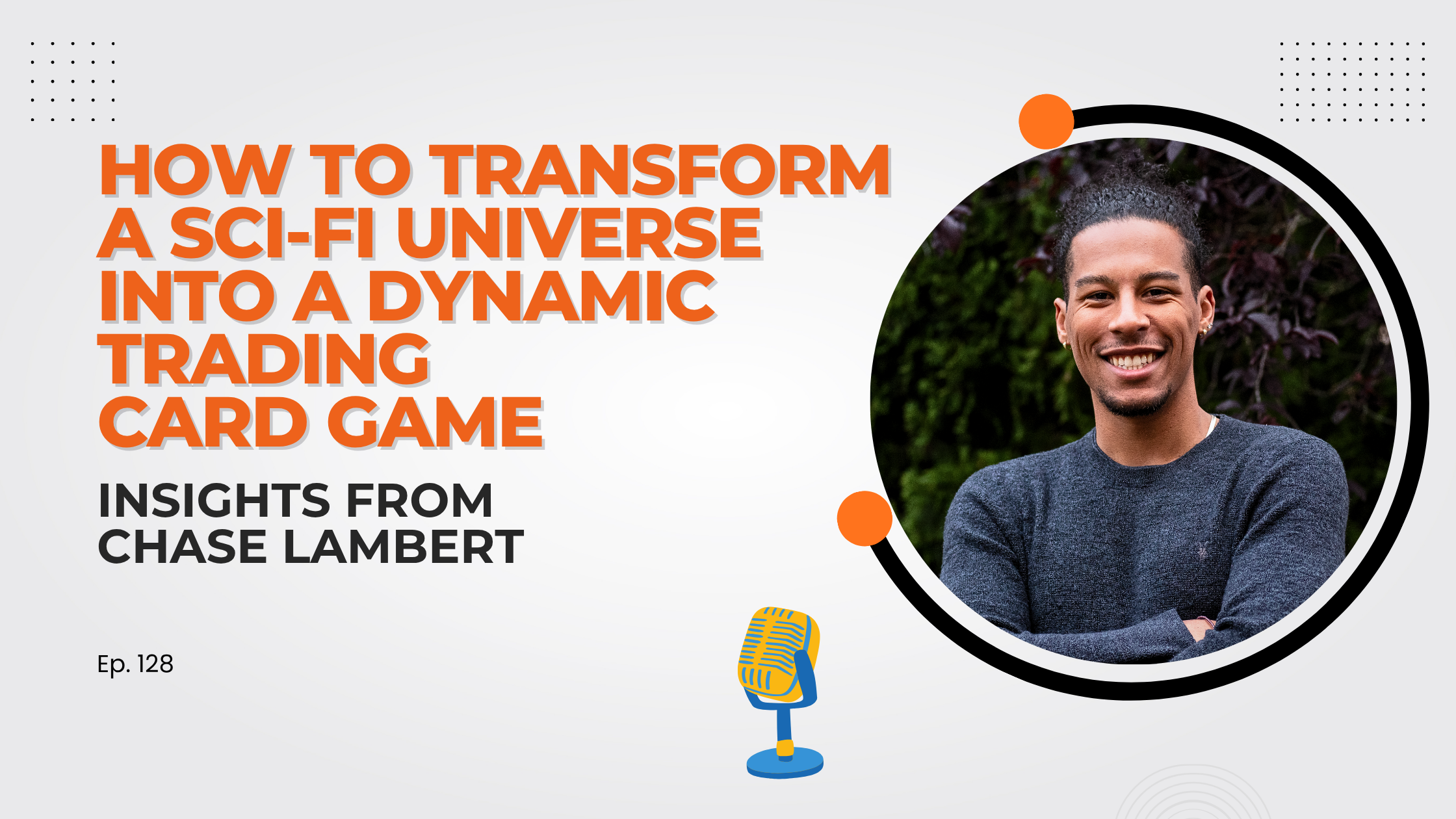
Welcome to a behind-the-scenes look at one creator’s journey from filmmaker to game designer. In this post, we explore how Chase built a thriving multimedia universe — one rooted in rich world-building, fan involvement, and strategic design. Whether you’re a storyteller, entrepreneur, or game enthusiast, his path from self-taught animator to trading card game creator offers a practical blueprint for turning passion into a sustainable IP. Here’s what he learned — and how you can apply it to your own creative projects.

#128: From Film to Card Games: Building an Evolving Interactive Universe – Toy Business Unboxed
Episode Highlight
- 00:00 Chase’s Journey from Filmmaking to Game Design
- 02:38 World Building in The World of Kalia
- 04:58 Transforming Ideas into a Trading Card Game
- 08:26 Challenges in Game Development
- 10:34 Game Mechanics and Objectives
- 12:47 Playtesting and Feedback in Game Design
- 14:08 Animation and Storytelling in Kalia
- 15:56 Balancing Sci-Fi and Fantasy Elements
- 17:49 Engaging Fans in the Creative Process
- 20:29 Feedback from Retail and Conventions
- 23:40 Licensing and Future Plans
- 24:42 Goals for 2025 and Beyond
- 25:51 Marketing Strategies for the Game
- 27:57 Advice for Aspiring Game Designers
From Film to Fantasy: Chase’s Evolution into Game Development
Chase’s journey began at 16 with his own production company, IQ Pictures, focusing on commercials and music videos. When Hollywood slowed during COVID-19, he pivoted to animation, teaching himself Blender and 3D modeling to bring a sci-fi idea he’d been nurturing since high school to life. Recognizing the high costs of film production, he found a smarter path in game development, an interactive medium where fans could directly participate in the universe he was building. The World of Kylia became his way of merging storytelling with community engagement, proving that adapting your skills to new formats can unlock both creative growth and business resilience.
Building a World: The Art of Rich Storytelling Embedded in Gameplay
At the core of Chase’s success is a compelling, clearly differentiated universe. Kylia is a sci-fi fantasy realm with its own unique lore, a society fallen into a dark age where rediscovered technology is mistaken for magic. This layered world is built for multiple formats including comic books, animation, and a trading card game, with each medium reinforcing the others. The result is a holistic experience that invites fans to explore and participate, while opening up diverse monetization avenues and fostering deeper emotional connections through lore-driven gameplay.
From World-Raising to Interactive Gaming: Creating a Trading Card Universe
Transitioning Kylia into a trading card game was driven by a desire to empower fans, giving them a platform to build their own characters and stories that static storytelling couldn’t offer alone. Chase chose a TCG for its accessibility and flexibility, though the process came with a steep learning curve in manufacturing, gameplay balancing, and card design. After a year and a half of playtesting and community feedback, the game took shape, bridging narrative with mechanics and integrating RPG elements that emphasize skill, teamwork, and creative participation.
Fan-Driven Content: How Engagement Fuels Growth and Authenticity
One of Chase’s standout strategies is active fan involvement. Through Discord communities and live events, fans participate in storytelling, character creation, and even influence the game’s lore, with some contributions making their way into official art and storylines. A great example is the “Heart of Malik,” a character designed by a community member who won a contest and is now an iconic card in the game. This participatory approach deepens emotional investment, turns consumers into co-creators, and generates valuable feedback that guides future development.
Overcoming Challenges: Balancing Innovation with Practical Constraints
Bringing Kylia to life as a playable game came with real challenges, from balancing gameplay complexity to managing card manufacturing and distribution. Early convention appearances like PAX West and LA Comic Con proved invaluable, giving Chase’s team direct player feedback that made the game faster and more intuitive. The takeaway is straightforward: iterative testing and adaptability are essential to building a product that truly resonates.
Future Horizons: Scaling the World of Kylia
Looking ahead, Chase plans to expand Kylia with more sets, comics, and eventually animation and live-action projects, with a full in-house animation studio in the pipeline. To grow the IP, he leverages social media platforms like TikTok, Instagram, and YouTube, while strategic influencer partnerships and tournaments drive visibility and engagement. The long-term vision is a full ecosystem of merchandise, media, and community that sustains and amplifies the universe’s reach.
Advice for Aspiring Toy & Game Creators
Chase offers pragmatic advice for newcomers: solidify your project’s core identity early. Having a clear, unique concept prevents costly redesigns later. He also stresses the importance of reaching out for help, building relationships and collaborating with artists, players, and community members. Most importantly, patience and persistence are vital. Chase’s decade-long journey underscores that sustained effort and genuine engagement lay the foundation for long-term success.
Final Insights
Creating an immersive universe is a complex but rewarding endeavor, blending storytelling, game mechanics, and community engagement. Chase’s experience reveals that authenticity, adaptability, and fan involvement are key ingredients to breaking through industry noise and building something truly special. Whether you’re developing a toy line, a game, or a multimedia franchise, the principles remain the same: craft a rich world, empower your community, and stay committed for the long haul.
Connect with Chase Lambert
If you’re interested in learning more about World of Kylia or connecting with Chase Lambert you can reach out through the following channels:
- Website: Visit The World of Kalia Official Website for the latest news, game updates, and more.
- Instagram: Follow World of Kylia on Instagram for visual updates, game previews, and creative inspiration
Transcript
Jason Hsieh (00:42)
Welcome back to Toy Business Unboxed. Today’s guest is Chase, a filmmaker turned game designer whose original IP, The World of Kalia, spent comic animation and trading card games. Chase’s journey started with a film camera at age of 16 and since then have evolved into multimedia universe, really built on rich storytelling and interactive design. In this particular episode, we’ll be chatting about
game development and what it takes to really build your own world from scratch and how the fan can really play a big part in shaping the future of your business within the toys and game industry. Thank you so much for being on our show today, Chase.
Chase Lambert (01:19)
Yeah, absolutely. Thank you for having me.
Jason Hsieh (01:20)
So first of all, can you share with our audience a little bit about your background? Like I mentioned in the intro, you have a huge background in filmmaking. Can you kind of talk about your journey so far?
Chase Lambert (01:31)
Yeah, absolutely. So you’re right. When I was 16, I started a film production company called IQ Pictures. Originally it was just a way for me to do like small commercials with friends or family that needed, you know, filmmaking help. And as I developed the project and the company, I ended up going to college and learning more about filmmaking. I was a filmmaking major at Loyola Marymount I had an amazing time, met some great friends and I did a lot of commercial work in California.
did a little bit of music videos and commercials, did a live action film. And then during COVID at the start of it, Hollywood basically shut down. So a lot of us had nothing to do and I had an interest in animation. So I decided to teach myself Blender and started picking up 3D modeling and animation gigs. And then as I was developing my skillset there, I realized that there had been an idea that I had been working on since high school.
And I kind of wanted to turn that into a full-time job later on. And COVID seemed like the best time, because I had all the time in the world and nothing else to do. So I ended up developing and putting it out on social media. And then now I’m here as a full-time game designer, animator, and creative director.
Jason Hsieh (02:38)
Where is the idea to come from behind the world building that you have currently?
Chase Lambert (02:43)
When I was young, I watched a lot of movies. ⁓ And in high school, my senior year, I took a trip to Hawaii. And I had just learned about the Dune franchise, Frank Herbert’s Dune. I was, and this is before they did the remake. So this was like originally the book and then the older movies. And I fell in love with it. I had been a huge fan of Star Wars. Things like the Twilight Zone were also huge inspirations for me. And as I was kind of developing out the sci-fi world, the original ideas I wanted to make
feature film set in this universe. But then I quickly realized upon going to college that the budgeting of a project like that would be borderline impossible because I’d have to get like hundreds of millions of dollars as a 20 year old. So I knew it was impossible. So I thought, you know, I’d seen other people. There’s an animator called Ian Hubert, who was a big inspiration for me. And he was doing his own animation on YouTube. I did small tutorials teaching people how to learn Blender.
and how they could turn their projects into real life. And I was like, okay, maybe this is something that I could teach myself how to do and turn into a job.
Jason Hsieh (03:43)
I see, see. And can you talk about this World of Kylia that you’re building? What is in it? What kind of character?
Chase Lambert (03:50)
Absolutely. Kylia is a sci-fi fantasy universe. So think of like similar to Star Wars where they have you know, the ability to fly, There’s, you know, science things like ray guns and stuff like that. But at a certain point in their history, there was an event called “the fall” in which society kind of regressed back to kind of like more of a fantastical age where you’re kind of in a dark age. So rather than having access to technology, like everyone just has it at default.
they have to discover it through ruins and ancient artifacts and stuff. So to them, it’s the same as magic because if you were in, you know, 1700 and someone just pulled up in a spaceship, you’d be like, okay, they’re a magic person. They can fly. Okay. So that’s a little bit of that, Kylia. And then one of the main projects we’re working on right now is our comic book series, which should be coming out later this year, which kind of has more of a traditional storyline.
where it follows one character and his journey throughout the planet, discovering a lot of the ancient history of the world and kind of how they got to the point they’re at. at. So yeah.
Jason Hsieh (04:51)
I see. So there is a whole project to build a world that you currently have. How does that idea turning into a trading card game?
Chase Lambert (04:58)
Yeah, absolutely. So when we when I started working on the project, one of the things that I quickly realized was filmmaking is amazing. It’s you know, where I grew up, I love that it’s probably what I’ll be doing for the rest of my life. But one of the downsides of that as an art form or as a medium is as soon as you deliver the film, the process kind of ends like you show someone your narrative story, they can, you know, take it, they can come up with theories. But at a certain point, there’s just kind of no more to discuss with the topic.
And I wanted to build a world that allowed people who also liked similar things in this kind of sci-fi fantasy genre to make their own characters and be able to tell their own stories. And not everyone is going to have the skill set and the time to like learn how to animate and tell their own stories. So I wanted to come up with a format that allowed people to make their own characters and really like build out the world that I was building alongside me. And as I was talking to my friends, it seemed like a trading card game was probably the easiest
format to do that. We talked about maybe doing a video game, but then again, the same thing is like, it’s so expensive to develop. then we ended up doing a couple art competitions and meeting some really talented artists. And then the person who won our original, first art competition ended up being the creative director and does, he’s the head illustrator of our project for the visual side. So that’s Colin. So yeah, he’s, he’s amazing. And we ended up kind of transitioning a lot of the stuff that we had written.
for the screen or for a comic book and just reworking it into card game format to allow players the ability to, if they liked the genre or if they liked our project specifically, they could then take the cards and then make their own characters and then play against each other in kind of an ever evolving storyline rather than just one set narrative.
Jason Hsieh (06:41)
I see what has been some of the biggest challenge in turning the world into the playable trading card game so far.
Chase Lambert (06:48)
Yeah,
I mean, there’s been a couple of things that have been pretty difficult. One was there’s a steep learning curve when it anytime you go to a different genre or a different medium. I had a background in when I was a kid, I played a lot of Yu-Gi-Oh! and I collected Pokemon I never really understood. I don’t know if anyone actually can play Pokémon. I’m not convinced it’s a Mandela effect, I did collect Pokémon and Yu-Gi-Oh! as a kid. So I knew a little bit about the trading card game space, but honestly,
the manufacturing side and understanding the business of trading card games was probably the most difficult part. Whenever I talk to new designers or try to give them advice, I always say that like 10 % is designing the game. The other 90 % is getting it into customers hands. So, know, it’s, very easy to say like, let’s just make a game where this happens and this happens and that’s cool. But then you have to figure out like, okay, will this work in a card game format? You know, if people buy these cards, will they hold value?
What GSM card stock are we using? What barcodes like that was for me the biggest the biggest hurdle. And then design wise, I think there was a brief moment initially, where I was trying to come up with a game that felt unique compared to other games. Okay, there’s definitely the idea that there’s no new ideas under the sun. Everything is kind of borrowed from somewhere else. Yeah, I really wanted to make a game where it felt like you were playing a new game rather than just a rehashing of something like Magic the Gathering or Pokemon.
So the initial development time was around six months of me just trying to figure out the base format of how cards would function in our game. I had 10 cards and one d20 and that was it. That was the whole game. And then I ended up developing 85 total cards for our first set.
Jason Hsieh (08:26)
I see. I see. see. have some of the set with you if you can show the audience that’s watching.
Chase Lambert (08:31)
Yeah, so these are our booster packs for set one. It’s called the Sake festival. And then here are the starter decks. This is my favorite paragon specifically. It’s called Calidis and it’s all about transmutation. So taking inorganic things and changing them and changing their properties. And then for me, this is my favorite because it just looks awesome. And this is like our booster box. Okay, being able to hold this as a physical thing is
Jason Hsieh (08:55)
Wow.
Chase Lambert (08:58)
also amazing compared to coming from film, right? I can see it on a screen, but there’s no like tangible nature to it. But when I have like any of my cards from my game, like in my hand and I know the story behind it, but I can almost feel it in my hand. It’s, an amazing feeling.
Jason Hsieh (09:14)
Can you also explain the rule behind your version for our audience that also play other games?
Chase Lambert (09:19)
Yeah, absolutely.
So our game differs from most TCGs in that a lot of TCGs kind of default to like a creature battler, which is where you have a bunch of independent cards that kind of act on your behalf and you’re kind of like this omniscient force. In our game, it’s a first person card game. So each card is a skill, ability or weapon that you’re learning to use throughout the course of the game.
And it plays more like a traditional RPG rather than a TCG So the idea is you can always do things in our game and that’s all decided by one of these It’s just a standard d20 dice And when you’re trying to attack or run away you roll a dice and then as you learn abilities You’ll put cards down on the field which give you bonuses to your roles So the idea is basically you’re learning skills and then the more skillful you become
the easier it is to win roles because you’ve kind of modified them to the point where, you know, rolling a D20, you could get like a three, you could get a 13. But if I have a plus 15, it’s very hard to lose a role versus someone that doesn’t have a plus 15. So it’s a very numbers-based kind of traditional RPG kind of melded into a card game. So yeah.
Jason Hsieh (10:27)
I see, see, I see. So what is the objective? Is it like gathering a certain amount of points or how do you win the
Chase Lambert (10:34)
Yeah, so kind of idea behind the game is that you are a gladiator we call them “Hydrai’da”. It’s basically like a mercenary. You’re fighting for other people and you’re in an arena or kind of whatever setting you want to tell the story in. The idea is you start with 60 health and a one-v-one and your goal is to beat your opponent by reducing their health points below zero or two. And then one of the fun things about our game is because it’s a first person game, one of the cool things that you can do is kind of
team battles. So rather than just one v one or like one kind of battle royale style where like everyone’s just fighting everyone. My favorite format is tag team, which is a two v two, or we also have squads, which is a three v three. And the idea is it’s like the teamwork between players can add to your role. So it’s it’s a very like team based function, which I love a lot.
Jason Hsieh (11:19)
I see, see, I see. How long does usually each of the game last? Like an hour?
Chase Lambert (11:25)
So when you get to the I’ll say competitive level meaning you’ve played the game a couple of times and maybe you’re just doing a game with friends or you’re at a tournament Yeah, we do three games in a 1v1 setting in 45 minutes. So Game or a match time is 45 minutes and you can get three games in Sometimes you don’t finish the third game and then just whoever has the most health in the third game will win and then we also have
In multiplayer formats, the games do take a little bit longer because there’s more turns to go And that’s one game in that 45 minutes. So it can be anywhere from 15 minutes to an hour for an individual game.
Jason Hsieh (12:00)
I see, but that’s a fairly fast pace.
Chase Lambert (12:02)
So yeah, we have a what’s called a high card velocity, meaning that each turn that a player takes, everyone is drawing cards and you use a lot of cards on your turn. So cards are going in and out of combat pretty fast. yeah, it feels it feels very quick when you when you play with people who know the game. You can take turns that are like five seconds long. It’s just like I want to attack. I know my plus and then I roll my dice and then everyone waits for the dice to settle to see what the role is and then you move on to the next role. So it’s pretty quick.
Jason Hsieh (12:29)
Yeah, I think one of the hardest part when it comes to game developing, obviously there’s the design element. That’s also the rule and the balance between the cards, especially in the trading card can there’s so many different cards. Like how much of a play testing did you did to decide on the current like balance between the card and the rule and the kind of a mechanic.
Chase Lambert (12:47)
Yeah, absolutely. So we did about a year and a half of play testing for our first set, which was absolutely crucial. We went to PAX West, Rose City Comic Con and LA Comic Con with our beta cards. And the idea was we had the core idea. Again, the game has always been with dice. We knew the numbers on the cards. But the main thing is we had to figure out
how cards interacted with other cards in ways that I didn’t intend for them to work out. Because as a designer, you may build something into the game thinking this is what’s going to make the most sense. And then in practice, when people either don’t know the strategy or they come up with a new strategy, sometimes it breaks certain game functions. So there were a couple of moments where I was at, I remember at PAX, we were on the end of the first day and I was watching two people play and they didn’t understand how to draw resources correctly.
So then they kept saying like, the game is so slow. And I was like, okay, I have to take that feedback and figure out a way to make it easier to understand so that they feel like the game is faster. I didn’t really change anything about the game. I just made it feel faster. And it overall has improved the game a ton. So those early stages of about a year and a half of feedback was absolutely crucial.
Jason Hsieh (13:57)
I see, I see, I see. And because your universe have multiple different format, not just the trading card game, I think there’s also animation you’re working on as well. Can you also talk a little bit about that?
Chase Lambert (14:08)
Yeah, absolutely. Yeah. one of the first, forays into this project I actually took after the initial writing stage, was developing a project called the Kylian archives, which is an anthology series. it’s somewhere between 15 and 20 minute episodes that will be posted onto YouTube. and the idea is I wanted to show people a bunch of different aspects around Kylia’s history. So, different characters, for example, the first story is focused on a character named Helios and his friend Arthur.
and they’re pilots of a ship called the Wraith and they stole an artifact and they’re flying it out of a country to try to like bring it to the person who paid for it. So that’s kind of like the first thing that I was doing and it’s been a ton of fun. But right now I’m solo animating the project, which was amazing because if I wasn’t doing that, I probably wouldn’t have got the success we got early on because when you post, hey, I’m solo animating this project, you get a lot of views because people are like, I’m interested to see.
kind of if you can pull it off. So I posted a couple of videos on TikTok of my early animations. And then I woke up one day and one of them had like a million views and we had like 1000 followers at the time. And then just like overnight, we got like 20,000 followers came in and I was like, wow, people are kind of connecting with this universe and they’re interested to see what stories we have to tell. So then that was kind of the first time where I was like, okay, I got to animate more, I got to do more and kind of, you know, broaden my scope of this project so that
I can make this truly something special. So yeah, animation is definitely something that I’d love to do. I wish I had more time in the day, but honestly, it’s a lot of business stuff that is bogging me down.
Jason Hsieh (15:37)
Yeah, because you also need to balance on everything else as well as animations. and I know was the very unique world background was a mix of being like in the medieval setting and sci-fi. How do you keep the balance without like overwhelming the player?
Chase Lambert (15:56)
Sure.
Yeah. It’s interesting. And what we’ve noticed too is like everyone in their mind has a different understanding of what both of those genres are just in general. mean, I know some people who like I’ve heard her guy online and he was arguing that like Star Wars really isn’t sci-fi and I was like, okay, I don’t know. Maybe we have different definitions of sci-fi, but to me it’s sci-fi. So one of the things that I like to do is
the core aspect of a world building project is you kind of have a baseline and then everything kind of stems off of that. So as the creative director for the project, one of my main goals is just to keep everything in line with the core ideology of the world. So for example, there are places on Kylia you know, in the kind of grander scheme of things where they would have higher technology and there are places where they would be more into that like medieval sci-fi.
They’re still using swords, they have like torches and candle lit, you know, things. But one of the main ideas is you kind of have to keep those two things feeling connected by shared principles and by shared kind of like world building things. So if, for example, we have a thing called bolor, which is a crystalline energy source, essentially think of it like a crystal battery that people use. So in the medieval place, they still may use that, but they would use it in a more primitive way just for light.
Whereas in the more sci-fi way, they would use it to run ships and guns and different things like that. So my main goal with the project is to keep everything kind of aligned. Because of, even if you think of our world, right? Like even today, there’s so many different levels of technology. It’d be really hard to just to say like, this is what the average human experience is like. So for me personally, my main thing is just, I have to show people like, here’s where this belongs and here’s where this belongs.
⁓ and hope that it feels kind of grounded into the story.
Jason Hsieh (17:38)
I see. And I know one thing you are also really trying to focus on is like fan involvement. That’s why goes to a lot of trade shows. How are you bringing your audience into the world you’re building currently?
Chase Lambert (17:49)
⁓ So this is kind of a core philosophy of the World of Kylia as a project If nothing else the world of Kailia is just kind of a background for people to again tell their own stories So everything that we do including our animation including the comic and including the card game We always try to incorporate fan engagement into the process ideas that the project is a fan driven project and we want people that Dive into the world learn the lore they’re able to tell their stories and then I can kind of incorporate them in
So one of the main things we do is since I started the project in like 2021, we’ve had a discord that allows people to kind of learn about the project. And then again, we do kind of like role playing events where certain people will make characters and then their characters will try to solve puzzles or talk about a certain project. And then whoever wins will get either points in the server or they’ll eventually get mentioned in other projects. two things to note with that, one of our
big events ⁓ two years ago, I believe, the winner of which got their character into our card game. So the Heart of Malik is one of the most famous cards in our game. It’s honestly one of my favorite cards in the game. And it was actually a person who won a competition we had done and then got to design their character. And then they drew it and then they sent it in to us. And then we re-drew it in our art style and then incorporated them into the lore of our project. So now that character is forever a part of Kylia.
which is awesome for both of us because when I think about like when I started the story, that’s all I ever wanted to do, you know, making, my student films back in the day or whatever, it’d be like, this was in Star Wars, or if this was in, you know, this other project would be so cool. And now people have that opportunity with us. And then on top of that, there’s also people in our server that kind of make these factions, or groups of players that will kind of act like they belong to this faction identity.
And then when we’re working on the comic book, for example, because the characters are kind of moving around the world, you get to see pieces of that in the background. So actually won our last event. They’re called G and T.C. The Greater Nations Trading Company. And they were talking with me after the event where they were like, all we want is one of our casinos to be in the back of one of the shots of the comic. I’m like, those are things that I’d already be doing. And instead of me just calling it, you know, whatever.
naming it after them when they are actively participating in the world would be just way cooler. It’s like a way better story and it makes it feel more real because now there’s a history behind this one background piece because I know what happened in the event. So that’s kind of what I’m trying to do with fan engagement.
Jason Hsieh (20:17)
For sure, for sure. Yeah. And thank you for sharing that story of how you get people involved. What are some of the feedback you are getting from, let’s just say retail store and like people you’re meeting at the trade shows so far?
Chase Lambert (20:29)
Yeah, it’s been fantastic. We’re really lucky that we’ve been able to go to as many events as we do. Honestly, we go to around like 10 a year. And we’ve been I go to things as small as like little toy cons, which have, you know, like 100 vendors and maybe like 2000 people that go to them. And I get to really talk to people for, 30 minutes to 45 minutes at a time and learn about their life, what they like about projects and really get, you know, into the nitty gritty.
And then we also got invited to like New York Comic Con, which is one of the biggest conventions in the world. And there’s like 200,000 people there. we’re, we were right next to like Yu-Gi-Oh and stuff. it’s just like, I mean, you get a little bit of, you know, every experience. So getting feedback and seeing people get excited about the project is honestly like my favorite part because a lot of times if you just design kind of like at your house or whatever you’re
kind of isolated from that feedback. And it’s very easy to just be, you don’t know exactly if things are working or if they’re not working because you don’t get that like immediate, feedback. So I honestly love going to events. And then the other thing, which has been awesome is the fact that stores have believed in the project as early as they have a lot of projects take a good amount of time to then get into stores. Obviously within the card game space and a lot of game space, honestly now,
There’s a lot of volatility. So games will come out and then it looks like it’s going to be good. And then it just dies off and it’s kind of gone. People forget about it. And what I always tell people is like, I’ve been working on this project for 10 years. So like, this isn’t going to be something that’s going to come out and just die. Like I’m going to keep doing this no matter what. So stores have been extremely receptive towards that. And we work with them to try to do special events. And one of our stores, Discordia Games, which is in Bremerton in Washington, I was talking to the owner and he was discussing some of his
problems with other games and kind of me pitching him the game, he was like, there’s some things that I see in the game that I wish were different in terms of product packaging so that I could do draft tournaments, which in the TCG world is basically normally the way draft works is you would go to a store and you would buy a couple booster packs. You would sit down and play the game. My game has a very unique mechanic where instead of paying for a card with like a mana source, you actually play like go fish. So you’re looking for matching pairs of that card.
So in a booster pack where you get 15 random cards, that didn’t work. So when I was talking to him, I was like, I know you’re interested in this kind of format. I wish there was a way that we could do this. And we sat down for two hours and then designed a product called an And cards and you have four copies of each card. So the idea is, this is basically a randomized kind of like playing card deck where you can take this out of the box. And instead of having to buy multiple packs, you can just open this.
shuffle it up and then play with some friends random, or you can draft for events. So whenever I sell these products, I think of the store owner. But again, if I was, you know, hard headed or didn’t want to listen to feedback, I would have just been like, we don’t need draft. And then now it’s been a great product for us. So talking to people in the space, talking to fans, it’s always great because they give you feedback that is from their perspective. And then you can incorporate that and make that experience better for them. So.
Jason Hsieh (23:33)
I see. see. Have you considered licensing your IP out to other companies and make even other like.
Chase Lambert (23:40)
When we were like really early on, that was right when Magic started doing their universes beyond kind of part of their project. And it’s interesting because like one of the things that when you get to that level like Magic or there’s a couple other games like Weiß Schwarz or Union Arena who do license, either other projects license to them or you know, like vice versa.
But one of the unique things that we kind of have is that like intimate touch where we can tell stories and like all of the players we have the ability to talk to. And everything comes from us to them directly. So that is one of our like biggest strengths, I think right now. So at the moment, we’re not really thinking about licensing out the IP or again, the inverse where we take another product and kind of like put it in our game. But
really building up like a strong core identity for our project where we have control is kind one of our main strengths right now and you know kind of want to hold on to that.
Jason Hsieh (24:35)
I see, of course. So what is next for the, for the IP? Like what is your goal for 2025 and beyond?
Chase Lambert (24:42)
Yeah, so 2025, we’ll see the launch of our second set, which will be super exciting. It has 121 cards, which is over 40 more cards or around 40 more cards than our first set. So we’ve definitely like kind of hit our stride, I think in game design. And we’ve also added 30 new artists to the team, which is absolutely phenomenal. Side by sides. Yeah. Of art from set one where we were really rushed. And again,
We didn’t know how successful we would be. So the budget was extremely like non-existent essentially. And now we’ve been able to kind of like develop and cultivate an artist team, which is awesome. And the goal is basically just to take everything we’re doing, but then speed up the timeline that we’re doing it. So the idea is we want to be launching one comic a month, as well as a set every year. So one art set would come out and then the comic book would be coming out. And then my end goal is to eventually also have a full
animation company in-house that I can work with to make the live action style TV shows.
Jason Hsieh (25:42)
Okay, that’s
And a lot of things on the horizon as well. And on the marketing side, what are some of the marketing projects you’re working on?
Chase Lambert (25:52)
So some of the big stuff that we do right now is all through social media. That’s kind of like our bread and butter. TikTok has been huge for us. And then Instagram is kind of like the second one. But specifically in 2025, one of the things that we’re hoping to do is increase our brand activity on platforms with longer form content. So things like YouTube and then our main strategy has been short form content because you can get so much
engagement so quickly. But when you do it individually, it takes a long time because you have to come up with the idea for the video, then you edit the video and then it’s like seven seconds. So it’s like a lot of work for not that much payoff. So our goal is to transition to a YouTube style where we develop longer form content on YouTube, and then edit the longer form content down into digestible bites and then post it back onto social media. So we’re transitioning kind of into more of a long form content.
which I’m also a fan of because again, I like filmmaking where on, on TikTok it’s mostly just memes and like small clips of animation. I can do like more cinematic, you know, videos.
Jason Hsieh (26:55)
For sure. And how about promoting the trading card game that you have? What is the sound of the strategy you are currently working
Chase Lambert (27:02)
Yeah,
so we have a list of influencers that we’re talking to and will be talking to for the summer before our second set. The idea is, again, we want the game to be in as many people’s hands as possible and then have them give organic feedback of kind of how they feel about the project. And then if there’s any cross promotion with their audiences who play other card games or board games, even for that matter, to kind of bring them into the project. And then we also have in June,
our world’s tournament where we’re inviting a bunch of players and then also probably games for owners to an event for summer con in Washington where they can play the game and then again compete in a tournament and then film a lot of long form content for that. So yeah.
Jason Hsieh (27:43)
I see, I see. That’s a very decent strategy as well. And as well, kind wrapping up today’s interview, the final question I’d to ask the guests is if you have to share one piece of advice with someone that’s just getting started within the toys and game industry, what would that be?
Chase Lambert (27:58)
that’s tough. I’d say, the biggest piece of advice that I always give to game designers is before you get into the weeds, like before you get fully designed, have artwork and all that, try to stay in that first design level as much as you can and really figure out the identity of your project. Because if you have a very good core foundation, it’s very easy to build from that point.
But what I see a lot of designers do is they take from another project or they don’t make the game feel super unique and then they get to the end of production. Then they realize that they have to go back and like change everything. And it’s very hard to do that. So don’t feel like you have to rush into like, I need to make a game in like these four months. Because in my opinion, like when I was doing my game four months in all you could do in my game was roll a single dice.
there’s a website called Any Dice and I was looking up like charts of what the probability of roles are to try to balance things out. So I would definitely again, just make sure you have a core idea that you’re proud of and you want to work on for a long time, and then develop it from there. And again, don’t be afraid to ask for help. When I was doing my first set, we had again, a very limited budget. It was, you know, at the end of COVID. The economy wasn’t doing great. And I basically met a bunch of artists and I was like, Hey,
here’s my vision for this project and I would love to have you work with me. And again, a lot of people are scared to kind of, reach out to other people for help, but without doing that, I wouldn’t have gotten to where I am. And again, I owe the 11 artists and everyone else that helped me on this project, like the world, because without them, this project wouldn’t be, in this state it’s in, so.
Jason Hsieh (29:26)
Of course, of course. Yeah. Thank you for sharing that as well. And thank you so much for being on our podcast today and sharing your background and your story within the toys and game industry. where can our listeners find you online?
Chase Lambert (29:39)
Yeah, so if you go to http://www.worldofkylia.com, that is our main website, which has all of our information. It will have links to the comic when it’s out. It has the TCG and the rules, as well as it will have the animation. And then if you ever ask questions or want to know more about game design, I’m always willing to talk about that. We also have a Discord server, which will be linked on the website. And then I also run a game design server called Indy Card Labs, where I talk about game design with
friends and we kind of develop games and help each other with kind of this learning process.
Jason Hsieh (30:12)
I see. Thank you so much for sharing. We’ll make sure we put that in the show note And again, thank you for your time today on the podcast. For our listeners, thank you so much for tuning into this episode of Toy Business Unboxed podcast. We hope you have enjoyed the conversation and find it insightful and inspiring. If you like what you have heard, be sure to subscribe to our podcast on your favorite platform so you never miss an episode. We really appreciate your support and would love it if you can leave us a review and share the podcast with your friend and colleague.
For more resource tips and the latest update within the toys and game industry, visit our website at toy-launch.com. Join the conversation and connect with us on social media using #toybusinessunboxed. We’d love to hear your feedback and suggestion for future episode. Until next time, keep innovating, keep creating, keep bringing joy to toys. This is Jason Hsieh signing off on the Toy Business Unboxed podcast. We’ll see you in the next episode. Thank you so much, everyone.