
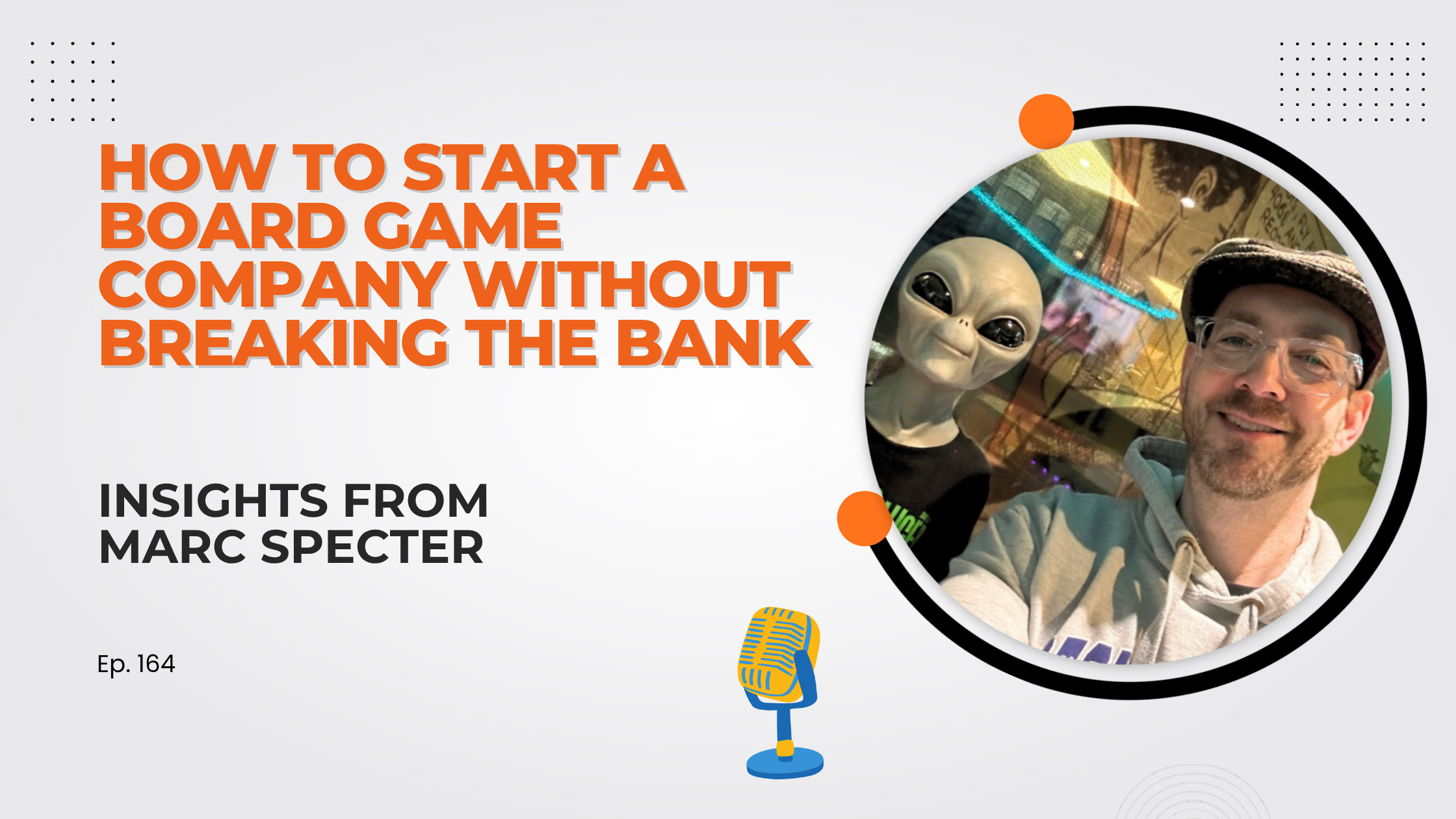
Welcome to the Toy Business Unboxed Podcast. In this episode, host Jason Hsieh speaks with Marc Specter, founder of Grand Gamers Guild and co-winner of the prestigious Kennerspiel des Jahres award for Endeavour Deep Sea. Marc shares his two-decade journey from board game volunteer to award-winning publisher, revealing how he built a catalog of over 20 titles without investors, a large team, or shortcuts. Whether you are a first-time creator or an experienced toy brand owner, Marc’s story offers a refreshing blueprint for building something meaningful at your own pace.

#164: Skip the Scale: Build a Game Company Your Way – Toy Business Unboxed
Episode Highlight
- 00:42 Welcome & guest intro
- 01:34 From D&D to Origins Game Fair
- 05:27 Founding Grand Con & handling success
- 07:26 First published game: Unreal Estate
- 10:09 Kokeshi & Japanese-themed games
- 13:40 Essen Spiel vs. US conventions
- 18:12 Winning the Kennerspiel des Jahres
- 21:13 Running a one-person company
- 24:56 Why Marc chose to stay small
- 30:13 Advice for game industry newcomers
From Dungeons and Dragons to the Origins Game Fair
Marc Specter’s path into the board game industry began long before he became a publisher. As a teenager, he was deep into role-playing games, particularly Dungeons and Dragons, before life pulled him away during college. After graduating, a mystery shopper job introduced him to the Wizards of the Coast store in Michigan, where he reconnected with tabletop gaming. In 2005, he attended his first Origins Game Fair and had what he describes as a mind-blowing experience that converted him from a role-play gamer into a board game enthusiast for good. That single convention changed the direction of the next twenty years of his life.
Learning to Lead Through Events and Conventions
Leadership instincts showed up early for Marc, long before he ever published a game. While still in college, he stepped up to become hall president and quickly discovered a talent for project management by running everything from simple movie nights to large-scale charity auctions. He later channeled those same skills into volunteering at Origins Game Fair, eventually building and managing an event team of eight to twelve people that ran more than 200 events at a single show. The trust he built with one publisher opened doors to the next, and the process of showing up and improving year after year became the foundation for everything that followed.
Founding Grand Con and Learning What Exceeding Expectations Really Means
In 2013, Marc and a business partner launched Grand Con in Grand Rapids, Michigan, a small-to-medium sized Midwest gaming convention. Based on comparable local shows, they expected somewhere between 300 and 500 attendees. Over 1,200 people showed up, overflowing the venue and making it immediately clear that they had created something the community genuinely wanted. Marc eventually separated from the business, but the experience of building something from nothing and watching it take on a life of its own prepared him for the publishing world in ways no class could have.
Starting Small on Purpose at Grand Gamers Guild
When Marc launched Grand Gamers Guild as a publishing company, he made a deliberate choice to begin with a small project. “Small projects, small mistakes, big projects, big mistakes,” he explains, a philosophy that shaped his first release, Unreal Estate, a card game designed by Jason Slingerland. The campaign reached around 1,200 backers and brought in $20,000 to $25,000, which Marc considers a strong debut for a brand-new publisher. That early discipline, choosing scope he could actually execute, set a tone for how Grand Gamers Guild operates to this day.
What Winning the Kennerspiel des Jahres Really Means
Few achievements in the board game world carry more weight than the Kennerspiel des Jahres, the internationally recognized award for strategy-level games. In 2025, Grand Gamers Guild and Burnt Island Games won the award together for Endeavour Deep Sea, a milestone Marc calls “literally rewarding” after nearly a decade in the business. The journey from unknown newcomer to recognized name in the industry took nine years of consistent work, honest communication with backers, and a commitment to doing what he said he would do. Beyond the award itself, Marc says the most rewarding moments have always been the genuine connections made across a table or at a convention booth.
Why Marc Specter Built a Lifestyle Business Instead of an Empire
When the topic of growth comes up, Marc is direct about what he wants and what he does not want. He runs a company of one, with four contractors handling development, social media, art direction, and bookkeeping. He still packs every order in his basement, answers every customer service email personally, and handles convention scheduling and travel himself. His reason is not a lack of ambition. It is a clear picture of the life he wants: one where he manages his own schedule, travels with his wife, attends Essen Spiel every year, and does not miss the things that matter because he was too busy scaling something bigger than he needs.
Advice for Newcomers in the Toy and Game Industry
Marc’s advice for anyone entering the toy and game industry starts with something he says is cliche because it is consistently true: everything will cost twice as much and take twice as long as you expect. He recommends saving more than you think you need before launching, and building buffer into both your budget and your schedule as a default practice. Beyond the finances, he stresses the value of finding a mentor, someone who has been where you are going and is willing to share what they have learned. He actively tries to be that person for others, responding to messages from strangers and offering introductions to manufacturers, because he believes the industry is stronger when people help each other up.
Conclusion
Marc Specter’s story is a reminder that there is no single right way to build a game company. He did it gradually, starting with volunteering, moving to event management, founding a convention, and then publishing one carefully chosen project at a time. His wins, including a Kennerspiel des Jahres, a catalog of more than 20 titles, and an international presence at Essen Spiel, came without outside funding, a large team, or a growth-at-all-costs mindset. The lesson is simpler than it sounds: do the work, get a little better at it every year, and build something that reflects the life you actually want to live.
Connect with Marc Specter
If you’re interested in learning more about Grand Gamers Guild or connecting with Marc Specter you can reach out through the following channels:
- Website: Visit Grand Gamers Guild’s official website for the latest news, game updates, and more
- Instagram: Follow Grand Gamers Guild on Instagram for visual updates, game previews, and creative inspiration
- Facebook: Follow Grand Gamers Guild on Facebook for updates, discussions, and behind-the-scenes content.
- BoardGameGeek: Find Grand Gamers Guild on BoardGameGeek for reviews, ratings, and community discussions.
Transcript
Jason Hsieh (00:42)
Welcome back to another episode of Toy Business Unboxed. Today we have Mark, the guild master behind Grand Guild. And he started with doing volunteering in 2005, and he has ever since immersed himself in the board game communities, running events, teams, and also even funding his own convention and eventually publishing games and many different games for players around the world. And his company to design games that can bring people together.
From one off puzzle games to strategy games. He have all kind of different games that he and his team have created over the years. So thank you so much your time for joining us on the podcast today, Mark.
Marc Specter (01:20)
Thanks for having me. I’m always excited about having a conversation.
Jason Hsieh (01:23)
Yeah, so I know you have been in the industry for quite a while now. So what get you started ⁓ way back in two thousand five? Like how what is your initial inspiration behind getting into the industry?
Marc Specter (01:34)
Sure. So my gaming biography actually begins in my teen years when I was a role play gamer, mostly Dungeons and Dragons. Yeah. then everything kind of came to a halt when I went to college. I didn’t do hardly anything for entertainment. I studied and studied hard. then after I got out of school, I had an interesting opportunity. I became in part a mystery shopper and
There used to be these stores in malls across the US. Maybe they were international, but I only had the one that I went to in Michigan, which was the Wizards of the Coast store. And so I would mystery shop them and I became exposed to all kinds of things. And then in 2005, I attended my first major convention, Origins Game Fair, and just really had my mind blown. I attended as a role-play gamer, but ended up
Jason Hsieh (02:10)
Okay.
Marc Specter (02:26)
I guess being quickly converted over to board games. no end. And after that, I just slowly dove in deeper and deeper. ⁓ as you indicated, I volunteered for the convention itself. I ran events for other publishers for a number of years. I expanded that into running an entire event team, anywhere between eight and twelve people and run over 200 events at the show.
Jason Hsieh (02:30)
Yeah.
Marc Specter (02:52)
then one year I came back from Origins and decided I wanted to found my own convention, which I had been considering for quite some time. Yeah. that actually had its first year in 2013. Mm-hmm. and then a few years later I moved out of that and into the publishing realm. And now we’re almost ⁓ ten years later, next year, 2026 will be our you know, tenth anniversary, so to speak.
Jason Hsieh (03:16)
⁓ congratulations on the tenth year anniversary and sounds like you have done almost every single aspect of the industry so far.
Marc Specter (03:23)
Well, there’s a lot I haven’t done. There are many talents that I do not have, I think I’ve touched on a lot of stuff, at least from a I don’t know, business consumer-facing perspective.
Jason Hsieh (03:33)
For sure. And I know not a lot of people have experience running their own event team and even funding your own conferences. That sounds like a lot of work. Like what are some of the lessons that you learn from doing that work?
Marc Specter (03:45)
I’ll tell you, when I was in college, I had sort of a strange opportunity thrust upon me. I was sitting in my dorm room one night, and the there was an announcement over the loudspeakers that the hall needed a hall president. and I looked at my roommate and I said, Should I do this thing? And he was kind of a dullard and basically said that he didn’t care. But I decided to do it, and I had never done anything like that before. And it really was a transformational experience. They basically said,
Here’s a budget, make fun stuff happen and do whatever you want to do. Yeah. And really, through just trial and error, I learned how to manage a project and slash put on an event. Yeah. Everything from a simple movie night on any given floor all the way up to I think probably the biggest event I ever did was I actually coordinated between the art school at college and Chicago-based comic book artists.
we did a charity auction based on student art and also on comic book art. And so again, I think the biggest lessons I learned there was I learned how to project manage. I learned how to run a small event. And then honestly, when it came time to run events for other companies at shows, that that was easy. That’s kind of like you know I reached out to them.
Jason Hsieh (05:01)
Ha ha ha.
Marc Specter (05:04)
Yeah. There is a trust building process because they have no idea who I am. Yeah. But you know, I got one person to buy in and then I was able to run those events. And then I would say would say to another, Hey, I did good by this person and can I run your stuff too? And then I put a team together. And yeah, you just you just do the thing and y every year you get a little bit better at doing it.
Jason Hsieh (05:27)
Mm, I see, I see, I see. And I think you also mentioned you also ran your own conference before. How would that experience look like? And how many vendor well, how many exhibitors do you got for
Marc Specter (05:36)
So actually the first year in twenty thirteen was kind of amazing because you know, I had a business partner and he still runs Grand Con today. but we didn’t really know what we were getting into other than that we knew we wanted to have a small to medium size Midwest based convention in Grand Rapids, Michigan. we put our hearts and souls into it and based on other small conventions that had a track history,
Jason Hsieh (05:41)
Okay.
Marc Specter (06:02)
A track record, that is to say, ⁓ on the other side of the state. We expected somewhere between three hundred and maybe seeing five hundred people would be a pipe dream. Well, it turned out we ended up with over twelve hundred people. well. space that we rented was not prepared for that. We were not prepared for that. but it was very clear that whatever we did, we did it well. Yeah and we were off and running. And we did that.
Jason Hsieh (06:14)
Okay.
Not
I see.
Marc Specter (06:29)
we did that very successfully for four years or three years, four years. and then I separated from that business and it continues to flourish today. And then honestly, when it came to publishing games, I sort of had a vague idea of what went into it. I knew the skills that I had and I knew the talents that I didn’t have and who I needed to either hire or contract with, depending on how you look at it. Yeah.
Jason Hsieh (06:37)
I see.
Yeah.
Marc Specter (06:52)
And I cobbled those people together and I deliberately made a decision that my first project would be a small project because small projects, small mistakes, big projects, big mistakes. Yeah. Yeah. I you know, look, everyone wants to run a million dollar plus project, but I didn’t want to have that kind of financial burden on my soul and not do it right. I think, you know, I’m far from perfect, but I think my backers would tell you that I communicate well.
Jason Hsieh (07:04)
Yeah, yeah.
Marc Specter (07:18)
I do what I say I’m gonna do, and that’s all a result of a very gradual process.
Jason Hsieh (07:24)
What was your first project and how did it go?
Marc Specter (07:26)
My first project was Unreal Estate, a small card game that I happened upon with a local designer by the name of Jason Slingerland. And it went really well. I hired Chris Kirkman from Dice Hate Me Games to be my graphic designer as well as my sort of Kickstarter manager. He had run a number of successful projects and was sort of a couple years ahead of me in terms of what I wanted to do. And so yeah, it made for a very good
experience. I think we I mean, I’d have to look at it no for sure, but I wanna say we did around twelve hundred backers. It was a low price point project. We made about twenty twenty five thousand dollars. That’s pretty Yeah, I was very happy. I was very happy. I I think I gotta be honest, I don’t know what I would do if I was trying to get into the publishing industry today. I mean every year it just gets harder and harder. And we’re seeing many Titans fall. Companies you thought would be around for
Jason Hsieh (08:01)
The the first one, yeah.
Marc Specter (08:18)
Decades don’t exist anymore.
Jason Hsieh (08:20)
Mm. Yeah, it’s de definitely getting tricky. especially with the tariff situation this year.
Marc Specter (08:25)
tariffs and also I would you know, I would say there’s no small amount of mismanagement. I like to think I’m a responsible individual, but you know, when I see a project make multi million dollars and then somehow run out of cash, it really causes me to question what went on behind the scenes. But
Jason Hsieh (08:41)
Mm. Yeah, yeah, yeah. I think that’s just a lot of moving pieces to run a game companies. I mean, I also run a tour company myself, so I know all the things that is behind the the screen behind the campaign that you need to coordinate and make sure the product actually gets into people’s hands correctly without you actually losing money. Because you can have a million dollar campaign, but if you don’t manage the finance in the back end correctly, you can still end up losing money.
Yeah, that’s the tricky part. So go back to Grand Gamer Guild. How many product do you have now? I know you have developed a lot of product over the years.
Marc Specter (09:14)
Yeah, I was somebody asked me that the other day, or I was in a circumstance where I was explaining it. And I wanna say, you know, in print and out of print, we have somewhere between 20 and 25 titles. Now a large bulk of that are my 18 escape room games. I mean, literally probably greater than half of those. But you know, those are shorter term projects, but they still require the same tender loving care that you know, a larger game. I think.
In some ways, even more because they are escape room experiences. And if you don’t get it right and you print up these things that go out into the world, yeah, ⁓ you’ve really messed up. You cannot, there is no patch for this. So you need to make sure that it is a hundred percent correct. And I I’m I’m very happy I have a very good, precise designer who holds himself probably to an even higher standard than I do.
Jason Hsieh (10:01)
I see, I see, I see. And I know you have a few of game with you today. Can you show some of the game that you and your team have designed and talk about how it works and all that?
Marc Specter (10:09)
Yeah, sure. So I have a few different products of all different kinds. I’ll hold up the first one to the camera right in front of my whoop, how about I hold it up the correct way? this is Kokeshi. this is actually a localization done in partnership with Ludofun out of Brazil. they came to us a while back and actually sent us a number of titles. And Kokeshi seemed like the best fit for my company.
we have it on pre order right now and I am hustling, hustling, hustling to have copies air freighted to Essen so that we can
Jason Hsieh (10:39)
okay. You’re attending Essen yourself?
Marc Specter (10:42)
Yep, I’ll be attending Essen. I bring a small team with me. so you know if folks are interested in pre-ordering that, it’s available whether you are attending Essen or not.
Jason Hsieh (10:49)
What
kind of game is it? Can you talk about the game?
Marc Specter (10:52)
So Kokeshi, trying to get it on screen here, yeah, is an engine building game. Kokeshi are Japanese wooden dolls. Yeah. And you are trying to score happiness points by building the most effective engine. So you’re gonna place a tile down that when you move one of your Kokeshi onto it, may activate another tile, which may activate another tile, on and on and on. So you’re trying to create a cascade of effects so that you
Score points. There’s a few different ways to score points, a couple ways to lose points. And yeah, the very first time I played it, I really just fell in love with it. and in a very funny way, apparently I have this penchant for Japanese themed abstract games because when all is said and done, this will be the third one of them that I’m doing. I published Gorinto a number of years ago.
Jason Hsieh (11:38)
Really? Okay, okay.
Marc Specter (11:41)
And I’m going to be reprinting Seikatsu, which was published a few years ago. Anyway, yeah.
Jason Hsieh (11:46)
What is the reason that you like the do you just enjoy the Japanese culture personally? Is that why? Well what is some of the reasons? my god.
Marc Specter (11:53)
First of all, mean, look, I enjoy cultural exploration in all its forms. ⁓ one of the things that’s really important to me, I love to travel. My wife and I will go just about any place we haven’t been. And when I travel, it’s really important to me to do as much research ahead of time so I can truly appreciate the things that I’m about to experience. If a country speaks a foreign language, I will spend a year trying to study that language, both for my own functionality.
But also out of respect, I think it’s you know, if I was I hope to travel to Japan one day, it’s on the bucket list and
you know, and I’ll read history books and I’ll try to just get as much information in my brain as possible. I just think it helps me appreciate the journey more. ⁓ it shows respect for the place I’m going, and it just makes me a better, more well-rounded person when all is said and done.
Jason Hsieh (12:41)
Got it. Yeah. Like I mentioned to you before, I actually used to live in Japan for five years. My wife is Japanese. I also speak Japanese myself as well. wow. I have quite a bit of connection with Japan. Used to live there for quite a while.
Marc Specter (12:53)
Yeah, I I’m jealous. I’m relearning Spanish and I sort of have discovered that ⁓ having taken it in school for many years, it’s still in there. I can do pretty well. Yeah. I’m attempting slowly and steadily to learn German.
It’s not as natural for me. And I don’t know if it’s because it’s so dramatically different from Spanish or because I’m 30 years older than when I learned Spanish way back when the brain changes and doesn’t take things in as well. But at least those both have the advantage of using, you know, the same alphabet. one day when I try to tackle Japanese or Korean or Chinese or Arabic or, you know, anything like that, it will be
an extra challenge to learn all of those all you know, symbols that represent an entire different alphabet and in some cases, you know, complete words. We’ll see what happens.
Jason Hsieh (13:40)
Since you mentioned Germany and you’ll be attending Essen next this upcoming months actually or weeks, yes. for those listeners that haven’t been to Essen yet, can you kind of explain what a conference is? I know it is one of the biggest one in the world and go because it sounds like you have been there a few times, so
Marc Specter (13:45)
Weeks.
Yeah, I’ve been attending Essen every year for gosh, probably it six years, seven years. I don’t know. It doesn’t matter. Essen is amazing. it’s takes place in a small town. so I mean Essen’s not a small town, but it’s not, you know, it’s not Berlin. You know, it’s not a giant city. it takes place in a hall called the Mesa, which is this I’m terrible spatially.
Can’t get around anywhere I go. So it’s this kind of very strangely shaped building with halls that connect to one another in a way that doesn’t really seem logical to me. but it’s fantastic. One of the best things about Essen is you meet people from all over the world and especially all over Europe. Yeah. We’re very fortunate that most of those folks also speak English, but just engaging all those people who have, you know.
Such a varied background is just truly incredible. it is the busiest convention in the sense that you’re ending your day an hour later. Convention technically runs from 10 to 7, not 10 to 6 as an exhibitor. Okay. And every so often there will be an announcement.
before the show opens up that says, Hey, we’ve exceeded the maximum legal capacity for people outside the venue. We’re opening up now. Exhibitors get to your boots. So hasn’t happened in a while, but there have been a few days that started at nine thirty. And then of course, as an exhibitor, you’re there early and staying late anyway.
Jason Hsieh (15:17)
Well I guess what our listener will be interested in is because a lot of people are used to the show in US, like Origin, Gen Con. Not everyone have been to the one in Germany yet. How will you compare the show in Germany versus the one you attend in US?
Marc Specter (15:31)
Sure, sure. I think the biggest difference is that Essen is it’s a commercial engagement. That is to say, people are there explicitly to buy games. Now they’re there to play games in the sense that they come to your booth and they want to play a game, whether it’s a significant portion of the game or a full thing. Okay. But whereas Origins and Gen Con and just about every local and regional convention have a heavy emphasis on just playing games, Essen at least
So far, does not make space for that. Games are played in their booths, and after hours, there is no gaming hall.
Jason Hsieh (16:04)
Okay, okay, okay. That’s very different.
Marc Specter (16:05)
now there are many hotels that that are concentrated, ⁓ they’re filled up by people who are attending the show. So if they have a they have a lobby or an eating area, very often that will be taken over by gamers. But I mean, when the bell rings, everyone is you know, is either gonna go to an industry event or they’re gonna disperse back to where they came from their hotel.
Jason Hsieh (16:24)
Interesting. That’s very different than the US show that I’ve been to because I haven’t been to Essen myself yet, just yet. So I’ve been to quite a few of different US one. So thank you so much for sharing that. Any other like key differences that you notice for the one in Germany versus US?
Marc Specter (16:38)
Yeah, you can buy food in the hall and walk around with it. You used to be able to buy beer in the hall and walk around with it. I think that changed. also I’m gonna say something that doesn’t apply as much as it used to. Essen used to be much more fifty-fifty men to women.
Jason Hsieh (16:46)
Okay.
Marc Specter (16:56)
Than American conventions. That has changed a lot in the past few years. But because gaming is so culturally ingrained in Germany as a family activity, I just think you got families. Whereas, you know, American conventions were much more concentrated on, you know, just dudes.
Jason Hsieh (17:12)
Thank you for sharing that. That’s an interesting insight. So okay, got it. So I want to transition back to your business because I know your business model is a little bit different. You’re focusing on partnering with creator. What make you make that decision instead of just coming out of your own design with your own designer?
Marc Specter (17:28)
Mostly because I’m not smart enough to design a good game and because I do not have the stick tuativeness that one needs to be a designer. I’m not crafty in the sense that I do not like to put together projects. I am not going to print cards over and over again. I just don’t have the soul of ⁓ that grind that is required to get a game to the point where it’s considerable for publication.
However, my skill set, at least I like to think, does lie in project management. I know how to take things from an idea to a finished product, whether that’s creating an event or creating a thing to sell.
Jason Hsieh (18:05)
Mm. Mm-hmm. Okay. And like what has been some of the most surprising or even rewarding moment as a publisher so far?
Marc Specter (18:12)
Well, clearly the most rewarding moment was a couple months ago when Grand Gamers Guild and Burnt Island Games won the Kennerspiel des Jahres for Endeavour Deep Sea.
Jason Hsieh (18:22)
I mean congratulations. Okay.
Marc Specter (18:24)
Thank you. I don’t think that I mean to go in essentially nine years from an unknown to you know the internationally recognized top award in the industry it is a journey that any publisher would want to make. so I mean that was literally rewarding. if you want to now talk about figuratively rewarding, I mean I think the best thing is just engaging people. It can be
often the most frustrating thing. But when a genuine connection is made, it is the most rewarding thing. Whether it’s sitting at my own table playing games with people who I’ve cultivated friendships with, or standing across from people in a booth at a convention, watching the light bulb turn on as they get a game. You know, I have taken them from ignorance to understanding to the point where they want to make a purchase. Or
Even electronically, just having a really a customer service experience that whether it’s on Kickstarter or via email, leaves the customer feeling truly valued. as you know, they’ve been genuinely engaged. I think I guess it comes down to you could probably cut put it all under the heading of genuine engagement, whether ⁓ on all levels.
Jason Hsieh (19:29)
Mm, okay, I see. And what has been some of your biggest challenge that you also learned from?
Marc Specter (19:35)
let’s see. My biggest challenge has definitely been getting professional people I work with to adhere to a schedule. There are people who for many and varied reasons, you set out a timeline and they on the front end say, no problem, I got that.
Jason Hsieh (19:43)
Ha ha ha.
Marc Specter (19:52)
And then on you’re, you know, three quarters of the way through the project, and all of a sudden they don’t got that so much anymore. and things slow down. okay. And I try to be very patient with people. I’ll give you an example. I had a very small project I was working on with a fantastic artist. Yeah. And we were waiting for one image to finish the project. every week I would talk to my graphic designer and I would say, who’s also my art director, and I would say,
You know, have you talked to the artist? Where’s it at? How much time do we give them? And finally, after waiting two months for this image
Jason Hsieh (20:26)
Yeah, exactly. Okay.
Marc Specter (20:27)
I look, I’m a very patient man. I build in a lot of buffer. I try to give people the benefit of the doubt. Yeah. But I wrote the person a note and I said, Look, you know, you are now materially affecting my project. We need this image. And finally they got it to us. But I mean, yeah, I build a lot of buffer in my life. I build a lot of buffer in the bank account. I build a lot of buffer in the schedule.
Jason Hsieh (20:45)
Two months later, okay.
Marc Specter (20:54)
So I can accommodate the things that go on in people’s lives. But it crosses a line where through their inaction, they’re just being disrespectful to everyone involved with the project. And that can’t hold. You can’t run a company like that.
Jason Hsieh (21:07)
Yeah, for sure, for sure, for sure. Yeah, with your current company, how big is your team currently?
Marc Specter (21:13)
Well, in terms of employees, I am a team of one. I have four people with whom I don’t know if you want to say they’re on retainer or they’re on what the word would be, but they’re contractors. Yeah. have a developer, I have a social media manager, I have an art director slash graphic designer, and I have a bookkeeper. Those are items that I have chosen to
allocate out to other folks either because I don’t have the time or I don’t have the talent to do those items. And quite frankly, ⁓ you know, at the end of the day, like I’ll use social media as an example. I just don’t do it well. and part of that is because I dislike social media. and part of that is because there are people who love it. And if they can be a flag waving champion for helping to grow my business through that method, then
Let him take the reins. I I don’t want to do it.
Jason Hsieh (21:59)
I see, I see. Yeah, that’s you accomplished a lot with a very lean team, so
Marc Specter (22:04)
there are days, Jason, that I look and I am in awe of how much I do. And then there are other days when I throw out my hands and I wonder, you know, if I’m ever going to get it all done. Yeah, I mean, I literally hand pack virtually every order. I still do that, yeah, yeah. I mean I keep inventory in my basement, and when the orders come in, I got boxes and I got packing materials and I go and grab it.
And I take a lot of joy in physically handling the item that’s going to end up in the customer’s hands. Okay. I mean, I know it’s a conjuring in my own mind, but it really makes me feel connected to that person. And when I see the person’s name and when I see repeat names, it reinforces what I do. I’m the one that answers every customer service email. I am the one that schedules conventions.
Jason Hsieh (22:35)
whoa, okay.
Marc Specter (22:51)
For my company, I schedule all the events that we run on behalf of the games I publish. I schedule, you know, I schedule the travel. Yeah. Yeah, I mean, everything that I didn’t name, I do it. and part of that, I got to be honest, part of it really is is I’m my own worst enemy. in the sense that at some point something slips. like for instance, another area where I currently need to improve is I really need to up my localization game in the sense that.
Jason Hsieh (22:56)
Okay.
Marc Specter (23:16)
a lot of really good titles and that is something that I’ve not given the time and attention it deserves, which is something I’ve been turning over in my mind.
Jason Hsieh (23:24)
I know there’s some company that specialize in localization that you might able to research.
Marc Specter (23:29)
Yes.there are a handful of folks and I’ve had some things go well and I’ve had some things not go well. and if I engage someone for instance to do localization and I begin to have to ask myself or I begin to observe this isn’t going so well and I was doing better when I did it myself, it really makes me say, okay, it’s time for a change. So
Jason Hsieh (23:53)
Yeah, I think that’s a dilemma as a business owner. Sometimes it’s almost like it’s hard to let go sometimes. Absolutely.
Marc Specter (23:59)
Absolutely.
And that’s why I’m my worst enemy. Because I do have a hard time letting go.
Jason Hsieh (24:03)
Yeah, I struggle with that initially before we really, really grow the team. It’s like I can do this better, but right now my mindset is if my employee can do eighty percent of what I can do, I’m happy. it doesn’t need to be a hundred as long as they are eighty percent there. that’s my expectation, because otherwise you will get stuck as a business owner into the weeds. Yeah, and you cannot manage the team because right I have eighteen employees. There’s no way I can do everything a huge thing right now. So
I just need to let go more. And I think that’s something I want to challenge, even for our listener that you run a small team right now, sometimes I know it is a very common issue that each one of us all struggle with is letting go and trusting sometimes our employees to do a decent job. It might not be a hundred percent compared to what we can do, but as long as it’s eighty percent, sometimes it’s better to let go of that and focusing on some other high level tasks that we can only us can focus on as a business owner.
Marc Specter (24:56)
Yeah, I realize that. And and but the other half of the equation, which you know is probably a little unusual, is I also ask myself, who do I want to be in this industry? and in my life. And at least currently, I’ve never wanted to run a big company.
I think we culturally, Americans anyway, have a problem in the sense that they feel that something always needs to grow. It always needs to get bigger and bigger and bigger. And if it’s not getting, you know, exponentially bigger. You know, if I’m not the venture capitalist that’s turning my million dollars into $50 million, now something is wrong. ⁓ I live a very good life. I manage my own schedule, I travel extensively.
Jason Hsieh (25:32)
That’s true, true. ⁓
Marc Specter (25:38)
I eat great food. I have amazing experiences. I have a family that I surround myself with and I don’t miss things because I’m too busy for my own good. Yeah. and the things I do within the business bring me joy. And
Jason Hsieh (25:53)
Very important. I a hundred percent agree.
Marc Specter (25:55)
And you know, I’m also very blessed. I realize that I’ve gotten here through both a lot of hard work and a lot of luck. Yeah. ⁓ and I’m not sure that well that my happiness would grow if the company got bigger.
Jason Hsieh (26:08)
Hmm, yeah, that’s a very good point. You know exactly what you want. You kind of it’s like a lifestyle business, kind of similar to my business. I create it very intentionally. So I can work from home, I have a flexible schedule, I can just leave for a week and my team can take care of the rest if necessary. So but it’s about being really intentional on what you want out of the business you are creating and also enjoy the process at the same time. It’s not gonna be an easy process sometimes.
Marc Specter (26:33)
Now what I would say is this. If I did have a project go viral and I and it was multi-million dollars, that would create a need that would have to be filled. You know, that becomes a scaling issue. And I truly believe I would not be able to handle that and keep things up to the level that my customers, backers, supporters deserve. And so at that point, I think I feel comfortable at least contracting with someone to take some duties while I
moved through this very large circumstance that has been thrust upon me. so again I go back and forth. I mean would I love greater success? I would. Do I want it to become so much success that I can’t handle it myself? I’m actually not sure. but I’m very happy right now and
Jason Hsieh (27:02)
Yeah.
It’s always a journey. That’s the fun part about it. So looking ahead, what is your plan for the next year, two years, ten years for the business going forward?
Marc Specter (27:23)
Sure. So, you know, it’s funny that you asked that at this time because I just had a meeting this morning with one of my designers, Jonathan, who does the Holiday Hijinks games. and he’s been pretty consistently turning those out. And I’m definitely at a point where, okay, let me change how I’m saying this. I never dreamed I would be more than a one project at a time company. And at this point, I’m about an eight project at a time company.
Jason Hsieh (27:46)
⁓ whoa, okay.
Marc Specter (27:47)
And so, you know, and some projects are small and some projects are big, but they’re all in different stages. I mean, some are in a holding pattern, some are under development, some are getting the art done, some are on Kickstarter, some are being readied for sale. And I mean, goodness, if you go to my pre-order page at my website, I have 11 different games that are premiering at Essen that have never been there.
Jason Hsieh (27:59)
Hmm, okay.
That’s a lot. No, no. That’s a lot. Okay.
Marc Specter (28:12)
I kinda couldn’t believe it when we put it together. Yeah. so okay, to answer your actual question, what’s next?
Jason Hsieh (28:18)
So go ahead. Mm-hmm.
Marc Specter (28:19)
I’m beginning to look at, I mean, right now my games under contract take me about three years out. I’m continuing to look at localizations that are a good fit so that I can have another source of product and revenue generation that doesn’t rely solely on my team. I mean, that’s where a game like Kokeshi comes in that came to us pretty much fully formed and was a really good fit for my line of games.
And I routinely get approached by designers, I mean, almost daily. And my submissions are closed through at least early 2026. Yeah. but other than that, it’s pretty much just about keeping that product line rolling. keeping all of the things in the various stages where they’re going. We are preparing for our 10th anniversary. I mentioned the first game we did was on real estate. about a year ago, I got pitched a game.
That was so uncannily like on real estate that I couldn’t say no. and so I’m pretty excited that we sort of have this 10th anniversary project coming out that’s gonna be a callback to our beginnings.
Jason Hsieh (29:18)
⁓ nice. Okay.
Marc Specter (29:19)
But other than that, it’s really just about keeping the machine moving. I mean, I have Endangered Australia on Kickstarter right now. That closes in a couple days. So like I said, it’s about you know, life and business is an engine building game. You start out with one resource and you create a thing, and that hopefully generates two resources at which create more things and so on and so forth. So it’s just about building that engine, but then hearkening back to what I said a few minutes ago.
Jason Hsieh (29:41)
Yes.
Marc Specter (29:46)
not letting that engine run wild. I really want to manage my engine well. And from one project to the next, I see things that I could be doing better. And the landscape changes. The social landscape changes, the political landscape changes. Every time you think you’ve nailed the process down, some random factor is gonna come in.
Jason Hsieh (30:03)
For sure, for sure. So as we’re wrapping up today’s interview, if you have to share one piece of advice with someone that’s just getting started within the toys and game industry, what would that be?
Marc Specter (30:13)
Okay, so I’m gonna use the cliched advice, which is everything is gonna cost twice as much and take twice as long as what you expect. If I had a time machine and I could go back and tell myself, I would tell myself to save twice as much money to start the company because I didn’t start this company with a loan. I started it through years of cobbling together from little tiny jobs. Other thing I would say is find a mentor.
Jason Hsieh (30:34)
I see.
Marc Specter (30:38)
someone who’s been there before you and done the thing. I just actually had I answered someone on Facebook a couple days ago, tried to build a bridge with them to a manufacturer. Yeah. And they told me today they reached out to the manufacturer and I said, Hey, you know, wherever you are on this journey, if you need any help, just reach out. I try to live by an ethos that if we don’t help lift others up.
We’re not really, high quality human beings if we don’t try to help those who come after us. and there is, you know, no shortage of people who helped get me where I’m going. People who I took a decade to form relationships with, who I can now call up and say, Hey, I have this random situation and I need to bounce it off of you. there are people who came before me.
There are people who are my contemporaries and there are people who started after me who figured out how to do it better. And I’m willing to learn from any of those people. So find your community, your cohort of people who are coming up with you and mentors who came before you and you know, build a bridge and get their advice.
Jason Hsieh (31:39)
Yeah, actually that’s the part I really love about the toys and game industry. everyone I talked to for the show, which I already interviewed over a hundred and fifty business owners so far, everyone’s very open. They are like open book, they’re willing to share what is working for them, not working for them. I feel like we really don’t treat each other as competitor. We’re all to just create a game, we’ll create a toys that can really benefit and people can enjoy the end result or the end product that we’re producing. And I really love the advice that you’re giving on
just ask if you have questions, ask because the same struggle you are going through right now, for those that are listening, someone else might already came through the similar struggle and they figured out a solution. So you don’t need to you’re not alone in this journey for sure. Right.
Marc Specter (32:20)
Well, see, you know, there are bad actors in every industry and we certainly have our share, but there’s something when I think about people who game, there’s something I come back to, which is that when you engage in a game, what is the cardinal sin of gaming? That would be cheating, right? Because it breaks the game. So we don’t have a lot of cheaters in our industry. We have people who wanna sit across from a table, who wanna build a genuine connection and wanna build something with other people.
And I think that shows across the gaming table and I think that shows across the business sphere. There’s not a lot of reason to cut each other down because we’re all here just to have a good time. It’s one of the benefits of being in an entertainment industry.
Jason Hsieh (32:56)
That’s true, that’s true, a hundred percent. So for those listener that would be interested to learn more about you and your business, where is the best place for people to find you online?
Marc Specter (33:05)
Sure. So GrandGamersGuild.com, if you fill out the contact form there for whatever reason, you are absolutely talking to me. in my auto reply, my phone number is there. I actually have had people call me up. like two, but I have had people call me. and on social media, I’m hit or miss. I mean, fairly often I’ll be the one answering you, but again, I have a social media manager.
⁓ if it’s a business matter, he’ll pass it on to me and you’ll be talking to me directly. yeah, but Grand Gamers Guild dot com is pretty much the place to go.
Jason Hsieh (33:30)
Got it.
Got it. Well sure we put that in the show note. And thank you so much for your time today, sharing your experience and your journey within the industry.
Marc Specter (33:41)
Yeah, it’s been a ton of fun. I really appreciate the invitation. It was great to meet you and bring this to fruition so quickly.
Jason Hsieh (33:46)
Yeah, no problem. And also thank you so much for our listener for tuning in to this episode of Toy Business Unboxed Podcast. We hope you have enjoyed today’s conversation, find it insightful and also inspiring. If you like what you have heard, be sure to subscribe to our podcast on your favorite platform so you never miss an episode. We really appreciate your support and would love it if you can leave us a review and share the podcast with your friend and colleague. For more resource tips and the latest update within the toys and game industry, visit our website at toy-launch.com.
Join the conversation and connect with us on social media using #ToyBusinessUnboxed. We’d love to hear your feedback and suggestion for future episodes. Until next time, keep innovating, keep creating, keep bringing joys trhough toys. This is Jason Hsieh, signing off on the Toy Business Unboxed podcast. We’ll see you in the next episode. Thank you so much, everyone.
Grow your toy brand’s content reach
From SEO blog content to influencer outreach — we handle the full content engine for toy and game brands.