
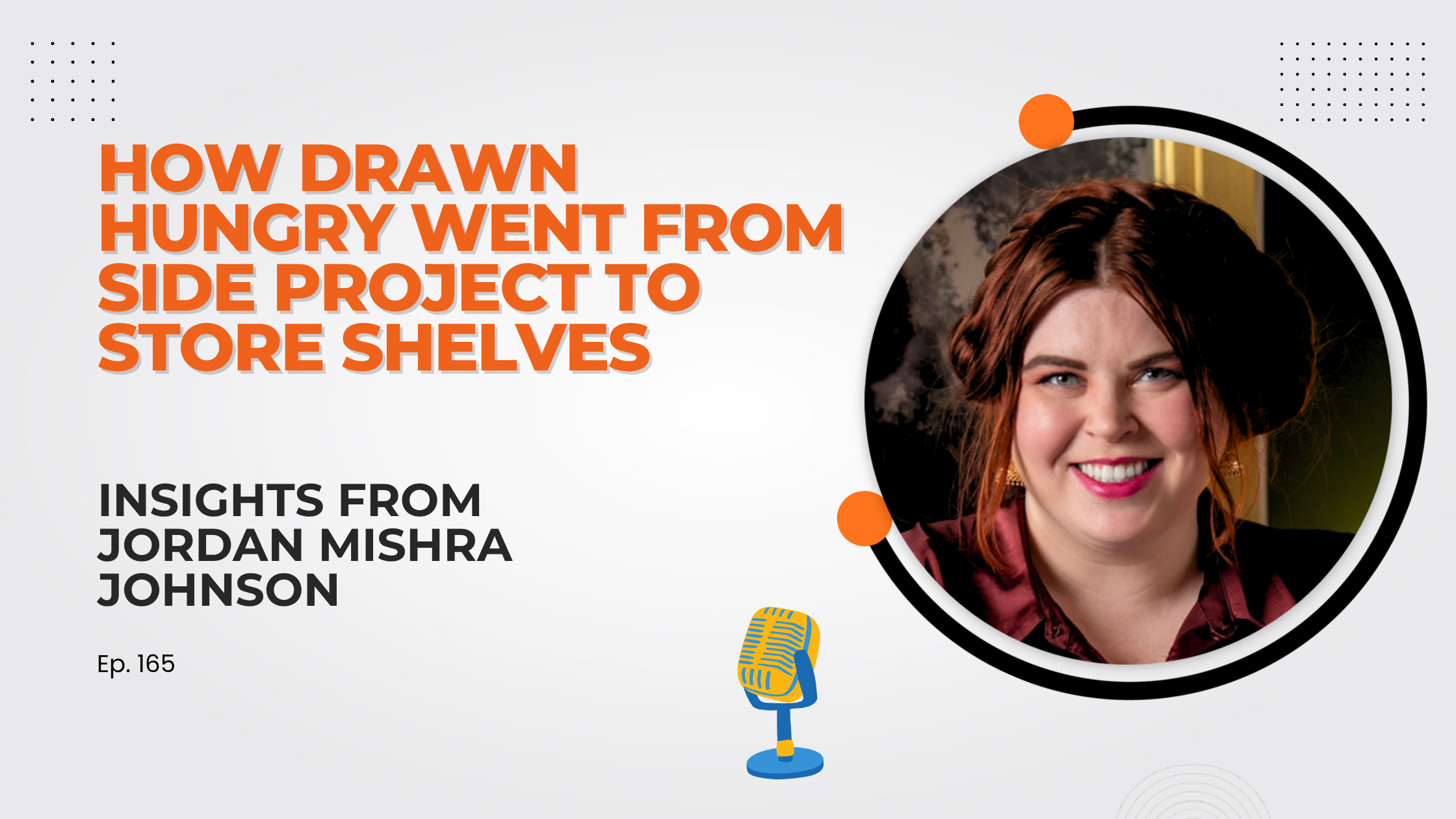
Welcome to the Toy Business Unboxed Podcast, where we share the real stories behind toy and game creators building products they believe in. In this episode, host Jason Hsieh sits down with Jordan Mishra Johnson, the artist and entrepreneur behind Drawn Hungry, a food-themed card game that blends the creativity of a cooking competition with the social appeal of a classic party game. Jordan’s path from business school graduate to indie game creator is a study in patience, resourcefulness, and knowing when to use every skill you have. Her story offers honest lessons for anyone building a product on the side, trying to break into retail, or simply wondering if a passion project can become a real business.

#165: From Side Project to Store Shelves: The Drawn Hungry Story – Toy Business Unboxed
Episode Highlight
- 00:42 Side project to published game
- 01:28 Business school over art school
- 02:43 The Drawn Hungry idea
- 05:40 A thousand hours of artwork
- 06:08 How the game works
- 11:21 Kickstarter timing mistakes
- 12:50 PR skills and visibility
- 13:33 Social media content strategy
- 18:27 Breaking through market noise
- 20:37 Bite Size and what’s next
From Art School Dreams to Business Instincts
Jordan’s creative journey began with a defining decision in her senior year of high school. She had been accepted to both an art college in Seattle and the University of Oregon, where the plan was to study business. Her father encouraged her toward business, and despite some initial hurt feelings, Jordan took the advice. Years later, she credits that decision as the foundation for everything she built with Drawn Hungry. The business skills she gained, including marketing, networking, and campaign management, gave her the tools to bring her art to market in a way that stuck.
The Spark Behind Drawn Hungry
When Jordan was ready to focus her creative energy on a single product, she mapped out three possible paths: writing books, painting murals, or creating a card game. She chose the card game because she already had the Adobe design skills, publishing knowledge, and manufacturing awareness needed to make it happen. Her inspiration came from two familiar sources: Chopped, the TV cooking show she loved for its creative basket challenges, and Apples to Apples, the party game she played at sleepovers growing up. The goal from the start was to build something people could pick up and understand without a rulebook, so anyone could join in and have fun. That instinct for accessibility became one of Drawn Hungry’s defining qualities.
One Thousand Hours at the Drawing Table
Every card in Drawn Hungry features original artwork, and Jordan created all 320 designs herself. She estimates the artwork alone took over 1,000 hours, and that figure does not include playtesting, manufacturing discussions, or marketing. She spent roughly a year and a half at home, heads-down on illustration, building a visual universe centered on food, culture, and discovery. The game features dishes and ingredients from around the world, including tadig from Iran, dumplings, shakshuka, pierogies, and paella. Jordan wanted anyone who picked up the game to find something that felt familiar, a priority shaped in part by her own family connections to India and the Philippines.
How Drawn Hungry Works
The game uses three decks: special occasion cards, dish cards, and ingredient cards, with 170 unique cards total. Each round, one player becomes the head chef and reveals a special occasion card plus a secret ingredient drawn from the deck. All other players hold five dish cards and five ingredient cards, and have five minutes to create a meal that fits the occasion and features the secret ingredient somewhere in the dish. When time is up, players present their meals to the head chef, pitching their creations with storytelling and personality. The head chef judges based on creativity, flavor logic, and fit with the occasion, awarding points that continue until one player reaches twenty-five.
The Kickstarter Campaign and What She Learned
Jordan launched her Kickstarter in July 2023, more than a year before the product arrived in November 2024, a timeline she would not repeat. She still had over 150 cards left to illustrate when the campaign went live, and the long gap between campaign and delivery stretched momentum thin. That said, the campaign opened doors she had not anticipated, including an account with Uncommon Goods and a wave of early players who tested the prototype packs she created as backer rewards. Her advice now is to have all your assets ready before launching, so the excitement of your campaign can convert directly into sales and relationships. The Kickstarter taught her that timing matters as much as the product itself.
How PR Skills Build Visibility
Jordan’s background in public relations gave her tools that most indie game creators simply do not have. She knows how to find the right journalists, read bylines, and develop pitches that are genuinely targeted to what a writer covers. When Drawn Hungry launched in 2024, she secured a feature in Portland Monthly that drove a strong wave of early sales. She also launched a YouTube series where she invites chefs to play the game at local culinary destinations, turning each session into a demo and a story that has converted into retail accounts, including one with Vivian Culinary Books. Her core belief in PR is simple: turn communication into visibility, and go where your potential partners already are.
Drawn Hungry Bite Size and Custom Card Collaborations
Two key projects in development for the near future for Jordan is first, Drawn Hungry Bite Size, a simplified edition targeting players eight and up, designed to be played on its own or slotted directly into the core game as an expansion. The idea grew out of her in-person demos, where she found herself simplifying gameplay on the fly to ease hesitant festival-goers into the experience, and realized that simplification could stand alone as its own product. The second project is a series of single-card collaborations with local food makers for the holiday season, using platforms like Game Crafter to produce custom cards featuring a restaurant or business’s signature dish. The core game box was designed with extra space built in, because Jordan always intended to grow.
Advice for Newcomers in the Toy and Game Industry
Single piece of advice for anyone entering the toy and game industry from Jordan is to build your fan base before anything else. She encourages creators to take a prototype out into the world, grow a newsletter list, start their social media handles, and let people follow along with the development process. The fan base you build before launch is what drives your Kickstarter, gets you into retail conversations, and creates the word-of-mouth that turns strangers at events into excited customers. Jordan learned this firsthand, going from struggling to get festival-goers to engage with her game to developing a live demo that reliably converted hesitant passersby into buyers. Getting people invested early means they become ambassadors, not just customers.
Conclusion
Jordan Mishra Johnson’s story is a reminder that patience, craft, and business instincts can all live in the same person. She spent two years building Drawn Hungry from a blank page, drew every one of its 320 cards by hand, and used PR skills and in-person hustle to get it onto shelves across the country. Her journey shows that a side project can become a real business when you combine passion with strategy and a willingness to learn from every step, including the missteps. If you are working on something you believe in, Jordan’s path is proof that the hours you put in compound over time. Keep building, keep showing up, and start growing your fan base today.
Connect with Jordan Mishra Johnson
If you’re interested in learning more about Drawn Hungry or connecting with Jordan Mishra Johnson you can reach out through the following channels:
- Website: Visit Drawn Hugnry’s official website for the latest news, game updates, and more.
- Instagram: Follow Drawn Hungry on Instagram for visual updates, game previews, and creative inspiration
- Facebook: Follow Drawn Hungry on Facebook for updates, discussions, and behind-the-scenes content.
- Youtube: Subscribe to Drawn Hungry on YouTube for cooking, card games, actual play, and more.
Transcript
Jason Hsieh (00:42)
Welcome back to another episode of Toy Business Unboxed. Today we’re talking with Jordan, a creative powerhouse whose side project became a published game. From childhood baking session to restaurant jobs to PR works, even editing for magazines, Jordan really has honed her craft and discovered her very unique niche, which is celebrating food through art. And that really pass that passion really involved into the current card game that he also represents, which was launched back in 2024.
And now it’s sold in multiple stores across the country. So thank you so much for joining us on the podcast today, Jordan.
Jordan Mishra Johnson (01:16)
Thank you so much for having me, Jason.
Jason Hsieh (01:18)
Yeah, so first if you can take our audience back to the beginning, what kind of sparked the idea for the card game and like why do you even start it way back as a side project?
Jordan Mishra Johnson (01:28)
Yeah. I’m gonna take you really far back. I think that this sort of explains a lot about me. Sure. One day when I was a senior in high school, me and my dad sat down. I had been accepted to an art college. I got like a really nice scholarship, but I was also accepted to a state school. And the plan with going to the state school, University of Oregon, was to study business. Okay.
And I really wanted to go to the art school. I was like, wow, I could go up to Seattle. It’s also very expensive. Even with that scholarship, it was gonna cost way more than going to the state school. Yeah. And my dad talked me into business school. And for all the artists out there, it was the best decision we could have made together.
Jason Hsieh (02:13)
Okay, okay.
Jordan Mishra Johnson (02:14)
You know, I had some hurt feelings at the time. But I’ve been able to pour myself into my art after college and have so many more skills in understanding how to run a business, how to run a marketing campaign, get connections, networking, and like Drawn Hungry is an example of how I’m able to like bring those two worlds together.
Jason Hsieh (02:37)
Hmm,
okay, okay, okay. Got it. And how did the idea even came about?
Jordan Mishra Johnson (02:43)
So I had been doing these mini art collections for about a year. I did some coloring books, some different screen printed products. I was going to different art markets, I had done face painting, I was just sort of like trying a lot of different things, seeing what felt right, what did I enjoy doing, what was I good at?
And one of the last projects I worked on was a calendar featuring this sort of like universe of foodie rabbits. Okay. I myself have a pet bunny at home. Okay. And it was a great way for me to sort of be like, I can build a little universe with my art. I can create a product and sort of like create this entry point into like the way that I see the world. And
I was like, I’m ready to take all this experience and pour it into like a single product or service that I can really just devote my whole self to. I don’t need to try and like reinvent the wheel every three months with a new collection. I’m ready to just like really focus in. I created three different paths that I could see myself going down. Writing books, doing
murals or creating a card game. And I thought of a card game because I had the skills in Adobe, in publishing, knew that I was capable of creating all those assets and managing the manufacturing process, which that is its own can of worms.
Jason Hsieh (04:13)
Yeah, for sure.
Jordan Mishra Johnson (04:14)
I was not prepared for game manufacturing in China. But I did actually have like most of the skill set to make it happen. Using my design process knowledge from entrepreneurship program in college helped me in developing the game. And then I was in like first grade when the Pokemon phenomenon hit.
And I was like, I loved Pokemon. I had the Game Boy color like yellow. Like that was one of my favorite Christmas memories, opening that up. But the trading card game was huge, but me and my cousins could never actually figure out how to play it.
Jason Hsieh (04:52)
Okay. Yeah.
Jordan Mishra Johnson (04:53)
I was like, I just want to try and come up with a game that like me and my friends would love to play. Like you could basically pick up the cards and sort of like figure it out on your own. But that was sort of like my initial spark. I thought of combining chopped with apples to apples, chopped the TV show, which was one of my favorite shows to watch.
I would always think about like what would I make with that basket of ingredients that the chefs were working with. And apples to apples was like our sleepover game of choice when I was a kid. And so sort of like all those different sources of inspiration came together in coming up with Drawn Hungry.
Jason Hsieh (05:29)
And you did all the design yourself as well, or like who else is involved in this project?
Jordan Mishra Johnson (05:35)
No, it’s a hundred percent me.
Jason Hsieh (05:36)
okay, okay. It’s a lot of work, you know, doing it all by yourself. So
Jordan Mishra Johnson (05:40)
artwork alone, we estimate took over a thousand hours. That’s not including playtesting, it’s not including you know, like discussions with manufacturing, that’s not marketing, just artwork alone. A thousand hours. I was at my house for a year and a half and I did not leave.
Jason Hsieh (05:45)
yeah.
I see. So well for those listener that or audience that don’t know about your game, I think you have a sample with you. Can kind of explain how the game’s being played and maybe showcase some of the elements inside the games.
Jordan Mishra Johnson (06:08)
Yes, so this is the product here. I love this top. So the way that Drawn Hungry works is there are three different decks of cards. So we have our special occasions, there are dish cards, and then we have our
Jason Hsieh (06:23)
Okay.
Jordan Mishra Johnson (06:28)
Ingredient cards. There is 170 in there. Wow. All different. So you are preparing meals for different special occasions using the dish and ingredient cards as your inspiration. Yeah. Every round, you start out with one player who is the designated head chef. So they’re sort of like the judge comparably in apples to apples. Yeah. And the head chef starts out by choosing a special occasion card and then
Jason Hsieh (06:32)
Okay.
Jordan Mishra Johnson (06:56)
A random ingredient from the deck that is now the round’s secret ingredient. Okay. All the other players have their own hand of five ingredient cards and five dish cards. And they must prepare a meal for the special occasion and include the secret ingredient somewhere in their meal. Okay. You get five minutes to prepare your meal, have discussion, chat about, you know, whatever you’re thinking. And then after the five minutes are up.
Jason Hsieh (07:01)
Okay.
Jordan Mishra Johnson (07:23)
All the players go around and present their meals to the head chef. Storytelling, sort of like selling your meal, is a big part of the experience. Okay. And then the head chef will choose their pick of the bunch to win the round based off of like how well does it meet the special occasion, the flavors, creativity. They could even come up with their own secret judging criteria.
Jason Hsieh (07:47)
Okay.
Jordan Mishra Johnson (07:48)
To help them you know, narrow the field, figure out who’s the winner. And then whoever wins gets points, which you can see on the bottom of the cards there. There’s a point value. So you get points based off of the ingredients and dishes that you were able to include in your meal. And then you continue playing rounds until one player gets twenty five points or more.
Jason Hsieh (08:07)
twenty five points. And how many players usually?
Jordan Mishra Johnson (08:10)
we recommend three to ten. And if you get like eight, nine, ten players, you’re only playing to eighteen points. Yeah. But I find that a group of like four to six is really a sweet spot where you’re getting through the game a little bit faster. But I’ve played with groups, even where I’ve sort of like I highly encourage house rules in my game. So like however you really want to play it at home, love that. I’ve played with groups of up to like
twelve or thirteen and we’re still having a great time. It just, you know, it takes a while to get through everyone’s presentation at that
Jason Hsieh (08:42)
Yeah, yeah, yeah, yeah, yeah, yeah. That’s so many people. I see, I see, I see. Interesting. And like what are some of the feedback that you got from the customer so far with the game?
Jordan Mishra Johnson (08:52)
I have had people come up to me and be like, this is just the most delightful game. Thank you for making this. People love just the way that this game evokes conversation and getting to know each other. And it it’s meant to get you talking about like the occasions or like how do you relate to it? if it’s a beachside breakfast, like
When’s the last time you went to the beach? How you know, like what do you like to eat at the beach? And just it’s this really great tool for conversation and getting to know people, which was really my goal, you know, in the whole time.
Jason Hsieh (09:27)
I see, I see, I see. Got it, got it. And I know there’s so many different cards. Is each of the card in the greeting card you all have its own different design? That’s why it took so long.
Jordan Mishra Johnson (09:37)
It is definitely why it took so long. So like we’ve got a rack of lamb, we got macadamia nuts, we got tomatillos. In total there’s three hundred and twenty unique designs in the game.
Jason Hsieh (09:51)
whoa, okay. That’s a lot, yeah.
Jordan Mishra Johnson (09:52)
Yeah, I could not hire someone to do this for me. So this was definitely a a passion project.
Jason Hsieh (09:58)
I see, I see, I see. So and I know you’re jugging juggling that like part time and also like working on other projects on the weekends and the evening as well. How long does this project took you from like the idea to finally having the product ready to publish?
Jordan Mishra Johnson (10:13)
It was exactly two years. Yep. November twenty-two is when I came up with the idea and November twenty-four is when product was delivered here to my garage.
Jason Hsieh (10:15)
I’ll see you.
Okay. Okay, okay, okay. I see, I see. And y did you also did a Kickstarter campaign for the product as well?
Jordan Mishra Johnson (10:30)
I did. It was in July of twenty-three. So there was about a year and change between the Kickstarter project and delivering product. I wouldn’t recommend that to folks. You know, as an artist, I just want to get the thing made. Like I had this idea for my PR like building buzz. Being on the other side of that, I would not recommend
running a Kickstarter over a year before you have product ready to deliver.
Jason Hsieh (10:54)
what will you be your recommendation then? Launch it a little bit later or
Jordan Mishra Johnson (10:58)
I would say have all your assets ready. You know, I still had well over a hundred and fifty cards to illustrate at that point.
Jason Hsieh (11:05)
whoa, that’s still a lot left.
Jordan Mishra Johnson (11:06)
Still a lot left. Yeah. You know, I definitely was very hasty, very excited to get it out there. And it’s great. Like I got my account with Uncommon Goods from running that campaign.
Jason Hsieh (11:20)
okay. I see. Yeah.
Jordan Mishra Johnson (11:21)
Yeah, I was able to
Get people really excited. I created essentially prototype packs as one of the levels for the game and get that out there so folks were playing it, sharing it with their families. They were understanding the mechanics and sort of having that experience of playing the game before the final product was ready. Okay. But definitely like some things I wouldn’t repeat if I were to do it again.
Jason Hsieh (11:43)
Mm. I see, I see, I see. And I know you also work in PR and like the editing or editorial field. What s what are some of the crossover skill set that you were able to took into launching your own game?
Jordan Mishra Johnson (11:57)
Mm-hmm. You know, being scrappy is really what PR is all about. You are able to turn communication into visibility is what that comes down to. So I am able to look through publications, find look at bylines, track down the writers of those articles.
Develop a pitch that is targeted towards what they are interested in and be able to get some stories out of that. When the game launched in 24, I had a great article in Portland Monthly, which is one of our local magazines here. And that really helped my sales right off the bat. I got a ton of sales out of that coverage. Yeah.
I have knowledge of like how to collaborate and how to approach people. I have a YouTube series where I get chefs to play Drawn Hungry with me in different delightful destinations. Yeah. And so I’ve been able to partner with different businesses here that have turned into retail accounts now. Vivian Culinary Books. Okay. Yeah. So I think that I
Jason Hsieh (12:50)
That sounds fun.
Jordan Mishra Johnson (13:04)
was able to just see how businesses here, how restaurants, wineries, hotels are able to work with each other in order to boost each other up without spending a ton of money and be able to sort of like tap into each other’s customer bases in order to boost each other.
Jason Hsieh (13:21)
I see, I see, I see. And I think in the pre interview you also mentioned like social media also play a really big role in your growth. What is working for you or what kind of strategy you would like to share with our audience?
Jordan Mishra Johnson (13:33)
you know, social media is the beast that always needs fed. That I think is something that you cannot get away from. And so however you approach social media, you have to figure out the life balance, the sustainability of how long you’re able to keep things going. And looking at social media, I have
sort of this recipe that I look to when developing content to get it out there. First thing is developing content buckets. So, what are the general topics that you can talk about over and over and over again? How can you go back to those buckets? Pull out something that you can take a new spin on and get it out there. You also like
No one wants to go to a social media feed and feel like they’re just being sold to. You have yeah, you have to find like how can I educate people? How can I like entertain? How can I tap into trends? all from like my perspective. And so something that really worked for me when I was doing my Kickstarter campaign was something I called my chopped challenge.
Jason Hsieh (14:20)
Yes, yeah.
Jordan Mishra Johnson (14:39)
So I would watch an episode, an old episode of the show Chopped, which was one of my sources of inspiration. I would record just like what are the ingredients in this basket? And then sort of like my game, I would come up with a meal and then present that as like what I was doing. So it’s a little bit culture remixing. It wasn’t a lot of money to do that, you know, is basically my HBO subscription to go.
Record that, share it. And I was consistently doing that like twice a week during that point. And you know, because it had this attachment to something that people knew, it the algorithm liked that, people like that. It was able to really get my message out there at that time.
Jason Hsieh (15:22)
Yeah, I think the hardest part with social media, and I struggle with this as well, is consistency, like you mentioned. Making sure we’re posting on a consistent basis. Like for me, I have a social media person that’s working on the social media account, but I also want to post more often on my like personal profile, which I wasn’t very consistent on. Yeah. Sometimes I’ll post like a few times in a week, then I don’t post for a few weeks at all. Then it’s I think, like you say, like sticking to a cadence of
posting twice a week and just make it consistent is gonna be the key if you want to see any kind of tractions on social media. So
Jordan Mishra Johnson (15:56)
Yeah, and you know, recently I’ve been struggling with consistency. And I’ve been using my Drawn Hungry account since twenty seventeen. It started out as a place where I posted portraits of chefs. It was really more of an art account at that time and it’s grown and evolved into the board game, the card game now. And so I’m struggling.
The algorithm doesn’t really know what to do with me anymore. So I’m actually launching new channels to sort of start fresh. Prepping for the holiday season. And sort of trying something new. And that
Jason Hsieh (16:31)
That’s true. That’s a good advice to see if you can kind of spice things up a little bit. And I like how you’re mentioning about just trying different content. Any tips on balancing between personal content versus like product promotional content to make the social media experience still very authentic?
Jordan Mishra Johnson (16:50)
Yeah, I mean, I feel like I’m a pretty private person. I don’t like putting a lot of things out there. I don’t think people who look at my social media would know that. Because I do get on there and I sort of have my own perspective on how I talk about things. Like it’s great to just talk about like TV shows. You know, I’m talking about Great British Bake Off.
Right now and like watching each episode and getting on stories and just sharing like, wow, that was beautiful. Or like, can you believe that they recovered from that like terrible mishap? And like there’s ways that you can highlight your personality without showing all your business.
Jason Hsieh (17:28)
Mm
mm mm mm I see, I see.
Jordan Mishra Johnson (17:30)
I think it comes down to like knowing your customer. You know, whenever I’m like, I have no more gas left in the tank. I have no idea what to talk about. I go back to like my customer profiles, like yeah, who are they? What do they like? what what sort of things do they get excited about? And it’s like, yeah, you know, maybe they really like housewives and there’s like
Something going on in the housewife universe that I could like play off of. Maybe I like go through their accounts and see like, there’s a trending audio. I’m gonna do that. So there’s ways that you can like utilize your personality, go back to what you know about your customer and create something that is personal without necessarily telling everyone everything about you.
Jason Hsieh (18:15)
Yeah, yeah, yeah. Okay. Thank you for that tip. Well looking back at your journey, what has been the biggest challenge from like doing it as a side hustle to now you’re in like retail shelf across multiple stores?
Jordan Mishra Johnson (18:27)
you know, there’s just a lot of noise out there. I think that’s something that everyone can relate to right now. Like what is it? Like five thousand new games get released every year. Yeah. There’s just a lot of noise to break through. And you know, I sometimes I’m like, man, if I would have had this idea a decade ago, it would have been so much easier. But like
I still find in-person interactions is one of the best ways to build my fan base. So I’m going out to food festivals, wine festivals. I was just at Oktoberfest last weekend.
Jason Hsieh (18:55)
I see. Okay.
Okay. Are you the only game company out there?
Jordan Mishra Johnson (19:06)
Yeah. Yeah. I am the only game company there. Yeah. It it’s definitely like people come up to me and they’re literally like, What is going on here? What is this? Play like a chef? I don’t see a kitchen anywhere.
Jason Hsieh (19:10)
Yeah, that’s very unique. So yeah.
Okay.
Yeah.
Jordan Mishra Johnson (19:22)
But like I went from like earlier this year, I was really struggling with like showing up at these events and like at a food festival, people aren’t expecting to do a game demo. And so like handing them cards, they’re actually like scared to even hold on to the cards at this event. And so like I’ve had to develop strategies where I basically play the game for them in front of them.
And like it’s amazing how that gets someone excited. And then I’m like, okay, do you want to play around? And they’re like, Yes, I do. I actually do. So like there’s all these different ways where people are like almost afraid to engage with new things. They’re overwhelmed with how much is out there. They’re like, Thanks. I have, you know, all the entertainment I could ever want. I don’t need a new thing. But
if you find ways to approach people where they’re at, you can get them excited and sign up for your newsletter, you know, get them to an event and you know, eventually they’re going to make a purchase because they’re so excited to share this with their friends and family and be like, here’s the cool new thing that I discovered that I want to share with you.
Jason Hsieh (20:24)
Mm, I see, I see. Thank you for sharing that feedback and your experience as well. So as we’re kind of winding down in today’s interview, what is next for the company? Any new product, collaboration or any other new marketing campaign you’re working on?
Jordan Mishra Johnson (20:37)
Yeah, you know, I am totally an ideas person. In case you can’t tell, I’m excited to do new cool things. Right now I am looking at doing sort of like a new edition of Drawn Hungry next year. We’ll see if it’s next year. You know, I tend to like to be very ambitious with my timeline. So we might try to make that a 2027.
Jason Hsieh (20:57)
Yeah.
Jordan Mishra Johnson (21:02)
Execution, but it’s going to be called drawn Hungry bite size. It’s going to be compatible with the core game, but it’s going to be a little bit simplified, it’s going to be a younger age range. So maybe eight, ten and up. I’m still dialing that in, but it’s going to be a little bit more family friendly. The core game right now is targeted 14 and up. But
Jason Hsieh (21:05)
Okay.
Jordan Mishra Johnson (21:24)
My goal is that it’s something that you can get this bite-sized version. You can play it on its own, or you can add it right into the Drawn Hungry core game and like expand the game.
Jason Hsieh (21:37)
So it can be both. It can be standalone or extension. Okay, that’s a wonderful idea actually. So Yeah.
Jordan Mishra Johnson (21:43)
So that actually what developed from my demos with people in person as sort of like I had to simplify the game a little bit to get people comfortable with it at first. And then it’s like, this could actually be its own thing. So you don’t know where inspiration is going to strike. Yeah. But then I’m also looking at doing some
Jason Hsieh (21:59)
Got to yeah.
Jordan Mishra Johnson (22:04)
single card collaborations for the holiday season with some local food makers so that’s sort of a strategy that I’m working on right now.
Jason Hsieh (22:12)
How does that work? So you have a card that’s designed specifically for that store and then do you create a dedicated version for that store as well?
Jordan Mishra Johnson (22:20)
Yeah. So if there is like a restaurant that has a signature dish, I can create an illustration of that dish, print using something like the Game Crafter. And have like a very simple, you know, sort of it’s like that seed packet packaging, right? Yeah. And then people can get the game. They have that signature dish from the restaurant, and then that card can go right into the game.
If you’ll notice, there is about an extra inch of space for the core game box, and that’s because I designed it for expansions in the future.
Jason Hsieh (22:46)
Okay, I see.
Okay, okay, okay, okay. And that could be also used as like a promotional material for the restaurant too.
Jordan Mishra Johnson (23:00)
Yeah, exactly. So hoping to be able to partner with a restaurant, a hotel, another food maker, highlight their you know, signature event, their signature ingredients. And that’s something that I’m working on with a strategy coach in developing right now.
Jason Hsieh (23:15)
Got it, got it. For most of the dishes, is it mostly European dishes, any Asian dishes in there?
Jordan Mishra Johnson (23:20)
there’s stitches from all over the world. I wanted the game to have a sense of discovery as well as familiarity. So anyone could find something that they know. There’s dumplings, there’s hot and sour soup. Let me see. We got pierogies, there’s paella from Spain.
We’ve got Cvice. Shakshuka Tadig from Iran.
Jason Hsieh (23:44)
I see, I see, I see. Yeah.
Jordan Mishra Johnson (23:46)
So I really wanted to make sure that like I have family from India, from the Philippines. I actually got to like do a playtest with my extended family in India with my in-laws. I love the game. It was really important to me that like anyone could like come see this game and like find something that they you know.
Jason Hsieh (23:57)
okay.
Jordan Mishra Johnson (24:09)
feels like home to them.
Jason Hsieh (24:10)
Got it, got it, got it. So as we’re wrapping up today’s interview, if you have to share one piece of advice with someone that’s getting started within the toys and game industry, what would that be?
Jordan Mishra Johnson (24:19)
Build your fan base. Get out there, take your prototype, have a newsletter list, have your social media handles, and just like build your fan base. Get people who are really excited about what you’re doing. Let them know about your development process. Just get more and more people behind you because
That’s going to help you in everything else, in your Kickstarter, in getting retail accounts, in making sales.
Jason Hsieh (24:47)
Hm, I see, I see, I see. Okay. Thank you so much for sharing that. And for our listener and audience who will be interested to learn a little bit more about your company and what you are doing, where is the best place for people to find online?
Jordan Mishra Johnson (24:59)
you can visit drawnhungry.com. I’m at Drawn Hungry on Instagram, at Drawn Hungry on YouTube. I really suggest you check out the YouTube channel where I get chefs to play the game with me. And you can really get a sense of like what makes Drawn Hungry special.
Jason Hsieh (25:16)
Okay, we’ll also make sure we include that in the show notes. And thank you again so much for your time today, sharing your story and your journey within the toys game industry.
Jordan Mishra Johnson (25:24)
Yeah, thank you so much, Jason.
Jason Hsieh (25:26)
You’re welcome. And thank you for our audience for tuning in for this episode of Toy Business Unboxed Podcast. We hope you have enjoyed the conversation and find it insightful and inspiring. If you like what you have heard, be sure to subscribe to our podcast on your favorite platform so you never miss an episode. We really appreciate your support and would love it if you can leave us a review and share the podcast with your friend and colleague. For more resource, tips, and the latest update within the toys and game industry, visit our website at toy-launch.com.
Join the conversation and connect with us on social media using hashtag Toy Business Unbox. We’d love to hear your feedback and suggestions for future episodes. Until next time, keep innovating, keep creating, keep bringing joys through toys. This is Jason signing off on the Toy Business Unboxed Podcast. We’ll see you in the next episode. Thank you so much, everyone.
Grow your toy brand’s content reach
From SEO blog content to influencer outreach — we handle the full content engine for toy and game brands.