
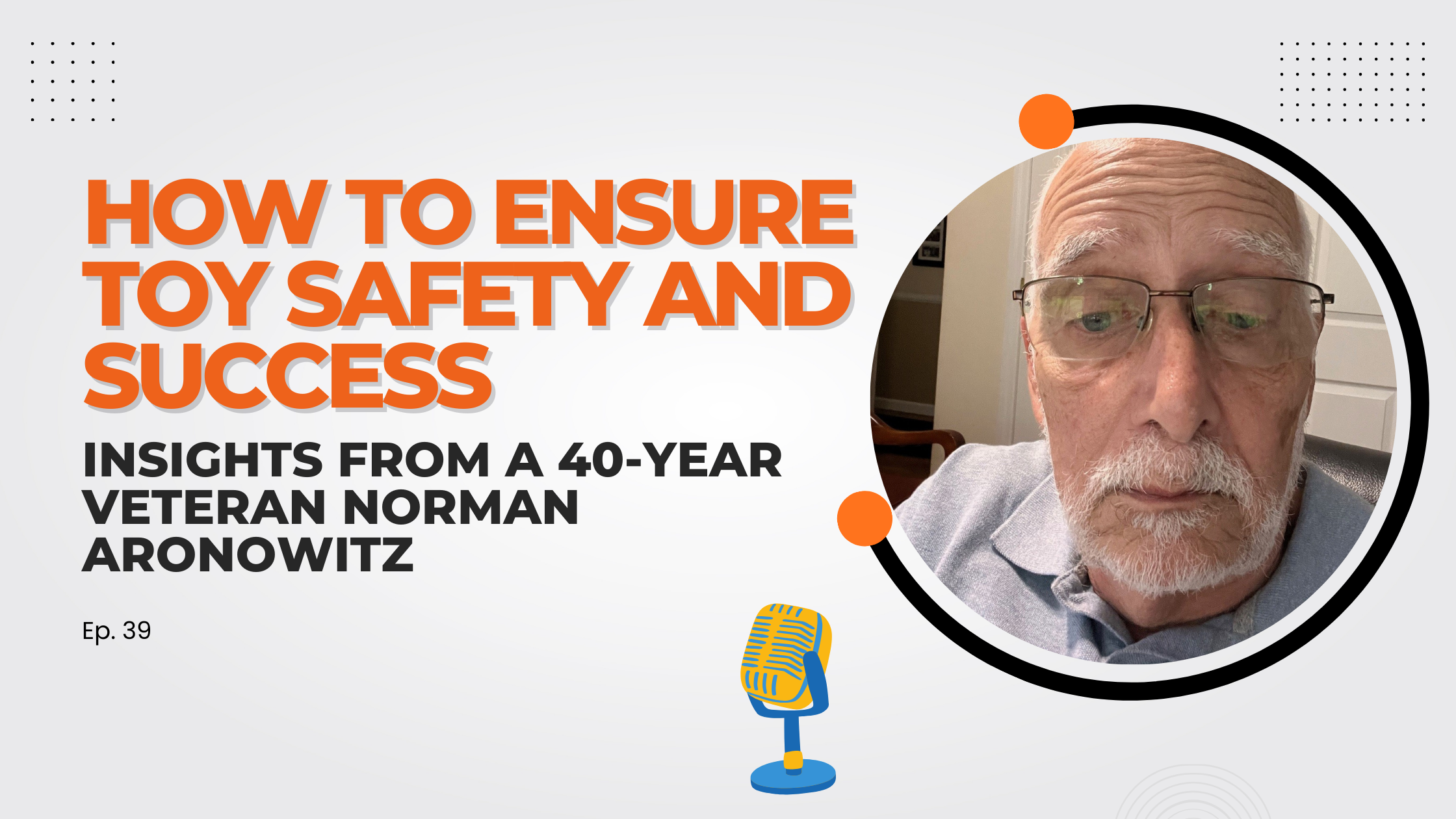
Welcome to another eye-opening episode of Toy Business Unboxed, where we delve into the intricacies of the toy industry. In this episode, we interview Norman Aronowitz, a stalwart in the toy industry with over 40 years of experience. From his vast experiences spanning sales, marketing, product development, and especially toy safety and compliance, Norman shares invaluable insights that are crucial for anyone involved in the toy business.
Episode Highlight
- 00:00 Introduction to Toy Business Unboxed
- 00:42 Meet Norman: A Toy Industry Veteran
- 01:30 Norman’s Journey in Toy Testing
- 03:21 Understanding U.S. Toy Compliance
- 06:37 International Toy Testing: Focus on Japan
- 08:48 Common Challenges in Toy Compliance
- 13:56 Cost-Effective Toy Testing Strategies
- 16:24 Navigating Amazon’s Product Compliance
- 16:51 Amazon’s Testing Requirements
- 18:25 Navigating Amazon’s Compliance Challenges
- 19:25 Working with Toy Launch for Amazon Approval
- 22:20 Lab Testing Process for New Toy Companies
- 24:22 Choosing Between US and China Labs
- 26:53 Sourcing and Testing in Mexico
- 28:52 Final Advice for Toy Entrepreneurs
- 31:40 Contact Information and Closing Remarks
Introduction to Norman Aronowitz
Norman’s journey began as a retailer in the toy department of a major department store. His career evolved from being an assistant buyer to managing sales for small and medium toy companies across the nation. Later, he transitioned into toy testing, a vital area where his expertise ensures the safety and compliance of toys for children worldwide. His role involves navigating complex regulations, ensuring safety standards, and guiding businesses through potential pitfalls.
The Importance of Compliance in Toy Manufacturing
Norman emphasizes the critical role of compliance, particularly in the U.S. market, regulated by the Consumer Product Safety Commission (CPSC) under CPSIA guidelines. He explains how every toy must be vetted against standards based on age appropriateness and functions like battery usage. Missteps can occur if manufacturers overlook age grading, which determines the safety requirements for each toy.
Insightful Strategies to Reduce Costs While Ensuring Safety
Norman provides strategic advice for minimizing testing costs without compromising safety. He stresses the importance of consulting with testing labs and using consistent materials throughout production. This helps avoid unnecessary testing expenses, especially when designing toys involving various components and colors.
The Challenge of Amazon Compliance
Given the growing importance of Amazon as a sales platform, Norman discusses the rigorous compliance requirements sellers face. He shares experiences dealing with Amazon’s frequent testing demands and offers strategies to navigate the often frustrating requirements. Partnering with a knowledgeable testing lab can significantly aid in understanding and meeting Amazon’s compliance standards.
International Testing: A Complex Landscape
When expanding into international markets, Norman addresses specific challenges, such as the unique testing protocols in Japan. He highlights the benefits of consolidating testing for multiple regions to save costs, but advises manufacturers to weigh the benefits against sales prospects in those regions.
Practical Advice for Toy Entrepreneurs
Norman advises new toy entrepreneurs to take compliance seriously. With increasing regulatory scrutiny, adherence to testing protocols is essential to avoid costly mistakes. He recommends establishing strong relationships with reliable labs that will support and guide in testing processes, and ensuring all necessary paperwork and testing reports are up-to-date to prevent shipment delays.
Conclusion
Norman’s detailed insights are grounded in years of hands-on experience and are essential for anyone in the toy industry. As the industry grows and regulations tighten, his advice is invaluable for navigating the complexities of toy safety and compliance.
You can reach out to Norman directly via email or visit their website at www.stc.group/en to learn more about their services. Continue to innovate and inspire through your creations, and remain committed to bringing joy through toys.
To stay updated with the latest episodes of Toy Business Unboxed and embark on your own journey into the toy business, don’t forget to subscribe and follow the podcast. If you found this episode insightful, please leave a rating and review, and share the podcast with fellow toy enthusiasts. Let’s embrace the world of toys together, staying curious and continuing to innovate.
Transcript
EP039_08-07-24_Norman Aronowitz
Intro: [00:00:00] Welcome to Toy Business Unboxed, your gateway to the secrets of the toy industry. Here, Jason Hsieh, a toy entrepreneur and expert in the field. “Every product we develop is really inspired by some of the real life experience that we have with our son.” “60 percent of all toys last year were sold on Amazon.”
“Be passionate about it. Because it’s a road. It’s a journey.” “Like when you have an idea that you think is gonna somewhat change the world, make things better, I’d say go for it.“
Jason Hsieh: Hello, welcome to another episode of Toy Business Unboxed. I’m your host, Jason Hsieh. And today we have a special guest, Norman, who have bring over 40 years of experience in the toy industry, including roles in sales, marketing, and product development, was eight years dedicated to toy development. Testing specifically, and Norman’s [00:01:00] here to share his expertise to ensure toys are safe and compliant for children worldwide. From navigating Amazon’s approval process to understanding the importance of compliance in toys manufacturing, I believe this episode is going to fill with essential information for anyone in the toy businesses. Please stay tuned as we start today’s interview, and so much for joining us on the podcast today, Norman.
Norman Aronowitz: Thank you for having me.
Jason Hsieh: Can you start out by sharing with our audience a little bit about your background and how you got started doing what you currently do?
Norman Aronowitz: Okay. I started out as a retailer and I worked for a major department store and they put my first assignment with the toy department. So I spent years as an assistant buyer in toys, moving on to different places. And then went to work for mass merchants in toys and then got involved in toys and sporting goods because they’re very well related and junior sports and I was with them did that for about 10 years and then I moved over to the other side into selling and sales [00:02:00] managing for small and medium toy companies. That’s where I got involved a little bit with toy development as well as your product development as well as selling to the major retailers across this whole country, toys and sporting goods. And then about eight years ago I made the move. I was offered a position with my, because of my background in toys and related products to get into the testing business. The toy industry had been caught for kind of flat footed, but people were not testing very much and the government started really implementing toy testing. So the CPSC, the Consumer Product Safety Commission, started CPSIA, which is basically the regulations for toys for the United States. So I got involved with that, and I’ve been in that now for the last eight years, testing toys and helping people. We help people as they’re developing so that they don’t get involved in the pitfalls of having products that either can’t pass or are dangerous.
Jason Hsieh: What inspired you to focus specifically on toy testing and compliance [00:03:00] after your career in sales and marketing?
Norman Aronowitz: It was just a good opportunity. It’s good helping people do this their, product development. And it was, I’d say basically just a good opportunity and I found it really interesting. It was more than just pounding on doors, trying to sell my product. It became more of a like a mission as well as a good job.
Jason Hsieh: Can you also explain to the audience, the main compliance requirement for toys? Let’s start out with the U. S. first, because majority of the listeners are in U. S., but then we can talk about other international marketplaces, but let’s start out with U. S. first.
Norman Aronowitz: Well, U. S. testing is controlled by the Consumer Product Safety Commission, as I said. And the rules are CPSIA, which are readily available online but it’s a very extensive and there are standards for almost every type of toy depending on age rating, depending on function with batteries, without batteries. So there’s all kinds of regulations. So every toy that someone develops should be checked out before you go [00:04:00] into the process of actually manufacturing. I’ve gone through many cases where someone’s bought a mold, start molding something and find out that it’ll never pass. And also your age grading. Many people think that age grading is just a suggestion for the parents. Okay. But it’s not, it’s also a suggestion as to what requirements your product must pass. An item that’s for three, three and up is different than an item that’s eight and up. And of course, all ages for babies, there’s a whole additional requirements.
Jason Hsieh: The younger the age, the more strict the requirement, correct?
Norman Aronowitz: And also sometimes a lot of the size of the parts, batteries now batteries have become a very big part of the testing, especially the small button batteries. Law was passed called Reese’s law. It’s based on a child who actually died from ingesting a button battery. So there’s all kinds of new regulations on button batteries, labeling locking the battery [00:05:00] into the product. So these are all things that you should know before you,
Jason Hsieh: before you design the product,
Norman Aronowitz: before you produce. You can design it, but if you don’t know that you have to have a tiny little screw locking the compartment, that becomes an adjustment later on. when you want to go into production. A lot of the labs and we do this we’ll work with our customers in advance that can ask us a question. They can send us a picture of what they wanna do and somebody will say to ’em, Hey, don’t do it this way. Do it this way. Yeah. ’cause you did pass. You won’t pass if you do it the way you wanna do it.
Jason Hsieh: You mentioned about different age group. What are the most common age group? Maybe under three then above three, above eight? Or what is the group?
Norman Aronowitz: Children’s toys in the United States are considered 12 and under. But you can’t beat the system by saying, okay, I’ll give you an example. You make a radio control car and you don’t want it caught with the regulations.
Jason Hsieh: They say 13 plus.
Norman Aronowitz: So you make it 13, but you have Mickey Mouse sitting in the driver’s seat. [00:06:00]
Jason Hsieh: Okay. That doesn’t work.
Norman Aronowitz: Packaging shows a six year old playing with it. Just because you call it 12 and up over 12 doesn’t mean it is. So it’s really a common sense thing. Now, at 8 and up, there is some kind of judgment. You can make that judgment that you won’t recommend it. Let’s say a science or a STEM toy. You might not want it. You recommend it’s not good for Children under eight years old. Listen, most parents always think their kids are smarter than the age rating. So they made this. My kids, six years old, but he’s smart. But that’s not your problem. Your problem it’s recommending the proper age for the item
Jason Hsieh: One more marketplaces that we also focus a lot on here at toy launch is Amazon Japan. When we actually help our client to expand into Amazon Japan.
Norman Aronowitz: Right.
Jason Hsieh: Can you also talk about the, how much do you understand the Japanese?
Norman Aronowitz: I’m glad you picked Japan. STC is one of the few non Japanese government labs. That can test for Japan. [00:07:00] Because we are a leader in Asia and our headquarters are in Hong Kong, we do Japan, Japanese toy testing and Japanese toy testing is totally different than everybody else.
Jason Hsieh: Yes. Yes.
Norman Aronowitz: Each material has to be tested separately, different types of plastics where in the U S and most of the countries we can combine plastics. Japan is totally different and we can help people with that, but we recommend also is when you’re looking at your product, where you want to sell it, the more countries you can combine at the beginning. We’ve saved money because we can share some of the results, especially the chemical end. When we test a plastic for lead, the testing for Europe is different than testing for the U S, but the U S will accept the results from the lab. That kind of testing. But on the other hand, if you don’t have customers in a certain area, it doesn’t pay to pay for the extra testing. Many Amazon customers that we deal with, what we recommend is [00:08:00] sell, take tests for U. S. and Canada.
Jason Hsieh: U. S. Canada first.
Norman Aronowitz: There’s a lot of cross selling across the border. And we can share it. And of course you have a small amount more to add Canada, but if you don’t add Canada and you come back six months later, you’re starting to get bored.
Jason Hsieh: How about Mexico? Because it’s all part of the same North America.
Norman Aronowitz: Mexico is becoming, is still up in the air for a lot of things. Many Mexican companies just use the U S testing, but Mexico is putting in regulations and it’s something that has to be watched in the future.
Jason Hsieh: I see. I see. Yeah.
Norman Aronowitz: But right now a lot of US product is sold in Mexico, probably without testing. I’ll be honest with you. They, feel they have US testing and they ship it in. There’s a lot of that going around and all markets have testing and they think that they’re compliant. So you have to handle that on a case by case basis.
Jason Hsieh: Based on your experience doing testing for the toy industry for so many years, what are some of the most common challenge that you see toy manufacturers usually face when trying to meet those compliance [00:09:00] standards?
Norman Aronowitz: The biggest thing is size of product to start with choking hazards. That’s a big thing. Especially, small balls. And things like that, becomes very hard to pass a certain regulation. Sometimes you may have to make the ball slightly bigger, so that you’re compliant for that age group. Package warnings, like some they’re not restricted necessarily from carrying something or producing something, but you may have to put a warning on the package. A choking hazard warning, or not suitable, or adult require, adult supervision required. The biggest problem most people have though is the chemical testing. You get a sample from your manu, whoever manufacturing your plastics, your plastic toy.
Jason Hsieh: Yes.
Norman Aronowitz: It passes testing. The shipment comes in and the U. S. Customs happens to do a spot check on your item.
Jason Hsieh: Yes.
Norman Aronowitz: Now they find lead in it. Why did that happen? Manufacturer went ahead and produced whatever they [00:10:00] want to do once they had the passing. So we always suggest to people at the beginning dealing with a factory.
Jason Hsieh: Yeah
Norman Aronowitz: Let just an inspector go and pull the sample, the testing sample from your shipment. That way you know what you ordered is what you’re getting. You ordered a safe product, and now you’re getting a safe product.
Another bad thing that really causes problems for many small toy companies is they over design. You make an example. You’re doing a sorting toy for little children and you have 20 blocks of and you do each one in a different color.
Jason Hsieh: Oh,
Norman Aronowitz: every time, every color stands on its own. Now we’re, you’re allowed by us standards to test up to three colors of the same material as a group. So if you design something with nine colors, that’s three test groups. If you design it with 10 colors, you’re now at four test groups. You’re not spending more money just because you added an extra color. So we [00:11:00] tell people to think about those things in advance. Do you really need So many different colors,
Jason Hsieh: or I think a lot of the problem, a lot of the toy entrepreneur, toy inventor I talked to, they don’t know what they don’t know. It’s what? Yeah, exactly.
Norman Aronowitz: And also, if you’re going to sell it to Europe, there’s more stringent testing for lead and chemicals in Europe. So the more components you add, the more colors you add, adds to your cost. That doesn’t mean that it’s going to hurt your item. Question? The prime example is, I once had a customer who was selling bicycle accessories.
Jason Hsieh: Okay.
Norman Aronowitz: Horns, bells, things like that.
Jason Hsieh: Yeah.
Norman Aronowitz: They had a distributor in Europe who wanted to sell their horns.
Jason Hsieh: Okay,
Norman Aronowitz: how much was he going to get an order for 300 horns?
Jason Hsieh: Yeah,
Norman Aronowitz: the testing was three thousand dollars.
Jason Hsieh: Oh okay
Norman Aronowitz: all of a sudden it didn’t pay to ship to europe. So
Jason Hsieh: yeah. Yeah. Yeah
Norman Aronowitz: So even though you can pass the testing and if that you have a large [00:12:00] enough business But you have to know what it’s going to cost you. Can you support the item? So if you’re going to sell an item in the u. s. Now there is Regulations for small batch manufacturers. You can get away with certain testing not being done. You can get, take a report from a factory. But in most cases, we suggest that the toy entrepreneur or the toy importer does the testing himself. Because two things happen when we see when people get factory testing, we see a few things happening. One, U. S. regulations require testing yearly. So the test is three years old. You may have a test, but it doesn’t mean it’s not valid. You can’t use it. Secondly, if you have a test from the factory, you don’t know what sample was sent sent to the lab so they can send a perfect sample, get a passing test and then go ahead and manufacture whatever materials they want to use. And thirdly, people say, Oh, I saved money. I didn’t [00:13:00] pay for the testing. It’s in the price. Factory is not doing it as a charity. So we always suggest the smartest thing to do is to do your own testing that way you’re in charge, but the worst thing I’ll get perfect example, we had a customer He tested four items with us. All four passed. His shipment came into the U. S. Customs happened to flag his shipment randomly. He tested all four items for lead. Three of them failed and said, wow, what happened? What happened? I can’t You passed me. And what we told him was
Jason Hsieh: The sample is then is not right.
Norman Aronowitz: The lab that the factory sent, we didn’t test your shipment.
Jason Hsieh: Shipment, yeah.
Norman Aronowitz: So at the beginning, and that’s where a lab can help you. We advise our customers. So if as you’re getting ready to order, as you’re getting ready to even manufacture, talk to your lab. And we’ll give you information on what to do, what’s the best way to handle it to avoid that disaster.
Jason Hsieh: That is actually a perfect segue to my next question. How can the toy company minimize their testing costs [00:14:00] without compromising on the safety?
Norman Aronowitz: Again, we’ve talked about most of it. The bottom line is, talk to your lab advisor your salesman at your lab beforehand and get advice. You can go up on the CPSC website and read a lot of the regulations and some of them will make sense to you. But some of them may be vague to you when you’re looking at it. So for instance if you talk, when I talk to the customers, I’ll say to them, let’s say they’re making stuffed animals. That’s a perfect example and they want to do six different varieties. Okay, that’s two test groups. But if the I’s are all, if you do the same I, let’s say black plastic, we can test that once. Apply that to all six items. We say to the customer, why don’t you do it this way? Does each I have to be different? It’s just advice. It’s just common sense ways to try to minimize. We know what we have to charge you to test something.
Jason Hsieh: Yes.
Norman Aronowitz: So if you can eliminate that test, you’re saving money. Same thing, like I said to you with colors or plastics.
Jason Hsieh: Yeah.
Norman Aronowitz: And also [00:15:00] using the same materials. If you’re using polyethylene. Use it throughout. Don’t switch to another plastic for one piece.
Jason Hsieh: Yeah, then
Norman Aronowitz: we don’t realize you have to test everything. Screws, velcro, zippers, all have to be tested. And if you look at a zipper has the teeth, the slider, the handle, those are all separate items. So if you put a zipper on a product, Use the same zipper for all your products because if you change the color, then you have to test all those things again.
Jason Hsieh: Again, okay, makes sense.
Norman Aronowitz: So again, common sense approach to toy design. One of the things that I’ve always said, toy designers, they’re luckily, they’re many of them are in a fantasy land. They’re making something for children to be a fantasy. Oh, let’s make it 17 colors, and let’s, the other thing also that they also have to look at is anything that has to do with a liquid. Inks, paints. If you’re doing a painting, How many colors are you applying? I’ve had people where they send [00:16:00] you a palette of 36 different
Jason Hsieh: colors.
Norman Aronowitz: Now you’ve got a big testing group. So these are all the things to use. Just use common sense. A good lab will work with the customers in advance. And like I say, we advise customers all the time on what to do and what not to do, sharp points, round it off.
Jason Hsieh: Thank you for sharing that. So I want to transition to the next part of the interview to talk a little bit more about Amazon because Amazon is like the biggest elephant in the room, most of the toy manufacturer are selling or trying to sell on Amazon.
Can you share a little bit of your experience dealing with Amazon’s product compliance?
Norman Aronowitz: First of all, Amazon started to crack down on testing every year.
Jason Hsieh: Yes.
Norman Aronowitz: So that’s the first thing. If you’re selling on Amazon, be prepared that yearly you will have to retest your product. Now, the law says if you can produce, tracking information to say that it’s still the same batch, let’s say you made 5, 000 pieces [00:17:00] and it’s the second year and you got a thousand pieces left, the government says you can still keep selling them, but amazon is too rigid. So basically if they’re, The computer says it’s over a year old, they’re going to ask you for testing again. And you really can’t fight that. You can try by saying it’s the same batch. If you get lucky enough to get a live person to talk to, maybe you get away with it. But for the most part, plan on testing every year. The second thing, on Amazon, for the most part, only requires what the locality requires. So if you’re selling to the U. S. The only standard they want is the U. S. CPSIA. They don’t ask for extra. Some major retailers, a lot of times, will ask something extra. Now, in their experience, they want this or they want something else that’s not part of the regulation and that’s their prerogative.
But for Amazon, it’s strictly whatever that local country requirements are. So if you’re selling in Europe, you need European testing. And [00:18:00] one of the things we find also is if you get lab, I didn’t mention this before, but if you get testing from a factory, many times the, Barn factory doesn’t really know each regulation. So they’ll give you a test. They pass the test in Europe. They give you the test and they want to ship it to the U S. So Amazon will make sure that your testing is for the right country and the right standards. One of the problems you can hit with Amazon and we help customers with this all the time. Let’s say a regulation changes. It’s either light, looser or tighter, but they still have in their system, the old standard. Sometimes they won’t accept the new testing and we have to go fight for them. So in other words, if the standard was two years older and they haven’t changed it yet and now you’ve actually tested something safer than the old standard, it doesn’t matter to Amazon. They just want that old, that testing result. So our lab managers in many cases can send and give you a test to submit. And it [00:19:00] works most of the time, not all the time. Some of the time it goes back to the thing. We’ve actually had one customer, we went back and tested to the old standard for them. Just so they could get past.
What is there? Two million sellers on Amazon and
Jason Hsieh: yeah,
Norman Aronowitz: millions of products. I guess at a certain point they can’t check everything and be right about everything.
Jason Hsieh: Yeah. Yeah I think the Amazon customer support just following a standard checklist. They don’t really understand what they’re looking at.
Norman Aronowitz: Yeah, exactly.
Jason Hsieh: But do you have any strategy that you recommend to overcome those Amazon compliance requirement? And that’s actually something we are dealing with on the daily basis here at Toy Launch because we try to help our client to get approved by Amazon, but sometimes we keep on getting disapproved or get rejected because it’s missing like a line or the wording in the testing is not how Amazon want to see it. But Amazon doesn’t, it’s not really specific on exactly what they want to see neither. So it’s very frustrating sometimes dealing with Amazon platform.
Norman Aronowitz: I don’t know what, I can’t speak for the other labs. But what [00:20:00] we’ll do is we’ll, a customer calls us and says whether we tested before and they’re in trouble or they’re new to us, we’ll ask them to send us what Amazon has sent them, whether it’s, an email, an attachment, and then we look at it and our lab manager has a way to, he’s dealt with so many of the problems. He comes up and sometimes he has a simple answer. Oh, all you got to do is this and all you need is this piece of paperwork and we’ll do a small test or maybe a test was omitted. And we’ll do that test for them. All I can say is what we do is that we help, we try to help interpret what Amazon is asking for and I would say we’re probably 90 percent successful. No one’s a hundred percent successful, but we’re, pretty successful. We have a joke in the, lab. We say our lab manager speaks Amazonese. He’s done with enough products. He knows what, sometimes it’s just the picture, there’s no picture on the report, a test report usually has a picture of the item and they’ll say, [00:21:00] Oh, we have to put a picture into that report.
Jason Hsieh: Because like I say, Amazon’s customer support just follow a basic checklist. They don’t really understand what we are reading.
Norman Aronowitz: And by the way, we, I’ll warn your listeners, don’t ever try to change something on your report to make Amazon happy. We get that all the time where Amazon will send us a copy of a report and say, Is this the valid report? And we’ll see where someone either added a new skill or sometimes even our mistake. The picture is off center. Being that pictures are always centered, they may say, Is this your report? Because It looks different. Never try to change a report to try to get past, because if Amazon catches you altering the report, then you can be suspended forever.
Jason Hsieh: Yes, they can suspend you. Exactly. They can suspend your account now that you’re in big trouble.
Norman Aronowitz: Very much yes. The other thing too is that, we didn’t talk about this before, but when you’re testing even, when you’re in production, if something fails, [00:22:00] you have the opportunity to resubmit a new part. So in the case of, if you’re doing it as the agent for the manufacturer, we can make sure that it’s a valid thing. If a factory does it, the factory is going to send a perfect sample to get the test passed. It’s always better to take control of your own business. You want to take control of your own business. That’s the best advice.
Jason Hsieh: Can you walk us through the process on how your lab work with new like toy companies? And what kind of question do you ask them before you take them on?
Norman Aronowitz: It’s first of all, what we do is we, I send out a basic questionnaire, which gives us, you’re asking the name of your company, address, contact information, all that basic stuff. Then we ask for a picture of the product, a bill of materials, if you have it, so that we know what the product is made up of, what countries you want to sell it in. And then what we do is we take that information and in most cases we can quote what the testing is going to cost going forward. [00:23:00] Now we may look at it and say, this is going to be extra because it’s not, it doesn’t fit the regulations or things like that. Then what we do is once the client looks at the cost for the testing. They say yes or no. If they say yes, we then require samples, usually a minimum of two to three samples of an item. So if you have, you only have one prototype. It’s not a good, it’s not possible for us to really test. And then what we’ll do is we get the samples in, we re quote it. Why is that? Because maybe we couldn’t see that there was a screws at the bottom of the item or in some cases we didn’t realize it was battery operated.
Jason Hsieh: Oh yeah. That’s a big difference. Yeah.
Norman Aronowitz: Now it’s a big change. Then we send a formal quote to the client. I took approving the normal testing in China is five to seven days. In the US, it’s seven to 10 days.
Just so everybody is aware of it. All labs require payment in advance of releasing the report. In all honesty, [00:24:00] not that it doesn’t happen that often. But if somebody fails, Okay. They go, I don’t want to pay for it. But so you have to know you’re going to pay for the report. Even if there’s a failure on it, you’re going to pay for the report before you read it. . Then when you read the report, if there’s a failure, we’ll work with you on how to Correct.
Jason Hsieh: Correct the failure part.
Norman Aronowitz: The failure so that you can get a pass.
Jason Hsieh: I see. So you mentioned about the lab in China and lab in us. Which lab do you most of clients use?
Norman Aronowitz: It depends on where they manufacture. Usually testing in Asia is cheaper than testing in the us
Jason Hsieh: of course. Yes. Yes.
Norman Aronowitz: If the product is here, though. Sometimes it’s more money to send it overseas. We’ll advise made in USA products, most of our customers will test here. And also, it depends on the product. Some products you save a lot of money by testing in China. Some products you don’t save that much because things like cardboard puzzles it’s not that much different. So you might as well do it locally and we can handle it here. It all depends that [00:25:00] we advise the people as it comes up. What we don’t normally do is if you’re manufacturing in China, we ask what city factory is in, because we have multiple labs and we try to have the lab that’s closest to your factory working with you and that way if they need another sample it gets there in a day instead of waiting two weeks to get a sample.
Jason Hsieh: But I guess, back to the thing you mentioned earlier, how can we make sure the factory sample that’s being sent by the factory is actually the product they’ll be making at the end? Because you mentioned about this as a potential issue.
Norman Aronowitz: There’s two ways to do it. Most labs, and we have one also, it’s an inspection company and we recommend that, especially when you’re first getting started. Number one, if a factory, if you tell a factory that you are going to be sending an inspector. A lot of people do is they’ll test from the prototype samples that they get or samples they get from the factory. Cause a lot of the stuff is already made. But then when the shipment is ready, they’ll send one piece, but just [00:26:00] for chemical testing, because that’s really from
Jason Hsieh: the production run,
Norman Aronowitz: it’s from the production run. When you first start out as a new importer or a new product, it pays to add that one extra test. Down the road when you know your factory is good I have certain factories that never fail.
Jason Hsieh: Yeah.
Norman Aronowitz: We deal with their suppliers, with their customers all the time and they never fail. They make good product. But sometimes you meet a small factory that you don’t know and to go to China, you know what it costs. You gotta fly to China. You don’t speak the language. You have to get somebody to work with you. The average inspection is around 300 US dollars.
Jason Hsieh: Yeah. Usually. Yes.
Norman Aronowitz: So to send someone to a factory to inspect and plus they’ll inspect more than one piece. They’ll pull
Jason Hsieh: Yes. Yeah.
Norman Aronowitz: 50 pieces and randomly look to make sure the product coming in. What you ordered, and it’s a quality product.
Jason Hsieh: I have another question. It’s more of a selfish question because right now I’m actually looking into sourcing from Mexico for my own program [00:27:00] because of the U. S. China relationship and also the upcoming elections. There’s a lot of uncertainty whether or not they’re going to race the tariff again they did a couple years ago. So I don’t know how much experience have you working with your customer that’s being currently manufactured in Mexico and how is your experience dealing with the factory in Mexico?
Norman Aronowitz: Manufactured in Mexico that most of those customers will test in our U. S. lab. Again, you’re not talking about selling in Mexico. You’re talking about just
Jason Hsieh: manufacturing.
Norman Aronowitz: Right? So the only difference there is the few people that we’ve done with that, that done that with their people, they’re pull the samples. We don’t have an inspection company there to do the sampling, but most of the companies that are producing in Mexico, most of them are, a lot of them are California companies. Okay. And they’re always going back and forth between Mexico and California. So they’ll pull the product and we’ll test it in the U. S. lab. If it’s a lot of stuff, could you ship it to China? Yeah. But you [00:28:00] got to deal with customs and all these other stuff. We handle it on a one to one basis, but again, most of the stuff that if it’s made in Mexico, we’ll test it here. One thing we have found though, Lots of failures on paints coming out.
Jason Hsieh: Okay.
Norman Aronowitz: Haven’t dealt too much with the actual plastics, molded plastics, but the paints, anything that’s painted. We’ve had a lot of problems getting lead free paint. We’ve got a couple of customers that actually got new samples of paint and the paint was again tested and it didn’t pass either.
Jason Hsieh: Oh, whoa. Okay. That’s not good.
Norman Aronowitz: So you got to be careful with that in Mexico, right? For now.
Jason Hsieh: Do you have any referral or sources for inspection company in Mexico? Cool.
Norman Aronowitz: I do have some people that I know from the industry. Yes, we could refer. I could give you or the client some information on how to contact them.
Jason Hsieh: Okay. Sounds good. Sounds good. As well, wrapping up today’s interview my final question is What advice will you give to new toy entrepreneur or [00:29:00] manufacturer about the importance of compliance and safety when it comes to product development and what should they think about? You mentioned a few points earlier during our today’s interview of what to think about doing product development. So they don’t overproduce or overdesign the toy itself.
Norman Aronowitz: Even more important, we’ve discussed most of the ways to avoid excess costs. My advice though is not to take it lightly. Testing, there have been many people that have brought merchandise in over the years that are selling merchandise that wasn’t tested or not, wasn’t properly tested. The times are changing. Number one, within a year, you are gonna have to, anybody importing is going to have a way to put their test results and their CPC, their consumer product certificate on the cloud. Customs is going to require it with every shipment. So it’s not going to be like before, Oh, I, I got through. I would say there’s so many products on Amazon that people have been selling for years that never tested but now they’re getting [00:30:00] caught. Going to get caught by Amazon and the future it’s going to be the U. S. government. Anything coming into the United States is going to have the proper paperwork and because of A. I. and because of massive computer systems now. 30 years ago, a customs agent would have to go on and look through files to try to find paperwork.
So the days of trying to get away with not testing or, Oh, I’ll just get the factories report. It’s dangerous for you. It’s dangerous for the consumer. And more important, it’s dangerous for your pocketbook because the last thing you need is a shipment, customs and charging you rent every day, eventually destroying it because they won’t let you sell it.
Jason Hsieh: Yeah, you’ll lose a lot more money than you try to save on the test report.
Norman Aronowitz: And also if you have a good test report and you do the inspections, and if that the product that container that’s coming in is saleable. I’ve had people that get shipments in and then when they open it up. It’s not what they ordered.
Jason Hsieh: Yeah, that would be bad. That would be really bad.
Norman Aronowitz: The quality is so bad [00:31:00] that they’re getting 30, listen, everybody that works on Amazon knows that they track everything. If you’re getting 25 percent returns, you’re not going to be a very high ranked on Amazon. You’re just going to look at it as a designer of toys or a non new toy manufacturer you have to have, you’re paying a designer, you’re paying a packaging person, you’re going to have to pay for testing.
Jason Hsieh: It’s the cost of running a business, yeah.
Norman Aronowitz: Exactly. And we recommend finding a lab that will work with you. And as we always say, we answer the phone. As a designer, you call somebody. And you don’t want to wait two weeks for someone to call you back. So find a lab that’s going to work with you and treat you the way you deserve to be treated.
Jason Hsieh: Thank you so much for sharing all your knowledge and the advice. Where can our audience find you?
Norman Aronowitz: We’re, our lab is in New Jersey. My email address, will you be posting the email address?
Jason Hsieh: We’ll put it in the show note. Okay,
Norman Aronowitz: so the email address is there. I have a direct phone number. It’s 201 391 4727. [00:32:00] We’ll get back to you. And I say you’ll have the email address. Just email me and we’ll get I want to talk to you about a toy. Or here’s my new toy. And we’ll talk to you and get back to you and we’ll start working with you now.
Jason Hsieh: What is your website as well?
Norman Aronowitz: Website is www. stc. group.
Jason Hsieh: Okay.
Norman Aronowitz: Backslash EN. Otherwise you get the Chinese version.
Jason Hsieh: Okay. Got it. Got it. Got it.
Norman Aronowitz: That’s the company website. And like I said, we have labs in China, Vietnam, Germany, U S so we can help with most of your needs.
Jason Hsieh: Thank you for tuning into the today’s episode of toy business unbox podcast. We hope you enjoy the conversation and find it insightful and inspiring. If you like what you heard, be sure to subscribe to our podcast on your favorite platform, so you never miss an episode. We really appreciate your support and we’d love it if you can leave us a review and share the podcast with your friend or colleague in the toy industry.
For more resource [00:33:00] tips and latest update in the toy industry, visit our website at toy-launch.com join the conversation and connect with us on social media using hashtag #ToyBusinessUnboxed. We’d love to hear your feedback and suggestion for future episode until next time, keep innovating, keep creating, keep bringing joys to toys.
This is Jason Hsieh signing off on toy business unboxed podcast and see you in the next episode.