
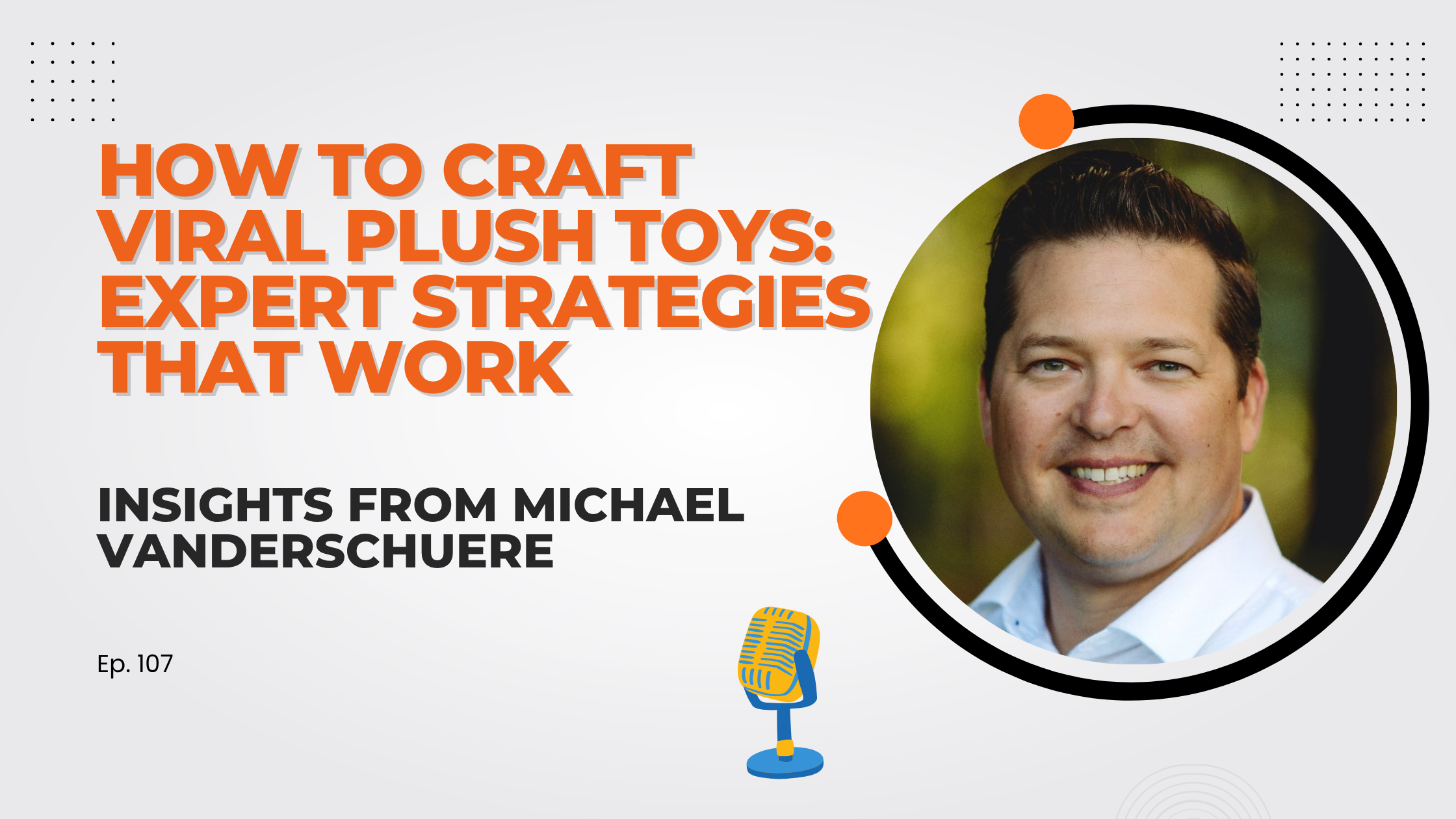
Welcome to an inside look at how plush toys are made in the U.S. and what drives their success—viral appeal, quality, or logistics. Industry veteran Michael Vanderschuere of Fairfield Processing Corporation shares insights on domestic manufacturing, market challenges, and strategies for creating plush toys that truly resonate. With social media trends and shifting global trade, understanding U.S. production is key for anyone developing or collaborating on a plush line.

#107: Viral Plush Toys: The Secret to Success – Toy Business Unboxed
Episode Highlight
- 00:00 Introduction
- 01:27 Get to know Michael, toy industry veteran.
- 02:52 Michael’s tenure at Fairfield.
- 03:10 Fairfield’s family-owned history.
- 03:44 Fairfield’s historical background.
- 05:18 Fairfield’s plush designs.
- 06:10 Viral plush bear story.
- 09:40 U.S. manufacturing pros/cons.
- 11:58 Plush materials and quality.
- 12:41 Product Development & Manufacturing
- 21:32 Design to production timeline.
- 24:35 Final advice & resources.
The Rise of U.S. Plush Manufacturing: From Hat Factory to Toy Powerhouse
Fairfield Processing Corporation, founded in the 1940s in Danbury, Connecticut, began as a wool and hat manufacturer. When hats fell out of fashion in the 1960s, then-President Sam Young pivoted the company to fiber and plush production, transforming polyester fibers into soft stuffing for dolls and pillows. Today, Poly-fil—Fairfield’s flagship product—is recognized worldwide, showcasing how U.S. manufacturers can adapt and innovate over decades.
Controlling the Feel: How Material Choices Drive Viral Success
One of Michael’s key insights is how much the physical feel of a plush toy drives its popularity. For example, Fairfield’s 16-inch teddy bear with siliconeized fill went viral on TikTok and Instagram during a Valentine’s campaign at Walmart, selling out quickly and sparking secondary market demand.
Its success wasn’t due to complex design but to premium materials that felt soft, huggable, and engaging—proving that tactile quality, simplicity, and strategic placement can create emotional connections and social media buzz.
Manufacturing in the U.S.: Benefits, Challenges, and the 16-Inch Threshold
While many toy companies outsource overseas, Fairfield highlights the benefits of U.S. manufacturing—especially for plush toys 16 inches and larger. Domestic production reduces freight costs, enables faster turnaround, and allows better quality control. Smaller toys under 16 inches can be less economical due to higher labor and material costs, making 16 inches the sweet spot for balancing cost, quality, and sustainability.
Material Science Matters: Polyester and the Feel-Good Factor
Polyester is the standard for plush shells and fillings because it can feel luxurious, with Fairfield using recycled PET for fillings to support sustainability. Material choices affect tactile feel, safety, durability, and visual appeal—like embroidered versus plastic eyes or varying pile lengths and textures. High-quality fabrics, proprietary fill blends, and secure closures help create plush toys that are safe, appealing, and capable of going viral.
From Concept to Creation: How U.S. Manufacturers Support Private Label and Viral Products
Creating a plush toy involves design, prototyping, and precise manufacturing. Fairfield’s workflow includes client design input, six weeks for production setup, sampling and testing, and typical order minimums around 1,000 units. The company also supports packaging, safety testing, and efficient shipping. For newcomers, starting with clear specs, early prototypes, and partnering with local manufacturers helps ensure quality and faster turnaround.
Navigating Global Trade: Why Domestic Production Offers Competitive Edge
Amid trade tensions and tariffs, offshore manufacturing is increasingly complex. Fairfield notes that domestic production reduces shipping and tariff costs, lowers environmental impact, and mitigates high international tariffs. While labor costs may be higher, for plush toys around 16 inches or larger, the savings in logistics and the flexibility of local production often outweigh the expense.
Final Thoughts: Building a Successful Plush Brand in the U.S.
For entrepreneurs and toy newcomers, Michael Vanderschuere advises focusing on quality, strong relationships, and solving customer needs—people and innovative thinking are your greatest assets. By controlling materials, manufacturing locally, and leveraging social media trends, you can create plush toys that resonate and have viral potential. Your next step: partner with U.S.-based manufacturers like Fairfield to streamline production, ensure quality, and maximize impact.
Conclusion
The plush industry is at an exciting crossroads, where domestic manufacturing offers quality, agility, and sustainability. Success depends on premium materials, strategic placement, and products that connect emotionally with consumers. Partnering with U.S. manufacturers like Fairfield helps bring high-quality, innovative plush toys to market faster while building trust and a compelling story.
Connect with Michael Vanderschuere
If you’re interested in learning more about Fairfield World or connecting with Michael Vanderschuere , you can reach out through the following channels:
- Website: Visit Fairfield Processing Corporation’s Website for more information and updates.
- Linkedin: Follow Michael Linkedin for more updates.
- Email: Email Michael directly on michaelv@fairfieldworld.com for more insights & collaboration.
Transcript
Jason Hsieh (00:00)
Hi, welcome to Toy Business Unboxed podcast. I’m your host Jason Hsieh. And in today’s episode, I’m interviewing Michael, a veteran in the toys and the consumer product industry, who is now leading plush manufacturing at Fairfield Processing Corporation. And Michael’s background, spanning from working with various of different branded toys and companies. And today he’s also at the forefront in the plush industry, overseeing the production of everything from 16-inch plush to eight-foot teddy bears.
So you got those super giant ones that they also make. And we’ll dive into the world of plush design and how his company has grown as one of the powerhouse in U.S. based manufacturing for the plush industry. Thank you so much for joining us on the podcast today,
Michael Vanderschuere (00:45)
Yeah, thanks for having me.
Jason Hsieh (00:46)
So can you kind of tell our audience about how you got started in the toy industry and what led you to your current position?
Michael Vanderschuere (00:53)
Yeah, absolutely. Yeah. So how I got started in consumer products and in the toy industry was actually through my wife, who was a retail toy buyer. And I met a lot of the people that were in her industry and they said, Hey, why don’t you come over here and work with us? And so I had started that it was for a rep group that was dealing with the secondary channel. worked with MGA, little tikes, upper deck, ⁓ craniums, some other toy and games.
manufacturers in there. So I really got started with a lot of the grocery and drug channel.
Jason Hsieh (01:27)
I see. And how long have you been working with Fairfield so far?
Michael Vanderschuere (01:30)
I have known Jordan Young, our president and CEO for more than 15 years and I’ve been working here for coming up on five total years where I’ve been working with Fairfield. ⁓
Jason Hsieh (01:41)
Yeah, I know Fairfield has been around since the 1940s, right?
Michael Vanderschuere (01:46)
Yeah, you nailed it. Yeah, so third generation family owned US manufacturer have two locations and Danbury, Connecticut and our powerhouse facility and Saint Louis, Missouri.
Jason Hsieh (01:58)
And based on some of my research, the company also has evolved over from early years of processing just like natural fibers to nowadays, we focus a lot on like making and producing plush toys. I guess if you can also kind of share a little bit about how that has come around and how like maybe why does a company make that decision on changing?
Michael Vanderschuere (02:20)
Yeah, yeah. So I mean, so the story funny that you mentioned, and it’s actually it’s in the National Archives. So originally, Fairfield, where Danbury, Connecticut is and was the hat making capital of the world. So wool processing, making hats, our corporate facilities actually in the old hat making factory of Mallory’s that is in there. So in the early 60s, when John F. Kennedy
got inaugurated as president. He was the first president to not be wearing a hat. And so if you’ve ever seen the show that was on AMC Mad Men where they were wearing hats a lot in the beginning and then it really fell off towards the end as it changed, that was the same thing that happened. so Sam Young, our president at the time was working with DuPont on what to do with polyester fiber. And so we ran it through some of our proprietary processing machines.
It turned it into these fluffy clouds and it worked out to be a great doll and pillow stuffing. And that’s where it got started. So the brand name and registered trademark we have right above me that’s here, it’s Poly-fil. That is our registered trademark. We are kind of like the Kleenex to facial tissue. So when you see that red sign that says Poly-fil that’s us.
Jason Hsieh (03:22)
I see. Yeah. Yeah, I think you can see it in all the major arts and crafts store as well.
Michael Vanderschuere (03:42)
A lot of presence in those stores, A very loyal fan base.
Jason Hsieh (03:46)
Yeah, for sure, for sure, for sure. And ⁓ you also, your company also design some of your own plush, if I understand correctly.
Michael Vanderschuere (03:54)
under our brand, we do a lot of private label, you know, for major US retail. And the real benefit is the cube savings and the final leg of the journey, if you will, coming to life. But yes, we do some subcontract work where we will manufacture for others in the plush space. We also deal with pillows and dog beds and all things like that that can use a fiber foam film.
We do some of our, we do have our own brand name that’s in there. We have some of our own proprietary designs that we do in different shapes and fills and that kind of stuff. But, but yeah, we do a lot of private label in association with a U.S. retailers.
Jason Hsieh (04:35)
And in our pre-interview, you mentioned also in our previous conversation, some of the product actually went viral on social media. Can you share that story as well, how one of the product went viral?
Michael Vanderschuere (04:46)
Yeah, yeah, so it was it was really fun. We made a very soft and elastic feeling bear it was at Walmart this last Valentine season and it was like a gem colored bear, a simple bear. And it had a very luxurious siliconized fill and all that that’s in there. I have ⁓
I have some samples, just not right here, right at my fingertips. So sorry about that. But it, yeah, it went crazy on TikTok and Instagram and they were selling out, it was a 16 inch bear, you know, that was just a very simple, basic design, but it just took off and resonated with people. And a lot of that has to do with how it feels.
You know, I very much with blush. It’s either in the shell and how luxurious the shell feels or also how huggable is it? And this was just, was a, it was a great partnership with a great retailer and we had, ⁓ we had a really good time. It was on a Tik Tok and Instagram, Facebook, there are several millions of views, lot of comments and likes.
and it was selling out the day that it would get into store.
Jason Hsieh (06:01)
Was the people dancing with the bear? What are they doing?
Michael Vanderschuere (06:05)
It actually went a little bit insane to me, but on the, on the secondary market, people would try and resell it online and they were putting it for five, six times the retail.
Yeah, it was interesting. was a really, it was a fun one to get behind.
Jason Hsieh (06:21)
I see, interesting. And you kind of mentioned some of the reason why you kind of say now because of the material. Any other thing that you, because I think a lot of the toy company I talk to is like, how can I make my product go viral? So what are some of the major, I guess, lesson learned or takeaway based on that experience that you notice, okay, maybe there’s some criteria of how our product went viral versus other product that you also make that didn’t went viral?
Michael Vanderschuere (06:47)
So yeah, absolutely. No, so that’s a, it’s a great question. would love to have that formula for everything that we do. It is, it’s definitely one that we, we thought it was a great item. we really liked it. mean, ⁓ us as a U.S. manufacturer, we also can control several different ways the item feels because we control the fill. You know, we have, ⁓ we, have a real proprietary way of handling.
and managing all of that manufacturing part. So how it interacts and how you can really feel it. As far as it goes on the item and how and why it went viral, I think that has a lot to do with our retail partner on that one and their presence. A lot of people are walking into a major national retailer like that and they see it and a a lot of people are, that’s how they’re getting views. They film themselves going into stores and
You know, when a couple people that got followers, they like it. Next thing you know, it was wildfire. You know, it did have an end cap. So that never hurts to have that kind of placement and have a retail buyer that’s such a great partner to be with you and to believe in the item as well. How fast it took off, it was days after it set.
Jason Hsieh (07:58)
Okay, interesting. Yeah, that’s a very interesting success story for sure. And what you just mentioned is also a perfect segue to one of my next question, because with so many plush toys being manufactured and produced overseas, what are some of the advantage and also maybe some of the challenge of manufacturing plush in United States?
Michael Vanderschuere (08:16)
Sure. Yeah, no, it’s a great question. what are some of the benefits? I’ll start with those and then I’ll give you the challenges to answer them in two parts. The benefits are really the lower amount of containers and especially like, you know, during the peak of COVID when containers were 18 to $22,000 and things were crazy. The cost on something like this, that’s a large cube item that doesn’t weigh much. It really there, there was a lot of cost of freight.
on any of those that was in there. So the real benefits that we have is also getting it right into the heart of the country in St. Louis, Missouri, where we are, where it is so easy to ship from and to get things out. There’s a lot of people that will bring something into the West Coast, and then it’s got to traverse 3,000 miles to get all the way to the East Coast. We’re right in the heart. So it’s pretty even. It makes it the over-road time a little bit less.
The challenges that we have as far as US manufacturing on anything plush is anything that’s too small. That’s where you don’t get that balance between the US manufacturing, the cost of labor, the cost of materials. But we really find that that balance equals out. It’s really at about 16 inches. how we do it. That’s where we do like tens of millions of pillows a year.
Jason Hsieh (09:36)
16 inches okay,okay.
Michael Vanderschuere (09:40)
There is a lot that we do as a US manufacturer to help support and actually ⁓ with several retailers help improve their carbon footprint scoring and anything that is out there in that way.
Jason Hsieh (09:54)
I see, okay, that’s definitely a very interesting number that you share 16 inches like a sweet spot sounds like.
Michael Vanderschuere (10:02)
They are larger, you know, like you had mentioned at the beginning, those eight foot bears. And we don’t make a ton of those. We’ve made a few of them, you know, in our years. you know, anything from like these behind me are about, you know, three and a half, four foot bear. And that’s in there. Those day in and day out easily from a US-filled perspective, filled and finished here.
Jason Hsieh (10:26)
I see, see. And what material do you typically use for the plush toy itself and how does it impact? You mentioned about the feel and the quality of the final product.
Michael Vanderschuere (10:35)
Yes, we use it’s all polyester that is on the shell itself and on the fill recycled PET on the on the fill and there’s different there’s sometimes you can get some spandex in there. You can get you know, some softer Velboas some longer pile first. You know, there’s a lot that can be done there. We do everything from embroidered to plastic eyes on those. Yeah.
Jason Hsieh (10:57)
I see. And you mentioned one of your courses that you’re specializing is really private label manufacturing. How much work does your customer still need to do in shaping the design and providing all the file and the document that your team need? Can you walk the listener through how the process typically works?
Michael Vanderschuere (11:17)
Sure, yeah. Yeah, so both sides come together at the beginning when it comes to like a trend deck or a trend guide. Like this is what we’re seeing as far as in the world of toys. So we’ll look at everything from harder plastic toys to home decor design trends, you know, when it comes to color palettes or different fabrics and materials, things that are there. Then from that point, it depends on the customer. Some are very involved.
and they want to get like exactly involved as far as size or how the face looks or what the eyes have or others they ask us to do it for them and then to give them one or two options. So there’s a couple different ways that we go about it. It has to do with dealing with the value proposition, you know, as far as, where’s the retail going to be? You know, where
Everybody is kind of on eggshells right now wondering from the toy world. Are there going to be crazy tariffs? Are there going to be things that are going to impact and how did that retail right now when you look at someone like us if there’s going to be tariffs that come in it also it’s only on a component. It’s not on the whole good. So if a whole good comes in, you know you’re paying a tariff on the whole cost of a completed item versus just a component.
So there’s some help in savings there with either a manufacturer that needs us to help finish that leg for them or a retailer where we can come in and provide that full service solution, either way. But yeah.
Jason Hsieh (12:47)
Yeah, that’s definitely a big worry. I also worry about it myself because of my brand. my product currently is all manufacturing in China. So if there’s a huge increase in tariff, it’s going to really spike. ⁓
Michael Vanderschuere (13:00)
Impact the price of the goods. It’s going to impact the retail. Absolutely. that’s things that as we look at our business and our partnerships, either with retailers or manufacturers, that is one major benefit that we have as doing that big final leg here.
Jason Hsieh (13:18)
Yeah, for sure. I think that’s another way to drive down the cost of the goods that way. And also not just safe on shipping, but also safe on tariff as well.
Michael Vanderschuere (13:29)
Yeah, yeah. Well, and it really helps with that, you know, that eco score, that carbon footprint, that lower, know, when we’ve gamed it out and looked at, say, like a three foot teddy bear, you’re saving 25 to one on containers.
It’s impactful, you know, on how much, you know, not just the cost of freight, but also how many containers are getting moved.
Jason Hsieh (13:51)
I see, I see, I see. And ⁓ I know your current company also work with a lot of like product, just so the audience understand the scope. How many unit is being produced at one of your main facility right now? And how many facility do you currently have? it just one large
Michael Vanderschuere (14:09)
We have two facilities that we operate in and that’s Danbury, Connecticut, where corporate headquarters is and then St. Louis, Missouri. How many different products are you asking like product categories? Are you looking at like how many like total items or what are you?
Jason Hsieh (14:24)
Let’s put all items first and we can talk about the different kind of categories.
Michael Vanderschuere (14:27)
Yeah, so well, I mean, it’s tens of millions that go through. So we are a large manufacturer that goes through and that’s out there and in millions of plush toys that go and have gone through our facilities over the years. Yeah, I mean, we’re, we’re private. So there’s only certain things that I can really divulge that’s on there. But definitely we are, we are a large scale US manufacturer.
Jason Hsieh (14:50)
I see. And I know Fairfield also have a strong focus in maintaining the product quality and the customer satisfaction. How do you ensure consistency across such a large scale operation like the one you mentioned?
Michael Vanderschuere (15:06)
Yeah,
we have. So we’ve done gone through several audits and we have a really great product management QA and our operations team. So we run everything through a QL testing standards with ourselves and each one of the operators. The tough thing, you know, this isn’t like injected or molded plastic like hey, did it get to the full edges? Did it have, you know, the overages and is it cleaned up?
this is something that is really has a lot to do with feel and how does that work and is it within a weight tolerance? know, when it’s fiber and it’s polyester, it’s a weight in, weight out kind of it, a certain weight creates a certain volume, but also how it’s distributed within the plush toy will make a big difference. You know, if you make say the arms too hard or the head too hard, it’s not going to have the same interaction with the child or the customer.
And so we have a lot of training and we have some fabulous operators that really know how and they check them constantly. then it gets to be, like watching them has me in awe when I see how it’s a talent, it’s an art where they can fill these, where there’s a consistency within how it’s filled based on the time and where they fill it in what order.
By no means am I an expert in it. I’ve tried it a few times.
Yeah, my my if I tried to put any of mine on a retail shelf, I’m sure it’d be unsaleable. But our team they got a whole different approach.
Jason Hsieh (16:36)
Hahaha
For sure, for sure. And for our audience and the listener that listening that might be considering to do like some kind of plush toy design, can you also walk us through like, do you have like a minimum quantity requirement? What kind of people that usually that would be a best fit? You mentioned about a size already of about, you know, 16 inches and bigger. would be the best type of plush toy. But any other criteria that you would
Michael Vanderschuere (17:05)
Opening sizes, you know, and different things with the equipment that we have, it’s high speed, high output, as far as the filling, so when we’re working with contract customers, really, for us, it’s, you know, we look at 1000 piece minimum, because we run things within a work cell. That’s on there.
the size of the cavity, like you just mentioned Build-A-Bear, where they have that nozzle that’s about the size of your thumb. The cavity is way bigger than that because we do much larger cavities. And so there’s things that we can work on. We work with some people. We do a lot of mutual NDAs so that people are protected. We take that very seriously. We have a quality room where all of anybody’s designs that are very proprietary.
other customers can’t come in there. And when we’re running customers production, we’re not just letting anybody onto the floor. So there are things like that, that we are very protective of our contract manufacturing partners. So on top of that, it’s really like what we require is like an image of an item. Do you have any specs on the item? You know, really for us, it’s what’s it filled with and how much, how is it?
closed like you know on a pillows there’s zippers does it need to be sewn closed that kind of thing we’ve seen and tried like build a bear they have that ladder stitching and we have tried to run that before but we find that it doesn’t pass the child safety protective act because it doesn’t pass the finger probe kids can get their fingers in there so we have to go with a zipper or a sewn closure in order for that because that’s
That’s our obligation as that finishing edge for that to go in with our audits on as far as a US manufacturer. The other that we have is how is it packaged? So we have a lot of different options with compression, with different cartons, different cube utilizations that go through. And then finally, how is it shipped?
So we do everything from big club programs that go in on a CHEP or a PECO palette, and then it goes through and out the door to where Amazon and people like that are looking for a SIOC item to ship in its own container. And is it going to be only an eight inch height? So it goes through their sorting facilities. We deal with all of it. So it just depends what’s the end customer, what’s the item that we’re doing.
certain fibers are going to really rebound really well out of compression. Others take a little bit more massaging just by the nature of it. It’d be like the difference if you’re a baker or anything, the difference between a pastry flour and a bread flour. Certain things are different.
Jason Hsieh (19:49)
I see. Thank you for that detailed explanation. think that also helped kind of visualize the step. So as far as timeline goes, if let’s just say one of the listeners is interested to engage and work with your company, how long does that usually take from the initial design to prototype to actual productions?
Michael Vanderschuere (20:08)
So from the word go, it normally takes us six weeks to get things in the setup of getting items set up in our system, getting a confirmed PO here. Sometimes it takes a week or two if it’s, hey, I have a design of an item. This is my item. I’m going to send you a shell. Can you fill it? This is our projected spec. This is what it looks like. Sometimes people will send us a filled example and say, can you match this?
Can you match how it feels? Can you match how it looks? What can you do there in different materials? And that’s from everything from pillows to plush animals to dog beds. All of those things apply. So it can take a week or two. It takes us less than a week, like five working days to be able to import a sample, tag it, log it.
Record all of the data that’s on it and then we work with the customer. How do you want to pack it? What are we looking at here? Here are some different box configurations and options. If we need to do a box fit test, make sure there’s no bulging. Is it stackable within a warehouse? There are things from manufacturing side in the US where we need to use height and it’s a lot different than like floor loading a container out of Asia. load a container out of Asia.
It’s a 40 foot container, maybe a 40 foot IQ. But you’re only going up maybe 90, 95 inches, something like that, that’s inside that container. We’re going upwards of 20 feet to stack. The strength of how everything stacks because we manufacture. And so we need to consider how is it stored as well as.
Jason Hsieh (21:40)
Okay.
Michael Vanderschuere (21:50)
How is it manufactured? So there’s really two parts to it. And so that’ll help with the Overland freight. But we also use ⁓ USA Corrugated and USA liner board with all of our partners that are great packaging partners that we have. And they provide us with something, especially as we test it, that it’s a little bit harder of a board than comes out of Asia.
Jason Hsieh (22:12)
I see, see. Well, that’s very different because I haven’t been working with US-based manufacturing recently. I switched all my manufacturer partners to China a few years ago because of the cost and all the others.
Michael Vanderschuere (22:25)
Well,
the cost of labor is so much less, you know, I mean, and also there’s a lot of manufacturing that’s there, especially, you know, when you consider plush shells in the fabrics that are being extruded as far as a polyester, that’s where they’re coming from. That’s currently who who is best at at all of that right now is China as well. Yeah, I know some others have looked, you know, they’ve looked around and Vietnam and Cambodia and, you know, even India is getting into some other
different fabric manufacturing. But the US was always so strong, especially within cottons and denims and so much of that there, but not always the same when it comes to a plush type of shell. We’ll see what the world brings with that.
Jason Hsieh (23:09)
I see, yeah, I think.
Yeah, we’ll see how goes. But thank you so much for sharing some of the story and background. As we’re kind of approaching toward the end of today’s interview here, the final question I would always like to ask the guests is if you have to share one piece of advice with someone that’s about to getting started in the toy and game industry, what would that be?
Michael Vanderschuere (23:32)
So, you know, that’s a great question. So what is somebody, what if they’re getting started in the industry? You know, what I got involved in it is it was people that I respected, liked, trusted, and then also working with, it was something that I could believe in.
You know, and so I really liked the people that I was working with. There’s always going to be somebody that’s coming up with something new, something fun. There’s always going to be something edgy, different, you know, especially in games and in toys and stuff there. I think it’s really, to me, a lot of things that I do in my career and have done, it’s about the people and it’s the people that you work with. And ⁓ that’s that. I know that’s not always easy to find, but when you do find it, hang on to
Jason Hsieh (24:20)
Okay, that’s a good advice. People is definitely a very important component.
Michael Vanderschuere (24:26)
You know, I mean, I’ve seen a lot of different designs of toys, Jason. I’ve seen, you know, every all these different fun and unique games. and some of them have a quick burn, you know, and then it’s a quick burnout, you know, and then things can get a little bit different and the pressure can get on. And then people are turning on each other. I’ve seen it. I’ve seen it happen. You know, I mean, because that’s that’s fickle.
You know, where what we do, you know, we’re solution. And I think if somebody can in the toy world can look at themselves as a solution and where can you be different and unique, but also get partners that think the same way. And so if you can be a solution to a retail buyer and they know that, then you are, you’re a partner for a long time.
Jason Hsieh (25:15)
For sure, for sure. So for our listeners who are interested, what is the best way for them to find you and your company? there a form they can fill it out for more information? ⁓
Michael Vanderschuere (25:25)
Absolutely. Yeah, so we have a form on our website. So that’s Fairfield f a i r f i e l d world w o r l d.com and then there is a contract manufacturing and there’s a questionnaire that you can fill out. You also can reach me at Michael m i c h a e l v as in victor at Fairfield world.com and I can direct you to a member of our team. I can help you out with any of that we can
tell you where to be able to send your samples for us to be able to test and fill, we’d be happy to help.
Jason Hsieh (25:58)
Okay, sounds good. Thank you so much for sharing that and I’ll make sure I include that in the show note in the podcast as well. So and for our listeners, thank you for tuning in into today’s episode of Toy Business Unboxed podcast. We hope you have enjoyed the conversation and find it insightful and inspiring. If you like what you have heard, be sure to subscribe to our podcast on your favorite platform so you’ll never miss an episode. We really appreciate your support and we’d love it if you can leave us a review and share the podcast with your friend and colleague.
For more resource tips and the latest update in the toys and game industry, visit our website at toy-launch.com. Join the conversation and connect with us on social media using #toybusinessunboxed. And we’ll love to hear your feedback and suggestions for future episodes. Until next time, keep innovating, keep creating, keep bringing joy to toys. This is Jason Hsieh signing off on the Toy Business Unboxed Podcast and I’ll see you in the next episode. Thank you so much everyone.