
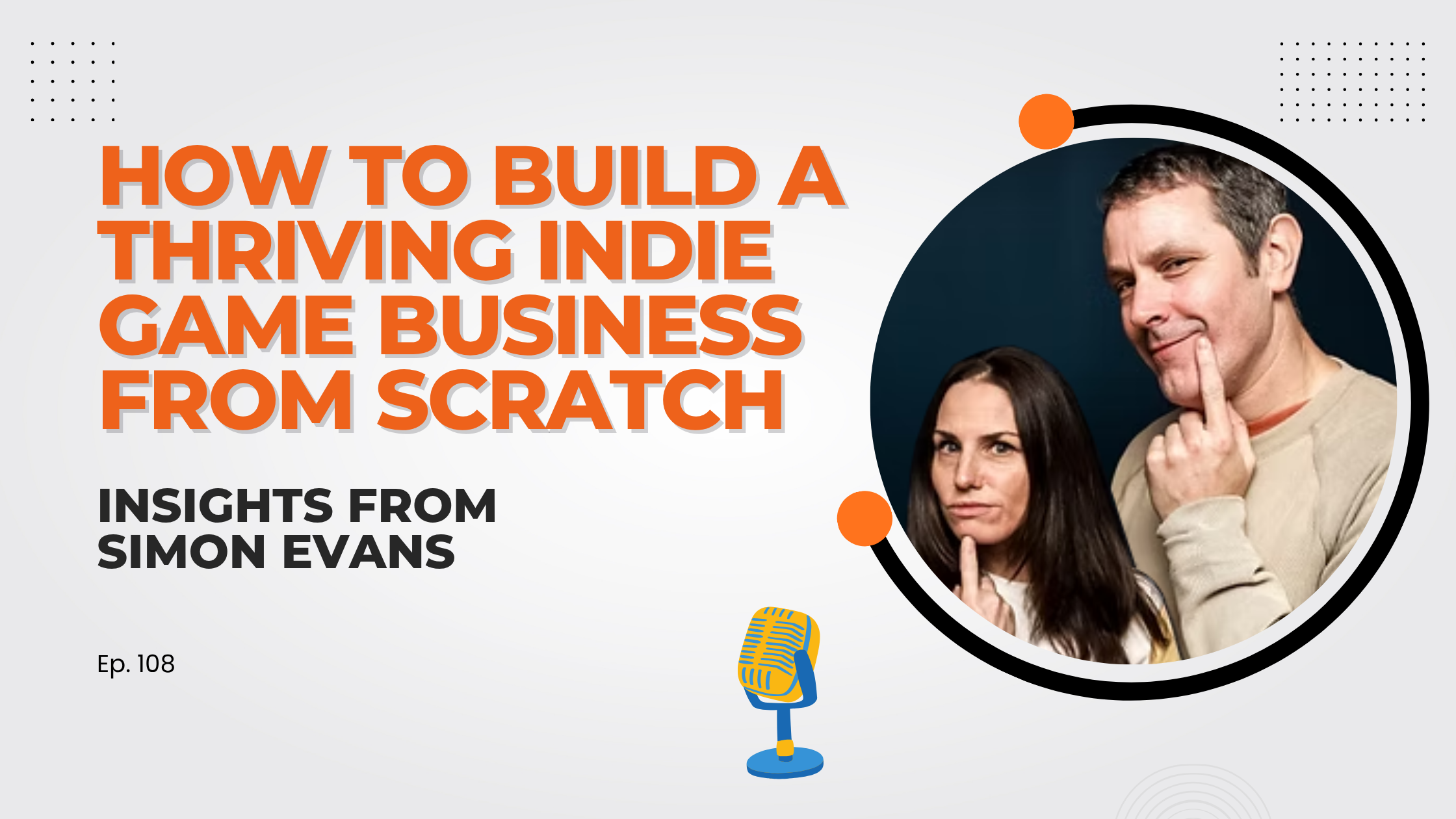
In the recent episode, we explore the journey of Strongpoint Games, an indie publisher that turned a love for games into a full-time business in a highly competitive industry. From their origins to strategic decisions packed with lessons, the discussion highlights how they’re carving out a space and thriving amidst challenges. You’ll learn key steps for building your own game business, navigating industry hurdles, the importance of community engagement, and practical tactics to elevate your brand.

#108: Indie Game Revolution: Inside Strongpoint's Success – Toy Business Unboxed
Episode Highlight
- 00:00 Introduction
- 01:17 The story and inspiration.
- 03:19 Introduction of the game “Strongpoint.”
- 05:08 Transition to full-time in 2024.
- 07:05 Main reason behind the transition.
- 08:43 Discussion on biggest challenges faced.
- 11:11 Strategies and plans for the future.
- 14:11 Successful strategies for the company.
- 16:33 Unique twist of the game.
- 18:20 Explanation of game rules.
- 21:48 Surprising aspects of transitioning to full-time.
- 24:30 Advice & Resources
The Passion-Driven Origins of Strongpoint Games
Simon Evans, co-founder of Strongpoint Games, traces his journey to a childhood love of board games, which deepened with his partner Jill and reignited during the pandemic as a way to connect. Inspiration struck during reflective 30-minute runs, highlighting a key insight: successful businesses often start with genuine passion. By leveraging your interests as the foundation of your business, authenticity fuels resilience, creativity, and products that truly resonate..
From Concept to Launch: Their First Game and Its Unique Twist
The debut game, Strongpoint, showcases the founders’ creative approach: a trivia game where players predict how others will perform, making it interactive and appealing even to non-trivia fans. Extensive blind playtests helped refine the core concept, and a targeted version for younger audiences added accessibility and extra fun. Designing a game with a unique mechanic like prediction can set it apart in a crowded market—thorough testing ensures it delivers a compelling and enjoyable experience.
The Transition to Full-Time Entrepreneurship
Simon’s move to full-time indie publishing was sparked when external circumstances freed him from traditional jobs. Recognizing his passion and the chance to control his own path, he took the leap. Key lessons: embrace risk and trust your passion. Juggling responsibilities was easier with community support and belief in their product.
Pro tip: transition confidently with planning and a supportive network—don’t wait for perfect conditions, start laying the groundwork early.
Challenges, Control, and Community in Indie Publishing
One major hurdle for indie publishers is navigating production without prior experience. Simon recalls early missteps, like shuffling game components, as key learning moments. Choosing self-publishing helped maintain creative control despite competition and limited resources. Community support—from collaborative testing to online networks like Board Game Proto-Hype and Board Game Design Lab—has also been essential in making the journey manageable.
Winning Strategies in a Crowded Market
With thousands of new games each year, standing out requires a fun, accessible, and well-designed product. Strongpoint succeeds because it’s engaging and shareable, boosting organic growth. Marketing combines in-person events, conventions, and social media—especially Instagram and TikTok—fostering authentic connections and driving sales.
Tip: prioritize a high-quality game first, then invest in meaningful online and offline marketing to build a trusted, loved brand.
How Their Unique Gameplay Sets Them Apart
Strongpoint’s unique prediction mechanic makes success about social intuition, not just trivia knowledge, creating shared joy and appealing to a wider audience. Jill’s “light bulb” moment highlights how iterative, community-focused testing refined the game to ensure it’s fun for all players.
Practical Advice for Aspiring Indie Game Entrepreneurs
Simon’s core advice: believe in your concept and reach out for support. Whether through online communities, conventions, or industry groups, building relationships and seeking feedback is invaluable.He emphasizes the importance of confidence, persistence, and a willingness to learn. If you have a strong idea and a passion for your game, start small and grow as you go.
Conclusion
The plush industry is at an exciting crossroads, where domestic manufacturing offers quality, agility, and sustainability. Success depends on premium materials, strategic placement, and products that connect emotionally with consumers. Partnering with U.S. manufacturers like Fairfield helps bring high-quality, innovative plush toys to market faster while building trust and a compelling story.
Connect with Simon Evans
If you’re interested in learning more about Strong Point Games or connecting with Simon, you can reach out through the following channels:
- Website: Visit Strongpoint Games’ Website for more information and updates.
- Facebook: Follow Strong Point Games on Facebook for the latest content and updates.
Transcript
Jason Hsieh (00:43)
Hello, welcome to another episode of Toy Business Unboxed. Today we’re talking to Simon, co-founder of Strongpoint Games. They are an indie publisher that’s making waves in the industry. Simon took the lead into doing this business full-time to be a full-time game publishers and navigating a lot of different challenges in self-publishing, marketing, and growing the brands in a very competitive space.
And so today I’m looking forward to today’s interview and sharing some of Simon’s stories. So thank you so much for being on the show today.
Simon Evans (01:13)
Thank very much for having me on. It’s a pleasure to be involved.
Jason Hsieh (01:17)
Yeah, so let’s first off, can we kind of dive into your story on how you got started and what inspired you to create the game company that you have today?
Simon Evans (01:26)
I I think it begins with a love of games. So I grew up playing board games, played a lot of them from very early on in my childhood. And while occasionally as you’re doing adult things, you drift away from those things. But once I met Jill, my partner, it became part of our life, playing games again. And then as we all know,
in 2020, COVID hit. And like a lot of people, you were confined to your homes. And one of the things that kind of kept a lot of people going and kept us going was playing games. That was something that I think was a catalyst for a lot of people to get back into the games industry or games playing. And it was while we were doing that, we were doing our, you know, we had
30 minutes daily exercise that we’re allowed to get outside and do that. And while we were doing those 30 minute runs, we started the conversation about what would it be like if we could come up with a game and we started just chatting and we had had an idea for a game that we thought actually, you know, it’s a good concept. It’s a strong concept. And that was kind of really where we, we got the
the inspiration to go, yeah, well, let’s see what we can do with this. Let’s see what can become of it. Rather than just have it as an idea that rattles around in our heads, can we make it something real? So it was that opportunity, I think, that was apart from the fact that we are games lovers, it was the opportunity to do something like this that kind of inspired us to give it a go.
Jason Hsieh (03:10)
Yeah, and I think you have some of the game actually ⁓ in your room as well. Could you share the first game that you created as a company?
Simon Evans (03:19)
So
the first one is this one here, which is called Strongpoint. And it’s a trivia-based game. So the of the hook to it or the twist to it or the USP, as you like to say in business circles, is that it’s not just about answering questions on trivia. And it’s not just about your own knowledge when you’re playing the game.
you’re secretly predicting what other players are going to get on their turn. So you have a category with five questions to answer on that category. And it could be something, anything from, you know, the periodic table to TV cartoon pets. So there’s all sorts of different subjects in there. You get to answer five questions that everybody else secretly predicts how many they think you’ll get right. So whether that subject could be a strong point of yours. that’s, that’s our first game. then
We’re now in the stages where we’ve just released an expansion pack to go with that. where this year, probably May this year, will be the second expansion pack to the game, which is aimed at youngsters. So it’s a set of cards, 100 category cards, that are specifically targeted at a younger playing audience. So they can just join in without being…
penalized if you like by having categories that are probably a little bit out of their knowledge base. They’ll have their own categories in the expansion that are within their sphere kind of thing. So that’s where we’re at at the moment.
Jason Hsieh (04:53)
Yeah. And going back to your story a little bit further, because it’s kind of similar to how I started, because I also started this business part-time many years ago, back in 2017. And I think you also went through this transition period of like working on a business part-time and you finally decided to go full-time in 2024. What made you finally decide to go full-time and how has that transition been like?
Simon Evans (05:16)
Yeah, I mean, so I’m full time Jill, the other my partner who’s the other the other side of the other person involved in strong point games. She still works part time in her other job. So I was working in education, freelancing education. So I was would go into into schools and deliver physical education lessons. And it came to the point at the end of the last academic year.
one of my major contracts, one of the schools that I did a lot of work in, were looking to move in a different direction. And so they said that I wouldn’t be needed for this academic year going forward. And actually, it was a case that it was the push that I needed. So I was at that point, given the face with the choice of, do I go out and seek more contracts to do that job? Or do I just go?
full time and give everything I’ve got to Strongpoint Games. And it was an easy decision. It was an easy decision to make. This is where my passion is. This is what I love to do. Like I said, we love playing games. I love the idea of creating more games and having a whole catalog. And the dream is eventually to be the point where we are employing other people to come up with games ideas.
We have a team that we’re working with. That’s kind of our vision and goal where we want to be further down the line.
Jason Hsieh (06:40)
Yeah, and I think one of the common issues that a lot of the companies are facing is to make that decision of, know, self-publishing versus licensing some of your book into like bigger or more established publishers. What was some of the challenge you faced early on when you making that decision from like, do I go with the licensing route or do I go with the self-publishing route?
Simon Evans (07:05)
You know, basically the main thing, the main reason behind it was a lack of knowledge of what options there were to us at the point, because we came into this from different backgrounds. We weren’t in the toys and games industry at all up until four years ago. So we didn’t have that knowledge of, shouldn’t come up with an idea and go and pitch it to a publisher. We just thought, we’ve got this idea. We think it’s good. We tested it with different…
different groups, they all said it was really good and they all said well if this was a if we could buy this we would. So we thought well let’s give those people that opportunity and we just went down the self-publishing route because we had no we basically had no other knowledge of what else to do other than try and fund it ourselves and do it in our own way. And we’re glad we did that. I mean it’s like you said there are there are
challenges to be an indie publisher.
But we’re glad we did that. We kind of have that. We control the direction of flow for our business going forward. We’re not in the hands of somebody else to say, we like the idea of the game, but we’re going to do it this way. It’s our game, and we get to publish it in the way we want, which I guess is a little naive, but also
Jason Hsieh (08:16)
Yeah, yeah.
Simon Evans (08:26)
think for a lot of people, especially, you know, in the the board game, in the board game community, that is what people want to do. They want that that control a little bit. But obviously, the the the challenges are huge when you start as an indie publisher.
Jason Hsieh (08:44)
Yeah, what are some of the biggest challenges that you faced so far?
Simon Evans (08:47)
Well, I mean, I think, I think that the lack of knowledge, the not knowing what you don’t know is, one of the challenges because we’ve had to learn everything that we’ve done. We’ve had to learn it on the fly as we’re going along. So from, so it’s all we, you know, we had the concept, we knew what, what we wanted to do. We had to learn how to contact manufacturers. We had to learn about how.
how they even wanted all the files for the manufacturer to be sent to them, all these sorts of things that you don’t necessarily, when you’re coming up with the idea for designing a game, you don’t think, well, you’ve got to be able to do this, you’ve got to be able to do that. To the extent that when we first manufactured the game, when we wrote all the category cards for the games, they were all done in kind of sets so that they were all
you know, all the questions that were relative to music were all together, all the questions that were relative to films were all together, and so on. So when the manufacturers got those files and we got the game back, all those sets of cards were all together. So when people first got the game, it looked like all the questions were all very similar categories. So we had to open up all the boxes of the games and hand shuffle them so that when people got the game…
got the game, weren’t thinking, this is rubbish. They’re all, all the questions are all the same. So we have to go through the, like the first 750 boxes of the game and shuffle them ourselves. So it’s that kind of not knowing that sort of thing when you first start, that was one of the huge challenges. Now we’re in a position where we know what we know a little more about what we’re doing. So, um, yeah, we’re, uh, we’re,
Jason Hsieh (10:18)
⁓
Simon Evans (10:33)
One thing you do adapt very quickly is you tend not to make the same mistakes twice.
Jason Hsieh (10:38)
Yeah, that’s very important. Learn from our mistake and get better and be more efficient from it too. And ⁓ with the current landscape, I know there’s a lot of ballgame companies and card game companies that’s popping up. If you look at the Kickstarter landscape, there’s a lot more companies that’s coming up with different concepts of different ballgames and card game ideas.
Simon Evans (10:47)
Absolutely.
Jason Hsieh (11:06)
How do you compete with all the different brands in the board game industry? Do you have any strategy or things that you have in mind?
Simon Evans (11:15)
I mean, it’s, it’s a, like you said, it’s a, it’s a huge landscape. I mean, I think I read something that’s over 3000 new board games published every year. So you’re, are, you are competing in a vast pool of other games that you’re trying to get noticed in. And when you’re a small, you’re an indie publisher, you’re, you’re very much, your game is a very much a little fish in a very big pond.
And you’re competing even on Kickstarter, some of the huge games publishers use Kickstarter as a way of getting their games and notice, getting awareness of their games. And that’s some of the biggest publishers do that. So it is difficult to get yourself noticed. think what you have to do first and foremost is you have to make sure that the game that you come out with is a good concept.
It’s strong and it’s fun to play. And if it isn’t those things, if it isn’t fun, and if it isn’t any good, then you are going to get very much marginalized. I think we’ve, we’ve got a game. Strong point is a game that, you know, people enjoy playing. The reviews have been, um, from our customers, um, have been spectacular. mean, they’re all five star reviews and a number of people have said it’s the
the best game they’ve ever played and all this sort of thing, which you take that with a pinch of salt because some people, perhaps their experience of games that they’ve played is less than others. So you don’t, you know, but what we do know is that when people play our game, they enjoy it. It’s fun. And I think what you have to do to get noticed in this vast sea of games is make sure your game is one that people enjoy playing. And if you can do that.
you’ve got off to a good start. And then I think it’s just, you know, kind of making sure you have a presence, whether it’s at games conventions, whether it’s at trade shows or online social media presence, you have to do all of those things. And honestly, mean, it’s for when it’s just at the moment, it’s just two of us.
having that consistency, especially in the social media and online can be a challenge. It can be hard to do that because especially as my kind of social media skills aren’t great. ⁓ a lot of that, responsibility for doing that falls on Jill’s shoulders. And she’s the one who’s also has the other part-time jobs. it does make things difficult.
think, you know, like I said, I think our concept, the concept of our game is strong and I think that as long as you have that, you always have that kind of possibility to be noticed and to be for people to kind of be aware of you.
Jason Hsieh (14:03)
I see. I know that just like you say, marketing is definitely very, important to get your voice out there for the game that you represent. What has worked well for the company so far? Like any specific platform, any specific strategy, marketing strategy that has been working well?
Simon Evans (14:20)
I mean, I think we do relatively well on things like Insta. I mean, we’re not as active on TikTok as probably we could and maybe should be. It’s a platform that we haven’t really delved into very much. And I think it’s obviously one that has a great…
great kind of opportunity for marketing strategies. So that’s something that we probably in the future will probably take more seriously looking into that. But actually, one of some of the things that have worked best for us have been the kind of live in person events. Whether it’s being games conventions where you just have that visibility and people will
Jason Hsieh (14:59)
Mmm, smug.
Simon Evans (15:07)
you know, your convention of gamers, your game isn’t necessarily going to be for everybody, but people will will stop and have that conversation. What’s this? How does this work? And usually when we can stop and engage people in conversation about the game, quite often they’ll walk away with a copy of it because they like the sound of the concept. So games conventions are definitely a strong marketing strategy for us. even I mean, one of because
the nature of our game is, it’s very much kind of a gift. The kind of game that people will give to somebody as a gift who may not, these might not be somebody who’s necessarily a kind of board gamer as such, but it’s very much a game that non-gamers can get into and can like. we find that it does get gifted quite a lot. So in the run up to the
Jason Hsieh (15:55)
I don’t know what goes on.
Simon Evans (15:57)
you know, things like Christmas, that quarter fall from October to December, we do a lot of kind of Christmas market events and things like that. And they nearly always do really well for us. Not just in terms of selling the game, but in terms of marketing and bringing the awareness of the game and our brand and what we have going forward and our future. Those are good places for us and always have been.
Jason Hsieh (16:10)
I see
Yeah, and I think your game has a unique twist on the typical trivia game. Can you explain the concept a little bit further and how do you land on that concept?
Simon Evans (16:33)
Yeah, so the twist is that you don’t necessarily have to be brilliant at trivia to win the game, which I think does set it apart from a lot of the other trivia games that are available. You can win based on how well you know the people that you’re playing with and knowing what their strengths and weaknesses are. So if you can effectively predict
accurately how well other people are to do on their own goes, you can score points on other people’s turns and win the game without even answering all that many trivia questions correctly yourself, which I think does provide a little bit more of an opportunity for those people who will say, I’m hopeless at trivia. I’m no good at that sort of thing. I don’t like trivia.
It’s always the same person who wins when we play trivia games. think our game kind of levels the playing field a little bit. So that’s that’s probably the unique selling point. And how we settled on it. It was almost like a light bulb moment because the game started out something different. And we were we were testing it, we were playing it ourselves and playing it with other members of the
family and friends. And it was, I don’t think this is going to work. I don’t think this is going to work. And we couldn’t kind of nail down what it was that wasn’t quite right with the game. And then Jill came home from her other job and said, I’ve got it. I know how we got all the things that are wrong with what the concept as it was. She was like, I know how to do this. I’ve solved this. And she had the name, she had the concept.
everything and I was like yeah that sounds like that would work so then we went and tried it again with other people blind playtesting it with people we didn’t know and the results were as I said people
Jason Hsieh (18:20)
For our listener that’s not familiar with the rule, can you also explain the rule of your game and so, you know, give the listener more context on how this is different than the typical trivia game.
Simon Evans (18:32)
So yeah, when it’s your turn, somebody else will reveal a category card and they’ll say your category is going to be Shakespeare’s plays or it’s going to be US sports teams or it’s going to be whatever, lots of different things. At that point, there will be five questions on the card for you to answer. But at that point, the other players have a set of prediction counters, zero to five.
and they secretly take one and they place it face down and deciding how many they think you will get based on whether they think that that category that’s come up for you is a strength, a strong point or whether it’s not. So then you get asked the five questions and you score points for how many answers you get right. And rather than having a scoreboard or a score pad or something like that, we have points cards. So you would collect them.
say you got three answers right, you would collect a three points card. All the players who predicted that you would get three, they also score a point. As you’re you’re collecting cards for your correct answers, you’re collecting additional cards, the strong point cards for your correct predictions. And whenever you decide you’ve played for as long as you want, maybe it’s everybody’s had three turns.
you just add up all the points cards you’ve collected for answering and for predicting. Whoever has the highest total wins the game. So it’s actually very simple, very straightforward. one of the beauties is there’s no downtime for any player. You’re kind of involved all the time in everybody’s turn, which I think can be a problem.
people find with other trivia games is that when it’s not your turn, you kind of zone out a little bit. And like I said before, generally, a lot of trivia games, you sit down and play and you go, well, I know that person’s going to win anyway, because they always win at trivia stuff. hopefully we’ve tried to address kind of some of the most common complaints that people have with a trivia type party game.
make it a much more inclusive experience for players and make it a game that even people who aren’t big trivia fans can actually get something out of.
Jason Hsieh (20:41)
I see. Yeah, yeah, that’s, that’s, think that make the dynamic a little bit more interesting because you also need to see how many do they actually got right to keep track of like the.
Simon Evans (20:52)
It’s one
of those things in a lot of games when somebody does something well or there’s one person getting that moment of joy that you can get in a game, that expression of, yes, and I’ve got five right, whatever. But in our game, you might have three or four people who are experiencing that same moment of joy if their predictions are correct. So it’s like ⁓ more of a collective
expression of happiness at the same time, You can have multiple people celebrating success at the same time, which is a bit different.
Jason Hsieh (21:28)
I think also for a lot of our listeners, they are probably also going through a similar journey that you and I went through where they are also trying to start their own game company or toy company part-time on top of their full-time career and, you know, hoping to do that transition to become like a full-time game entrepreneur. What are some of the surprising parts once you transition that you notice that you’re not expecting before you go full-time?
any stories or anything that you’d like to share.
Simon Evans (21:56)
I think it probably shouldn’t be surprising. But one of the things that has has kind of been a pleasant surprise is how much of a supportive community there is out there of other indie board game publishers. There’s there’s so many places that online and in conventions and things so many places and people that you can go to where people
⁓ willing to offer help, offer support, ways to even things that might be things like, we’ll give your game a play test or we’ll public publicise your game on our socials. You do the same for us. you’re getting that kind of almost like a community spirit of board game, indie board game publishers and designers who are really
want everybody to succeed. We all kind of want, we all want somebody we know their game to be the next big thing would be great because it’s almost like a shared success story if you’ve been involved in collaborating, even in a small way. So there’s definitely, I mean, there’s communities out there. I mean, we’re involved in a few things.
online, there’s a board game proto hype, which is a good community of gamers who on Instagram, they’re constantly communicating and sharing stories and sharing ideas. And then there’s things like the board game design lab, which is a great, great resource for picking the brains of people who really know their stuff. So I guess that’s been, I shouldn’t have been surprised but
coming into this industry, like I said, a background of not having any knowledge of the industry at all four or five years ago, that’s been a real pleasant surprise.
Jason Hsieh (23:43)
I see. you mentioned the board game design lab and any other resources that you recommend for people to look into.
Simon Evans (23:44)
And hi, everybody.
So another one that we kind of are involved in, it’s more like, I don’t know how to describe it really, it’s like a group where you just chat and you share posts and every week you’ll have like a theme where you can talk about something that’s in your game or just something that you’re interested with and it goes into this feed.
and everybody’s communicating and sharing ideas and that’s called ball game proto-hype.
Jason Hsieh (24:23)
For game? Pro to high. Okay.
Simon Evans (24:25)
Yeah, so that’s another great community of people.
Jason Hsieh (24:30)
And what other advice will you give to us? We’re kind of wrapping up today’s interview. The final question I always like to ask is, if you have to share just one piece of advice with someone that’s getting started in the toys and game industry, what would that be, from your perspective?
Simon Evans (24:46)
if you have a concept that you believe in and you think is strong, you then you have to believe in yourself and take that opportunity to try and do something with that. Don’t be too scared to have a go.
there are people out there who you can seek and support and advice from who know who’ve been involved in the industry, who know what they’re doing, who have always willing to share their time and their knowledge and their expertise. So reach out, find those people, find groups, whether it’s by going to a games convention and meeting them in person or whether it’s reaching out to various
things like the Ball Game Design Lab online and just asking questions, asking questions and not being afraid to believe in your product, to believe in your game.
Jason Hsieh (25:38)
I see. Yes, thank you so much for sharing that. And where is the best place for people to find more about you and your company online?
Simon Evans (25:45)
So we have our own website, is http://www.strongpointgame.co.uk. that from there, you can tell us a little bit about our story, our journey. Also has a portal where you can buy the game if you’re interested, if it sounds like something that you would find fun. We also, are, you know, we do sell on the most
Massive selling platform in the world so you can get our game on Amazon, but I think at the moment that is restricted to the UK We haven’t got we haven’t got it we haven’t got Available in the u.s. Is yet. That’s one of our goals for this year
Jason Hsieh (26:25)
Okay, got it. Thank you so much for sharing that.
And for our listeners, thank you for tuning in to this episode of Toy Business Unboxed podcast. We really hope you have enjoyed today’s conversation and find it insightful and inspiring. If you like what you have heard, be sure to subscribe to our podcast on your favorite platform so you never miss an episode. We really appreciate your support and we’d love it if you can leave us a review and share the podcast with your friend and colleague. For more resources, tips, and the latest update we in the toys and game industry, visit our website at toys-launch.com.
Join the conversation and connect with us on social media using hashtag toybusinessunboxed. And we’d to hear your feedback and suggestions for future episodes. Until next time, keep innovating, keep creating, keep bringing joy to toys. This is Jason Shea signing off on the Toy Business Unboxed podcast, and we’ll see you in the future episode. Thank you so much, everyone.