
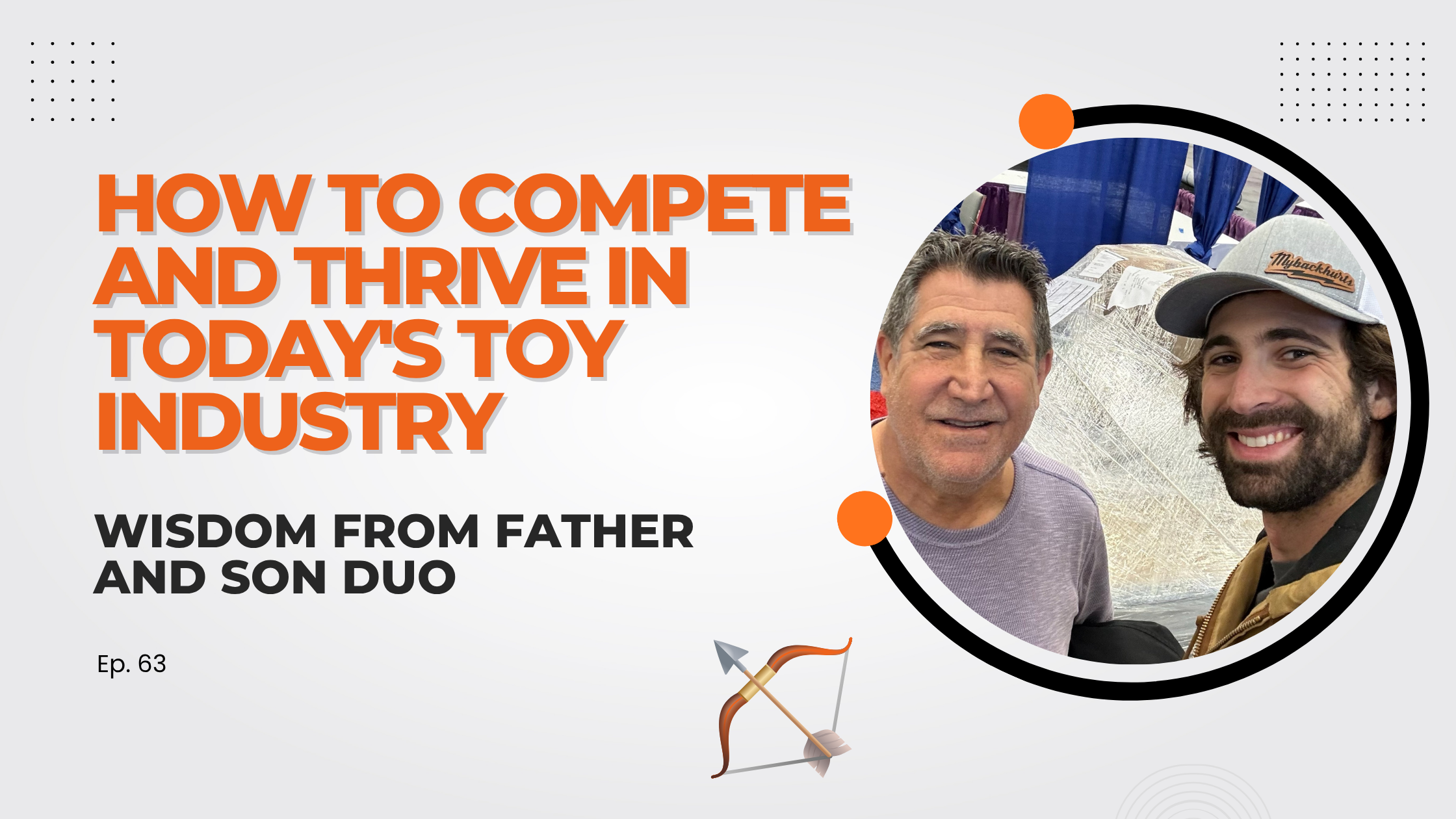
Welcome to Toy Business Unboxed, where we delve into the wonders and challenges of the toy industry with leading experts. In this episode, we had an engaging conversation with Ethan and Mark, the dynamic team behind Marky Sparky. They shared their journey, insights on toy innovation, and navigating the modern business landscape.
Episode Highlight
- 00:00 Introduction to Toy Business Unboxed
- 00:45 Meet Ethan and Mark of Marky Sparky
- 01:17 The Origins of Marky Sparky
- 03:37 Ethan’s Journey in the Family Business
- 05:14 Challenges of Growing Up in a Family Business
- 06:37 Ethan’s Role and Contributions
- 10:50 The Competitive Toy Industry Landscape
- 13:59 Amazon’s Impact on the Toy Business
- 19:13 Challenges of Selling on Amazon
- 20:20 Addressing Misconceptions About Chinese Factories
- 21:36 Innovative Toy Design Strategies
- 23:56 The Importance of Excitement in Product Development
- 24:01 Flipping Rings: A Case Study
- 28:06 Advice for Aspiring Toy Designers
- 33:22 Final Thoughts and Where to Find Us
From One Idea to a Beloved Brand: The Marky Sparky Journey
Mark and Ethan have worked tirelessly over the years to establish Marky Sparky as a household name. Mark began the company almost three decades ago with just one innovative product – the California Chariot. As the company evolved, Ethan joined, overseeing product development and brand strategy. Together, they’ve consistently offered quality toys with a touch of creativity and passion.
Growing in the Family Business
Jason explored the dynamics of working within a family business. Ethan shared his unique experience, explaining how he never felt overshadowed by his father’s legacy. Initially, he had no desire to join the company, but life’s circumstances, such as the COVID-19 pandemic, led him to reconsider. By letting Ethan find his way into the business, Mark ensured that his son became passionately invested, ultimately contributing significantly to the company’s success.
Challenges and Innovations in the Toy Industry
Mark and Ethan discussed the current competitive landscape of the toy industry. They’ve observed significant changes over the years, especially with the rise of online platforms like Amazon. There’s an ongoing struggle to compete not just with other toys but also with digital entertainment and gaming. Mark believes, however, that the ease of creating and prototyping new products has never been more accessible, thanks to technology like 3D printing and online resources like Kickstarter.
The Amazon Dilemma
Selling on Amazon presents both opportunities and challenges. While it has been a vital platform, the costs and competition from direct factory sellers have made it difficult to maintain profitability. Ethan explains that Amazon’s constraints often limit product design innovation. Consequently, Marky Sparky is shifting focus away from Amazon to explore new growth opportunities and product development free from these constraints.
The Art of Toy Design
Creating unique and beloved toys is an art in itself. Ethan and Mark emphasize the importance of inventing products they themselves enjoy and find compelling. They advise not to chase trends blindly but to follow personal excitement and passion for play. At Marky Sparky, products undergo rigorous testing for excitement and longevity before hitting the shelves, ensuring enduring play value.
Advice for Aspiring Toy Entrepreneurs
Mark and Ethan offer invaluable advice for newcomers to the toy industry. They recommend being cautious where money is spent, particularly avoiding unnecessary expenses. Both stress the importance of authenticity in product design and development. Mark advises against relying solely on positive feedback from acquaintances, cautioning that it may not always reflect market reality.
Conclusion
Navigating the toy industry is no small feat, but companies like Marky Sparky show that with passion, innovation, and the right business strategies, it is possible to succeed. We hope their insights inspire more creators to bring joy through toys.
To stay updated with the latest episodes of Toy Business Unboxed and embark on your own journey into the toy business, don’t forget to subscribe and follow the podcast. If you found this episode insightful, please leave a rating and review, and share the podcast with fellow toy enthusiasts. Let’s embrace the world of toys together, staying curious and continuing to innovate.
Guest Information
Websites: markysparkytoys.com, thebadrap.com
Social Media: Instagram, Facebook, TikTok (Search for Marky Sparky Toys)
Transcript
EP063_10-01-24_Ethan Rappaport
Intro: [00:00:00] Welcome to Toy Business Unboxed, your gateway to the secrets of the toy industry. Here, Jason Hsieh, a toy entrepreneur and expert in the field. “Every product we develop is really inspired by some of the real life experience that we have with our son.” “60 percent of all toys last year were sold on Amazon.”
“Be passionate about it. Because it’s a road. It’s a journey.” “Like when you have an idea that you think is gonna somewhat change the world, make things better, I’d say go for it.“
Jason Hsieh: Welcome to another episode of Toy Business Unboxed. Today we are thrilled to have Ethan and Mark, the leader behind Marky Sparky company that has been bringing innovative and found toys to kids for decades with deep rooted passion for the toy industry and is apparent and son duo that we cannot deny in [00:01:00] the industry.
And Ethan has been continuing the legacy by overseeing product development, brand strategy, and more for the company. And thank you both of you for coming on today’s episode
Ethan: Thanks for having us.
Jason Hsieh: Can we start off just by sharing with our audience, how do you guys start the company? Many, years ago? So what inspire you?
Ethan: Yeah, so mark right here. Started the company about almost 30 years ago now. Basically started with one product, the California Chariot, which was a scooter that most a lot of people would recognize as a part of their childhood. It’s the California chariot. It’s got a big bike wheel up front and two pads on the back and big bike handle bars and scoot around. It started with that product. It was actually the California Chariot company.
Little by little, and then lot by lot when that started to gain success and Mark wanted to make new products, he realized you have to name the company something other than the one product in order to make new products. So he pivoted to Marky Sparky, in order to open up the world of making a whole bunch more toys, which he did for about 20, 23 more [00:02:00] years or so. With until then I came aboard, and then we really started going, oh, okay. I was doing that math.
Mark: I insist you call me Mr. Sparky now.
Ethan: Mr. Sparky. Yes. Sparky calls him here. But yeah, so that was the inception of Marky Sparky one product at a time. Had a lot of successes, had definitely some failures. We’re really proud of the products in our history and really proud of the products coming forth in our future.
Jason Hsieh: And I think Mark is such a legend in the toy industry. You did invent one of the nerve bow and arrow product as well, right? Mark? I dunno what year you invented it.
Ethan: He’s on the, Mount Rushmore of old product. I would, say he’s a lot of people don’t know the lineage of a lot of these toys and he knows them ’cause he was there. So it really is cool to talk to him about all the things that he was a part of, even before his own company. Learn about the landmark toys that either he helped design or more often than not [00:03:00] wholesale invented and then either was working for a company or licensed it to those companies. It’s, really amazing to see what that lineage looks like.
Mark: I sound, like a pretty fun guy.
Jason Hsieh: Yes, you are. You’re really fun guy of course. And I’m going to throw some question that’s not in the interview question, just out of my personal curiosity because I also grew up in the entrepreneur family. My dad also run a business, but growing up I have been always living under the shadow of his success, so to speak.
So when I grow up, when my dad asked me the very important question, do you want to take over the business? I say, no, because I want to build something bigger than yours. that’s what I told him. So for you Ethan, like growing up under your dad’s shadow, what went through your mind when your dad approached you and say, son, let’s do this and grow this business together?
Ethan: What’s interesting is, there’s two things about that. One, I never felt in his shadow in that way. He was growing up, he was my dad, and what my dad did was what my dad did in the same way a lot of other kids parents had [00:04:00] other more typical jobs. My dad was a toy inventor. It was just what life was for me, so I didn’t really think about it differently, and I didn’t have a concept of what it meant to run your own business. Growing up because it was all I knew was that my dad ran his own business. He was a toy inventor, and he owned his company.
It’s not until I’ve been grew up and the second part of this is I never wanted to run the company. He always joke, One day you’re gonna grow up and take over the company.
Mark: That’s true.
Ethan: And it was always a joke. It was never like a, it never felt real. There wasn’t a pressure for it. And I went away to school for something completely different and didn’t really have any thought or interest in coming back to work for the company, run the company in any capacity? It was through just a series of the way life happens. COVID hit I had to move back home from dc I was working in a completely different field. I ended up coming to the office just to do some stuff, when things were weird and covid and everything was on pause.
I stayed and eventually it turned into a more serious role and then a more serious [00:05:00] role. And there wasn’t really a time for a while there that mark said I want you to do this, I want you to run the company. I want you to stay. It was really, he let me find my way into it which is why I think I care about it as much as I do.
Jason Hsieh: I see. Thank you for sharing. For my experience, because my dad started a company when I was born and he was able to grow the business from just him and my mom, two people to a hundred people company over the years.
So it was very intimidating for me growing up because everyone will call me like the boss son or something like that when I go visit the company. So it was a lot of pressure. Even if when my dad when we have that conversation. Okay, if I do take over the company, all the people that will be calling me, were reporting to me. They have saw me growing up. Pretty much. They are my uncle and aunts almost. It’s very awkward to manage people see you growing up.
Ethan: And I have had to navigate some of that because, especially for a while. We have a small team. But it [00:06:00] for so many years has been comprised of people that were employees for a very long time. And so they did see me growing up. They’d see me in high school, in middle school coming back from college.
Jason Hsieh: Yeah.
Ethan: To then transition to working for the company was a challenge. I started I knew very early on that was very important. Was how I presented myself and was perceived. I am the boss’s kid. It’s, there’s no getting around it. I made the decision very early on to call him Mark and not dad. No one else calls him Dad. So that would be weird. And then strive, while I was an employee and not in the position I am now abide by the same rules as everyone else and work on the same terms as a process.
Mark: He’s forgetting the main point, which is he’s incredibly good at what he does. He has. he’s got a an ability to look at products, look at the whole scope of things. So it’s not just, you don’t just roll into the play. He, he was lousy.
Jason Hsieh: I wish Dad could say that about me more.
Mark: If he was lousy for what he did, I would’ve fired him a long time ago. [00:07:00] He’s, really good.
Jason Hsieh: Okay, thank you for saying that, that redeeming a lot. I think
Mark: I was talking to your dad too, and he said you were great. He gave me a call before the show to put a plug in for him.
Jason Hsieh: I definitely have some childhood trauma. I’m still trying to go into it. I need to therapist about it.
Mark: Ethan. Ethan, don’t you dare.
Jason Hsieh: So back to the, but back to the toy industry. I guess the question I also wanted to ask is, you mentioned where you start working during Covid and you decided to stay.
What a attract you, what is so attracted to you within the toy industry that make you feel like this is what I want to do for my career?
Ethan: so many things and I don’t think at the time I was, thinking about careers, what I wanna do forever. when I started I, think my first official title was hr, which is funny in a company of what at the time was 10. It’s not a full, HR is not a full-time job in a company at 10. My first real job was project manager. It was oversee or designers and guiding the product through the pipeline from through design, through manufacturing, landing and selling. And that [00:08:00] I, learned so much in that process, both through Mark, our partners in manufacturing manufacturing overseas, and then from our designers. We had some really, we have and had some world class designers that taught me a lot about both design and manufacturing, and I continue to learn from them. It really this idea of imagining something that is fun and making it. Something new that wasn’t there before. Not just a better version of something. But something that without which a form of play couldn’t exist. It’s thrilling and that’s what we strive to do every day.
Jason Hsieh: I see. So nowadays is Mark, are you still the one who’s coming up with design or who is the one that’s in charge of coming up with design nowadays?
Mark: That’s a great question. I have a flotilla of stuff I’ve done over the years that’s all around us and I keep digging back into that stuff. But it’s a group effort. Ethan just came up with this new thing. Can I, announce it? Does it matter? Yeah he, invented this new javelin, Which is, a, it’s a brand new item. And it’s a [00:09:00] phenomenal product. It’s, one of those things where you go, wow, this is really an invention. And guess what? Ethan did that. So that’s just really cool. Although it was a group effort, a lot of people helped in ad-lib things. It was, he was the general he was the champion of this javelin, which I’ve been in the toy business a long time and there is nothing like it out there, has never been anything like it out there.
Ethan: It’s interesting when we talk about who invented this, who made this? It is a really hard question to answer, especially in a company like ours. The story of how the javelin came into play is a perfect example of this. It goes back a long time. For a long time I’ve been throwing our arrows, the arrows that we’ve been making for so long. I’ve been throwing them by hand very far, and it was always something that I did for fun. It takes someone doing that to get to the javelin, but it also takes someone else going. That is worth that’s, a note. It takes someone else designing it, making the details the whole team comes together to make it reality. saying one person invented it is, it’s just does, a disservice to the team, [00:10:00] I think.
Jason Hsieh: I see. How big is the team currently?
Ethan: Currently we’re at I think our team is
Mark: this big.
Ethan: I believe we have a team of eight right now.
Jason Hsieh: Oh okay. Got it. Yeah that’s a decent size. And you do all the design in U.S and you work with manufacturing company in China, correct?
Ethan: Yeah. We have really close manufacturing partners in China that we trust implicitly.
Jason Hsieh: So were you able to learn some Chinese over the years so we can do the interview in Chinese now? Yes.
Ethan: I know ba I know basic numbers. There was a time Yeah, no our, Mandarin is, it is not good We, are blessed to have manufacturing partners whose English is very good and better than our Mandarin would ever, hope to be.
Jason Hsieh: I see. And yeah, I think I want to continue on with the current landscape of the industry. I think it’s getting more and more competitive nowadays, of course, obviously compared to when Mark started. That’s just a lot more company, a lot more product, a lot more demand and the [00:11:00] hardest get people’s attention too.
Mark: That’s a diff that’s a hard, that’s a hard concept. When I was starting, I was licensing. The licensing landscape was a lot different then. There was a couple of major toy companies. You took your stuff directly to them. It’s not hard if you go in the right places, it’s not more competitive if you go in the right. In fact, it’s less competitive because, it’s hard to do it. It’s hard to do it hard, so not many people can do it. If you’re starting in your garage or with the advent of Kickstarter and Indigogo and all these crowd, crowdsourcing places. It’s really easy to introduce a product, much harder to sustain a business. That’s the hardest part.
Ethan: I’m looking at it a little differently in terms of you’re talking about competition. I do think it is more competitive nowadays, but I think that seeing where that competition is, a very, it’s a very different competition than there was 20 years ago. We, right now, when we make toys, we try and sell toys. We’re competing with not only other toys from American manufacturers, from European [00:12:00] manufacturers were competing with manufacturers in China selling direct from factory. Yes. Amazon. Yes. On other marketplaces. It’s incredibly difficult to compete price wise. It’s a globalized economy in a way that like, it was really hard to get direct from factory. They didn’t have the reach before this new age of globalization to get products here in an economical way. Amazon and, Temu and All Express have made this possible. The other thing is we’re not only competing with other products, we’re competing with social media for, attention for time. We’re competing with video games, which are cooler than they’ve ever been. I love video games and where they have come now, how accessible they are for kids. We, in a very real sense, our toys compete with video games and our toys compete with social media and staying this javelin is more fun than TikTok to a kid. You have to make a compelling case
Jason Hsieh: or you need to force them to go outside instead of staying on the iPad all day.
Ethan: It is a, tough,
Mark: i’ll give you a descent, I’ll give you a dissenting point of view.
Ethan: You always do
Mark: I know I do. Whether I’m [00:13:00] right or wrong, I’ll dissent. So when I was starting we had a fax machine and that was it. And so it’s so much easier now with the advent of 3D printers, laser cutters model shops that are you, throw a couple bucks at it and you have a model shop that can make final product in in a day.
Jason Hsieh: Yeah.
Mark: So in that way, although you’re competing with a lot more people. You’re not competing with a lot more people, although you’re competing in a different landscape it’s easier to make product than it has ever been if you have the ideas, if you have the product. I don’t see it as daunting in that way. I don’t see it as competing against all the social media landscape. I do not like China taking what we do and making it cheaper.
Jason Hsieh: Yeah.
Mark: And then going it on Amazon. That’s the hardest thing. But coming up with ideas that are marketable and interesting and compelling. I think it’s far easier than it has ever been.
Jason Hsieh: I do agree with that. So I [00:14:00] wanna transition, since you mentioned about Amazon, Amazon’s definitely the biggest elephant in the room for the toy industry because they dominate the online sales so much.
How do you feel about the state of Amazon and how does it affect your company or your marketing strategy as a whole? Are you trying to spend more time on it or trying to run away from it, or what is your standpoint when it comes to Amazon and marketing goals.
Ethan: This is a topic that comes up often. It’s a really difficult question because we’ve done a lot of business with Amazon for many years. And for a while it was a very large source of revenue. It has eroded considerably from two directions, basically, I guess three directions. The cost of selling on Amazon because of shipping and fees, has gone through the roof. Additionally, the cost of advertising on Amazon, which is absolutely necessary if you wanna compete on, pretty much any scale, has gone through the roof. In conjunction with the third reason, which is the direct from factory sellers of similar product. The [00:15:00] competitive landscape is unlike anything that we’ve seen before. If we are selling a product for $30 and that is essentially the price we have to sell it at, in order to make any money on Amazon to keep our numbers in line and actually turn a profit. A factory in China can sell it on Amazon for $22, $19.99, $18, $17, and still make a profit while spending 3, 4, 5 times more on advertising for the same keywords we’re bidding for. It’s inescapable
Mark: and it looks just like our product
Ethan: and it looks just like ours. Does it perform the same? Probably not. We really pride ourselves on function and quality. But you can’t tell these things very easily on an Amazon description. The consumer does not know how to discern quality and function. So long term we’ve made the decision and seen that largely no matter how much we sell on Amazon, it’s very difficult to turn a profit. Because of all of these factors.
And so we’re pivoting, we’re not gonna stop selling altogether on Amazon. But we’ve realized it’s not a growth market for us. And [00:16:00] so new products that we come out with are not geared for that market. The other thing is we got really tired of how our product design pipeline was constrained by Amazon. The way that Amazon structures its shipping prices, is very restrictive. It has to fit within what we call the magic Amazon box. If it doesn’t fit in this 14, 16, 8, something like that.
Mark: No, it’s 18. 18. 14, eight. You’re, it’s close.
Ethan: If it doesn’t fit within these dimensions, and we’re talking by a millimeter, and these are scanned by lasers and robots.
Jason Hsieh: You have different sizing here. Then you increase price. Yeah.
Ethan: You instantly get charged another four or $5. And so we would find ourselves in discussions of product design going, we can’t make the product we want, how we want to make it because it has to fit in this box. How do we break it down to fit in this box? How do we make this shorter, make it two pieces and we’d end up with a worse product that we were doing all these things to design product in a way that according to Amazon specifications, it was a sad thing to include [00:17:00] in discussions, very seriously in product design. We’re making efforts to knock that to the side and not make Amazon core market.
Jason Hsieh: Yeah, I think I do agree with that. But for outside Amazon, I think I did a whole webinar about it the five pillar we should be focusing on as a toy and game entrepreneur. That’s like the content, which I think your product will make some amazing content because it’s about outdoors, about kids. Playing outside, and that’s also, of course you mentioned about social media marketing is like the second pillar. Then you also want to really start more doing more pay advertising outside Amazon, which is a whole different ballgame, by the way when you’re doing Google ads, YouTube ads, very so Facebook ads and Instagram ads very, different than Amazon ads. But besides that, I think building your own list, both in an email format or even SMS format, like phone numbers, those is like the way to, to be successful as a toy brand going forward.
And that’s something I have been also focusing on with our own in-house brand currently for our list with a small list about [00:18:00] 20,000 parents. But it, is a good place to start. Because another main problem with Amazon you didn’t mention, I wanna mention to our audience, is when you sell on Amazon. You lose control over your customer data because Amazon doesn’t share any of that. You don’t even know if it’s a dog that bought your product. It could be a dog that just click a button and bought it. You don’t know. It could be anyone
Ethan: There’s a tremendous loss of control there. A while back, Amazon took away the ability to respond to reviews. A lot of people don’t know this thing that sellers can no longer respond to Amazon reviews.Which is really unfortunate when people say, I got your product, it’s garbage, it falls apart. Here’s a picture of it, and you’re looking at it going, that’s not even in the same category as the product you think you bought. Like it’s Amazon, shipped them the wrong product. Could have been returned, could have been whatever within their system. And we get bashed for it. Our rating takes a hit, the reviews are bad. They’ll return it for a refund. We get charge and it’s never any we get control over. these are problems that there’s no control over as a seller on [00:19:00] Amazon.
Mark: There is a caveat to all this. The Amazon, China’s never gonna let you make too much. There’s this, because of all the new software and all the APIs that Amazon gives out to the software companies, they can scrape the data. And so you, here you are sitting in China with your factory or Taiwan or wherever overseas. I don’t begrudge them a dollar, but if they can see how many of something you’re selling, they’re gonna go, oh, I can make that for $2. And you’re making it for five 50. This is the problem. So it doesn’t pay to innovate. And what’s happening is Amazon is turning into a commodity place. There’s no innovation there. All the people that have innovated are pulling off Amazon and selling through their own websites and stores. Secondly, if you’re a small business just starting to sell on Amazon, and you, I’m talking about just the toy business.
Jason Hsieh: Yeah.
Mark: We have never gone on Amazon at a lower price than our stores. We’ve always kept the price point. A $30 item is a $30 item, whether you buy it in the store or on [00:20:00] Amazon. ‘Cause a, as you start to cut those prices, the stores are gonna go, Hey, why should I sell your product? It’s on Amazon. So with those two things, it’s really becoming a very hard place to do business. It’s just super hard place to do business there’s so many things wrong with it. Where 10 years ago there was a lot of things right with it.
Ethan: I do wanna add an addendum and a caveat to that. I think there’s this sense that a lot of people feel that factories in China just do this, they just see what’s good. They copy it and they sell it on American marketplaces. This is not the norm in China, this is not all factories. Some factories have this business model of looking on Amazon, seeing what sells well, making it for cheaper and selling it. We are very proud of the factories that we work with and the partners that we have. Want to make clear that this is not a judgment against China or against we work with they really are, they are proud of the fact that they make innovative products that are not copies of other people’s. [00:21:00] This is something they feel strongly. And so we just wanna make sure that people don’t get the sense that this is a global problem.
Jason Hsieh: Yeah. There’s always some rotten apple in a group that kind of ruin it for everyone.
Mark: It’s not rotten apple. It’s a business. It’s a business concept. It’s really not. It’s, they just do it because that’s what they do. That’s their business model. They see something good. They go, we can make that, and then they make it. And so again, I don’t begrudge ’em. That’s just the business model. Amazon’s the one that’s not honoring copyrights, trademarks, patents and so that’s an Amazon problem. That’s not a an overseas problem.
Jason Hsieh: I see. Yeah. So I want to go back to the toy design piece because a lot of the product you designed, just like you mentioned, is very innovative, very different than everything else that you see in the existing marketplace. With the trend of social media like for my kids, they’re always on YouTube after homework.
How do you figure out what kind of toy that can still capture the kids’ attention nowadays? Do you have any [00:22:00] tips or tricks that you would like to share with our audience?
Ethan: Yes. We ask ourselves this a lot, do you follow the trend? Do you follow what people want? Or do you try and get ahead of it? Do you follow what you want? We, because of the way we work and the way we think very often or always are thinking, what am I excited to play with? What is something that I want? I, the javelin, to me is incredibly exciting. We are constantly playing with it at work. We’re constantly finding excuses to go throw it in the parking lot. That to me says it’s a good product because if I wanna play with it and our designers wanna play with it. Other people will wanna play with it.
Jason Hsieh: Okay. That’s a good way to look at it.
Mark: This holds true for all designers, all inventors in the marketplace. Build what you want. Build what you like. If you don’t like it go ahead.
Ethan: We have tried on several occasions to we’ll go into Target, we’ll go into toy stores and see what’s hot. And go, how do we make that better? What’s a way we could do this? And we’ll, make something. We’ll make a rapid prototype of a game, of a product a new twist. We’ll have some [00:23:00] idea. We’ll play with it and it’ll work. It’s not exciting. And we always come back to is that, exciting? Is that new? Yes, it works. Do we care? Is it something that’s compelling? And if the answer is no, we move on. We move on from a lots.
Mark: Almost every single thing I’ve ever done. And I’ve invented a lot of products. I again, I have a graveyard of stuff i’ve never brought to market. But literally almost everything is a category breaker. It’s ahead of where everybody is so much so that I don’t know how to sell it. Like people, I show it to somebody and they’ll go, what are we gonna do with that? I don’t know. That’s what we struggle with.
Jason Hsieh: It’s so different. Yeah.
Mark: Happens all the time. It’s not that it’s different, it’s that there’s no category for it.
Jason Hsieh: It’s no category. Okay. Okay.
Ethan: Yeah so, you look at it and you go, this is really fun to play with, but nobody wants it because it’s not a toy, it’s not a sporting good. It’s not a this, it’s not a that, but it’s still really compelling. The fact that we like it or I like it, is why I work on it. [00:24:00]
There’s a great example of this. We make a ring toss game called Flipping Rings. Flipping rings is a, it’s just such a fun ring toss game. But people look at it and they still, they’ll see the box of, see the packaging or the product or even someone playing it and they go, that’s a ring toss game. You’re like, yeah, but it’s not really, it’s not like what you’re thinking of. Oh, it’s like Plinko ’cause it looks a little like Plinko. But it’s not plinko. And to put something like this in a category without other things would be to miss the message.
It’s a product. It still defies our ability to really describe it. That’s flip and rings. And we try and describe this product and just come up empty and end up saying, just play it. You’ll enjoy it. And without fail, people love it when they play. It’s really difficult to describe because there’s not really a precedent for it.
Jason Hsieh: Yeah. Is it very different? It’s almost like a carnival game.
Ethan: It’s got a car carnival theme to it. I’d like to add on to that product ideation and design thing we were talking about with something that Mark always tells me when we’re making something, we have a lot of ideas. We come up with a lot of [00:25:00] kind of first drafts of things. We get really excited about them in the day we’ll, make a sloppy rapid prototype and play with it. It’s really exciting and cool. Mark will always say, awesome, great. Come back to it tomorrow. Sleep on it. If you still feel excited about it then, we’ll do another day. And if you still feel excited about it on that third day, then give it another day. At the point at which it becomes not exciting, you stop making the product because it’s, A lot of things are exciting to begin with. The thing that you want to make, the thing that is a good product is something that doesn’t stop being exciting. It has longstanding play value. Something that’s flash in the pan fun once, and then you get over for us is not worth making.
Mark: We don’t do novelty stuff like that. But that flip and rings game is really fun. It started out life I made, I really wanted to make a Rings game a long time ago, and so I, looked at the old Scottish games, the ring cost games. They’re really bar games and they started out as cup hooks. [00:26:00] And the rings were I think gaskets for the kegs. And so they used to play this in the bars. It was called rings or ringers. And so I really liked the game. Anyway, I made my own. And I brought it to market, it sucked. It was just terrible. The rings fell off 60% of the time you’d throw ’em and they wouldn’t hook. And we’d go to trade shows and I hated picking the rings up off the ground at a trade show. It’s just not fun to do that all day long. I task the group to come up with a ring toss game where the rings never hit the ground. And so that was, I didn’t want those rings to hit the ground so I didn’t have to pick them up. We had this one guy, jacob.
Ethan: Jacob was awesome.
Mark: Yeah and he came up with this one little mechanism. He didn’t even know he did it. It was just this really cool thing. He, you think he knew he did it?
Ethan: He, of course he knew he did it. The thing was, he had come up with this like Rube Goldberg ring thing where there were so many features of it, [00:27:00] it were really cool. But it was that one that you went, that’s the, that piece is the magic of it.
Mark: It was the ring that flipped was so cool and it didn’t hit the ground. So bam, flipping rings. It was just so fun. And now it’s just, if you see it, you can’t stop playing it because it’s so simple and so fast, and so compelling. I just wish I could win. Which I cannot, for some reason, Ethan wins every time. I think he has some weird secret on me.
Ethan: I have weird powers of having longer arms than you
Jason Hsieh: don’t go arms if that’s an advantage.
Mark: The adages go where they’re not, that’s the adage when you’re inventing toys, especially toys go with or not. If all the competition is going that way, go that way. Find someplace where it’s an underserved category. Someplace that don’t put this out on the internet ’cause we don’t want anybody to know our secret. This, is between you and me. Just go, whether or not it’s too hard to compete with all the big companies, all making x [00:28:00] product you gotta go someplace else.
Jason Hsieh: Yeah. Agree. Agree, Thank you for sharing that. So the final question as well, winding down today’s interview, the last question I always ask the guests is, if you had to share just one piece of advice with someone that’s getting started in the toy industry, what would that be? Each of you can take turn and answer that.
Mark: I want the last say so you go first.
Ethan: That’s a really tough one. I think, i’ll zero in on design and production. Don’t spend money on things you don’t have to. Development is very expensive. It can be very expensive. There’s a lot of companies that will offer services. They will, they’ll design your product for you. They’ll design packaging for you. They’ll help you with tooling files. They’ll help you with this, they’ll help you with that. They’ll help you with graphic design. These things are very expensive and not wholly necessary. It is my belief that if a product needs to stand on its own, if the product stands on its own, the other things will follow. Make something so cool [00:29:00] that people have to have it. It doesn’t rely on graphics. My other piece of advice is that making things is, it is not a black box. The manufacturing of items in this world is actually very attainable. It’s never been more attainable than it’s now.
I’ll share the story that Mark shared with me several years ago, started working with a new partner in China. And he’s been just amazing and he’s gone ’cause he is embarrassed about this story. That’s fine. We started working with an incredible partner in China. We had gotten to the point where we were gonna make a product with him and we had to send the deposit which I don’t know, $20,000, something like that for tooling and I was driving somewhere and I called Mark and I said how do we trust? How do we know there’s no, how do we verify? Because it’s not like it goes into an escrow account and you know they get it when you get the tool. You wire money into an account, into the nether and hope that somewhere someone is doing what you’ve agreed upon.
So there’s a lot of trust and he said do you, trust him? I went, yeah. He’s [00:30:00] do have you gone through all the due diligence, which is just a lot of conversations. He said that’s all we can do. When Mark was first creating these partnerships in China with his previous context that he’d been working with for 20 years, he was doing this via fact, just faxes. He wired money overseas based on faxes. Which is bananas. We’re now in an age where you can FaceTime with the people you are talking with. You can see that it is a real person and get a sense of what’s going on.
Jason Hsieh: Yeah. WeChat is the way to go for China.
Ethan: WeChat, we, yeah. WeChat, WhatsApp, all these incredibly amazing connective tools. Alibaba is a great way to meet people, but then moving off of it and forming a relationship on your own. This way to establish trust with a factory. Don’t try and buy things off Alibaba, on just a couple of messages and then send to the factory. You’re not purchasing something that exists. You’re purchasing something that, that you need a partner, not a vendor. And so I guess my advice is [00:31:00] establish relationships when you’re trying to make something and establish trust. It’s easier than people think it is.
Jason Hsieh: I see, And hopefully Mark is coming back. I dunno where he went.
Ethan: Lemme, get him.
Jason Hsieh: He disappeared.
Ethan: Where you at? Here come share your advice.
Mark: Oh, what happened to me? he took a lot of my thunder. But there, there a couple things. Don’t lose your J job. Just don’t keep your job. Don’t spend money where you’re not supposed to spend money, graphics of packaging, all that stuff. Unless you’re making a product that’s graphics and packaging. Don’t do the Oprah thing which is all the people in the cul-de-sac say, oh, this is great. You should make that. You get into the, you get into the cheerleader thing where your wife says it, and the kids around the streets say, this is fantastic. You should make that. It leads you down a path. That maybe is not the right way to it. The Oprah thing is don’t follow your dreams.
Follow your dreams. Follow your dreams. I get [00:32:00] that. But you could follow your dreams right over the cliff. You have to be smart about what you’re making. So if that’s the case again, unless you have somebody bankrolling you this is your own real money. I think Kickstarter is a great place to go for, young inventors, it doesn’t cost very much. You really get to feel of the marketplace. But Ethan said pretty much everything I was gonna say.
Ethan: Can I add one quick thing?
Mark: Go ahead. Yeah.
Ethan: Be kind and do the right thing, even if it costs more money. Making the right choices along the way and treating people right is worth whatever it costs, it will always come back in the end to help you. And if you do the wrong thing, it will always come back in the end to harm you.
Mark: Agreed. Yeah where that follow that when you’re starting out with a product, and let’s say the product costs $30, you’re gonna retail it for $30. If you make that product, the first hundred that you come out with costs you $25, right? You don’t sell it for because that’s just a whole you can’t do that. You have to sell it for [00:33:00] 30, whatever the end price is, even if you lose money, if this is the way you want to go, sell it for what it’s gonna sell for. And then if those products all break that’s where Ethan comes in and you fix it. You don’t, just because you screwed up doesn’t mean the people that bought it. Does that make any sense at all or did I just. Whatever.
Jason Hsieh: Yeah, it makes sense.
Mark: Do the right thing. Yeah. Fix what you break.
Jason Hsieh: For Sure. Okay, where can people find your company Online?
Mark: We are at markysparkytoys.com. We have Instagram, we have Facebook, we have I think TikTok somewhere. We’re gonna be online with a brand new brand, brand new company. The bad rap. Thebadrap.com. The company’s bad rap. That’s gonna be the javelin and assortment other products that just don’t fit the mold for other.
Jason Hsieh: Thank you again for the audience for tuning in for today’s episode of the Toy Business Unboxed podcast. We hope you have enjoyed the conversation and find it insightful and inspiring. If you like what you have heard, be sure to subscribe to our podcast on your favorite platform so you never miss episode. We really [00:34:00] appreciate your support and would love it if you leave us a review and share the podcast with your friend and colleague.
For more resources, tip in the latest update in the toy industry. Visit our website at toy-launch.com. Join the conversation and connect with us on social media using hashtag #ToyBusinessUnboxed. We’ll love to hear your feedback and suggestion for the future episode. Until next time, keep innovating. Keep creating, keep bringing joys to toys. This is Jason Hsieh signing off on the Toy Business Unbox Podcast. See you in the next episode.