
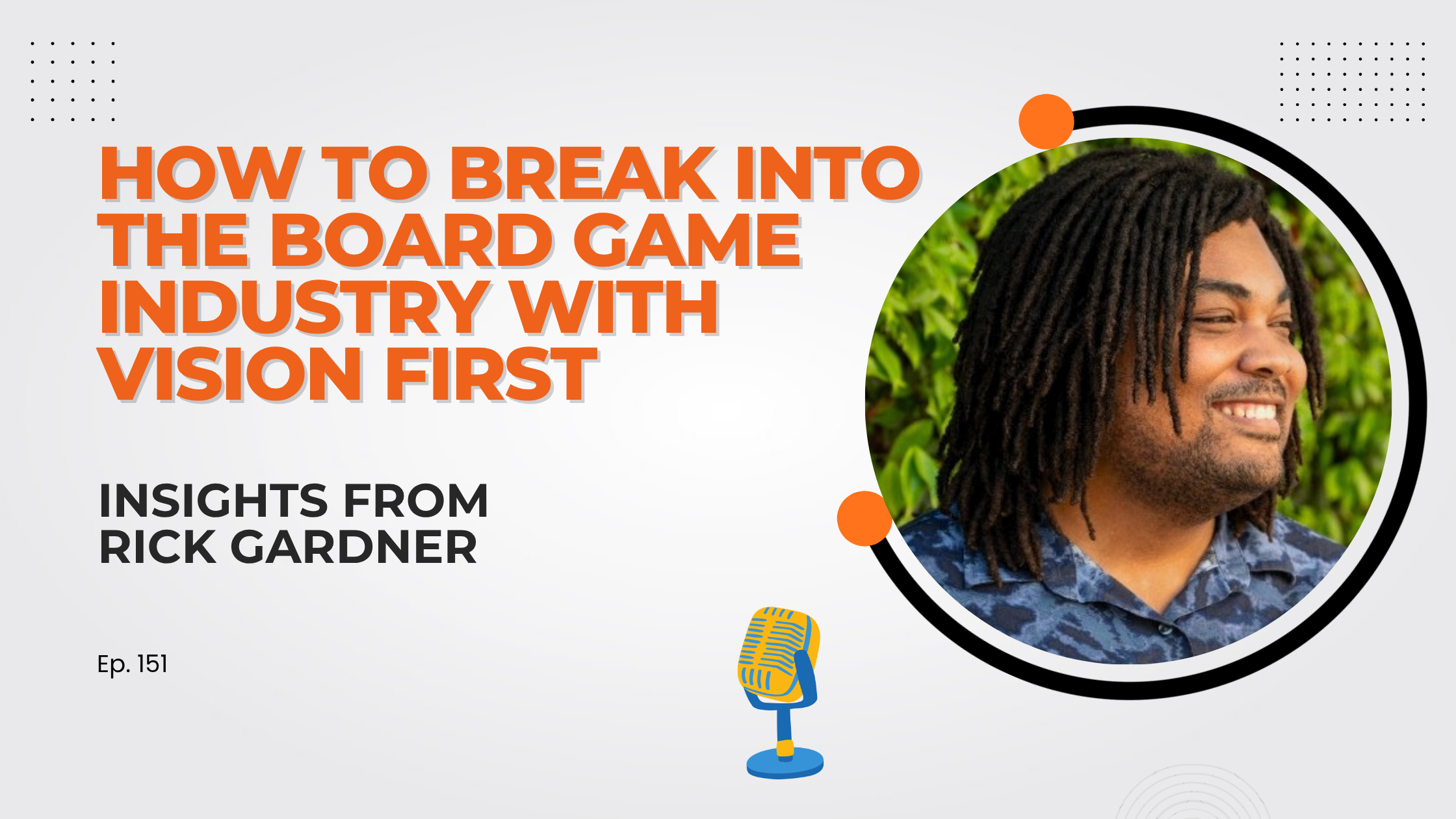
Welcome to Toy Business Unboxed Podcast, where we explore the real stories behind the people building the toy and game industry from the ground up. In this episode, host Jason Hsieh sits down with Rick Gardner, founder of Blue Rondo Games and the creator of Crabs in a Bucket, a fan-favorite shedding card game with a devoted following. Rick shares how a COVID-era idea born in Germany evolved into a growing studio with multiple games in development, a Kickstarter launch on the horizon, and an auteur-driven design philosophy unlike anything else in the space. From the GAMA Horizon Fellowship to the mechanics of time-travel heists, this conversation covers what it really takes to build a mission-driven game company from scratch.

#151: From Tarot Cards to Kickstarter: Blue Rondo's Rise – Toy Business Unboxed
Episode Highlight
- 00:00 Rick Gardner’s pandemic origin story
- 02:33 How Crabs in a Bucket was created
- 04:35 Crabs in a Bucket gameplay explained
- 06:39 Zeit Heist overview and Kickstarter date
- 09:24 Zeit Heist development journey
- 11:31 GAMA Horizon Fellowship overview
- 16:17 Blue Rondo’s future expansion plans
- 20:05 Advice for new entrepreneurs
From a Pandemic Hobby to a Real Game Studio
During the pandemic, Rick was a grad student living in Germany, playing a shedding card game called Mau-Mau with friends and experimenting with tarot cards for divination. Those two passions collided into a creative idea he began developing solo during lockdown, testing gameplay mechanics entirely on his own. When he returned to the United States, the idea had grown into something real: a card game with enough depth and playfulness to appeal to a wide audience. That realization prompted him to found Blue Rondo Games LLC and start recruiting artists, designers, and business partners to bring the vision to life.
The Birth of Crabs in a Bucket
The original concept was a tarot-inspired shedding card game, but Rick knew it needed a theme that matched its mechanics. During solo playtesting, he noticed he was having more fun pulling opponents down than winning outright, which is exactly how crabs behave when trapped together in a bucket. That insight led to the name, and from there he turned to Wikipedia to discover the colorful variety of real crab species that could populate the game’s universe. The result was Crabs in a Bucket, a game built on the principle that what a game looks like should feel like how it plays.
Inside the Gameplay of Crabs in a Bucket
Crabs in a Bucket is a shedding-style card game where players race to empty their hand by matching the suit or value of the card in play. The star of the show is the Joker Crab cards, which carry special abilities that let players sabotage opponents or claw their way to an unlikely win at the last moment. One example is the Vampire Crab, which forces a hand swap between players, while the Imitation Crab can copy whatever the last Joker did. Face cards like Jacks, Queens, and Kings act as blockers, stopping opponents from playing their Joker crabs at the worst possible moment.
Zeit Heist: A Time-Travel Heist Game Coming to Kickstarter
Blue Rondo’s next release is Zeit Heist, a heist-themed drafting game launching on Kickstarter on October 28. Players take on the roles of the world’s greatest masterminds, competing to steal a newly discovered element called Zeitnium, which enables time travel and is worth one trillion dollars. Each player assembles a crew by drafting underworld contacts, choosing specialists who can pull off the heist at different moments in the day, from sneaking in before the museum opens to bribing crooked cops during the unveiling. The twist is that every player can manipulate time itself, rewinding or fast-forwarding the clock to set up the ideal conditions for their crew to strike.
The GAMA Horizon Fellowship: Supporting Diverse Game Publishers
The GAMA Horizon Fellowship is a program that supports game publishers and brick-and-mortar retailers from marginalized communities who are bridging the gap between early-stage success and broader industry recognition. Rick was one of just six publishers selected from a pool of fifty applicants, and the fellowship provided him with funding, free booth space at GAMA and Origins Game Fair, and monthly sessions with some of the most experienced voices in the industry. Each session focused on a different topic, ranging from marketing and business development to understanding how the distribution side of the industry actually works. Rick was matched with mentor Whitney Kimerling from Hootenanny Games, whose guidance helped him navigate the specific challenges of scaling a small game studio.
Building Games Vision-First: Blue Rondo’s Design Philosophy
At the heart of Blue Rondo Games is what Rick calls a vision-first, auteur-driven approach to game design. Rather than starting with a mechanical concept and fitting a theme around it later, Rick begins by asking what a game needs to feel like and then builds the mechanics to serve that feeling. This approach is central to a new collaboration with artist Hannah Comstock of Totally Normal Frogs, where Rick’s job is to translate her creative vision for the frog universe into a playable cooperative choose-your-own-adventure board game. The result, Rick believes, is always something bigger than what a single designer could produce working alone.
Advice for Newcomers in the Toy and Game Industry
Rick’s most important piece of advice is direct: nobody is running or hustling to save you. Whether the economic environment is rough, funding is tight, or the product is not where you want it to be, the entrepreneur has to be the one pushing their thing all the way forward. The board game industry is full of generous people who will help along the way, but the relentless drive to keep going has to come from within. Rick urges anyone on the fence to start now, without waiting for the right capital or better conditions, because that moment will never arrive on its own.
Conclusion
Rick Gardner’s journey from pandemic-era hobbyist to the founder of a vision-driven game studio is a study in creative persistence. Blue Rondo Games has built its identity around making experiences that feel as good as they look, and that commitment shows in both Crabs in a Bucket and the upcoming Zeit Heist. The lessons Rick shared about the GAMA Horizon Fellowship, the value of a strong cohort, and the importance of relentless forward motion are relevant far beyond the toy and game space. For anyone thinking about turning a creative passion into a business, Rick’s story is a reminder that the only move guaranteed to fail is the one you never make.
Connect with Rick Gardner
If you’re interested in learning more about Blue Rondo Games or connecting with Rick Gardner you can reach out through the following channels:
- Website: Visit Blue Rondo Games’ official website for the latest news, game updates, and more
- Facebook: Follow Blue Rondo Games on Facebook for updates, discussions, and behind-the-scenes content.
- Instagram: Follow Blue Rondo Games on Instagram on Instagram for visual updates, game previews, and creative inspiration
- TikTok: Follow Blue Rondo Games on TikTok on TikTok for clips, highlights, and behind-the-scenes content.
Transcript
Jason Hsieh (00:00)
Hi, welcome back to another episode of Toy Business Unboxed. Today I’m with Rick, the founder of Blue Rondo Games, the studio behind Crabs in a Bucket and an upcoming time hopping high scene game called Zeit Heist. And Rick is going to share us how his journey started a spark during the pandemic, involved into a full mission-driven companies that he’s working on ⁓ scaling this year. And he also share some of his experience with the GAMA’s horizon fellowship program as well. Thank you so much for joining us on the podcast today.
Rick Gardner (00:31)
Thank you for having me, Jason.
Jason Hsieh (00:32)
Yeah, so first of all, before we kind of talk about the products and the games that you developed, kind of walk us back on your journey. What’s inspired this like this whole company from the very beginning?
Rick Gardner (00:43)
Yeah, no, it’s a great question. When I first started out, I didn’t necessarily have some sort of grand ambitions to join the board game industry and create group of ⁓ bunch of different artists and programmers and musicians and so on. you know, I was just a grad student at the time, and during COVID, I was living in Germany and we used to play this game called Mau-Mau, which I it’s a shooting style game, it’s pretty popular over there.
maybe it’s inspired other sorts of shedding card games that we play over here in the West. And at the time I really enjoyed ⁓ using tarot cards for divination purposes and I wanted to create a game that has those sorts of shedding style elements but incorporated the major arcana and so on. And because it was COVID, I was mostly testing the game by myself then I came back from
Germany to the United States. And as I was playtesting it and trying to make it into more and more of the best thing that it can be, I eventually got to a place where I I realized that I had something that was strong enough to be a real product. And I think once that happened, I think that’s when things sort of started to shift in terms of me trying to think through ⁓ how to make this into an actual reality. And that’s when
I founded the LLC and that’s when we started trying to find people to join the company in those early days. And we’ve just been kind of knocking on the doors of fate ever since, trying to see how far we can take what we’ve built and seeing where we can go next. ⁓ It definitely didn’t start off with kind of the ideas that we have now in terms of kind of what our vision is for the company and what we want to build and so on. It definitely was an inductive sort of process over time, it’s nonetheless ⁓ the reality for our company. So yeah.
Jason Hsieh (02:19)
And can you also kind of talk about the first game that you work on, where the idea come from and kind of just walk us back like your the journey of creating that like that product from idea to like actually in productions and into people’s hands.
Rick Gardner (02:33)
Yeah, for sure. Yeah. So like I said, you know, in the beginning it was a tarot card game. And I think once it got to the point that I realized that this thing could be enjoyable enough for for anybody to be able to get into, not just tarot card enthusiasts, but anybody, you know, grandma or you know, a young kid or and so on, I realized I needed to connect the theme of the game closest to kind of the aspects of the game mechanic.
I I needed a game that felt like how it looked and looked like how it felt to play the game. And so as I was play testing by myself, I noticed I was having more fun trying to pull my opponents down and stop them from winning than trying to reach for a victory myself, which is how crabs are when they’re in a bucket, of course. Yeah. They’re more likely to pull each other down than to actually escape. So I had this tarot card game.
I was like, man, it’s got to be called crabs in a bucket. But where’s the crabs? Right. so I went on Wikipedia, looked up all the different crabs, I found that there’s a Yeti crab out there, there’s a clown crab, and so on. There’s a lot of different sorts of crab species, and we kind of themed it around there and just kind of built it up from that point onward. And I think we thought carefully about
about kind of what we wanted the aesthetics to kind of appeal to, because we wanted this to be kind of a game that anybody could get into but still had its own unique flavor and was still connected deeply to the mechanics of the game. But I think the core of kind of what drove forward the creative process of making this game was kind of the vision that existed kind of behind all of it in terms of kind of how this game needs to feel in terms of its playfulness.
And so on. That was kind of the number one motivator behind pushing things forward as we started to develop things more and more. And so as we started to get artists and business people involved and we started play testing and so on, we used that as kind of the focal point as we built things out, which I think became kind of the seed for how we go about ⁓ making our games.
Jason Hsieh (04:23)
I see. Thank you so much for sharing that. And since you are kind of on the topic of talking about the game for our listeners that haven’t played with your particular game, can you also kind of explain the rule how to play and kind of just quick overview?
Rick Gardner (04:35)
Yeah, it’s pretty straightforward. It’s a shedding style game where you’re trying to get rid of your cards as quickly as you can. similar to other sorts of shedding style games that you might have played in the past where you’re trying to match the color or the number and so on. ⁓ But the star of the show are the Joker crabs. Those are these cards. so in addition to having regular cards that have ⁓ various suits and so on, you also have these Joker crab cards, which have special abilities that are able to pull your opponents down right before a victory or or catapult yourself to a win.
Let’s say that Jason, you have only one card. And I’ve got like ten whole cards, right? And you’re about to win because, you know, you’re about to match the right number or the right suit or whatever. But thankfully, one of the cards that I have in my hand happens to be the vampire crab, which has an ability that lets me trade hands with you and I’ll give you my hands. Yeah, yeah, exactly. Now I’ve got one card left, right? But maybe you’ll fight back with something
Jason Hsieh (05:20)
Oh you swap hands.
Rick Gardner (05:26)
like the imitation crab, which is able to copy the effect of the last crab, so you get to, you know, swap hands again. Okay. so it’s very much a tactical sort of take that kind of game where you’re trying to anticipate what is in your opponent’s hand and using the abilities that are in your hand to be able to catapult yourself to an unexpected victory. How do you get rid of the cards in your hand again?
By trying to match the suit or value of the given card for the most part. The Joker crabs have their own special pile that you play on. These ones they function almost kind of like wild cards in that you can play them at any point. They don’t have to match a particular type of value or whatever. You just play them on the Joker pile. ⁓ But along the way, there are other cards that are able to block those ⁓ Joker crabs, like the Jacks, Queens and Kings, for example, where they can stop people from playing those Jokers. So if you
know that I’m gonna play that that vampire crab. Maybe you’ll play this jack to be able to stop me from being able to play that card. So it’s all about using those kinds of tactics to be able to steal a win at the last minute.
Jason Hsieh (06:21)
I see. Okay, okay. Now I kind of understand. You have a very interesting theme obviously than other games in the market, so
Rick Gardner (06:29)
Why, thank you very much. Yeah, it’s been it’s been fun, it’s been adventurous.
Jason Hsieh (06:33)
Yeah, I know you have another game that you’re working on. can you also kind of elaborate that one you’re working on?
Rick Gardner (06:39)
Yeah,
so that one is going to be hitting Kickstarter in October, October 28th. It’s called Zeit Heist. It’s a heist-themed drafting game with time travel in it. Basically, with this one, ⁓ you and your friends are the ⁓ most intelligent masterminds in the world. And you guys have all recently gotten the news that scientists have unveiled a new element called Zeitnium. it’s an element that
enables the ability to travel forward or backward in time if you’re able to harness it correctly. So naturally it’s worth one trillion dollars. And so with you and your friends being the greatest masterminds in the world, of course you want to steal it. And of course you want to steal this Zeitnium. You want to create a heist to steal this Zeitnium. And these scientists they happen to be unveiling this element at this science museum specifically at twelve o’clock on the day that you guys are playing. And so
you and your friends are competing in this drafting game where you are passing around the different contacts of the local underworld and trying to bring in the right types of team members to be able to accomplish the heist, to steal the element at a specific time. Some of the team members have abilities that can allow for you to steal the element before the museum is open. like you know, certain team members can sneak into the museum and steal the element that way, or other team members can
break into the museum and then steal it in kind of like a high stakes heisting sort of way. And other ones are crooked cops that you can kind of turn to your side to be able to steal it once it gets unveiled. and depending on which team members you have at these different times when the museum is closed or open or when they’re unveiling it, you can steal the element at different times with different win conditions. But the sauce, the magic with this game is that everybody has the ability to manipulate time
along the journey towards being able to steal the element. So if you have some team members that are really good at being able to steal the element before the museum opens and the museum has already opened, you can use the time machine to rewind time so that you can then go send in your people to go steal the element. Or maybe you can fast forward time while the museum is closed to be able to go steal it. So it’s very tactical, very straightforward and we tried to make it a game that is
just as easy to pick up as something like Crabs, but still has different levels of mastery without it being too complicated. We don’t have a whole bunch of words on each of the different cards. We went for a very minimalist aesthetic compared to something like Crabs. and I think as a result, we’ve got something that’s very different but still is something that everybody can enjoy.
Jason Hsieh (09:00)
So I assume you are competing against other people’s team and see who can do it first. Okay. Okay.
Rick Gardner (09:06)
Yep, you got it. Exactly. So everybody has their own heist and they’re trying to recruit the different heist members into that specific heist and manipulating time to be able to accomplish it in the ways that favors them. it’s good.
Jason Hsieh (09:17)
Came up with this very interesting magic. I don’t I haven’t seen a lot of game used like time traveling in there.
Rick Gardner (09:24)
Yeah, you know, one is a little bit of a long story. This one has had an interesting journey. We’ve been developing this one since before Crabs even launched on Kickstarter, to be honest. Yeah. At the time my my buddy and former business partner, ⁓ Warren Jensen had the idea for this game while we were developing it. and with all of our games, we try to be
Jason Hsieh (09:33)
well.
Rick Gardner (09:43)
very vision focused, very vision first, very focused on kind of the feel or the essence of what the game is meant to be and building out things from there. And so he had this vision of creating a ⁓ drafting game that doesn’t have all this point solid at the end. A drafting game that can be enjoyable for everybody, that doesn’t involve having to count up a bunch of points at the very end. And he came up with a clever system of having these different types of win conditions.
That are all bounded to clock that that the players are passing around over time. and so it started off there. Those were the seeds of it. He eventually had to leave the company and focus on his own ⁓ sort of personal ventures and along the way we’ve had a lot of different artist changes and stuff like that. And so it had been a journey of trying to speak to his original vision. Being able to kind of build out
the game in a way that felt Blue Rondo, you know, in a game that really felt us, that is still feel first and vision first. And it all really crystallized, to be honest with you, Jason, it all really crystallized I think over the past couple of this past year, the past six months. It really has, yeah. I mean, ⁓ between us bringing in another designer, Joshua Tucker, who originally was a fan of Crabs in a Bucket before it released, who’s now working with us, he
Jason Hsieh (10:43)
Really? Okay.
Rick Gardner (10:53)
has kind of taken the reins on with the design. ⁓ And I’m still doing the directing for the game. and then Monica Sivai Virozna, she’s been working with us for a while too, but she’ll be debuting with Blue Ronda with this one. Her art as she’s kind of taken up the designs, the concepts originally created by the amazing artist Logan Stahl. it’s all really kind of come together and crystallized into this very unique sort of vision where we’re doing time travel heists, you know.
and I’m really proud of it’s gonna be coming out on Kickstarter probably October 28th is the date we’ve settled on. So it should be exciting.
Jason Hsieh (11:23)
Yeah, I wish you you have a successful launch for that. So I want to kind of switch topic a little bit and talk about GAMA Horizon Fellowship because I think you are the first guest that I interviewed that actually participated in the fellowship itself. First of all, congratulations on being approved to receive the fellowship. But can you kind of educate the audience on how this whole program works and what kind of benefit and what kind of things do you get from being part of the fellowship program?
Rick Gardner (11:26)
Thank you, Jason. I appreciate it.
Yeah, so I’ve been very fortunate in terms of being able to receive the Horizons Fellowship. it’s a fellowship program that is available to publishers, like game publishers as well as brick and mortar store retailers for now. And then they might expand to other sorts of categories in the future. and they’re focused on ⁓ being able to uplift people of different marginalized communities towards being able to develop their businesses. It’s definitely a business intensive
sort of And it’s open to anybody of any sort of marginalized community. It’s not just black folks, it’s everybody. and they’re especially focused on trying to, you know, if your business is at the stage where okay, you have a proper idea and you’ve been able to prove that you can make it into a real thing but there’s still that gap between having started the business and successfully made something and then having it you know take off into something that
you know, society might know. They’re focused on trying to help out with people at that stage, trying to cross over from the successful entry entrepreneur stage to that more advanced sort of stage. and they do not just through being able to provide a little bit of funding and also you know, free booths at at GAMA and Origins Game Fair and so on, but also the aspect as well.
I was one of six publishers chosen out of an original application of a fifty And when it comes to the people that they select, they are very careful in terms of who they choose to match up with in terms of mentors and so on. And so I was super fortunate in that they were able to identify where I’m where I’m at and where I’m trying to go and find somebody who’s been there to be able to kind of show me.
what it takes to make it to that next stage. They chose Whitney Kimerling from Hootenanny Games and she’s been an absolutely phenomenal mentor who’s helped me through quite a bit through this intermediary sort of stage. highly recommend the program to anybody who might qualify.
Jason Hsieh (13:37)
I see. So besides getting your own mentor, and you also mentioned some like financial support for the trade show, what other type of support are you also getting as part of the program? And also how long would that be? The program?
Rick Gardner (13:48)
Yeah, the program was I think let’s see, I won the award in September of last year and then it ran until I think last month or maybe the month before. So Yeah, yeah. Almost a full year. Yeah, exactly. Okay.
Jason Hsieh (13:58)
Yeah, yeah. ⁓
month do you receive different training each month?
Rick Gardner (14:05)
Yes,
exactly. Yeah. So every month there’s a call with some of most successful people in the industry who share their insights related to marketing, business development, other sorts of things. There’s usually a different topic every month. And ⁓ that has been especially helpful, not just like learning from people who’ve gone through stages and seen it all, but also in terms of being able to
be exposed to people that are in those sorts of places has been extremely helpful. A lot of my connections come from that sort of thing. So yeah, those of aspects I think have been incredibly helpful.
Jason Hsieh (14:36)
I see. What are the topics do you like the most out of the program? I it sounds like it every single month it’s a different topic.
Rick Gardner (14:44)
Yeah.
I honestly I like them all because you know with each of the sessions, they just kind of pick somebody who has experience with that particular subject and they just let them go, you know what I mean? And so we get a lot of different sorts of talks. I think in terms of the things that have been most useful have had to do with kind of where our weaknesses traditionally have been. So things
like marketing and so on, as well as topics tied to some of the new avenues that we’ve been trying to pursue. Like, you know, a lot of what we’ve learned about how the distribution side of things works, comes from those sorts of sessions and so on. So it’s been really helpful, I’d say.
Jason Hsieh (15:18)
Yeah, and also you kind of have a same group of people kind of in a similar journey. You say that’s total of six recipient of the program.
Rick Gardner (15:26)
Yes, yes, yes. The camaraderie has been especially helpful. And I’m really fortunate in that the cohort that I was in. I felt just really lucky to be with the people that were in that cohort. Everybody was so talented and so driven and had such positive energy and was so willing to share various insights that they’ve learned. It’s been great. Yeah, that’s been very helpful.
Jason Hsieh (15:45)
Okay, thank you for sharing that. And I’ll definitely make sure we put ⁓ information in our show notes so for people interested they can also try to apply. Obviously pretty hard process to get it.
Rick Gardner (15:54)
Yeah.
It
is, yeah. Unfortunately the application process is closed for this year, ⁓ but it will be available next year. I highly recommend it to anybody who is interested. It’s been very helpful.
Jason Hsieh (16:06)
I see, thank you so much for sharing that. So like how do you see the Blue Rondo company growing in the next couple of years? Like what is your vision? What are some of the projects you’re working on?
Rick Gardner (16:17)
Yeah, you know, I think with kind of the current headwinds it can be difficult to be able to say with absolute certainty in terms of kind of where things are gonna go. I think compared to previous eras, I think our trajectory is a little bit more squeezed by the circumstances of the surrounding economic reality than in days past and so some of it is has to do with kind of what we even can do.
with kind of ⁓ how things have been moving with the tariff situation and all that. the things that we do know ⁓ ultimately are the things that are ⁓ closest to who we are as a group, ⁓ closest to kind of how we operate as Blue Rondo Games. I often describe our group as a OTR driven company, one where we are focused almost entirely on building out games that align
very close to a person’s specific vision for that particular game. An example of this, a good example of this comes from a game that we’re working on currently. We haven’t officially announced it, but we are working in collaboration with Hannah Comstock, who’s a legendary creature designer based in LA, who has a line of frog pins called Totally Normal Frogs. We’re gonna be making a cooperative choose your own adventure style board game about
The frogs called a totally normal game about frogs. ⁓ and while I’m the designer on the project, she is the vision holder for that project. And the way that we work together is, you know, I’m not creating this game design and then trying to find, you know, some sort of hole in the game design to be able to take Hannah’s frogs and stick them into the game design, right? I’m going to Hannah instead and asking her, like, okay, what does this world need to feel like?
You know, when the player is moving around this part and doing this particular thing, how do they feel? What should the essence of this be? And with her being an artist, she’s really good at being able to talk in that sort of way. And my job is to kind of translate those sorts of vibes and essences into game design. And as a result, we wind up building something that is much bigger than I could have created on my own, right? And that’s always been kind of what’s driven our
process. Even with the turbulent Zeit Heist development, that’s always been kind of the guiding light. And I think that’ll continue in these coming years, regardless of what things look like from an economic perspective. We’re still gonna be creating a bunch of products. We have so many in the works. Just because we’ve come out with maybe two products up until this point doesn’t mean that we’ve only been working on two products at a time. We’ve got maybe probably five or six in the works. and so you know we’re gonna keep releasing stuff. We’re gonna keep
crowdfunding projects and we’re gonna definitely keep working within our means in terms of what we can control. I can definitely say that. And of course, you know, we’re gonna keep focusing in on being able to build out experiences that we are confident that we can make the best sorts of experiences that we can, focusing on starting with what is the most fun thing that we can make in building things out from there.
so at the very least, we know that those things are on the horizon. ⁓ And beyond we have plans to expand outside of just board games as well. ⁓ We have a plush project in the works that’s been basically finished, all but finished. We just need a couple of samples and stuff. We’ve just been waiting for the right opportunity to launch, but we’ll be moving in that sort of direction. ⁓ And then we’ve also got some video game projects on the horizon as well.
Jason Hsieh (19:21)
Okay, that’s very different.
Rick Gardner (19:23)
Yeah, a whole different industry. but you know, with all of these kinds of things, it’s never been about just making a board game and making this board game and making that board game. It’s about the essences that are driving these sort of creative ventures. We’ve never wanted to just make crabs in a bucket and have it just be that. We’ve always wanted to make kind of a whole universe of different sorts of things that are tied to this thing that people have come to like. And that
sort of auteur focus drive I think is at the core of who we are and that’s gonna continue as we move into different sorts of industries.
Jason Hsieh (19:53)
I see. Thank you so much for sharing that. And as we’re kind of wrapping up today’s interview, if you have to share one piece of advice with someone that’s getting started within the toys and game industry, what would that be?
Rick Gardner (20:05)
It’s a good one. You know, might sound kind of negative. I don’t mean to make it sound negative at I will say the advice that I I could tell myself in the past is that you know when it comes to any sort of entrepreneurship, you know, nobody that is running or hustling or jogging to try to save you. You know what I mean? You have to be the one to
push your thing all the way forward to be able to have a chance of making any of that stuff work. And that did not come naturally to me at all. It still doesn’t come naturally to me. It’s still something that I have to continue to learn. But I think that is probably the most useful thing that I wish I knew in the past. And that’s not to say that people don’t help out each other in the board game industry. They absolutely do. You know they we have I think the board game industry is probably one of the kindest
Industries there is. You know, competitors regularly help each other out. It’s been nothing but positive on the board game side. but that essence is still true. You still have to fight and push your thing all the way forward if you want to have any sort of chance of of having anything work out. So I think that that’s probably the most important thing for me. and maybe other folks, certainly the fact that you cannot give up and you have to have a certain relentlessness.
You have to decide that no matter what, no matter how many times you get slapped in the face, giving up is not possible. You have to really embody that, you know. Yeah.
Jason Hsieh (21:21)
Only way you can lose in entrepreneurship is when you give up. As long as you don’t give up there’s always a chance that you can come back. It doesn’t matter how big of a hurdle or the mountain that you need to climb, I believe.
Rick Gardner (21:33)
Exactly. A hundred percent. so I’d say those two things and then I guess to anybody who has who’s thinking about starting and hasn’t yet started, you got to start now. You can’t wait until you have the right capital, you can’t wait until you know, the economic headwinds are better, ’cause if you do, you’re never gonna do it. You got to do it. You got to do it right now and just figure it out. So that’s what I would say.
Jason Hsieh (21:48)
Yeah.
Yeah, thank you so much for sharing that. And for our listening, I would like to learn a little bit more about you and your company. Where is the best place for people to find you online?
Rick Gardner (22:01)
Yeah, I mean, you know, our website’s bluerondogames.com and on all social media, our handle is Blue Rondo Games. It’s B-L-U-E, like the color Rondo, R O N D O Games. you can find us on TikTok, you can find us on Instagram, and yeah, Zeit Heist will be hitting Kickstarter October 28 so please check it out.
Jason Hsieh (22:17)
Okay, sounds good. Thank you again for being on the show, sharing your experiences and your journey for our audience. It has been very insightful.
Rick Gardner (22:25)
Thank you for having me, Jason. It’s been awesome.
Jason Hsieh (22:26)
You’re welcome. And thank you for our audience for tuning in for this episode of Toy Business Unboxed Podcast. We hope you have enjoyed today’s conversation and find it insightful and inspiring. If you like what you have heard, be sure to subscribe to our podcast on your favorite platform so you never miss an episode. We really appreciate your support and would love it if you can leave us a review and share the podcast with your friend and colleagues. For more resources and the update within the toys and game industry, visit our website at toy-launch.com
Join the conversation and connect with us on social media using #ToyBusinessUnboxed. We’ll love to hear your feedback and suggestion for future episodes. Until next time, keep innovating, keep creating, keep bringing joys through toys. This is Jason Hsieh signing off on the Toy Business Unboxed Podcast. We’ll see you in the next episode. Thank you so much, everyone.
Rick Gardner (23:12)
Thank you.
Grow your toy brand’s content reach
From SEO blog content to influencer outreach — we handle the full content engine for toy and game brands.