
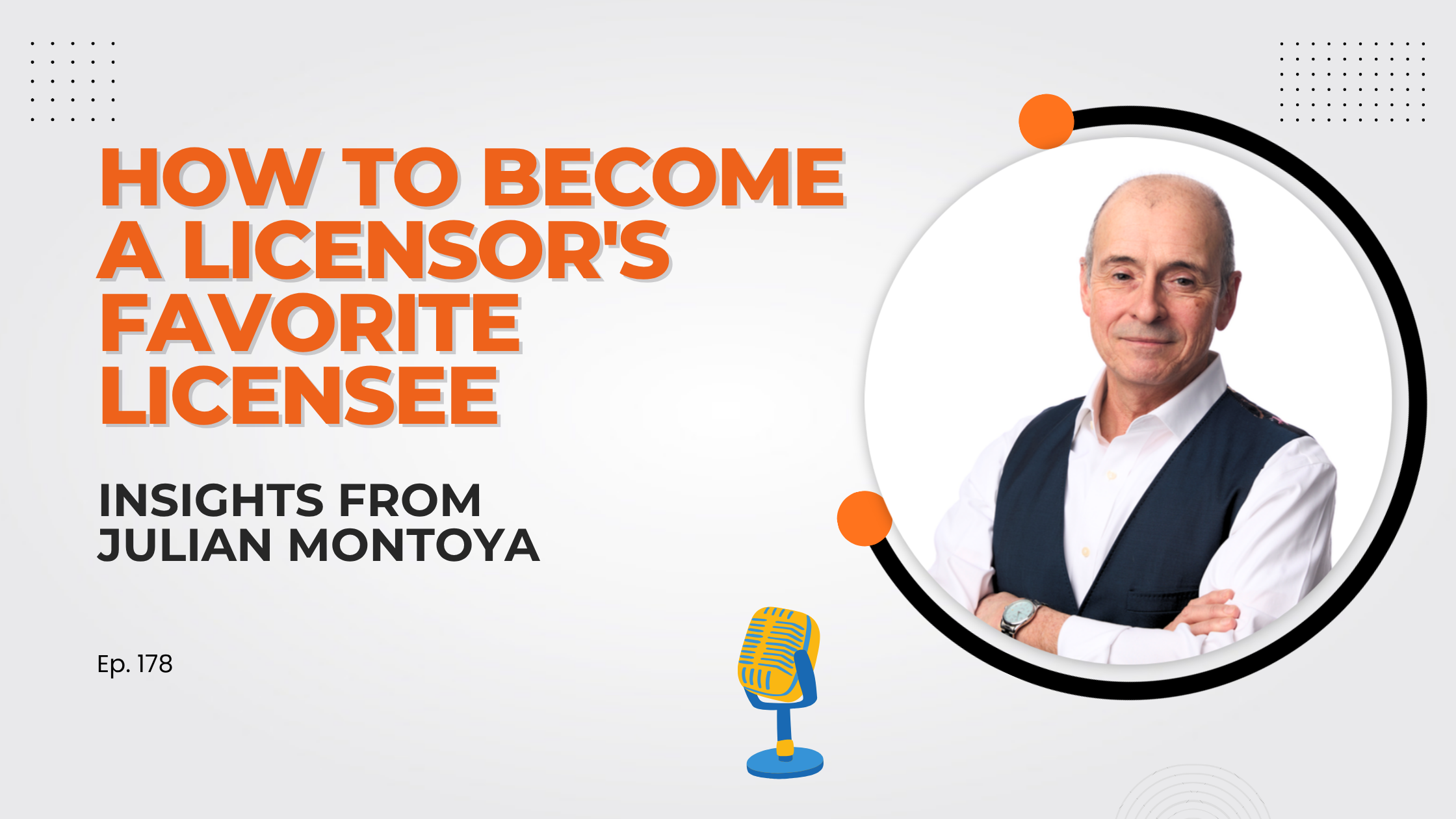
Welcome to another episode of the Toy Business Unboxed Podcast, where we sit down with Julian Montoya, a licensing leader whose career has spanned Lucasfilm, Warner Bros, and now Noble Collection. Julian has worked with some of the most recognizable names in entertainment, including Star Wars, Lego, Funko Pop, Harry Potter, and Wicked. He walks us through how a career that started in home video marketing turned into decades of building licensing relationships on both sides of the table. Julian also shares what it takes to become the kind of licensee that studios want to keep working with.

#178: Inside the World of Toy and Collectible Licensing – Toy Business Unboxed
Episode Highlight
- 00:00 Welcome and guest introduction
- 00:44 His career started in VHS
- 01:11 Meeting the Lucasfilm team
- 02:20 The first Lego Star Wars deal
- 03:22 Pushing Funko Pop through approval
- 06:51 Joining Noble Collection in 2020
- 09:14 What new licensees should know
- 16:26 3D printing speeds up development
- 21:33 His advice for newcomers
From VHS Marketing to Lucasfilm Licensing
Julian’s career began at Warner Home Video, working on domestic operations back when the industry was still deciding how many units of VHS, Beta, and laserdisc to produce. After six years there, he spent four years at 20th Century Fox Home Entertainment, where he met the Lucasfilm team while overseeing the international marketing campaign for the 1995 rerelease of the original Star Wars trilogy. That relationship led to a recruitment offer in 1997 to head up international licensing at Lucasfilm. His background in international home video marketing translated directly into managing licensing structures for toys.
Being in the Room for the First Lego Star Wars Deal
At Lucasfilm, Julian worked closely with Hasbro, the lead toy partner, after Hasbro acquired Galoob, which originally held the Star Wars micro figure rights. Around 1997 or 1998, he was in the room when Lucasfilm negotiated and signed the first Lego Star Wars deal, one of the earliest major entertainment licenses Lego had taken on. He describes watching Lego’s onboarding process as remarkably professional and detail-oriented, especially in how carefully they approached marketing to kids. That early exposure to Lego’s standards stayed with him throughout the rest of his career.
Helping Push Funko Pop Through Approval
After three years at Lucasfilm, Julian returned to Warner Bros and eventually became head of Global Toys, where he worked on a concept Funko originally called Funko Force. The early versions had simple black eyes and minimal facial features, and several stakeholders worried it was not on-brand enough to approve. Julian and his colleague Daniela Butner kept pushing until DC Comics finally agreed to let them move forward, effectively putting the risk on Julian’s team if it failed. The concept became Funko Pop, and Julian calls it one of the more successful risks he took in his career.
Building the Collectible Business at Warner Bros
During his twenty years at Warner Bros, Julian managed the Lego relationship, including renewing the Harry Potter deal and bringing Batman and Scooby-Doo licenses to Lego. He also helped launch QMX’s Q-Figs line and worked on collectibles with Mattel, Funko, and Mezco across franchises ranging from Scooby-Doo to Harry Potter. That period built the foundation of Warner’s collectible business and gave Julian broad experience managing licensing relationships with many of the industry’s biggest toy makers. In 2020, after twenty years at Warner Bros, he decided it was time for a new challenge.
Joining Noble Collection After Nearly Two Decades as Their Licensor
Julian joined Noble Collection in 2020, a company he had actually signed as a Harry Potter licensee seventeen or eighteen years earlier for their prop replica business. He wanted experience on the manufacturing side of licensing after two decades on the licensing-out side, and the move also brought him closer to his two daughters, who were both living on the East Coast. Prop replicas were not originally an approved product category for Harry Potter, so Julian had to pitch key stakeholders before Noble Collection could get involved. That early bet paid off, and Noble Collection’s Harry Potter prop line has grown into a wide range of products, from wands to deep-cut items like Horace Slughorn’s hourglass.
What New Licensees Need to Understand
Julian says any licensing executive is motivated to grow the brand and bring in the right partners, but franchise plans still set hard limits on what is possible. A great product idea can still get rejected if it does not fit the franchise team’s target audience or existing plans. Licensors also look for licensees who can stay in a clean lane without stepping on other partners’ existing agreements. Above all, licensors run a constant calculation of revenue against the effort a licensee requires, and the partners who deliver results without creating drama are the ones who get renewed.
Moving Faster With 3D Printing and Cross-Generational IP
Julian says Noble Collection increasingly relies on in-house 3D printing to speed up prototyping, including testing multiple sizes and poses for pieces like chess sets before settling on a final design. That speed matters because content does not stick with audiences the way it used to, pushing companies to move from concept to shelf faster than before. Noble Collection recently signed on to create Transformers keychains and dioramas, adding to a portfolio built around IP with broad, cross-generational appeal like Harry Potter, Wicked, and Minecraft. Julian says the company looks for brands with both wide age range and dual gender appeal, while staying selective about IP the team is genuinely passionate about.
Advice for Newcomers in the Toy and Game Industry
Julian’s advice centers on persistence and networking, since he has seen people spend years working their way into the industry through sheer determination. He tells the story of Kevin McNulty, founder of Endless Games, who offered free shoe shines outside New York’s old Toy Building just to ask people how they got into the business. Julian says the industry is small enough that toy people tend to recognize each other, and that passion for the work comes through in a way that gets noticed. His core message is to stay patient, build genuine relationships, and take advantage of every opportunity to connect with people already in the business.
Conclusion
Julian Montoya’s career shows how a background in international marketing can turn into decades of building some of the most recognizable licensing relationships in toys and collectibles. From negotiating the first Lego Star Wars deal to helping push Funko Pop through approval, his path has touched some of the industry’s biggest milestones. Now leading licensing at Noble Collection, he applies those same lessons to building a brand known for craftsmanship and cross-generational appeal. His story is a reminder that persistence, relationships, and genuine passion carry a career further than any single deal ever could.
Connect with Julian Montoya
If you’re interested in learning more about Noble Collection or connecting with Julian Montoya you can reach out through the following channels:
- Website: Visit The Noble Collection’s official website for the latest news, game updates, and more
- Instagram: Follow The Noble Collection on Instagram for visual updates, game previews, and creative inspiration
- Facebook: Follow Three Noble Collection on Facebook for updates, discussions, and behind-the-scenes content.
Transcript
Julian Montoya (00:00)
Toy industry. Here, Jason Shea, a toy entrepreneur and expert in the field.
Jason Hsieh (00:04)
Welcome back to another episode of Toy Business Unboxed Podcast. Today I’m happy to join by Julian, a seasoned licensing leader whose career is spent with Lucasfilms, Warner’s Brothers, and currently with Noble Collections. Julian has worked with some of the most recognizable names in entertainment, including Star Wars, Lagos, Funko Pops, and many other licensing brands. Bringing the beloved character to Toy Shelf Worldwide. So thank you so much for joining us on the podcast today, Julian.
Julian Montoya (00:32)
My pleasure. Thank you for having me.
Jason Hsieh (00:34)
So let’s first start out with your long career in marketing and in the toys game industry. What year do you start? And I know you have been doing this for a while. So what is the background on you even getting into it.
Julian Montoya (00:44)
You know, in entertainment it would have started that Warner Home Video when I started with domestic operations back in the day when we were figuring out how many units of VHS to make, how much beta, and how much laser disc. So that goes back a long time. And after six years of Warner Home Video went to 20th Century Fox home entertainment where I spent four years. Yeah. And it was there that I met the team from Lucasfilm. While I was at Fox
Jason Hsieh (00:59)
Okay.
Yeah.
Julian Montoya (01:11)
In ’95 is when they released the original trilogy. It was the campaign was the original One Last Time. And it was released on VHS at the time, and I was overseeing the international marketing campaign for it. Developed all new key art with a wonderful artist named John Alvin, some new trailers, and it was all for the international launch of the of the original trilogy. But
Frequently I’d have to go up to Lucasfilm and get sign off on some of the creative elements and some of the plans. And got to know the team up there. So in ’97 I was recruited to join them and head up international licensing based on my experiencing dealing with the international marketplace marketing. And
We do licensing in the video industry. Back then, you know, we would license the distribution rights of the company. So I was familiar with the licensing structure. And that was really my introduction to toys and the traditional consumer products business. Phantom obviously a wonderful experience. I learned a lot. But it was
Jason Hsieh (02:14)
Wow, okay.
Julian Montoya (02:20)
There that I really got under the hood and began working closely with companies like Hasbro. Which was the lead toy partner. Originally it was Galoob who had micro rights, but Galoob was acquired by Hasbro. I think. And then it was while I was at Lucasfilm, sometime I think it was ’97 maybe ’98 yeah, that we negotiated and signed the Lego Star Wars deal.
Which was one of the first big entertainment licenses Lego had done. They’d done some licensing in the past. But on an entertainment side, this was a big shift for them. It was a big move. And I was in the room when that happened when we negotiated that deal with them and witnessing the onboarding of Lego within Lucasfilm and how professional and buttoned up they were, experiencing first hand how
Good they are at marketing to kids and what a wonderful approach they have towards the products that they make. It was a great experience. So I’m proud to been part of that. So my experience with Lego goes back to that. And after three years at Lucasfilm, Warners came calling from the toy side they wanted someone they recruited me to come back. Our family was in LA so I opted to take advantage of the opportunity.
And eventually became the head of Global Toys. So I helped I work with a lot of partners. Some of the more notable ones that we helped get launched at the time was Funko. Funko had had a concept for something they used to call Funko Force, which it became Funko Pop, which at the time we couldn’t get it approved.
Jason Hsieh (03:42)
Okay. Okay. Okay.
Julian Montoya (03:46)
The original iterations they had the you know the black eyes, yeah, they had very limited facial features and there was a lot of concern that it wasn’t on brand from a few people because ultimately, you know, and we can talk about this later, as you’re licensing toys, you still have to follow a roadmap set up by the franchise team. Yeah. Here’s the core consumer here’s the DNA of the IP. Do’s and Don’ts.
With unique interpretations of the characters, it did require approval. And there was a lot of resistance. But the person I was working with, the woman named Daniela Butner, really believed in it. I believed in it and we, you know, kept pushing really hard. And then finally, I annoyed the people at DC Comics to the point where they said, Okay, fine, go for it. And in essence you just do it, you know, how bad can it be? and in essence said, you know, on your head be it. If it doesn’t work
Jason Hsieh (04:26)
Yeah.
Julian Montoya (04:34)
You know, this is you know, figure it out. I said, it was not the first time I had to take a risk on something like that. Obviously it panned out. It played very well. Yeah. And it was it was a very good run for us. Managed the Lego relationship when I was at Warner Brothers based on my experience y working with them obviously and I was heading up the Global Toys. Yeah. So they had the Harry Potter deal
Jason Hsieh (04:37)
I see. Okay.
Obviously it’s very successful. Yeah.
Julian Montoya (05:00)
When I had gotten there already. I was involved with renewing those, bringing Batman to Lego. We did some Scooby Doo with Lego. Did a lot of work with Lego, I’m very proud of. Yeah. Also helped work with a company that unfortunately isn’t around anymore, but QMX used to do some great figures called Q figs that we helped get off the ground and get going. And just you know, having the opportunity to work at while I was at Warner Bros on everything from
Scooby Doo to Harry Potter to it, you know, and everything in between from G to R was a lot of fun. We had a chance to really build the collectible business while I was there at Warner Brothers and do some great stuff on the toy front with Mattel and Lego and Funko and companies like you know QMX and Mezco doing some cool collectibles with them as well.
Jason Hsieh (05:47)
Okay. And what year do you got into Noble Collection, the current company?
Julian Montoya (05:51)
So I joined Noble Collection in 2020. So I joined I went back to Warner’s in 2000, right? So I was I joined them in 2000. And then was there until 2020 so twenty years. And just did a lot of things came together that made it the right time to move. One, I had been thinking about being on the manufacturing side because all my experience was just on the licensing side, licensing out, and I thought, you know.
Doing something with a manufacturer is a chance to leverage everything I’ve learned over the years. And learn new things. There’s always new things, especially on the other side of the table. So that was a good opportunity. Second, both you know, I was living in California at the time with my wife and both of our daughters were on the East Coast. My oldest was doing residency in South Carolina. And my youngest was finishing law school in in Boston. So
As we were looking at opportunities, there were a couple we were looking at, but the opportunity to come to the East Coast was very exciting for us because our daughters were out here. So we thought that’d be great. And then perhaps most equally as important was the company, you know, Noble Collection. I had known them for about you know almost 20 years. I signed them as a licensee seventeen, eighteen, nineteen years ago.
Jason Hsieh (06:57)
Really? Okay. Full circle. Okay.
Julian Montoya (06:59)
Yeah, they were a big Lord of the Rings licensee, making prop replicas for Lord of the Rings, swords, jewelry, inspired by jewelry, just a b exquisite program of beautiful products. And you know, I thought, you know, their attention to detail, the quality, their understanding of props and the consumer and the collector market, they’d be great for Harry Potter.
Jason Hsieh (07:21)
Mm. Okay.
Julian Montoya (07:23)
Talk to them about Harry Potter and they saw it right away. We’re talking like I said, 17, 18 years ago. They said, yeah, prop make a lot of sense. Wands are a no-brainer, but they also had other great ideas. Interestingly enough, at the time, obviously the programs evolved over years, but at the time, there was a specific list of categories that we were green lit to license consumer products. And there were some areas they didn’t want to go into, some you know, were common, others were just
No one had thought of it. Prop replicas wasn’t on the list. So we had to do a big pitch to get the key stakeholders to sign off. Obvious you know, obviously they did. We brought on Noble Collection and the rest was kind of history. So for 15 to 18 years, Noble Collection has really grown as a company. Their range of Harry Potter props is phenomenal.
We make everything from the obvious like a Harry Potter wand to the you know, to a deep cut like Horace Slughorn’s hourglass. You know, okay. We make all these things. You know, our prices range from the affordable to the aspirational. And it’s just been a wonderful, wonderful run. So I’ve seen all their product. I’ve just been a huge fan of what they were doing. When they found out I was of you know, I could be
Available for an opportunity and they reached out. It was just between that, the fact that we’re on the East Coast, it was too good to miss up, too good to pass up. So I’ve been here since 2020. Have learned a lot in in that time and really enjoy working on this side of the table.
Jason Hsieh (08:44)
I see. So I have a follow up question. I think this is also a question for a lot of our audience because obviously a lot of our listeners are entrepreneurs in the toys and games space and obviously licensing is a big deal for the industry. Since you have been on the both sides of the table, especially on the licensee side, what are some of the things for some newer people trying to get into licensing that should be aware of when they are on the negotiation table, try to get a license from
Harry Potter or from some of the bigger license that they should know before going to the negotiation. Right.
Julian Montoya (09:14)
So,
Well you should know that any licensing executive you’re going to deal with is obviously looking to grow their business, enhance the brand, and bring the right partners on board, right? So there’s a willing audience on that side. The limitations that they’re good that they have to navigate are, for example, franchise plans. Let’s say you make
Prop replicas. And you’ve got an idea for a proper upgrade, you want to do it for a product, but for whatever reason the franchise team says, no, we’re targeting whatever, seven year old boys. We don’t want to go into prop replicas. It is what it is, right? But no matter how good a product idea is, if it doesn’t fit the franchise plan, there’s nothing they can do about it. So they have to manage that piece. And second, there’s other so many agreements that are usually in place on some of these brands that
These licensing executives are looking for, you know, a clean lane, a swim lane that you can optimize and go into with someone that they can trust to stay in their lane. You know, we aren’t that partner that gets a lot of you know, that our licensing partners get a call from whatever, Toy Company X or toy company Y saying, Why’d you do this with Noble Collection? There’s you know, they’re stepping on my toes. We don’t. You know, it’s important to us and it’s important to the licensed source to find
Know, some clean lanes that you can go into that build the business, generate incremental revenue while being on brand and following the franchise plan. Yeah. Sometimes, you know, it depends on there’s different factors involved and different players. But you get some pretty crowded marketplaces and a lot of licensing taking place in similar spaces and you know, it’s more common with some brands or licensors than others, but
That’s a challenge. You just have to figure a way to hopefully differentiate your product and minimize the overlap. But just you know keep in mind these licensing business groups exist to you know optimize the revenue opportunity for the studios on the different IPs and to you know keep the brands relevant. At the end of the day, some of these brands, whether it’s you know, a twenty year old property or you know, twelve year olds or or three.
There’s no new content, it’s the consumer products team and the you know live team entertainment people that are keeping it relevant. Keeping it going. You know, as one of my old bosses once said or frequently said, there’s a new seven year old born every day, right? So there’s a seven year old today that has, for example, didn’t see Harry Potter in the movie theaters. Mm-hmm. But, you know, there’s a new HBO series coming. They will watch that. So yeah, you keep in mind that
Jason Hsieh (11:14)
Right, right.
Julian Montoya (11:31)
No matter how much you love something, there’s a new generation that hasn’t experienced it yet unless there’s a lot of content behind it. And in the case where there’s not a lot of content behind it, it’s the studios and the licensing divisions that are really driving engagement with consumers and keeping it relevant and top of mind. You know, and some people look, you know better than others. You know, there’s not a lot of Mickey Mouse movies out there, but Mickey Mouse is, you know
Iconic, you know, and he’s part of our cultural DNA at this point around the world, right? and you know, on average it’s not content that’s driving that today. It’s other factors that drive.
Jason Hsieh (12:03)
I see, I see, I see. I think it’s always the hardest when you try to get your first license, but once you get some under your belt things get a little bit easier, I think.
Julian Montoya (12:13)
Well it gets easier as long as you are able to deliver on what you need. And like sometimes deliver doesn’t necessarily mean hit the minimum guarantee, right? Sometimes you you know, you might find you might not hit your get your guarantee. But you deliver as a licensee. You know, you don’t create drama for the licensor or people enjoy the product, you know, you follow the rules. You listen to the product development people, you you know, you dot all your I’s and cross all your Ts, you know. We pride ourselves on being a
High return low maintenance licensee. You know, they won’t say it, but every licensor does a dollar to pain ratio calculation, right? Some licensees are a pain. They’re just always a lot a lot of work to be involved. You know, if they deliver the revenue, you know, you do it. If you don’t if there’s not enough money there by the amount of work and effort and relief you have to do and you would just probably won’t renew that licensee.
Right. They all everyone does that calculation in in business.
Jason Hsieh (13:04)
Mm-hmm. And like for you on the other side, like which license are you trying to secure? Do you have like a certain criteria you’re also looking at before you try to do the negotiation on say, because of the new movie that’s coming out, I we should try to get this license, so on and so forth.
Julian Montoya (13:19)
Right.
Well we can’t talk about deals that we’re pursuing ’cause in some cases there are negotiations ongoing. Sure. I can say that what we look for, the Noble Collection, is all of the IP that we manage enjoys cross generational appeal. Probably the you know, the product that we make that skews the youngest is our wicked roleplay toys. But those wicked roleplay toys, which are based on the film
Are based on a film that are based on a play that’s 25 years old that was inspired by a book that’s what yeah by Frank Baum, the original Wizard of Oz that goes back, you know, decades. So, you know, there’s a lot of Wizard of Oz fans who know Wicked and who are bringing their kids to it. You know, things like Harry Potter, you know, the first film is celebrating 25 years released next year. True. So you’ve had a couple of generations come through
Now. You know, my daughter was you know, eight years old when she started reading the books and now she has her own little girl who she’ll be introducing to the books. So all of our IP has this cross generational appeal. We also enjoy a consumer base that’s very broad. We have you know eight year old kids who wanna buy or a six, seven year old kid can buy a
Glinda bubble wand. You know, an eighty year old grandmother can buy a Harry Potter wand either for herself or for her grandchild. Our products have a very wide range. You’ve got a wide range and we also benefit from a very strong female base as well. For collectibles company that makes us pretty unique. Yeah. That’s a function of the IP that we manage, right? We have
You know, yes, our DC products, we do a lot of wonderful products based off Chris Nolan’s Dark Knight films, some really beautiful collectibles. Those obviously sell more to men, but things like Harry Potter, Wicked, even Jurassic Park, have audiences that are both male and female. Look at Minecraft is celebrating fifteen years now, right? Yeah. So and our Minecraft product is enjoyed by adults.
By younger Minecraft players, enjoyed by boys and girls. So cross generational appeal, dual gender appeal is important, but we recognize some IP skew one way or the other. And the timeliness, you know, like I said, it’s these are timeless IPs that get passed down are the most important.
Jason Hsieh (15:32)
Okay, okay, okay. And what are some of the trends that you’re seeing today in like toy licensing and collectible in general?
Julian Montoya (15:40)
I think toy companies are becoming more nimble at turning things around and getting them quicker. You look at how quickly like Mattel went from announcing their K pop Demon Hunter dolls to bringing them out, it’s pretty remarkable. We get more, limber. We’ve taken something like a chess set, which normally takes about a year to produce, okay to market.
We were able to bring our wicked chest set to the market in about once we decided to move forward with it, about eight months from green light to on shelf, which is pretty quick. But I think companies are getting quicker. I think that was necessitated by the speed at which concept is being consumed and how there’s a lack of stickiness for content is the best way to put it. You know, things can be great, but do they stick? You know,
Jason Hsieh (16:26)
Yeah, yeah.
Julian Montoya (16:26)
Is it just something that burns hot and brightly and goes away or does it continue and the reality is even the biggest of IP faces stickiness chat.
Jason Hsieh (16:34)
Mm-hmm. Are you also trying to utilize some of the latest technology like 3D printings and so on to kind of shorten the development cycle?
Julian Montoya (16:42)
For prototyping, yeah. We have a wonderful printer, a great printer in-house. We do a lot of 3D printing here and that in for some of our products it’s also a key part of the development to just determine you know how the sizing looks, how the fit looks you know. If we’re looking at a chess set we’ll actually print up a couple of different sizes and options and poses just to get a feel for what looks and works best on the board. Ultimately one of the things you have to factor when designing a chess set
Is do the pieces fit on the board. You know, if you look at a Jurassic Park chess set, you’ve got a T-Rex on there. Now if you put a T Rex in a running pose, it’s not gonna fit on the board. You can’t put a figure up, you know, in chess, the figures sometimes stand are placed next to each other. And if you’ve got a T Rex in a running pose, you can’t have a you know, say it’s a pawn. You can’t have the pawn standing behind it. So we have a pose where it’s whipping around, turning out it to attack, so the tail is whipped around so it fits on the board.
Jason Hsieh (17:09)
Yeah.
Julian Montoya (17:33)
Things like that you have to do. So there’s a lot of time that goes into developing, but we’ve compressed it. I think the speed at which they’re doing it is just a factor of how challenging it is for content to stick and stay relevant with people. Yes. Especially kids.
Jason Hsieh (17:45)
True, true.
O of course, yeah, they have very short attention span nowadays.
Julian Montoya (17:51)
Short
Attention span and they can see whatever they want anytime they want. 24/7 right? you know, they wanna see Scooby Doo, they can watch Scooby Doo. They to watch Batman, they can watch Batman. They wanna watch Shrek, they can watch Shrek. No limit to what they can truly sort of access almost.
Jason Hsieh (18:02)
Yeah.
And based on your current experience, what would you say is some of the biggest challenge that you have faced working with some of those iconic brands?
Julian Montoya (18:12)
With the iconic brands, you know, it’s not so much a challenge as it is a responsibility. You’re working on brands that matter to people. It’s important to them. It’s part of they’ve integrated into their lives. It’s part of the displays they have in their home. People have tattooed you they have tattoos. You know, they these things matter. They pass it down to their kids. There’s moments in their lives that they connect with that creates an emotional connection with the IP. When you’re developing
Products for that consumer, I believe you need to hold yourself to a higher level of accountability. You know, I didn’t mention it, but one of things that we look at is it needs to be an IP that we want to work on as well.
Jason Hsieh (18:45)
Yeah.
Yeah, yeah, the team got to work on, yes.
Julian Montoya (18:55)
In our space, collectibles, a fan or a collector, you know, they’ll know if this something was built by some person in a suit working in some office and you know, whatever might have versus you know, a a group of nerds who love this as much as they do and are putting it into the product. You look at, you know, companies like I think Mesco’s a good example of that. Those with their figures are absolutely phenomenal. And you the
The folks over there love these IPs. You know, same thing with our approach here. You know, as we’re looking at it, you know, when we signed up recently, I don’t think we put an announcement out yet, but we’ll have some product on display that coming shows for Transformers. We’re gonna do some keychains and a couple of dioramas. Yeah. And it’s just the fact that, you know, people here love Transformers. You know, with the opportunity to present itself as you know, you know, when
There’s no we get plenty of calls from people saying we think you guys would be great for this. Yeah. And unless it’s a total non fit, you know, I’ll discuss it with the team. And it was, you know, every so often you bring out we got a chance to transformers and yeah, what can we do for transformers? You know, we can do this property. I don’t know, maybe. But we’re looking for that response. And the challenge from our side is can you meet the expectations?
Jason Hsieh (19:54)
Ha ha
Julian Montoya (20:06)
Of a consumer who is passionate, informed, and demanding, understandably, right? Same way I am with the collectibles that I pick up for myself as well. So there’s added pressure, but it’s not if that’s what we see ourselves as a company. That’s one of our missions is deliver product that brings the joy
To a collector that starts with the unboxing experience when they get the packaging, when they open it, you know, do you deliver on it? You know, in many cases it’s a considered purchase. Some cases they had to answer, you know, they talked if it’s expensive, they had to get, you know, buy in from a significant other. Uh-huh. You know, I know no matter how much I like it, I can’t go spend, you know, a thousand dollars on a replica of
Jason Hsieh (20:42)
Yeah.
Julian Montoya (20:48)
The slippers from Wicked without checking with my wife, right? That’s kind of a big expense undertake myself. You know, so you’ve gotten signed off in some cases. You’ve saved up money in other cases, and or you’ve answered the dreaded where are you gonna put that question, right? You know, so there’s a lot of expectations on their end. And if you can deliver on that, you’ve done your job as a collector part. And you’ve done right by the brand and the licensor know that. The licensed stores know which
Partners are bringing that type of joy to the fans. And it’s important to
Jason Hsieh (21:17)
Mm-hmm. I see. Yeah, that’s definitely a very important aspect to be aware of. And as we’re kind of wrapping up today’s interview here, if you had to share just one piece of advice with someone that’s getting started within the toys and game industry, especially related to licensing, what would that be?
Julian Montoya (21:33)
You know, I would just tell people, persistence is key. Your network is important, you know, who you’re dealing with. Be patient. You’re passionate about it, so you’re gonna pursue it. I’ve encountered people in this industry who wound up in it because they were recruited. They were great in, you know, their legal minds, marketing minds, you know, recruited to come into it. And I’ve met people who were in it because it was their dream to work in town industry.
All the time. Now, and those people tend to stick around. The industry is incestuous. You know, people will move from toy company toy company to toy company, or they’ll move from licensor to licensor or back and forth. It happens, yeah. Because I think toy people recognize toy people, right? Yeah. Who’s a toy person who really gets excited into this thing? You know, one of my favorite stories is
There’s a gentleman in the business named Kevin McNulty. He started a company called Endless Games. And he knew he wanted to get in the toy business. And Kevin’s you know, I’m not sure of his age, and he probably wouldn’t even want me to guess, but certainly I’d say he’s old, I can comfortably say he’s older than I am. But you know he knew he wanted to get in this business, and
The toy industry used to be centered around a toy building in New York City down near the Flatiron District. Okay. It was called the toy building. And that’s every toy company had showrooms either in the building or or nearby it. Okay. And he bought a shoe shine kit. This is back in the days when people did shoe shines. And he set it up in front of the toy building and he offered free shoe shines to anyone who came out of the building.
And as they was giving him a shoe shine, he’d ask questions where do you work? How did you get in there? How did you start in this business? Do you know anyone who’s looking for someone who’s looking? I mean, he just kept doing that over and over again until an opportunity presented itself. And it presented because of his, you know, dogged determination to get into the business and the innovative approach that he took. So you know, there’s also, you know, just recruiting you know.
Happens through normal process. But it’s your network’s important. You know, you’re gonna take a shotgun approach at first as you’re applying for opportunities. And then you know hopefully one pops through. But you know, it’s engaging with with people that any opportunity you get, whether it’s at you know, toy fairs, etcetera and just remember, it’s a huge business but it’s small in terms of the people. It’s
Fueled by passion. The people in it are passionate about it. We know other toy people when we’re talking to them and we know, you know, nope, hey, I’m thankful for the just solid, you know, legal and finance people I’ve worked with over the years that are just finance and legal people, aren’t toy people. They’ve contributed a lot to the business over the years. But if you’re gonna get into the manufacturing side on the licensing side on here on toys, it’s important you’re passionate about.
That will come through. People do look for that in the business.
Jason Hsieh (24:12)
Mm-hmm.
Yeah, yeah, yeah. I really like the emphasis you put on your network because that’s a common saying your network is your net worth. So it’s really about who you know.
Julian Montoya (24:21)
It is, it is. You know, it over the years it proves to be helpful in terms of calling someone on my network saying, Hey, I’m sure they’re just real busy, but I just can’t get this person to call me back. Do you mind reaching out for me on my behalf? all that? It’s been very helpful over the years. Likewise I’ve had people call me and say, Look, I’m trying to get this deal done with this person. Can you make an introduction? sometimes it turns into
You know, a deal that works out for you know, for everybody. You know, as you look around the companies that you could look at there’s so many fueled by passion it’s fun. You know, I love especially on the collectible side. That’s really absolutely driven by a connection to fandoms. And there’s all types. You look at someone like Lionel. I love what Lionel’s been doing over the years. I used to play with trains, I love trains. I have a couple of collectible pieces
And I’m just I enjoy seeing
What they do with their fan interactions. They really engage with their consumers very well. And we’ve taken some pages from that book as well through our fan engagement on social media, Instagram pages has been a way to really connect with our fans in a way that has been very rewarding for us.
Jason Hsieh (25:21)
Mm, for sure. Yeah, thank you so much. And thank you so much again for your time today on the show. For those of our audience want to learn more about your companies, where is the best place for people to find online?
Julian Montoya (25:31)
Best place to find us online is noblecollection.com N O B L E collection dot com. It’s a place to see to learn a bit about us, our history and all of the products that we current have available and our product lines across all the IP we currently represent. And then follow us on on Instagram as well. The Noble Collection is on Instagram and it’s a great way to see the some of the ways that we’re engaging with our collectors.
Jason Hsieh (25:47)
I see. Okay.
Mm, for sure. We’ll make sure we put that into the show note. And thank you so much for your time today, sharing your knowledge, your story, and your journey within the industry so far.
Julian Montoya (26:03)
Great. I love the business. Love the people that’s in it. And it’s rewarding in many aspects. The best of which is walking down the street and seeing either a kid or a fan or a cosplayer holding one of our products. It just fills my heart. It really makes me happy when I can see that happen. So it is very rewarding. In addition to being fun, right? we’re in the business of ultimately.
Bringing happiness and joy to people. And in some cases with some of our toys and games, something helps, like chess sets, you know, People feel good about giving people chess sets. You learn things. So, you know, small ways to make bring a little bit of happiness or light into people’s worlds.
Jason Hsieh (26:40)
For sure, for sure. And thank you again for your time. And thank you for our audience for tuning in to this episode of Toy Business Unboxed Podcast. I hope today’s conversation gave you some practical insight and fresh inspiration for growing your own toys and game brands. This podcast is proudly brought to you by Toy Launch, a leading marketing and growth partner for toys and game companies. At Toy Launch we help brands scale on Amazon and beyond through full service account management, PPC, SEO, creative, catalog optimization, influencer marketing, and more.
If you are looking for a proven team that understands both the toys and game industry inside out and digital marketing, we are here to help. If you like a personalized breakdown of your brand, your opportunity, and your best next step for digital marketing, you can schedule a free consultation with us. Just visit toy-launch.com/schedule. If you want to connect with other toys and game founders and entrepreneurs, feel free to join our free community, Toys and Games Launchpad, at toy-launch.com/group.
For more resource, update and industry insight, visit us at any time at toy launch dot com. Until next time, keep innovating, keep creating, keep bringing joys through toys. This is Jason Hsieh signing off on the Toy Business Unboxed Podcast. We’ll see you in the next episode. Thank you so much, everyone.
Julian Montoya (27:49)
Thank you. Bye.
Grow your toy brand’s content reach
From SEO blog content to influencer outreach — we handle the full content engine for toy and game brands.