
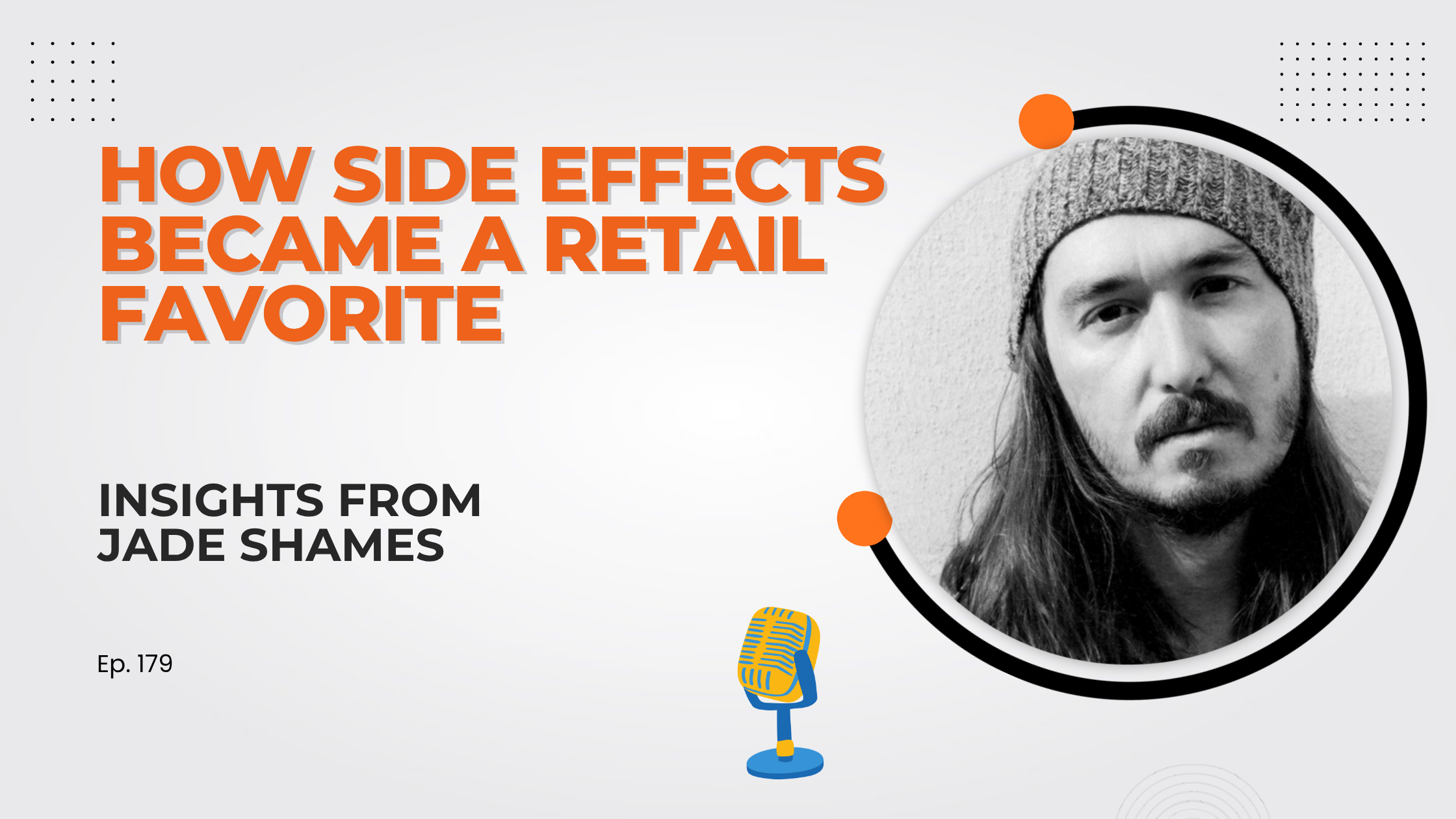
Welcome to this episode of the Toy Business Unboxed Podcast, where we talk with Jade Shames, co-founder of Pillbox Games. Jade takes us back to the very beginning, when a card game about pharmaceuticals and mental disorders started as nothing more than a fun project made on index cards. What began as a hobby with a friend turned into a full time company built on bold design and a clear sense of brand. In this conversation, Jade walks through the journey from that first prototype to running multiple successful Kickstarter campaigns.

#179: The Secret to Side Effects' Retail Success – Toy Business Unboxed
Episode Highlight
- 00:42 Jade’s origin story begins
- 01:17 Starting Pillbox as a hobby
- 02:18 Designing the first game cover
- 04:54 Early Kickstarter lessons learned
- 07:17 How Side Effects is played
- 10:57 Building an authentic brand
- 13:00 Deciding to go full time
- 17:22 Team size and organization challenges
- 19:13 Vision for next two years
- 20:25 Advice for new industry creators
From Index Cards to a Real Card Game
Side Effects started as a personal project for Jade, made on index cards and shared with friends for fun. A friend, Ben Ronstein, saw real potential in the take-that card game and pushed to formalize it into an actual product. Together they refined the rules and found an art style that matched the tone Jade wanted. That early partnership became the foundation for Pillbox Games.
Designing a Box That Belongs on Your Coffee Table
Pillbox Games built its identity around games that people are proud to display, not hide away. The original cover for Side Effects left off the game’s name entirely, favoring a mysterious, eye catching design. Jade expected retailers would ask for a more traditional cover with the title front and center. Instead, distributors and stores asked Pillbox to keep the original design exactly as it was, proving the bold choice was the right one.
Learning the Business Side of Kickstarter
Every Kickstarter campaign brought new challenges for the Pillbox team, and Jade says they simply got better at handling them each time. Early campaigns were run without a full grasp of manufacturing costs, profit margins, or what customers actually wanted. Over time, the team learned to analyze margins closely and build offers that fit both backers and future retail buyers. That growth in understanding is what let Pillbox take on a bigger, more ambitious project like All True Believers.
Building Side Effects Into a Full Game Universe
Side Effects plays as a take-that card game where players treat disorders while dodging side effects passed on by opponents. Since launch, Pillbox has expanded the world with the Booster Shot expansion and the Legal Vice expansion pack, both adding new drugs and disorders to the mix. The team also created Hex Effects, a fantasy version of the same mechanics built for players who wanted something lighter for younger audiences. Each version keeps the same core gameplay while giving fans a different flavor to explore.
Why Word of Mouth Still Drives Pillbox Games
Jade says building a brand that feels authentic to Pillbox is an ongoing process, not a finished project. The team constantly asks what a Pillbox version of any new idea would look like before deciding if it fits. That filter has helped create trust with fans, so people are willing to try new releases even outside their usual preferences. Jade sees that trust as one of the most valuable things the brand has built over time.
Going Full Time After Years as a Side Project
Pillbox Games launched its first Kickstarter in 2017 and 2018, but Jade and Ben did not go full time until roughly two years ago. The shift happened gradually, with slow periods followed by bursts of new ideas and growing attention from the business. As profits increased, the team found they could finally justify paying themselves real salaries. Jade says the decision to go full time was purely financial, since giving up never felt like an option in the first place.
A Bigger, Bolder Kickstarter With All True Believers
Pillbox Games has a new Kickstarter coming this year for All True Believers, a social deduction card drafting game. Jade says the team is bringing more pieces and more production complexity to this release than anything they have made before. They are also continuing to expand both the Side Effects and Hex Effects universes based on ongoing fan requests. Jade admits organization remains a challenge as a small, founder-led team, but says the right systems and support will help them handle the growth ahead.
Advice for Newcomers in the Toy and Game Industry
Jade’s advice for anyone starting out is to look closely at what already exists and find something that genuinely has not been done yet. The goal should be building a game that the creator would buy and champion themselves, not just something they think will sell. Jade believes that authentic taste and enthusiasm come through in the final product and help attract the right fans. Chasing what other people want, instead of trusting your own instincts, rarely leads to the best outcome.
Conclusion
Jade Shames’ journey with Pillbox Games shows what happens when a hobby is treated with real intention over time. From index card prototypes to full retail distribution, the company grew by staying true to its own sense of brand and design. Word of mouth, careful financial planning, and a willingness to try new ideas all played a part in that growth. As Pillbox heads into its next Kickstarter, that same formula of passion plus patience looks set to carry the company forward.
Connect with Jade Shames
If you’re interested in learning more about Pillbox Games or connecting with Jade Shames you can reach out through the following channels:
- Website: Visit Pillbox Games’ official website for the latest news, game updates, and more
- Instagram: Follow Pillbox Games on Instagram for visual updates, game previews, and creative inspiration
- Facebook: Follow Pillbox Games on Facebook for updates, discussions, and behind-the-scenes content.
Transcript
Jason Hsieh (00:42)
Welcome back to another episode of Toy Business Unboxed Podcast. In today’s episode, I’m honored to be joined by Jade, the co-founder of Pillbox Games, from game prototyping made up on index card to creating unique places in marketplace for visually astounding and also soul-provoking games. I think his journey is nothing short of inspiration. So thank you so much for joining us on the podcast today and share your journey within the industry.
Jade Shames (01:09)
Thanks for having me.
Jason Hsieh (01:09)
So I guess looking back, what was the moment that you decided to start like a publishing company and raise a whole bunch of cool games, I guess?
Jade Shames (01:17)
I well, I didn’t really think about it back then when we were starting it. I just like creating things and it was much more of a hobby for me to make games or just other sort of creative projects. And one of the things I made just happened to be this take that card game involving
Pharmaceuticals and mental disorders. And I thought it was really fun and it was kind of interesting. And I made a prototype on index cards, as you mentioned. Yeah. I took it to a party to show a friend of mine who’s much more into games at the time than I was at that time. Okay. And he is a really brilliant illustrator.
And he played it and he said, you know, this could be something. Let’s, you know, let’s try to form a partnership here and actually do this right. So Ben Ronstein was actually really the catalyst for the company in terms of organizing into okay, let’s you know, finalize these rules and let’s figure out if there’s an art styling that works for this game. And then we collaborated very, very easily on making a new prototype that actually
Looked pretty good.
Jason Hsieh (02:18)
And what was that first game that you designed in?
Jade Shames (02:21)
So that was called Side Effects. So that turned into this game here. And you know it’s kind of interesting in terms of marketing about this game. So when we first launched this on Kickstarter, we imagined that this cover would be unique to the Kickstarter edition. Yeah. Because it didn’t have the name of the game on the cover. But we preferred this cover because
We have this ethos in our company that we want all of our games to live proudly on your coffee table. Something like that. Not exactly like that. But that’s sort of the idea that you don’t need to shove away. They look good and they look presentable and they can be, you know, conversation starters if you leave them out. And we just like the idea of just having it more mysterious and not having the name. The name can live on the side, on the top. But when we
Jason Hsieh (03:02)
I see on the side.
Jade Shames (03:06)
Brought it to retail, we found that the distributor that we’re working with and the retail stores said, you know, no, no, no, we really like this. We want you to keep the box exactly at like that. We don’t want sort of a special retail edition where you have the name of the game and you take away the foil and all the sparkly elements. So that was a interesting awakening into what works you know for them in terms of
Our games.
Jason Hsieh (03:30)
I think that design is also very eye-catching on the shelf, you know, compared to other kind of planned looking board game that doesn’t really stand out.
Jade Shames (03:38)
Yeah. Yeah. Yeah. We’re told by hobby shops that it really flies off the shelf because people just kind of look by it and the o the light will catch it in a certain way and they’ll pick it up and you examine it. And I think it once it’s in your hands, I don’t know if this is true or not, but I like to think that if it’s in your hands you have much more likely chance of buying something.
Jason Hsieh (03:57)
Hundred percent. That’s hundred percent true. You want to catch people’s attention so they will pick it up and say, what is this? Then you know, otherwise you don’t even have a chance. That’s like thousands of product on the shelf. Yeah. Did you design that package in like with retail in mind? Or that was just a pure coincidence?
Jade Shames (04:07)
Right, yeah, exactly.
Yeah, so that was really just what we wanted it to look like. Like when we launched the game, it first launched on Kickstarter, and we wanted it to look just like this. We thought that was ideal and then it wasn’t and we anticipated that we would have to change it for retail, but it turned out the retail liked it. But yeah, found that to be really interesting.
Jason Hsieh (04:25)
This was
I can’t.
I see, I see. That’s really cool.
Yeah. And for your Kickstarter journey, can you kind of walk us through some because now you have been doing a few different Kickstarter campaigns, but when you first do your first one, how was that learning curve look like and what are some of the major lessons you learned and some challenges that you experience along the way?
Jade Shames (04:54)
I think there are challenges, there are new challenges every Kickstarter. And they’ve we’ve just been getting better at weathering those challenges. I think in the beginning, you know, we just we weren’t really thinking holistically about the product from its inception, the manufacturing, the profit margin, all the way down to the consumer.
Yeah. I think it we just felt very fortunate to even be able to do a Kickstarter and to have people out there desiring to buy our games in general. As we progressed, I think we’ve just gotten, we’ve refined all of those parts. Okay. So now we are just so much better at analyzing our margins, figuring out what our customers are likely to want, what we could offer them special on Kickstarter.
What we could bring to retail after that. So we’re just refining it and refining and refining it. But we’re also very excited to try new things. Like we have a Kickstarter coming out this year for a new game called All True Believers. And we’re really excited about this game. I think we have we have a lot of knowledge now on how to do a Kickstarter properly and how to bring the right product to the consumer in the easiest way possible.
But we also are making a bigger, more comprehensive game with more pieces, more parts, that’s going to be more expensive to produce. So I think that more challenges will arise, but we’re more excited and more prepared to face them.
Jason Hsieh (06:15)
I see. Do you have a roadmap of how many product are you launching each quarter, each year and with your team?
Jade Shames (06:21)
Yeah, yeah, we we definitely do. And we go over these frequently about what we’re planning on launching so that we could accommodate that and we could have a timeline for the whole year. However, I will say that sometimes just inspiration will strike. And last year it didn’t. We have a new game that’s going to be coming out later this year. I almost don’t even wanna give too much of it away because we’re so excited about it. But we just did not anticipate this game getting
Put into our roadmap at all. But the response has been incredible. As soon as we started doing prototypes, people were really digging it. So we said, you know what, let’s do it. Let’s just like slot it in and dedicate resources to try to fitting this in. And we made it work.
Jason Hsieh (07:01)
Mm-hmm. Mm-hmm. I see. I see. I see. Got it. And I wanna go back to the game that you’re showing our audience earlier. I think a lot of people haven’t seen the game yet for a side effect. Can you kind of have just a quick demo about what a game is, how to play and the game play?
Jade Shames (07:17)
Yeah. So yeah, it’s a it’s basically like a kind of take that card game. You’re dealt a series of disorder cards. So they’ll look like this, like anxiety, and they’ll be face up in front of you. You’ll be dealt four, and we call that the psyche, and then you’ll be dealt a concealed hand of a medley of different cards, and a draw pile will be placed in the center for people to draw from on their turn.
The object of the game is to find the right treatments. So things that will treat anxiety, like this anxiety drug. You would place this on top on your turn if you have it in your hand. And now your anxiety is treated, and then you just have whatever remaining disorders in your psyche left to treat. And if you can treat all of them, you win the game. The problem is that every drug will also contain a list of side Effects, and that means that your opponents on their turn.
Can deal new disorders, provided you’re taking medicine that have that disorder as a side effect and add that to your psyche. So then you have new issues to deal with. And there are really interesting and fun action cards like therapy. Therapy will treat anything, but you could conceivably get it again because therapy will make this card go into the discard pile.
And you can trigger episodes of any untreated disorder with a you’re having an episode card.
Jason Hsieh (08:29)
Okay.
Jade Shames (08:29)
So yeah, it’s really beautifully designed, really fun game, sort of based in reality dealing with drugs and disorders. And we’ve created two expansions for it now. There’s the side Effects booster shot, which adds more disorders and drugs that do different things, like treats two different disorders at once. And then the legal vice expansion pack, which adds things like
Coffee, tobacco, and alcohol that you can play with. And those give you special advantages in the game. So it’s all really based in reality. But we also created, because we have a lot of our friends are wanting to play with their kids, and it’s such a simple game that they just wanted something that they could play with a younger audience. So we created Hex Effects for that purpose. Hex Effects is the same basic.
Game with some new mechanics and some new cards, but based in fantasy. So you play as an alchemist in the 12th century, and the whole premise of the game is that you’re not very good at being an alchemist. So you’ve accidentally given yourself sort of funny and grotesque Hexes that you have to treat with different remedies. And we’ve pulled a lot from different like lore and
Fantasy and fiction. So hexes such as evil ultra ego or whisper worms and piper’s plate things from fantasy folklore and there are different treatments that will treat those things and have side Effects as well so similar game mechanics you can do a few other cool things with Hex Effects that you can’t do with Side Effects
And there are different cards and different possibilities for expansion packs for Hex Effects as well. But all based within the kind of universe that we’re creating. So yeah, we’re planning on expanding both of those as SKUs for different audiences because we find that there’s an audience for each of them. Some people prefer Hex Effects and they like living in that fantasy world, and some people really like side Effects and they want more. We keep getting requests for.
Vicer drugs, things like, you know things like weed and stuff like that. We we’re always getting sort of suggestions for that. And so we’re gonna we’re thinking a lot about that right now.
Jason Hsieh (10:27)
Okay, okay, okay. Hopefully it’s not something illegal.
Jade Shames (10:30)
Yeah, it will definitely will be. But yeah. Yeah. All within the game, within the context.
Jason Hsieh (10:32)
Okay.
Again,
Again, for sure. So yeah, and I want to kind of switch our conversation a little bit about marketing because I think before the interview, you also mentioned to me like word of mouth marketing is definitely very important to you and your business. Can you kind of share some of the strategies that’s working well for your brand as you’re building up more influences, more awareness?
Jade Shames (10:57)
Yeah, I think that trying to create a brand that feels right for us is a constant it’s just an ongoing journey, I think. Yeah. Like we have inspiration for certain games that sometimes we feel are don’t really fit our brand as well.
So sometimes we think, well, how can we make that a pillbox game or what does a pillbox version of that game look like? Yeah. And I think cultivating that has been really fun. Like I don’t think that that’s something that we ever feel like is a limitation, but more of maybe a boundary that has created a game within itself. The game of what is our brand? how do we talk about ourselves? Okay. And
It’s constantly evolving, but it’s always sort of part of what we’re thinking about in terms of building an audience that we can say, Hey, if you buy another pillbox game, even if you’re unsure about it, you know, you know that we’re putting that same level of intention to detail and quality and maybe a little bit of whatever uniqueness we’re bringing to our other games to this new one.
And I think building that trust is really important.
Jason Hsieh (11:55)
Hmm, for sure, for sure, for sure. Yeah. And do you do a lot of in person events and conferences throughout the year as well? Is that kind of part of your like core strategy?
Jade Shames (12:06)
Yeah, I mean we try, you know, I really like going to conventions. We try to do it as much as we can, and make sure that we’re doing the right ones, where we can be profitable at the end of the day. And yeah, and we can also bring something to that event that we feel like is, you know, makes it worthy for our fans to come out and see us at that particular event. So yeah, but I always have a blast and I love meeting people at conventions.
Jason Hsieh (12:29)
I see. And the other question I like to ask is because a lot of people I met in the industry over the year and I have been in the industry since 2016 So this year is actually going to be a decade for me in the industry. Yeah. It has been a very long journey. But a lot of us, myself included, started part time. Like I was doing it part time for like six years before I go full time full time. What of what was your journey look like? Did you just go like full force and go full time on day one? Or
That’s also like a traditional process for you.
Jade Shames (13:00)
No, no, no. I very much relate to your experience. This was a hobby, and it was a fun thing to do for a while. Yeah. That isn’t to say that we didn’t take it seriously. We definitely took it very seriously. Part of the fun was taking it seriously and seeing if it was possible to grow this into something that could be profitable enough that we could all quit our jobs. Okay. I just was lucky enough that.
It did happen that way. And after many years of doing this and expanding into, you know, new markets and getting picked up by new retailers. Okay. We eventually started saying, Hey, okay, the finances are working out and you know, it would be okay if we started taking proper salaries and doing this full time. So I feel incredibly fortunate to be able to do something like that.
Jason Hsieh (13:43)
How long does that take you?
Jade Shames (13:44)
I guess we really started doing that about two years ago. So our first Kickstarter was in 2017, 2018. Yeah. So yeah, it was a long time of just kind of doing this as a hobby. Although I will say there was a kind of gradual slope. So
Yeah. We focused on it and then we would kind of like let it coast for a little while and then we’d say, Hey, we got an idea. Let’s try this idea. Let’s try that idea. And as it became more profitable, the ideas came more swiftly and the attention that the company required, you know, grew. And you know, so eventually it did kind of just make sense. Like we’re at this level now. I think we can do this.
Jason Hsieh (14:22)
Hmm, I see, I see, I see. I think I mean, also based on my own personal experience, this is not a type of business that is a get rich quick type of business. You take a very long time to even break even and finally become profitable. So you definitely need to have a lot of passion and interest about the product and the customer that you’re serving. Otherwise, a lot of people I met, they will just give up after years. This is doesn’t make sense. I’m not making any money. I spend all these hours designing stuff.
Making prototype, doing playtesting, but it’s just not paying the bill. But if you have the passion and if you don’t give up, I believe that’s always a role, like at the end of the light at the end of the tunnel, to make it a full time and a successful business in the long run. So I think that’s very important. But looking back at your own personal journey, is there any particular decision that you make early on that really significantly help you in your journey of you know going from part-time to full time?
Jade Shames (15:17)
I don’t know if there was a significant decision aside from just seeing the numbers, yeah, realizing that it was a possibility, yeah, and that I could be joined by my co-founder in that journey of going full-time. And then going over all the possible pitfalls and and just kind of figuring all that stuff out and saying.
Okay, let’s just try it out. Let’s do it and see what happens. And then, you know, and we had some thoughts like, okay, well, you know, we could take freelance work here and there, and we could do this and you know that, and we can kind of make this work and yeah, and I think it’s just been really fortunate to have this opportunity. But I don’t know if there was like one decision that I just said, okay, that’s it.
Jason Hsieh (15:59)
Yeah.
Jade Shames (15:59)
It just felt right at the time. It just felt like it made more sense. But I think going back to what you were saying earlier, like it’s you know, about you know, giving up because it’s not being profitable or I don’t know if there was ever really a time when we thought about giving up though. I think that’s the thing. It’s like the decision to go full time was very much a financial one.
Jason Hsieh (16:11)
Yeah.
Jade Shames (16:21)
Sure. But the decision to give up didn’t really exist.
Jason Hsieh (16:24)
Okay. So that’s a good mindset. Yeah.
Jade Shames (16:27)
It’s not because we were following some sort of like golden egg at the end of this journey, right? Like it was because the whole thing was fun along the way. Right. Yeah. So, you know, it’s not a it’s not a chore to play test to get together with friends and say, Hey, let’s have a few beers and try out this new game. That’s like what I would be doing anyway.
Jason Hsieh (16:37)
Enjoy the process, yes. Right.
Yeah,
Okay. Yes.
Jade Shames (16:53)
I think that’s a great life lesson to be honest. I think that you know, whatever you want to do in life, you really try to anchor it on the thing that you would be doing anyway.
Jason Hsieh (17:01)
Mm mm. Yeah, I think it’s very, very important to enjoy the process of and I think the outcome will follow if you put in enough time and energy and also passion into for sure. Yeah. So but thank you so much for sharing that and the journey with us as well. That’s very interesting as well. I’m just wondering how big is the team currently with the company now.
Jade Shames (17:22)
Well, right now full time it’s just myself and my co-founder Ben. And then we have a bunch of freelance people who work around us. And we have two other investors that are acting as like consultants that will come and give influence and help out at conventions and this, that and the other thing.
Jason Hsieh (17:27)
Okay.
Hmm, I see. Okay. Thank you so much for sharing that. Because I met a lot of people that’s just like just one person, like a solo, solo situation. And I was a one person team for like the first couple of years as well before we slowly scaled. Right now we have like twenty-two full-time staff now, but that was after many, many years of you know working on the business days in and days out. So but what would you say is some of the challenges for you balancing
Everything with you know you and your co-founder with marketing, operation, design, you know, logistics, distributors, all everything that’s going on all at the same time.
Jade Shames (18:17)
Yeah. I would say the challenge is organization. Okay. I think that’s the biggest challenge. Yeah. I think that like we talk about this a lot about what kind of new skill could we bring to the team. And I just think we both come from sort of an artistic background. Yeah. And so someone who could come in that is a little bit more analytical and help really just organize workflow and things like that, I think
Would be welcome to the team at this point. But we get by. I mean, it’s not so dire that it’s been hurting us. But I do think that I don’t know, it’s like one of those things, like you just you kind of need the right brain, left brain, whatever it is. You know, you sort of need two sides of that you know, that spectrum of skill sets for somebody to kind of, you know,
Be the anchor to creativity and balance each other out in that way. So I’d say that is a challenge that we deal with sometimes.
Jason Hsieh (19:06)
Yeah, but looking ahead here in the next year and next two years, what are some of your goal and vision for the company looking moving forward?
Jade Shames (19:13)
I would love it if we just continued to grow and produced more games. And also at the same time helped our existing games with expansions, new ideas to those games. So just kind of growing everything slowly. I also just love the opportunity to try something new out. And I think that our fans have been
Really great in accommodating that. And I would love it if we continue to have that relationship. Okay. Where if you know, if we say, you know, let’s try a trivia game, you know, our fan base could be like, okay, I’m not that into trivia games, but I trust you and I trust that whatever you’re gonna do, it’ll be fun because you’re doing it. I would love that would be a dream relationship. That kind of trust that I would love to build with our with fan base.
Jason Hsieh (19:57)
Hm, I see, I see. Yeah, that’s definitely very important for the company and also continue engaging with the community that you have been working in so hard on building up and really enjoy and follow your games and your journey as well. So
Jade Shames (20:10)
Yeah.
Jason Hsieh (20:10)
And as we’re kind of wrapping up today’s interview, thank you again for sharing some of your advice and your journey and lesson you learn learned along the way. If you have to share just one piece of advice with someone else that’s just getting started within the toys and game industry, what would that be?
Jade Shames (20:25)
I would say look at what else is out there and see if there’s anything new you can bring to the table. And then if you could develop something that you feel like really truly hasn’t been done, and you enjoy the process of doing it and you really like the game for yourself, that this is also a game that you would definitely buy.
A hundred percent. You would buy the expansions even. You would you would be a fan of this game. I’d say that’s really the North Star. Do that thing. Every time we’re sort of waffling about what we want to do with our games, we just come back to well, what do we want? You know, it’s chasing what you think others are going to want doesn’t always yield the best results, in my opinion. So that would be my advice. You really got to
Jason Hsieh (21:07)
Yeah.
Jade Shames (21:09)
Be a fan and have some taste and follow, you know, what you think you would buy, you would be a fan of. You have to have faith that there are other people like you and that there are other people that are gonna be like you and be fans like you are.
Jason Hsieh (21:20)
For sure, because just take your own game as an example. We have a very unique knit like twist to the gameplay and now I at least I haven’t seen any other game using the same kind of a universe and the same setup.
Jade Shames (21:32)
Thanks. Yeah. Yeah. No, this would be a game that I mean, especially Jade in high school, I would be just buying the hell out of this thing. So I I knew that this was something that I wanted to develop. And it’s been fun to also bring that same energy to other types of games. Like we have a party game that is more about asking questions to the group that it’s called Perfect Stranger. And it’s been fun to say, okay, well, how do we do a party game?
And you know, with the new Kickstarter that’s coming out, All True Believers, is really sort of a social deduction card drafting game. And it’s what how do we do that? How what would we want out of that genre? You know, and that’s been really fun to explore.
Jason Hsieh (22:08)
Hmm, for sure, for sure. So for our audience that really love your journey and your story and would love to check out your product more, where is the best place for them to find you online?
Jade Shames (22:18)
Well, you can go to pillboxgames.com. You can sign up for our mailing list there. You could also follow us on Instagram. We’re probably the most active on Instagram. So that’s just @pillboxgames. Okay. Yeah, those places would be excellent.
Jason Hsieh (22:32)
Mm, I see. Okay. I’ll make sure I put that in the show note. And thank you again for your time and sharing your story and your journey with our audience today.
Jade Shames (22:40)
Of course. Thanks for having me.
Jason Hsieh (22:41)
And thank you for our audience for tuning in to this episode of Toy Business Unboxed Podcast. I hope today’s conversation gives you some practical insight and fresh inspiration for growing your own Toys or Game brands. This podcast is proudly brought to you by Toy Launch, a leading marketing and growth partner for Toys and Game Company. At Toy Launch we help brand scale on Amazon and beyond through full service account management, advertising, SEO, creative, catalog optimization, influencer marketing, and more.
If you’re looking for a proven team that understands both the toys and game industry and inside out and digital marketing, we are here to help. If you’d like a personalized breakdown of your brand opportunities and your best next step, you can schedule a free consultation session with us. Just visit toy-launch.com/schedule. If you want to connect with other toys and game founders, join our free community, Toy and Game Launchpad. You can find it on Facebook or you can visit toy-launch.com/group to find out more information.
For more resource, update, and industry insight, visit us at anytime at toy-launch.com. Until next time, keep innovating, keep creating, keep bringing joys through toys. This is Jason Hsieh signing off on the Toy Business Unboxed Podcast. We’ll see you in the next episode. Thank you so much, everyone.
Grow your toy brand’s content reach
From SEO blog content to influencer outreach — we handle the full content engine for toy and game brands.