
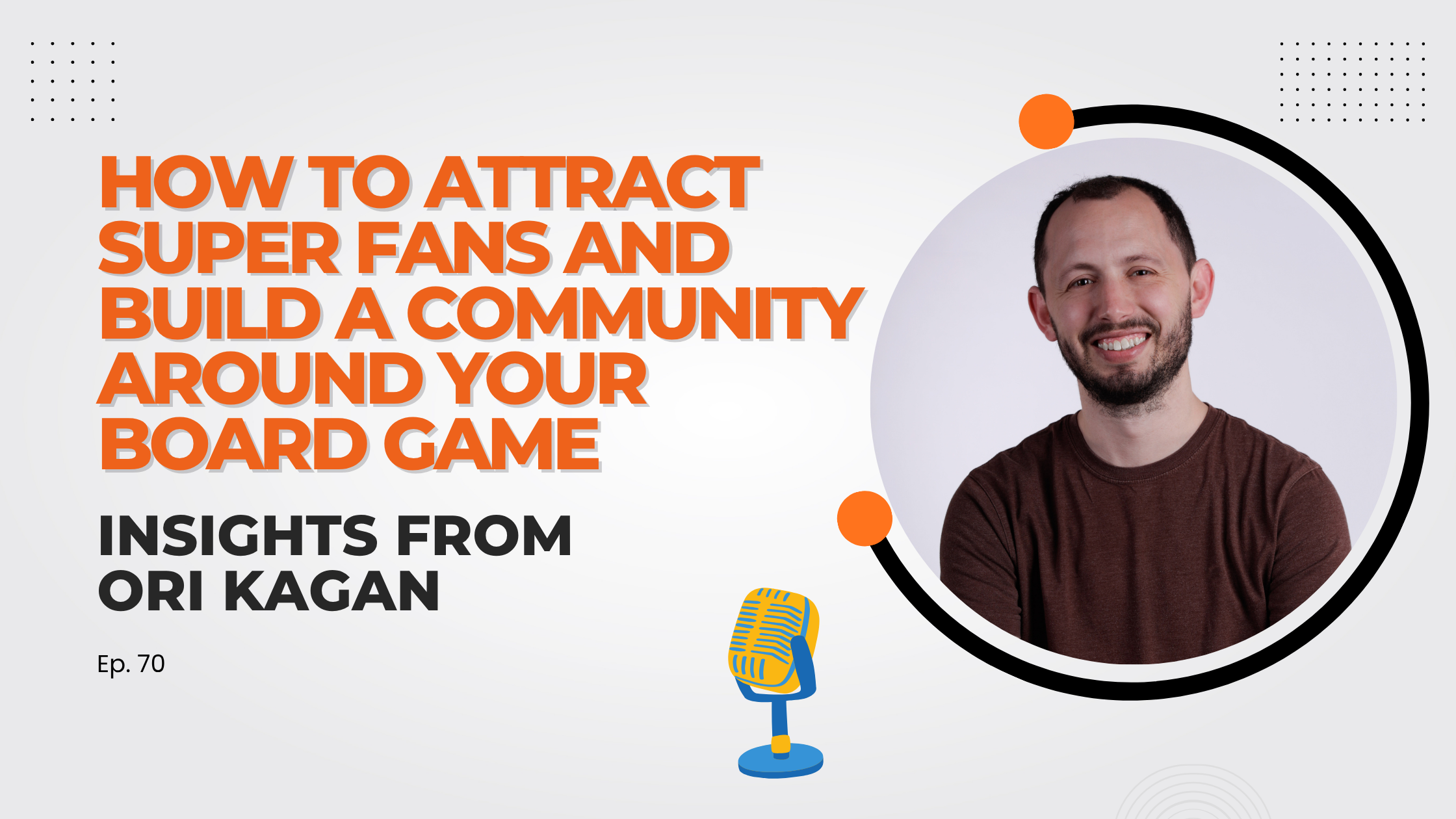
Welcome to another insightful look into the world of the toy and game industry. In this episode, we took a deep dive into the art and science of crowdfunding success for board games with Ori Kagan, the mastermind behind Kagan Productions. We welcomed Ori, often known as the Kickstarter video guy, to share his journey and wisdom.
Episode Highlight
- 0:00 Welcome to Toy Business Unboxed
- 00:42 Meet Ori: The Kickstarter Video Guy
- 01:15 Ori’s Journey to Kagan Productions
- 03:31 The Power of Storytelling in Campaigns
- 08:35 Understanding Your Super Fan
- 15:21 The Importance of Pre-Launch
- 17:55 Kagan Academy: Training Future Creators
- 19:48 Common Mistakes and Final Advice
- 23:12 Conclusion and Farewell
The Journey Begins: From Hobby to Passion
Ori Kagan’s story is one of passion evolving into a thriving business. He reminisces about his early days of filming fan-made Star Wars videos in his backyard and his love for board games, which came full circle when he realized the film industry wasn’t for him. His pivot into creating videos for Kickstarter campaigns was fueled by a pure love for storytelling and creating.
The Power of Storytelling in Campaigns
Ori’s unique approach to video production isn’t just about the visuals. Instead, it’s built around crafting stories that convey the true essence of board games. He emphasizes understanding what makes each game special and the storytelling elements that resonate with the core audience. By identifying these elements, Ori’s videos often serve as the key to successful campaigns.
Jason and Ori delve into how storytelling isn’t just marketing; it’s about sharing a part of yourself, much like recommending a movie you love. Ori’s method involves creating a persona for the product and identifying the ‘super fan,’ those individuals who are almost predestined to buy the product once they discover it.
A Case Study in Success
An illuminating example from Ori’s repertoire is the campaign for the board games Botany and LaFleur. By targeting the super fan persona they crafted named Mary, who embodies an appreciation for beauty and elegance and a love for Victorian-themed aesthetics, the campaign exceeded expectations. Their approach turned a hopeful target into an astounding triumph, amassing over a million dollars.
The Crucial Role of Pre-launch Strategies
One standout piece of advice from Ori is the importance of vigorous pre-launch efforts. Building a community and nurturing your audience before the actual product launch is pivotal in crowdfunding success. This preparatory phase lays a strong foundation, ensuring that once the campaign starts, success is only a matter of scale.
Tools of the Trade: Health Checks and Academies
For those gearing up to launch their campaigns, Ori offers tools such as the Kickstarter Health Check scorecard. This tool is crucial for creators to evaluate their readiness by focusing on community building, marketing, and understanding their goals. Moreover, Ori’s Kagan Academy aims to train creators in storytelling frameworks to guide them confidently toward their launch.
Final Words of Wisdom
As the conversation draws to a close, Ori and Jason discuss the vital need for creators to know their end goal. Whether it’s a revenue target or a product portfolio, having a clear vision allows for strategic planning and success.
Conclusion
Ori’s expertise in building communities and the importance of pre-launch strategies offer a blueprint for creators aiming to make their mark in the industry. As you embark on your creative ventures, keep Ori’s insights in mind: focus on your super fans, tell compelling stories, and lay a strong foundation before your launch.
To stay updated with the latest episodes of Toy Business Unboxed and embark on your own journey into the toy business, don’t forget to subscribe and follow the podcast. If you found this episode insightful, please leave a rating and review, and share the podcast with fellow toy enthusiasts. Let’s embrace the world of toys together, staying curious and continuing to innovate.
Guest Contact Information
If you’re interested in learning more about Ori Kagan and Kagan Productions, you can reach out through the following channels:
- Website: Kagan Productions
- Socials:
- Instagram: @kaganproductions
- TikTok: @kaganproductions
Transcript
EP070_04-25-25_Ori Kagan
Intro: [00:00:00] Welcome to Toy Business Unboxed, your gateway to the secrets of the toy industry. Here, Jason Hsieh, a toy entrepreneur and expert in the field. “Every product we develop is really inspired by some of the real life experience that we have with our son.” “60 percent of all toys last year were sold on Amazon.”
“Be passionate about it. Because it’s a road. It’s a journey.” “Like when you have an idea that you think is gonna somewhat change the world, make things better, I’d say go for it.“
Jason Hsieh: Welcome back to another episode of Toy Business Unbox, where we bring you the story behind the place. In today’s episode, we’re joined by Ori, also known as the Kickstarter video guy. And Ori is a founder of Kagan Production, a studio responsible for helping board game campaigns raise over $27 million on the [00:01:00] Kickstarter platform.
What make his work stand out is the story. He really believed the power of storytelling and understanding the true fan or your super fan is a secret of building successful campaigns. Thank you so much for joining us on the podcast today.
Ori Kagan: Thank you so much, jason,
Jason Hsieh: I want to first start off just diving into your background story a little bit. What were you doing before you started the studio and what lead you to starting the studio in the first place?
Ori Kagan: I always love going back to this. It’s like reminiscing on the beginning of this journey because this is definitely not a planned to journey. I never saw myself as a business owner. I was just like a little, geek playing with his plastic lightsabers in his backyard and making fan films for star Wars, and I’ve always loved playing board games. That’s part of my life. And I wanted to become a filmmaker. That was my original inspiration. And it’s only when I got exposed to the reality of today’s industry. I’m from Israel, so the film industry isn’t very big and it’s very competitive and cutthroat. And I realized that’s just [00:02:00] not for me.
So long story short, after going through a lot of different jobs of, just being an editor or an after effect artist, and I realized, being inside of a system is just not for me. There’s toxic bosses, there’s a grinding, no satisfaction . The purity of creating beautiful art and telling stories was just gone from there. I quit my job and I started making my own business, my own videos. And eventually I decided, board games are usually funded on Kickstarter and crowdfunding platforms.
Jason Hsieh: Yeah.
Ori Kagan: And crowdfunding platforms famously always need videos. Maybe there’s something there I can do. So it started with just one client finding someone on Facebook that needed a video, putting my 200% into it. Because honestly, I was having fun. This is not like a corporate video. This is not an explainer video. This is Greek Gods firing lightning and, lasers and robots. This is the stuff I grew up with.
Jason Hsieh: I see.
Ori Kagan: And they loved it. That led to another one [00:03:00] and another, and word of mouth was the only type of marketing I needed because the tabletop niche is I don’t know if small is the right word, but tight. It feels like everybody knows everybody. At the moment, you put your name on the map somewhere people will just come and the good faith just keeps coming around. That’s where I decided to build my own brand. That’s where Kagan Productions came from. And I completely dedicated myself to board games since that day. And it honestly doesn’t feel like work anymore.
Jason Hsieh: I see. Thank you for sharing that story. And I know storytelling is also very critical to your process when you’re working with a client with a video production. Can you talk a little bit about your process when you come to creating the story for the board games?
Ori Kagan: Absolutely. So I guess I need to tell this story first for, in order to understand how I even got to this idea because I got hired many times to make a video for a campaign. Most of the times the campaigns were successful and then I felt validation. The video is actually helping, sometimes the campaigns failed, [00:04:00] and I was very frustrated. Thankfully, I was never blamed. It always seemed to be something else, and I decided that if I am going to get paid to make a video, the video should be the outcome. The outcome should be a successful campaign. And I dove into a whole journey to discover what makes campaigns actually work, and how does that coexist with my videos with my trailers. And I dove into a marketing, into branding a lot of brand strategy I’ve studied and then I’ve discovered the whole realm of storytelling marketing. Which is, it’s a whole new. You tell someone from a marketing firm do you do storytelling? And you ask that to three different people, each one of them will have a different reply.
Jason Hsieh: Yeah.
Ori Kagan: And I think that’s a clue to the power of storytelling. There is something in stories, which is survivalistic in a way because we grew up with stories ever since we were like children. We were told stories too. If you go back in history, there was always the [00:05:00] storyteller, this was a job that some people had to tell stories to the tribe around the fire. stories basically help us reaffirm our lives of what is right and what is wrong. What is something we can connect to without, we could hear stories about danger without actually experiencing real danger. And it sets us up for the real world. Then I looked back, what is actually happening when you’re marketing something. When you’re marketing something, you’re essentially telling a story about what will the future look like once you buy this product. But in a way that it’s it takes away the saleseness us out of marketing because one of the number one problem that most of my clients come up with is that they hate selling, they hate marketing. They work so hard on creating these wonderful games and the feeling to that they need to now shove it down people’s throat and they’ll people oh, play my buy my game.
They usually say, trust me. I’ve played this game so many times. Every person I played it with immediately fell in love. If they would just understand how great it [00:06:00] is, they would buy it. And that’s the problem. That is the gap where so many people fail to sell their products because they haven’t actually conveyed the true experience of playing this game.
Jason Hsieh: Yeah.
Ori Kagan: Because they don’t have the tools, and that’s where storytelling comes in.
Jason Hsieh: Yeah. I think that’s a very, also, you mentioned a very common gap because people doesn’t want to sell or they don’t enjoy selling. But if you look at it from a different perspective, if you’re just sharing your story, that you feel very passionate about, you’re not really selling, exactly. You’re just sharing a product or sharing the services with your friend. Like you watch a wonderful movie that you just, watch you, you naturally wanna share that with your friend. I’ve seen that also related to like the mindset when it come to selling, if you are really doing it correctly, you won’t feel like you’re selling anymore. You are just sharing the service or the product, or the board game that you truly believe in. At least that’s from my perspective.
Ori Kagan: Absolutely. That, that last part was important because you have to believe in your [00:07:00] product. And I’ve never met, and I’ve worked with many clients, I think over 300 clients we’ve worked with so far. I’ve never met a client that is not in love with their own product, that is not passionate, especially in the board game industry. There’s such a pure part of it where it starts from pure passion. And sometimes along the way you forget about it because it’s, now you need to market it, now you need to sell it. So my goal is to bring that back. Bring back that pure passion that you had when creating this product. And again, through storytelling, you’re conveying that, you’re conveying why this game is truly special and it will literally transform your life. And I’m not kidding about this. I think board games have life-changing, transformative properties to them that I, my life has been completely, I can thank my marriage thanks to board games. It’s, I connected to my wife. I even remember it. I, there was like a, small convention next to our house and we were dating back then, and it was like, it was a we, were [00:08:00] getting it on, but nothing really clicked yet.
Jason Hsieh: Yeah.
Ori Kagan: And I just took a leap of faith because I’m like, it’s so geeky, it’s so weird. But okay, come on with me. And we went to that convention and we sat down around a table and we were looking for a game to play. And this guy came to us and he introduced us to a game. And we both played it and we played it again and immediately after the convention, she said, let’s order that game so we can continue playing. It just came out of there. And we still play these games until today, every day, every with my kids. And it’s something that is foundational for our family.
Jason Hsieh: Yeah. Thank you for sharing that. That’s a very unique story for sure.
And based on your experience, how is the storytelling approach different when you’re marketing a board game versus any other product?
Ori Kagan: So how different is this from a board game? let me explain exactly how my method works very briefly. Because we can’t dive into all the all the tiny little details. It’s simple. It’s a simple formula, but it’s actually very hard to implement. So the formula is easy. You [00:09:00] figure out what is special about your game. Yeah, it’s simpler. no dive deep. What is truly, list all the things that you love about your product and I’m gonna put toys under this umbrella because I think this can be done for every single product that people are passionate about or any product.
What are some people call them KPIs. I don’t like acronyms. I love let’s live in the realms of stories. What excites you? What are moments that are always memorable after you finish playing the game? What are things that you’ve seen that cause delight every time you’ve tested the game or shown it around. And just list as many of these as you can. And slowly, like a sort of persona would emerge of your product, you’re essentially humanizing your product and then you can try to figure out their personality. So is the game more, playful or more serious? Where are you on that scale? Is it more casual or more for hardcore players? It’s like that, it’s a very niche thing. Is it classic meaning it’s pretty much [00:10:00] something that is very familiar just with a different twist. Or is completely innovative. This is something you’ve never seen before. And once you have that affirmed, you’re like, okay, this is my game. This the person that my game is.
Now we’re gonna look at what I call the super fan. And the definition of the super fan is, literally the lowest hanging fruit. It’s that person. The game was truly made for, meaning the only abstraction from him to actually buy it is him knowing, him or her, is them knowing about the game. They only need to know about it and understand it, and then they go into shut up and take my money.
Jason Hsieh: Okay.
Ori Kagan: We don’t wanna try to sell to people that we need to convince. That’s an uphill battle, and that’s a waste of our time and energy and money. We want to sell to the people that are waiting for this. And the good news is so a lot of people ask me how do I know who that is? You are your own super fan. You cannot bring this game into this point without still being a fan of it. So that’s one side of the [00:11:00] equation. So a lot of this you’re banging on basing on your own experience.
The other side is games inherently have to be play tested. You have to play them, and games are special because they are their only form of entertainment, which can be fully experienced by your test group. Movies, you can only show maybe a trailer or test screenings, video games you only have like very rough versions and you need to keep saying, don’t worry, it’ll look better. It will look better at the end games, essentially you’re, giving them the final experience.
Jason Hsieh: Yeah.
Ori Kagan: And everyone has this moment in their play testing. I ask them, have you had this experience where you play test the game and the person in front of You It’s silent for a few seconds and then they go, can I buy this now? Where can I get this? I need this in my life. Yeah. And a hundred percent of the time everyone says, yes, I’ve had this experience. I’m like, great. That is a super fan.
And using these clues we construct. Again, a persona, a human person. Not only we constructing, [00:12:00] but we give them a name. We give them a personality. We figure out how their house looks like. We take an imaginary tour around their house. What is on their shelf? What movies do they like, what games do they play? Who do they play with? What are their spending habits? How much do they research before they buy a product? And then we dive into what is their core needs, their challenges, frustrations, all of that till we have an actual human. And it’s so interesting at a certain point, you know how some authors will say that at a certain point their characters start speaking for themselves. And I say, I wrote the scene for my character, but the character did something else than I expected them to. A lot of fantasy authors, they say that, or authors in general, the super fan will also start doing that.
I can give an example for these two games behind me. They’re botany and LaFleur. So this is a wonderful publisher named Dux Somnium and when we try to figure out who their super fan is, we came up with a persona of Mary. Mary loves pretty things beyond all oils. [00:13:00] She loves having pretty, she’s very tidy. She has a very nice and organized house. She might be into flowers maybe she has a garden. Her guilty pleasure is Victorian era TV show, like Downtown Abbey and Bridgeton. And she loves hosting. Not only she loves hosting, she loves wowing her guests. And then we understood that once we understood this, we knew that this is the game she’s been waiting for. Because having this on her shelf taking it down and presenting this beautiful game about collecting flowers in Victorian era times is literally the things she’s been waiting for.
The moment they implemented that strategy of targeting this super fan of putting on ads Bridgeton as an audience, botany, looking for botany influencers. Their leads spiked their campaign. They hoped for a hundred k by the end of the campaign. They had that within a few hours and it just continued going up and up, and they finished over a million dollars.
Jason Hsieh: Oh, wow. Nice. Okay.
Ori Kagan: It was just instantaneous. Okay, so now [00:14:00] reeling it back, we have, remember stage one, we have the product, the human product. Stage two, we have the super fan. And now we’re gonna come and bridge them together. We’re gonna find out exactly what about our product is special for our super fan. And our goal is to lead them through a journey of getting to know our product. And this is where the magic happens, because suddenly people suddenly realize, oh, I need to start talking about this, and then about this selling point, and then about this. And we’re leading them through basically a story. I call it the story of how do we talk about our game to attract only that one person? And then another magical thing happens. The super fans are getting attracted to this product. They’re signing up, they’re backing. And other people are starting to get attracted to it, even if they’re not super fans. Even if the, what I call casual fans, they’re like what is all the FUS about? Why is everyone so excited? And now they also wanna sit by the fire, they also wanna hear this story. And eventually they convert to becoming super [00:15:00] fans. But we, as a publisher, we don’t need to make the effort on attracting everyone. Anyone who would say this game is for everybody. That means the game is for nobody. You just focus on the super fan and the crowd will come.
Jason Hsieh: I see. And I noticed if you can change your mic setting it was a little bit more clear if you can switch,
Ori Kagan: is that better?
Jason Hsieh: Yeah, that’s much better. Thank you. Thank you so much.
So based on your experience working with so many different working company with their crowd funding campaign, what are the most successful one have in common?
Ori Kagan: So this, I’m gonna narrow in into crowdfunding, but I think this is still true about any product that is released in any way. And it’s letting go of the notion. Once it’ll be out there, people will come. Okay. Putting all the effort into the actual launch is only the tip of a pyramid where underneath it you need to have a foundation of a pre-launch. And that is where most of your work and, I would say spending your time rather than money. Okay. Because you have [00:16:00] two currencies. You have time and you have money. So you need to spend most of your time and your prelaunch and gathering that crowd, getting to know them, get letting them know you, spreading yourself across. I call it like a marketing ecosystem. So you have your landing page, you have your social media. You have your content and all of these points of engagements where people can find you. You appear on podcasts, you appear through influencers. You appear in conventions where people can literally interact with you. And you’re slowly growing that community. And publishers who spend a lot of time and effort on doing those steps will almost guaranteed to be successful. The question won’t be, will they succeed? Usually the question is by how far will they succeed?
Jason Hsieh: Yeah. And I think on your website you also offer a free tool for a Kickstarter Health Check score card. Can you also walk through like the benefit of using that tool?
Ori Kagan: Absolutely. So I realized there’s just so [00:17:00] much that people don’t know. And sometimes it’s hard to sometimes I would have a sales call with a new client and I realized they need a lot of info to know which way to go. And I cannot. It just, there’s so much to know. I wanted to create a tool that would curate exactly what you need to do right now in order to improve your chances of succeeding in crowdfunding.
So the scorecard will ask you roughly 30 questions, 20 or 30 questions, and those answers will inform how ready you are to launch. And it narrows down on community building, on marketing, on building trust value of knowing your own goals. Which I think is very important. We might talk about in a moment.
But it gives you a score, a clear score, so you can do it again like a month later or two months later and see if you’ve improved your score and it’ll give you a report card telling you exactly what you need to do.
Jason Hsieh: Okay. Okay. We’ll also make sure we include that in the show notes as well.
And I know you are also working on like a training program as well. Can you also talk about the mission or the story behind the training program? [00:18:00]
Ori Kagan: Absolutely. So I love making videos that’s my bread and butter, but I realized I wanted to find more ways to help people in this industry, I just love this industry. I wanna help it as much as I can. And I decided, what if I built an academy in a way where I will teach to multiple people at the same time, this storytelling framework, and watch them guide them as they go through it. Up until their launch, no videos involved. I can help with the video if they want, but the point is for them to de-risk their campaign and follow the framework, so they’re pretty much guaranteed to launch. I’m happy to say that our first member we’ll launch next week and I’m really excited for it.
The game is called FU. And it’s about Chinese New Year celebrating Chinese New Year. And that’s launch next week. It’s, I think it’s gonna be pretty successful. It has, they followed it to a T so we’ll see. The program is called the Kagan Academy because with me for some reason, everything is involved with ducks. And we’re launching our next [00:19:00] round this September.
Jason Hsieh: So how does it work? So you have different, so everyone start at the same time in the academy or?
Ori Kagan: Yeah, so it’s a three month process where we do weekly sessions of either workshops or live group coaching. We do have a few one-on-ones, and then we have an ongoing community. Which we’ll share goals, weekly goals, weekly wins. If there’s any questions, then I’m there to answer. The goal is for you to not be alone because so many people are just doing this alone, and it’s hard, it’s terrifying, and there’s so much uncertainty. And I wanna just take a little bit out of that.
Jason Hsieh: Oh, thank you for doing that for the community as well.
Based on your experience, what are some of the common mistake the creator make when they are launching like a brand new campaign and how can they fix that?
Ori Kagan: So one that a lot of people are discussing now with the tariff situation and everything. It seems that a lot of people seem to launch without planning out to build a [00:20:00] business. they’re only thinking on their product. And sometimes they don’t realize that they’re not essentially just kick-starting a product. They’re kick-starting a business. And that framework completely changes how you do things. And they need to look it’s, I’m not a numbers guy, but you have to do the numbers. You have to figure out your margins. You have to figure out your target goal, you need to talk to a few manufacturers. All of that stuff it sounds for a lot of people, sounds boring and tough, but it’s something that if you don’t do very early on even when you’re play testing the game and you don’t know if it’s final, get those manufacturing quotes.
Jason Hsieh: Yeah.
Ori Kagan: Talk to those influencers early. Get to know them. Don’t wait. And don’t wait to talk about your game. A lot of creators are waiting till everything looks amazing and they have all their art done, and they will only talk about their game for the first time like a month before launch. No. The moment you have only, you need only one asset, the cover of your [00:21:00] box. Once you have the cover, you start pushing that everywhere. Talk about it because people aren’t gonna get sick of it. People are actually gonna be interested, and you’re gonna find people that don’t care will just scroll away.
People that do care we’re gonna thank you for you’re exposing them once, twice, three, four times. Then they give you their email and then they become super fans and then they start getting interacting and then they start attracting other people that you gotta start that early.
Jason Hsieh: Yeah. Thank you for sharing that tip. Yeah, that’s definitely very important to start talking about your product, getting your name and the product out there. It’ll take a few months to really get some traction before the launch.
Ori Kagan: And one more thing about that, the important thing about doing that is not only to let things out, it’s also to learn things back. Okay. Getting feedback early on from your super fans and learning already what do they actually want? Honing in about exactly who that super fan is, figuring out mistakes. Do that, mistakes early Okay. Before they become [00:22:00] expensive mistakes. it’s a conversation.
Jason Hsieh: For sure. For sure. Thank you so much for sharing that. So as we’re toward the end of today’s in interview, if you have to share just one piece of advice with someone that’s getting started within the board game industry what would that be?
Ori Kagan: So again, bringing it back to a story, A lot of people will sometimes decide they just want to go on a journey and see where the story takes them. And usually when you wanna tell a good story, if you don’t know your ending, you would feel lost and your listeners will feel lost. When it comes to starting your board game company, know what the final outcome for you is. What does success mean to you? What would be the thing that you would be celebrating one year from now, three years, five years, 10 years? ‘ cause the moment you know where you’re heading to, it’s so much easier to plan your way there. And you can dream big. You can go for some audacious goal. You could say, I want 1 million in revenue next year, or I want to be release already five [00:23:00] games within three years.
You can dream big because that gives you the measuring stick where it can start going towards that and really following that dream.
Jason Hsieh: Yeah. That’s definitely a very important thing to do when you first get started. And for those of the listeners that want to learn more about you and your company, where is the best place for people to find you online?
Ori Kagan: A good place to start would be the website, kaganproductions.com. Through there you can learn more about the academy and find the scorecard and everything is there. If you’re interested in more of the content I released, then you can follow me either on Instagram or TikTok again at Kagan Productions on both. And I release content regularly where I talk about this stuff ’cause I love games.
Jason Hsieh: Thank you again so much for your time today to share some of your knowledge, your experience, and your expertise within the toys and game industry. I think it has been a very valuable lesson for a lot of our listener today as well.
Ori Kagan: Thank you for inviting me. This was a blast.
Jason Hsieh: And thank you for our listener for tuning into this episode of Toy Business Unbox podcast. We [00:24:00] hope you enjoy the conversation and find it insightful and inspiring. If you like what you have heard, be sure to subscribe to our podcast on your favorite platform, but you never miss episode.
We really appreciate your support and would love it if you can leave us a review and share the podcast with your friend and colleague. For more resource tips and the latest update, we the Toys End game industry. Visit our website at toy-launch.com. Join the conversation and connect with us on social media using hashtag #ToyBusinessUnboxed.
We’ll love to hear your feedback and suggestion for future episode. Until next time, keep innovating. Keep creating, keep bringing joys to toys. This is Jason Hsieh, signing off on the Toy Business Unbox podcast. We’ll see you in the next episode.