
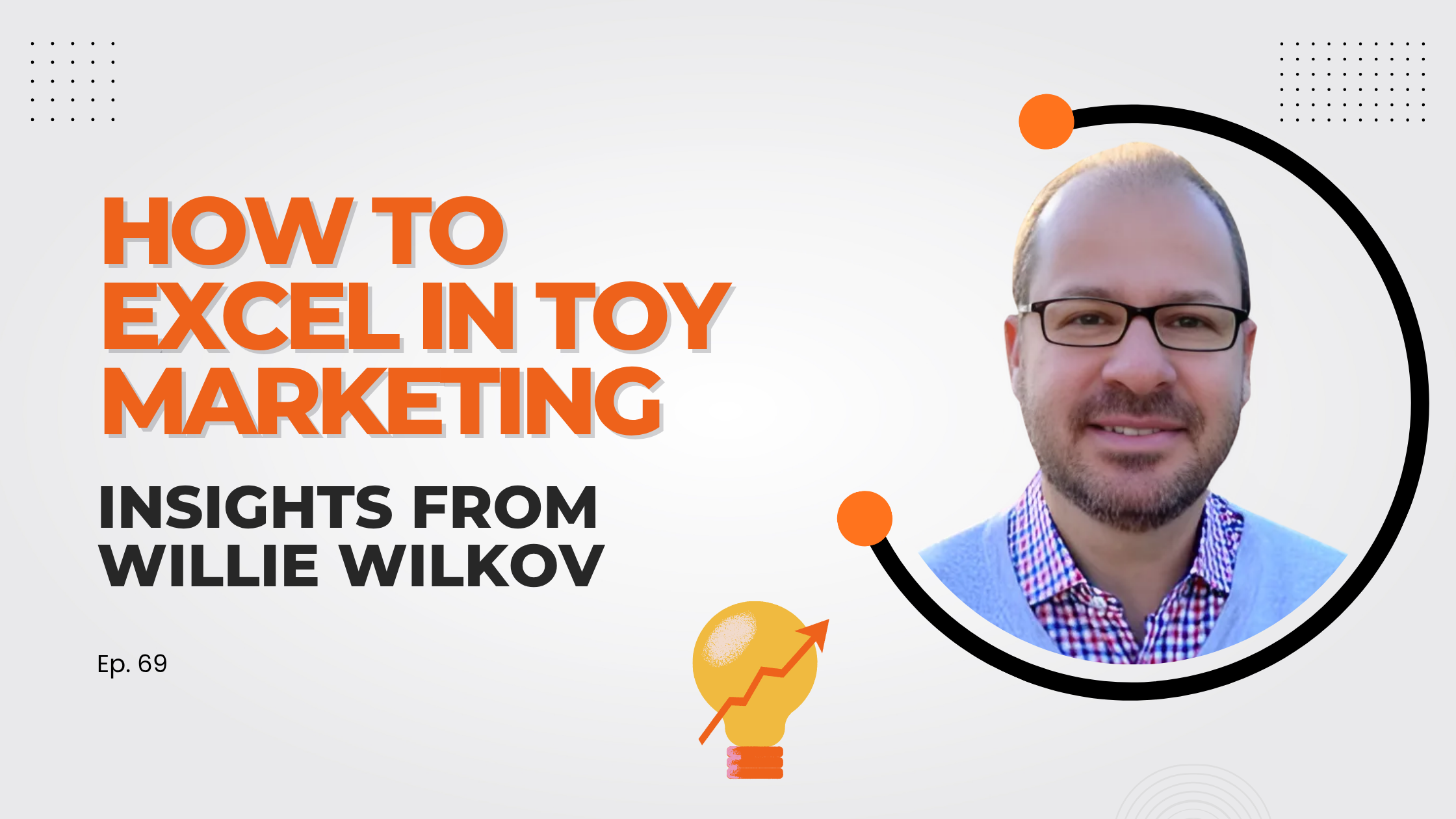
Welcome to the Toy Business Unboxed blog! In this exciting entry, we’re taking you behind the scenes of the toy industry with insights from a recent episode featuring Willie Wilkov, the visionary CEO of HABA USA.
Episode Highlight
- 00:00 Introduction to Toy Business Unboxed
- 00:42 Meet Willie Wilkov, CEO of HABA USA
- 01:23 Willie’s Career Journey and Leadership Insights
- 04:12 Navigating the E-commerce Landscape
- 09:12 Target Demographics and Marketing Strategies
- 15:12 Successful Campaigns and Industry Insights
- 19:18 Advice for Newcomers in the Toy Industry
- 20:57 Conclusion and Final Thoughts
Willie Wilkov’s Career Journey
Wilkov began his career in advertising at Leo Burnett, learning the ropes of brand advertising and direct marketing. His path then led him into the toy industry, where he took up significant roles at companies like Learning Curve and TOMY. His diverse experience has shaped his unique approach to leadership and brand development, inspiring both his team and the strategies at HABA USA.
Embracing E-Commerce in the Toy Industry
A focal point of the conversation was the immense shift towards e-commerce that has transformed the toy industry, especially with platforms like Amazon leading the charge. Wilkov touched on the strategies his company has employed to adapt and thrive in this digital-first era, emphasizing the critical importance of trying, measuring, and adapting marketing strategies to what truly resonates with the consumer.
Insights and Strategies for Toy Brands
Wilkov also shared invaluable advice for emerging toy brands, stressing the importance of customer-focused strategies, operational efficiency, and maintaining flexibility with marketing channels. His recommendation? Embrace the new tools and tactics that e-commerce offers, test widely, and lean into the tactics that prove effective.
Engaging with Education and Libraries
For those interested in marketing educational toys, Wilkov highlighted the importance of programs like their library discount initiative. Such programs not only expand brand presence but also build strong relationships within educational circles, providing a win-win for both the company and educational institutions.
Highlights and Advice from Willie Wilkov
Wilkov recounted some of his proudest marketing campaigns, including the record-setting tallest toy train track at Grand Central Station, showcasing the power of creativity in capturing public attention and media buzz.
Looking forward, Wilkov envisions continuing to push the boundaries of digital marketing and e-commerce, eager to see how these platforms evolve and influence the toy industry landscape.
Collaboration with Educators and Communities
Collaboration plays a pivotal role in Play-A-Maze’s development process. Shafir shares how working with early childhood educators, psychologists, and parents helps to refine and enhance the products. By observing children’s interactions, Play-A-Maze continuously adapts and improves its offerings to meet varied educational needs.
Concluding Words: Embrace the Joy of the Toy Industry
In Wilkov’s own words, the key to thriving in the toy industry is simple: have fun. Embrace the joy that comes with creating products that bring happiness to children and families alike. Lean into the collaborative nature of the toy community, and never stop exploring the exciting potentials of this lively and creative field.
Conclusion
As we wrap up this insightful exploration into the world of toys with Willie Wilkov, we hope you’re as inspired as we are by the innovative strategies and heartfelt passion driving the industry forward. From embracing e-commerce to building strong educational partnerships, Wilkov’s insights offer a roadmap for success in a rapidly changing environment.
To stay updated with the latest episodes of Toy Business Unboxed and embark on your own journey into the toy business, don’t forget to subscribe and follow the podcast. If you found this episode insightful, please leave a rating and review, and share the podcast with fellow toy enthusiasts. Let’s embrace the world of toys together, staying curious and continuing to innovate.
Guest Contact Information
If you’re interested in learning more about HABA USA or connecting with Willie Wilkov, you can reach out through the following channel:
Socials: Willie Wilkov on LinkedIn
Transcript
EP069_11-19-24_Willie Wilkov
Intro: [00:00:00] Welcome to Toy Business Unboxed, your gateway to the secrets of the toy industry. Here, Jason Hsieh, a toy entrepreneur and expert in the field. “Every product we develop is really inspired by some of the real life experience that we have with our son.” “60 percent of all toys last year were sold on Amazon.”
“Be passionate about it. Because it’s a road. It’s a journey.” “Like when you have an idea that you think is gonna somewhat change the world, make things better, I’d say go for it.“
Jason Hsieh: Hi, welcome to another episode of Toy Business Unbox podcast. Today we’re thrilled to have Willie, the CEO of HABA USA, who have bring over 25 years of experience of leadership within the toy industry. he started his impressive career in marketing and grew into the management role in both [00:01:00] Tommy, PlayFusion and also now HABA and driving impactful growth across both digital and traditional channels. So he’s definitely have tons of experience and tons of story that he can share with us on today’s episode. And he’s experience also offer a very unique view of building brand that from many different perspective, from all sizes as well. So thank you so much for joining us on the podcast today.
Willie Wilkov: No problem. Thanks for having me.
Jason Hsieh: Can you talk about your career and how you develop into like your current role?
Willie Wilkov: Sure. I started my career in the advertising agency business. I moved to Chicago, didn’t know anybody. I started working for a company called Leo Burnett, and I learned a lot about brand advertising. I learned a lot about promotions, sales promotions, and then over time I really evolved into direct marketing, digital marketing, where I moved to another agency. Then I went to the client side and I worked in media. And then eventually I found myself at a company called Learning Curve based here in Chicago, which was eventually acquired by [00:02:00] tommy, so after starting in the agency business, the half of my career has all been in the toy space.
Jason Hsieh: How would that, your career really shape your approach to your current style of leadership?
Willie Wilkov: Sure. I think when you start in marketing you really have this foundation that everything begins with the customer. And that has really carried through with me as I now lead Haba here in the us. The other thing is, as a somebody in the marketing and communication space, you realize how important it is as a leader to not only have a clear strategy for the company, but to be able to articulate that clearly so that everybody in the company is rowing in the right direction. And lastly, as a marketer if you’re really good at what you do you have to be able to measure the performance of the campaigns and the investment. Really think like the cfo, if you will. And that sort of experience has helped me as I moved into my management role.
Jason Hsieh: I see. Yeah that’s a very good point. You also need to understand the financial implication of [00:03:00] the decision you’re making, obviously.
How do you balance all the different like initiative that you have? I can imagine you’re doing quite a bit of different marketing initiative. Are you also still very hands on with all the different marketings campaigns and the strategy right now?
Willie Wilkov: It’s funny. First of all, I have an amazing team of people. So I rely on them very heavily to do the wonderful job that they do. I would like to be more involved when you think about where my passion lies and based on my experience and what gets me excited. I’d love to be more involved in the marketing department, but they really don’t need my help. I’m there to provide guidance. I’m there to answer questions and remove obstacles and provide perspective, but they do such a fantastic job. The best thing I could do is stay out of it.
Jason Hsieh: I see. And I think HABA is also a pretty big organization for the US team alone. How many staff do you currently have?
Willie Wilkov: We’re relatively small compared to some of the bigger players out there. But I think if you were to look at our company I think you’d think that we’re much. Much bigger than we are. And [00:04:00] I think that’s part of the beauty of having a smaller, more resourceful team is if you stay out of the way and you give people the opportunity to really prove themselves to grow and shine, they’ll do outstanding work.
Jason Hsieh: I think over the last decade within the toy and game industry, there’s a big shift into e-commerce with the rise of Amazon and all the other online commerce. Has that changed your business strategy over the last decade or so?
Willie Wilkov: I’ve been working with Amazon in some capacity dating all the way back to 1998 when they were just selling books, cDs and DVDs, and it was very clear that they were going to continue to grow and change the way that people shop. And so when I started with Tommy we were a first party seller on Amazon. We had a vendor account. We did some limited direct to consumer. And then when Play Fusion, it was a smaller company that was more direct to consumer. And now at Haba, I mean we’re really a third party seller on Amazon. We sell on [00:05:00] marketplaces, we do direct to consumer. It’s a very big portion of what we do. We also own another company called Bella Luna Toys. Which is an e retailer in the toy space. And so this is a really big part of our business and something that I’m very passionate about.
Jason Hsieh: Yeah and I think that’s when it come to, that’s something you also have a lot of experience with digital marketing. With all the different platform right now. What will use advice to some of the smaller brand to focus more of their effort on?
Will you suggest to spend more of their marketing maybe into Amazon or Facebook, Instagram, or even Google or YouTube? Do you have any preferences out of all the different marketing channels?
Willie Wilkov: Sure. It really depends on your business and my advice to everybody is to try everything and measure everything, and then you need to lean into what works and you need to shut off what doesn’t work. For us we, do a lot of different things. We spend a fair amount on Amazon. Amazon’s become a pay to play platform. If you wanna succeed, you have to run [00:06:00] to it. And then when it comes to direct to consumer we do a fair amount with Google. That seems to be our highest performing channel. We also use Facebook for more of the top of the funnel and Instagram as well. We’ve tried things like Pinterest and have had a lot of success in those areas. And we’ve tried things like TikTok and we’ve had less success. And so I think the key is really lean into what works.
And then from a budget standpoint, I mean we have specific parameters that we approve, and if we meet certain thresholds, the team can have unlimited budgets as long as we’re delivering the business performance that we’re looking to do. And I think that’s a different philosophy than most companies where the marketing department is given a fixed budget and they have to stick within that. We are variable in how we approach these things.
Jason Hsieh: What would you say are some of your biggest challenge in growing the digital marketing present for Haba? Especially into the future in 2025 and beyond?
Willie Wilkov: I think a lot of adjacent is just mindset. I feel like we are a company that traditionally like most toy companies was [00:07:00] wholesale, business to business and as our company has changed as the economy has changed in America and the toy business has changed it’s been necessary to focus more in that e-commerce space.
We’ve had to rethink how we do our business entirely from an operational standpoint, right?
Jason Hsieh: Oh yeah.
Willie Wilkov: Finding the right platforms. There’s areas like drop shipping, which would become more important. We’ve started revisiting how we package our products so that we can maximize sales and e-commerce and reduce our cost in the supply chain. So that’s been very different. Looking at how we merchandise our products, having the right videos and images, copy, I’m more of a traditional person when it comes to copy explaining how the products work, but you really need to focus on search engine optimization if you want. Getting our team to lean into some of these tools and tactics that hadn’t been used previously. I think was a bit of a cultural change. But then when you start seeing the results, I think everybody kind of rallies behind it.
Jason Hsieh: And because I know Haba have a lot of sku [00:08:00] with the overall marketing present. Will you say like maybe offline and online, 50 50? Or where is like the revenue share, majority measure revenue is coming from currently?
Willie Wilkov: I would say it’s more e-commerce than it traditionally has been. I won’t necessarily get into specifics in terms of percentages, but it is a very big part of our business. It doesn’t mean that we are not interested in wholesale or B2B. It’s just, the interesting thing about it is if you think about the democratization of media and the control that people have e-commerce, you have all these tools at your disposal that you can drive there. There’s no buyer that you need to sell into. There’s no decision maker that’s gonna limit you, you really have the ability to pull the different levers that you have at your disposal to drive your sales and we’re a relatively small company compared to other larger toy companies, and our brand isn’t as well known here in America. And a platform like e-commerce really levels the playing field for us, where maybe you haven’t heard about our [00:09:00] brand, but if you see that our products have five stars and thousands of ratings and reviews people are gonna know that we sell quality products that we deliver, that we have great customer service, and as a result we can grow share.
Jason Hsieh: I want to also talk a little bit about your target customer. What would you say your target demographic that you are developing the product around currently?
Willie Wilkov: Our products are high quality. A lot of them are made in Germany. We use a lot of wooden materials and components. So as a result, our products tend to be a little bit more expensive than some of the products you might see on a shelf at a Target or at a Walmart. We tend to have customers that are a little bit more affluent have a higher household income. Our buyers are traditionally more female, although there are plenty of men who buy our products. We focus on parents, and then we also focus on grandparents. They’re increasingly folks who look for the types of products that we sell that are more open-ended, play higher quality no batteries. Things that are a bit more [00:10:00] traditional ’cause we sell a lot of blocks and we sell a lot of dolls and we sell a lot of board games. And these are products that resonate with grandparents ’cause there’s a bit of a nostalgia factor and I think they’re very interested in keeping their kids off screens and keeping their grandkids off of those devices.
Jason Hsieh: That’s true. Do you also try to sell to school directly as well as part of your marketing strategy?
Willie Wilkov: We do. We would like to do more of it. That’s definitely an initiative that’s gonna become more important for us. We do sell a lot of items that are used by educators and people who buy on our website. We also have a very large library program. We give significant discounts to libraries that carry our board games. We also replace any missing pieces or parts. So instead of replacing the whole game, if they’re missing a piece, we’ll send them to pieces ’cause things tend to walk away. But that’s a great opportunity for us to, get exposure for our brand and get people to try our products at no cost.
Jason Hsieh: Yeah. That’s also something with our own brand, because we also own the brand ourself. We design sensory product for kids with special needs. But getting and [00:11:00] marketing to school has always been like a challenge. We never really cracked the box on exactly how to do it, because I think each school or sometimes the school district make the decision. Sometimes the school make the decision, sometimes the principal make the decision. Sometimes a special education director make the decision. So that decision maker is like all different. It’s really hard to figure out who exactly we need to market to or put our product in front of.
Do you have any like successful case study or like strategy for toys brand that’s thinking about marketing to school they should consider on doing to have a successful marketing to the school?
Willie Wilkov: Two things come to mind. One is just a general practice and principle. We really pride ourselves in having industry leading customer service. And if you reach out to us, you will speak to a human. If you do wanna chat with us or email us, you will get a response. Being available to the educators, whether it’s a teacher or administrator, and be able to answer questions, I think is part of it. And we also are flexible so that if somebody wants to use a purchase order we can support an order that way we can take credit cards, [00:12:00] we do tax exempt. And so when you do these things, people talk and educators talk to other educators and say this is a great program. The librarians will talk to other librarians and talk about how great our program is. On the other side we’ve done programs where schools drive sales to our websites we will give a portion of the proceeds back to the school.
Jason Hsieh: Oh, okay.
Willie Wilkov: Some of the products we sell on our Bell Luna site are Waldorf toys, Montessori toys, and so we have relationships with Montessori schools and Waldorf schools where if they say, Hey buy things on these specific platforms that’ll return a certain percentage back to the school as a fundraiser. And we’ve seen a lot of success with those programs.
Jason Hsieh: Can you elaborate a little bit more about how is your library program even work?
Willie Wilkov: If you can prove that you’re a librarian by showing your credentials or business card you get basically it’s like a 35% discount off of our retail price. If you’re tax exempt we won’t charge you tax. And then, like I said, if there’s any issues with the product and [00:13:00] sometimes there’s a board game and there’s 12 pieces, two of them get taken away or go missing, they can email us and we will send them at no cost replacement parts for those games. And so that’s basically the program. And so there’s great word of mouth. People reach out to us. We don’t have to do a whole heck of a lot to promote it to other people. And it’s something that we have gone to some library conferences and put out a table and a booth to educate people if the program exists.
Jason Hsieh: I see
Willie Wilkov: for the most part, it sells itself.
Jason Hsieh: Do you also send out like free demo kit to the library as well or do you just only a discount?
Willie Wilkov: We, we don’t do free demo kits, but we’re pretty liberal with demos. So if you’re a customer that’s looking to make a significant. Investment in our brand, we will make sure that you have products for display and that goes for our retail customers as well. If you’re somebody looking to get into one of our new games, we’re happy to include a complimentary copy so that you can use it to teach your staff or educate the customers in your store. ’cause we know that those programs work and improve [00:14:00] conversion.
Jason Hsieh: I see. Okay. Thank you for sharing that. And what would you say is inside your current product catalog? What is the most successful products, especially when it come to the school? You mentioned about board game and other product that you have?
Willie Wilkov: Yeah it’s really our board games right now, for Haba. We have a product called First Orchard, this is a game that was designed by an educator in Germany. Over 30 years ago, it sold over 3 million copies, and it’s basically a board game for two year olds.
Jason Hsieh: Okay. Okay.
Willie Wilkov: It teaches them how to identify colors, learn how to take turns, how to win or lose together. There’s light strategy, and that’s been our bestselling product across the board, not just with the educator. And then the other thing is on bell Luna we actually design and manufacture our own toys here in the United States. And some of the products we’ve done, there are play kitchens, play refrigerators, play stands, and these sort of larger items with higher price points. We’ve done very well with educators, a lot of preschools. We’ll buy these products ’cause they’re [00:15:00] sturdy, they’re well made, and they’re sustainable. So those are things that have really resonated in that community for
Jason Hsieh: and I know throughout your career you have done a lot of different marketing campaign with your previous career and your current career.
What is the most successful marketing campaign? That’s more related to the toy side, that you would like to share with our audience?
Willie Wilkov: One I’d love to share ’cause it makes me really happy and really proud was I had been working at tommy on a toy train brand called Chuggington and
Jason Hsieh: Oh yes, I heard that one before. Yes.
Willie Wilkov: Yeah. We had a product that was pretty amazing. It was an elevated toy train track. So you not only could build the train set like to run your train, but you could build it vertically. It was like a combination of construction play, toy train play. So you could build these elevated builds and the toys could go with gravity in multiple loops and go multiple
Jason Hsieh: Oh, I see. Nice.
Willie Wilkov: So we wanted to do an event that talked about elevation and stability. Those were the key benefits of the brand. And so working with our wonderful PR agency at the time, [00:16:00] we created an event at Grand Central Station in New York. It was the 100th anniversary of Grand Central Station and we said we set a Guinness World record for tallest toy train track at 17 feet four inches high. It was great. We got over a hundred million media impressions. We have a plaque in the office from setting this world record. It was a wonderful event and something that I’m still very proud of today.
Jason Hsieh: I see. So you also hold a few world record, so that’s incredible.
Willie Wilkov: Yeah. So that was one I’m really proud of.
Jason Hsieh: Thank you for sharing that. And actually to piggyback on the thing you just shared, because you have worked in different toy company over your career as well, if you look at all the different company you have worked with so far, how does each of the toy brand have different approach to ecommerce today? Do they have like different strategy that you implemented with different company or anything that you would like you could share?
Willie Wilkov: Yeah. The biggest distinction I think is [00:17:00] when it comes to Amazon is first party selling versus third party. And that’s, it’s a huge difference. For me I liked getting purchase orders every week. That was nice when we were a vendor seller. Every year you had vendor negotiations with Amazon and they were very, they were challenging and every year Amazon was looking for more money and every year the metrics that they were evaluating on were changing and it was very unpredictable. ‘Cause it tended to happen after you’ve set your business plan for the year. Now doing third party sales as a marketplace seller it’s so much more within your control. And that doesn’t mean Isn’t gonna increase their fees or change how they measure. Measure your and weigh your products and things like that. But you have way more control over your pricing. Way more control over your catalog, way more control over your promotions. And for me I’m a huge fan of doing third party selling. And I just feel like it gives you way more flexibility and ownership over your business.
Jason Hsieh: I a hundred agree with that, with all the different brand that we also assist and partner [00:18:00] with using the seller central platform does give you a lot more flexibility, just like you mentioned on what you can do and cannot do. And one of the like most frequent complaint I heard from Toy brand that selling to vendors Central is you lose a lot of the pricing control because sometimes Amazon can just go in and change your price without get your consensus.
Willie Wilkov: It was a bigger issue when I worked at a big company, like tommy, it was significantly bigger. What would end up happening was we were selling on Target, Walmart, and Amazon. And then inevitably one of the prices would change for whatever reason, maybe somebody on Amazon, a third party seller, was selling at a very low price, clear out a unit or two Amazon would temporarily lower to, win the buy box. Target would match Amazon, Walmart would match target. Suddenly everybody’s selling it at a ridiculously low price money and nobody is willing to fix it. They don’t want to talk about prices, and all it does is erode value for everybody. And that was a really big challenge, and I spent a lot of my time focusing on that, trying to fix those problems [00:19:00] instead of trying to grow the business.
Jason Hsieh: Yeah, that’s definitely even with seller Central itself, it is not without problem. It still have other challenges, but just like you mentioned, it does give you a little bit more bell and whistle and more control over your brand. But thank you so much for sharing that and because you have experience doing both obviously.
And what other advice would you give to newcomer like a new or smaller toy brand? To the digital e-commerce and other within the industry right now. What was some of the strategy you would recommend them to try?
Willie Wilkov: Yeah, there’s a variety of different things. First and foremost you just gotta ask a lot of questions and try a lot of different things. If it’s an area you’re not familiar with, you gotta find the right partners who can educate you on what needs to be done. Folks that have their finger on the pulse of the latest trends. But I would also encourage you to not rely on your partner, but to figure it out to really understand what they’re doing so much so that you could do it yourself. ’cause that’s the only way to really learn and though those skills will stick with you throughout your career. And then [00:20:00] lastly, as I mentioned earlier, do not discount the importance of the operational side because I think as a marketer, you think about how do I merchandise my products and how do I sell them? How do I do the SEO? Things that really have a huge impact or your cube efficiency. Your e-comm packaging, your in stock rates, those sorts of things. And I think those were things I didn’t think about early on in my career. When you think about it, most people, when they buy a product in e-comm, it comes in a box.
Any retail packaging that you’re putting in there, unless it’s for a board game and it’s essential for the play, is really waste. And it’s money that you’re spending in production. It’s space that’s costing you in terms of your inbound shipments. Your outbound shipments to the retail partner and then your fees for them to ship out to the end cost of brand. When you think about how much you can save throughout the entire process, it’s something every company should be thinking about, not just toy companies. Plus it’s better for the environment and there’s less space.
Jason Hsieh: Yeah. Yeah, that’s a really good, thank you for sharing that. And as well wrapping up today’s [00:21:00] interview.
If you have to share like one major piece of advice with someone that’s really just getting started in the toy and game industry, what would that be?
Willie Wilkov: It sounds silly, but have fun. We get to work every day and in the toy industry where what we’re doing is bringing joy to kids and bringing families together and connections. And really celebrating play. I’m thankful ’cause I’ve worked in other areas that’s it’s significantly less fun when you’re working on insurance, no offense insurance, but lean into the fact that we’re selling toys, have fun, enjoy it get to play the products and play with the toys and for sure, it’s a really nice community. Everybody in the business knows each other. People for the most part, while the business is competitive, are still very friendly. Willing to work together and collaborate and share. Really also lean into the community as well.
Jason Hsieh: Yeah. That’s a really good piece of advice. For our listener,
where can people find you online?
Willie Wilkov: Yeah, look for me on LinkedIn, it’s just Willie Wilkov, W-I-L-K-O-V. Shoot me a note. I’d love to [00:22:00] connect with you. If you have questions, I’m happy to answer ’em. And I always like meeting new people in the industry.
Jason Hsieh: Yeah. And thank you so much for joining us on the interview and sharing all your knowledges. I find it very beneficial as well.
For our listeners, thank you for tuning into this episode of Toy Business Unbox podcast. We hope you have enjoyed the conversation and find it insightful inspiring. If you like what you have heard, be sure to subscribe to our podcast on your favorite platform, so you’ll never miss an episode.
We really appreciate your support and we’d love it. If you can leave us a review and share the podcast with your friend or coworker. For more resource tip and the latest update in the toy industry, visit our website at toy-launch.com. Join the conversation and connect with us on social media using hashtag #ToyBusinessUnboxed.
We would love to hear your feedback and your suggestion for future episode. Until next time, keep innovating, keep creating, keep bringing joys to toys. This is Jason Hsieh signing off on the Toy Business Unbox podcast and we’ll see you in the next episode. Thank you everyone.