
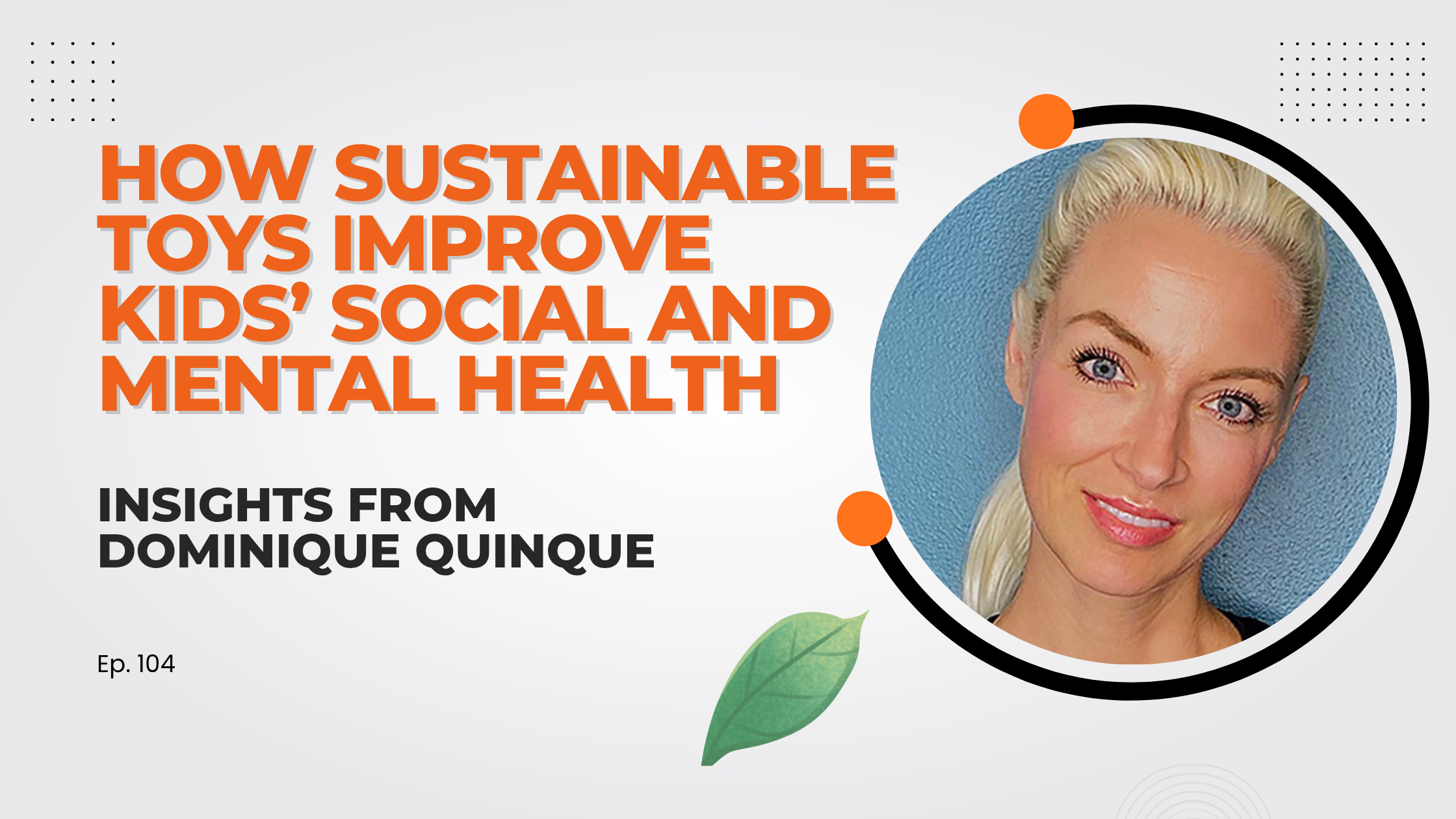
Welcome to a closer look at how the toys children play with shape more than just entertainment—they influence skills, perceptions, and environmental awareness. As conversations around sustainability and mental health grow, it becomes increasingly important to understand how eco-friendly toys support holistic development. This post explores how nature-inspired, sustainable toys not only benefit the planet but also nurture essential emotional, social, and environmental skills in children.

#104: The Surprising Role of Paper Dioramas in Building Resilience and Connection in Kids – Toy Business Unboxed
Episode Highlight
- 00:00 – Intro by Jason Hsieh
- 01:24 – Episode Overview
- 02:21 – Diorama Kits Explained
- 05:24 – Inspiration from Childhood
- 08:16 – Supporting MESH
- 10:31 – Creativity in Play
- 12:15 – Family Benefits
- 15:30 – Sustainability Practices
- 19:44 – Environmental Mission
- 22:12 – Niche Marketing
- 25:49 – Business Partner Intro
- 29:02 – Sustainability & Advice
- 32:22 – Closing & Online Presence
The Power of Nature-Inspired Play and Its Impact on Child Development
Heidi Huckleberry’s eco-friendly diorama kits go beyond toys by helping children reconnect with nature through creative, hands-on play. Inspired by the creator’s childhood of outdoor exploration and resourcefulness, these kits encourage imagination, independence, and environmental awareness.
In a time when children spend less time outdoors due to screens, they offer a meaningful alternative that supports creativity, bonding, and a deeper connection to the environment.
Supporting Mental and Emotional Resilience through Creative Play
Heidi Huckleberry’s diorama kits support children’s mental health by encouraging creativity, independence, and problem-solving in a supportive, hands-on environment. Through shared activities like building scenes and exploring nature, they promote collaboration, emotional security, and social skills, while also fostering mindfulness and patience—helping children build resilience and better manage stress in an increasingly digital world.
The Business of Building a Sustainable, Impact-Driven Toy Brand
Integrating sustainability into toy design is both ethical and profitable, as consumers increasingly value eco-friendly products that support children’s development. While small brands face challenges like higher costs and sourcing materials, these efforts help differentiate them and build loyal customers. By emphasizing educational value, local manufacturing, and transparency, brands can strengthen credibility and appeal to environmentally conscious families.
Supporting Kids’ Connection to Nature and Resilience
The way children learn about their environment shapes their future behaviors, and toys that promote nature, sustainability, and creativity help build a strong sense of responsibility. Through eco-friendly play and storytelling, children develop environmental awareness, appreciation for nature, and values that encourage them to become more conscious and responsible individuals as they grow.
The Value of Small Business Innovation in Creating Impactful Toys
Heidi Huckleberry shows how small brands can shape the toy industry toward sustainability and social impact through eco-friendly materials, local production, and educational value. While larger companies rely on short-lived plastic products, smaller businesses stand out by focusing on reuse, creativity, and meaningful experiences, appealing to niche audiences willing to invest in sustainable, purpose-driven toys.
Essential Advice for New Toy Entrepreneurs
Shafir offers valuable insights for budding entrepreneurs in the toy industry: understand your product deeply and its relevance to your audience. Highlighting both rational analysis and the power of intuition, he encourages innovators to trust their creative instincts while being receptive to feedback and market trends.
Conclusion
Heidi Huckleberry’s journey shows that toys can do more than entertain—they can educate, empower, and foster care for the planet. By choosing eco-friendly, hands-on activities, parents and educators can help raise resilient, socially responsible children who value both nature and connection. Small steps—like building a diorama, exploring outdoors, or supporting sustainable brands—can make a meaningful impact.
Connect with Dominique Quinque
If you’re interested in learning more about Heidi Huckleberry or connecting with Dominique Quinque, you can reach out through the following channels:
- Website: Visit Heidi Huckleberry’s official website for more information and updates.
- Youtube: Follow Heidi Huckleberry’s Youtube channel for video contents.
- LinkedIn: Follow Dominique on LinkedIn for professional updates.
- Instagram: Follow Heidi Huckleberry on Instagram for more updates
Transcript
Jason Hsieh (01:24)
Hello, welcome to another episode of Toy Business Unboxing. I’m your host, Jason Hsieh. Today we are joined by Dominique creative force behind Heidi Huckleberry, hopefully I say that name correctly, Seattle based startup offering natural inspired diorama kits. And her passion for sensory rich creative play and her commitment to sustainability have shaped her company’s mission to foster children’s mental, emotional and social health.
And in today’s episode, we’ll be talking about the story behind the company, why she got it started, and different topic about how is this kind of product really played a role in shaping kids’ connection to the natures in environmental awareness. So thank you so much for being on the podcast today.
Dominique Quinque (02:08)
Thank you for having me. That ⁓ summarized.
Jason Hsieh (02:11)
Okay, thank you. And can you start out by sharing with the audience a little bit about the company and how do you even got this idea from and how do you got started in the journey?
Dominique Quinque (02:21)
Okay, I would like to start explaining what Heidi Huckleberry makes, what we sell, what our product is. So we papercraft products, nature-inspired papercraft specifically for children five years and older, but also for their adults with the aim to build a diorama, a quaint little scene. It’s always hard to imagine
What is she talking about? So if you don’t mind, I have a little show and tell. have a sample. I came prepared. So this is one example of our diorama, Gnome Sweet Home. And so we have different themes and they go with the seasons. Here’s another one, a camping one.
Jason Hsieh (02:49)
yeah, please. Please.
nice!
Dominique Quinque (03:10)
which is very popular in the Pacific Northwest to no surprise. So our product is this. It comes in a paper card stock envelope and contains the framework, meaning the little characters, they are printed on card stock, the props, and by props I mean elements that you have to like…
fold and glue to turn into 3D elements. So there’s lot of that involved. And the kit comes with instructions and inspiration just to give ideas how to go about building a diorama, a background picture, and also a little ⁓ mini book, like a zine. Zine is short for magazine, and it’s basically a letter size
piece of paper that gets folded and cut and then it’s into this cute little book. There’s some cutting out pictures involved and matching it up to the recording pages.
Jason Hsieh (04:05)
wow!
They actually need to make this book. doesn’t just kind of sit like that.
Dominique Quinque (04:15)
It’s just another activity and contains a little story that accompanies the diorama.
Jason Hsieh (04:18)
⁓ I see.
I see, very cool.
Dominique Quinque (04:25)
is what’s included. So the idea is to use a box. It can be just a cardboard box or you can build your own frame if you’re handy. I like to build these. I can hang it on the wall. looks really pretty. And then you go outside. garden or wherever and you collect natural materials.
Jason Hsieh (04:38)
Hahaha
Can I put garden gnome
Dominique Quinque (04:49)
So my go-to is moss and lichen because the Pacific Northwest has tons of it. But also bricks and stones and dried flowers, pine cones, whatever you can find to just keep your eyes open. And then you assemble your findings with the characters into a scene using your own imagination.
in your own resourcefulness. So this is in actual our product,
Jason Hsieh (05:20)
What inspires you to create the product that you have?
Dominique Quinque (05:24)
yeah, it’s been quite a long journey. So I am a mother to a daughter. Her name is Heidi, hence the name Heidi Huckleberry She’s now 12 years old. But as I was and still am raising my daughter, I came to realize that our childhood experiences are so different.
Jason Hsieh (05:45)
Hmm,
Dominique Quinque (05:46)
Polar opposite like a different.
Jason Hsieh (05:48)
I see.
Dominique Quinque (05:51)
When I was growing up, I spent so much time outside. And over the weekends, our parents, they would shove us out the door and say, don’t come back before dinner. And we would be bored and, oh, what can we do? But that boredom sparked our creativity. And we spent so much time in nature just exploring. And we spent time with other kids together.
Jason Hsieh (06:01)
Yeah.
Dominique Quinque (06:16)
And so we were free roaming or free range, you can say, and we were independent and adventurous. Nowadays, kids spend a lot less time.
Jason Hsieh (06:27)
More on the iPad?
Dominique Quinque (06:28)
iPad, ⁓ kids love it. I feel are less connected to nature. They know less about their immediate ⁓ environment. They also spend less time with their peers outside of school. So now we live in a world of exponentially evolving technology and instant gratification.
Jason Hsieh (06:39)
Yeah.
Yeah.
Dominique Quinque (06:53)
over consumption, to be honest, and convenience. Everything has to be convenient. And I do embrace technology, but I also miss the simplicity of a more grounded lifestyle. And this realization led to the creation of Heidi Huckleberry I was drawing
those scenes that are my fondest childhood memories, like climbing on a tree, picking apples, just being outside, exploring, and then it turned into a diorama. That is my way of hanging on to my past. And I wish I want my daughter to have that too, that feeling of…
freedom and nature. There’s so many positive things that come with it.
Jason Hsieh (07:45)
And the other question I have, I think this also have implication to MESH, which is a really hot topic in the toy industry recently. For those the audience doesn’t know what I’m talking about. MESH also stand for mental, emotional, social health. So I think there’s some implication on how your product can also help with some of those aspects, which is also part of your core mission. That sounds like.
from your perspective, how does your kid help kids to develop those critical skills to create and play?
Dominique Quinque (08:16)
Yeah, so we all know STEM and STEAM, those are the products that designed to focus on academic skills. However, experts and parents, they found that our children are struggling psychologically and COVID has something to do with it, but evidence such as that the issue runs deeper.
It has been going on for a much longer time. So the initial response of the toy industry was to create calming, soothing toys. And this is where we got the fidget toys from and the more stuffed animals, blankets, just to name a few. But beyond soothing, we also need toys that build resilience in our children.
And this is when toy industry leaders and resilience expert got together and they came up with this category MESH. Although that ⁓ acronym existed already for 10 years, but they certainly shed some light on it and so our product,
does several things. for one, kids and families do something together. So in mind, I see kids doing this together with their parents, grandparents, caretakers, and they get to go outside. the second is we connect children to nature together with their grownups who can help them understand our
their immediate environment.
Jason Hsieh (09:50)
Yeah, but I think makes total sense because it kind of encourages the kids to interact with each other, just like you mentioned, outside of iPad. And that’s really part of social emotional health. It’s just an alternative way to interact with other peers and also interact with nature, like you just mentioned.
Dominique Quinque (10:10)
Yes, it’s easy to outsource our parenting to technology. The digital pacifier, really like that word because of digital pacifier. But this is not what our kids want or what helps them thrive. They want to know that their grown-ups take the time.
spend the time together with them. This is what makes them feel loved and safe. So if you want a happy child, spend time with your child. And the other thing about our product is that it leaves room for your own creativity. So you can give this kit to 10 different children and they will come up with 10 slightly different
versions of the diorama, depending on what materials they find, how resourceful they are, how creative they are. And I feel that is also very important in a world where a lot of products are designed to be almost as easy as possible and to not use your own imagination so much.
Jason Hsieh (11:09)
Yeah.
true. mean, I guess that’s also an interactive part because it’s almost like a group exercise because the box, like the parent need to help find and if you want to put it in the box. Well, you can always use the Amazon box. There’s a lot of Amazon.
Dominique Quinque (11:35)
That
was my thinking. Everybody has…
Jason Hsieh (11:39)
I have an Amazon box. So, and I guess because of the uniqueness of your product, I have been interviewing a lot of people on the podcast. I think you are the first, you know, toy entrepreneur I met that create, you know, type of diorama that you guys make. I guess, what do you think is the, you already touched on it a little bit earlier during our conversation, but what do you think are some other benefit of building a diorama
together which could be good for not just the kid but also maybe for the parents or even the grandparents as well.
Dominique Quinque (12:16)
Yeah, think when you… So what I want to achieve… So these scenes that I create are scenes of children being outdoors. You can tell… I’m telling my story of my childhood and I want my generation to remember what it was like because we live in the now and the now is so different.
Jason Hsieh (12:26)
Yeah.
Dominique Quinque (12:39)
you can easily forget. And so I like to tell my stories, what I did as a child to my daughter. And she’s like, what? You did that? You climbed the stairs? You roamed freely? Why can’t I?
Jason Hsieh (12:57)
You don’t have an iPad?
Dominique Quinque (13:00)
Yes. For example,
this is a winter scene. when I was…
Jason Hsieh (13:06)
⁓ yeah, yeah, yeah, very nice, yeah.
Dominique Quinque (13:08)
When I was a child, would go ice skating at the village pond that froze over every winter. That doesn’t even happen anymore because it’s too warm. doesn’t freeze over anymore.
Jason Hsieh (13:22)
Have
ever considered, of course you have about three scenes right now, have you ever considered also creating scenes for like different cities? For example like a diorama version of Seattle.
Dominique Quinque (13:31)
I actually have one in the making. It’s about to launch that It’s a dog park with Seattle skyline
Jason Hsieh (13:41)
why I mentioned it is because this is actually a personal hobby of mine with my family. We travel across US. We have visited 30 states out of 50 states. Every single state that we visited as a family, buy, like my wife buy a Starbucks mug, you know, the Being There series. How have you seen one of those? They have a mug designed for each of the states. So each of the states have a specialized coffee mug.
So my idea for your brand is have you considered maybe creating a version for each either city or just state? It’s like you can use a lot of the state, for example, California have Yosemite, right? That’s a very, very well known, like a natural place. But if you have a diorama version of it, now I feel like not only the parents want to buy for their kids, they might buy it for themselves for like, you know, collection purposes. That would be a really, really cool idea.
actually, I one for myself.
Dominique Quinque (14:37)
There’s certainly a lot of potential, a lot of different directions you can go, but I’m starting with the Seattle one.
Jason Hsieh (14:43)
Yeah.
Yeah, if you just start with Seattle first and see what is the reaction people give you and then you can slowly expand to other cities. Please do one for Phoenix as well. That’s where I live.
Dominique Quinque (14:58)
one will be in Phoenix.
Jason Hsieh (14:59)
Phoenix have Grand Canyon. So ⁓ Arizona is very famous for Grand Canyon. It’s called Grand Canyon State. You can do it by the state.
You can even have like national park theme because I think that would tie with the nature theme of your brand, which is amazing. And a lot of people that like to visit national park would like to collect those kinds of as well. And maybe you can also sell it at the national park gift store. That might be a really cool idea.
and I think that was a fit with overall brand. And the other next question I want to kind of ask you is also, I think sustainability is, very important to you and your brand as well. Can you also talk about how your brand incorporates some of the, you know, eco-friendly practice and material into your product?
Dominique Quinque (15:29)
Yeah, that would be good.
Yeah, I would love to talk about sustainability. Sustainability is very important to yeah, so 90 % of all toys are made from plastic. And a lot of the toys, they have a really short life cycle because it’s a trend or quality is inferior. 80% of those toys
cannot be recycled because of mixed media, colored plastics, and they end up in a landfill or incinerator. And globally, it’s estimated that yearly, one million tons of plastic toys are discarded.
I can’t even comprehend how big that pile is, but it sounds massive. with our dioramas, I’m very proud that we are not contributing to the plastic pollution problem. So it’s all paper-based and we encourage people to use natural materials that can be composted.
paper can be recycled and also you build a diorama. It’s an experience, right? You can hang on for it, put it in a shelf or even hang it on a wall, gift to a friend, give it to another. And then when you had enough, then you just take it apart and no harm done. That barely leaves a trail.
Jason Hsieh (17:20)
I see.
Dominique Quinque (17:20)
This is what I like about having this paper-based product. And we would also like to manufacture locally in the States, because that makes for really good carbon footprint if you don’t outsource it.
Jason Hsieh (17:35)
well that’s actually a very tricky business decision to a lot more expensive to make in the US compared to China. That’s a tough business decision to make. I respect your choices.
Dominique Quinque (17:39)
I know
Those are my convictions that I try to all squeeze in this one product, which turns out to be really difficult.
Jason Hsieh (17:59)
Yeah, especially for making it in the state. But even if you make it overseas, that’s also a way to try to make sure it’s eco-friendly with the material. And you just need to be on the same page with your manufacturer to make sure they are doing the sustainable practice. But I do understand of you want to make it in US, but as a business practice, it’s going to increase the cost, as we know.
Dominique Quinque (18:22)
I do like the idea of supporting other local businesses.
Jason Hsieh (18:27)
That’s true, that’s true.
Dominique Quinque (18:29)
Somebody has to start somewhere.
Jason Hsieh (18:31)
Yeah, I understand that. I did when I first started the brand in 2016, I will use to use a few US supplier, but man, the cost is just too high. We couldn’t sustain the growth. And also they couldn’t make the quantity that we wanted to be once we scale. For example, some of the product we originally sell, we were selling like maybe 50, 100 unit a month.
we scale to a couple hundred unit a month, then the local supplier couldn’t keep up without demand. So that also kind of adds a little bit of a complexity. mean, I do like to support US-based businesses, but it’s just too cost prohibited for me as a business owner, because at the end of the day, it’s still numbers. I need to make sure the number makes sense at the end of the day to make the right decision. So I did transition all my supply chain.
to China. don’t have I don’t use any US suplpier anymore.
Dominique Quinque (19:25)
Yeah, and maybe in the future we end there, but at least want to try.
Jason Hsieh (19:31)
Of course and ⁓ thank you so much for sharing. And my next question is, how do you think about toys in general shapes the kids’ mindset about environment and their sense of responsibility to the planet?
Dominique Quinque (19:45)
Yeah. So part of Heidi Huckleberry’s mission is to raise awareness for the parents. What kind of toys are not good for my children? What is good for my children? What materials? What effect does it have on our environment? So there is that.
And I also want to teach kids about nature, bring them a little closer, because there is a disconnect between nature and children nowadays. Because the more they know, the more they understand their ecosystems, the more likely they are to protect it.
So there is a lot of work to do and that is a big part of our mission.
Jason Hsieh (20:28)
Yeah, thank you for sharing that. As a startup company, what challenge have you faced in staying true to your mission of supporting kids in today’s digital landscape?
Dominique Quinque (20:40)
Well, as we briefly already talked about it, it’s really hard want to do all the right things. The local production, the good materials. is hard because buyers, they compare our product to a product that was mass produced in China.
Jason Hsieh (20:47)
Yeah.
Hmm, yeah.
Dominique Quinque (21:01)
we are noticing that. So we’re kind of relying on the people who have a big space in their heart for local businesses, for small businesses and for businesses with emissions.
Jason Hsieh (21:15)
Have you considered going after homeschool parents?
Dominique Quinque (21:18)
going after homeschool parents uh, yeah.
Jason Hsieh (21:21)
Yeah,
like marketing to specifically for homeschool parenting because they could be part of their homeschool curriculum is a little bit harder for school to implement that kind of, know, item like the type of product you have into the regular school curriculum. But for homeschool parents, they have a lot more flexibility and say, Oh, today we’re gonna learn about nature, we’re gonna make this diorama outside. That’s today’s You know, that might be something, especially I feel like the parent that
decided to do homeschooling, they are also more conscious about environmental issues and all the other issues. That’s why that is also one of the reasons why they decided to homeschool, right? They want to teach the kids their, you know, their own way instead of whatever the school teach nowadays, right? So I feel like that might be a potential kind of niche to do on digital marketing too.
Dominique Quinque (22:09)
It’s definitely… …nichey.
Jason Hsieh (22:12)
Yeah, but I think the success for the small and mid-sized business like us, know, me and you, is we need to focus in on the niche. Because if we try to go after everyone, then you just get overflowed by the noises that we have right now. Because just like you mentioned, if you go after the mass produced product, you’re never going to succeed because you don’t have the budget to outcompete against them.
And your cost and the price doesn’t make sense to compete against them as well because they can make it so much cheaper at such a bigger quantity. But if you really want to sell the mission, the vision that you have, maybe talking to a smaller group of people like the home school parent and create dedicated content for the home school parent, like, OK, use this as part of your curriculum. When they buy the kit, they not only get to make it, they all learn this as well.
That might resonate with some parents like, wow, this is not just a toy. It’s also like a mini curriculum that I can share with my kid about environmental, sustainability, eco-friendly, and other concepts.
Because at the end of the day, the main mission is we want to keep the planet that we’re all living on, right? And I feel like a lot of the adult nowadays or some politician as well is like, I’m probably going to be dead by the time the planet is over. So they don’t really care. They just want to make, they just want to grab as much money they can. They don’t really care about how their decision is going to affect the future generation
Right. So I feel like your product can be like not just the product, but also really give a lot of different kinds of life lesson for the kids as well. If you position it that way, again, it’s all about marketing and how to package your product. It’s the same product. How can you package and position it in a way is so unique and people are willing to pay more for it that’s the added value
Dominique Quinque (24:04)
And finding those people has been a journey.
Jason Hsieh (24:07)
I have some connection for you. I’ll share some connection for you after the interview. Because I have been involved in a special education or special needs space for a very long time. There is a nonprofit foundation. I know their president, which they do a nonprofit for special needs homeschool parent.
They have like a whole parent network for kids with special needs actually. That’s also homeschooling. And the reason why I bring it up because my wife and I has been thinking about like originally when we’ve learned about the diagnosis many, many years ago about potentially doing homeschooling, but it’s just a lot of work. Homeschooling is a lot more work for the parents obviously. And I have a full-time job and
my wife have other things going on. So we ended up didn’t choose that route. But the reason why so many special needs parents decided to do homeschooling is because of the complexity of the kids. For example, for my son that have autism and ADHD, it depends on teachers, like the interaction with the teacher, especially when he was much younger, he have so much more sensory issues, it’s a lot harder to know.
is the school doing all the right things and really giving him all the attention that he need, even so he have an IEP, individualized education plan, but not every single teacher follow it really closely as well. So it is a very, common for special needs parents to decide to go home school, to do homeschooling.
It’s actually a niche within the niche. because your product can teach the kids on so many different levels. And I think that could be a potential, you know, market try to go after and see if you can gain some traction that way. So, but you don’t know until you try and just like everything else we do in business.
Dominique Quinque (25:50)
Yeah, we learned so many things as we go. Yeah, I don’t want mentioning my business partner. So Heidi Huckleberry is not just myself, but my friend and business partner, Jacqueline. We met two years ago at the Seattle airport. were both flying to Germany because this is where we’re both from, specifically East Germany.
Jason Hsieh (25:55)
Yeah, for sure.
Dominique Quinque (26:15)
and we became friends. We do same cultural background. And we also share a similar journey of immigrating to the United States, moving around a fair bit and having to reinvent yourself. we both have a daughter each. So we got together and we started one year later, started Heidi Huckleberry.
Jason Hsieh (26:40)
Did you ever considered to market it as design in Germany? Now you can sell for a premium because everyone associate Germany as premium product right? You can say it’s designed in Germany because that’s where you’re from technically.
Dominique Quinque (26:52)
Maybe I could say designed by a German.
helps but yeah I mean those scenes that I depict are scenes from my childhood in East
Jason Hsieh (27:05)
that during the Cold War
Dominique Quinque (27:09)
Came down in 89. I think I was 11 years old. So I experienced communism as a child.
Jason Hsieh (27:17)
⁓
okay, okay. That should be part of the lesson. That should be part of the lesson that, you know. In there. In there. Yeah. Because. Do you have like more like a clear curriculum?
Dominique Quinque (27:25)
It’s in there
I mean, my work, my illustrations, my thinking is strongly influenced by my childhood and how I grew up. So in ⁓ communist East Germany, we didn’t have any fancy toys, you know. we had to play outside and we had to be resourceful to fill our time.
But I think that made me the creative person that I am today.
Jason Hsieh (28:02)
Yeah, that’s such a wonderful story.
Dominique Quinque (28:04)
I would’ve grown up with an iPad, who knows?
Jason Hsieh (28:06)
Yeah.
100%. That’s part of your original story. So you should definitely share more about that more in everywhere on social media and all the different marketing channels. should definitely relate that People can resonate to that. Oh, that’s where I mean, that makes sense.
It’s also sounds historical significant to it, right? So yeah, now it’s more than just, being outdoor is also like connecting to our root as well. Like you are trying to connect to your root which is Germany, and trying to connect back to my root which is Taiwan, right? It doesn’t matter where we live now. And in many different ways, we are also trying to connect with each other.
Right? Because we all share the same planet at the end of the day. It doesn’t matter what race, ethnicity background. We only have one planet, one Earth, unless you want to move to Mars, but we are not ready to move to Mars yet.
Dominique Quinque (28:57)
I would like to stay here and I would like for my daughter to have like… Earth to live on
Jason Hsieh (29:02)
⁓ For sure. Well, as well kind of running down today’s interview, have a few more, just a few final questions. What is your thought on the state of the toy industry when you come to sustainability and where do you think there’s some room for the industry to do better job?
Dominique Quinque (29:20)
Yeah, as I already mentioned, there’s a lot of plastic in the toy industry. sometimes we just make things more complicated than they have to be.
Jason Hsieh (29:25)
Yeah.
Dominique Quinque (29:35)
Like going outside, being in nature, getting in fresh air, being together with your grown-ups, that’s so many good things for your child. Movement, the physical activity alone. And I think there is room to expand in this direction.
Jason Hsieh (29:47)
Yeah.
I see. Yeah, yeah, I did interview another company that specializing in eco-friendly packaging as well.
Dominique Quinque (30:04)
I’d love to do all these things. I want to use eco-friendly ink to print my designs and eco-friendly everything. We’ll see. I’ll try my best.
Jason Hsieh (30:16)
So the final question I have for all the guests actually on the show is if you had to share just one piece of advice with someone that’s getting started in the toy industry, what would that be?
Dominique Quinque (30:26)
My advice is don’t do it alone and ask for help. Running a business, you have to wear so many hats and my business partner and I, we’re a team, we’re sharing the hats. I also focus on the illustration, on the art itself and
Jason Hsieh (30:31)
Hmm.
As for health, yes.
Dominique Quinque (30:50)
Jacqueline does media and a thousand other things. I mean, some people can pull it off, but my advice is have a business partner, have a friend, you know, to bounce ideas.
Jason Hsieh (31:04)
I agree. I wouldn’t be to run the business I run right now without my sister. It’s a really critical part of our growth as a company. So I’m more of crazy visionary. I always come up with crazy ideas and then she kind of put me in check and she also helped to implement some of the ideas.
Dominique Quinque (31:24)
Ask for help. I think there are a lot of people non-profit organizations that are more than happy to help small businesses thrive. Small businesses are not doing so well in the state.
Jason Hsieh (31:35)
Yeah.
It’s not easy. But for shameless plug here at toy launch, we do provide a lot of free content and free education for the toy entrepreneurs, including the podcast that we’re on right now. And also all the webinars that we do on a monthly basis, trying to educate people in the industry, either new or they have been there in a while, but they just, you know, they don’t know what they are doing when it comes to digital marketing.
So that’s what I’m really passionate about. How can we use the power of digital marketing to really share and spread our mission with the potential customer that we want to also touch and change their life. So thank you so much for joining us on the podcast. Where can people find you online?
Dominique Quinque (32:22)
online, we are online on the heidihuckleberry.com website where you can see our current designs. And we are trying our best to be active on social media. So we have Instagram and Facebook accounts, Pinterest and all that on the heidihuckleberryworld It’s long, it’s one word, Heidi Huckleberry world.
So we do host crafternoons, We have an event this Saturday with small collaboration with REI where we craft with kids together. So we have these events a few times.
Jason Hsieh (33:04)
Nice.
Okay, thank you for sharing that. And they can also find that information on the website, correct? Yes. Thank you so much. So for our listeners,
thank you for tuning into today’s episode of Toy Business Unboxed podcast. We hope you have enjoyed the conversation and find it insightful and inspiring. If you like what you have heard, be sure to subscribe to our podcast on your favorite platforms or you’ll never miss an episode. We really appreciate your support and we love it if you could leave us a review and share the podcast with your friend and colleague.
For more resources, tips, and latest updates in the toys and game industry, visit our website at toy-launch.com. Join the conversation and connect with us on social media using #toybusinessunbox. We’d love to hear your feedback and suggestions for future episodes. Until next time, keep innovating, keep creating, keep bringing joy to toys. This is Jason Hsieh signing off on Toy Business Unbox, and I’ll see you in the next episode. Thank you, everyone.
Dominique Quinque (34:00)
Thanks for having us. Very much appreciated.