
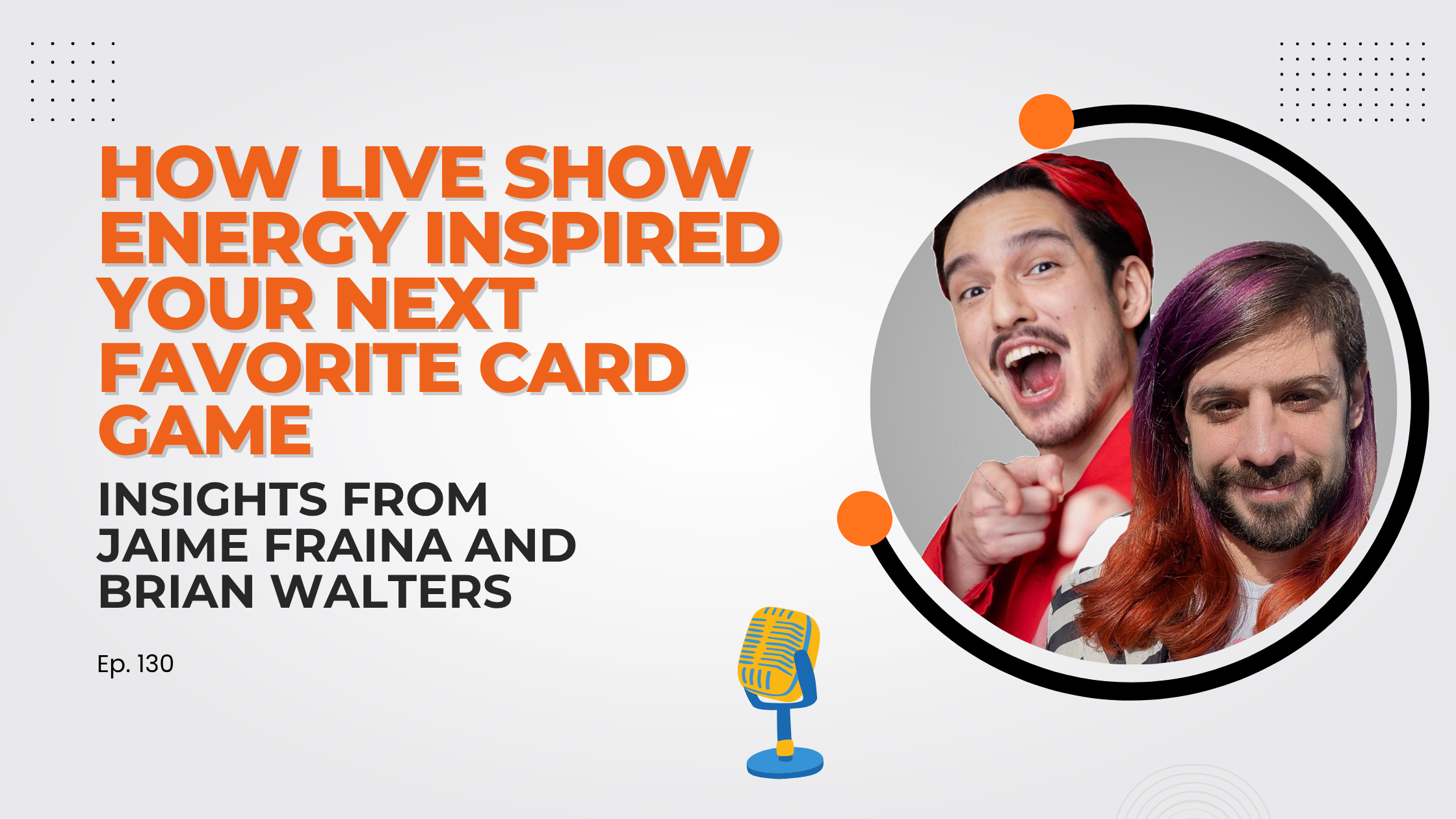
Welcome to an exploration of how the energy of a live comedy or game show can be translated into a tabletop or card game. The process isn’t just about copying; it’s about preserving excitement, humor, and interaction in a new format. We’ll explore this fascinating intersection based on a discussion with industry insiders involved in bringing the Japanese-American game show BATSU! into the world of card and mobile gaming. Whether you’re a game designer, a toy industry professional, or simply curious about how entertainment transforms, this article offers actionable insights into creating compelling games that echo the spirit of their live counterparts.

#130: From Stage to Shelf: A Game Show's Card Game Journey – Toy Business Unboxed
Episode Highlight
- 00:00 Welcome and Introduction
- 00:25 Transforming Live Shows
- 00:51 BATSU! Show Origins
- 02:58 Live Show Experience
- 04:17 Show Duration and Format
- 06:00 Designing the Card Game
- 08:10 UX Design Influence
- 09:02 Playtesting Adjustments
- 10:34 Cultural Authenticity
- 13:18 Game Rules Overview
- 22:58 Advice for Newcomers
- 23:27 Where to Connect
The Power of Live Entertainment: Capturing the Essence in a Box
Transforming the high-energy experience of BATSU! into a card game required confronting a core challenge: how do you capture spontaneity, humor, and physicality in a static format? The physical elements of BATSU!, like paintball punishments or shock collars, are impossible to directly translate. Instead, the game design prioritizes the humor and social tension that make the show engaging. This is achieved through silly challenges, role reversals, and consequence mechanics that evoke the same atmosphere of playful risk. The goal was to preserve the show’s unique vibe without losing what makes it exciting.
The Evolution of Translating a Live Show into a Game
The journey began with a simple prototype: a deck of paper cards representing challenges. Early versions were rough but set the foundation for refining gameplay. The designers developed a judge and loser mechanic, inspired by Cards Against Humanity, where players avoid being the worst rather than competing to be the best. This shift helped maintain the show’s humor and energy while making it approachable for a wider audience. Instead of physical punishments, players face embarrassing or silly penalties like pretending to be a tree or doing a goofy dance, keeping the spirit of the show intact.
Balancing Authenticity and Accessibility in Game Design
A key challenge was keeping the game true to the Japanese roots of BATSU! while making it accessible to diverse audiences. Cultural authenticity was maintained through subtle language puns and manga-style illustrations that reinforce the show’s identity. The language shifted away from punishments to consequences, reducing perceived severity and increasing mass market appeal. Challenges were also reworked to be physically inclusive, working for players in wheelchairs or with different abilities. This balance between authenticity and accessibility became one of the most important pillars of the design process.
From Stage to Screen: Creating Synergy Across Formats
One standout lesson is the synergy between the live show and its game versions. The designers drew directly from the show’s mini-games, translating improv challenges into card-based equivalents. Physical scenes and props became acting challenges, and the judge mechanic mirrored on-stage decision-making. Consistent visual styles inspired by the live show reinforced branding across formats. Challenges were designed to evoke shared experiences for fans while remaining accessible to newcomers, ensuring broad appeal.
Navigating the Cultural Divide: Making Japanese Humor Work for All
Adapting Japanese humor, especially the concept of Batsu, into Western markets meant rethinking how to communicate game mechanics without alienating unfamiliar players. Physical punishments are funny due to their visual and physical absurdity, but that doesn’t always translate across cultures. Framing them as consequences or fun penalties, and emphasizing their playful nature, helped broaden the game’s appeal. Visual cues like manga-style art and onomatopoeic text were used to convey emotion and humor subtly. This approach allowed the game to honor its cultural roots while welcoming a global audience.
Lessons in Iterative Design and Player Engagement
Feedback from playtests and audience observations drove continuous refinement throughout development. Early versions had punishments that were too intense, prompting a shift toward milder and more inclusive challenges. Mini-games were adjusted to suit small groups of two to four players as well as larger parties of eight or more. Adding house rules for two-player versions and team-based gameplay further broadened the game’s appeal. Iterative testing proved essential in shaping a final product that felt both authentic and fun for a wide range of players.
Advice for Newcomers in the Toy and Game Industry
Creating games that bring live entertainment to every table starts with focusing on the emotional core: the energy, humor, and unpredictability of the live show. Use visual and thematic cues to reinforce branding and authenticity throughout the design. Be prepared to adapt elements for cultural and audience differences without losing the essence of the original. Emphasize fun, inclusive challenges that evoke the same sense of playful risk. Continuously test, gather feedback, and iterate to refine the experience and ensure it resonates with your audience.
Conclusion
Transforming live entertainment into engaging tabletop games requires a delicate balance of preserving the original energy and adapting it for a new format. By focusing on the emotional core, incorporating cultural authenticity, and embracing iterative design, creators can craft games that resonate with diverse audiences. The journey from stage to screen is filled with challenges, but with creativity and insight, it’s possible to capture the spirit of live shows in a way that entertains and connects players around the world.
Connect with Jaime Fraina and Brian Walters
If you’re interested in learning more about Get BATSU! or connecting with Jaime Fraina and Brian Walters you can reach out through the following channels:
- Website: Visit Get Batsu’s official website to purchase the card game.
- Website: Visit Giant Fox’s official website for the latest news, game updates, and more.
- Instagram: Follow BATSU! on Instagram for updates and show info.
Transcript
Jason Hsieh (00:00)
Welcome back to another episode of Toy Business Unboxed and your host Jason Hsieh. Today we are diving into a very interesting conversation, which is an intersection of live entertainment and tabletop game design. We’re joined by Jaime principal designer for Monopoly Go and the founder of Giant Fox Studios, and Brian, host for BATSU! a hilarious Japanese-American-fused game show. Today’s interview will be walking through…
the journey of transforming a high action live experience into a party card games from early development to challenges they face and updating the game’s visual and syncing it back to the live stage experience. So thank you so much for both of you for being on our podcast today.
so first of all, Jaime, can you share on how you even got involved with the BATSU! show and how do you turn the show into a card games?
Jaime Fraina (00:51)
Yeah, for sure. So BATSU! is a live show in New York and Chicago. They’ve also had shows in London, different festivals around the world. And I saw it back in 2012 in New York City while I was living there. After the show, the cast is all very approachable. They’re all like, come on up, say hi to us. So I went on up there, told them I’m a game designer. And they immediately were like, I want to be in a video game.
So we actually started off with a mobile game version of BATSU! way back like over a decade, know, 13 years ago at this point. I see. And we tried it out. It worked OK. It was kind of like Jackbox game sort of style where there’s a little challenge. Everybody does their thing and you know what the mobile platform though you’re not in person with each other. It was like I record my little
thing that I’m doing and then send it off. And the comedy of BATSU is way more enjoyable when you’re in person. Because if people aren’t familiar with the term, BATSU means punishment and penalty in Japanese. So during the live show, these comedy warriors get punished if they aren’t funny. it’s funny for the audience either way. But if you’re not in person and you don’t get to see the
actually, you know, reaction of that person getting punished in person. It’s just, doesn’t hit the same, you know. So years later, during the pandemic, when the BATSU! show had to temporarily shut down, we kind of came back around to the idea of, hey, know, board games are picking up, people are all in their living rooms. Maybe we converted over to a card game version of it. And I think I still have the…
the little original prototype of it was this little deck of cards, know, just paper, paper pro typed it, you know, cut it out and everything looks very different than it does today. But yeah, we kind of started with that and then went from there.
Jason Hsieh (02:47)
I see. And Brian, can you also kind of elaborate on exactly the kind of the experience that the show is trying to provide to the live audiences?
Brian Walters (02:58)
So BATSU is a live dinner show in Chicago and in New York City where audiences can come enjoy eat, eat some sushi, enjoy some sake. And while they’re enjoying their meal, they watch some comedians go through challenges. If those comedians don’t make the audience laugh or if they fail a challenge, they have to get a BATSU!. They have to get punished.
Punishments range from physically painful punishments like getting shot with a paintball marker close range to hand in mousetraps to a shot collar on the neck. And then we do have some volunteer opportunities as well, which aren’t physical punishments. They’re more embarrassing punishments. You’ll have to come to the show to check those out.
One thing that is super interesting to me is that we have all of these physical elements in the show. We can’t fit a paintball marker or an electric shock into our card game box. So we had to do a lot of problem solving ⁓ from the get-go of how do we make this entertaining? How do we bring that same quality that we bring to the show to
the card game form.
Jason Hsieh (04:17)
I see, I see, I How long is the typical show?
Brian Walters (04:20)
the experience starts at seven o’clock. The game show portion will start around seven thirty and then because it is improv based is a little bit fluctuating in terms of the end time. But you’ll be out probably around from seven to nine or so.
Jason Hsieh (04:36)
I see, I see, I see. And what was it like for you to see your live show get translated into like mobile games and card games format?
Brian Walters (04:44)
Oh my goodness, so exciting. I have to say that if it weren’t for Giant Fox and studios and Jaime, I don’t know if we would have been able to survive the pandemic. You know, those two years of us going dark were very difficult for us. And yeah, it gave us a lot of hope as well that
you know, whenever we do reopen again during that time period, that people are still interested in our product. So it was really cool to see once we did the Kickstarter campaign for the original card game during the pandemic, that there were people interested. And then we started getting some more for just the card game and people not knowing about the show.
Jason Hsieh (05:33)
I see, okay.
Brian Walters (05:33)
So
my favorite thing has been the synergy of the show promoting the card game and now the card game at different conventions and different game shops, they promote the show. So great synergy there.
Jason Hsieh (05:48)
Yeah, and I guess I have a question for you, Jaime. It’s like when you first designed the game, how do you maintain some of the humor and the energy of the impromptu version of the show into the game design?
Jaime Fraina (06:00)
Yeah, great question. We’ve went through a lot of different iterations of it to kind of land where we are today. Where we are now is a kind of cards against humanity style. You know, there’s a judge each round, but instead of picking a winner, they’re going to pick a loser. Now the loser is gonna get the BATSU! I like to say you don’t have to be the best. It’s okay to be mid. It’s okay to be average. Just don’t be the worst. Otherwise, punishments kick in.
So I went to a bunch of the live I saw it a few different times. I even took one of the improv classes that the founders are running. I learned a lot about the games, you know, they play on the show in their free time. We had a lot of conversations of like, OK, well, how does this mini game feel? How will we translate our little schoolyard rap game from the live show?
into the card game version of it. A lot of people feel a little put off by the word improv, I find, when they’re looking at a card game. D &D players, tabletop players, they’re more okay with breaking out of their shell. But a parent buying something for their kid or even college kids looking for a game for their parties, improv, the theater kids will like it. But else, it’s a little off-putting. They might not feel like they’re good about
at it, they might feel that they’re, you know, a little scared about it. So we’ve now kind of pivoted to be more of like, silly challenges, you know, ridiculous things to do. So not using the word improv and kind of putting it, you know, through that lens of making it more casual, more approachable. It’s it’s not like you have to come up with the most difficult phrases and think really deeply about this.
storyline, it’s okay to just be like a little, just silly little lines here and there. We’ve actually put bad jokes on the cards to make people feel better about the jokes they can do.
Jason Hsieh (07:53)
I see.
I see. Okay. And I know you have tons of experience in mobile game design as well, being part of the project for Monopoly Go, which is a hugely successful as well. How does that experience influence the way you’re designing the physical version?
Jaime Fraina (08:10)
Yeah, yeah, for sure. So I’m on the UX design side of the design team over here and really focus on designing things in a user centric way, understanding who our players are, what are their motivations, not breaking them down by demographic, but like what actually gets them to come back? Are they achievers that want to check off all boxes, finish up all their quests?
Are they more socializers that wanna connect with people instead? thinking through who are the personas that go see a BATSU! show and then the personas of who plays cards against humanity and trying to find a little bit of that overlap there and finding the fun that they both enjoy.
Jason Hsieh (08:54)
I see, I see, I see. Was there any early design decision you have to like get rid of once like playing play testing with actual player?
Jaime Fraina (09:02)
Yeah, some of the punishments were too much. Yeah, tone it down a little bit, you know, different freezings of things, making it more inclusive for different types of audiences. People who are disabled, you know, they might not be able to be as physical. So we tried to really make all the cards work, you know, even if you’re in a wheelchair. So really adjusting, the challenges, the
Jason Hsieh (09:06)
It’s too much.
Jaime Fraina (09:28)
the punishments, everything in the game to work with the audience that will actually play it.
Jason Hsieh (09:33)
Got it, got it. What were some of the early challenges when you started working on this product?
Jaime Fraina (09:39)
Let’s see, just finding, I think, the different mini games that worked for the group sizes. Some of them were really good for just a couple of players. Some were a lot better when you had a bunch of players. And kind of adjusting it to be like that nice party game, four to six players, most likely. We also have had some people wanting to play two player version.
of the game and you know, a game like Cards Against Humanity, typically you need that judge player. So we recently added in two player rules for you just try to get the other person to laugh. You try to do something so ridiculous that you break the other person so it’s whoever can be more serious, you know, kind of silent library sort of thing.
Jason Hsieh (10:20)
I see. That’s an interesting kind of a twist on the game mechanism itself. And I guess I have a question for you, Brian. It’s like, how hands-on were you and the cast in like shaping and designing some of the game content alongside with Jaime’s team?
Brian Walters (10:35)
Yeah. So of course, as Jaime mentioned, know, Jaime came to our show a lot of times and, we started communicating with Jaime and the team and, I believe that for me as a half Japanese individual who grew up in Japan and ⁓ experienced a lot of
Japanese game shows and culture, it was really important for me personally to create an authentic Japanese game show experience for the card game. And so through communication and through drafts and such, you know, we would always check in and say, is this authentic when it comes to the show?
is this authentic when it comes to Japanese culture or Japanese game shows? And so that’s how I feel we contributed in terms of making it authentic to those categories and those cultures.
Jaime Fraina (11:31)
Yeah, Brian wrote a bunch of the little Japanese jokes kind of along. Like in the artwork, there’s, you know, kind of different phrases and puns and things. And I don’t really know what they say, but I know that there’s funny things. Brian wrote them.
Brian Walters (11:43)
Yeah. Well, our updated newer version of the game, our 2.0 version, has a lot more manga style drawings and such. as we got the… There we go. It’s the bento box there. But there are certain things in…
Jason Hsieh (11:58)
Yeah, this is the new version.
Brian Walters (12:04)
Japanese manga or animation where, you know, for example, three blue lines means someone’s like really sad or like upset, you know, like little sweat drops are like someone’s stressed out or, you know, so was like, when we were getting these drafts of the drawings for the cards, I’m like, if we just add these details, this will make it so much more
Jason Hsieh (12:31)
I think we lost you for a minute, Brian So I think he will come and rejoin.
Jaime Fraina (12:38)
Yeah, I can kind of show you though, like, I think like this card where someone has to, as a punishment, stand up like a tree and wait until they get a hug. There’s a little Japanese text there. And, you know, if you don’t know Japanese, I think it says like guys, like somebody just kind of left him there. So just like subtle little things like that in the background.
I’m not sure what this one says where you have to put ice in your pants, but
Jason Hsieh (13:05)
He says “Samui” means cold in Japanese
Jaime Fraina (13:08)
okay, see, exactly. It’s just cold. There’s just silly little things like that around. Yeah.
Jason Hsieh (13:14)
And while you have the game, can you also explain the game rule really quick
Jaime Fraina (13:18)
Yeah, for sure. each round starts with the judge drawing a challenge card. So the challenges are all sorts of different things. you know, cards against humanity is always kind of fill in the blank. So we have the rules kind of split up on the different challenge cards. So each one is very different from the others.
for example, you might be doing something a little bit more physical props here. It says to draw a place card and then, act as props in that place instead of the actors of like a scene. The players are the props. So we have people, places or things. So I’m to draw a place card. and so it’s a skyscraper. So then the players would each try to be a prop that would be in like a skyscraper scene.
they might try to be a fax machine. They might try to be a laptop or like water cooler doing silly little things you might see in an office in a skyscraper. and then the judge picks not who did the best, but who did the worst at it. It’s like, that was not a very convincing, ⁓ chair you did there. so then that player would have to grab a BATSU! card, which could be, you
dance for a minute with no music and just kind of like awkwardly doing it or act like a dog and beg for some pets. Things like that. Not like the paintball guns and tasers they do on the live show. It’s kind of a little bit more mild, sometimes physical, sometimes just embarrassing things. Yeah.
Jason Hsieh (14:40)
I see, I see, see. And how does the game end?
Jaime Fraina (14:43)
Yeah, so whoever got the BATSU last round is now the judge and you play however many turns as there are players. There’s like a set amount of turns and you know, kind of just keep switching off the judge. At the end, it’s whoever has the most BATSU’s lost and everybody else won.
Jason Hsieh (15:00)
okay, okay, okay. Got it, got it. That’s interesting. And what is the recommended amount of player to participate?
Jaime Fraina (15:06)
⁓ I’d say like five, four or five is ideal, but we can play, you we just added those two player rules and we’ve done up to eight people and even we’ve done like kind of team based after that if there’s more players too.
Jason Hsieh (15:19)
How do you balance some of the overall and some of the gameplay that you just showed us still being aligned with the live version?
And what are some of the feedback you have been getting for the people that actually went to a live show and also get the games?
Jaime Fraina (15:35)
The live show bunch of the different mini games and quite a few of them in the board game are very inspired by them. They’re pretty one-to-one of like the exact rules they play on their improv show converted really well to the card game. So people who have seen the show kind of recognize like…
Oh, it’s always fun to now. You know, I’ve seen it on the live show. I could go home and play it with my kids. You know, the same exact And the the other side of it, too, is like the visual side and kind of the branding of in a visual way. So we have like the the original box here is very one to one to the like BATSU! live show branding. Pretty minimal. Just kind of the black.
white-red sort of colors. And of course, Mr. Chicken here, one of the characters, he throws eggs at the contestants. But this didn’t really pop well on store shelves. It was a little kind of simple compared to some of the other games in the party genre. There are games like Cards Against Humanity, and it doesn’t do terrible. It’s just…
could be more, could be calling more attention to it. So we worked with them a lot to kind of identify what we could play with, how far we could go. And we were able to go pretty far away and make it this sort of new manga, city pop, but still our own branding style.
Jason Hsieh (16:56)
I like the new design a better. It’s a lot more catchy. It kind of pop up on the shelf a lot more than the older designs. It’s kind of hard to know exactly what they are looking at.
Jaime Fraina (17:07)
Yeah,
you don’t know, you don’t get the vibe of the game from just this. Like if you get it on the show, you’d have no idea what this is. While this is like, oh, energy, something fun, know, silly card game is like coming across right away. Yeah.
Jason Hsieh (17:19)
For sure, for sure, for sure. I think the new design is actually much better than the original one.
Jaime Fraina (17:25)
Yeah, so getting there took a bit though, because like we were very much like, no, this is the brand we can’t stray too far away from that. But after, you know, kind of some iterations, we’ve we’ve landed on the game having its own kind of identity. And even in the live show now, they’re starting to integrate this new style into some of their posters. And the game is kind of informing the live show a bit more, too. So there’s this synergy back and forth like Brian was mentioning.
I think for another big aspect of the live show is this punishment, right? And they’re very forward with like, hey, you’re gonna watch actors get punished. And people sign up to be in the audience and some people sign up to actually be a volunteer on the stage. But when you’re actually playing the game, it’s a different.
feeling because now you’re the one at risk of the punishment. you know, it’s not like you’re watching somebody and enjoying, you know, that, comedy now it’s you’re experiencing it. So the word punishment also has been a little bit off putting for, some users. And we’ve been playing around with like, different kinds of taglines, focusing more on the party aspects, focusing more on, the silly challenges and still,
talking about the punishments or penalties. Yeah, there’s a few other words we’ve started using instead of punishment for it. Consequences, things to kind of just help with that as soon as you read it. Expectation for what it is.
getting people to not feel like, ⁓ I don’t know if I want to play that because it seems scary, you know. It’s okay. It’s mild. It’s nothing too bad. You just stand up and look like a tree for a bit. It’s nothing too bad.
Jason Hsieh (19:03)
It’s kind of like the balance, but if there’s no punishment, you kind of lose the essence of the game also.
Jaime Fraina (19:09)
Exactly. we still it’s essential to the brand, but also slightly scary for some users. Some people are like, sign me up. Let’s go. But others, if we want to go more mass market, more casual, we have to make it approachable for them. We also have a rule of like a house rule, like a backup punishment. If people don’t want to do what’s on the card, they can just whatever they’ve decided at the beginning of the game. Usually it’s take a shot. ⁓
We definitely have drinking game rules here. One of the expansion packs is the thirsty pack here. So all sorts of silly little drinking inspired challenges and punishments.
Jason Hsieh (19:36)
It’s become a drinking game, okay.
I see, see. Well, Brian, thank you for joining us back on the stream here. And I have a follow up question for you because actually my wife is Japanese and I used to live in Japan for five years. I don’t know if Jaime mentioned that to you already, but I’m kind of familiar with the Japanese culture as well. I think one of the struggles is like how, like, I don’t know if you also experienced that when you’re running the show, like.
How do you translate some of the Japanese humor for the American audience, which they have no clue what’s going on sometimes?
Brian Walters (20:21)
Yeah, so I think the aspect of the Japanese culture that we’ve been working with is that it’s the punishment aspect, you know, it’s the batsu aspect. A lot of the humor, like the quick wittedness or the verbal humor is more American style, short form improv. So
I think the beautiful thing about BATSU! game in general is that physical punishment when it’s not too bad is kind of universally funny. You know, anyone will kind of chuckle when they see somebody slip on a banana peel and not get seriously injured, you know. So it’s kind of that aspect of,
are comedians getting punished that feels like the Japanese culture, Japanese aspect of our show.
Jason Hsieh (21:07)
I see. Okay. Thank you for sharing that piece of insight as well. Any interesting story that you would like to share with the audience since you have been running the show for so long? Any interesting happening that happened during the improv?
Brian Walters (21:21)
I mean, there’s so many. In New York City alone, we’ve done 2,600 shows. So many iterations of crazy stories I could think of. But a fun positive one recently was that we had Neil Patrick Harris, the actor and comedian.
He celebrated his 50th birthday, at our show. And we were able to celebrate it at midnight. Like when he became 50, that was a great, memorable moment. And he was such a class act and he had to do the body sushi, punishment.
Jason Hsieh (21:57)
Can you explain the body sushi punishment for the listener that doesn’t know what it is?
Brian Walters (22:02)
Yeah,
it’s we have a body sushi model come out and they lay down on a bench, but it’s not the typical body sushi model that you might be envisioning or fantasizing about. It would be someone a lot hairier and a bit larger than your typical body sushi model. And
Yeah, we do a whole demonstration with sauce and sushi rolls and then we do it right in the belly button as well. The sauce goes in the belly button and we do an extra little bonus challenge for them to get a free pitcher of beer. Yeah, it’s a crazy punishment.
Jason Hsieh (22:43)
I see that sounds really fun. So, okay. Thank you so much for sharing that piece of story. So as well wrapping up the final question I have for you is actually for Jaime is if you have to share one piece of advice with someone that’s getting started, we in the toys and game industry as a whole, what would that be?
Jaime Fraina (22:59)
Yeah, just make stuff, try it, make a bunch of different things. I’ve worked on over 200 different games at this point. Some of them didn’t make it very far. Some of them ended up making 5 billion in two years. So, you know, wide range of things, but you know, you got to keep trying with stuff. Make little paper prototypes. You see a fun show.
Talk to the cast afterwards and see if you can make something together. Doesn’t hurt to try and never know where it’ll go from there.
Jason Hsieh (23:27)
I see. Okay. Thank you for that piece of advice. And where can our audience find you and your company online?
Jaime Fraina (23:33)
Yeah, if you want to check out the card game, it’s getbatsu.com. You can order copies of it right then, And then we have a upcoming Kickstarter for the new art version, which will be batsukickstarter.com. So those are the two for BATSU! And then for my video game sides and Giant Fox, would be giantfoxstudios.com.
Jason Hsieh (23:53)
Okay, and Brian, for people who want to learn more about the show, where can people find more about the show?
Brian Walters (23:58)
Yeah, you can follow us on Instagram at batsulive or you can just Google BATSU! and you can check out our show in New York City. Tuesdays through Saturdays, we do seven shows a week and then in Chicago, we are in Old Town at Kamehachi three shows a week, Thursdays through Saturday.
Jason Hsieh (24:18)
I see. Okay. Thank you for sharing that. We’ll make sure we put that in the show notes. And for our listeners, thank you so much for tuning in to this episode of Toy Business Unboxed podcast. We hope you have enjoyed today’s conversation and find it insightful and inspiring. If you like what you have heard, be sure to subscribe to our podcast on your favorite platform so you never miss an episode. We really appreciate your support and would love it if you can leave us a review and share the podcast with your friend and colleague. For more resource, tips, and the latest update within the toys and game industry.
visit our website at toy-launch.com. Join the conversation and connect with us on social media using #toybusinessunboxed. We’d love to hear your feedback and suggestions for future episodes. Until next time, keep innovating, keep creating, keep bringing joy to toys. This is Jason Hsieh signing off on the Toy Business Unboxed podcast. We’ll see you in the next episode. Thank you so much, everyone.
Ready to grow your game brand on Amazon and beyond?
Toy Launch manages Amazon, digital marketing, and in-house studio for toy and game brands — all under one team.