
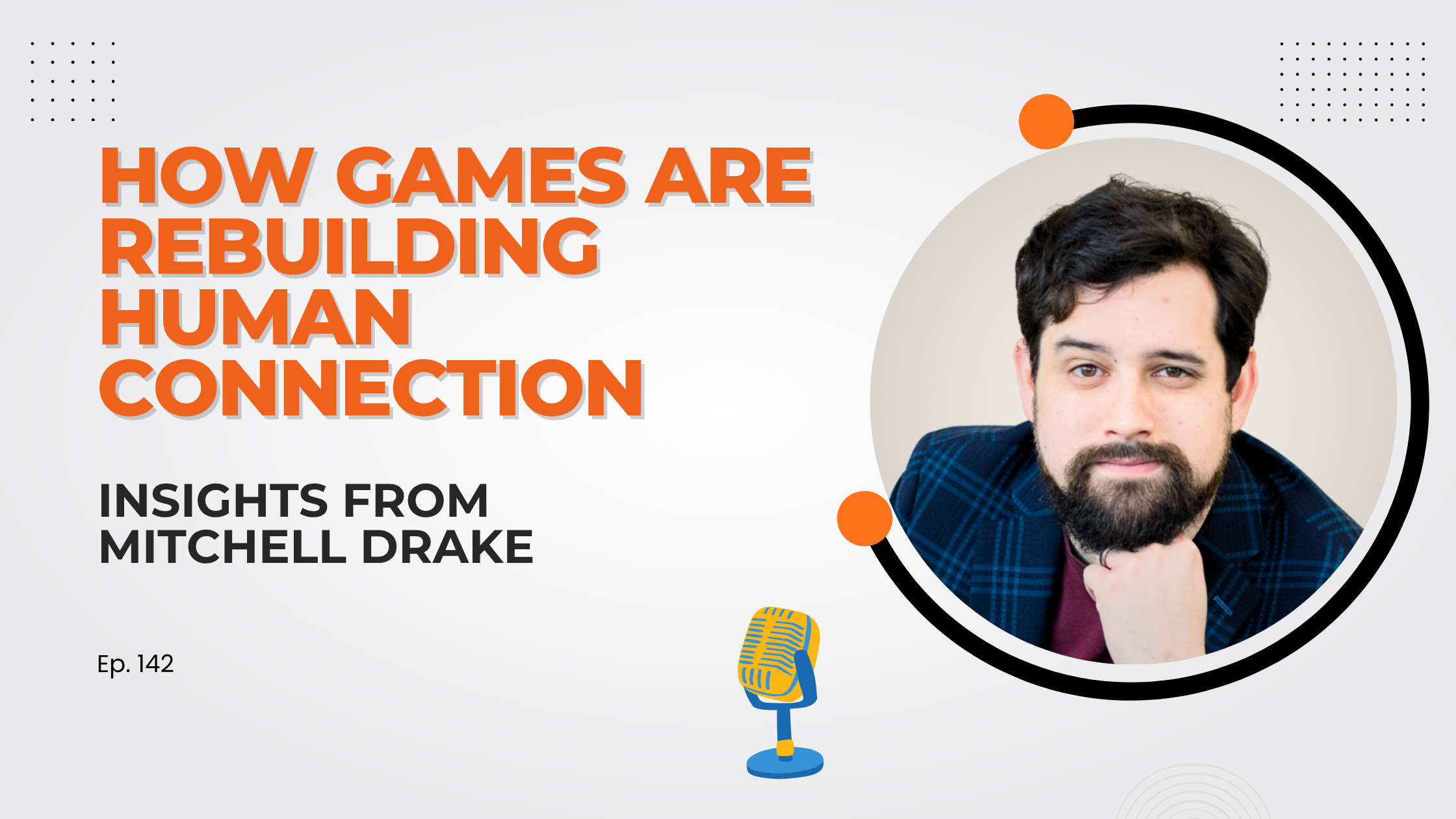
Welcome to an exploration of the creative journey behind game design, featuring insights from Mitchell Drake, owner and lead designer at MADgical Productions. This episode delves into the passion and strategy that drive the creation of engaging tabletop games. From the inspiration behind his projects to the importance of playtesting, Mitchell shares valuable lessons for aspiring designers. Discover how personal interests shape game mechanics and how effective marketing strategies can bring your creations to a wider audience.

#142: Why Play Is More Than Just Fun: The Hidden Power Behind Game Design – Toy Business Unboxed
Episode Highlight
- 00:00 Intro to Mitchell Drake and MADgical Productions
- 00:39 How Magic the Gathering Inspired Mitchell’s Journey
- 01:19 Origins and Vision of MADgical Productions
- 01:54 Creating Celeste and Its Core Mechanics
- 02:36 Balancing Luck vs. Strategy in Game Design
- 03:43 Mitchell’s Unique Sci-Fi Factions
- 04:53 Designing Celeste and Faction Balance
- 05:07 The Playtesting and Iteration Process
- 06:32 Addressing Balance and Avoiding Over-Tweaking
- 07:04 Designing for Different Ages and Mindsets
- 08:02 Using Games to Bring People Together
How Personal Passion Drives Game Development
Mitchell Drake’s journey began with a lifelong love for video games, tabletop adventures, and the social side of gaming. Nightly sessions of Magic: The Gathering with friends showed him early on how games can build real connection and community. That passion, combined with a deep love for science fiction, shaped his first major project, Celeste, a deck-building game featuring four factions: humans, aliens, robots, and a mystical life force. For Mitchell, personal interests aren’t just inspiration, they’re the foundation of authentic game design.
The Iterative Design Process: From Concept to Balance
Designing a game isn’t a one-and-done task. Mitchell’s approach involves starting with a rough idea, then repeatedly testing, refining, and balancing. His method includes creating rough prototypes using simple materials like paper and cards, playing against himself or friends to identify flaws, recording game outcomes in spreadsheets to see which strategies dominate, and inviting skilled playtesters like a Dungeons & Dragons min-maxer to break the game and reveal balance issues. This process helps Mitchell ensure each faction in Celeste offers a distinct and balanced experience, so players can identify with different strategies without feeling overwhelmed or frustrated.
Crafting Games for Different Audiences and Building Community
Understanding your target audience is critical. Mitchell starts from a foundation of players he knows, families, college students, casual party-goers, and designs games accordingly. His party game Get With It exemplifies this approach: easy to learn, accessible for all ages, and capable of spontaneous drop-in/drop-out play. One standout example of game design for social bonding comes from a recent party where Mitchell’s Get With It helped strangers become friends. Despite different social circles, the game facilitated interaction among eight or more players, blending into what appeared to be a single, unified group of friends.
Strategies for Marketing and Growing Your Game Presence
Creating a great game is only part of the journey; marketing makes it accessible. Mitchell leverages local events like Phoenix Fan Fusion and the game expo in April to showcase his products. He also maintains an active online presence through platforms like X (Twitter) and Instagram, alongside a dedicated website. This multi-channel approach helps reach different audiences: local attendees, online communities, and industry insiders. Mitchell stresses the importance of attending conventions, engaging with communities, and sharing stories about the game’s development, elements that foster authentic interest and loyalty.
Future Visions: Expanding and Customizing Games
Looking ahead, Mitchell plans to expand his current titles with new packs and chapters, like the Celeste story expansions and Get With It themed challenges. His focus is on creating flexible, customizable experiences that deepen engagement and storytelling. One interesting project in development is Like, Oh no, my bones!, a family-friendly skeleton-themed game with a Halloween twist. Featuring a modular board and simple mechanics, Mitchell envisions this as a fun yet strategic game that appeals to kids and adults alike.
Advice for Newcomers in the Toy and Game Industry
The core of Mitchell’s advice is simple: prototype quickly, test often, and know when to release. He strongly discourages over-polishing early versions, advocating instead for rapid iteration and real-world feedback. His philosophy is that no game will ever be truly perfect, so designers should aim for a solid, playable state rather than chasing endless refinements. Once the game is good enough to share, getting it in front of real players is far more valuable than another round of tweaks. Community feedback, not internal polish, is what shapes a great game.
Conclusion
Cathy and Marie’s journey from a family game night idea to a successful indie business is a testament to the power of creativity and determination. Their innovative approach to game design and commitment to inclusivity have set them apart in the industry. Through collaboration, strategic marketing, and a passion for fun, they continue to grow their brand and inspire others. Their story serves as a reminder that with perseverance and a supportive network, anything is possible in the world of toys and games.
Connect with Mitchell Drake
If you’re interested in learning more about MADgical Productions or connecting with Mitchell Drake you can reach out through the following channels:
- Website: Visit MADgical Productions’ official website for the product, latest news and more.
- Facebook: Follow MADgical Productions on Facebook for visual updates and creative inspiration
- Instagram: Visit MADgical Productions on Instagram for visual updates, game previews, and creative inspiration.
Transcript
Jason Hsieh (00:00)
Welcome back to another episode of Toy Business Unboxed. Today’s guest is Mitchell, a creative MADgical Productions, a lifelong fan of video games, tabletop adventure, and everything in between. Mitchell has turned his passion a purpose, which is designing games that connect with people. As the owner and the lead designer, he’s on a mission to prove that play isn’t just about fun, but it’s also fundamental to human relationship. Thank you so much for joining us on the podcast today.
Mitchell Drake (00:27)
Yeah, thank you for having me. Appreciate it.
Jason Hsieh (00:29)
Yeah, so as we start today’s kind of conversation, can you kind of share with the audience what was the first game that, you know, make you fall in love with like the tabletop industry?
Mitchell Drake (00:39)
I grew up playing board games with my family and everything, but Magic the gathering that got me really deep into the board game card game world. And because I’m best friends with two guys today, we knew each other in high school, but we become friends until after high school because we’ve had nightly magic nights and we all learned the game together and we all got together. And it was every day. It was like poker night.
Jason Hsieh (01:02)
I see.
Mitchell Drake (01:03)
Yeah, and again, we knew each other. We didn’t really know each other as friends. I don’t know what I’d do without those guys. And so I don’t know what I’d do without Magic the Gathering. It’s really what brought my friend group together.
Jason Hsieh (01:12)
I see, I see. And can you also tell us a little bit about the origin story behind the current publishing company that you also run?
Mitchell Drake (01:19)
So starting around when COVID-19 happened, I had an idea while I love Magic the Gathering, it has some issues. And I sought to choose and also create a science fiction game because I’m more of a science fiction fan than a fantasy magic kind of person. Even though I do enjoy those, I just prefer science fiction. And
I didn’t want to make a one-off game. decided I wanted to make a company because I’m sure there’s other ideas I’ll have. And that’s the idea of magical productions. I made it specifically production so it’s not limited to just games.
Jason Hsieh (01:49)
I see. And what was the first game that you worked on? or first product that you worked on?
Mitchell Drake (01:54)
Uh, so at first, before I was officially calling it a company, I was just, I was taking a game and just kind of coming up with, Oh, what if the elves were this or what if the dwarves are that making a science fiction? And I found that I ended up changing so much that it was a completely new game and ended up just coming up with a whole brand new one. and I’ve actually got sitting right here. Um, Celeste and it’s a science fiction deck building game.
where you play as four different factions and then wage war each other. And that carried through COVID, ⁓ that design process. But yeah, that was the first one.
Jason Hsieh (02:32)
OK, OK, so that’s kind of like a deck building game, right? First one.
Mitchell Drake (02:36)
Yeah, yeah, right now it’s a self-contained game. So per box you get all four factions with issue I don’t like with magic is that very dependent on what your opening hand is. And there’s a lot of luck in that. With Celeste it’s dependent on how you build your game engine or your strategy rolling.
Jason Hsieh (02:53)
I see, see, I see. How fast is the gameplay? Usually how many minutes is it?
Mitchell Drake (02:59)
Well, I mean, that’s kind of the funny thing. But I’m sure people who play Magic the Gathering know the same issue. You have two people a game in 20 minutes easily. You get three people and suddenly that might take 30 to 40. Four people. The game goes up to four. It could take two hours, mostly because some people have to go up and go to the bathroom. Other people want to go get a drink. Two people start having a side conversation.
If you were if you were actually dedicated and playing the game you could easily play with four people in under and hour.
Jason Hsieh (03:30)
OK, under an hour for four people. OK, that’s not too long. I see. And what are some of the other kind of characteristics that you feel like you make your game a little bit more unique compared to the rest of the product in the market?
Mitchell Drake (03:43)
So a lot of other science fiction games, they focus on like one aspect of sci-fi. You might be humans fighting robots, robots fighting humans. You might be humans fighting aliens and just things like that. I’m a kind of conglomerate of science fiction. So the four factions are the humans, of course. It would be hard to have a game without that.
But then you have the aliens and they’re the in technology, superior and intellect kind of group. So they play a lot. And then the robots that took a lot of inspiration from famous movies with robot were Terminator in specific. But the idea is that they’re heavy hitters. There’s a lot of them. They die easily. Like one human soldier could take five of them out. But that one robot gets a hit. It’s going to take out the human.
just a never ending swarm of guys coming at you. And then I also wanted some mystical element in there. There’s got to be some mystery in the story. So the fourth faction comes in. It’s kind of like the force in Star Wars in that there’s like there’s no explanation of how it fits in the physics, but it’s there. And it’s the it’s the living life force of the planet. the most unique one.
You actually play as the planet itself.
Jason Hsieh (04:51)
Okay, I see, I see, I see.
Mitchell Drake (04:53)
Yeah.
Jason Hsieh (04:54)
And how do you design the game initially? How do you came up with the idea and also the dynamic between the cars and make sure all the cars have enough balance? Can you also walk us through your design process?
Mitchell Drake (05:07)
So when I sat down to design the cards, I came up with just an idea of how I wanted the game to flow. then I threw down ideas I read several books on game design and one of the top tips was play test. Even if it’s you playing against yourself or you playing with a friend, you need to be able to play test and be able to change it on the fly.
Play a quick round, oh, that doesn’t work. Make changes around. and that way you can try to, you know, tease out what, what is important and what things aren’t going to work. So honestly, what I did was I took, with magic, the gathering cards at home and then cut out like nine sheet of paper and just wrote the name and a brief description of just kind of what it does and just slipped it over to the top.
OK, I could actually have a deck that I shuffled and everything and I sleeve them according to what group they were. The life force red was a lot. So I could. Yeah. And then I ended up creating a whole spreadsheet that said four games against each and kind of record how the games go. And that’s the initial idea. And then I pretty it up the prototypes a little bit and I showed friends and.
One of my a min-maxer in Dungeons and Dragons. He absolutely loves to break games and he finds it fun to Do that. So I told him, have at it, tell me what’s wrong. And sure enough, Hey, you know, if you do this one specific thing, you’ll win every single game. And I’m like, I need to find kind of a way to balance that out because that once that catches on the game needs to be.
refined before it gets released. find with a lot of video games, digital card games these days, it feels like they go and cheat. They’ll release the thing and then just update the game. I want, you know, once it’s printed it out there, you can’t change it. I need to make sure that the quality was a top notch and that all four factions felt balanced. I want people to fit in which faction that they play, they identify with.
Jason Hsieh (06:42)
Hmm.
I see, I see. When you come up with a design, do you design with a certain group of people or like a particular age group in mind as well?
Mitchell Drake (07:04)
⁓ yeah, so particular age group, the, whole reason I wanted to do that especially after COVID, it happened to coincide with COVID. wasn’t because of COVID, but it was, people getting together, kind of like a magic did with me and my friends. And so I started with what I know magic gathering style game, complicated, competitive. the second game I made was a college party.
very loose rules meant to be fun move one town to the next and it’s casual. but because I’m looking at bringing friends and family together, yes, I, target many different age groups. So I usually start with, okay, group of people do I want to target next? It’s a specific age, but it might be a specific mindset or something like that. because I’m trying to, okay,
I have product and I don’t have a group of people that would like this. Okay, what can I make for them so that they can play around the table as well?
Jason Hsieh (07:55)
I see, interesting. Have you seen the game that you may bring people closer in any unexpected way?
Mitchell Drake (08:03)
actually, just recently, my girlfriend had her birthday party at our house and she ran into some old high school friends from like seven years ago and she invited them all over and with my group of friends and nobody knew each other. It was her friends talking in one corner and mine in a different corner. Yeah. And I jokingly said to my friend, hey, you want me to break out a Get With It?
actually probably be a great idea. you know, it can go up to 10, 12 people. There’s like 10, 12 people here and anyone can join in and drop out. I mean, that’s one of the advantages is it’s you, do a minute challenge, you move on to the next challenge. before you know it, both groups were talking, chatting and having fun. And it, knowing it was two, two groups to begin with, it looked like just one group of people. even though for about an hour, was two separate groups talking.
Jason Hsieh (08:50)
Hmm, okay, okay. And which game were they playing together?
Mitchell Drake (08:53)
So it was my other party game, which I unfortunately don’t have sitting with me at the moment. Get With It. it’s a casual party game. It encourages some drinking, but it’s not required. I didn’t want to make that a requirement. It’s meant to be casual.
Jason Hsieh (09:06)
⁓ I see. see. see. see. So how does that game work? Is that also a car-based game?
Mitchell Drake (09:11)
Yeah, so that one’s a card based game. again, easy, easy prototyping. I found out very quickly that, I had an issue with, if you were colorblind, I had to fix it immediately. But like, because I play tested within a half in the idea, I found that out and was able to get it corrected. But basically there’s, three decks of cards, easy, medium and
there’s no benefit to picking one. hard usually is more eccentric, acting, singing, dancing, just doing things that are embarrassing. well, easy is try to guess someone’s favorite color, kind of icebreaker stuff, something that you can participate and it’s just going to ask you very minimally how to do something.
And as I said, there’s no points attached to it. So you can pick easy all day long. You can pick medium all day. But I know some people like to be the center of attention. They like to be the next day. Hey, remember last night, we, you know, had to act like that and stuff like that. So it’s purely what participation level do you want to have? And then, as I said, you win the challenge, you lose the challenge, you move on. And then as soon as you finish that one, the next person grabs a card.
And sometimes the cards separate you. You know, divide into two different teams and do something. So sometimes you get split up. I draw a card and I’ve got to do something. Sometimes it involves everybody around you.
Jason Hsieh (10:22)
Hmm, I see. How do you win the game?
Mitchell Drake (10:25)
So that’s the weird part. You don’t win overall, you win a challenge and then you move on to the next one. And that helps a lot with parties. If it was a 20 minute game or 30 minute game and people are coming over, they gotta wait and finish or try to figure out what’s going on. With the drop in, drop out, you wait till the two minute challenge and then you can jump in on the next one. Sometimes you can even jump in on the current one.
⁓ Or somebody can be like I’ll be back and they aren’t gonna really miss and like lose out on points or anything
Jason Hsieh (10:57)
OK. It’s based on the challenge So there’s going to be like a challenge card pile that they control and see what kind of challenge the runner going to be able
Mitchell Drake (11:04)
That’s the easy medium or hard.
Jason Hsieh (11:05)
OK, OK, OK. Got it. OK, interesting. And what are some of your favorite part of the game design process since you have created several different games over the years?
Mitchell Drake (11:16)
honestly, sometimes it’s premature, but I want to show people all the ideas I have. It looks bad at the moment. It’s, you know, handwritten notes on something. I’m just so excited about. Yes. I’ve got a notebook full of games I want to make. ⁓ but the most exciting thing is the new game, but it’s also the nerve wracking because, ⁓ what if they don’t like it? What do I do?
Jason Hsieh (11:37)
Yeah, for sure. I mean, you never know. That’s why you do play testing, I think. And you try to more feedback,
Mitchell Drake (11:42)
However, my most hated part by far is I don’t like play testing.
Jason Hsieh (11:47)
you don’t like play testing?
Mitchell Drake (11:49)
It’s way too repetitive and one of the books I read they said you know what playing your game at the end of the day you didn’t play test it enough and I’ve said people look at me weird when I say like I really don’t like playing my game and they’re like why I’m like do you realize how many times and also I can’t I can’t play the game and not go into I could have done that a little better or
Well, what if I would have done that? Could that have fixed this problem? Something like that. I can’t play the game without going into edit mode.
Jason Hsieh (12:17)
Oh yeah, you become more critical on it as well. Definitely interesting. mean, that’s definitely a struggle, I think, for a lot of the game designer. yeah, and I think like for obviously you have party games, you also have like a card building game, any other games that we haven’t mentioned that you also have right now.
Mitchell Drake (12:35)
Just two. The next one I’m working on, you mentioned the age group and drinking games great for friends, not great for family. The competitive deck building game great for friends, like I mean, families can have competitive, but it usually that doesn’t work. Next game I’m working on. It’s I think the working title is,
Like, Oh no, my bones. And the idea is you’re a little skeleton. you’ve lost your bones so you’re just a skull and you’re trying to move through the little town, on the board kind of land or something. You roll the dice, you move the number of spaces. but like the board’s going to be split, picture a four folding board, a quad fold board. Each action is going to be like a different part of the town and be its own little board.
Jason Hsieh (13:05)
I see, okay.
Mitchell Drake (13:17)
So during your turn, can choose to move around that area or you can move to a new area. And like the areas would be like neighborhood, the graveyard, the witch’s house, stuff like that. I want it to be cutesy, Halloween themed and designed for, it means candy land. Kids can play this sort of thing. But I want adults to have fun with it too and be able to, you you can make choices and it’s not roll dice
I landed on a good thing. It’s okay. I can roll dice or I can move. And the idea is you, you rebuild then first player to get all their bones back wins.
Jason Hsieh (13:51)
Mm-hmm. I see. see. Okay, that’s an interesting game. When are you planning to publish that game?
Mitchell Drake (13:56)
No idea at the moment. It’s a slow working title, but if the other games take off, that helps me more time and more focus on that one too.
Jason Hsieh (14:05)
I see, see, I see, got it. So what is next for the company and what is your vision for the company in the next couple of years?
Mitchell Drake (14:13)
well, actually I do have get with it here. It’s get dirty with it. It’s the NSFW expansion for it. okay. But get with it has expansions. I want to continue to release more. I have a Halloween pack of that, that focuses a lot on like you and a partner have a challenge that you have to do together. Stuff like that.
I want to continue to release a little expansion packs like that and then have an expansion for Celeste planned with the science fiction deck building game. I failed to mention it earlier, but there is a there’s a free to read story online. I talked about I want people to have pride in their faction. So the idea is it’s a story with four different perspectives. OK, I want to continue to expand upon that story.
Jason Hsieh (14:54)
Okay.
Mitchell Drake (14:56)
So add chapter two to each of the faction kind of more like chapters five through eight. I have a second expansion plan for that as well to introduce some new mechanics and the trading card that that allows people to customize their factions right now you can play as the United Fleet, the humans, but the cards that come with the starter kit. ⁓ I am with the expansion, the game will come in.
like fruition in that you’ll be able to, if you play a person who uses United Fleet, they won’t be necessarily the same someone else who plays United Fleet. It’d be similar to if you played two red players in Magic or two Archfiend users in Yu-Gi-Oh! They’re different decks, even though it’s the same archetype.
Jason Hsieh (15:34)
Oh, let’s see. Okay. Okay.
Mitchell Drake (15:35)
So, it gets people customization to make it’s not, I’m a United Fleet. This is my United Fleet. And this is the group I’m bringing to the game. And that’s, I think that’ll bring the story and everything. On Spotify to help people get, they play their theme when they’re gonna do something really big and grand and expansion will just really help tie that all together.
Jason Hsieh (15:57)
OK, OK, OK. And the extension is also coming out soon. What does the timeline look like?
Mitchell Drake (16:02)
I don’t exactly have a timeline on that. It’s dependent on how well the others do, but it’s definitely on the radar and I’ve done some little playtesting with it.
Jason Hsieh (16:12)
So I see I see I see. So OK, thank you so much for sharing all the different wonderful game that you have. And as far as ⁓ marketing wise, what are some of the marketing strategy that you are currently doing to promote your games and try to get more public awareness?
Mitchell Drake (16:27)
I’m based out of Phoenix, Arizona. I’ve done events at Phoenix Fan Fusion or Phoenix Comic Con. But I’m most active in
the game on expo that happens April every year. Yeah. Yeah. So in the convention center, and I’m present on X as well as Instagram. and then I have a website madgical.com. They, explains that’s where the stories are and explains the background
Jason Hsieh (16:53)
Hmm, I see. see. We’ll make sure we put that into the show now. And as well, kind of wrapping up today’s conversation, if you have to share just one piece of advice with someone that’s getting started in the toys or game industry, what would that be?
Mitchell Drake (17:06)
So it’s kind of two pieces of advice, they’re tied. First, as I mentioned earlier, I would highly recommend prototype. Don’t spend a lot making a prototype. Don’t go find pictures for everything. Don’t type everything up The only way you’re going to play the game.
and tweaking the rules as you go along. as I said, write on a piece of paper and start play testing it. Even if it’s against yourself. You’ll find issues that you never even thought of and don’t tweak the game forever. If you continue to tweak the game, you’ll never release. At some point, At some point you got to go, you know what? It’s as good as it’s going to get. And I’ve got to get the game out because you can always continue to make
changes here and there. games ever perfect and to think yours could ever be perfect is a fallacy. get it up to that, you know, 80 % and then you want to that 90, 95 and start to actually release the game. And, and you’ll, you’ll hit that extra 15 % between the 80 and 95 with the public and going to a prototyping night and stuff. Game designers night, getting actual feedback
Jason Hsieh (18:06)
I see, I see, I see. Got it. Yeah, thank you for that advice as well. And we’ll make sure we put all your information in the show note today. And thank you so much for being on our podcast today and sharing your journey and your story.
Mitchell Drake (18:20)
Yeah, well thank you so much.
Jason Hsieh (18:21)
And thank you for our listener for tuning into today’s episode of Toy Business Unboxed podcast. We hope you have enjoyed today’s conversation and find it insightful and inspiring. If you like what you have heard, be sure to subscribe to our podcast on your favorite platform so you never miss an episode. We really appreciate your support and we love it if you can leave us a review and share the podcast with your friend and colleague. For more resource tips and the latest update we in the toys and game industry, visit our website at toy-launch.com.
Join our conversation and connect with us on social media using #ToyBusinessUnboxed. We would love to hear your feedback and suggestions for the future episode. Until next time, keep innovating, keep creating, keep bringing joy to toys. This is Jason Hsieh signing off on the Toy Business Unboxed podcast, and we’ll see you in the next episode. Thank you so much, everyone.
Grow your toy brand’s content reach
From SEO blog content to influencer outreach — we handle the full content engine for toy and game brands.