
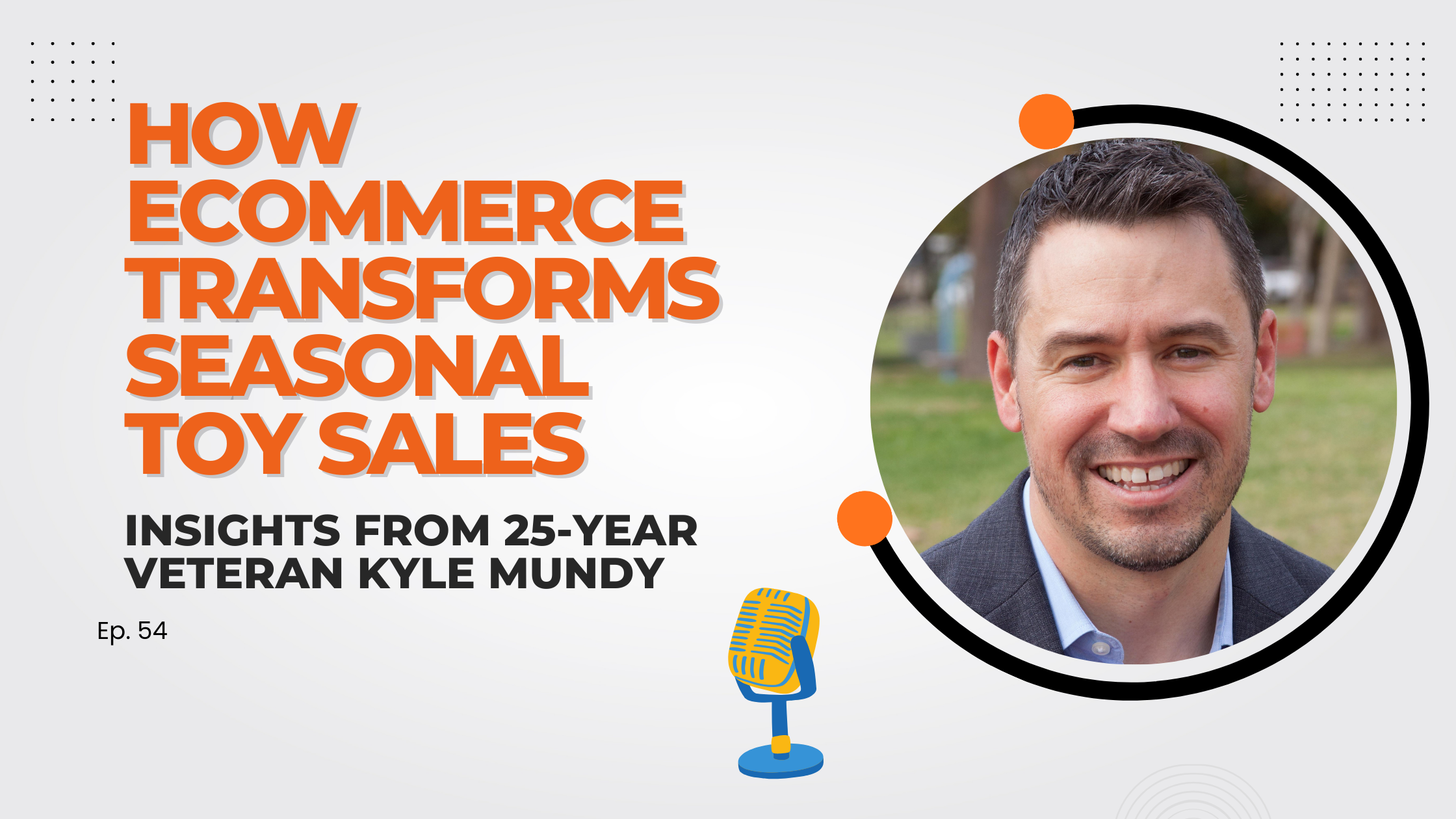
Welcome to this enlightening edition of Toy Business Unboxed, where we dive deep into the evolving dynamics of the toy industry. Today, we bring insights from Kyle Mundy, a seasoned leader with over 25 years of experience across product development, marketing, and e-commerce. With extensive experience in both big brands and smaller startups, Kyle shares invaluable strategies for navigating the complex landscape of the toy business, especially through the lens of e-commerce giant Amazon.
Episode Highlight
- 00:00 Introduction to Toy Business Unboxed
- 00:42 Meet Kyle: A Toy Industry Veteran
- 01:24 Kyle’s Journey in the Toy Industry
- 02:21 Challenges of Managing Seasonal Products
- 06:44 Impact of E-commerce on the Toy Industry
- 10:58 Navigating Amazon’s Marketplace
- 22:10 Vendor Central vs. Seller Central
- 25:49 Final Thoughts and Advice for Toy Entrepreneurs
Introduction to Kyle Mundy and His Journey
Kicked off the conversation by introducing Kyle Mundy, who started his illustrious career at Intex, one of the largest producers of above-ground swimming pools and inflatables. Intex provided Kyle with a comprehensive bootcamp into the toy industry, where he honed his skills in marketing and product strategy. This foundational experience paved the way for his subsequent roles at companies like Pacific Cycle, Banzai, and more, where he applied and expanded his expertise in managing seasonal product lines.
E-commerce and the Shifting Landscape
One of the most significant transformations in the toy industry, according to Kyle, is the rise of e-commerce and the influence of platforms like Amazon. The barriers to entry have substantially decreased, allowing startups to potentially go viral overnight. However, this increased opportunity comes with heightened competition for established brands. Managing distribution and pricing has become crucial, as these factors directly impact a brand’s market positioning and profitability in the fast-moving e-commerce environment.
Seasonal Product Insights
Kyle emphasized the challenges of forecasting and managing seasonal toys, noting that e-commerce has softened traditional retail peaks and valleys. Brands must now plan even further in advance, employing data analytics and historical patterns to predict demand accurately. The ability to offer year-round availability for complementary products, even out of season, is becoming an expectation among consumers, further extending the selling season and reducing inventory risks.
Adapting to Amazon’s Marketplace
The discussion also delved into the nuances of operating within Amazon’s marketplace. Brands must carefully choose between Amazon Vendor Central (1P) and Seller Central (3P), balancing control over branding and pricing with logistical capabilities and marketing expertise. Whether utilizing Amazon’s platform for broader market reach or engaging directly through focused branding efforts, Kyle stressed the importance of a strategic approach to capitalizing on Amazon’s extensive consumer base.
The Importance of Consumer Feedback
Feedback and ratings on e-commerce platforms like Amazon have become invaluable in real-time product development and competitive analysis. Brands can now leverage direct consumer feedback to enhance their offerings continuously, indicating a shift from traditional survey methods to an ongoing dialogue with their customers.
Conclusion
In wrapping up, Kyle advises potential entrants into the toy industry to leverage Amazon’s platform for its unparalleled ability to gauge and generate demand efficiently. This pull strategy, combined with the right product and pricing, can significantly accelerate a brand’s market penetration and consumer engagement.
To stay updated with the latest episodes of Toy Business Unboxed and embark on your own journey into the toy business, don’t forget to subscribe and follow the podcast. If you found this episode insightful, please leave a rating and review, and share the podcast with fellow toy enthusiasts. Let’s embrace the world of toys together, staying curious and continuing to innovate.
Guest Contact Details
For those interested in learning more from Kyle Mundy or connecting with him for further insights into the toy industry and e-commerce strategies, you can reach out through the following channels:
- Website: https://sustainoutdoors.com/
- Email: kyledmundy@gmail.com
- LinkedIn: Connect with Kyle Mundy on LinkedIn.
Transcript
EP054_09-16-24_Kyle Mundy
Intro: [00:00:00] Welcome to Toy Business Unboxed, your gateway to the secrets of the toy industry. Here, Jason Hsieh, a toy entrepreneur and expert in the field. “Every product we develop is really inspired by some of the real life experience that we have with our son.” “60 percent of all toys last year were sold on Amazon.”
“Be passionate about it. Because it’s a road. It’s a journey.” “Like when you have an idea that you think is gonna somewhat change the world, make things better, I’d say go for it.“
Jason Hsieh: Hello, welcome to another episode of Toy Business on Box. I’m your host, Jason Hsieh. Today I’m joined by Kyle, a dynamic leader with over 25 years of experience in product development, marketing, and e-commerce. Having worked with all the different top brands in the toy industry and beyond, Kyle has been first hand [00:01:00] and see how the e-commerce have shift the landscape for season toy product from navigating the complexity of online workplaces to finding strategy that actually extend the shelf life of the toys. Kyle, thank you so much for joining me on today’s interview.
Kyle Mundy: Hi, Jason. Good to see you again.
Jason Hsieh: Good to see you as well. I think you have a lot of different things that we can talk about within your own experience within the toy industry.
But can you first start out with sharing with the audience how does your journey within the toy industry started for you?
Kyle Mundy: I started my career with Intex. For those who don’t know is the world’s largest producer of above ground swimming pools, backyard, summer, inflatable toys, and other inflatables such as air mattresses and things of that sort. I spent really my early years earning my stripes with the company, starting in marketing as an analyst, and worked my way up managing advertising, licensing, trade shows eventually moving into product [00:02:00] marketing and really focusing not only on the product but the strategy in terms of who we would distribute that product to how we would do that and what exactly that would look like. It was really a great experience. I always look at it as my bootcamp into the toy industry and my career as a whole.
Jason Hsieh: One thing I think we talk about in the pre-interview is. Intex is really known for selling a lot of seasonal product because it’s mostly around like summers pool inflatable, and I think you have a very unique experience was, is like managing the seasonal product, which is actually a big challenge for a lot of the entrepreneur.
Can you also share a little bit about what you have learned over that experience on handling and managing the like a seasonal product the one Intex makes?
Kyle Mundy: Yeah, of course. The biggest challenge always with seasonal products is forecasting. You have a very tight window to sell the product usually, I think that the [00:03:00] landscape with the emergence of e-commerce, specifically Amazon I think it has softened the curve in terms of the big peaks, the big valleys that in the past we would’ve experienced with traditional brick and mortar. I think that it’s, I don’t wanna say it’s, made it easy to sell seasonal, but it’s made it perhaps easier.
Jason Hsieh: I see. So what are the few things for you, like how, far advance do you need to like approach for the forecasting? For example, for a seasonal product? Is that a year in advance or how much of advance do you usually try to do that?
Kyle Mundy: Yeah, for sure. With, again, with my experience in my past with not only in techs but other toy companies that I worked with that specialize in a seasonal market. We would not only, I would say, look a forecast a year in advance but really looking back even in the case of Intex, we had decades that we could look back on and really see the patterns and understand [00:04:00] okay when would consumers first want to buy certain products? So when did that demand start? And then when did we start to see that trail off? And again, what was interesting in the days of brick and mortar being the primary retail outlet is you really had to be smart with that forecasting because obviously if you got towards the end of the season, they were unable to sell, they would come looking for markdown monies looking for cooperation to help move them out of that inventory because as we all know that retail shelf is prime real estate and they have something else that they want to put there and sell more of. Again, yeah early days forecasting was extremely important. You had to be right. If you weren’t right it made it not a very attractive business, right? If you didn’t get it right, very hard to be profitable because again retailers would look for cooperation. The form usually of markdown allowance, markdown funding. And all of a sudden you find yourself in a non-profitable business.
Jason Hsieh: Yeah [00:05:00] Yeah. And I seen you based on your experience, you work in multiple different companies that have season apart, not just one, correct?
Kyle Mundy: Yes, very much yeah.
Jason Hsieh: Can you also kinda explain about a few other companies you have worked for and how is their product line different compared to you?
Kyle Mundy: Yeah, absolutely, yeah. So from Intex I went to Pacific Cycle, the time that I worked for Pacific Cycle, they were most famous for owning the brand of Schwinn bikes, as well as mongoose bikes, and at that point they had just started to distribute those in Walmart, target, a lot of the big box stores and, you know what’s interesting about bikes is that’s also a very seasonal category. People don’t think of it that way. But you have really two seasons for bikes, right? You have coming into spring, summer is a spike. And then of course the holidays specifically for Christmas is another big spike. And so I was able to apply a lot of what I had learned with Intex in that role with specific cycle. And from there I moved on and eventually got back into more like product Vintex working [00:06:00] for the likes of best way. Best way, USA as well as Banzai, and those brands, again, very much fall in line with Intex. Again, very critical that you are forecasting correctly at least again, at that juncture. And as you said, a lot of experience of that kind of always had those parameters in my career.
Jason Hsieh: Yeah. Yeah. Yeah, because I think it’s also almost opposite of other toy company I’ve interviewed in the past, because usually for a typical toy company, summer is usually the slowest season. Summer’s like the peak season almost. exactly. It’s It’s different as far as managing expectation and managing supply chain as well.
And my next question is, since you have worked with all kind of different brands from big brand to like maybe a little bit smaller startup. Within the toy industry itself, and I’m pretty sure you have seen the industry have really changes over the years. How do you see as far as the rise of e-commerce, like of Amazon really change? You mentioned it earlier as well, but how does that change and how [00:07:00] does the business need to adapt because of the popularity of the e-commerce compared to the traditional brick and mortar?
Kyle Mundy: Yeah, great question. I think business moves a lot faster today. With the emergence of e-commerce and specifically Amazon. I think that you don’t have the same barriers to entry that again, we had maybe 15, 20 years ago. So I think that with the right strategy and perhaps a little bit of luck there’s that opportunity for a startup to create a brand and have it go viral almost overnight. Again, 15, 20 years ago, that was impossible. You were definitely more in a crawl, walk, run type of situation then. And so now there is that opportunity. I think the flip side of the coin is that for the big brands, the existing or well established brands, they have a lot more competition than in the past. Because those barriers to entry are removed. I also think that there’s a lot more prevalence of competing with yourself. What I mean by that is distribution [00:08:00] really has to be looked at much more carefully than it did in the past. It was the case before that on a global perspective, if you were an international company, you really didn’t have any hesitation selling one country to another. You had very little concern of that inventory making its way back into your market. Obviously now across borders, very prevalent, very easy, I would say. For different parties to be able to distribute in other areas. I think on top of that the, just the visibility of your pricing.
Now again amazon and others, not just Amazon with that price being online. It’s very easy for others to see the price compete with it. And because of price matching policies that different companies have repricing policies I, should say. What you find yourself in often is what some term as the race to zero, where there’s this constant beating down of the price. lower lower. Making your retail customers perhaps less and less profitable, they’re earning less and [00:09:00] less margin. So you have to be really smart now with how you go to market and making sure that you have a strategy more than just, okay anyone who wants to buy will sell it to you.
Jason Hsieh: Yeah, and I think a common problem I see since I consult with a lot of brand myself is when you don’t have a very strict regulation or control over the supply chain something like Amazon is, you could have either same product could be sold in a big box retail store at Walmart, for example, but Walmart will also put your product at a huge clearance aisle when they have a exit supply and sometimes people will pick it up and resell it on Amazon and competing against yourself. So it goes back to retail arbitrage. Yeah, retail arbitrage. And people, do that like quite often. And how do you control that? How do you create different barriers? So people, you don’t really compete against yourself because Walmart doesn’t want to sell your product anymore. They don’t want to offload everything at 90% off now you lose on [00:10:00] both ways. You lose the profit that you could make in Walmart and now you have a more competition competing against yourself on Amazon too, by people trying to resell your product. So that’s definitely a very valid concern.
And I, see that pretty often, especially for some brand that kind of lost touch of their Amazon’s channel because, oh, I have my distributor handle in, but guess what? Your distributor is not monitoring it. The distributor, sometimes they are carrying it thousands of product, they couldn’t monitor every single product they carry on the daily basis. Do they have 10, 20 resellers trying to sell the same product or not? So absolutely, that’s definitely a very valid concern, and I see that on Amazon all the time as well.
Kyle Mundy: Yeah, and I think it’s hard as for, again those big brands that have been established for a long time. They generally have the widest distribution and so now how do you reign that in? And smell sell smarter versus harder. So.
Jason Hsieh: Yeah, For sure For sure. For the brand that you work with, is [00:11:00] everyone also on Amazon as well? What kind of problem have you seen on the Amazon marketplace with the brand that you manage in the past or currently?
Kyle Mundy: Yeah I in terms of, is everyone on it? The answer to that is mostly yes. And, in many cases they may be without them. For the audience those who may not quite understand it, is how Amazon works with having the ability to sell directly to Amazon or through Amazon’s platform. What I’m talking about are those third party sellers who obtain product through some means, hopefully by legitimate means, buying from a distributor or but in any case have come across the product and now are selling your product on Amazon not on your behalf, but on their behalf. And do they always serve your brand and serve your policies? No, they don’t. Of course. So the answer to your question is yes, I think, you’re hard pressed really to find a brand that is out [00:12:00] there that isn’t being sold on Amazon or at least some marketplace. I think that the big challenge, again, is for those brands themselves to make sure that they’re managing their business, they know what’s being sold, they know how it’s being sold, they are controlling the message, they’re controlling the, you know what that look and feel is online.
Jason Hsieh: Yeah, that’s a really good point. Especially when you have someone else selling your product, but they might not have the time and resources to represent your brand at the best light. And maybe they just took some random picture of the product in their garage and they just threw it out on Amazon.
Kyle Mundy: Exactly right.
Jason Hsieh: And the problem you might create is when other consumer trying to look for your product in the store, sometimes I do this as well. It’s okay, lemme check on Amazon, see how many reviews this product have before I buy it at a retail store. And now you have a very poor representation of your brand and your product because you didn’t spend the time and energy trying to manage the marketplace, but people can still see it regardless and people doesn’t know is that from you or from [00:13:00] someone else? People don’t know that.
Kyle Mundy: Exactly. Exactly right. And actually you’re touching upon something that I failed to bring up before and how e-commerce and Amazon has really changed the business. And, another big, component is just what you were saying with the reviews and the ratings there’s a lot more direct feedback that before required focus groups or surveys. Now that’s readily available to you and your competitors. And I think that’s another part too, right? Is that even from a product development standpoint, even fairly large brands will sometimes get their ideas from seeing their competitors’ feedback on Amazon.
Jason Hsieh: And there’s actually a different tool that you can aggregate it and use the AI to say summarize all the 10,000 review and you can get a summary of what is everyone saying, what people are complaining about and you can go out, just like you said, make a better version of the same product using the feedback that and the review that you can already see. And I think that those are all very valid point [00:14:00] and especially for like seasonal product for some of the brand you manage. By the time you see the problem, if you don’t react fast enough, the season might be already over. Because it’s a very short season as well.
Kyle Mundy: That’s very true. Now I will say another way that, that e-commerce and, again, specifically Amazon is changing that seasonal business is that more and more there is request for evergreen product, meaning the, continuation of the product lifecycle. You know how Amazon and e-commerce really in general works is that’s all about the data behind those products. What sells and that’s what drives demand. In Amazon, for example, they’re not extremely excited about new products that you introduce until those new products gain traction in the market. Then they’re very excited and then they might have they might come to you and request that those products be made exclusive to them, or other retailers may make that request. But it’s, I think it’s very interesting in how that is something that it [00:15:00] really we didn’t have again in the past of brick and mortar, is this demand to continue products year in, year out even in the seasonal category.
Jason Hsieh: Yeah, and like you mentioned earlier, in Amazon it’s also very unique. It’s there’s a industry term called Amazon honeymoon period. I dunno, have you heard of this term? But pretty much the first 30 days where Amazon, their algorithm and their search engine will really give you a lot of more people call it ranking juice. So you get to rank a lot higher for the first 30 day than you could be in for other product, but in the first 30 days, it’s really about how do you gain the maximum of about, of attention, self velocity, conversion, review, and then after 30 days, if you don’t really prove yourself to the Amazon algorithm that your product’s worth to be ranked, then you start losing rank and people couldn’t find you anymore. Just like on Google, usually the best place is like a inside job, best place to hire a dead body is on the second page of a search result, and same as Amazon, the best place to hire dead product is to [00:16:00] hide it on the second page of a search result because no one gonna see it so true. ever. Yeah, and that’s, I think, especially for some people that is not familiar with the e-commerce landscape, especially the Amazon marketplace, they don’t understand that. And sometimes, oh, I’ll just show something up there and see how it goes. But guess what? If you don’t like fully optimize it before you turn it on, you are really hurting yourself for the best chance to be successful ever on the platform. That’s also very unique because Amazon sees so much data and or they almost give you instant feedback based on all the data they are seeing.
Kyle Mundy: The flip side of that coin is again Amazon gives you this ability to take items that may be, poor performers. And with the advertising tools available now you, would have to spend, you’d have to have some budget available to spend, but you have this unique opportunity to take a some dogs and actually make them look a lot more attractive through advertising.
Jason Hsieh: Yeah for sure, because it’s like [00:17:00] a pay to play platform nowadays. You have to run that. Yeah.
Kyle Mundy: And I think, again, for seasonal, that’s. That’s really been huge because you have this opportunity really to put product in front of people that they may not be looking at that point in the season, for example, with an intex or best way, the above ground pools is a large purchase. That’s a, it’s a big ticket item and people may want these products, but they’re not thinking about those products until it gets hot. But what you really want them to do, where there’s more ability for them to make that purchase, is for them to start thinking about it in February, before it gets hot. And so the advertising enables you to do that, to get those products in front of them much, much sooner than they ever would’ve been in the past.
Jason Hsieh: I see. Yeah. I think that the e-commerce does allow for a longer selling season. Like you just mentioned, that’s that’s one way to maybe leverage that. And maybe also, [00:18:00] is there any other strategy that you have done in the past to try to reduce the risk of like excess inventory?
Kyle Mundy: Yeah, for sure. I think again, it’s the, various tools that are provided ability to promote anytime. If you’re looking in the past with brick and mortar you had a plan co-op promotions well in advance when you got to the season. You could have come to an agreement to mark down and discount the product, but discount is different that’s different than a promotion that can think, can come off as a, positive and an exciting opportunity, right? For purchase. And there’s various promotional events, prime Day happens to fall, what we would’ve considered in summer seasonal. And really the end of the season and prime Day is a perfect example of where I have this opportunity that, okay you’re sitting on some large quantities, it’s great potential to get eyes on that product and move it in a quicker timeframe.
Jason Hsieh: I see. And have you noticed any trend or like differences in customer behavior on the e-commerce platform, especially that unique to seasonal product?
Kyle Mundy: [00:19:00] Yeah, we talked about it a little bit for sure about the season being extended. The more likelihood that somebody would look at something earlier again, with summer seasonal products they might look at it before spring even in the wintertime. There’s also, I would say, in terms of behavior, an expectation that accessories are carried year round. In the past that would’ve been something where, okay they understand when they go to a Walmart in November, December they’re not gonna have a filter pump for a bogram at that time. They called the company, the company would then sell it to them or make arrangements. But now there’s this expectation that those products should always be available on Amazon.
Jason Hsieh: On Amazon. That’s true. That’s true. That’s true. You can find, like Christmas ormond in you want
Kyle Mundy: Yeah, in July, right?
Jason Hsieh: July, yes. If you wanna, yeah.
Kyle Mundy: So I think that’s like I said, became an expect, a consumer expectation now. And likewise, I would even say some of like in the [00:20:00] summer inflatables, things like that, that again, you would not have been able to find in the wintertime when you’re going on vacation to Florida or you’re going on vacation to Hawaii. And now there’s this expectation, oh, I can just go on Amazon and I’ll be able to find
Jason Hsieh: That’s true. Yeah. Yeah. That, expectation explains why the selling seasons longer too, because people are looking for those items specifically online.’cause they know they couldn’t find it in the retail store.
And of course you have worked in so many different brands and I think the current company you work for is a little bit different than toys. I don’t know if you want to also elaborate a little bit about your current experience working for the the current company that’s a little bit different than the toy category?
Kyle Mundy: New for me is I’ve switched over on more of the agency side. With recent, more recent years, my experience with Amazon has proven to be valuable. Learning not only the vendor central side, but the seller central and understanding the pros and cons to those two different channels, if you will. And now what I’ve come to find is there’s a lot of brands out [00:21:00] there who, I don’t wanna say struggle they have some difficulty in figuring out how to manage their Amazon business. Trying to figure out the right strategy to maximize their revenues, but at the same time protect their margin, their profitability. And I’ve come to learn a lot about hybrid models where, you know, brands can sell both directly to Amazon and, through Amazon. Some advantages in that for those companies. And so I work with them to, help to.
Jason Hsieh: Yeah, I actually talked to a few brands that also doing a hybrid I think it would make sense if your catalog’s big enough, but I think for some of the smaller brand that doesn’t have like hundreds of product, it might be better just to choose one instead of trying to do both. You’ll be threading yourself two thing if you only have five product and try to post
Kyle Mundy: and you hit the nail on the head. It’s not for everybody, there are some companies that I talk to and say you, it makes a hundred percent sense for you [00:22:00] to work directly with Amazon sells as a one P vendor. And there’s others that I say, it makes no sense for you to sell as a one P vendor. You should strictly sell as a three P seller.
Jason Hsieh: What kind of brand will be best fit for the vendor central? And maybe we can also talk for the listeners that might under, might not understand the differences because it’s like an insight terminology almost one P versus three p. Can you also explain the differences for the as well?
Kyle Mundy: Sure. I’ll start there. There’s Vendor Central, which is a one P relationship in which you are selling to the retailer in a wholesale traditional wholesale type relationship. And then they are reselling the product. The three p seller or seller central is where you are selling directly utilizing Amazon’s platform to do so. basically using their site as your storefront. And those companies where it may not make sense for them to sell to Amazon directly. Maybe those companies that you know are very interested [00:23:00] in controlling, again, their messaging, making sure that they are you certainly you cannot control price, but you can abide by your price policies. Make sure that you’re being committed to your price policies and in a lot of cases it makes sense to sell on the seller central side. Those companies where it may make sense to sell through or to Amazon, I should say directly, is those that perhaps they’re import companies, perhaps that they don’t have the the infrastructure to sell directly. They may not have the knowledge in how to sell directly. Amazon’s done everything they can to make that an easier process with FBA. FBA is where you’re selling the product directly, however you’re utilizing Amazon for the fulfillment and shipping and basically your warehousing, fulfillment and shipping. And so they, they’ve made that easier. But there are still those companies that or set up to sell to resellers.
Jason Hsieh: Yeah, and I think one more thing I want to share with our [00:24:00] audience is when you come to Amazon, you really have four different very important, very distinct skillset that you need to have within your team, or you need to hire someone to have those four skillset design, catalog management, SEO, and then advertising, which is PPC. So if you don’t know how to do all those for either in-house or partner with someone, you’ll struggle a lot when you try to do seller central because there’s a lot of work to make it correctly. But that’s advantage and disadvantage. It’s more work, more control. But if you know how you’re doing, you’ll also make a lot more money because you have a higher margin. Now you’re not selling it to Amazon, you’re selling direct to consumer, so your margin could be higher. But when it come to vendor Central, at least based on my understanding, is they’ll do a lot of the initial work, but their work usually is not better than what you could be doing yourself. And because Amazon is so big, they will do what, I call minimal viable product for your product. They just try to throw the spaghetti on the wall and hopefully you’ll sell on [00:25:00] Amazon by doing the minimum. So they won’t be spending a lot of time trying to optimize. They won’t be doing any kind of AP testing for your listing and oftentimes when my, I have people that complain to me when they try to sell vendor Central, is that they also lose control of some of the pricing because Amazon also controls the pricing on that. Is that, pretty true based on your experience as well?
Kyle Mundy: I think a lot of what you said is true. I think that again, I think there are those brands where it does make sense for them to sell as a one P. And again there’s a number of reasons for that, and it may simply boil down to how they like to be paid. The nice thing about when you sell to vendor is you get that one big check on whatever frequency, you know that based on the demand of your product. But it’s a different situation when you’re selling directly to the consumer, so
Jason Hsieh: for sure. For sure. Thank you so much for being on the show today, and I think we talk a lot about all different aspect from seasonal product to Amazon to all the other different challenges that you have [00:26:00] at the over the years. One of the last question I’d like to ask all of our guests on the show is if you had to share just one piece of advice with someone that’s getting started in the toy industry what would that be?
Kyle Mundy: Yeah. I don’t think the toy industry is, unique in the sense of, I think it, no matter what it is you have to have the right product, the right price, the right offering. And now I think what’s, different again, as we discussed is if I was starting a business and I was going to market, I would start with Amazon. I’m very much a believer in the poll strategy and I think creating that poll that demand is easier today than it was again 20 years ago. And I think the opportunity to do that through Amazon is there.
Jason Hsieh: Yeah, if your product is the right product and the right price, obviously. That’s a very good point. So for our listener, where can they find you?
Kyle Mundy: Yeah. Of course I’m on LinkedIn Kyle Mundy, easily searched. [00:27:00] And can also email me directly at kyledmundy@gmail.com.
Jason Hsieh: Okay. Thank you for sharing that.
For our listeners, thank you for tuning in for today’s episode of Toy Business Unbox podcast. We hope you have enjoyed the conversation and find it insightful and inspiring.
If you like what you have heard, be sure to subscribe to our podcast on your favorite platform so you’ll never miss a episode. We really appreciate your support and we love it if you can leave us a review and share the podcast with your friend and colleague.
For more resources, tip and latest update, we in the toy industry, visit our website at toy-launch.com join the conversation and connect with us on social media using hashtag #ToyBusinessUnboxed. We would love to hear your feedback and suggestion for future episode. Until next time, keep innovating, keep creating, keep bringing joys to toys. This is Jason Hsieh signing off from Toy Business Unbox podcast and I’ll see you in the next episode.