
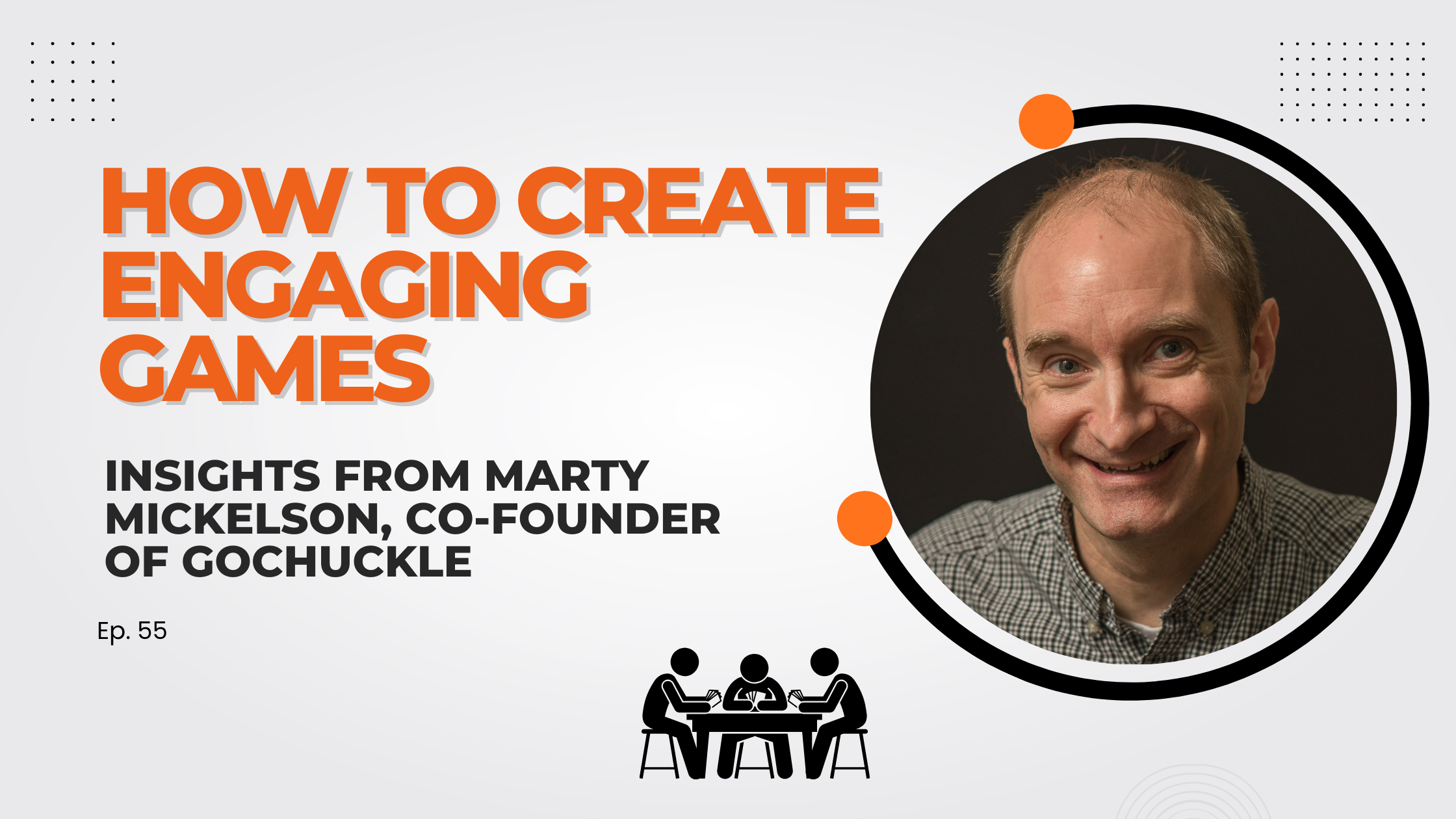
Welcome back to Toy Business Unboxed. In this episode, we delve into the fascinating world of toy creation with special guests Marty and Brett, co-founders of GoChuckle. Known for their innovative and engaging family games, GoChuckle has taken the toy industry by storm with creations like Hasty Baker, a delightful card game inspired by baking competitions.

#55: Playful Recipes: Baking Up Joyful Games – Toy Business Unboxed
Episode Highlight
- 0:00 Introduction to Toy Business Unboxed
- 00:42 Meet the Guests: Marty and Brett from GoChuckle
- 01:30 The Inspiration Behind GoChuckle
- 02:41 Designing and Developing Hasty Baker
- 03:49 Game Rules and Mechanics Explained
- 05:53 Playtesting and Community Engagement
- 09:02 Challenges in Publishing and Manufacturing
- 10:18 Kickstarter Experience and Lessons Learned
- 15:48 Navigating Amazon and Retail
- 21:10 Future Plans and Advice for Aspiring Game Designers
- 26:06 Conclusion and Where to Find GoChuckle
Turning Passion into Play
Marty and Brett’s journey began with a simple yet powerful idea: transforming their love for family entertainment into a business venture. Their first successful creation, Hasty Baker, emerged from their shared enjoyment of baking shows. As two professionals from different industries—tech and accounting—the duo faced the challenge of entering the toy and game market with no prior experience. But their passion for creating fun, interactive games for families shone through every step of the way.
Designing Engaging Games with Heart
The design process was an exciting journey filled with extensive playtesting and community feedback. From conceptualizing game mechanics to illustrating with engaging artwork, Brett and Marty invested countless hours to ensure Hasty Baker would provide families with a thrilling and competitive experience. By hosting community events and utilizing feedback forms, they refined the game to ensure it was both accessible and challenging, weaving in elements of surprise akin to twists you’d encounter in a real baking show.
Navigating the Business Landscape
Taking a game from concept to market is no small feat. For GoChuckle, this meant learning the ropes of manufacturing, negotiating logistics, and tackling unexpected challenges such as navigating Kickstarter campaigns and fulfilling holiday season orders. Their tightly scheduled Kickstarter campaign not only helped fund their endeavor but also taught them invaluable lessons about pacing and preparedness in the world of crowdfunding.
Conquering the Amazon Marketplace
One of the most significant milestones for GoChuckle was establishing their presence on Amazon, a crucial platform for any growing toy company. Marty and Brett learned the hard way about the nuances of Amazon’s requirements, such as certification compliance, and the intricacies of effective marketing and customer engagement. Their candid insights reveal the necessity of mastering Amazon’s complex ecosystem to ensure product visibility and success.
Expanding Horizons with Retail and New Creations
Retail expansion remains a key focus for GoChuckle as they continue to seek growth opportunities despite initial setbacks due to the pandemic. Their games are gaining traction in local stores, and they are committed to becoming a recognized brand in the toy industry. Beyond Hasty Baker, Marty and Brett have numerous prototypes in the pipeline, each designed to captivate and delight families worldwide.
Advice for Aspiring Toy Entrepreneurs
Towards the end of the episode, Marty and Brett shared heartfelt advice for aspiring toy creators: focus on passion and authenticity. Whether inspired by a theme or gameplay mechanics, creating a meaningful and engaging product is paramount. Their enthusiasm and genuine love for game creation have been their guiding lights, driving them to produce quality games that resonate with families.
Conclusion
Marty and Brett’s journey with GoChuckle exemplifies the power of passion and perseverance in the toy industry. From the inception of a simple idea to creating cherished family games, their story is an inspiring tale of innovation and dedication. As they continue to expand their reach and develop new creations, GoChuckle stands as a testament to what can be achieved with creativity, community engagement, and a relentless pursuit of excellence.
To stay updated with the latest episodes of Toy Business Unboxed and embark on your own journey into the toy business, don’t forget to subscribe and follow the podcast. If you found this episode insightful, please leave a rating and review, and share the podcast with fellow toy enthusiasts. Let’s embrace the world of toys together, staying curious and continuing to innovate.
Guest Contact Information
For those interested in exploring GoChuckle’s products or collaborating with Marty and Brett, you can visit their official website at GoChuckle.com for more information about their games, including Hasty Baker and the new House Hounds. To purchase their games directly, check out their Amazon store at amazon.com/GoChuckle. Additionally, retailers interested in carrying GoChuckle products can reach out through their website’s contact options.
Transcript
EP055_09-17-24_Marty Mickelson
Intro: [00:00:00] Welcome to Toy Business Unboxed, your gateway to the secrets of the toy industry. Here, Jason Hsieh, a toy entrepreneur and expert in the field. “Every product we develop is really inspired by some of the real life experience that we have with our son.” “60 percent of all toys last year were sold on Amazon.”
“Be passionate about it. Because it’s a road. It’s a journey.” “Like when you have an idea that you think is gonna somewhat change the world, make things better, I’d say go for it.”
Jason Hsieh: Hello, welcome to another episode, Toy Business Unboxed. Today we are thrilled to have Marty and Brett, the co-founder of GoChuckle joining us. The duos have joined and turned their passion for family time into mission to bring family together to fun, interactive games. Their first game hasty [00:01:00] baker has not only brought joy to countless household, but also earn numerous different world in the toy industry for its engaging gameplay.
And today we’re gonna share the story behind the ins and outs and, then the struggle and the success behind starting a game company from scratch and also publishing a game. So today’s conversation will be packed with insight from breaking into the toy industry. From creating memorable game experience and also balancing creativity with business. So thank you, both of you, to be on today’s podcast.
Marty: Yeah. Thanks for having us.
Brett: Yeah, thank you.
Jason Hsieh: So can you first start out telling the audience on what was the story behind GoChuckle and what inspired you to start this game companies?
Marty: Sure. We both enjoy watching baking competition shows and Brent was watching baking competition shows with his daughter. And he thought it could be a game. And so he called me up and I’m in the tech industry, he’s accounting, so we didn’t know anything about making games, but he said, Hey, you wanna make a game out of this? And I was like, yes, let’s, let’s [00:02:00] make it a business. Let’s do this. This sounds like a lot of fun.
Brett: To be honest when it first started it just sounded like something that would be fun to play. And so I am the last, the furthest thing from an artist. And so I called Marty and I was like, Hey do you want to draw for this? And he was like, I could, or we could just hire an illustrator and it would be better. And so I hadn’t even thought of that. But then we did, and then then we had these really great illustrations. And we started talking out the idea of the game together. Came up with a prototype of it and it just worked one thing into another until it became better and became what it was.
Jason Hsieh: And one thing I always find it very interesting is what was your process for designing and developing the game? Especially the rule because we also do a little bit of toy design, but we currently don’t have a car game or board game yet. So that’s one of the question I always have in mind that because there’s so many car games, so many board game out there.
[00:03:00] How do you come up with a rule that makes sense that’s easy for the kids and family to get instantly and also engaging at the same time?
Marty: The nice thing about having it themed around a baking competition is that we could use that and think, okay what are some things that people can relate to in real life that you could do to interact? Because the idea, the initial idea was like this baking competition where there’s twists and turns, they get thrown into it, and you’re competing with one another. There’s things you’re doing to try to finish your dessert before the others. What kind of aspects of that could be turned into actions that you can do in the game that allow people to interact.
Jason Hsieh: I have your product pulled up here. Let me see if I can make it the right size. For those of you that’s listening you, we are also having the interview on our YouTube channel that if you wanna see what a game look like, feel free to watch our episode on YouTube as well.
So can we talk a little bit about the rule for the game? How does it work? I haven’t bought one myself yet, so for the new parent, like myself that’s interested to maybe buy one for my family, can we [00:04:00] walk through the basic rule on how the game work and how to play it?
Brett: Sure. So basically everybody, each player gets their own recipe card in front of them. Recipe card is gonna list four different ingredients on it.
Jason Hsieh: Okay.
Brett: So you’re trying to collect those four ingredients in front of you to complete your recipe. And once you complete your recipe, then you can set your recipe card aside that represents a point.
Jason Hsieh: Oh, okay.
Brett: And there are some cards that you can that can give you extra points, like a blue ribbon. That’s essentially saying the blueberry pie that you made is an outstanding blueberry pie. It’s worth an extra point. Okay. So the first person to get five points and their points pile wins.
Jason Hsieh: I see. Do you need to make different combinations like other card game I have played in the past?
Brett: Yeah, so each recipe is a different combination of ingredients. Where one might be frosting, sugar, butter, and flour, and one might be chocolate butter flour, sugar [00:05:00] so they’re gonna be similar, but slightly different. And then when you finish a recipe, you’ll just grab a new recipe. Put that in front of you. Now you’re working on that one.
Jason Hsieh: Oh, okay. Okay. Okay. So you’re collecting
Brett: Yeah. The twist come when you, there are some cards that you can we call ’em strategy cards where you can sabotage each other, like ingredients from each other, or spoil ingredients that people have played out.
Jason Hsieh: Okay.
Brett: Something like that. And so Marty was saying, you can think of in the show, it’s like in the middle of one of those baking shows, there’s some kind of twist that always happens. The twist in the game is you don’t know when somebody’s gonna throw down a spoiled ingredient and say, butter spoiled. Now you have to get rid of your butter and you have Oh, that again, or someone steals something from you.
Jason Hsieh: Okay. Okay. Okay.
Brett: So it keeps you engaged with each other.
Jason Hsieh: I see. How do you come up with the mechanic of the game and the rule? Do you did a lot of like play testing initially or how do you come up with the idea?
Marty: [00:06:00] Yeah, a lot of play testing, A lot of thinking of the statistics of it, I think is the nitty gritty. It’s almost the boring part depending on how much you like statistics and things. You’ve gotta find the right balance. You don’t want too many steel ingredient cards in the deck. And you don’t want it to be too easy or too hard. And, so we started out making a sharpie deck, you take a deck of cards and you write what the cards are on ’em, and played like that a bunch and started to get a feel for, okay, here’s this type of card works really well. There’s way too many of this one, and we just kept playing with our family and we played maybe every day. I don’t know. At least, a few times a week for months. And until we felt like we had it really nailed down to something that was a blast. And the nice thing is I think we did a great job, but we, get a lot of compliments on it.
But when you get to the end of the game, usually everybody’s pretty close. Like a number of times I’ve played, it’s oh, if I just had one more turn I [00:07:00] could have won, but they got it before me. And so it’s not one of those games where somebody can just blow everybody away and everybody’s just sitting there waiting for the game to end because they know they lost. It’s the twist can change the direction of things. And so it works pretty well like that, I think.
Jason Hsieh: Yeah. One thing I, play in my household is we play a card game called Tacos and Burritos. It’s similar in a way. I don’t know, have you two played that game yet? It’s also collecting different ingredient cards, try to make a set and you can do all kind of crazy stuff to each other’s card as well
Brett: We tried to be thoughtful in wanting to make sure that it wasn’t, that nobody would feel at some point in the game, like they have been so far left behind in the game that the game’s not even fun anymore. And so we wanted to make sure that it was gonna be a close enough game that everybody feels like it’s, anybody’s game until the end.
And the other thing that we did too. In addition to playing with our family and our friends Marty and I each held an event at our local library where we invited [00:08:00] people from the community to come.
Jason Hsieh: Okay. That’s always nice.
Brett: And just play the game. And we had feedback forms for them to fill out and rate the game and tell us what they liked about different aspects of the game, and if there’s anything they liked or thought it was lacking in that way. Even outside of our friends and family group, we were able to get that feedback and figure out really what people were liking and or not liking about.
Jason Hsieh: I like the idea for the design itself. How many of those have you did you done initially?
Marty: We did a lot.
Jason Hsieh: Oh, okay.
Marty: I think it’s really important too, because families. Family’s really easy to say, oh yeah, what you did is great. We love you.
We even went to a retirement community, there where the retirement community had this little get together. They had a room with a bunch of tables and all these older people playing the game and just laughing. So we got some pictures, got feedback from.
Jason Hsieh: Nice. Yeah, that’s a definitely a very interesting way to engage the community and also get some live feedback that’s a little bit harder if you don’t do [00:09:00] those events in person, it’s definitely different.
My next question is, when you come to initially publishing the game, what are some of the unexpected challenges that you two have faced?
Brett: Like Marty mentioned, I work in accounting in my full-time job outside of this. And Marty’s in tech. So neither of us really had any experience in this before GoChuckle. Once we started getting into this, we were learning kind of everything on the fly. We were learning everything as we go. And we had to figure out how do you get in touch with a manufacturer? Where do you even go to find out who they are. And so we went through lots of like forums and talk until we found ones that were talking about people and we got in touch with. And it just was like, as we learned more about the industry and got to know more people that are in the industry and it just really took, like diving deep into it and combing over it over and over again and it became [00:10:00] another full-time job. Learn the ins and outs of that.
Jason Hsieh: Yeah. I welcome to be Aton entrepreneur. That’s the life of entrepreneur.
Marty: Like the more you know, the more you realize you don’t know
Jason Hsieh: a hundred percent and by the time you learn something, things change. So yeah, that’s just that’s a constant thing. And I also, our team’s research, I think crowd founding also play a really big part in launching the game initially, which I was looking at your Kickstarter campaign. You guys were able to raise about $10,000 when you did a Kickstarter.
Can you also share a little bit about your experience with Kickstarter and how you approached that and what was your experience like?
Marty: Yeah. So that was also an eyeopener. Because we’d never done an a Kickstarter and we didn’t really we really underestimated what it takes to do a Kickstarter.
Jason Hsieh: Oh yeah. I did one before. Yeah. It’s,
Marty: that was a huge thing. We did a, pretty short timeline, from like launching the Kickstarter to or announcing it, and then having the [00:11:00] Kickstarter period and then wanting to get the game to the backers. And so we didn’t get a ton of social media and stuff out there. Like we’ve heard now we’ve learned a lot of people they do a year of building buzz.
Jason Hsieh: Yeah. Building of the buzz. Yeah. Yeah, yeah. That’s how you get like quarter million, half a million or million plus campaigns.
Marty: We did, less than six months, probably like four months of really pushing that we were gonna do this Kickstarter. And then during the Kickstarter it was like, it was a full-time job. Every day just going on Facebook messaging, all the friends. I have friends that I forgot who they were, but they’re connected on and telling them about it and we managed to make our goal and then have a little stretch goal that added an ingredient to the game. We had debated whether or not to do that because we had talking about the balance of cards. If you add an ingredient in there, then was that gonna make it harder to get the right ingredients and stuff? But we tested and it worked out and I think it worked out great. But [00:12:00] we had a manufacturer lined up. That we were like, okay as soon as the Kickstarter’s done then we’re pulling the trigger and we can have it manufactured. ’cause we had most of the graphics and everything. Were all ready to go. Ready to do. When the Kickstarter was over, we told them, okay, we’re ready. And they said, oh now’s not a good time because
Jason Hsieh: oh no
Marty: the kickstarter, was in September and so the end of September it’s
Jason Hsieh: oh, okay. Yeah,
Marty: And we were like, oh, we were telling everybody that we were gonna try to get it to ’em by Christmas. Another thing that we naively,
Jason Hsieh: oh yeah, that’s a busy season to try to do it.
Marty: Yep. But we found a manufacturer that committed to it, and we managed to get it to our backers. It was live on Amazon, I think it was like December 13th. You made.
Jason Hsieh: Oh, okay. Good job. Yeah.
Marty: Yeah.
Jason Hsieh: It was, a short window.
Marty: It was pretty amazing.
Jason Hsieh: What do you learn in the process [00:13:00] as far as logistic of getting the game from concept to market? Of course as designer, finding manufacturer, negotiating the price, NMO q there’s a whole bunch of different things that’s involved in the process, but I guess what is some of your major takeaway in that experience?
Brett: I would say one thing is that it’s probably gonna cost more than you thought. The plan for it to cost more than you think it’s going to, and then if it doesn’t, that’s great.
Jason Hsieh: Yeah. Yeah.
Brett: But then you know, the better than planning lower and it costs more and then you either don’t have the money or you’re
Jason Hsieh: Yeah. Be safe.
Brett: So it’s probably gonna cost more than you think. And it’s probably gonna take more time than you think. Especially if it’s your first one. Once we got our first one out our second one ran a lot smoother because we already had a relationship with a manufacturer. We already had the logistics of how we were gonna get it overseas, so all we had to do was give the information to our [00:14:00] logistics coordinator and she shipped it over so those things went a lot quicker. Where we didn’t have to go find those relationships in the heat of moment and plan ahead because marty was saying we, had said we wanted to get those to our Kickstarter backers by Christmas and in order to fulfill that, we had to airship a lot of it over here.
Jason Hsieh: Oh, whoa. That, is expensive
Brett: shipping cost.
Jason Hsieh: Yeah. That’s very expensive. Yeah.
Brett: We could have done it a cheaper way and saved a lot of money, but we wouldn’t have, we wouldn’t have been able to fill, fulfill our promise. In time to get it by Christmas time. And we really wanted to do that. So it cost us more, but we really wanted to, try to make our to keep our promise. So I would say just give yourself more time and expect it to cost a little bit more. And the other thing a third thing that I would say that I don’t think that we did a good enough job doing [00:15:00] at first is we got comfortable with our manufacturer and we just stayed there and stopped looking for another one.
Jason Hsieh: Ah, yeah. You didn’t do enough.
Brett: We stuck with them for a long time and they were great and they were doing a good job. But we didn’t start looking for another one until we had a reason to and then we found another one that is doing just as good a job or better, but much cheaper only for a lot lower price. Yeah. And we realized why didn’t we find these guys earlier? So there’s really no reason that you can’t continue to look at other manufacturers and compare them just because you found one good one doesn’t mean you can’t find a second good one too. Because it, what if one of ’em isn’t able to do it at some point in time? You don’t wanna start looking in.
Jason Hsieh: Yeah, Exactly. And since we talk about Kickstarter, the next biggest platform that everyone use is Amazon.
What are some of the biggest lessons you have learned about marketing and selling gain, especially [00:16:00] for platform like Amazon so far?
Marty: That’s like a two hour subject menu. Amazon is a beast and we’re still learning. We’re still definitely finding things that we’re doing wrong and that we need to do better. And so things like the child’s certification, I forget what it’s called.
Jason Hsieh: CPC Yeah. Children Product Certification. Yes.
Marty: We didn’t have that in the beginning and and we didn’t have it for years. And Amazon didn’t flag it or anything, and we didn’t really know. It was the first week of December. Was that last year or the year before? I don’t know. They flagged it and said, Hey, you don’t have a certificate? And they took our listing down. We had to scramble and get somebody to get the certificate
Jason Hsieh: Lab testing. Yeah.
Marty: Because that was something the. The worst time, worst, 60% of a game company’s revenue happens in the last two months of the year.
Jason Hsieh: Yes. Two months. Yes, that’s correct.
Marty: And we lost out on a ton there. And so we learned a lot from [00:17:00] that. The whole process of advertising the keywords and the, and all those different aspects of it. There’s just so much to learn.
Jason Hsieh: Yeah, I think for a successful Amazon platform management, there’s I talk to my team all the time. There’s four main like pillar. There’s design, there’s catalog, which is catalog management, and making sure everything is, up and going. And then there’s SEO, which is search engine optimization. Then there’s pay per click, PPC, you need to do oh four really well in order to be successful. If you miss one, then the whole thing doesn’t work. And it’s funny, every time I have friend that’s asked me what I do nowadays, I say I play in the casino called Amazon. It’s like a casino. And the way I like to explain it is just imagine playing in the casino. You need to, in order to win, you need to not only understand the rules in and out, but you also need to learn how to counter the cards. And that is [00:18:00] Amazon for you in a casino sense.
Brett: That’s, spot on. And, is it can be difficult to work with Amazon because if you have if you’ve got issues or problems that you need to work out with them. Their support is very hard to work with. They have phone support that you can call and you can email with, but it is very difficult to work with their support. It can be disheartening and discouraging and at times you can be thinking, why are we even selling on Amazon? Because our advertising costs are so high, we’re not even making money or something like that. But even in those times the other thing that I think about is unfortunately selling on Amazon is a necessity also because it’s,
Jason Hsieh: yeah.
Brett: When, Marty and I approach retailers to try to get them to sell it in their stores. One of the first things that they think about and talk about is how is it selling on Amazon?
Jason Hsieh: Yeah.
Brett: Or how’s the, how are the ratings on [00:19:00] Amazon? Unfortunately one of the first things that even the retailers will do is they’ll go look at Amazon to see how the game is performing.
Jason Hsieh: Yeah.
Brett: ’cause they don’t wanna sell something that, that doesn’t sell the masses. They don’t wanna Yeah.
Jason Hsieh: Or have reviews too yeah. Yeah. Reviews also very, big. I wanna transition away from Amazon and talk about other activity you guys have tried so far. You mentioned about retail. So how’s the retail going so far for the, brand?
Marty: It’s, going okay. We’re growing. We’re growing and growing. We created the game in 2019. And like we said it was in Amazon December 13th and then it was 2020, which, that’s when Covid came. And so retail stores were all really shaky at that point.
Jason Hsieh: Yeah.
Marty: And we got into to some retail stores locally or a couple here and there. And we decided we just need to focus on Amazon. We only have a limited amount of time. Both of us have [00:20:00] day jobs, and so we really put a lot of focus on the Amazon side of things, the online presence.
Jason Hsieh: Okay.
Marty: And then in the last year or so. We’ve started really pushing retail again. So we went to Te Gamma, the Game Manufacturers Association.
Jason Hsieh: Yes. Yeah. You went to GenCon?
Marty: We didn’t go to GenCon.
Jason Hsieh: Oh, you didn’t go to GenCon. Okay. Okay.
Marty: Yeah, it’s expensive and we’re still trying to get there.
Brett: We’ve got, several stores that have started selling it and that have had good success for with it. And we’ve got some, good big game stores that are having good success with it too. We’ve got interest from lots of others as well. I don’t wanna speak outta turn or anything, but yeah, so lots of repeat retail customers that have been saying that it sells like hotcakes, that it sells really well. One of our one of the retailers that sells our store has had our games front and center at Right when you walk in their door.
Jason Hsieh: Oh, okay. Good.
Brett: Since they started selling it. [00:21:00] November of 23. It sells so good that they have wanted that to be there. One of the first things people see when they walk in the door,
Jason Hsieh: okay. That’s good. That’s good feedback. That’s good feedback. So what is next for GoChuckle? Are there any more new games that you guys are launching this year or maybe early next year?
Marty: We’ve got a lot of ideas. And we’ve been developing a lot of we have I don’t know how many prototypes laying around that we’ve made. Different ideas as we play with different ones and try to build them out. We wanna shoot for a game a year at least. We found that it’s really tough having full-time jobs. That get really demanding sometimes and families Yeah. And everything. So we’re really pushing to do that. It was this year was when House Hounds came out our second game. We made Hasty Baker in 2019, so it took a few years to get another one out. But we’ve got a whole bunch of ideas. And we’re not sure. I’m not gonna say what the next one will be just yet. But we’ve got, a lot in store and we hope to become a brand that people recognize [00:22:00] that as a force in the industry.
Jason Hsieh: Yeah, it’s always tricky. And I remember when I first started in 2016 for this, for the first five year, I also have a full-time job and I was running my toy business on top of my day, full-time job, and I was working 70, 80 hours a week for just, I was just working a lot.
So I understand the struggle. I’m trying to build a business on top of a full-time career. But it’s also good that you have a full-time career because in case anything went wrong, at least you have something to fall back to. It’s a little bit different type of stress when you are doing this. Like me right now, full time. And this is the only thing I have. So if it doesn’t work, then I’m in a very big pickle. So
Brett: I’ll tell you what though Marty and I do look forward to the day when we can leave our daytime jobs behind and just focus on GoChuckle only because I work as a tax preparer right now. And I, like that, but there’s a different sense of joy that [00:23:00] I get from making games and people rarely come to me and say, man, I loved doing my taxes with you this year. That was so much fun. I really enjoyed. I can’t wait for next year’s tax season to come. You actually get people that come and say. We’ve been playing that game so much. We play it every night. We love that so much. When’s your next game gonna come out? We do hear that. And that is so much more fulfilling.
Jason Hsieh: Sure. Very, different. Yeah. It, is funny, like I shared before the interview, my previous career was also corporate finance, so actually accounting actually as my previous career.
So I can relate to the number or the number crunching you, need to do as part of your career for sure. So as well, wrapping up today’s interview, one of the questions I always love to ask for our guests is.
If you had to share just one piece of advice with someone who’s getting started in the toys and game industry, what would that be? And maybe each of you can share one.
Marty: I think, maybe I would go with be [00:24:00] passionate about it. I know Hasty Baker turned out great and people love the game. You read the reviews and they talk about how they didn’t think that the adults didn’t think they would like it, but they ended up just loving it. We put a lot of work and a lot of attention to detail in it so that things wouldn’t get in the way of having fun. In the game and we were really passionate about it and there was tons of hours put into it when we made it and I think it shows through. I think if you went into it without that same passion and just wanted to make a game to have extra money on the side or something, it would show in the game. And it wouldn’t be successful. So it’s the fulfilling part of it and the, just the joy that comes out of it is really when you put passion into it and put your heart and soul.
Brett: I think I would piggyback off of that too because with we mentioned earlier that Hasty Baker came about from the idea of watching some baking competition shows. And I know that, some [00:25:00] game designers come up with their games by thinking of the the game mechanics. Yeah. And then applying a theme to it and we work backwards in that we think of a theme and then we think, how could you play a game that would go along with that theme?
Jason Hsieh: Theme? Yeah. I like that.
Brett: And that helps us to keep the game. Something that’s relatable and makes it so that when you’re playing the game it’s fun and it seems like you’re playing that game and not that you’re just playing some game that has that picture on it. And not that there’s anything wrong with the other way of doing it, but that’s just how Marty and I have found that’s helped us have more passion in the games that we’ve created. If you can get excited about it and be passionate about it, when we’re at our booth and we’re telling people about the game and we’re excited about it. That helps them feel like, man, this could be an exciting game, but if we’re there saying, a taking game, it’s 20 bucks, take it or leave it, they’re [00:26:00] like nah. It’s not exciting sounding.
Jason Hsieh: Hundred percent. That’s a very great piece of advice. So for our listener and the people that’s watching on the YouTube channel, where can people find you?
Marty: Yeah, you go to GoChuckle.com. That’s our website. And you’ll find information about Hasty Baker and about House Hounds. Also on amazon, amazon.com/GoChuckle. You’ll get to our Amazon store. And ask your retailer for it and if they don’t have it, have ’em contact us.
Jason Hsieh: Thank you so much being on our show today.
And for the listeners, thank you for tuning in for today’s episode of Toy Business Unboxed podcast. We hope you enjoy the conversation and find it insightful and inspiring. If you like what you have heard, be sure to subscribe to our podcast on your favorite platform so you’ll never miss an episode.
We really appreciate your support and we love it. If you can leave us a review and share the podcast with your friends or colleague. For more resources, tip and the latest update within the toys and game industry. Visit our website toy-launch.com. Join the conversation and [00:27:00] connect with us on social media using hashtag #ToyBusinessUnboxed, and we’d love to hear your feedback and suggestion for future episode.
Until next time, keep innovating. Keep creating, keep bringing joys to toys. This is Jason Hsieh signing off on Toy Business Unbox podcast and I’ll see you in the next episode.