
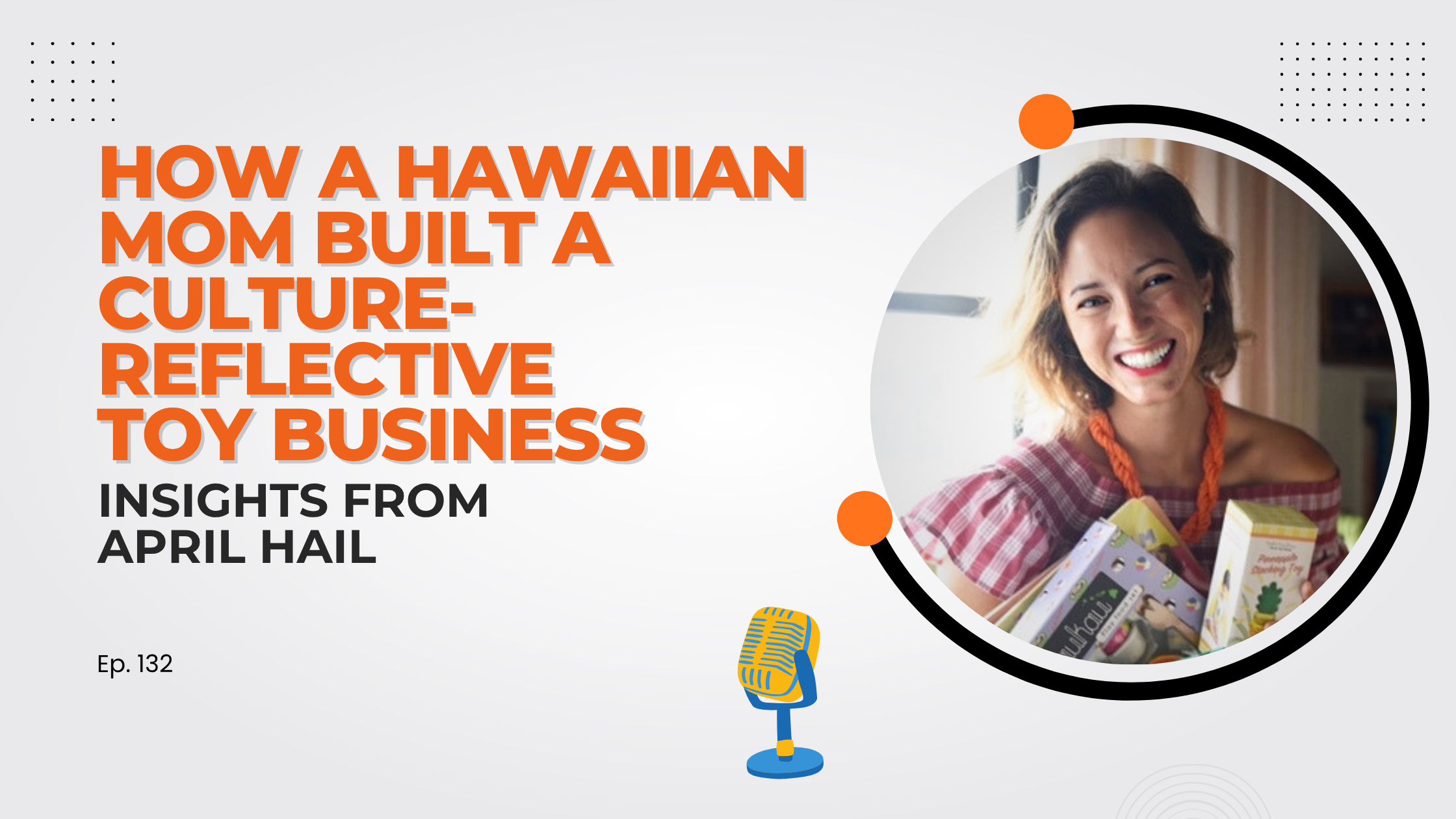
Welcome to an inside look at April’s journey as a Hawaii-based entrepreneur and the founder of Keiki Kaukau, where she transformed her deep passion for local culture into a thriving, community-focused toy brand. This post unpacks how she navigated the real challenges of product development, importing, and scaling while staying true to her roots. Whether you’re curious about maintaining authenticity, managing production costs, or growing organically without relying on major marketplace channels, April’s story offers actionable insights for anyone looking to build a meaningful, culturally relevant business from the ground up.

#132: Hawaii Toy Business: Cultural Authenticity & Community Giving – Toy Business Unboxed
Episode Highlight
- 00:42 Welcome to Toy Business Unboxed
- 01:26 Inspiration from Hawaiian Culture
- 02:14 Community Influence on Design
- 03:15 Growth to 50 Products
- 04:45 Product Development Roadmap
- 05:52 Initial Customer Reactions
- 06:49 Importing Challenges in Hawaii
- 07:36 Shipping Inefficiencies
- 09:02 Focus on Local Market
- 11:01 Showcasing Product Catalog
- 12:08 Managing Catalog Complexity
- 13:17 Community Giving Back
- 14:47 Educational Influence on Products
The Inspiration Behind a Culturally Rooted Toy Brand
April’s journey began when her toddler developed a fascination with play food and she noticed a lack of culturally relevant options reflecting Hawaii’s rich heritage. She decided to design her own, creating toys that honor local culture and immigrant influences like musubi, loco moco, and shave ice. Her story highlights a core principle for small businesses: products inspired by genuine experience resonate deeply with customers. April’s approach shows that a strong brand can be built around cultural storytelling, making products that are both educational and emotionally meaningful.
Building a Product Line: From Idea to Market
Starting from her days as a teacher, the inspiration behind Keiki Kaukau grew out of a simple observation: her toddler loved play food, yet nothing on the market reflected Hawaii’s rich cultural heritage. That gap led to the creation of toys honoring local and immigrant influences like musubi, Loco moco, and shave ice. Her story highlights a core principle for small businesses in that products inspired by genuine experience resonate deeply with customers, proving that a strong brand can be built around cultural storytelling that is both educational and emotionally meaningful.
Logistics, Importing, and the Hawaii Challenge
Running a business from Hawaii comes with unique logistics hurdles that mainland entrepreneurs rarely face. Shipping costs are significantly higher due to the island’s geographic isolation, and goods must pass through the continental US before reaching Hawaii, adding delays and expense. Most of Keiki Kaukau’s products are manufactured in China, shipped through LA, and then transported to Hawaii, a process that is often longer and more costly than expected. For island-based businesses, shipping is a major obstacle that requires strategic planning and patience.
Focused Strategy: Serving a Niche, Not the Mass Market
April consciously opts to serve primarily local boutiques and tourist-oriented outlets, rather than aiming for wide-scale national distribution via Amazon or large retailers. Her reasoning is strategic: her toys reflect Hawaii’s unique culture, and she doesn’t want to dilute that authenticity or compete on price and scale. She acknowledges that her business often ships directly to consumers across all 50 states, but she avoids aggressive expansion that might undermine her brand’s local charm. Her approach allows her to retain quality and community ties, ensuring her brand stays manageable and true to its roots.
Giving Back and Building Community
A core value for April is community support. She dedicates 5% of sales to local charities like Hawai’i Food Bank and other nonprofits, reflecting a sense of social responsibility that resonates with her customers. This practice aligns with Hawaiian values of giving back and community solidarity. For small business owners, especially in tight-knit communities, integrating charitable initiatives can foster loyalty and embed your brand within a local ecosystem, making your business not just profitable but meaningful.
Personalized Approach: From Education to Handmade Toys
April’s background as a teacher heavily influences her product development. She intuitively understands children’s developmental stages and crafts toys that are both relevant and educational, from bead threading kits to culturally inspired puzzles that promote motor skills and cultural appreciation simultaneously. This perspective demonstrates that deeply understanding your target audience can help you design more impactful and purpose driven products.
Advice for Aspiring Toy Entrepreneurs
When asked for advice, April emphasizes mentorship and delegation. She advocates seeking out experienced advisors, focusing on what you do best, and outsourcing or consulting where needed. This strategic support helps new entrepreneurs avoid common pitfalls. Her overarching message? Start with authentic stories, prioritize quality and community, and build slowly. Avoid rushing into large markets until your core offerings prove viable.
Conclusion
April’s experience shows that building a successful toy business rooted in local heritage comes down to authenticity, strategic focus, and community connection. You don’t need to chase every trend; serving a niche with meaningful, high-quality products can lead to sustainable growth. If her story inspires you to bring your cultural stories to life through toys, start small, focus on quality, and stay true to your values.
Connect with April Hail
If you’re interested in learning more about Keiki Kaukau or connecting with April Hail you can reach out through the following channels:
- Website: Visit Keiki Kaukau’s official website for the latest updates and more.
- Instagram: Follow Keiki Kaukau on Instagram for visual updates and creative inspiration.
- Facebook: Follow Keiki Kaukau on Facebook for updates and community discussions.
Transcript
Jason Hsieh (00:42)
Hi, welcome back to another episode of Toy Business Unboxed. For today’s guest, we have a guest all the way from Hawaii. April, run a business based in Hawaii that’s designing culturally inspired children’s products from Loco moco playset to bilingual books and her brand has been spreading joys while honoring local heritage. And in today’s episode, April and I is going to talk about how she launched her brand back in 2019.
navigating the growth and also all the different products you have created over the year. Thank you so much for joining us on the podcast today,
April Hail (01:15)
Thanks Jason, aloha.
Jason Hsieh (01:17)
Aloha, so can we first start out with like what inspired you to start the toy company that you currently operate and a little bit background story.
April Hail (01:25)
Yeah, so first of all, my company is called Keiki Kaukau, which in Hawaii means “kid food.” I started my business back in 2019. I had been a teacher up until that point, but when I had my second baby, I took some time off to be with my kids. And my toddler at the time was really into play food. And as you know, as a parent, developmentally around that age, two, three years old, there’s a lot of role playing of kind of learning how to be a person in the world through acting things out.
and play food was really big in our house. So it’s at that time that I noticed that we didn’t have any play food that’s available that reflected our local Hawaii culture and cuisine. As you know, having traveled here, Hawaii has a very unique culture. You know, there’s the beautiful foundation of Hawaiian culture. And on top of that, all the immigrants from around the Pacific who have come through generations and contributed food and cultural elements. So
items like, you know, musubi or loco moco that you mentioned, malasada, shave ice, these all have sort of roots in other cultures that kind of created this interesting melting pot. And so, yeah, I just set out to make the one play food set and I really did not intend to create a business, but it just kind of grew from there.
Jason Hsieh (02:39)
I see. And how many products do you have right now in the…
April Hail (02:43)
At this point, probably around 50 toys, games, but you know, sometimes I’ll do even unrelated things. Like I just did like a tote bag collaboration. I feel like even though my first few products are still my best sellers just for my own creative stimulation and entertainment, I feel like I need to keep making stuff.
Otherwise I get bored and so that’s why I kind of… just a few things a year.
Jason Hsieh (03:09)
I see, I see.
want to kind of go back a little bit, talk about the first product that you designed first, which is the one that you just showed to the audience earlier. How long does that take you to come up with the idea, contacting with manufacturers and getting the actual, I guess, prototype to the actual product? How long does that take you and what are some of the challenges that you are facing?
April Hail (03:31)
I think the first, I remember I got the idea for it in February of 2019. And I launched with the product in hand on August 1st. But I probably wasn’t working as quickly as I could. It was the first time going through all those steps and figuring out a freight forwarder and a customs broker safety testing, like all those steps. But once you kind of go through that process, I think it can become faster.
once you know the steps involved. Yeah, I mean, I had never thought of myself as someone who could run a business or manufacture products. And I think it was just at the time I saw some peers around me, like former classmates who had started businesses, product businesses. And that’s when I kind of thought, if this person I know was able to figure it out, maybe I can too. And I was lucky to have some friends who kind of walked me through what that process looked like.
Jason Hsieh (04:23)
I see, see, I see. Got it. And what was some of the initial reaction when you launched the product from the customers?
April Hail (04:31)
I think it was positive. mean, I had nothing to compare it to. The bar was pretty low. So I think a lot of local people thought it was fun and validating to have some products for their children that felt reflective of the environment that they were growing up as you know, Hawaii is kind of unique in that it’s a global tourist destination. So even though
our state population hovers around a million people. We have thousands of people coming in and out every day. And a lot of people want to come and bring something unique back home to their loved ones, to their kids. And so there’s sort of those two audiences, the local audience, who I can kind of try to make things that reflect their life and culture, and the visitor audience who is looking for something special from Hawaii.
Jason Hsieh (05:20)
Hmm, I see. see. see. And I think one thing that I because I also own the toy company myself and we import quite a bit of product from China. Yeah. And how was your experience importing product into Hawaii versus the mainland US? is it harder to get like freight forwarding and all that?
April Hail (05:37)
Yeah, I mean, well, it’s definitely not getting easier in the current climate. This year we’re facing some challenges. It’s always been expensive because of shipping. And there’s this weird like legal provision that requires unless things are coming by air, like ships need to cargo ships need to pass through the mainland US, the continental US before they come to Hawaii.
Jason Hsieh (05:59)
really? Okay, that I didn’t know.
April Hail (06:01)
kind of ridiculous, but so these products are taking a very long journey to get here. So shipping here is expensive and then outbound shipping to anybody outside of Hawaii is also expensive. Especially since we have products that are, you know, they’re wood, they’re bulky, they’re heavy. Shipping is probably our number one expense.
Jason Hsieh (06:19)
I see. That I didn’t know. So all the product that you import, as you say, from China, you actually need to go to somewhere in LA first.
April Hail (06:25)
Although yeah except for air air shipments, but we can’t really do many air shipments because of the size and weight
Jason Hsieh (06:31)
see, okay, okay, okay. That’s very interesting. It sounds very inefficient. You’re going all the way.
April Hail (06:38)
It is inefficient
And it’s really hard to forecast because I feel like, you know, that the shipping time and the delays like are so unpredictable. And so I never do pre-orders. I hate to guarantee, you know, an arrival date for anything because it’s, yeah, it fluctuates too much.
Jason Hsieh (06:57)
I see, I see. And one of the things we discussed before the actual interview is about your decision on you are kind of focusing on the market within Hawaii instead of trying to market directly in mainland US as well. Can you talk about the reason behind that decision? you stayed mostly locally and without going through some of the major channels like amazon.com, et cetera?
April Hail (07:20)
Yeah, I mean, I don’t know that our products would be relevant to that many people outside of Hawaii or who are coming here because they love it. Somehow people do find us. We do end up shipping direct to consumer to all 50 states. And I have requests from Australia and Japan and other places too, because Hawaii is a place that holds a special place in a lot of people’s hearts or in the popular imagination.
But beyond that, don’t, I guess it’s hard for me to visualize like going super mainstream. I’m also, to be honest, I’ve kind of accepted the fact that I don’t think I’m going to scale my business beyond a certain size because I kind of like it the way it is. Kind of manageable. You know, I don’t like being a boss to other people. I have, you know, assistance here and there, but.
Jason Hsieh (08:01)
I see.
April Hail (08:08)
I guess I’m just not super ambitious in that way of just wanting to get bigger and bigger. And then the Amazon thing, you first of all, I give enough money to Amazon and I think we all do. And I think putting stuff up there, it’s like, first of all, they’re putting everything alongside all your competing products, right? Someone might go there to buy your stuff and then they saw this and they see these other things and get, you know, drawn into something else.
And it’s this constant price game of having to go a little lower, a little lower to be the one that stands out. And our products are just, I think they would lose some of their specialness like if they’re being fulfilled by Amazon and not something that’s actually based here in Hawaii.
Jason Hsieh (08:45)
OK, and I want to go back to the product line beside the first wooden product that you showed us earlier. Can you also show some of the other product that you have? Because thank you again for sending some of the sample to me. I was able to use it with one of my kids. And I was able to understand how unique the design was.
April Hail (09:00)
Great. Yeah, I mean, I haven’t invented anything. It’s sort of just the art and the colors that kind of bring a Hawaii feel to it. Another sort of classic toy is like a bead threading kit that toddlers use, you know, to enhance motor skills. And so it made sense to make this little Lei kit, which represents flowers that we often see on Hawaiian Lei. So that’s a very popular one.
So we have a collection of wooden food puzzles that reflect Asian Pan Pacific cuisines that are popular here in Hawaii because of those immigrant populations that I talked about earlier. So this is like a dim sum wooden puzzle. Filipino food, Vietnamese. Again, all referencing back to that melting pot culture that we have here.
Jason Hsieh (09:46)
I see, see, I see. And the best seller right now is still the wooden play food set or is it…
April Hail (09:50)
The play food, the Lei, we have a little vehicle set, a little car set that’s pretty popular. And the books sell pretty well as well. Some of them sort of pair with the toys.
Jason Hsieh (10:01)
I see. see. see. Okay. Thank you so much for sharing that because that’s quite a bit. That’s a decent sized catalog to manage and you came up with all the product idea by yourself.
April Hail (10:10)
I guess it doesn’t feel like that much because if you look at like a fashion brand or something that’s like churning out new collections every few weeks or months, that to me sounds exhausting. With what I do, you know, I’ve been doing this for a little over five years now and it’s really just a slow drip of a handful of products a year because that development timeline, you know, prototyping and sampling and safety testing and all that, because it does take a while.
I feel like we don’t have that much, but.
Jason Hsieh (10:37)
You should be proud of yourself. That’s a decent catalogue. That’s a lot of product to develop. And can you also tell our audience a little bit more about your give back initiative that you’re also doing with your company.
April Hail (10:49)
Yeah. So another thing, because I’ve kept my business small and, you know, low overhead, I’ve been able to commit, 5 % of sales to give back to local charities. So 3 % every quarter we, send to the Hawaii food bank and then 2 % will go to other local nonprofits, you know, seasonally. So actually that’s really not unusual for Hawaii businesses. I would say almost every,
other small local business that I know of. it’s a pretty, you know, I know of a lot. There are a lot of people doing product businesses here or food businesses, whatever. Almost all of them have some sort of charity or give back initiative built in. And I think that just comes from the fact that we feel so lucky to live in this beautiful place. And at the same time, are very aware of the challenges that many of our neighbors face. You know, there are, of course, there’s like
beautiful hotels and their beautiful suburbs, but you only need to go a few blocks to see people who are homeless on the beach. And because the cost of living here is so high, there’s a great deal of inequality. And I think that just makes everyone hyper aware that, you know, we need to work together to even things out.
Jason Hsieh (11:56)
I see. Okay. Well, thank you for doing that and helping the local community as well. And I know your background was also educator in the past. How has your background kind of shaped the brand and the business so far?
April Hail (12:09)
I don’t know if my teaching background has influenced things that much because I taught high school. would say more so just watching my own children and their friends grow. I’m able to sort of, more closely track what are their developmental interests at each age level. and so certainly as they’ve grown a little older, I’ve started to try to make things that are more relevant to them.
So that’s why it leans more a little into games that, you know, instead of just selling to like the toddler age group that we can extend that a little bit.
Jason Hsieh (12:39)
I see, I see. And is majority of your focus right now selling into the local stores on the islands? ⁓
April Hail (12:47)
So it has become mostly a wholesale business and that’s, so it’s going to local boutiques, but also a lot of tourist facing areas. So, you know, hotel boutiques and a little bit in the airport, just places that visitors are going to be present at as well. So it’s hard to know if the products are ending up, you know, more so in Hawaii or leaving Hawaii. But we kind of, yeah, try to cover as much ground as possible.
Jason Hsieh (13:12)
Got it, got it, got it. How about online? Are you also selling quite a bit on your own website?
April Hail (13:17)
Yes. So
we have a would say on a typical day, it’s sort of a trickle. We get a handful of orders, but if we have a new release or a big sale or in the holiday time, that can step up quite a bit. about half of our online orders are going to the continental US.
Jason Hsieh (13:32)
Half. Yeah, okay. how is the shipping from Hawaii to mainland US?
April Hail (13:37)
Really expensive.
Packages to the continental US, I would say typically are like 12 to over $20 just for the shipping. I do try to offer free shipping after certain thresholds. So you just kind of got to eat that cost. And that’s just kind of the price of doing business from Hawaii. I did briefly work with a fulfillment center on the continent.
Jason Hsieh (13:57)
I see,
you did? Okay.
April Hail (14:03)
I want to say Michigan. Yeah, I forget the name, but I can get it for you. was like a smaller 3PL that was willing to work with, you know, a small company like mine with just different palettes. But it just ended up not really being worth it to me to, you know, you’re paying to sort of like pay rent for your items there. And they’re all the pick and pack fees along the way. So
At the end of the day, I felt like it kind of wasn’t worth it. But if I were to scale, that would certainly become necessary.
Jason Hsieh (14:32)
Yeah,
that’s because of the cost of the shipping from the island is so much higher. and what is your vision for the companie for, you know, in 2025 and beyond?
April Hail (14:38)
Yeah.
I don’t know. mean, definitely the tariff situation has caused me to be a lot more conservative because there’s a lot more risk involved in, but just because everything’s more expensive, right? So I’m less willing to take a risk on a new product that might not move. And so I feel like I’m sort of honing down my catalog to the MVPs, right? The stuff that kind of moves consistently.
because then I can absorb that higher cost. I really don’t want to change my retail costs because they’re pretty expensive. for $35. Of course it includes, it’s FSC wood and it includes a donation, but yeah, I don’t think customers can support higher costs. And so I’m going to just absorb whatever the higher cost is, but that…
That means, I think, sort of whittling down our offerings.
Jason Hsieh (15:34)
I see, I see, I see. Okay, that sounds like a decent strategy. You want to focus on the one that’s more profitable. Otherwise you have too much inventory sitting around. That could be also a drain on the business itself as well.
April Hail (15:45)
Yeah, I think I make all my decisions just based on like stress level and if it’s going to bring more or less anxiety into my life. you know, I still have three small kids that takes up a lot of time and energy. And so I just kind of take the path of least risk
Jason Hsieh (16:02)
I see. How big is your team right now?
April Hail (16:06)
I
don’t really have a team. mean, it’s me, my husband’s free volunteer labor, you know, I outsource things like bookkeeping and some of the design and then I have a very part time packing assistant to help me pack and ship orders. So that’s it.
Jason Hsieh (16:20)
Okay, just trying to keep it lean. sounds like, okay, that makes sense. Okay. And also as well kind of wrapping up today’s interview, if you have to share just one piece of advice with someone that’s getting started within the toys and game industry, what would that be?
April Hail (16:35)
Oh gosh. I would say try to find mentors. at least I found that, you when you’re an entrepreneur, you have to wear all the hats, you’re supposed to all of a sudden be like a quasi expert in all of these things. And I know my limitations. I know what things I’m just not good at, like numbers, for example, or keeping good records. And so finding experts to
to consult with and those might be paid consultations, but those can pay off or just people to take on the tasks that are not your forte. So that frees you up to be able to do the things that you are good at, I think is really important and helpful, especially in the beginning.
Jason Hsieh (17:11)
I see. Thank you for sharing that. I think definitely like seeking out advice from other entrepreneurs is definitely one of my main takeaways as well.
April Hail (17:20)
Yeah, and of course you are that resource for so many companies now. You have the expertise to be able to advise. So I mean, think that’s wonderful that exists. And had I met you earlier in my toy journey, I probably would have been hitting you up for all kinds of advice.
Jason Hsieh (17:35)
You can still ask. thank you again for being on the podcast and sharing with our audience your journey and all the different scenes that you went through as well. Where is the best place for our audience to find you online?
April Hail (17:48)
So our website is keikikaukau.com. K-E-I-K-I-K-A-U-K-A-U.com. Same for Instagram, Facebook. Yeah, I hope you’ll come check us out.
Jason Hsieh (18:01)
Okay, thank you so much again for being on our show and sharing your experiences. And you’re welcome. And thank you for our audience for tuning into this episode of Toy Business Unboxed podcast. We hope you have enjoyed today’s conversation and find it insightful and inspiring. If you like what you have heard, be sure to subscribe to our podcast on your favorite platform so you never miss an episode. We really appreciate your support and would love it if you can leave us a review and share a podcast with your friends and colleagues.
For more resource tips and the latest update we in the toys and game industry, visit our website at toy-launch.com. Join the conversation and connect with us on social media using #toybusinessunboxed. We’d love to hear your feedback and suggestions for future episodes. Until next time, keep innovating, keep creating, keep bringing joy to toys. This is Jason Hsieh signing off on the Toy Business Unboxed podcast, and we’ll see you in the next episode. Thanks so much, everyone.
Grow the brand you built
Toy Launch works with toy and game brands at every stage — Amazon, digital marketing, and in-house studio creative.