
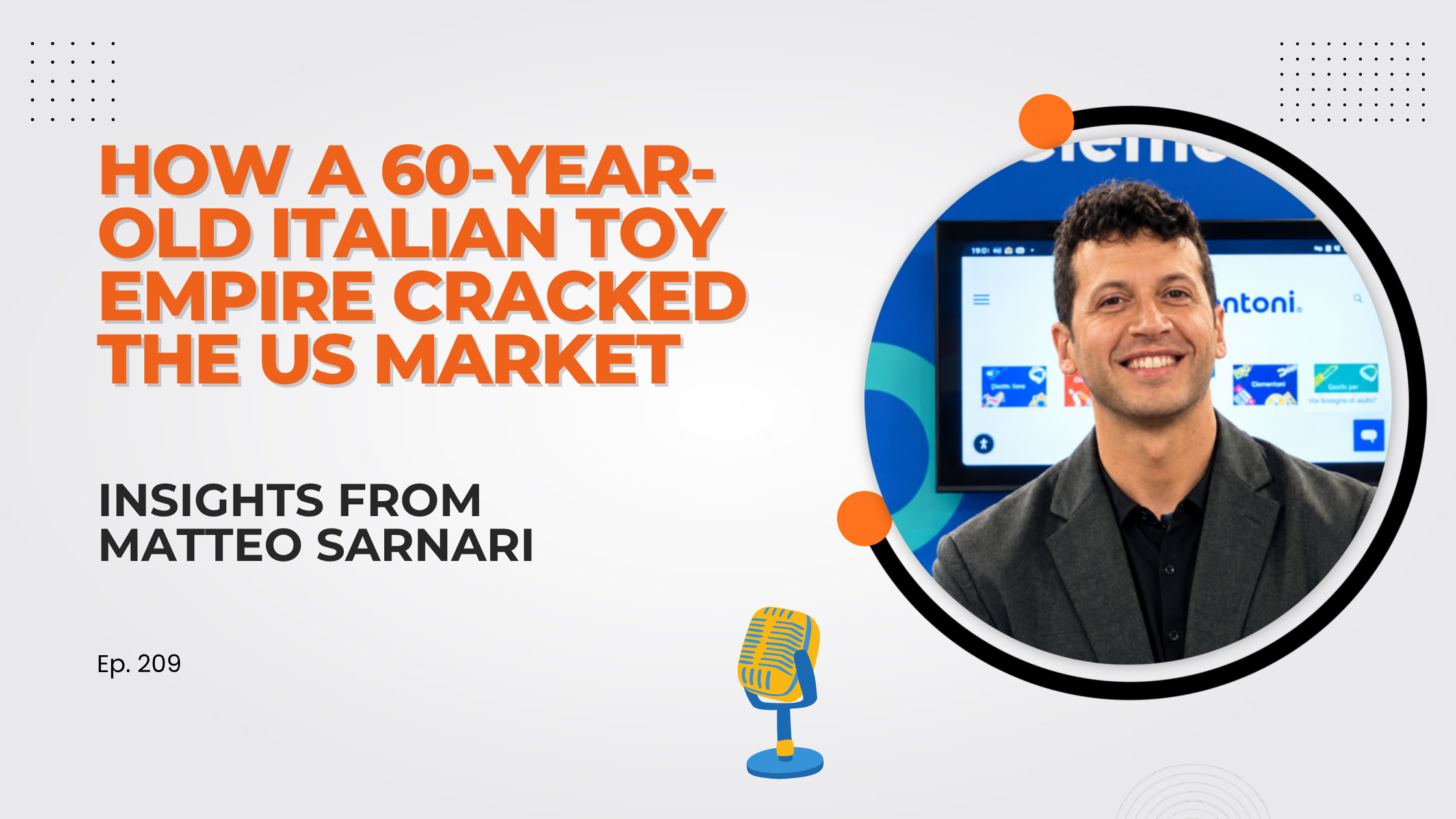
In this episode, Jason sits down with Matteo Sarnari, Business Development lead for the Americas at Clementoni, an Italian toy and game company that has been designing puzzles, board games, and educational toys since 1963. Matteo pulls back the curtain on why a company with 700 employees and more than 8,000 SKUs waited six decades to make a serious push into the US, and how that timing collided head-on with the 2025 tariff shakeup. He shares what it took to open a new showroom in El Segundo, why thinking like a European brand is the easiest mistake a newcomer can make, and how US and European toy buyers actually differ. If you have ever wondered what it takes for an established international brand to start over in a brand-new market, this conversation is for you.

#209: Betting Big on America After 60 Years in Italy – Toy Business Unboxed
Episode Highlight
- 00:42 Welcome and guest introduction
- 01:41 Clementoni’s 63-year company history
- 04:30 US business development strategy
- 06:02 The 2025 tariff timing shock
- 09:04 Opening the El Segundo showroom
- 10:47 Inside the LA Toy Preview
- 20:37 Biggest mistake entering the US
- 23:33 US versus European toy buyers
- 28:36 Final advice for newcomers
How Clementoni Is Bringing 63 Years of Italian Toy Making to America
Welcome to another conversation about global toy strategy on the Toy Business Unboxed Podcast. This week, host Jason Hsieh sits down with Matteo Sarnari, Business Development lead for the Americas at Clementoni, an Italian toy and game company that has been making puzzles, board games, and educational products since 1963. Matteo shares how a 63-year-old family business built on caution and craftsmanship is now making its first serious push into the US market. From tariff whiplash to opening a new showroom in El Segundo, this episode covers what it really takes for a European toy brand to win over American retailers.
Sixty Years of Italian Toy Making
Clementoni was founded in 1963 as a family business and it remains family-run today. The company started with simple educational connecting and logic games made from paper and cardboard, then grew after founder Mario Clementoni struck a deal with an Italian TV broadcaster to create board games based on a popular show. About a decade later, Clementoni signed its first licensing agreement with Disney, opening the door to character-based products. Today the company designs and manufactures baby and preschool toys, educational games, art and craft kits, science toys, board games, and puzzles, all in-house.
Why It Took Six Decades to Get Here
Matteo explained that Clementoni is a company that likes to be ambitious while playing it safe, taking small steps to protect the solidity it built in Europe first. For years, the company relied on US distributors to maintain a presence in the market, a strategy that worked but kept growth flat. About two to three years ago, the distributor Clementoni depended on went out of business at the same time leadership was already reconsidering its global branch strategy. Matteo called it a kind of alignment that pushed the company to finally open its own US operation in 2024.
Navigating the Tariff Whiplash of 2025
Clementoni made the decision to go direct in mid-2024, and just as the new strategy was taking shape, the wave of tariff changes Matteo called “Liberation Day” hit the toy industry in April 2025. He described waking up to a different tariff rate almost every morning, with numbers swinging anywhere from zero to 140 percent while the team tried to finalize its price list. Because 85 percent of Clementoni’s products are manufactured in Italy rather than China, the company’s actual tariff exposure stayed in a much narrower zero to 20 percent range. That stability unexpectedly opened doors with retailers frustrated with their Chinese suppliers, who for the first time were willing to talk to a smaller, unfamiliar vendor like Clementoni.
Turning a Showroom Into a Sales Hub
Clementoni opened its first dedicated US showroom in El Segundo, California in August 2025, right after opening its US office there. Matteo said the location was deliberate, since major toy companies like Mattel, Hasbro, and MGA already draw distributors, specialty retailers, mid-tiers, and mass retailers to the area throughout the year. The showroom now functions as Clementoni’s US sales hub, giving Matteo and his team a consistent place to meet customers, retailers, and reps whenever they are in town. He noted that El Segundo is increasingly pulling business away from Hong Kong’s traditional January toy trade window.
Inside the LA Toy Preview Circuit
Matteo walked through the rhythm of the LA toy preview calendar, which runs an April spring preview, an August preview for customers who want an early look, and a bigger September event that has become one of the industry’s global toy hubs. Unlike a traditional convention like New York Toy Fair or Nuremberg, the LA previews happen inside private, permanent showrooms rather than shared booths, giving vendors more privacy for scheduled meetings while still allowing walk-in buyers to stop by. Clementoni’s showroom sits inside the Toy Association building directly across from Hasbro and Lego and close to Mattel and MGA, alongside brands like Funko and Crayola. Matteo said reps typically bring store owners to these previews, and the mix of major and independent brands in the building creates the same energy as a full trade show.
The Biggest Mistake: Thinking Like a European Brand
Matteo said the easiest mistake a European brand can make in the US is assuming its home-market reputation will automatically carry over. In Europe, Clementoni does not need to introduce itself since the brand already holds leadership positions in categories like STEM and arts and crafts. Bringing that same confidence to the US meant Matteo had to start from scratch, and the company deliberately launched with only about 50 of its roughly 8,000 SKUs rather than replicating its full European catalog. Licensing deals, contract structures, and go-to-market strategy all needed to be rebuilt for the US, including leaning far more heavily on sales reps and agents than the company ever needed to in Europe.
How US and European Toy Buyers Really Differ
The biggest surprise for Matteo has been how much longer the US retail decision pipeline runs compared to Europe. In Europe, Clementoni can present new products at February’s Nuremberg Toy Fair and still expect orders for the fall season, but US mass and mid-tier retailers plan 12 to 18 months ahead and expect physical samples in hand, not just a PDF presentation. Matteo also said US retailers want a clear story behind why a product or category was chosen, not just the item itself. On top of that, US product design sometimes needs to be less overtly European and more bold or eye-catching to stand out to American shoppers.
Building Trust With Independent Toy Stores
Looking three to five years ahead, Matteo said Clementoni’s definition of success in the US is solidity, the same value that has carried the company for 63 years, not chasing volume for its own sake. He wants to build a base of independent and specialty retailers who trust Clementoni the way European customers already do, calling small stores the backbone of the US toy market. At the same time, Clementoni wants to grow with mid-tier retailers and eventually prove to the biggest big-box chains that it can deliver both the quality and quantity they require. Matteo was clear that a hit product or a trendy license can only carry a brand for a couple of years, but consumer trust is what sustains a toy company for the long run.
Advice for Newcomers in the Toy and Game Industry
Matteo’s first piece of advice is curiosity, since working in toys means understanding audiences that range from toddlers to kidults, and that requires genuinely wanting to know why a movie, show, or meme resonates with people outside your own age group. His second piece of advice is to never accept the phrase “we’ve always done it like this,” which he called the biggest barrier the team faced while adapting Clementoni’s European playbook for the US. He encouraged newcomers to stay humble, seek out people who will give honest advice, and be willing to try something new simply because it has not been done before.
Conclusion
Clementoni’s slow, deliberate path to the US shows that even a 63-year-old, family-run toy company has to start over when entering a new market. Matteo Sarnari’s experience underscores that curiosity, humility, and a willingness to abandon old habits matter as much as product quality when building trust with American retailers. As Clementoni grows its El Segundo showroom presence and expands its US catalog, the company is betting that the same solidity that built its European legacy will eventually win over American toy buyers too.
Connect with Matteo Sarnari
If you’re interested in learning more about Clementoni or connecting with Matteo Sarnari you can reach out through the following channels:
- Website: Visit Clementoni’s official website for the latest news, game updates, and more
- Instagram: Follow Clementoni on Instagram for visual updates, game previews, and creative inspiration
- Facebook: Follow Clementoni on Facebook for updates, discussions, and behind-the-scenes content.
Transcript
Jason Hsieh (00:42)
Welcome back to another
episode of Toy Business Unboxed Podcast. For today’s guests, we
have Matteo,
the business development for America for Clementoni. which is an Italian toys and game company that has been making puzzles, science toys, board games, and much more very high-quality products since 1963. So it’s definitely a company with a lot of experience and they are making their push into the US market right now.
including a brand new showroom here in US. And we’ll be talking about the legacy of their European toy brand and some of the strategy they are trying to do right now to break into US and how to compete with all the other bigger toy companies here in the United States as well. So thank you so much for joining us on the show today.
Matteo Sarnari (01:25)
Thank you. Thank you very much, Jason. Thank you, everybody. it’s a pleasure. It’s a pleasure to be here with you and to be able to talk about the company and what we’re doing every single day. Thank you.
Jason Hsieh (01:34)
Yeah, so first of all for our listener doesn’t know, heard of your company in particular, can you kind of share a little bit about a background about the story? I know you
Matteo Sarnari (01:41)
Of course.
Jason Hsieh (01:41)
have a lot of history in Europe, but in US, not a lot of people know about your company yet. So
Matteo Sarnari (01:47)
Yeah, that’s something I’m trying to do every day. So that’s not new. I’m trained to do that. so Clementoni is a family run business was founded
Jason Hsieh (01:55)
Yeah.
Matteo Sarnari (01:55)
in 1963 So it was founded by a family, still run by the same family. That’s the red line that is still going on. And
Jason Hsieh (02:03)
Mm-hmm.
Matteo Sarnari (02:04)
we were born as an educational games company. So the first few games were based on connecting games, logic games, very easy simple paper and cardboard.
games like that.
Jason Hsieh (02:15)
Mm-hmm.
Matteo Sarnari (02:15)
I’m gonna try and be very quick with that. the huge step was made when the founder, Mr. Mario Clementoni, sealed an agreement with an Italian TV broadcasting to create some board games based on
Jason Hsieh (02:27)
okay. I see.
Matteo Sarnari (02:29)
a specific TV show. fast forward
Jason Hsieh (02:31)
okay.
Matteo Sarnari (02:32)
Almost 10 years he signed the first agreement with Disney. So that’s when we started doing
Jason Hsieh (02:36)
wow. Okay.
Matteo Sarnari (02:38)
Disney license items. And then again,
Jason Hsieh (02:39)
Nice.
Matteo Sarnari (02:40)
fast forward again, we are now making baby, so preschool toys, educational
Jason Hsieh (02:45)
Mm-hmm.
Matteo Sarnari (02:46)
toys and games, art and craft, science items, board games, kids puzzle, adult puzzle. So everything is made and designed in-house.
we
Jason Hsieh (02:56)
Yeah.
Matteo Sarnari (02:56)
are now the number 14 company toy manufacturer, number one company in some categories like STEM and Arts Craft.
Jason Hsieh (03:04)
Yeah.
Matteo Sarnari (03:05)
and that’s basically where we are arrived up to now.
Jason Hsieh (03:08)
For our listeners
to understand the scope of the company, can you also share how many
Matteo Sarnari (03:11)
Yeah.
Jason Hsieh (03:12)
employees and how many SKU do you currently manage as a company?
Matteo Sarnari (03:15)
Yeah, we’re talking about 700 employees in all year round
Jason Hsieh (03:20)
And good. Whoa, okay. Yeah.
Matteo Sarnari (03:23)
that also covers some of the workers because we have our own manufacturing plant. Another key
Jason Hsieh (03:26)
Yeah. Yeah.
Matteo Sarnari (03:29)
factor of Clementoni is that we are producing 85% of our choice in Italy, which is something
Jason Hsieh (03:33)
Interview yeah,
yeah, yeah. That’s very unique, yeah.
Matteo Sarnari (03:35)
A bit different. Yeah, it was a very interesting.
topic of conversation last year
with some American retailers, of course, when tariffs came in place. And
Jason Hsieh (03:42)
Yeah. Mm. Yeah.
Matteo Sarnari (03:45)
so yeah, 700 and can go up to a thousand when we’re talking about our peak season of production, of course.
Jason Hsieh (03:49)
whoa. whoa. Okay. Okay. Okay.
Matteo Sarnari (03:53)
you asked me about the SKU. We’re managing something like eight.
thousand, eight thousand plus SKUs. Yeah, yeah, that’s a lot. Yeah. Yeah.
Jason Hsieh (03:59)
A thousand, whoa. That’s a lot of manage. Yeah. I see.
I see. Yeah. Thank you for sharing that because then that’s the easiest way for people to understand like the scope of the company. Because
Matteo Sarnari (04:08)
Absolutely.
Jason Hsieh (04:09)
we have all kinds of different businesses within the industry from solo-preneur to hundred company to well, a thousand employee company as well. So very different in scope, obviously. And with a size, it also comes with different challenges and different issues.
I want to kind of ask because you are ahead of like a kind of business development here in US, can you kind of walk
Matteo Sarnari (04:30)
In the US yeah.
Jason Hsieh (04:31)
me through some of the things you have tried and what are the strategies that’s working, were the thing you have tried that didn’t work? for our audience to also
Matteo Sarnari (04:37)
Mm-hmm.
Jason Hsieh (04:38)
learn from.
Matteo Sarnari (04:38)
Yeah, when it comes to the US, first of all, one interesting thing is how long it took us to try
Jason Hsieh (04:45)
Hmm.
Matteo Sarnari (04:46)
for good, and that’s sometimes a question I’m asked
Jason Hsieh (04:49)
Yeah.
Matteo Sarnari (04:49)
several times. Why did it take you so long? because as we said we were founded in 1963. the
Jason Hsieh (04:55)
Yeah, yeah, yeah, yeah.
Matteo Sarnari (04:56)
reason why is that first of all, this is a company always wanted to be ambitious but playing safe. So taking
Jason Hsieh (05:03)
Safe, I see. Yeah.
Matteo Sarnari (05:04)
some baby
steps sometimes,
Jason Hsieh (05:07)
Mm-hmm.
Matteo Sarnari (05:07)
but for the solidity of the company. The company is extremely solid from any perspective.
Jason Hsieh (05:12)
I see.
Matteo Sarnari (05:14)
And we wanted
Jason Hsieh (05:15)
I see.
Matteo Sarnari (05:15)
to cement our position in Europe. That was the most important thing for us. And because
Jason Hsieh (05:20)
Hmm. I see.
Matteo Sarnari (05:21)
the US comes with a great opportunity, also with great challenges. So there has been
Jason Hsieh (05:26)
Yeah, yeah.
Matteo Sarnari (05:27)
something that was tried in the past, and then
we had found a balance until two, three years ago with distribution method. So we
Jason Hsieh (05:35)
I see.
Matteo Sarnari (05:37)
were always helped by distributors in the US.
Jason Hsieh (05:40)
Mm-hmm.
Yeah.
Matteo Sarnari (05:41)
but that was like maintaining the status quo that’s what sounded like to us and to the company
Jason Hsieh (05:45)
Yeah. Yeah, yeah.
Matteo Sarnari (05:47)
to the ownership at a certain moment so we said
Jason Hsieh (05:49)
I see.
Matteo Sarnari (05:50)
they said of course let’s try and do something different let’s try and change the gear here there was a very specific moment the company was looking into changing their strategy in terms of branches subsidiaries presence worldwide
Jason Hsieh (06:02)
Okay.
Yeah.
Matteo Sarnari (06:03)
That
specific distributor went out of business at the same time. So we said maybe
Jason Hsieh (06:07)
I see.
Matteo Sarnari (06:08)
that’s a star alignment. let’s try, let’s try and do something different. So that was the reason why. Yeah.
Jason Hsieh (06:10)
okay, okay, okay. okay. I see, I see,
I see. But the timing is just kind of having an interesting timing. I think you launch right around like the tariff madness that’s happening as well in US.
Matteo Sarnari (06:24)
Yeah, yeah,
that was interesting. Let’s say the company decided
to make this step in 2024. Let’s say it was mid-2024. So the first
Jason Hsieh (06:31)
Yeah. Okay.
Matteo Sarnari (06:33)
months were a lot of study, a lot
Jason Hsieh (06:35)
Yeah.
Matteo Sarnari (06:36)
of analysis of who we are, who we can be, who the others are,
Jason Hsieh (06:39)
Yes.
Matteo Sarnari (06:40)
how we have to work in this huge, huge market. And then just
Jason Hsieh (06:43)
Yes, yes.
Matteo Sarnari (06:44)
when we started to say, Okay, let’s do like this,
the tariffs thing started let’s say. so yeah, so yeah liberation day April 2025 that’s when say every
Jason Hsieh (06:49)
Started to happen. Yeah. Yeah. Crazy. Yep.
Matteo Sarnari (06:57)
morning I was waking up to a different tariff rate so and that was the moment we were… that’s exactly the
Jason Hsieh (06:59)
Yeah. Yeah. I remember that. That was insane.
Matteo Sarnari (07:04)
moment in which we were building our price list to be very, very practical you know and so
Jason Hsieh (07:08)
yeah, okay. Yeah. That was crazy. Like is it 20%?
or is it a 125%? Like that’s a big difference. Yeah, yeah, yeah, yeah. Yes, yes, yes,
Matteo Sarnari (07:15)
Yeah, you know, I mean zero, 20, 30, 50, 140. So it was, it was like gambling at a certain point. but
and that the unicity of the company actually came handy, I can say. as I said, 85% of what we do is made in Italy. So we Yeah. So we
Jason Hsieh (07:30)
okay, true. in Italy, not China, yeah, that’s true, that’s true. So
Matteo Sarnari (07:36)
we did were impacted by Tariff, but
Since the
Jason Hsieh (07:40)
Mm-hmm.
Matteo Sarnari (07:40)
majority of what we had and the great majority of what we were offering to the US was made in Italy, the impact was kind of small, I have to say it was relatively small. We always
Jason Hsieh (07:45)
Yeah, yes. okay, okay, okay, okay, yeah.
Matteo Sarnari (07:52)
played within zero and 20, something like that. So even if
Jason Hsieh (07:55)
Yeah. I I see.
Matteo Sarnari (07:57)
there was some fluctuation, of course, that can be done. And as I said as a
Jason Hsieh (08:01)
Yeah.
Matteo Sarnari (08:01)
joke at the beginning, it was an interesting topic of conversation. There were some customers.
Jason Hsieh (08:04)
Yeah.
Matteo Sarnari (08:05)
Who would have taken ages for them to talk to a small unknown vendor as Clementoni to turn their
Jason Hsieh (08:10)
Yeah.
Matteo Sarnari (08:13)
head to us and say, You guys are manufacturing Italy, maybe we can talk because we are having a huge problem with our Chinese. Yeah, so again that
Jason Hsieh (08:17)
Yeah, yeah, yeah, yeah, yeah. Huge problem with China factory, yeah, yeah, yeah, yeah, yeah, yeah. Exactly. Okay.
Matteo Sarnari (08:25)
maybe they did not result in opening business right away.
But it really
Jason Hsieh (08:29)
Yeah.
Matteo Sarnari (08:30)
it certainly accelerated some process. So that was I
Jason Hsieh (08:33)
Mm, I see, I see, I see, I see.
Matteo Sarnari (08:35)
can use an old saying, from every challenge there’s an opportunity, sounds like something out of a movie. It was true this time, it was true.
Jason Hsieh (08:39)
Of course. Yeah,
true. True, true, true. And let’s talk a little bit about your US presence right now. I know you just recently opened a dedicated showroom in US as well. Can we kind of talk
Matteo Sarnari (08:51)
Yeah. Correct?
Jason Hsieh (08:52)
about that? And what is your goal for the showroom? Is it to show the distributor or like are you trying to like invite actual retail buyer to that location? What is your strategy around your dedicated showroom?
Matteo Sarnari (09:04)
Yeah, we did open our showroom August last year.
Jason Hsieh (09:06)
Yeah.
Matteo Sarnari (09:07)
just after we open our US offices. It was still August last year. our
Jason Hsieh (09:11)
Yeah. Yeah.
Matteo Sarnari (09:13)
office is office and showroom is in El Segundo.
Jason Hsieh (09:16)
Yeah.
Matteo Sarnari (09:16)
so a very, very popular toy area at the moment. what’s
Jason Hsieh (09:20)
Yes. Yes, yes.
Matteo Sarnari (09:22)
the strategy? Well then
It’s gotta be our sales hub, I would say, in the US. So
Jason Hsieh (09:29)
Okay.
Matteo Sarnari (09:29)
there’s several occasions during the year where a lot of distributors, specialty retailers, mid tiers, mass retailers
Jason Hsieh (09:38)
Mm-hmm.
Matteo Sarnari (09:38)
are traveling to El Segundo. I mean
I don’t need to hide that Mattel is there, that Hasbro is there.
MGA is there, so of course they were going anyhow. That’s why we all wanted to open that. And
Jason Hsieh (09:51)
Yes.
Matteo Sarnari (09:52)
yeah, a center it serves as a hub for us and for me every time I go there, but it’s a great, great
Jason Hsieh (09:56)
Mm, okay.
Matteo Sarnari (09:57)
opportunity to meet customers, to meet retailers, to meet reps.
Jason Hsieh (10:01)
Mm-hmm,
mm-hmm, mm-hmm.
Matteo Sarnari (10:01)
Even that’s
a very interesting point of contact with everybody in the US we want to talk to. there’s several moments
Jason Hsieh (10:08)
Mm, okay.
Matteo Sarnari (10:09)
throughout the year when to go there. September,
Jason Hsieh (10:11)
Yes.
Matteo Sarnari (10:12)
of course, is becoming a one of the centers, one of the global centers of for toys, I would say.
for the full preview. August is also very interesting. Some customers, some big toy retailers and some mass retailers want to go and see new items before everybody else, I would say. So even before September. So that’s interesting. And of course, April
Jason Hsieh (10:32)
yeah yeah yeah yeah yeah yeah yeah yeah I
Matteo Sarnari (10:36)
with the spring preview is also very, very interesting. So yeah, it’s
Jason Hsieh (10:40)
I see.
Matteo Sarnari (10:40)
becoming very important for the American retailers and not only. I see that LA is replacing somehow
Hong Kong in January. it’s draining some of the traffic there.
Jason Hsieh (10:47)
really? Okay. Yeah.
Matteo Sarnari (10:49)
So we got a lot of it is still within my scope of business developer Americas, a lot of Mexican
Jason Hsieh (10:55)
Yeah.
Matteo Sarnari (10:56)
retailers, South American retailers,
Jason Hsieh (10:58)
So did you
participate in the most recent LA toy preview as well then? Yeah, yeah, okay. Yes.
Matteo Sarnari (11:04)
We did, we did. we participated in April. we’re
set to go again next week, actually, to have a preview of the preview. in August. Yeah. next week we’ll be
Jason Hsieh (11:12)
already. I thought it’s in September. But it’s already next week. Whoa, okay.
Matteo Sarnari (11:18)
there as I said, some customers want to have a preview of a preview. if you’re
Jason Hsieh (11:23)
Preview of a preview.
Okay. Preview of a preview.
Matteo Sarnari (11:24)
If you’re a, if you’re a Walmart, if you’re a
Costco, if you’re a Target, you
want to have some very special preview, let’s put it that way.
Jason Hsieh (11:33)
I see, I see. I haven’t personally attended any of those preview events. For those of our listeners that also haven’t been to those events, can you kind of talk about h how is that different than the trade show? Who usually get invited to it and what exactly is happening during those preview events based on your experience. So
Matteo Sarnari (11:51)
Yeah. well, I can compare it to a of course a New York Toy Fair, or if you’re thinking about Nuremberg Toy fair, I’m thinking about the big ones in Hong Kong too.
Jason Hsieh (11:56)
Yeah. Yeah. Yeah.
Matteo Sarnari (12:00)
that’s slightly different. You don’t go to a convention venue, let’s put it that way. it’s not like
Jason Hsieh (12:05)
Hm, okay. Yeah, yeah, yeah.
Matteo Sarnari (12:08)
fair when you have a booth and you have an open space that you share with everybody,
Jason Hsieh (12:12)
Yes.
Matteo Sarnari (12:13)
you get more privacy, I would say. So you need to have your own showroom.
Jason Hsieh (12:17)
You need to have
the ownership.
Matteo Sarnari (12:18)
You you
you have you can always have some private meetings, but you
Jason Hsieh (12:22)
I see.
Matteo Sarnari (12:22)
know that there’s a lot of wall buyers too. So you can preset a lot of meetings, but not only that. So you can have both, you can meet your current customers and and accounts, and you can meet a lot of new ones just walking by your booth, every door is open there. it’s it’s very well organized now.
Jason Hsieh (12:41)
So do those are
they mostly like sales rep or retail store owner or who usually go to the previews in LA?
Matteo Sarnari (12:50)
I would say reps bring store owners. you don’t
Jason Hsieh (12:52)
Reps I’ll reps green store.
Matteo Sarnari (12:55)
yeah, you don’t get a lot of specialty store owners walking by the buildings in LA. So
Jason Hsieh (13:03)
I see.
Matteo Sarnari (13:04)
this is something you get at New York Toy Fair, this is something you get a lot at Astra, for example.
Jason Hsieh (13:09)
Yes, yes, yes, yes. In Astra, yes, yes, yes.
Matteo Sarnari (13:11)
yeah.
So you get a lot of reps bringing customers there, bringing stores there, and of course you can meet a lot of me tier key accounts and you get the big ones going there.
to meet you and of course to meet also the big suppliers. So it’s certainly more higher end if I can say than an astra because of the quality of course but because of the size of the customers but it’s still something that’s it’s very, very useful it’s very well organized now by the Toy Association. We are in the Toy Association building which is just facing yeah, yeah
Jason Hsieh (13:45)
I see. you’re in the same building. Okay, okay, okay. I see.
Matteo Sarnari (13:49)
Which is facing Mattel’s and
Jason Hsieh (13:49)
I see. Yeah.
Matteo Sarnari (13:51)
very close. I mean Hasbro is in the same building, MGA is not very far from there, so it’s a very, very convenient location for customers. Yeah. Used to be
Jason Hsieh (13:55)
Yeah. okay. the big company. Yeah, yeah, yeah. I see I
Matteo Sarnari (14:00)
way more complicated in the past, like 20 minutes
Jason Hsieh (14:03)
I see.
Matteo Sarnari (14:04)
Ubering from a building to another that was a nightmare. Now just walking distance from the others.
Jason Hsieh (14:09)
I see. Will you say most of the company that’s participating is like giant corporation? Or is it also some smaller like brand in that building?
Matteo Sarnari (14:17)
Yeah, you get a mix of that. I can say in the building where we are, we’re having Hasbro and Lego. not the smallest I can think of. and so they are there, of course, with huge, huge showrooms, taking almost a full floor. They deserve it
Jason Hsieh (14:27)
Yeah, that’s not a smaller brand Yeah. Yeah. Yeah. Yes.
Matteo Sarnari (14:37)
Can name a few, but Funko is there, Crayola is there. So you got some big ones too. And then you get us,
Jason Hsieh (14:41)
funcle, yeah, yeah, very big. I see.
Matteo Sarnari (14:44)
a newcomer in the market, but not a newcomer in the business in general. And then you have also some other brands, some are American brands, some are Chinese brands. You get a little bit of everything. And as you get a mix of potential customers, you also get a mix of potential suppliers and vendors for customers.
So that’s really what makes you breathe like a trade show air in there.
Jason Hsieh (15:09)
Interesting. It’s a different type of trade show because it’s permanent too, right? It’s not a you move
Matteo Sarnari (15:14)
It is.
Jason Hsieh (15:14)
room. It’s always the same kind of location, same room.
Matteo Sarnari (15:17)
It is.
you can do both actually. So if you’re interested,
Jason Hsieh (15:20)
Oh you could okay, okay.
Matteo Sarnari (15:22)
yeah, you can book like two or three weeks if you want to stay just say in the preview weeks, you can do that. In terms
Jason Hsieh (15:28)
I see. I see. Okay. Interesting.
Matteo Sarnari (15:31)
of yeah, in terms of making the investment, we said it was convenient to have it for the long run. So it’s always there. Again, it’s our hub. we wanted to have
Jason Hsieh (15:39)
I see.
Matteo Sarnari (15:40)
what can I say? Wanted to have a place to go when we were meeting
Jason Hsieh (15:42)
Go yeah, yeah.
Matteo Sarnari (15:44)
a customer during those weeks, so it was convenient for us to have it permanent.
Jason Hsieh (15:45)
I see, I see, I see,
I see. Got it, got it. And usually you already start contacting customer weeks before the preview to schedule
Matteo Sarnari (15:52)
Yeah.
Jason Hsieh (15:53)
meetings or by the time when it happened, your kind of agenda is already fully booked. Is that typically how it works?
Matteo Sarnari (15:58)
Yeah,
also there you get a mix of
behaviors I can say. So some of the customers plan months ahead. So you got some customers
Jason Hsieh (16:03)
okay. Tell me more. Yeah. I see.
Matteo Sarnari (16:08)
asking for meetings like three months ahead of the show, something like that. And yeah,
Jason Hsieh (16:11)
whoa, swing on the head. whoa, okay, okay.
Matteo Sarnari (16:14)
I have and then you got customers who were asking in the last few weeks. So every few days I get a new meeting for September already. And you
have a lot actually of again wolf buyers. So
So they can be random, if I can say customers who don’t know you and just walk by your booth. they’re trying and a sneak peek of what you have inside and if they’re interested, they walk in. Or
Jason Hsieh (16:35)
I see. Okay.
Matteo Sarnari (16:39)
again, we got reps bringing their old customers and those kind of
customers usually don’t work with an agenda. So you always have to be ready because
Jason Hsieh (16:46)
I see, I see.
Matteo Sarnari (16:48)
If you’re planning a day with eight meetings, you’re gonna end up with 16 or something like that. So you always have to be ready. Got to be flexible. Yeah.
Jason Hsieh (16:55)
I see, I see. So yeah, yeah. How about
service provider? Do you also have meeting with service provider during that period of time or is it only for like sales rep and retail store and all that stuff?
Matteo Sarnari (17:05)
service providers you mean like marketing people?
Jason Hsieh (17:08)
Could be just like could be 3PL,
it could be like logistics, could be lawyers, could be other companies that you work with. So
Matteo Sarnari (17:13)
Could definitely be. Yeah,
3PL logistics can definitely be. we now have find a solution for that, but of course they
Jason Hsieh (17:22)
Yeah, yeah.
Matteo Sarnari (17:22)
usually pop up and they ask you if if they can be helpful. we got marketing,
Jason Hsieh (17:26)
Yeah.
Matteo Sarnari (17:27)
a lot of marketing. We got designers, you’ve got inventors,
you got a little bit of everything also there.
I usually bring home a lot of leaflets from inventors and designer, graphic designer, board game designers. I got a lot of samples in my hands
Jason Hsieh (17:40)
okay. Yes. simple. Do they just walk up to you? do
they need to book an appointment with you first? Or do they just walk out and say here’s the sample? okay. Yeah. Yeah.
Matteo Sarnari (17:48)
No, they just walk they walk by and they have a sample and they give it to you and then they describe it. That’s fantastic. And sometimes it’s very interesting. And then they give
you those samples. And I also have to always make some room in my luggage because then otherwise I don’t know what to do with them. so sometimes I need an extra luggage just for that.
Jason Hsieh (18:08)
Interesting.
Okay, okay. I see, I see. Maybe I’ll try to go to the one next month. But you say you’re already doing that next week? So Yeah. I see.
Matteo Sarnari (18:13)
You should. Next week I’m gonna be there for a few days and then
I have some other meetings in the country. but definitely
Jason Hsieh (18:20)
Yeah. I see.
Matteo Sarnari (18:22)
September is looking like two very busy weeks.
Jason Hsieh (18:25)
I see, I see, I see. Okay, I’ll definitely attend. I’ll reach out to the client we work with, see if anyone is in that building as well. So but thank you so much for sharing
Matteo Sarnari (18:31)
You should. Definitely should.
Jason Hsieh (18:34)
your experiences because I’m also trying to learn a little bit more about the LA Preview since they are so well known in the industry, but personally haven’t been to one of those yet. I’ve been to a lot of other trade shows. I’ve been to Nuremberg, I’ve been to New York, been to Astra, obviously, but
Matteo Sarnari (18:48)
Yeah.
Jason Hsieh (18:49)
that is the only one I haven’t been to that I always wanted to go.
So thank you so much for sharing your experience. So
Matteo Sarnari (18:52)
It’s it’s becoming a main one, yeah.
Jason Hsieh (18:55)
and in the I guess in the building, do you also run across a lot of other European toy brands as well? if so, how is their strategy different than your strategy as far as getting into the US market currently?
Matteo Sarnari (19:07)
yeah, I c I can name a few that I know of. I mean, when we talk
Jason Hsieh (19:11)
Yeah.
Matteo Sarnari (19:11)
about European w we know each other very well, I have to say. Europe, it’s
Jason Hsieh (19:16)
okay, okay.
Matteo Sarnari (19:17)
still a big market. but everybody knows everybody. I can, I can put it like that. So you get a lot of familiar faces sometimes when you go there.
Jason Hsieh (19:21)
okay, okay, okay, okay. I see, I see.
Matteo Sarnari (19:27)
there’s several strategies I see. So
Jason Hsieh (19:30)
Yeah.
Matteo Sarnari (19:31)
I see someone
working with distributors and that’s it because that’s what they like, that’s what they feel confident with.
Jason Hsieh (19:37)
only to Jupiter. I see.
Matteo Sarnari (19:40)
That’s what they want to do and they’re happy with what they do. That’s a very respectable strategy. we’ve gone that way for many, many years and it worked for us until it didn’t. So I
Jason Hsieh (19:50)
Sure, sure.
Matteo Sarnari (19:51)
absolutely respect that.
Jason Hsieh (19:53)
Sure.
Matteo Sarnari (19:53)
Some
other companies do what we do or what we are trying to do. So trying to build a local presence. yeah, so local team and
Jason Hsieh (19:57)
Okay. local team, yeah, okay, okay, okay. Yeah,
Matteo Sarnari (20:03)
that’s where it gets tricky and
Jason Hsieh (20:05)
Yeah,
yeah, yeah.
Matteo Sarnari (20:05)
I don’t want to
sound like I’m lecturing anyone because I’m still learning a lot every single day. I can tell you what I did in the last couple of years.
Jason Hsieh (20:09)
Yeah.
Matteo Sarnari (20:13)
You need to try and find good people that give you good advice is to make good moves. so you got to be very humble.
Jason Hsieh (20:19)
Based
on you experienced so far, what has been the hardest part of introducing a European toy brand to a US consumer base that just doesn’t really know about you guys yet, even so you have so much history in Europe, but like what is like some of the struggle you face so far trying to introduce your brand into
the US?
Matteo Sarnari (20:37)
yeah. very good question actually. so that’s one of the hardest things or one of the easiest I let me put that this way. One of the easiest mistakes you can do is think with your European brain when you get here. that’s something sometimes I tried at the beginning, but then I was yeah, I that doesn’t work. And because
Jason Hsieh (20:51)
Yeah. Yeah.
Matteo Sarnari (20:57)
we come from a position where we are
extremely I would say well known in Europe. we
Jason Hsieh (21:02)
Yeah.
Matteo Sarnari (21:03)
have some leadership position in some very important segments. So everywhere
Jason Hsieh (21:08)
Yeah, yeah.
Matteo Sarnari (21:08)
I go to in Europe I say okay it’s Clementoni. I don’t need to introduce the brand. I mean that’s, that’s in everybody’s radar. either you like us or you’re trying to fight us or compete with us, you know who we are. and so
Jason Hsieh (21:13)
Yeah, yeah, yeah. Yeah. Yeah, yeah, yeah, yeah.
Matteo Sarnari (21:23)
if you go with that mindset into a country that
Jason Hsieh (21:26)
Yes.
Matteo Sarnari (21:27)
doesn’t even know
who you are, if you’re doing toys, if you’re doing shoes,
Jason Hsieh (21:28)
Who you are, yeah, that’s tricky.
Matteo Sarnari (21:30)
if you’re doing pasta. So you have to start from scratch and I mean that’s
Jason Hsieh (21:32)
Yeah. Yeah, it sounds like a pasta brand
actually for people that didn’t know, okay, this is a pasta company. Yeah.
Matteo Sarnari (21:41)
You know, that’s that’s Italian heritage we’re trying to export. so
you need to like, okay, rewind, start from scratch, and
Jason Hsieh (21:49)
Yeah. Mm-hmm.
Matteo Sarnari (21:50)
as I did with you in this podcast, explain who we are, where we started, where we are now. So if
Jason Hsieh (21:53)
Yeah, yeah, yeah, mm.
Matteo Sarnari (21:57)
you’re thinking about the fact that since you’re successful in Europe, it has to work no matter what in the US. That that that’s horribly wrong.
that’s something
Jason Hsieh (22:07)
Mm-hmm.
Matteo Sarnari (22:08)
we tried in the past. That’s some mistakes I’ve made in the last couple of years. So you really need
Jason Hsieh (22:10)
See I see I
Matteo Sarnari (22:14)
to try and be humble, I would say, not just with how we behave, but also with the decision we’ve made. I told you about the 8,000 SKUs we manage. I think I started with 50 here in the US. I there’s no reason to bring so many products trying to do exactly what you did in Europe.
It has to be a different strategy. It has to come with a different
Jason Hsieh (22:34)
Yes.
Matteo Sarnari (22:36)
catalogue. It has to be come with different license
Jason Hsieh (22:41)
Yeah.
Matteo Sarnari (22:42)
strategy if you have license, because of course the contracts here are completely different.
Jason Hsieh (22:46)
Yes.
Matteo Sarnari (22:47)
and reps for example are extremely important in the US. That’s something you can easily do without in Europe. you don’t always
Jason Hsieh (22:53)
Yeah.
Matteo Sarnari (22:54)
need reps or as we call them in Europe, agents. sometimes you do need them, yeah.
Jason Hsieh (22:58)
that’s very different. Okay, okay, okay.
Interesting. Okay. Hmm.
Matteo Sarnari (23:01)
Yeah, absolutely. then
of course we have our own Walmart and our own target that all the small
Jason Hsieh (23:07)
Yeah. Okay, yeah.
Matteo Sarnari (23:09)
stores are scared of. Of course, it’s we all we also have that in Europe just with different names. We have Amazon over there. So that kind of sales
Jason Hsieh (23:14)
Yeah, yeah, yeah. Yes.
Matteo Sarnari (23:18)
strategy and and protection you want to give to some of your customers, this is something we deal with every single day. But yeah.
Jason Hsieh (23:24)
Mm hmm.
Matteo Sarnari (23:25)
trying to think in different ways and start from scratch and
Jason Hsieh (23:29)
Well yeah.
Matteo Sarnari (23:30)
re evaluate what you’re doing every single day is something we have to do.
Jason Hsieh (23:33)
I see, I see, I see. And based on your experience, what are the differences you have noticed between how a European toy buyer and a American toy buyer evaluate product line? Like do you do you notice like how US buyers is looking for a different type of toy with different line of toys? Like what are the differences between US and European toy buyers?
Matteo Sarnari (23:53)
Yeah.
well actually the first difference I would say I can’t say shock me, but it’s something that really changed the way I’m working every single day is the is the pipeline for their decisions. So especially
Jason Hsieh (24:03)
Okay. okay.
Matteo Sarnari (24:07)
the meteor and big retailers have a much,
Jason Hsieh (24:10)
Mm-hmm.
Matteo Sarnari (24:11)
much longer pipeline when it comes to selection of items.
Jason Hsieh (24:15)
Okay.
Matteo Sarnari (24:16)
in Europe
it’s not a mystery. we have Nuremberg in February and sometimes
Jason Hsieh (24:21)
Yes.
Matteo Sarnari (24:22)
it’s still a very useful window to present and start quoting
Jason Hsieh (24:26)
For second, okay.
Matteo Sarnari (24:27)
items to retailers for fold. that’s
Jason Hsieh (24:29)
Yeah.
Matteo Sarnari (24:30)
unthinkable for a mid tier or big mass retailer in the US.
Jason Hsieh (24:36)
the lead time is much longer then. Yeah, okay.
Yeah.
Matteo Sarnari (24:38)
they
would need 12 to 18 months for a decision. So and so it’s not just
Jason Hsieh (24:42)
I see, okay, okay, okay. I see. That’s interesting.
Matteo Sarnari (24:46)
them deciding earlier, we have to be ready earlier. You can’t, you can’t go
Jason Hsieh (24:50)
yeah, yeah, yeah, yeah, yeah.
Matteo Sarnari (24:51)
to them with a paper presentation or just a PDF or some sort of.. they need to have something in hands, and that’s what really is a challenge for us. It’s something that we need to understand.
Jason Hsieh (24:55)
Yeah. Yeah, yeah, yeah. I see. Hmm.
Matteo Sarnari (25:02)
and when it comes to selection, I think.
The US retailer are very well organized in creating a story around the selection of the item. They want to know if you’re making marketing with a specific item, what’s our
Jason Hsieh (25:14)
Yes.
Matteo Sarnari (25:15)
idea of that item of that segment, why we decided to introduce that category, why the item. So we need
Jason Hsieh (25:20)
Yeah.
Matteo Sarnari (25:21)
to tell a story which is true, and they want to hear that story.
Jason Hsieh (25:23)
Mm-hmm. Okay.
Matteo Sarnari (25:26)
and then there’s a difference in
aesthetics I would say of course sometimes you don’t want to be too European even in your design so you got to
Jason Hsieh (25:33)
Okay. Okay. I see.
Matteo Sarnari (25:36)
act and feel funnier I would say more flamboyant sometimes you really
Jason Hsieh (25:42)
Okay, okay.
Matteo Sarnari (25:43)
want to catch the eye of the consumer so yeah
Jason Hsieh (25:46)
The consumer. Yeah. Yeah. Yeah. Yeah.
So I guess my next question, as we’re kind of toward the end of today’s interview is over the next few years, what does success look like for you and the company in US market? Like what do you want to accomplish in the next three to five years?
Matteo Sarnari (26:02)
yes, good one too. when I introduced the brand a few minutes ago, I talked about one of our key points being solidity as a company. So
Jason Hsieh (26:10)
Mm, okay.
Matteo Sarnari (26:11)
that’s also why it took us so long, let’s say, to go to the US, because we wanted this decision to be
Well thought.
Jason Hsieh (26:18)
Yes.
Matteo Sarnari (26:18)
and Solidity is what provided success to this company for
Jason Hsieh (26:22)
Mm-hmm.
Matteo Sarnari (26:23)
63 years now. And
Jason Hsieh (26:25)
Yeah.
Matteo Sarnari (26:26)
so solidity again would be our success here. So we really need to create a success that doesn’t only come from big volumes and
It’s easy sometimes generalizing this market to say, yeah, you just need to get in Walmart or get in Amazon or getting some of the other big ones. And the money is there, the success is there. It’s absolutely not that easy. and again, I’m not talking that much out of my experience in the US because it’s extremely small, but in general, we would
Jason Hsieh (26:53)
Mm-hmm.
Matteo Sarnari (26:55)
like to have a very solid base of customers that can trust the brand just like
Jason Hsieh (26:59)
I see.
Matteo Sarnari (27:00)
they trust us in Europe.
Jason Hsieh (27:02)
Yeah.
Matteo Sarnari (27:02)
So
we are trying to give the utmost attention to all our small independent stores, which is
Jason Hsieh (27:10)
Mm.
Matteo Sarnari (27:10)
the backbone of the market, especially in this country, I would say.
Jason Hsieh (27:12)
The success, yeah, yeah, yeah. I see, I see.
Matteo Sarnari (27:16)
we want to have all the mid tiers, of course, and
Jason Hsieh (27:19)
Mm-hmm.
Matteo Sarnari (27:20)
we want to show to the big boxes, I would say, that we
Jason Hsieh (27:23)
Hmm.
Matteo Sarnari (27:24)
can be interesting, we can
provide the level of quantity and quality they ask.
Jason Hsieh (27:31)
Yes.
Matteo Sarnari (27:31)
so I’m not giving myself a huge target in volume of sales in the next two or three years, let’s put it that way. because
Jason Hsieh (27:38)
See. Okay.
Matteo Sarnari (27:39)
we’ve always thought about the long run. So
Jason Hsieh (27:43)
Long term, yeah.
Matteo Sarnari (27:43)
Establishing a
good business, getting the trust of the consumers, that’s what’s gonna help you. You might have the most interesting, the most successful item for a couple of years. You can hop on the most trendy license for a couple of years, but all
Jason Hsieh (27:58)
Mm-hmm.
Matteo Sarnari (27:59)
these will be up and down, up and down. But if you have a nice base, so trust, would say customer trust is what we would like to have and consumers trust that’s a success in the long run.
Jason Hsieh (28:09)
I see, I see, I see. Yeah, it does take a while for especially for
Matteo Sarnari (28:12)
Yeah.
Jason Hsieh (28:13)
like brand recognition. So they know it is a toy company, not a pasta company.
Matteo Sarnari (28:18)
No. I mean if you wanna come to our showroom, there’s always gonna be very
good pasta anyhow. So that’s one thing doesn’t exclude the other, of course.
Jason Hsieh (28:23)
Ha ha ha.
Matteo Sarnari (28:25)
But but we don’t do that. We don’t produce that.
Jason Hsieh (28:27)
Yeah.
Of course, of course, of course. So as we’re wrapping up today’s interview, if you have to share one piece of advice with another entrepreneur with people that’s just getting started within the toys and game industry, what would that be based on your experience?
Matteo Sarnari (28:42)
Okay. there’s a couple of things that I think are extremely useful and this is not something that you learn working in the business or in any school or university.
Jason Hsieh (28:53)
Yeah.
Matteo Sarnari (28:54)
first thing is curiosity. I think if you wanna work
Jason Hsieh (28:56)
Okay, I was at the
Matteo Sarnari (28:57)
in a business like this, especially because we’re talking about toys
and
especially because you’re talking about sometimes kids, sometimes toddlers,
Jason Hsieh (29:03)
Yeah.
Matteo Sarnari (29:04)
sometimes adults. Kiddults is now extremely popular. So so sometimes
Jason Hsieh (29:06)
Yeah. yes. Yeah.
Matteo Sarnari (29:10)
you have as a target people that have your own age. So that
Jason Hsieh (29:13)
Yeah.
Matteo Sarnari (29:14)
maybe requires less curiosity and of course it requires a lot when you’re talking about others.
Jason Hsieh (29:18)
Well.
Matteo Sarnari (29:18)
But you always need to wanna see that movie.
wanna see that series, wanna know why that is a meme and what does that mean. So that’s extremely important.
and the other thing I would say is never accept the sentence, we’ve always done like this.
Jason Hsieh (29:38)
yeah yeah yeah yeah yeah yeah
Matteo Sarnari (29:37)
Which is to me horrible. and especially
when we were transitioning from Europe to US, it was easy to say, why does this customer want to have things like that? We’ve always done like this. And that was the huge, the biggest barrier you could put, the biggest cultural barrier you could put. So be ready to really put all those walls down and
Not because you’ve never done this before it’s something that you have to do. Or maybe just because you’ve never done it, you need to do that to do something different that you’ve never done before. So this will be my
Jason Hsieh (30:11)
Mm-hmm.
Matteo Sarnari (30:12)
two cents.
Jason Hsieh (30:13)
Okay, that’s a very good piece of advice. Thank you for sharing that. And thank you so much for
Matteo Sarnari (30:17)
Thank you.
Jason Hsieh (30:18)
your time appearing on our show. I know you’re on your vacation this week, so thank you so much for even joining on your vacation.
Matteo Sarnari (30:23)
Yeah, yeah, I mean
as a salesperson I don’t know if we’re ever on vacation, but yeah, let’s say, let’s say, let’s say it was it was a couple of days off, but it was
Jason Hsieh (30:29)
True. Yeah. Yeah.
Matteo Sarnari (30:34)
it was my great pleasure to be here for the podcast today.
Jason Hsieh (30:37)
thanks. And this is also my pleasure to have you on the show. And thank you so much for our audience for tuning in to this episode of Toy Business Unboxed Podcast. I hope today’s conversation gives you some practical insight and a glimpse into working inside the industry more. And this podcast is sponsored by Toy Launch, a leading marketing and growth partner for Toys and Game brands. Here at Toy Launch, we help brands scale on Amazon and beyond through full service account management, advertising, SEO, creative catalog optimization.
influencer marketing and more. If you are looking for a proven team that both understands the toys and game industry and e-commerce marketing, we are here to help. If you like a personal breakdown of your brand opportunities and the best step for digital marketing, feel free to schedule a free consultation session with us. Just visit toy-launch.com for more information. If you want to connect with other toys and game founders or people within the industry, feel free to join our brand new
Community, toys and game launch pad. You will also find more information on our website as well. And for other resources, update, industry insight, our podcast, and our monthly webinar, you can see all the resources on our website, toy-launch.com as well. Until next time, keep innovating, keep creating, keep bringing joys through toys. This is Jason Hsieh, signing off on the Toy Business Unboxed podcast. We will see you in the next episode. Thank you so much, everyone.
Grow your toy brand’s content reach
From SEO blog content to influencer outreach — we handle the full content engine for toy and game brands.