
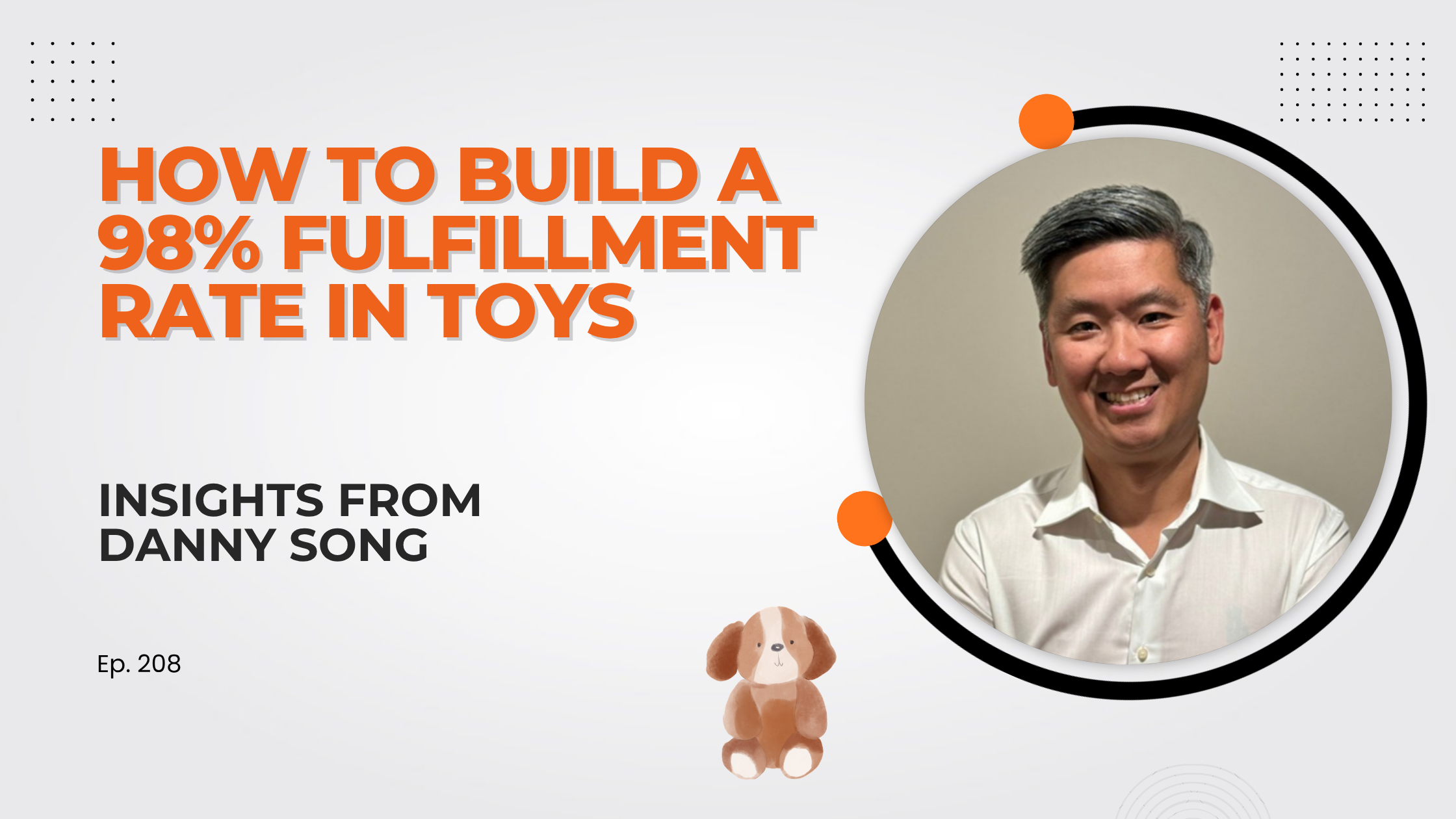
Welcome to another episode of Toy Business Unboxed Podcast, where host Jason Hsieh sits down with Danny Song, president of Goffa International and its new premium plush brand Giffa. Danny grew up in the toy business, and now runs a company manufacturing plush for mass retail, amusement parks, and specialty stores, built on a fulfillment rate that outperforms most of the industry. Jason and Danny trade stories about family businesses, the real math behind shipping toys empty versus filled, and what it takes to build a brand retailers can count on.

#188:The Game Industry Secret Behind Anomia's Longevity – Toy Business Unboxed
Episode Highlight
- 00:42 Welcome and guest introduction
- 01:32 Growing up in the family business
- 03:08 Learning to drive on forklifts
- 05:07 Resisting the family business
- 09:10 Technology changes Danny introduced
- 11:37 How the toy industry changed
- 16:23 Introducing the new Giffa brand
- 20:04 Relationships versus spreadsheet driven deals
- 24:57 The 98% fulfillment rate
- 30:40 Shipping toys as empty shells
Growing Up in a Family Toy Business
Danny’s father founded Goffa International in 1981, but he was already in the toy business years earlier, importing toys through his contacts in Taiwan and selling them at flea markets on the East Coast. When the family first moved to Queens, their living room doubled as the company’s first warehouse, with boxes of toys stacked against the walls next to the television. As the business grew, the family moved through several New York City warehouses, in Maspeth, Long Island City, and Bushwick, before eventually relocating the company to New Jersey about 15 years ago. Danny remembers learning to drive on a forklift before he ever drove a car, and comparison shopping at the original FAO Schwarz in midtown Manhattan.
Resisting the Family Business Before Finally Joining
Like many children of founders, Danny felt the weight of everyone around him watching him grow up, since employees who had worked for his father for 25 or 30 years constantly compared him to his dad. After graduating school, Danny resisted joining the company outright, working instead for a computer company and an advertising agency to build his own career first. His father eventually gave him an ultimatum, framed around the idea that it made little sense to work for somebody else when he could build on the foundation already in place. Jason shared a similar story about resisting his own father’s business, though Jason ultimately chose to build his own company instead of joining his dad’s.
Learning the Company From the Ground Up
Danny did not step into a leadership role when he joined Goffa. He spent his early years shadowing his father, sitting in on meetings with clients and retailers, and doing hands on work like unpacking and repacking boxes without saying much. He also worked as a project manager on specific accounts, coordinating directly with factories and customers the same way any other employee would. After about 15 years, one of the best compliments his father ever gave him was that he finally knew some things, even if he was still, in his father’s words, in kindergarten.
From Toy Distributor to Plush Manufacturer
In the 1980s, Goffa operated as a toy distributor on the East Coast, stocking everything from die cast cars and electronic robots to blasters, darts, and bicycles for retailers like Caldor, Bradlees, and Service Merchandise, all of which no longer exist today. When Taiwanese manufacturing began shifting to China in the late 1980s, Danny’s father decided to start manufacturing instead of distributing, opening the company’s first plush factory in Shanghai. Danny is candid that there was no grand strategy behind entering the plush category, it was simply the lowest cost of entry, since it required no injection molding costs and no expensive machinery. That same dynamic still makes plush one of the easiest toy categories for new competitors to enter today.
Building Giffa as a Premium Specialty Brand
Goffa is a well established trade name built for mass market and amusement industry volume, but Danny and his team wanted a distinct brand for the independent specialty market so there was no confusion about product type. Giffa’s idea came partly from wanting something of their own, and partly from a discovery during the 2020 pandemic: as an essential grocery distributor, Goffa stayed open while others closed, and Danny and his sister spent that time fielding calls from independent florists and toy stores who found them online. Those conversations revealed retailers struggling to keep shelves stocked reliably, which became the opening for Giffa to bring Goffa’s mass market logistics know-how to a market that never had access to it.
What a 98% Fulfillment Rate Actually Takes
Danny defines premium plush by two things: hand feel, which comes down to fabric choice, and design, pointing to Jellycat as the current benchmark for comforting, well made plush. Giffa targeted a 95 percent fulfillment rate from day one and has delivered 98 percent over the past two years, a measure of how much of every order ships complete. Danny notes some independent retailers receive only 60 to 70 percent of what they ordered, a shortfall mass retail would never tolerate. Giffa’s promise is that anything in its catalog will be in stock and fulfilled within five business days, a standard Danny built specifically for a market that never had access to it before.
The Shell Versus Filled Shipping Math
For about three decades, Goffa has shipped some plush products as flat, unstuffed shells to facilities in New Jersey and Texas, where the stuffing happens domestically instead of overseas. The decision between shipping a shell or a fully filled toy comes down to a running set of spreadsheet calculations weighing ocean freight costs against US labor costs, and it depends mostly on a product’s size and complexity. An octopus with eight tentacles, for example, takes so much labor to stuff that shipping it already filled can make more financial sense than shipping the shell. That math became especially important after 2021’s freight costs spiked roughly tenfold, and again over the past 18 months as tariffs reshaped the calculation further.
What’s Next for Goffa and Giffa
On the Goffa side, Danny expects to keep finding new retailers across regions the company already serves, including North America, Central and South America, Europe, and Africa, while continuing to add SKUs to the existing lineup. Giffa spent its first three years establishing staple products, including several bear collections and line extensions, and is now shifting toward niche products that will build the brand’s own distinct look. New releases happen roughly every six months, with about two dozen new SKUs at winter gift shows in Atlanta, Las Vegas, and Dallas, and about a dozen more in summer. Media and content aren’t an immediate priority, though Danny has experimented with AI tools to turn a photo of a Giffa character into a short animated video.
Advice for Newcomers in the Toy and Game Industry
Danny’s advice centers on the unglamorous fundamentals of running a business rather than the excitement of product design. He argues that the greatest concept in the world is worthless if a company cannot build a reliable supply chain, fulfill orders completely, and navigate testing and compliance standards. He has seen this play out over the past couple of years as tariffs pushed many brands to try moving manufacturing out of China, only to discover how difficult it is to replicate decades of built up supply chain infrastructure somewhere new. His core message for founders is simple: do not let the operational side of the business get overshadowed by the product itself.
Conclusion
Danny Song’s path from a childhood surrounded by boxes of toys to leading a plush company built on reliability shows that a family business can grow into something bigger without losing sight of its roots. His emphasis on fulfillment, hand feel, and honest business math offers a grounded playbook for any toy or game brand trying to stand out in a crowded, low barrier category. Whether a brand is chasing mass retail volume or carving out a specialty niche like Giffa, Danny’s experience is a reminder that the businesses that last are the ones that get the fundamentals right.
Connect with Danny Song
If you’re interested in learning more about Goffa International or connecting with Danny Song you can reach out through the following channels:
- Website: Visit Goffa International’s official website for the latest news, game updates, and more
- Instagram: Follow Goffa International on Instagram for visual updates, game previews, and creative inspiration
- Facebook: Follow Goffa International on Facebook for updates, discussions, and behind-the-scenes content.
- Website: Visit Giffa International’s official website for the latest news, game updates, and more
Transcript
Jason Hsieh (00:42)
Welcome back to another episode of Toy Business Unboxed Podcast. I’m your host, Jason Hsieh. For today’s podcast, we have a very special guest, Danny, who grew up in a family toy business. His family founded Goffa International back in 1981. So it has been a long time coming. And he has been surrounded by plush toys his entire life. Now, as a new president, he’s launching new brands and new products designed specifically for.
Gifts and retailer that want high quality plush with very high quality product as well. So I don’t want to take all the thunder from Danny. So Danny again thank you so much for being on our show it was my pleasure to have you.
Danny Song (01:21)
Yeah, thank you for having me.
Jason Hsieh (01:22)
So let’s first kind of dive in to very beginning. What was it like growing up in a toy company? Because it’s like a family toy company pretty much that you grew up in.
Danny Song (01:32)
Yeah. So growing up in a toy company, you know, my father started it, you know, like you said, back in 1981. But that’s sort of when he incorporated the company. But
Jason Hsieh (01:42)
Yeah.
Danny Song (01:42)
He was actually already in the toy business, because he’s originally from Taiwan and in the air freight business. And
Jason Hsieh (01:48)
Yes, yes.
Danny Song (01:50)
So through his contacts there and living in the United States, he would import toys and sell them
Jason Hsieh (01:56)
I see.
Danny Song (01:57)
At
Like flea markets on the east coast. And so, you know, toys had Yeah. And so
Jason Hsieh (01:58)
Whoa, okay. I see, I see, I see. He’s a hustler. He’s a hustler, Okay.
Danny Song (02:05)
Toys have been part of my whole life
Jason Hsieh (02:06)
Yeah.
Danny Song (02:07)
Since I was a child, you know, in a very different way than I guess most children with their toys. You know, ’cause
Jason Hsieh (02:12)
I see.
Danny Song (02:12)
I remember back when we were living in Queens, that’s where we first moved when we came to the United States. My living room or our living room was our first warehouse.
Jason Hsieh (02:21)
I see. Yeah.
Danny Song (02:22)
So, you know, next
To that TV with the antenna and like, you know, where there was no remote control, you had to get up and change the channel.
Jason Hsieh (02:30)
What
Danny Song (02:31)
There were just boxes of toys, you know, the
Jason Hsieh (02:33)
I see, I see.
Danny Song (02:34)
Whole walls were covered in boxes of toys and he would bring them to these flea markets to sell. And then,
Jason Hsieh (02:41)
Okay.
Danny Song (02:42)
You know, as the business grew we eventually moved into our first warehouse
Jason Hsieh (02:47)
Yeah.
Danny Song (02:48)
A proper warehouse where you know we’ve moved warehouses from like Maspeth and Long Island City and Bushwick and different parts of New York City.
Jason Hsieh (02:57)
Yes.
Danny Song (02:58)
Now, you know, I moved the company to New Jersey about 15 years ago. But, you know,
Jason Hsieh (03:02)
Okay. So you’re in New Jersey now.
Danny Song (03:04)
Just you know, visiting him at work, you know, and having toys everywhere,
Jason Hsieh (03:07)
Yeah.
Danny Song (03:08)
Learning how to drive on a forklift instead of like in a car. You know, so
Jason Hsieh (03:12)
Nice.
Danny Song (03:14)
So the business has really been a big part of my life.
Jason Hsieh (03:18)
I see, I see,
Danny Song (03:19)
And I remember comp shopping, like the original FAO Schwartz in midtown Manhattan, you
Jason Hsieh (03:23)
Hmm, okay. Yes.
Danny Song (03:25)
Know, things like that.
Jason Hsieh (03:27)
I see, I see, I see. So since your dad started the company, like to share a little bit of a story, my dad also started his own company when I was a baby. He actually founded his
Danny Song (03:37)
Yes.
Jason Hsieh (03:37)
First company the same year when I was born, which is 1984, actually. So very similar to your dad’s business. We almost started,
Danny Song (03:43)
Okay, so I’m a little bit older than
Jason Hsieh (03:45)
Yeah, this is like three years older than my dad’s company, but my dad’s company started in 1984, the year I was born. But
I always I guess I enjoy and also look up to my dad, but at the same time I also feel a lot of resistance getting into the family business because I feel like all the employees, if I do work in the business, they watch me growing up. That was just such an awkward feeling for me. Because
Danny Song (04:08)
Yes.
Jason Hsieh (04:09)
I feel like an outsider going into the business if my dad does decide to let me take over. I don’t know for you. Do you also feel that same way of like some kind of almost like a
Family pressure. It’s like, hey, you have to take over the business, but everyone that will ever report to you, they all watch you grow up as a kid, as a baby. So
Danny Song (04:26)
Yeah. So
A hundred percent. You know, they definitely watch me grow up, you know, ’cause we have a lot of employees that have been with us for, you know, 25, 30 years. So
Jason Hsieh (04:35)
Mm-hmm.
Danny Song (04:36)
They’ve known me since I was, you know, a toddler. And
Jason Hsieh (04:40)
Yeah, yeah, yeah, yeah.
Danny Song (04:41)
It just there’s always the comparison of, you remind me of your father. Your father
Jason Hsieh (04:47)
Yeah,
Danny Song (04:47)
Did it this way.
Jason Hsieh (04:48)
Yes, yes, yes, yes, yeah, comparison.
Danny Song (04:49)
Yeah there’s a constant reminder of you know,
The company that he built, you know, and the people that he’s worked with for so long. You
Jason Hsieh (04:56)
Yeah.
Danny Song (04:57)
Know, so there is a lot of you know, those constant reminders, especially, you know, in Asian culture.
Jason Hsieh (05:00)
Pressure almost. Yes. Yeah. Yes.
Danny Song (05:04)
It can be overbearing sometimes. So
Jason Hsieh (05:06)
It is, yeah.
Danny Song (05:07)
Like you, I did resist. When
Jason Hsieh (05:09)
Okay, okay, okay.
Danny Song (05:10)
I graduated school, I didn’t come here.
Initially. It was
Jason Hsieh (05:15)
I see.
Danny Song (05:16)
Very much no, I’m never gonna go work for you, you know.
Jason Hsieh (05:19)
That was same
That was what I say to my dad. That’s funny. Yeah. Okay. Okay.
Danny Song (05:22)
And and so I worked for a computer company, you know,
I worked in a advertising agency. You
Jason Hsieh (05:30)
I see, okay.
Danny Song (05:31)
Know, so I had a career prior to joining my father.
Jason Hsieh (05:35)
I see.
Danny Song (05:35)
But basically he gave me an ultimatum. He basically said you come now or you never come and, and
Jason Hsieh (05:42)
I see, okay, okay, okay. I see.
Yeah.
Danny Song (05:45)
Basically
It was just his thinking was why work for somebody else when you can work for yourself? You know, and I think that has a lot of merit.
Jason Hsieh (05:51)
For yourself. True. So when
So when my dad gave me the ultimate and this is my reaction. I’m gonna build something bigger than yours. That was my reaction. And I ended up building my own company instead. So yeah.
Danny Song (06:00)
Well, so yes. So the conversation with him was, you
Know, look, I’ve built this foundation.
Jason Hsieh (06:08)
Yeah.
Danny Song (06:09)
You can go and do with it what you want. But
Jason Hsieh (06:13)
Hmm. Okay.
Danny Song (06:14)
Why go start something new when you can
Jason Hsieh (06:16)
New.
Danny Song (06:17)
Build this into something bigger?
Jason Hsieh (06:19)
Bigger, I see, I see, I see, I see, I see, I see. Yeah, that was for me it was a very tough conversation with my dad to be honest many years ago. So yeah.
Danny Song (06:26)
No, for for me it was
It was we I think we had the conversation over and over for several years. And then he finally
Jason Hsieh (06:32)
Over and over again. Yeah, yeah, okay.
Danny Song (06:35)
You know, he finally won.
Jason Hsieh (06:37)
I see. What what make you finally decide to go back to the family business at the at the end out of out of all the other career that you have tried?
Danny Song (06:44)
I guess he was very persuasive.
Jason Hsieh (06:45)
I see. Yeah. I see. I see. I see. And what is your like stepping into leadership feel like? Do you start on the bottom up or do you all of a sudden become like a manager in the company? So
Danny Song (06:56)
Yeah,
So no, no, no there was I was definitely not a manager from the beginning.
Jason Hsieh (07:01)
Yeah.
Danny Song (07:02)
There was multiple parts, you know. The one part what I was doing was shadowing him. So the
Jason Hsieh (07:08)
Okay.
Danny Song (07:09)
Part of what I did was just follow him around the business, going to meetings
Jason Hsieh (07:13)
I see.
Danny Song (07:13)
With him, meeting with clients and retailers,
Jason Hsieh (07:16)
Yeah.
Danny Song (07:17)
And basically unpacking boxes and repacking boxes and not
Jason Hsieh (07:21)
Wow, okay,
Okay, okay. Yeah. Yeah.
Danny Song (07:22)
Taking notes and not saying anything.
And then there was also the other part where I functioned like a project manager in the office where, you know, I
Jason Hsieh (07:33)
Okay, okay, okay.
Danny Song (07:34)
Was assigned a few accounts and I would
Jason Hsieh (07:36)
Yeah.
Danny Song (07:37)
Have to work on them like everybody else. And liaise with the factory, liaise with the customer. So, you
Jason Hsieh (07:42)
Yeah. Mm-hmm.
Danny Song (07:44)
Know, I worked in multiple facets of the company before, you know
Stepping into a quote unquote leadership role.
Jason Hsieh (07:50)
I see, I see. And how many years did you took you to go through different role in the corporation?
Danny Song (07:58)
From my father’s perspective, I’m still in that training period.
Jason Hsieh (08:02)
Yeah, you know, typical Asian dad.
Danny Song (08:03)
Yeah. I I think
I think let’s see. One of the best compliments that I ever got from him was you don’t completely not know anything anymore. But you’re still like in kindergarten. And this was after,
You know, working with for him for I don’t know, 15 years or something where he looked at me one day and turned around and was just
Jason Hsieh (08:22)
15 Years, yeah, still in kindergarten.
Danny Song (08:28)
Said to me
Jason Hsieh (08:29)
Yeah.
Danny Song (08:29)
Well, you know some stuff now, just not every
Jason Hsieh (08:31)
You know some
Stuff after 15 years, okay. You better know some stuff. But yeah, I can see from your dad’s perspective as you know, that’s I think that’s really ingrained in the Asian culture, in many different
Danny Song (08:43)
Very much so.
Jason Hsieh (08:43)
Ways. So yeah, and I think since you have so much different success. But I also am very curious, what are some of the main things because as a almost an outsider looking in as of any kind of business, you always notice like
Gap or issues or scenes that your dad might never notice because he’s so in the business himself. Is there any special thing that you implemented since you become part of the business that really make a huge difference in the company?
Danny Song (09:10)
Yeah, so technology, for example.
Jason Hsieh (09:15)
Technology, okay. Yeah, yeah, yeah.
Danny Song (09:17)
You know, having more of a modern ERP system,
Jason Hsieh (09:21)
Mm-hmm.
Danny Song (09:22)
You know, to make it a lot more tangible, like using AI today,
Jason Hsieh (09:27)
Yes.
Danny Song (09:29)
To help run our business wherever we can.
He’s older. He’s from a different generation and
Jason Hsieh (09:34)
Yeah, yeah, yeah, yeah.
Danny Song (09:35)
Very, very
Jason Hsieh (09:37)
Different style, yeah. Old school, yeah. I see.
Danny Song (09:39)
You know, adverse to to technology. You know,
I don’t know if I mentioned to you in our pre-call, but my sister is also in the business, my younger sister, Lily. Yeah, and she actually
Jason Hsieh (09:49)
So it’s also a family business, yeah. Okay.
Danny Song (09:52)
Joined the business right out of school. And she’s three years younger than me. So
Jason Hsieh (09:55)
I see. I see. I see
Danny Song (09:58)
When she joined the company,
Jason Hsieh (10:00)
Mm-hmm.
Danny Song (10:01)
We had one email address
Jason Hsieh (10:03)
Yeah.
Danny Song (10:03)
That
Was shared by the entire company and one things
Jason Hsieh (10:08)
Okay.
Danny Song (10:09)
That she did was basically say how that made no sense and everybody
Jason Hsieh (10:12)
Yeah, that makes no sense. Yeah,
Yeah, yeah. It’s really hard to organize. Yeah.
Danny Song (10:15)
Yeah,
But you have to remember that this is I don’t know, 25 years ago, you know, where
Jason Hsieh (10:20)
Yeah, yeah.
Danny Song (10:23)
Orders were still coming in on fax machines. You know,
Jason Hsieh (10:26)
Okay, okay, okay, yeah.
Danny Song (10:28)
Where we would just Monday morning come in and there’d be rolls of paper falling off of the fax machines because those were the POs that were being faxed over. So
Jason Hsieh (10:36)
I see. Okay.
Danny Song (10:41)
It’s just
Incredible how much technology has changed and changed the way that we do things.
Jason Hsieh (10:44)
Yeah.
It’s funny you mention your sister because my sister also I convinced my sister worked for me is my dad.
She has been working for me for many years since I started a marketing company actually. So yeah, yeah. So she
Danny Song (10:55)
Okay. Cool.
Jason Hsieh (10:57)
Yeah, and she also didn’t want to work for my dad. So we are on the same page on that one. So yeah.
Danny Song (11:03)
Yeah, well
This is very different because both of us ended up working for him, you know, but she
Jason Hsieh (11:08)
I see, yeah, I see.
Danny Song (11:09)
She started actually while she was in school, you know, she was interning at the company and then as soon as she graduated she came straight here.
Jason Hsieh (11:17)
I see, I see. So I want to kind of switch focus to talk a little bit more about the industry as a whole, because you have been seeing it like over the years, obviously with your dad’s experience. And the company itself has been around for so many years within the toys, industry. What stayed the same or and also what has changed over the last few decades from your perspective?
Danny Song (11:37)
Well, our product assortment has changed. You know, to take it back to the 80s, we were actually a toy distributor on the East Coast. And so
Jason Hsieh (11:43)
Okay, okay, okay, okay.
Danny Song (11:46)
We stocked all kinds of toys, ranging from, you know, die casts, you know, electronic robots,
Jason Hsieh (11:49)
Okay, okay. I see. Yeah.
Danny Song (11:53)
You know, blasters, darts, bicycles, anything and everything. So
Jason Hsieh (11:55)
Okay, okay. Yes.
Danny Song (11:58)
So, you know, he leveraged his relationships with all the Taiwanese toy manufacturers and he
Jason Hsieh (12:03)
I see.
Danny Song (12:04)
Distributed for them on the East Coast. So, you know, to accounts like
Jason Hsieh (12:06)
I see. Okay.
Danny Song (12:08)
Caldor and Bradley’s and, you know, service merchandise, all these accounts that don’t exist anymore. Yeah. And then
Jason Hsieh (12:12)
I see, okay, okay. Yeah, yeah, yeah. Toys R Us I bet. So yeah.
Danny Song (12:19)
In the late 80s when
Taiwanese manufacturing started moving to China,
Jason Hsieh (12:24)
I know, yeah, yeah, yeah.
Danny Song (12:25)
That’s when he made the decision that instead of distributing for others to start manufacturing. And that’s when he opened up
Jason Hsieh (12:32)
So it was his own brand, okay.
Danny Song (12:33)
His first plush factory
Jason Hsieh (12:35)
Mm.
Danny Song (12:37)
In in Shanghai. And
Jason Hsieh (12:38)
I see. Okay. Okay. Okay.
Danny Song (12:40)
So, you know, there is no rhyme or reason why we entered the plush business. It was
Jason Hsieh (12:45)
Yeah.
Danny Song (12:46)
Really just lowest
Cost of entry, you know. Well, even today, and that’s one of the
Jason Hsieh (12:49)
I see. Cracked in, okay, okay. Yeah.
Danny Song (12:53)
Struggles that we have today, where, you know, anybody that can go buy product from a store and a
Jason Hsieh (13:00)
Yeah.
Danny Song (13:00)
Dozen sewing machines, you’re pretty much you can get into the plush business. You know, there’s no injection mold costing, there’s no
Jason Hsieh (13:04)
In the business. Yeah, okay. True. Yeah.
Danny Song (13:09)
Expensive machinery.
Jason Hsieh (13:11)
Yeah, yeah, yeah. So that actually I have a follow up question on that.
So you are looking ahead, what would you say will be the biggest lever for you to keep on growing the business? Is it acquire special licensing with different licensing characters and turn that into plush or any specific direction you want to really do in the next decades or so to take the business to the next level?
Danny Song (13:33)
Well, so
You know, with the plush industry, you know, as I mentioned, there’s a pretty low cost of entry. So every year there will be new factories in Asia, not just China, but outside of like Southeast Asia, where a lot of the retailers are pushing manufacturing to mitigate their risk.
Jason Hsieh (13:50)
Yeah. Yes.
Danny Song (13:53)
Factories will keep popping up and so there’s a big
Challenge there. And so
Jason Hsieh (13:59)
Yeah.
Danny Song (13:59)
One way to grow the business is like you pointed out, to get licenses so that you can’t be copied, or
Jason Hsieh (14:05)
Yeah.
Danny Song (14:06)
As we’re doing, creating our own brand so that
Jason Hsieh (14:09)
Mm-hmm.
Danny Song (14:10)
It’s something that we own. Our designs are unique to us.
Jason Hsieh (14:14)
Yeah.
Danny Song (14:15)
And we can grow that way.
Jason Hsieh (14:17)
Mm-hmm. One thing I noticed from a my perspective, because we as Toy Launcher Digital Marketing Company, we work with 30, 40 different toys and game brands. One thing I noticed recently in the industry is more and more company, especially in the toy and game industry, is becoming more than just a manufacturer, a publisher, but also a media company where you keep on producing outcome, output, like kids’ shows or you know, other
Danny Song (14:40)
Mm-hmm.
Jason Hsieh (14:41)
Characters, is that even in the playbook that you’re thinking about going in the business as far as creating more media content?
Danny Song (14:47)
So not
Necessarily a like YouTube channel of our characters. You
Jason Hsieh (14:51)
Yeah.
Danny Song (14:52)
Know, perhaps maybe down the road, you know, Jazzwares
Jason Hsieh (14:54)
Mm-hmm.
Danny Song (14:55)
Has done a great job with Squishmallow and expanding that brand. But you know,
Jason Hsieh (14:57)
Yeah, yeah, yeah, yeah. Yes.
Danny Song (15:00)
We’ve looked at taking some of our characters and making them into sticker packs or something
Jason Hsieh (15:04)
Okay. Okay.
Danny Song (15:05)
Like that where it’s a little bit more adjacent to what we do as opposed to going into a completely different industry like media.
Jason Hsieh (15:12)
I see, I see, I see. So that’s something you are definitely also considering, you would say, for your brand?
Danny Song (15:18)
You know, something that is easier to execute as opposed to, you know, putting on another hat and learning a completely new industry.
Jason Hsieh (15:27)
Yeah, yeah, yeah.
Danny Song (15:28)
You know, but with AI these days, I think everybody has played with AI to one extent or another. You know, I found it rather easy to just take a picture of one of our plush characters.
Jason Hsieh (15:41)
Yeah, and
Turn into video, yeah.
Danny Song (15:42)
You know, go
Into one of the AI programs and create
Like a thirty second video of
Jason Hsieh (15:47)
Mm-hmm. Yeah.
Danny Song (15:48)
Like our unicorn running around and in
Jason Hsieh (15:51)
Yeah, yeah, yeah, exactly, exactly, yeah.
Danny Song (15:52)
Some sort of meadow or something and
Jason Hsieh (15:55)
Yeah.
Danny Song (15:55)
Obviously you just have to go into another program to create a voice for it and then you can voice over it. So
Jason Hsieh (16:00)
Yeah. Yeah.
Danny Song (16:02)
It’s doable with AI. I don’t think it’s as great of a challenge as it was five, 10, 15 years ago.
Jason Hsieh (16:07)
Before, yes. That’s correct.
Yeah, yeah, yeah.
Danny Song (16:09)
But
It’s nothing on the immediate horizon for us right now. It’s more establishing this
New brand.
Jason Hsieh (16:16)
I see. So let’s talk a little bit about the new brand. I think it’s called we in the pre-interview you mentioned it’s Giffa. How is that different than
Danny Song (16:22)
Yeah.
Jason Hsieh (16:23)
Pre-existing brand for this new premium brand you’re trying to establish?
Danny Song (16:26)
So,
You know, Goffa, you know, is a well-known trade brand. We’ve been manufacturing plush toys for, you know, the mass market and amusement industry for, you know, decades. You know, so we’re really
Jason Hsieh (16:38)
Yes.
Danny Song (16:39)
Well known and good at mass market volume. And
Jason Hsieh (16:43)
Yes.
Danny Song (16:43)
So we wanted to create something that was more for the specialty independent market.
Jason Hsieh (16:49)
Okay, okay, okay.
Danny Song (16:51)
And so we wanted to differentiate the
Brand a little bit so
Jason Hsieh (16:55)
I see.
Danny Song (16:55)
That there was no confusion in terms of the product type, you know, because
Jason Hsieh (16:59)
Yeah.
Danny Song (16:59)
There’s certain types of products that we show and manufacture for mass retail
Jason Hsieh (17:04)
Yeah.
Danny Song (17:05)
That you know is not appropriate for the amusement market. And then there’s other stuff that we do in the amusement market that’s not appropriate for mass market. And
Jason Hsieh (17:08)
Mm. Okay. Yeah. Yeah.
Danny Song (17:14)
Independent specialty is also has a unique look and feel.
Jason Hsieh (17:18)
I see, I see. So it’s a totally different product line with a different character almost? Different design. Okay.
Danny Song (17:21)
Yeah, it’s a different product line. You know,
It’s something the genesis of it sort of came from you know, the thought of owning something ourselves.
Jason Hsieh (17:30)
Yeah.
Danny Song (17:31)
But also, you know, back in 2020 during the pandemic,
Here on the east coast, all the offices were closed, you know, they weren’t deemed essential.
Jason Hsieh (17:37)
It’s close. Yeah, yeah. Yes, yeah.
Danny Song (17:41)
But because we manufacture for
Grocery distributors and chains. We
Jason Hsieh (17:47)
Mm-hmm.
Danny Song (17:47)
Were deemed essential because we had to continue supplying mass retail. And so my
Jason Hsieh (17:52)
Okay. Okay. Okay. Okay. I see.
Danny Song (17:54)
Sister and I would come into the office every day, you know,
Jason Hsieh (17:56)
Yeah. Yeah.
Danny Song (17:58)
And man the phones and people would find us on the internet and call us and we would talk
Jason Hsieh (18:00)
Yeah. Okay. I see.
Danny Song (18:03)
To, you know, somebody with a florist or, you know, a toy store and just
Random people would call us and say, Hey, we see that you have plush. Do you have anything? And you know, everybody had a little extra time to chat on the phone. Everybody was a little
Jason Hsieh (18:12)
Yeah.
Danny Song (18:16)
Bit starved for, you know, social interactions. So chatting with
Jason Hsieh (18:19)
Yes, yeah, I think cover.
Danny Song (18:20)
These independent store owners.
And it seemed to me that there was you know, some challenges that they were experiencing, not just in COVID, but they were having challenges prior, you know, to
Keep their stores in stock with goods
Jason Hsieh (18:33)
Yeah.
Danny Song (18:33)
In a timely manner. And
Jason Hsieh (18:35)
Yeah.
Danny Song (18:36)
So we thought that there was a, a niche for us in the specialty plush market where, you know, we could take some of our, logistical know-how and our infrastructure that, we put together to service the mass market industry and apply it to independent specialty.
Jason Hsieh (18:54)
Mm, I see, I see, I see. Got it, got it. And also I’m just curious, because it sounds like you do a lot of B2B, like with wholesales and also do distribution. What is your business mix between B2B versus direct to consumer B2C? Like is it? Oh you don’t do any B2C. It’s all B2B. Okay.
Danny Song (19:08)
We don’t do any B2C. Yeah.
Correct. So everything we do is B2B. You know, we work with amusement parks and you know, crane operators and family entertainment centers and things like that. So we don’t distribute to or we don’t have like an Amazon page where we sell one teddy bear.
Jason Hsieh (19:29)
I see.
Danny Song (19:30)
Our infrastructure is just not set up.
Jason Hsieh (19:32)
Set up for the way they Yeah.
Danny Song (19:32)
That way, you know, and
Our approach always has been, you know, be good at what you’re
Jason Hsieh (19:36)
Yeah,
Danny Song (19:37)
Good at and not try to be everything to everybody.
Jason Hsieh (19:40)
Hmm, okay, okay, okay. Yeah, that’s obviously some my brand we do little bit of both, but every single brand
Danny Song (19:46)
Mm-hmm.
Jason Hsieh (19:46)
Do a little bit differently. And since you really specialize in the B2B kind of segment within the toys industry, what do you see that has changed in the last couple of decades? You know, with the introduction with Amazon and also faire.Com like any like trend was changes that you see?
Danny Song (20:04)
Yeah, you know, I think the relationships that you can develop. It’s funny. We’ll circle back to my dad where, you know, well I’ll have conversations with him and he will still be you know, back in my day, sorta conversations. You know, and it’s the same with our salespeople who, you know,
Jason Hsieh (20:16)
Yeah.
Danny Song (20:21)
Are a little bit older. You know, it seems like
Things were a little bit more relationship driven
Jason Hsieh (20:28)
Mm-hmm.
Danny Song (20:29)
Decades ago,
Jason Hsieh (20:31)
Yeah.
Danny Song (20:31)
And today it’s a little bit more Excel driven is the best way to describe it, where,
Jason Hsieh (20:35)
Hmm. Yeah.
Danny Song (20:37)
You know, all the numbers have to make sense
Jason Hsieh (20:40)
Yeah.
Danny Song (20:41)
For things to happen. So, you know, that’s one of the things that we also strive to do, you know, where we put products together where
We try to be freight efficient and so
Jason Hsieh (20:51)
Mm-hmm.
Danny Song (20:53)
We try to make sure that we hit everybody’s MU targets, things like that.
Jason Hsieh (20:58)
Mm-hmm.
I see, I see, I see. And I think in the pre interview you also mentioned some of the product lines actually made out of a 100% recycled material. Is that part of like a strategy to be more sustainable in your manufacturing process as well?
Danny Song (21:13)
So yeah, there’s definitely a desire for a 100% recycled product in the industry. You know,
Jason Hsieh (21:20)
Mm-hmm.
Danny Song (21:20)
I think it stems from you know, a lot of the pushback in fast fashion, in apparel. But
Jason Hsieh (21:25)
Mm. Mm-hmm.
Danny Song (21:27)
Because our product is also fabric based,
Jason Hsieh (21:31)
Yeah.
Danny Song (21:32)
It was an extension of that. And so I would say in the last five, six years there’s been a drive
You know, from a lot of different retailers to be more sustainable, both
Jason Hsieh (21:42)
Yeah.
Danny Song (21:43)
In terms of the products that we’re producing, but also in the method of how we produce.
Jason Hsieh (21:49)
Mm-hmm.
Danny Song (21:49)
And so I think there is a desire for it in the mass market industry, driven
Jason Hsieh (21:54)
I see. Okay.
Danny Song (21:56)
By a lot of retailers.
Jason Hsieh (21:58)
Mm-hmm.
Danny Song (21:58)
You know, so we’ve strive to be GRS certified. You
Jason Hsieh (22:03)
Mm.
Danny Song (22:03)
Know, we are able to, you know,
Rely on a supply chain that is GRS certified, you know, down to the mill and how they source their products and who they source their products from. But, you know, I think ultimately it also comes down to costs.
Jason Hsieh (22:20)
Mm, yeah, yeah, yeah, yeah.
Danny Song (22:22)
Because plush is a very price sensitive category.
Jason Hsieh (22:25)
Yeah.
Danny Song (22:26)
So it’s something especially generic plush, you know, we’re not talking about, you know, like Pokemon here or anything right now. Yeah. It’s
Jason Hsieh (22:32)
Yeah, or branded, yeah, yeah, yeah, yeah.
Danny Song (22:36)
If it still has to be price conscious.
Jason Hsieh (22:38)
But when you’re
Talking to the retailer, is that something that retailer will actually prioritize and say, your line is like hundred percent recycled, let’s buy from you because of that, or is that not even in the conversation?
Danny Song (22:49)
As long as it’s within the pricing structure of what they’re looking for, then I think it’s an added benefit.
Jason Hsieh (22:55)
Okay, okay, okay.
Danny Song (22:58)
But you know, not every retailer comes to us and says it doesn’t matter what it costs, as long as it’s 100% recycled, you know, we’re on board.
Jason Hsieh (23:06)
Of course, yeah, yeah, need the business.
So yeah, okay, that that totally makes sense. And I think you’re also trying to position yourself as a premium plush brand instead of you know the generic one. How do you define premium in the category where you mentioned price sensitive is really real?
Danny Song (23:23)
Yeah, I think in plush specifically, you know, I think it comes down to hand feel. You know,
Jason Hsieh (23:29)
Oh okay, okay. Yeah.
Danny Song (23:31)
What you can do with fabrics really determines the premium feel of it, but then also the design is also a part of you can establish a sense of premium, you know, like for example, Jelly Cat, they
Jason Hsieh (23:44)
Yeah, Jelly yeah.
Danny Song (23:44)
There’s sort of
The the upper echelon of quote unquote premium plush right now because
It’s first and foremost in everybody’s thoughts in terms of plush. You know,
Jason Hsieh (23:53)
Yeah. Mm-hmm.
Danny Song (23:55)
They’ve well exceeded being just a plush company at this point, you know, and
They’re doing a great job. But if you look at their product, you know, it has a nice hand feel. You know,
Jason Hsieh (24:05)
Yes.
Danny Song (24:05)
Their designs give you a a sense of comfort.
And that really is, you know, what the driving forces are of creating a plush toy, you know, because plush toys bring comfort to children and in you know
Jason Hsieh (24:19)
Yeah.
Danny Song (24:20)
In many cases adults as well. You know, and so plush hand feel is really important, but what we’re also trying to do with Giffa is not only provide
Product that has great hand feel and great designs with unique faces and what whatnot that bring comfort to the end consumer. But also,
Jason Hsieh (24:38)
Mm-hmm.
Danny Song (24:40)
You know, back it with a business infrastructure that delivers goods in full, on time. You know, so
Jason Hsieh (24:48)
Mm-hmm.
Danny Song (24:49)
One of the business principles that we put Giffa together was that
We would have a 95% fulfillment rate.
Jason Hsieh (24:55)
95%
Fulfillment rate. Okay, okay.
Danny Song (24:57)
And
So, you know, the past two years we’ve been executing at a 98% fulfillment rate. And so
Jason Hsieh (25:03)
How do you
Calculate fulfillment rate in your business?
Danny Song (25:06)
So in terms of orders, you know, it so for
Jason Hsieh (25:10)
Okay, okay, I see.
Danny Song (25:11)
Every single order we get if we’re fulfilling a 100% of the order or you know only 70% or 60% which you know, if you speak to some of the independents,
Jason Hsieh (25:22)
Yeah.
Danny Song (25:23)
They are not getting a 100% of their orders. And this is
Jason Hsieh (25:27)
Of the orders, yeah, yeah, yeah, yeah. Okay, okay.
Danny Song (25:29)
Not something that would be acceptable in mass market.
Jason Hsieh (25:32)
Yeah,
Yeah, yeah.
Danny Song (25:32)
You know,
If a mass market retailer places an order for a 100,000 units and you decide only to ship 60,000, 60% of it, you’re not going to be able to get the order next year. So what
Jason Hsieh (25:46)
Yeah, yeah. I’m surprised they can
Do that in the independent market as well. So
Danny Song (25:50)
Yeah, but
Based on a lot of the conversations we’ve had with independent retailers,
Jason Hsieh (25:55)
Yeah.
Danny Song (25:56)
You know, fulfillment rate is lower. It’s not in the nineties, you know, and there are a lot of back orders and
Jason Hsieh (26:00)
Really? Okay, okay.
Danny Song (26:03)
So that’s something that we’ve
Jason Hsieh (26:05)
Probably.
Danny Song (26:05)
Strived to, you know, eliminate from our business model.
Jason Hsieh (26:08)
Mm-hmm. I see, I see, I see. Thank you for sharing that. What does the next couple years look like for you and your company? Are you focusing on more retail expansion, international expansion, new product line, or something else?
Danny Song (26:20)
Well, in terms of our mass market, we are already manufacturing and you know, distributing product for retailers all around the world. So we work with North America, Central, South America,
Jason Hsieh (26:27)
Yeah. Yeah. Yeah.
Danny Song (26:32)
You know, Europe and Africa. So you know, international expansion for mass market, you know,
Jason Hsieh (26:38)
Mm-hmm.
Danny Song (26:38)
You can always find new retailers. You can always fine tune the product lineup.
To try to get extra SKUs.
Jason Hsieh (26:46)
Yeah.
Danny Song (26:47)
But in terms of Giffa, the first three years we really wanted to establish the staples of a plush line, you know, be it,
Jason Hsieh (26:53)
Yeah.
Danny Song (26:54)
With several bear collections and a couple
Jason Hsieh (26:57)
Mm.
Danny Song (26:57)
Of viable line extensions. But now as we’ve gotten our staples set, you know, we are looking to develop
More niche type products that, might not be for everybody, but
Jason Hsieh (27:09)
I see.
Danny Song (27:10)
It helps us establish our own look and feel so that we’re not, just another plush company.
Jason Hsieh (27:16)
Yeah, yeah, yeah. I see. Yeah, that’s there’s a lot of plush company out there obviously. Yeah. Yeah.
Danny Song (27:21)
Yeah, there’s so many. It’s a very, very crowded industry, you know,
It’s as I mentioned, not the most expensive category to enter.
Jason Hsieh (27:28)
You
Get to enter, yeah. Barrier of entry is fairly low. So well thank you again for being on our show. So as we’re wrapping up today’s conversation and interview
Danny Song (27:36)
Okay.
Jason Hsieh (27:37)
Together. The last question I always ask my guests is if you had to share one piece of advice with someone else that’s also getting started within the toys and game industry, what would that be?
Danny Song (27:48)
Yeah, so you know, I think it’s most important to you know, being really, really good at the unglamorous fundamentals of running a business. You know, you can have the greatest design, you can have the greatest concept, the greatest idea, but if you can’t execute it, if you can’t put together reliable supply chain.
If you can’t fulfill, you know,
Jason Hsieh (28:11)
Yeah, cool.
Danny Song (28:12)
Testing compliance and standards and navigate that, then
Jason Hsieh (28:16)
Yeah.
Danny Song (28:16)
You can’t bring the product to market. So, you know,
Jason Hsieh (28:19)
Yes.
Danny Song (28:20)
I know you work with a lot of founders, so
Jason Hsieh (28:22)
Yes, yeah.
Danny Song (28:23)
You know, I think that would be my best advice is make sure that all the business and the supply chain part of
The toy industry is not forgotten. And I
Jason Hsieh (28:34)
Yeah, yeah.
Danny Song (28:35)
Think a lot of retailers have also found that, that is, you know, i incredibly important the past couple of years because of the tariffs where people
Jason Hsieh (28:43)
Yeah.
Danny Song (28:45)
Were trying to push manufacturing outside of China and found,
Jason Hsieh (28:48)
Why not yet?
Danny Song (28:48)
The supply chain is just incredible in China. What’s been built the last 30
Jason Hsieh (28:52)
Yeah, it’s hard to compete. Yeah.
Danny Song (28:54)
Years to all of a sudden
Pick it up and move it to Southeast Asia is really difficult.
Jason Hsieh (28:58)
It’s very,
Very difficult. I agree, agree, agree. Yeah, that’s a very good piece of advice. And as we’re wrapping up, If you can also showcase one of your product and kind of
Danny Song (29:05)
Okay. Yeah. So, here is one of our unicorns.
Part of our Cuddly Critters line.
Jason Hsieh (29:14)
Yeah.
Danny Song (29:14)
It’s one of our best sellers that we put together about three years ago.
Jason Hsieh (29:19)
Okay.
Danny Song (29:20)
You know, we’ve been selling that really well. Here is a bear that we put together. I I can’t really get into frame really well, but
Jason Hsieh (29:28)
Yeah.
Danny Song (29:28)
You know,
Those are the type of things that we’re doing. Those
Jason Hsieh (29:31)
Yeah.
Danny Song (29:31)
Are more staple type products, but you
Jason Hsieh (29:33)
Yeah.
Danny Song (29:34)
Know, this past summer we’ve been launching new product but then also in January we’ll have another release. So we do new releases every about six months.
Jason Hsieh (29:43)
I see, I see. Every six months. And how many new products do you usually release every six months?
Danny Song (29:49)
During the winter shows, like the gift shows in Atlanta, Las Vegas and Dallas, we’ll launch maybe, you know, two dozen new SKUs. And then in the summers we’ll maybe only do like a dozen SKUs.
Jason Hsieh (30:00)
Okay, okay, okay. That’s still quite a bit. So yeah.
Danny Song (30:03)
Yeah. Yeah, but
Jason Hsieh (30:04)
Yeah.
Danny Song (30:05)
They’re always looking for new and
Jason Hsieh (30:07)
New product, yeah.
Danny Song (30:08)
New products. So whenever we go to those trade shows, you have to have something new and exciting. Yeah.
Jason Hsieh (30:11)
You need to have something new, yeah. New. Yeah, that’s true. That’s true. That’s
True. And before I let you go, obviously, I just think of one more question personally, I’m very curious, because I know in the plush market is such a very lightweight product but takes out so much volume. Some of the plush company owner I interviewed, they will actually ship the product itself in just a skin, then do the stuffing in US. Is that something you also do with your business model as well?
Danny Song (30:40)
Yes. So that’s something
That we’ve been doing for about three decades. And so
Jason Hsieh (30:45)
Okay, okay, okay, okay, okay. Yeah.
Danny Song (30:47)
We have facilities in New Jersey and Texas that do this where yeah,
Jason Hsieh (30:50)
That’s what a facility do. Ooh, okay, okay, okay.
Danny Song (30:53)
So we bring in shells flat, you know, it’s just mathematical formula of yeah, between ocean freight versus US labor.
Jason Hsieh (30:57)
Well, it’s too expensive to ship like a bunch of empty air. Yeah. Yeah.
Danny Song (31:05)
And
You know, what’s been really exciting about the last couple of years are tariffs. So you know,
Jason Hsieh (31:10)
Yeah. Yeah.
Danny Song (31:11)
Know, between 2021’s freight costs
Jason Hsieh (31:15)
Yes.
Danny Song (31:16)
Where containers became like 10x costs,
Jason Hsieh (31:19)
Yes, yeah.
Danny Song (31:20)
And then this past eighteen months with tariffs, you know,
Jason Hsieh (31:22)
Yeah.
Danny Song (31:23)
I have so many Excel models on, you know, what size makes sense.
Jason Hsieh (31:27)
Calculation. Yeah. Shell.
Danny Song (31:29)
To ship in just a shell and then we fill it here versus what items
We bring in filled already.
Jason Hsieh (31:38)
So you do it differently. Depends on the product line too. Okay.
Danny Song (31:41)
It depends on the size mostly. And also
Labor. So for example,
Jason Hsieh (31:45)
Yeah.
Danny Song (31:46)
Just to make it super simple, like an octopus, right?
Jason Hsieh (31:51)
Yeah.
Danny Song (31:51)
An octopus is eight tentacles. That’s a lot of labor and you know,
Jason Hsieh (31:53)
That’s hard to feel, okay. Yeah.
Danny Song (31:57)
Then the labor cost in the US outweighs the freight that you’re saving.
Jason Hsieh (32:00)
So it’s not just the
Size, it’s also the design as well. Okay, okay makes sense.
Danny Song (32:03)
Right.
Jason Hsieh (32:04)
Makes sense. Okay. Okay. Okay. Okay. Okay.
Danny Song (32:06)
So yes,
We do that as well. Thanks for bringing it up.
Jason Hsieh (32:09)
Yeah, I’m very, very curious because I don’t sell a lot of plush myself. So yeah.
Danny Song (32:13)
Yeah, no, it’s
It’s something that we’ve done for a long time. We do it for mass market and amusement and then so we’re also providing it to the independent specialty market, which
Jason Hsieh (32:24)
Dm.
Danny Song (32:25)
I don’t believe anybody else does.
Jason Hsieh (32:27)
I see, I see, I see. That could be well, definitely a competitive advantage if you already have a such a mature supply chain already set up. So
Danny Song (32:34)
Yeah. Mm-hmm.
Jason Hsieh (32:35)
That’s why your fulfillment rate is so high too. So yeah.
Danny Song (32:38)
Yeah, yeah. So, you know, we
We’ve made the commitment to, you know, the industry that if it’s something that we’re gonna be showing or if it’s
Jason Hsieh (32:45)
Yeah.
Danny Song (32:45)
Gonna be in our catalog, that we will have it in stock and we’ll fulfill it within five business days.
Jason Hsieh (32:51)
That’s a very yeah, that’s a very full promise.
Danny Song (32:54)
Yeah, yeah, well it’s you know,
We just thought for something that is expected in mass market, why wouldn’t we apply it also to independent
Jason Hsieh (33:03)
Independence, yeah, that’s very important. So for our listener and audience would love to learn a little bit more about your brands and your companies, where is the best place for our audience to find online?
Danny Song (33:13)
Yeah, so just to make it really confusing, our website is Goffa USA. G-O-F-F-A usa.com
Jason Hsieh (33:18)
Okay. Yeah. Yeah.
Danny Song (33:21)
And GIFA’s website is G-I-F-F-A usa.com
Jason Hsieh (33:26)
It’s not that confusing, it’s only one letter different. Okay,
Danny Song (33:28)
A lot of people think it’s a typo, so
Jason Hsieh (33:32)
Because it’s two different brands.
Danny Song (33:34)
Right.
Jason Hsieh (33:36)
Got it. But thank you again for being on our show, sharing your decade of experience and also sharing your journey on navigating a family business like I did personally as well. So
Danny Song (33:45)
Yeah. Yeah. Well you sounds like you avoided it.
Jason Hsieh (33:49)
I avoided it, yeah. That’s the my way of navigating it.
Danny Song (33:53)
But we can have a follow up
Call on on what it’s like to work with siblings.
Jason Hsieh (33:58)
Yeah, that’ll be an interesting conversation. Yeah, working
Danny Song (34:01)
Yeah.
Jason Hsieh (34:01)
With siblings. I actually enjoy working with my sister. I think we make a really good tag team. She’s more of an introvert
Danny Song (34:06)
That’s great to hear.
Jason Hsieh (34:08)
And a super outrovert. I love to talk to people.
Danny Song (34:10)
Okay.
Jason Hsieh (34:11)
She doesn’t like to talk to people. She likes to hide behind a laptop and do the stuff. So we’re actually
Danny Song (34:15)
Okay.
Jason Hsieh (34:16)
Pretty compatible in that way as far as personality wise, since we’re the total opposite of each other. So
Danny Song (34:19)
So, so it’s no coincidence that the
Two of us are speaking to each other on a podcast.
Jason Hsieh (34:25)
Yeah, well, because I’m an extrovert. I handle the podcast and the public speaking for the company as well. So again, thank you for being on the show and thank you for our audience for tuning in to this episode of Toy Business Unboxed Podcast. I hope today’s conversation gave you some practical insight and fresh inspiration for growing your own toy or game brands. This podcast is probably sponsored by Toy Launch, a leading marketing and growth product for toys and game companies.
At Toy Launch, we help brands growth, scale on Amazon and beyond through full service account management, advertising, SEO, creative, catalog optimization, influencer marketing, and more. If you are looking for a proven team that really understands both the toys and game industry and e-commerce marketing, we are here to help. If you’d like a personalized breakdown of your brand, your opportunity, and your best next step, you can schedule a free consultation session with us. Just visit our website at toy-launch.com for more information.
If you want to connect with other Toys and Game founders, join our free brand new community that we are creating for founders in the industry called Toys and Game Launchpad. You can also find more information about our free communities on our website as well as well. And also including all the other resources, updates. We also do monthly webinar, free trainings, and a lot more. So until next time, keep innovating, keep creating, keep bringing joys through toys. This is Jason Hsieh signing off on the Toy Business Unboxed Podcast.
We’ll see you in the next episode. Thank you so much, everyone. Have a good one.
Grow your toy brand’s content reach
From SEO blog content to influencer outreach — we handle the full content engine for toy and game brands.