
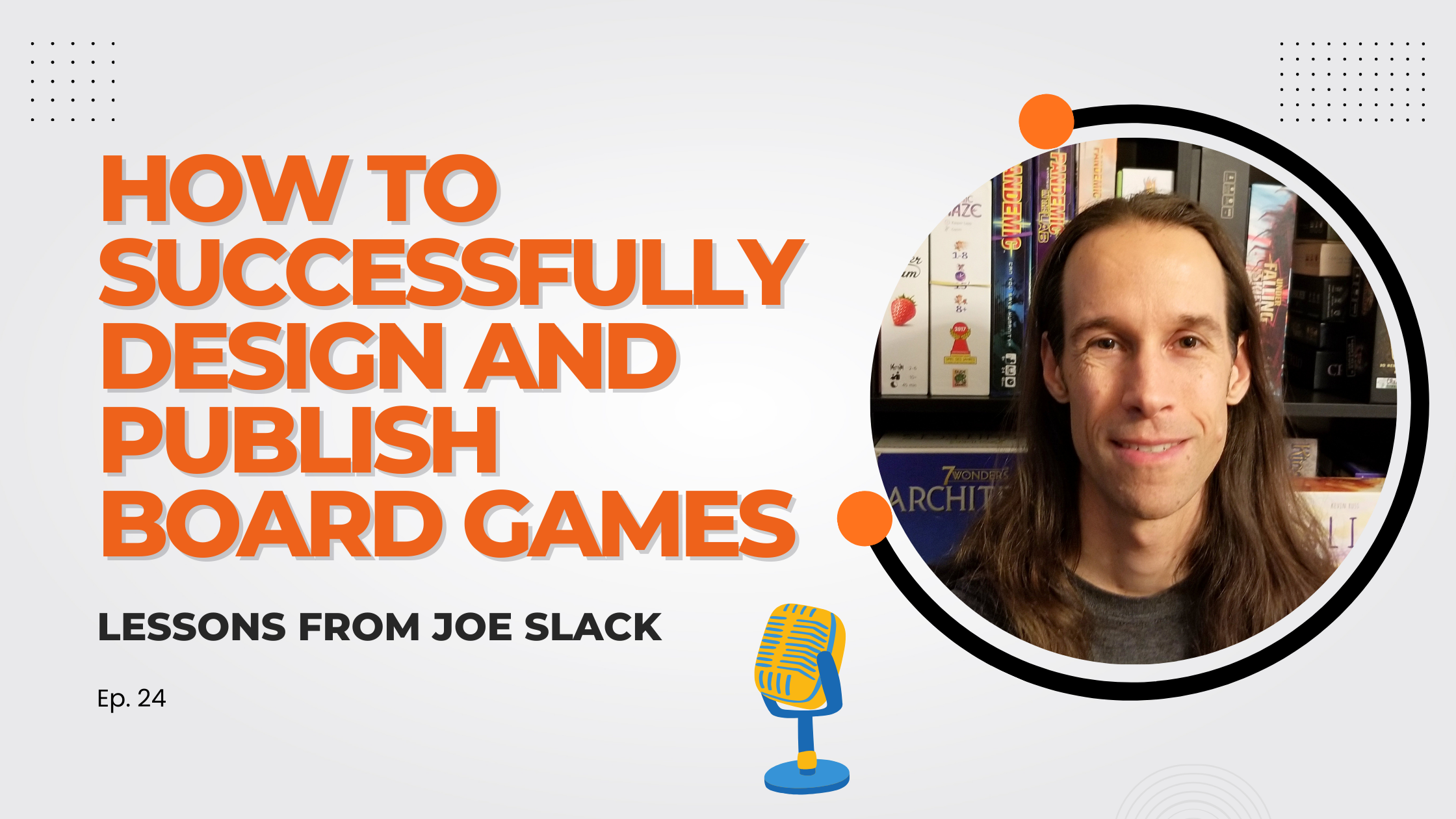
Welcome back to another insightful episode of Toy Business Unboxed, where we uncover the stories behind the toys and games that shape our world. Today, we dive deep into the realm of board game design with Joe Slack, the genius mind behind several published board games, best-selling author, and successful Kickstarter campaign creator. Join us as we explore the intricacies of board game creation, from inspiration to marketing strategies, and everything in between.
Episode Highlight
- 00:00 Introduction to Toy Business Unboxed
- 00:51 Guest Introduction: Joe, the Board Game Designer
- 01:20 Joe’s Journey into Board Game Design
- 02:54 The Creative Process of Board Game Design
- 04:27 Pitching to Publishers vs. Self-Publishing
- 07:04 Successful Kickstarter Campaigns
- 10:06 Marketing Strategies for Board Games
- 27:18 Playtesting and Refining Your Game
- 30:22 Joe’s Courses and Books on Game Design
- 32:28 Memorable Experiences and Final Advice
- 34:20 Conclusion and Contact Information
From Inspiration to Design
Joe Slack shares his journey into board game design, reminiscing about his early days playing classic games like Monopoly, Clue, and Life. His transition from video games back to board games was sparked by his wife’s enthusiasm for tabletop games, leading them to explore and purchase various titles together. It was during these moments with friends that Joe realized he could craft a more engaging and creative game, which birthed his first game idea.
Moreover, Joe’s background in math, stats, and healthcare data analytics paradoxically played a crucial role in his design process, blending creativity with problem-solving skills. Eventually, this passion led him to turn board game design into a full-time career.
The Creative Process of Game Design
Joe walks us through the essential steps of his creative process, from conceptualizing game ideas to developing a minimum viable product (MVP). He emphasizes the importance of quickly getting ideas out of one’s head and onto the table for testing. Iteration is key—creating a simple prototype, playtesting it, and gathering unbiased feedback leads to continuous improvement. Joe also talks about the decision point where one must choose between pitching to a publisher and self-publishing the game.
Pitching vs. Self-Publishing: Pros and Cons
Publishing a game involves significant differences from merely designing it. Joe discusses the pros and cons of pitching to a publisher versus self-publishing. If you’re not interested in starting a business and just want to design games, pitching to a publisher through conventions or online submissions might be the best route. On the other hand, self-publishing allows creative control but involves more work, costs, and risks. Successful crowdfunding platforms like Kickstarter provide budding designers an opportunity to gain funding and build an audience before production.
Navigating Conventions and Pitching Events
When asked about the best conventions for meeting publishers, Joe recommends events like Origins, which is large yet manageable, and Pax Unplugged. He also highlights the importance of preparation and knowing what each publisher wants, emphasizing the need for a sell sheet, a short video, clear rules, and a functional prototype to make a compelling pitch.
Marketing Strategies for Board Games
Joe shares valuable insights into successful marketing strategies, particularly focusing on the role of Facebook ads. He delves into the specifics of targeting, advising the use of interest-based targeting combined with kickstarter-related interests. Joe also compares various types of creative content, noting that images of the game in action or highlighting unique components can be very effective.
Playtesting: The Heart of Game Design
Playtesting is a critical part of refining board games. Joe emphasizes the importance of playtesting both in person and virtually. Observing players and gathering their feedback helps in identifying and resolving game mechanics issues before a game hits the market.
Joe’s Educational Resources
Apart from designing games, Joe Slack is also an educator, offering an online course called the Board Game Design Course. This course guides creators step-by-step from initial ideas to finalizing designs, tailored for those looking to pitch or self-publish their games. Joe also authored several books, including “Board Game Designers Guide” and his latest, “Board Game Designers Guide to Crowdfunding Your Game,” providing invaluable advice for aspiring game designers.
Conclusion
Joe Slack’s journey from a passionate gamer to a successful board game designer and educator is inspiring. His insights into the creative process, the decision-making involved in publishing, and effective marketing strategies are invaluable for anyone looking to venture into game design. As Joe says, the key is to get your ideas out of your head and start creating. For more detailed guidance, visit Joe’s website at boardgamedesigncourse.com.
To stay updated with the latest episodes of Toy Business Unboxed and embark on your own journey into the toy business, don’t forget to subscribe and follow the podcast. If you found this episode insightful, please leave a rating and review, and share the podcast with fellow toy enthusiasts. Let’s embrace the world of toys together, staying curious and continuing to innovate.
Transcript
EP024_05-17-24_Joe Slack
Intro: [00:00:00] Welcome to Toy Business Unboxed, your gateway to the secrets of the toy industry. Here, Jason Hsieh, a toy entrepreneur and expert in the field. “Every product we develop is really inspired by some of the real life experience that we have with our son.” “60 percent of all toys last year were sold on Amazon.”
“Be passionate about it. Because it’s a road. It’s a journey.” “Like when you have an idea that you think is gonna somewhat change the world, make things better, I’d say go for it.“
Jason Hsieh: Hello, Welcome back to another episode of Toy Business Unboxed, where we uncover the story behind the toys in the game that shape our world.
I’m Jason Hsieh, your host, and today we are diving deep into the real of board game design with the genius mind behind several different [00:01:00] published board games. He’s also author of a few best selling books and also a successful Kickstarter campaign. Thank you for joining me on the podcast today, Joe.
Joe Slack: Oh, thanks so much for having me, Jason. I don’t know about genius, I think you’re giving me a little too much credit there.
Jason Hsieh: You did create a lot more board games than I ever had in my life.
Joe Slack: That’s all, it’s a fun endeavor.
Jason Hsieh: What inspired you to venture into this world of board game design? And how does your background in teaching help you with your journey.
Joe Slack: Sure. So I guess I’ve always played games even from when a time I was a kid playing Monopoly and Clue and Big Deal and Life and all sorts of games like that. Played lots of card games with my my grandparents and with my family at holidays. I was into board games, but then fell more into video games as I was a teenager growing up and then got back into board games. Especially through my wife she actually started watching tabletop with Will Wheaton and was it was like, Oh we gotta go buy all these games that are so great. And I’m like I hope they’re good. We’re spending a lot of money here and we got some games and [00:02:00] they were amazing. And at that time we were also playing a lot of like party games with friends. One of the party games we were playing it, was fun at first and then it got a little bit repetitive and that kind of thing and I thought to myself. I can make something that’s more interesting and creative than this, like a spinoff on, this kind of idea. So I came up with my first game idea and played with some friends and it was all right it could be better and worked on it through over time.
I just loved the process of designing games, the creative aspects of it, problem solving and everything. Turn that into something I do full time now. And, you’re asking about my background, is actually in math and stats. I went to school for that and and then got into the healthcare world, helping with data analytics and that type of thing. Worked there for 17 years. By that point I was ready for a change. I was ready for something different and, board game design was so amazing to me. And I was really close to getting some games signed. I had written one book on it and I thought, yeah let’s, give it a try. We, made it work somehow.
Jason Hsieh: So for those listeners that’s not a board game designer by trade, can you walk us through the [00:03:00] creative process from concept to all the way to like game creation? What does it take?
Joe Slack: Sure. So the first thing is an idea, really, what’s your game going to be about? What are players in the game? What are they doing? What’s the theme? What are the mechanics you’re going to be doing? Are you going to collecting sets? Are you going to be moving around, placing workers, just getting some ideas of how it might work. But the one thing I was really encouraged is for people to get that idea out of their head and onto the table quickly, because you can think about it and think about it for forever and not actually do anything with it. It’s not until you actually put down some, dice and make some cards and just start playing around with just a very simple concept and MVP as, we refer to it, minimum viable product or, prototype and test it out and see how it works. Play it on your own. Find out what’s fun, what’s not. Add to it, change it and iterate it until it’s okay, this feels like a game and it’s actually functioning. It’s not breaking every time I try to do something. And then you go in and bring it in front of other people. Other Game designers, play testers, people who might be in your audience sometimes even just like friends and family to get started out, but you need that unbiased [00:04:00] feedback from people who don’t know you as well.
Just keep on iterating, putting in front of them and seeing what they like, what they don’t like, what’s intuitive, what’s not, what’s frustrating, and just keep making the game better and better until you get to the point where everybody’s like, Oh, this is a great game. Can we play it again? When’s it coming out and then you’re at that stage you’re like, okay I guess we’re ready to either Pitch it to publishers and establish publisher, or I want to go and I want to be the publisher. I want to launch this game and keep control. And that’s a decision that you have to make when you get to that point as well.
Jason Hsieh: How do you decide on which route to go? Do you pitch it to the publisher or go self publish? Can you talk about the pros and cons of each?
Joe Slack: There’s big differences between the two of those because designing a game is one thing, publishing a game is an entirely different animal. When you’ve just made a game and that’s all you’re really interested in doing, you’re not interested in starting a business and everything, then the best way to do that is, is to just pitch to a publisher, if you just want to design games and do nothing else, or just do this on the side, the best way is to pitch to a publisher and you do that through looking up like online [00:05:00] or going to conventions, figuring out what publishers might be interested in your game, which might be the best fit. Cause there’s lots of different publishers.
Jason Hsieh: Which show do you recommend like gamma or origin, which is particular show you recommend?
Joe Slack: Yeah. Origins is a really great one to meet publishers. Cause it’s a big one, but it’s not absolutely huge. Gamma has started branching out to allow designers in, before it was more of a trade show for Publishers and retailers. But this year they really started to open it up more to designers. So I think that’s going to be a good opportunity there. There’s other ones like the huge one in SN, there’s Gen Con and then there’s like packs unplugged, which is another really good one. But Gen Con and SN I find are like really huge ones and publishers are really, good. Putting out like their big game for the year or games for the year, so they’re usually very busy.
Jason Hsieh: So for indie publisher, you’re maybe recommend Origin then?
Joe Slack: Origins and Pax Unplugged, I think are among the better ones. But there’s other opportunities out there. And some publishers like Ravensburger, for example, does like designer days where you can pitch online.
Jason Hsieh: Oh, okay. That’s a big publisher.
Joe Slack: Yeah. They’re huge. [00:06:00] And then there’s other companies like unpublished as the unpublished game network. They do a speed pitching events that you can do online or at origins and other places where you have your game, you set it up and you just.
Jason Hsieh: So one of my follow up question is what do you need to bring to pitch?
Joe Slack: First of all, usually you reach out by like cold email or, a form or something like that to just see if there’s any interest to start off. And every publisher is a little different in what they want. So you really have to go to their website and see if they have a form that asks for, say a one page sell sheet that tells about your game. If they want to see the rules, if they want to see a short video on it, if they want a print and play version of it, you have to really see what they’re looking for, but generally you want to have a sell sheet, which is a one pager that says all the components, images of your game, a little bit about what your game’s about, just enough to get them interested and then having a short video, maybe two or three minutes, just talking about what’s really cool about your game and just maybe walking through what a player does on their turn, that type of thing. So having those things ready and your rules and a prototype are, really the things you need in advance before you set up those meetings or [00:07:00] before a publisher looks at it and says, I’m interested, can you send me a prototype?
Jason Hsieh: Let’s just say you did successful pitch to a publisher. They want to publish your game on your behalf. What does the business arrangement usually look like? Is it like a commission structure or how does it usually work?
Joe Slack: Usually when they license your game they’ll send you a contract and it has provisions in it for royalties just like you’re saying. It works very similar to like a book writer with a publisher. So if they sign your game, you may or may not get an advance against royalties. I would just put some skin in the game. Sometimes they don’t. And then your contract will say you’ll get a certain percentage of either the wholesale or the retail cost of the game, like the MSRP, you’ll get a certain percentage and
Jason Hsieh: typical percentage in industry.
Joe Slack: Oh it really ranges and it depends if it’s based on the MSRP might be a little lower. It might be two to four, two to 5%. But if it’s based on the wholesale price, it might be a little higher. You might be able to get five or six or 7%, but it depends on the publisher, it depends on your experience, what they think the game is going to do.
Jason Hsieh: I know you have [00:08:00] several different game that you have already published.
Do you have a few games that is currently in your office that you can show the audience as well?
Joe Slack: The only one I have really close at hand, actually I have two boxes just close at hand for Relics of Rajavihara, which is one of my games. And then Mayan Curse, which is another one that was on Kickstarter last year and is in pre production right now.
Jason Hsieh: For those of you that’s listening to the episode on the podcast, that would like to see the live demonstrations, please also watch our video on YouTube so you can see Joe kind of showing off his game design.
Joe Slack: So this is one’s relics of Rajavihara. It’s a solo game, in the puzzley style, like a legend of Zelda or other NES style games, puzzley games, where you’re pushing around blocks and trying to solve puzzles and move from one game or sort of one, one level to the next facing off against the boss at the end and then advancing introducing new blocks and that type of thing that, that come along. And then the other one that was just on Kickstarter last year is Mayan Curse. This one is [00:09:00] set in Mayan culture where there’s a temple that’s been discovered and there’s some ancient history you’re trying to discover and bring back to the locals. And so you have to traverse across all these different paths using sacred stones. Kind of Indiana Jones style, once you get a certain distance, you’re going to have these boulders are rolling back towards the entrance and you have to race to get back before them. So there’s a little bit of a push your luck aspect and trying to beat your opponents back.
Jason Hsieh: Nice. What is the typical age group that you design your game for?
Joe Slack: Generally, a lot of the games that can be played for eight and up. Other ones might be like 12 or 14 and up. Just depends on the complexity of the game itself.
Jason Hsieh: How long is the typical play time?
Joe Slack: I tend to design games that are somewhat shorter than others on the market, I don’t really play a super long game. So generally my games will play in like 30 to 45, maybe 30 to 60 minutes. You don’t want the game to overstay its welcome. You want somebody to play and be feeling like, Oh, I want to play this again, or this will be [00:10:00] something I’ll pull off the shelf again cause it doesn’t take half an hour to set up and learn and then two hours to play or whatnot.
Jason Hsieh: What are some of the good resources that you use?
Joe Slack: Some of the companies that I’ve used and that others have used would be the game crafter, that’s one of the better known ones for making prototypes and they can make it like your whole prototype or just send you components. There’s print and play by ad magic. There’s board games maker. If you’re just doing like a straight up card game, you can go through like drive through cards or printer studio and you can get them printed at any quantity from one copy to a handful. But if you’re going for anything really large, and you’re obviously going to want to go through a mass production, which is going to be 500 plus copies. So that’s just, if you want like prototype copies for your demos, copy to send out to reviewers.
Jason Hsieh: When do you switch the supply chain and have it manufactured in China instead?
Joe Slack: Oh, so that would generally be after you if you’re going to be a self publisher usually after you run like a Kickstarter or other crowdfunding campaign. So you were talking about earlier, how do you make that decision? Which one to go through, which are the pros [00:11:00] and cons. So yeah, we can talk about that a little bit. When you’re doing it on your own, there’s a lot more work involved. There’s a lot more costs involved, a lot more risk, but also a lot of the benefits that go along with it, you maintain creative control, which is huge for a lot of people because if you sign your game over to a publisher, they could change the name, the theme, anything about it, so you maintain all your creative control. But you’re the one that’s going to have to invest in art and graphic design and rule book and maybe like a crowdfunding video and anything else you need advertising, copies, reviews. So it’s a lot more work obviously. But for a lot of indie creators we’ll use a crowdfunding platform like Kickstarter, like game found, like backer kit, launch your game there and people can see it. You’ve advertised, you’ve built your audience up ahead of time, which you really need to do, because you can’t just rely on just people seeing it just then and there. So running ads, going to conventions, demo your game, building up an email list. And then when you launch, then you have all these people who are super interested in your game and then they back your game. And what they’re doing is they’re putting in [00:12:00] a commitment. They’re saying like, I’m going to spend $40 or $50 wherever it is to get your game when it comes out. Now they know there is a risk involved in that because some campaigns don’t fulfill. Sometimes you back something and you never, get something back. So you want to show that you’re trustworthy as well. You know what you’re doing, you’ve got your costs all aligned. Your game looks really good, all those things and then you collect your funds, as long as you hit your funding goal, backers credit cards will be charged and you’ll get those funds about two weeks after the campaign ends, but if you don’t hit your goal, nobody gets charged and you’re not under no obligation to make your game, so that’s at that point where you’d work with your manufacturer but you definitely want to be working with your manufacturer ahead of time because you need to know how much it’s actually going to cost to get it made are all these things possible? Can they source all the components? All these things. You need to know well beforehand what you’re going to get made and then what it costs to make 500 copies versus 2000 copies, et cetera, because you get better price points as you go along. But as a new creator, you may only sell a few hundred copies. So you need to be able to get that low [00:13:00] quantity of 500 copies.
Jason Hsieh: Yeah and Kickstarter is a whole different beast. I did a Kickstarter campaign for one of our toys in 2019 but we did horrible. We raised only 10, 000 for the whole thing. Then we invest so much time and energy, but I guess it depends on the board game and depends on the audience.
Joe Slack: It’s definitely a platform that’s better for certain things. Some tech companies done really well. Board games have become the biggest category on Kickstarter, nobody knew when Kickstarter came out that it was going to be so big for board game creators, but the barrier to entry is relatively low. So it’s very easy for somebody to go on there and much easier for somebody to actually deliver as opposed to a video game, which usually needs to be more team or like toys and things like that or even kids games generally wouldn’t do well because you’re not targeting to the right audience or you’re not talking to kids, right?
Kids are on Kickstarter. You’re targeting towards their parents and hoping the parents see it, but you might be better off going a different route with that. So even the same thing happens with board games like party games don’t necessarily do as well. Unless they have a big name behind them, [00:14:00] kids games, educational games, those types of things wouldn’t do as well as a game with like really cool miniatures or a really cool campaign or something like that, or some role playing games and that type of thing.
My first campaign wasn’t successful, but my next four were. So the first one is really a learning experience. So it was really after 2020 and on when I learned a lot from my previous one and from doing a lot of research and everything that I was able to run a successful one and continue those.
Jason Hsieh: What make your Kickstarter campaign successful? What do you change, and what is the thing that you did differently compared to your first Kickstarter?
Joe Slack: Relics of Rajavihara, my first successful one, I spent a whole lot more time developing and making sure it was a really solid game and getting it in front of more people. But I was also really active in a lot of groups. I discovered a solo Facebook group, like a solo gaming Facebook group, and there was like 20, 000 members at the time. I was like, wow, this is huge. All these people do solo gaming, play games just on their own, right? And I was involved in that group. I just got more involved in it, it was just like posting different things, not just going up there and just saying, Hey, everybody look at my [00:15:00] game, buy my game, just actually getting involved, like talking about like the solo games that I picked up, commenting on other people’s games, saying Oh, what did you like about this game? I was already part of the group and then I was like I’m working on a solo game, I’m trying to figure out what the best theme would be like here’s a picture of what the game looks like in a little bit about what it’s worth, what it’s like. And I did a poll, what do you think it should be like more like Indiana Jones style should be more like retro video game style or more like this wizard like in a cave kind of thing. It was overwhelming. People wanted like the adventure kind of theme of Indiana Jones. So going from there and people got interested and were like, Oh, tell me more about it. So as I was posting more about it, talking about that, talking about other games, I was building up some interest in there. I was also very involved in like the board game design lab which is a community of board game designers and getting better known there, going on podcasts, getting more reviews
so I just did a lot more to prepare myself and still, I didn’t know how well exactly I was going to do, but I was like, I was optimistic that I would at least get it funded and I launched it. It funded in four hours, which I was blown away [00:16:00] by, and it went on to get 663% of the funding goal. I was really happy.
Jason Hsieh: You manage all the campaign by yourself or do you hire like an agency does it?
Joe Slack: No I, ran it all by myself. There were other partners I definitely work with. I, can’t take all the credit because I had a great video production with Kagan Productions. I had a great artist and graphic designer and Tristan Rosson and I got other help from other people on little aspects here and there, but in terms of the game and running the campaign and everything, that was all me.
Jason Hsieh: Based on your experience, which is going to be the best app platform for those listeners that will also want to launch their own?
Joe Slack: Facebook. Definitely, I’ve heard that from other marketers before. That’s been my experience as well. It’s just, scrolling through Facebook, especially for people who are interested in board games, they’re just more interested, like they’re going to scroll by and you can make it, it doesn’t feel much like an ad, because you’re just scrolling, you’re seeing a post to post, Oh, this is a cool looking game and then people will engage with it. Especially if you have a really good looking game with great art, great table [00:17:00] presence, it can really be showed off well there and the ads can do really well. And I’ve since run more and more ads for my mind curse campaign, I ran I spent a lot more in ads there.
And I also use board game geek, which is like the biggest worldwide site for a board gamers as well, which got some success, but it’s more targeted, more like hardcore. So you really have to match that. Like I wouldn’t, if I had a party game or something like that, I wouldn’t be advertising it on there, but Facebook ads, I think generally work pretty well. And for my next upcoming campaign, I’m probably going to focus way more attention on ads and try to build that up even bigger for the next one.
Jason Hsieh: I see. would you mind if I geek out about Facebook ad because I did a lot of Facebook ad over my career so.
Joe Slack: Absolutely. I’d love to hear your experience too.
Jason Hsieh: First of all, I couldn’t really get it to work anymore since post iOS and actually not spending as much as we used to. For our toy brand, we used to spend five grand, sometimes upward of 10 grand a month just on Facebook ad before, but that was before the iOS update. Since the post iOS update for the listener [00:18:00] that’s not aware of the update is.
What pretty much happened is Apple stop Facebook from tracking all the conversion data and as we know, iOS user is 50 percent of all internet user. So Facebook lost 50 percent of all their data overnight because of that changes. So for the marketer or small business owner like myself, that is make a huge impact on whether or not ads is performing or not performing because Facebook now is running blind with the algorithm. They don’t know which one of the people that target actually buy. So what we did before when it was working, we did a lot of video ads and we’re targeting lookalike audiences or different interest based audience. What kind of target is that? Because there’s so many different aspects to the Facebook ad. Let’s talk about targeting first. For your targeting, what targeting work well for the board games?
Joe Slack: Yeah. So it’s all about trying to find your right audience first and what’s really I’ve heard his recommendation is for board games is to really start with an interest [00:19:00] base starting with board games as your interest, but that’s not enough. That’s too broad. So also Kickstarter. So interesting Kickstarter, cause you want to get people who generally already familiar with Kickstarter and back games there, and then something specific about your game. So for, both of my games, I tried to target different things that were adventure related. Sometimes it’s hard to find certain things like, puzzly games and things like that. It was like the keywords weren’t necessarily the best match. So I tried things like tomb Raider or Indiana Jones and then compared those results. And it’s all about testing. So like test one audience versus another one, see which performs better and go from there.
Jason Hsieh: I have a good friend. He’s also a master digital marketer. He’s actually have a totally different approach. He do open targeting. You know what open targeting mean? For the audience that doesn’t understand what open targeting means, means is you don’t do any modification. You target everyone in United States. All ranges, all ages. You target everyone and that [00:20:00] Facebook algorithm to figure out who’s the people that’s going to resonate by focusing on creative instead. So for his ad campaign for one targeting, which is open targeting, he will upload 50 different ad creative into one asset and that Facebook to show ads into as many people as possible, and then let the algorithm, the AI, does the work to find the right targeting. The creative for this strategy is super important because you need to make sure the ad copy is speaking to the right audience. The videos, the images, whatever you are using in your creative is speaking to the audience that you want. So Facebook will see who’s engaging with the videos and then they will find out the people on your behalf, you don’t even need to do all the researches and just you just need to trust the Facebook algorithm that does this work. But for him, like last time I was speaking with him, it’s doing amazing for him and he’s spending like 10, 000 a month in Facebook ads right now, just doing open targeting.
Joe Slack: That’s an interesting, [00:21:00] I can see that as something that if you’re doing something long term that could work really well, if you’re doing something, you wouldn’t probably have enough time to really drill down on that. But if you start with this, like a small enough spend and it it’s hitting everybody for at first people are going to be getting the ads and we’re like, this isn’t related to me. Why am I even saying this? Eventually it’s going to pare it down to just the people that
Jason Hsieh: he’s running it for the Shopify store with existing product is not for the Kickstarter, which is like a time-based launch, right? So I think that strategy definitely work before Kickstarter. It might not work as well because it does, like you say, it does take some time for the Facebook algorithm to figure out who’s the right audience to show the, ad in front of.
So now we briefly discussed about targeting. The next thing I wanna discuss is on the creative. What kind of creative that has worked well for you for your digital marketing effort for Facebook? Is it images or videos or what kind of creative that you usually use?
Joe Slack: I’ve tried images and videos. I’ve had varying success with videos. [00:22:00] Sometimes, they’re really good if you have a very like short clip that just pulls people in and gets them interested more that can be effective. But I think I’ve done a lot more with images and with images it’s interesting because a lot of people in the board game space will do a picture of just the, like the box, if they’ve got really good box art or just like the box and like the game out on display and what some other people find too, is sometimes if you have a more Natural look, it can work even better. So if you have a picture of your game, like in action. In some cases, even with some people around it or like a hand grabbing
Jason Hsieh: people actually trying to play it.
Joe Slack: Yeah, That can work. It depends on your game. If it’s more of a party game, you want to see people having fun and everything, right? If it’s a game with really cool components, focus in on one of the really cool components. One thing I saw for another campaign was called biome. They have these really cool nests and they look like for birds and it looked like actual nests. I don’t know how they were getting the manufactured or whatever, but it was like that with a [00:23:00] little bird on the side or beside it. And it’s is this the cutest board game component ever with a question kind of thing? It was attractive and it made people say how do they even get this into the game and get it made? What’s this game all about?
So you just want something that’s going to get people interested to learn a little more. So sometimes focusing on One really cool aspect, like a component or kind of a like a natural kind of a shot of the game in action. And sometimes it’s the box, but you really have to try a few different things and like you said let the algorithm decide, like you can do like AB testing and say, what works better, the box versus this natural shot of the gameplay and see which performs better and then go with the ad that’s doing better.
Jason Hsieh: Do you use dynamic creative? Or do you just create individual ads?
Joe Slack: I usually create individual ads and then just compare them to each other. I think there’s probably benefits to both. I just haven’t really used the dynamic ads. I think there, like if it can actually go through those and really figure out what the best combination is, I think it could be very powerful. Again it’s a matter of how long you’re gonna be running these for.
Jason Hsieh: And one major disadvantage for [00:24:00] dynamic creative is the social pool. It’s harder to stack the social pool because there’s so many variations. When I talk about social pool with the the engagement, the common, And those really also help the ad. The, more social proof you have on the ad, the more people is going to click on it. You also improve the clicks rate.
But with the dynamic creative, because so many variation, the social proof also get diluted as well. So that’s one of the major disadvantage of dynamic creative.
Joe Slack: Yeah. Because if you can do some low cost testing just to see what’s working and what’s not, and then get to your like ideal ad early, then you can get that out there. If you just have that one ad running, then get more people engaging with it, more people sharing, more people commenting and showing interest in that kind of thing. So yeah, it’s just that show social proof. If you see an ad and it has zero likes or one, like versus one that has a hundred likes. You see the 100 likes, okay there’s something to this, right? Yeah, most people are going to be interested, so yeah, it really benefits it.
Jason Hsieh: And the other question I have for you, sorry, I’m asking so much question about Facebook ads. It’s something I’m very interested in. So [00:25:00] for Facebook ads, when you’re running the ads, what is the objective? Traffic campaign or is it engagement as a conversion? What has been working for you when you run those ads?
Joe Slack: Pre launch what you’re really trying to do is get leads. So you’re trying to get those conversions, people who sign up to your email list.
Jason Hsieh: Do you use Facebook lead form or do you drive it to a landing page and try to collect it?
Joe Slack: Drive it to a landing page. I’ve found and heard that’s more effective, especially like you can have more control over that and you can do different things with your landing page. So when the campaign actually goes live, then you switch those ads because you’re wanting to drive people rather than to the landing page. You want to drive them right to your Kickstarter campaign now live, right? Like just, funded or whatever, or if it’s getting towards the end of campaign final days or whatnot. So you can tweak your ads to show okay, this is ending soon or look it’s doing really well you might want to check this out and then just focus on going to the Kickstarter page.
Jason Hsieh: Based on your experience, what is your typical cost per lead when you run those kinds of ads?
Joe Slack: Cost per lead. I’ve had it range. I’m in Canada so [00:26:00] I’m going with Canadian dollars. So we’re going to do a little, conversion here. But at, some points I’ve gotten them as low as like a dollar 50 to 2 per lead, which I’ve heard is pretty good Canadian, which is actually less than that American. It’s like a, 20 bucks or something like that. But I have at some points even got it down to almost as low as a dollar, however talking to some other people, they were saying where are you targeting exactly? And I was like basically in English speaking areas like Canada, US, UK, Europe, and they said, Oh, be cautious about Europe because sometimes there are some regions in Europe where you’ll get a lot of reactions or a lot of leads or a lot of people looking at your ad, but those people have a very much lower conversion rate. So maybe there are some, countries or some regions where maybe they don’t have as much money or as much intent to buy. So it may make your stats look better than they’re actually going to be.
Jason Hsieh: That’s a good piece of advice. And for your Kickstarter campaign you, ship worldwide as well?
Joe Slack: Yes, I ship worldwide. [00:27:00] Other than like a few countries that have difficulty shipping to which we have to state on the page, we pretty much ship it worldwide.
Jason Hsieh: I think that’s enough Facebook ad talk today, but for those listeners that want to listen to more about Facebook ad, we can have a separate episode, but I want to go back to the, board game design itself.
I know play testing play a really big role in board game design. Can you share your experience about how do you usually do play testings and how do you use those feedback to improve your design before the launch?
Joe Slack: Absolutely. Yeah. Play testing your game. Getting in front of other people is the most crucial thing. Cause if like some people, when they’re just starting out are reluctant to show it to anybody because they think, Oh, they’re going to steal my idea. What if somebody takes this, idea it’s worth a million dollars, right? The only way to make your game better is to put it in front of other people, particularly people who are audience or experienced people who can say here’s some problems with your game, or this, is running too long or you need to make some changes here so you can make your game better. Part of it is just watching and observing. Sitting back, letting other people play your [00:28:00] game. Sometimes you want to be involved, especially if you just made a change or it’s early on, you might want to play, but generally you want to sit back and let other people play so you can just take notes and you’re not thinking about your strategy at the same time as watching other people, you can see what people are doing on their turn, what are they doing when it’s not their turn? Are they bored? Are they looking at their phones? It’s happened to me if it’s turned to become too long and there’s six people playing it’s a minute or two per turn and you’ve got nothing to do. You got to think about what are people doing? Are they strategizing their turn? Are they engaging, interacting, or is it so quick? It’s going to come back around to them that there’s not going to be any time, but getting that feedback from people just by observing what’s going on, taking notes, seeing what people are doing, that kind of thing, observing what they say, what they do. And then at the end, asking pointed questions it depends at what stage, like at the start, you’re just trying to figure out, is the game fun? Is there something worth going into? What’s not fun about the game? What’s frustrating. And then after that, just like honing down the rules, the time, did people feel like they all had a chance to win or was there a runaway winner? Did they have fun? All sorts of different things around the experience [00:29:00] and what they liked and didn’t like, but it’s around focusing people on identifying the problem, not the solution cause a lot of times people will be like, Oh, I wish I wanted to go and attack that person to do this other thing, maybe your game is not about fighting at all or whatever. So you really want to ask why, did you feel that way? And sometimes you have to ask why. It doesn’t have to be through fighting or taking them off for somebody else. But you’ve identified a problem, there’s not enough resources going around. So we need to make it easier to get those resources. It’s getting that feedback, making changes, putting in front of another group and just continually doing that until your games it’s really shining.
Jason Hsieh: Do you do those in person or do you do those virtually?
Joe Slack: Both. I think it’s important to definitely do at least some testing in person because digitally you can do a lot of like rapid changes and test with people all around the world and go to different online events, which is fantastic. And I love it, I’ve even designed games with people halfway across the world who I would never be able to see in person, but you don’t know until you got everything in front of you, how it’ll feel, how the components work. Things in [00:30:00] person and generally digitally things can take like 50 percent longer because you’re not able to just scan across the table and see things you have to zoom in and out and interactions. Some games also just don’t work well online, like a dexterity game where you’re stacking things. It’s going to feel a lot different and dropping it versus doing it with your hands.
Jason Hsieh: Hundred percent. And I know you also instructor about the course that you have. Can you also talk about the course that you teach?
Joe Slack: Sure. Yeah. So I teach the board game design course. It’s an online course that anybody can take from anywhere in the world. As long as you have an internet connection, basically once you join, you have lifetime access to all the materials. It’s a number of step by step videos that walk you through the process from getting an idea to making the first version of your game, play testing, refining it, doing the rules, all the steps until you have to make that decision. Am I going to pitch or am I going to launch this myself. So it walks you through all those and it includes as well time in the [00:31:00] community where you can ask questions and twice monthly Q&A sessions where people jump in and they ask me questions and we just have great discussions around anything about board game design and what they’re working on.
Jason Hsieh: Where can people find your course?
Joe Slack: If you go to boardgamedesigncourse.com, you’ll find all the information on that course. And I also have other courses on a creation to publication program that I launched twice a year, enroll students to help them to get their game signed with other publishers and a crowdfunding success course as well for people who are a little more advanced and want to launch their own game as well. But board game design course is the, first one for people just started working on their game and they’re stuck and they want to take their game to completion.
Jason Hsieh: Thank you so much for sharing that. And I know you also wrote a few different books. Can you also talk about the book that you have, published?
Joe Slack: I have a board game designers guide series. It started with the board game designers guide which I wrote a number of years back probably about six or seven years ago now. It’s on the second version and that’s really a walkthrough of all the steps to take your game. So very similar to the course, the course is more hands on and, [00:32:00] more involved with Q and A’s and things like that. But it just walks you through from start to finish.
And then I’ve written other books since then on getting your game published and top 10 mistakes board game designers make. Careers in the industry for people who are interested in going into other branches in the industry, maybe working graphic design, working rule book design or content creation.
And then my newest book that I just launched is a board game designer’s guide. Crowdfunding your game. So talking about how to launch your game on Kickstarter or Game Found and that taking it, like building your audience.
Jason Hsieh: Can you also share some memorable experience or lesson you have learned from your journey as a game designer?
Joe Slack: Oh, sure. It’s trying to think because there’s been so many memorable moments. Just like meeting such a great people in the industry and working on games and everything. I think one of the greatest things is just the people that I’ve met and that have collaborated with since then. Particularly my co designer that I work with a lot, Sylvain Plante. He’s a surgeon and he started designing games and we met up at local board game design events and play [00:33:00] test each other’s games and everything. He knew I was working on a word game and he had a word game idea and he’s Hey I got a word game, but I don’t know where to go with it. You want to work on it together? I was Oh, sure. Okay, cool. And he showed it to me and we started working on it. And that, game wound up being the first game that either of us signed with a publisher.
So that was an amazing experience. Yeah. Doing that a few years back. And then since then, we’ve just gone on to design game after game and it’s, we’ve developed like an amazing friendship and we just love working together when we get together, it’s, it doesn’t feel like work. It feels like fun, which is just an amazing thing.
Jason Hsieh: Sounds really cool. Do you have any idea for creating a board game for kids with special needs?
Joe Slack: Not yet, ideas are always circulating up there. So you just never
Jason Hsieh: partner with you on that, kind of board game, because that’s my focus with my toy brand is we design sensory toys and we have a small community we’re trying to build. We have about 20, 000 parents that we engage with but I don’t have a board game. I have a lot of different sensory toys, but no board games. Yeah. [00:34:00]
Joe Slack: You never know. You never know. And my wife is a teacher as well. And she’s worked with a lot of special needs students as well.
Jason Hsieh: Exactly. I feel like that might be some kind of partnership we can talk about. Maybe creating a board game together for the special needs community. That’s because that’s where my passion really is. Of course, I’m also very passionate about creating toys, but toys specifically for kids with special needs.
Joe Slack: There you go.
Jason Hsieh: Thank you so much for jumping on our podcast today and sharing all your experience, sharing all your knowledge with our listener. The final question I ask all the guests is, if you had to share just one piece of advice with someone that’s getting started in the toy industry, what would that be?
Joe Slack: I think this is the advice that I usually give anybody starting off making a game is to get that game idea out of your head and onto the table. Don’t let it fester and just be thinking about it. There’s plenty of people that I’ve, met who are like, Oh yeah oh game design, yeah I have an idea for a game and they talk about it a little bit. And then you see them like six months later or a year later convention. Oh, how’s that game coming on? Oh I still haven’t made it. Like you need to [00:35:00] get that idea out of your head. Like for some people, it’s just, it’s so much, cause they think Oh, it’s going to need 400 cards and it’s going to need all these things and I can’t afford all this art and everything. You don’t have to start with that. Just start with making up a few different cards, some dice, some meeples, whatever you need, and just play around with it. You don’t need your whole game. You just need a piece of the game just to see if your idea works, cause if you go and spend so much time or money getting all this stuff done, and then you print it off and then you’re like, Oh this game sucks. This game doesn’t work at all. And you wasted a ton of time and effort, right? So it’s much easier to just try a small little version of it. See what’s working, what’s not and then iterate from there and just build on it.
Jason Hsieh: A hundred percent. And also just do some small playtesting, like you mentioned earlier with the prototype and improve and iterate from there and
Joe Slack: exactly. Yeah.
Jason Hsieh: Where can the audience find you? I think you mentioned about your course, but any other place people can find you?
Joe Slack: Yeah. I’m all over, but probably the best place is my site boardgamedesigncourse.com. That’s where all my blogs are and links to my books and my courses and [00:36:00] everything else. So you can get in touch with me directly there as well.
Jason Hsieh: Thank you so much for joining the podcast again and I would love to meet you in person in the next trade show.
Joe Slack: Oh, thanks so much, Jason. I really appreciate talking to you and hopefully we meet soon in person.
Outro: You’ve been listening to Toy Business Unboxed, hosted by Jason Hsieh. Thank you for joining us and exploring the fascinating world of toys and the ingenuity behind them.
To stay updated with the latest episodes and continue your journey into the toy business, remember to subscribe and follow us. If you found today’s episode insightful, please leave a rating and review and share this podcast with others who share your passion for toys. Until next time, stay curious and keep innovating.