
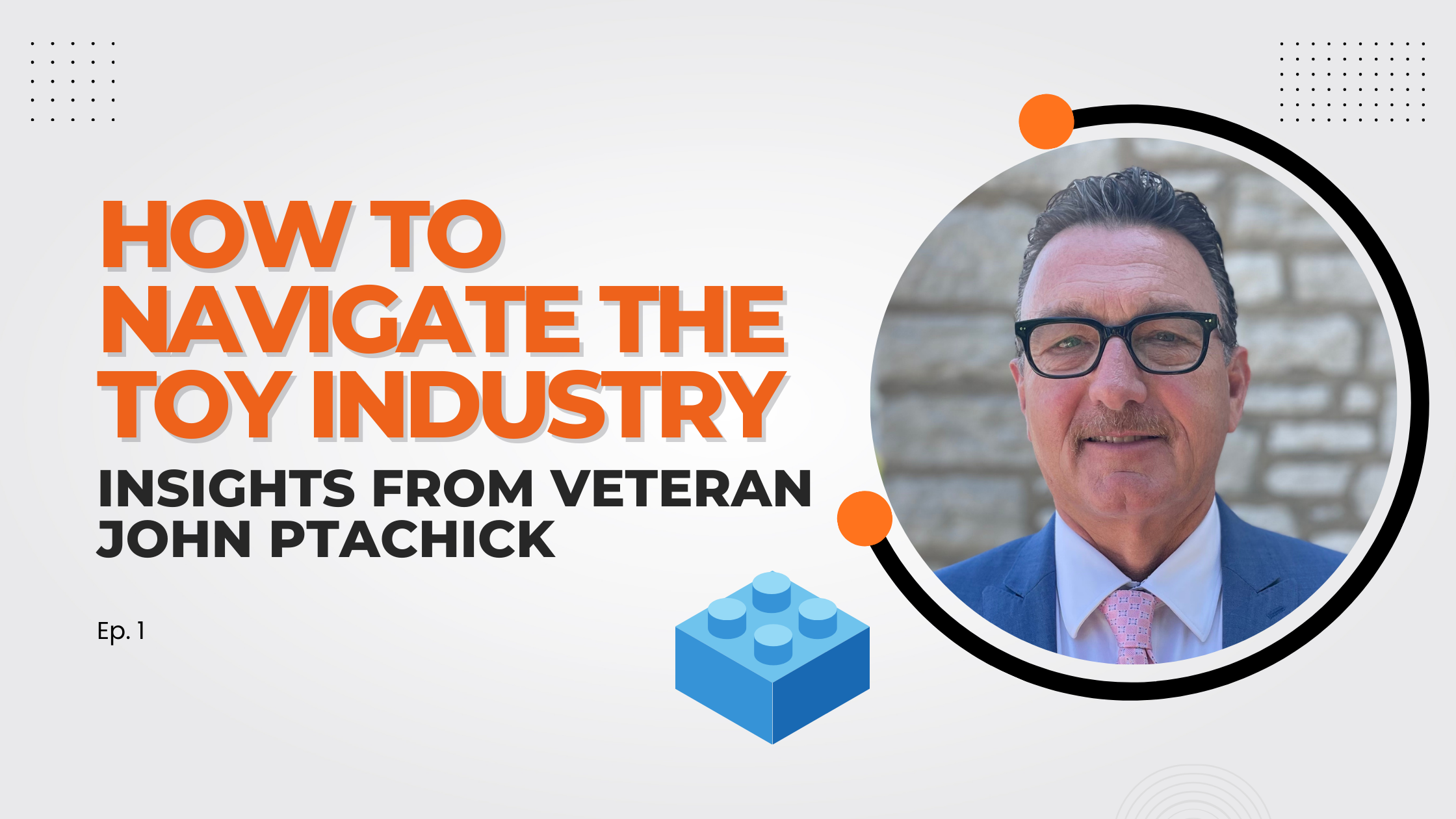
With over 30 years of experience in the toy industry, John Ptachick is a well-known figure with a treasure trove of knowledge about the trends, challenges, and future of the business. In a recent podcast episode of ‘Toy Business Unboxed’, John shares his journey and offers invaluable advice to toy industry enthusiasts and professionals.
Episode Highlight
- 00:00 Introduction and Guest Background
- 01:10 Journey in the Toy Industry: Starting with Lego
- 08:41 Transition to Hasbro and LeapFrog
- 14:17 Venturing into Entrepreneurship with Millennium Sales
- 16:53 Building and Maintaining Relationships with Major Retailers
- 22:49 Challenges and Opportunities in the Toy Industry
- 33:38 Advice for Newcomers in the Toy Industry
- 36:26 Conclusion and Contact Information
Breaking into the Toy Industry with Legos
John Ptachick’s toy industry journey began with Legos. Working with a number of key players such as Kmart, Target, Hasbro, and LeapFrog over several years, he played a significant role in their growth and development.
At Lego, the focus was on learning about the nuanced needs of individual retailers and understanding the unique facets of their businesses. But it wasn’t just about improving the merchandise; the emphasis was on education and constant growth.
From Giants to Startups: A New Chapter
After spending ten years with Lego and gaining experience at several high-profile companies, John felt the need for a different kind of challenge – one that heavily centered on entrepreneurship. He joined Millennium Sales, a smaller firm, and utilized his experience to help them grow.
Effective Relationship Building with Major Retailers
According to John, building trust with retailers is essential in this industry. Precise forecasting, clear communication, and understanding the retailer’s business identity are the keys to maintaining successful relationships. John emphasizes the importance of presentation efficiency and time management.
Discerning Impactful Trends in the Toy Industry
The toy industry’s lack of impactful trends in recent times is palpable. John strongly believes that innovation is integral to reenergizing the sector. He also notes that the considerable influences that once drove the industry, like TV, have evolved. Therefore, finding new ways to market and stimulate interest in toys is essential.
Pearls of Wisdom for Toy Industry Newbies
Starting in the toy industry may seem intimidating, but according to John, a clear focus and understanding of prevalent opportunities can yield positive results. He urges new entrants to clearly communicate their product’s unique proposition and to remain aware of upcoming trends in the toy industry.
The Future of Education and STEM Toys
Education-focused toys need to fit into the larger canvas of growing technology trends, believes John. Categories like STEM (Science, Technology, Engineering, Mathematics) toys have significant potential for growth if they can leverage advancements in technology.
Challenges and Changes in the Toy Industry
The most significant challenges in the toy industry today revolve around gaining market visibility and ensuring products meet productivity standards—the toy industry needs to speed up its pace in adopting new technology trends.
Achievements and Lessons
Throughout his journey, John Ptachick has interacted with some incredibly intelligent people and enjoyed working with smaller companies in recent years.
Despite these challenges, John’s passion for the field has never diminished. He firmly emphasizes, “Stick to your idea. Don’t give up. If you have to use Amazon and the dot coms as a platform to grow your business, definitely do that.”
John Ptachick’s journey is an inspiring tale of consistent growth and adaptation to changing trends in the toy industry. It underscores the need for innovation, precise forecasting, and maintaining strong relationships with retailers—crucial lessons for anyone aspiring to make their mark on the toy industry.
In an ever-evolving industry dominated by colossal players and riddled with challenges, learning from the experiences of seasoned industry professionals like John Ptachick is undoubtedly enlightening.
Transcript
Intro: [00:00:00] Welcome to Toy Business Unboxed, your gateway to the secrets of the toy industry. Here, Jason Hsieh, a toy entrepreneur and expert in the field, will guide you through the enchanting world of toy design, marketing, and manufacturing. Now let the unboxing begin.
Jason Hsieh: On today’s podcast for Toys Business Unboxed, we have JP, a long time veteran in the toy space with over 30 years of experience in toys and retail.
And he’s Started his career working with Legos and work with various of sales role and become a senior national account manager working. On target and spend times at both Hasbro and multiple companies and eventually moving to leaf Rock and running half of the national account business as a VP of sales and also become partners with Dave and Applebee’s and median cells.
And she, he bought a lot of passions to develop new vendor businesses, and also have tons of experience working with different vendors in the toy [00:01:00] space. And thank you so much for joining us today. JP is honored to have you as a guest.
John Ptachick: Thank you. I appreciate that. Happy New Year to everybody.
I’m hoping that 2024 for the toy industry is is more prosperous than 2023.
Jason Hsieh: Yeah, 2023 is definitely a rough year for a lot of us in the industry, and I’m also looking forward to a better outlook. So I’m just going to start out today’s podcast interview with can you walk us through a little bit more about your journey in the toys industry, maybe starting off with your time at Legos up to your current roles?
John Ptachick: Yeah, sure. Lego, Lego likes to pronounce the Lego, not with the S cause then you start to get into generics, but so I started with Lego in 1986, different business. Then in that retailers were decentralized, so they didn’t have the luxury of the computer to be able to write orders.
So you literally had a territory. My territory was Southern [00:02:00] California. I went all the way up to Paso Robles and all the way to the Orange County border, Fresno, Bakersfield that whole Central Valley area and Las Vegas. So you were. Going to individual Kmart stores, you were writing orders, you were writing orders for a section.
And in those days, you might add a section that was a four foot, six foot, eight foot, 12 foot. You have the opportunity to write in caps at store level as well. And we had this little computer, a little handheld computer. It was sort of state of the art in its day. And. We would do a yearly beginning inventory at each individual Kmart store, and we would take a consumption report every single time we were in there, and basically, the computer would show what we needed to reorder for that store at that given time.
And then the interesting thing with that is that we. Also come Christmas [00:03:00] time, or this would be like probably May of every year, we would start to write what we would call seasons needs. And so you’re writing Christmas orders that would ship September, October even as early as August, depending upon the volume of the store.
So we were constantly in these individual Kmart stores. And when you’re in there, your orders coming in. So we’re responsible for merchandising it, getting it back on the shelf. Building an in cap, re merchandising in cap. There might have been side caps that we might been merchandising. We had counter display programs at the register that we would do as well.
So there was a lot going on at an individual store. You were constantly touching product. You really got to know and see what worked and what didn’t work, price point that the type of product, whether You know, as we brought in buckets storage we brought in different themes.
And when I was a Lego, we didn’t have licenses, so we didn’t have star wars or any of the Disney licenses, Harry [00:04:00] Potter, this was all non licensed product. And early had people tell us in those days, let it go. Doesn’t sell. You would be at a Kmart store. We can’t sell Lego. But as we started to develop the line product continued to build and continue to sell.
As we started to incorporate storage and improve the themes we started to really build the business. The other thing that Lego did really well, so Jim O’Connor was the VP. I felt like he was a very, he was a sharp visionary. He really knew how to build a team, a lot of training. So we would go back and we would do, training seminars as a group you would come in with a class of sales reps and you would have training.
For a week time period, and then you’d have a trainer. That was a national trainer. Come out and spend a couple of days with you as well, just to track your process or progress. So there was a lot of hands on and if you were willing to work hard, then there was [00:05:00] opportunity. And so you started as a sales rep and you move from a sales rep to a territory rep and the territory manager at a territory manager level, you started to take on more regional type accounts.
For instance, when I became a territory manager, I started to do Costco and Fred Meyer account experience there. And I also had some training experience. So as a younger sales rep was coming in and the company, I then was doing some training with that sales rep and help groom them for their future within the company as well.
So that was really my journey at Lego in terms of. Getting my feet wet on a larger account was Costco and Fred Meyer, which were good platforms and and then I was promoted to call on target and target was interesting because I was promoted in 1990. And I did [00:06:00] the 1st year of target from Los Angeles, but we were at toy fair in 1991 target was 550 stores really hadn’t developed a base in California or Florida yet.
East coast was still, open for them. They were primarily Midwest stores in California where they bought some Fed Marts and Jim co stores, but, this was a point where they said, hey, we are going to grow. Lego is going to be a brand that we want to invest in and we need the national account manager living in Minneapolis.
So I moved to Minneapolis with my family in in 1991. And I invested in target, they invested in me. There were 2 of us, Larry Hunter, who was the national account manager for Fisher price, they put training and we were in a training class with their business analysts. So we started to understand how target forecast, how they plan, how they ladder start to really [00:07:00] learn the mindset of target.
They target ties this and. It was a win for Target and it was a win for Lego. And for me, I learned a lot. And I, you were very proud to be a Target account manager. As were our guys that were a Walmart guy or a Toys R Us. We, they were all passionate about their accounts.
One of the things that Lego was really good on was Making everybody understand every single account, whether it was a Fred Meyer, a Target, a Walmart, Toys R Us, each one of them have an individual business system and each one of those business systems, they may have similarities, but they have differences and that’s what you really needed to understand where.
What were those differences and how do you leverage those differences? And we did a very good job of that. And that’s, again, I think, these were factors in how we grew the business from being that brand where we all believed in it, but there were people who said Lego doesn’t [00:08:00] sell.
And today it’s the largest brand of toys out there. And, It does sell definitely come a long way. They’ve come a long way. Where they really come a long way is in the technique brand of product. Because back when I was there, it was a difficult sell, but it was more of a stem build.
Than it is today where it’s a realistic build, but you a a Mustang or a Ducati, you couldn’t have done that back when I was doing it. So they’ve really changed that brand for the better, and it’s just been another segment for them. That’s that’s, driven growth.
Jason Hsieh: I see.
Yeah. So thank you for sharing that background. I think it transitioned to my next question is throughout your career, how has your role and responsibility involved over time, especially from transitioning from a large corporation like Legos and, hasbro and other, and to your current position right now.
John Ptachick:
Yeah. Yeah. I spent 10 years at Lego and after Lego, I went to Hasbro and I was there [00:09:00] for a couple of years and I was doing the play school and talk of brands at at Target. And then I also moved over to Kmart as well. So I started to learn about. I spent two years there, learned a lot because Lego was all domestic.
There was no FOB shipments in those days. Everything was made in Connecticut, so everything was domestic. Whereas when I went to Hasbro, now all of a sudden you learn the FOB business, which was really going to become the future. Of toys because margin becomes more critical and you get more margin out of China than you do out of out of us domestic production.
So I learned a lot about Hasbro, a lot about forecasting. There were some really sharp people there because you had a blend of Hasbro people and the Kenner people. So there’s some real characters there. So I learned a lot from my two years there. And then I went to a company galoob and galoob was a more of a [00:10:00] promotional, very entrepreneurial.
We had micro machines. They were the first to do like they had wrestling. So they had, back in the day they had all of the wrestlers. But so when I was there the company was starting to have some financial difficulties. Micromachines, we had Spice Girl dolls, so they would find these trends and they would jump on the trend before some of the bigger guys.
That was a really fun company to work with, but it was only for a year. They were sold and bought by Hasbro. And then I went to LeapFrog. So at LeapFrog Mike Wood was he was one of the smartest people I’ve ever been around in my life. Tim Bender, who I worked with at Lego he was a personality he was super smart, super engaging.
You could bring him into any situation and he could win the customer over and really was great at helping fortify and develop the relationships at all of the big accounts with senior management. So that [00:11:00] was that was a seven year journey for me. And the first three years we went from being a 20 million to a 450 million account.
Our manufacturer. The thing there was that was like a rocket ship. And those 3, 4 years of my life went by fast. There was a lot of travel. I was calling on target. I was calling on Kmart. I was calling on. Toys R Us at first, even Walmart, Kohl’s, Shopko. So there was a lot of, meetings at headquarters, meetings at Toy Fair, meetings in Hong Kong.
And the interesting thing with that whole category and how Leapfrog transformed the category was that VTech was the dominant in the category. And they were basically doing some preschool, some baby, but mainly precomputers, and they had a range of precomputers that might have went from 19 to maybe it’s 150 retails and the category started to all of a sudden decline.
[00:12:00] And was over inventoried on 1999. We introduced the leap pad and the leap pad came out. It was the most revolutionary thing I’d ever seen. When I saw a prototype of it, you knew this item would sell. It just was that next evolution that you would expect to see. And it was a kid friendly item.
It was something that parents for the price point, they knew their kids were going to learn and have fun learning. They’d learn phonics, they could learn math, they could learn anatomy. There’s all kinds of things that could learn it, but it was really a great product. And that product got put on the Rosie O’Donnell show in November of 1999.
And that. Took the item to a whole different stratosphere. And what was interesting about the leap pad is you had the leap pad, you had software, a book with a cartridge, and now all of a sudden you would sell a platform and now you’re selling a razor, razor blade, and you’re starting to look at what’s [00:13:00] the ratio of a platform, the leap pad against the software.
And so we started then to take away store space from the tech. And aside from the LeapPad and the software, we came out with the Phonics bus, the writing desk the numbers train, Alphabet Pal, we had a number of really good selling preschool items to complement LeapPad. So now all of a sudden we’ve got, we’ve got 10 items out at retail and those are 10 productive items.
Now, all of a sudden, the minute you start getting productive items, in those days, you had the appetite from your retailers to grow. And so the buyers are looking for more from us. So then we started to develop more products. And those products all continued to be productive products. And we got to a point where.
We had 100 ft of space at Toys R Us. We had, 12 ft [00:14:00] sections at a Target, 16 ft sections at a Walmart. Plus, there are some stores that might’ve had 24 feet of space for leapfrog as well. But at the end there was a point where VTAC had a few, and that was their V smile. And we were able to basically take space from them.
And we became the dominant player in the category. So it was a great experience. It was fun. But at that point, after eight years there, I decided that I wanted to be a part of be a little bit more entrepreneurial and start to get into working with smaller vendors, manufacturers, where I thought I could really take what I’ve learned from Lego leapfrog Hasbro and help.
Grow with these smaller manufacturers. And so I was lucky enough to have worked with Dave Appleby. He was a rep for us at leapfrog and I had an opportunity to buy into millennium [00:15:00] sales. And I did that in 2005 and that first year I worked with him, I had wild planet as a customer and step two as a customer.
And, it was an opportunity Ohio art as well and to take those and now to start to bring some new businesses into my portfolio. And the next year I was able to bring little kids and favorite Castile as well on board. At that point. I knew that I had made the right choice and I knew that it was going to be a good fit for me personally.
And I really enjoyed working with the smaller companies and being able to work on, a strategy for a listing and forecasting and looking for ways to grow businesses and. Mutually grow and grow profitably. And, it was very, it was enjoyable. It was fun. You got to work with people you really liked working with.
And it’s basically taking me to where I’m at today. And, today I continue to represent, I continue to [00:16:00] represent Faber Castell and little kids. And I also have adapted into my portfolio where I’m, Yeah,
Jason Hsieh: that’s definitely a long journey from working in a corporate job to running your own show.
That’s definitely a very different dynamic.
John Ptachick: Yeah. And one of the things that I was able to do is when I was. With leapfrog, I brought and padless overs from target and she became like my right hand. She really helps in terms of, everything behind the scenes. And even, she’s also.
In meetings right with me where we’re working with planners and forecasting and, she’s doing ladders and item setups and has a real good feel for the overall business. So she was very beneficial in the growth that leapfrog and has been beneficial came with me in 2006 to millennium and continues to work by my [00:17:00] side and continue to be a valued cohort in developing, business.
Jason Hsieh: Yeah, I think it’s very important to have definitely a very solid partner on your side. So my next question is, since you work with so many different like big retailers, like Target Costco and all the different retailers that you just mentioned earlier, what, based on your experience, what do you have you found that’s most effective in building and maintaining a Successful relationship with the major retailers.
John Ptachick: Yeah. Yeah. So I think the first thing is, you have to build trust. The retailers need to trust you forecasting is super important and, you can’t, you have to throw out a forecast that. is a right forecast. You just can’t throw numbers out there that are unattainable because it’s at some point over the course of time, if you say you’re going to do 100 and you do 50 you’re going to lose that trust.
So there’s that big [00:18:00] factor there where, you’ve got to come in prepared. You have to when I work with manufacturers, the key thing is that know the space. If we’re a brand new vendor and we’re walking in and you have no product on a target shelf, you’re not gonna come in asking for 15 SKUs.
That’s not gonna happen. Yeah. You’re focused on getting your foot in the door with one to three SKUs possibly. So you’re prepared with what are my three best skews? What are the three that is going to be most productive? What are the three that have a point of difference from what’s on the shelf today?
Do they fit the right retail? Do they fit the right margins? And those are really important things. One time, that funny story is that I was representing a radio control company and, it was an old school sales manager and. His whole thing was you have to show every product in your line, but we had no product to target.
So I walked in with a buyer that had a very good [00:19:00] relationship. The guy was coming into Minneapolis. It was snow storm. He got stocks. I let her know. She just said, get there when you can get there. So we came downtown and I came walking in with a hand truck. And I’m six foot two and she barely could see me because I had all of these boxes stacked on the hand cart.
She looked and said, JP, that’s a lot of product right there. So the lesson learned was, again, we were showing too many items. We needed to be more focused. We ended up not getting a product. She didn’t purchase anything. We were closer to getting in, but again, we needed to be more laser focused than coming in with every skew in the line and the old school sales manager, his response was, the guy that was on the salt trail that was selling.
moccasins. The one time he forgot one pair of moccasins. That’s what the consumer wanted to buy. So that’s really old school thinking. [00:20:00] You really need to be like, have an understanding of again, what’s the opportunity and, be focused on the number of SKUs you’re presenting and make sure you’re ranking your SKUs instead of just going in there and every SKU you have is a number one ranked SKU.
That’s not going to work. When I play. Meeting with a customer, what I like to do is if they give me an hour, I like to say, we’re going to present maybe it’s a company history. If we have current business, we’re going to present a business review. We’re going to get into, you know that what do we want for the next season and then I want to be able to have the last 15 minutes open 10 minutes.
I want to save for conversation like feedback from the buyer next steps. And I want to give the buyer back 5 minutes because I think a buyer respects that when they know this vendor doesn’t go over their time. Because if you go over their time, buyers time throughout the course of the day, [00:21:00] they don’t have time to all of a sudden lose.
Five minutes and 10 meetings a day. It’s just, it doesn’t work for them. And I think they appreciate a vendor that understands their time and gives time back.
Jason Hsieh: Yeah. So I have a kind of a follow up question to that is in my own line of work, since I also operate a small toy brand and we also partner and represent a few other smaller toy brand is feel sometimes to like a.
New, newer toy brand owner is intimidating to approach those big box retailers, based on experience, some piece of advice. That you can give to the entrepreneur that is listening, that is developing their own small toy brand and try to, what are the things that they should even consider before they even try to either do that approach themselves, or maybe partner with someone like you that can represent them on their behalf.
To do that negotiation was was a big [00:22:00] box retailer.
John Ptachick: Yeah, I think that you really do want, you need to be confident in your product and understand, like you’ve done your research, you feel like it’s an opportunity for whatever chain you’re bringing it to. It’s priced right. It’s got the right margin.
It’s got all the intangibles where you think it’s going to succeed there. But I also do think it’s important that you have the right representation with you that has a relationship with. The account relationship with that buyer has a relationship with the planners and business analysts as well, because one, it’s presenting, it’s getting placement, but then two, it’s setting up the products correctly.
It’s tying orders to the proper factories, because if you don’t do that, and then all of a sudden, it’s that item isn’t at that factory. It’s factory number two. That causes rewrites, which causes fines. So you really want to get somebody that’s knowledgeable, that’s respected at that account to help you and guide you.[00:23:00]
Jason Hsieh: I see. I see. Yeah. Thank you for sharing that. And the next question I have is from your perspective, what has been some of the most impactful trend that you have been seeing in the toys industry over the past years?
John Ptachick: Yeah, I think that’s a great question. I think right now what we’re seeing in the toy industry is that we lack that impact item.
We lack that trend. And when you look at the toy industry in those years where we’re really. Like the increases were double digit increases, you had things like cabbage patch or brats or you had L. O. L. You had, um, leap pad Leapster, you had those items. I think that right now we’re at a point because of COVID.
It really stifled the industry and that COVID was good for the toy business. It was great for, little tech step to outdoor play bubbles. All of that did really well. Arts and crafts did [00:24:00] well. The emergence of slime that happened during right before COVID and flourished during COVID.
But, I think right now we’re just at a point because of that innovation hasn’t caught up and we’re still at a point where we’re having zoom meetings for line reviews. We’re just getting back to we’ve had now 2 years of toy fares and Astra, but we still have the zoom meetings and we still aren’t meeting as frequently as we used to.
With buyers. And I think we need to get back to that pre covid. And I think we need to become innovators in the toy business and look for these opportunities. You look at if you’re a company and you’re trying to get into this space. I’m not going to look at. The the highest grossing categories.
I’m not going to look at construction and think I can get into construction and compete against Lego. What I’m going to do is look at the categories that are down downtrodden. Where’s there an [00:25:00] opportunity within that downtrodden category? A couple of years ago, plush was a down. It was a down category.
There was no innovation and plush and who comes in there. Squishmills comes in there and they create this collectible brand of plush and they take it by storm. And they become one of the top items in the industry. Those are the types of things that we need to get back to where the industry needs to be.
Hopefully. We start to see that in 2024. But we need product. We need a cabbage patch. We need we need some of these items that we’re the must haves. It’s interesting. I don’t know if you’re aware of this, the target. They just did a an item. They were two packs of tumblers from Stanley and they ran them and it was like a Valentine’s day a red and a pink version.
They ran from a 20 retail to a 45 retail. People got in line in front of target stores to buy [00:26:00] this product. They had in a day, they sold out. Okay, so why is that what can we learn from that? Was there, two pack, there was value there color wise for Valentine’s Day, pink and red makes sense.
What lesson can we in the toy industry take from that and apply to product and now all of a sudden create something that people want to get in line to purchase. That’s where we need to get back to.
Jason Hsieh: Yeah. Yeah. That’s definitely a big. Bigger question for the industry and for the inventors and for the entrepreneur in the space for sure.
John Ptachick: And I’ve been lucky in my career too, I’ve worked with a lot of smart people, a lot of great entrepreneurs. Like I mentioned, when leapfrog Mike would, Mike would the whole product. The phonics desk was the original product. You had a card, you slip the card in, you had a desk that had removable letters, and the card might have been a picture of a cat.
You grab a C, you grab an A, you grab a T, and phonetically it [00:27:00] pronounces cat, and that item he took to Toy Fair in like 1996, I think it was, went to a sales representative Who had an office at the old toy building, who didn’t have space, who on a heater grate, old heater grate, put a piece of wood on there.
They put the product in there, Target and Toys R Us bought the product at that show, literally in a corner space. And that’s how he built that brand. But he had a passion for learning because he had a child who had some learning disabilities. And so he learned that. If you learn to read, you’re better at math and to learn to read, you have to learn phonics.
That was the way to quickly become a better reader. And that’s where his focus was. So it was interesting that, anytime we would go into a meeting The passion that he would bring with a buyer or senior management. And so I’ve seen that from Mike Wood. I worked with Charlie Embi [00:28:00] and Jeffrey Greenberg at just play.
And you see it from them. Just us not, Oh, who’s it. We cool and slime and activities. I’ve seen it there. Shy Chen, who I worked with shy at fly catcher and he developed an item that I put it up there. It was some of the best items I’ve ever sold, which is the smart sketcher. Which is a learn to drop platform that has art reach and step by step.
It teaches kids how to drop. We’re not putting money in schools anymore to art. And this item did really well. It was a target. It was at Walmart. It was Barnes and Noble. It was Michaels. He’s now selling it on his own Shopify platform. The killer part about this is I could take your picture, stream it to the device and all of a sudden your image appears on paper.
You And now I could trace your image or trace my dog’s image or whatever. But it’s one of those products that kids. Anytime you have a toy that kids play with once, but then they go back to twice and three times, this is the [00:29:00] type of toy that kids constantly go back to. And that’s where mom says, hey, for 70, that’s a good value.
I’ve been blessed to work with people who, that, they’ve got this passion for the business that I’ve learned from, I work with little kids, Jim Engle Jason Engle, families who have built the business from scratch and today have really nice businesses. It’s been a great journey for me.
Honestly, I wouldn’t have, I wouldn’t trade it, for the world.
Jason Hsieh: For sure. And what would you say are some of the biggest challenge that you have faced in the toy business and how have you overcome them?
John Ptachick: The biggest challenges are, in today’s world, you have challenges, just getting a meeting and getting a platform to be able to present product.
That’s become a big challenge and growing businesses now is very challenging and getting, if you have eight items on the shelf. You’ve got to make sure every one of those eight items are meeting [00:30:00] productivity. And if they’re not meeting productivity, you’re not going to get the ninth and 10th item in there.
So those are the challenges of getting products that are productive and building out lines have become the biggest challenge.
Jason Hsieh: I see. Yeah. And I think you also have a lot of experience working in the educational and kind of STEM toys industry as well. How do you see those categories have been evolving in the past year and in the future?
John Ptachick:
Right now education is basically driven by VTAC. VTAC owns LeapFrogs and then Fisher Price. They’re the ones that are driving that whole area. Spin masters made some acquisitions recently. So I think they’re going to start to come into the space a little bit more. I think we need to see some innovation in the category to take it from where it is today to that next level.
I think stem is a big opportunity. And again, I think that [00:31:00] innovation is what’s going to drive the category in both categories. You have the cloud, And you might start to develop products that, basically can interact with the crap with the cloud and can continually be updated via the cloud, continue to bring content into it.
We had a product like that. Mike would again was way ahead of his time at leapfrog. The item was too far ahead of its time, but it was a very similar concept, but you would go. To retail and you would have a cartridge that you could download and pull up content and as your child grew, let’s say, through math, they would progress to different levels.
And every time they progress, they go to the retailer. They pay. whatever the price was, download additional content. Now you’ve got a brand new learning aid, basically. So I think there are these opportunities to use technology more differently than we are today to take things to the next [00:32:00] level.
Jason Hsieh: Okay.
Okay. Yeah. Thank you for sharing that. And kind of extension to that question. Do you have any insight on how the innovation in those toy design and marketing has changed the way the toys has been developed and also sold?
John Ptachick: Yeah, I, I think that selling has really changed because TV isn’t as big of an influencer as it once was.
Big influencers are, in holiday timeframe. Or an Easter time frame, summer time frame, where on the Today Show, they may highlight top toys for the holiday or top toys for summer. It’s, you really need to get your product on there so that they can demonstrate the products on those shows.
You can really see a lift in your sales by getting that type of placement. And working with somebody like the Toy Insiders, I think that they are beneficial to be able to take a product, get it out in front of the public and help jumpstart your sales on a product. Traditional TV is [00:33:00] just, it’s different the way kids watch TV today as opposed to in years prior.
So you’re not seeing as much of traditional TV. So I think again, we have to figure out as an industry of how do we market. And how do we drive I think
Jason Hsieh: for my kids, they don’t watch TV anymore. They all watch YouTube.
John Ptachick: That’s exactly right. They’re watching YouTube and, kids are growing older faster, by seven years old or even earlier, they’re on tablets or phones.
And they’re not playing with toys like they once did. It’s up to us as an industry to figure out how we can tap into again. It goes back to this whole thing of technology. How do we tap into technology to bring kids back into toys? We’ve got to create it. We’ve got to figure it out.
Jason Hsieh:. And as well, towards the end of today’s interview and just want to wrap, wrap up the interview with the, one of the final questions for a lot of our listeners who could [00:34:00] be toys entrepreneur, could be an inventor, or it could be someone that’s just starting out in the toy industry as a professional, what advice would you give someone that’s just starting in the toy industry and looking to make a significant impact in either, either.
Their career or their business was on the device
John Ptachick: I think it’s focus. I think it’s understanding where the opportunities are at and really focus on that opportunity and figure out why what you’re creating is different from what’s out there and clearly be able to communicate your point of difference.
It’s also understanding like there could be grassroots trends that are developing, years ago when slime started to come back. What was happening? Kids were developing slime at home. They were making it in the kitchen and they were using boron and borax, which is not real safe for kids. Then the younger kids want to do what the older kids are doing.
It’s definitely not safe for them to do it. So what are the, what’s out there that the kids are doing at [00:35:00] home that we again, you as a startup? that you could create a category on. And that’s, literally what happened was when kids were making slime like that, all of a sudden slime was created in manufacturers were developing.
We cool, for instance, developed pre made slime. They had D I Y. But the pre made is what the customer wanted, and that’s what sold. And all of a sudden this category of slimes created. So again, I think it’s looking at the categories that air down. Looking at what are kids doing at home? What are the trends?
What’s going on? Whether it’s Instagram TikTok, what are kids doing that we could develop products around?
Jason Hsieh: Yeah. Okay. Yeah. Thank you for sharing that. It’s definitely, like you mentioned, it’s a little bit more challenging now, especially getting the kids attention as well. Yeah.
John Ptachick: Yeah. Yeah.
But again, I think if you do it and you grab hold of what they’re looking for I [00:36:00] think that you’ll see the sales results, and but then again, the challenge after that is being a, it’s very difficult being a. Small manufacturer now getting the time with the buyers. That’s why going to toy fair is important and going to some of these shows become very important and having good representation.
I just again, I can’t stress that. That’s important as well because a good rep, they’re talking to buyers and you may not have a meeting, but they’re mentioning, hey, I’ve got this guy. He’s an innovator and I really think you should see him. And next thing you get a meeting because of that.
Jason Hsieh: For sure.
For sure. Yeah. Thank you for sharing. So for those listeners that want to find more about you and maybe reach out to you, what is the best way for the listener to find you?
John Ptachick: I think the best way is to shoot me I’m on LinkedIn that shoot me a note on LinkedIn or shoot me an email at my private email, which is JS Patachic PTA.[00:37:00]
C H I C K at yahoo. com.
Jason Hsieh: Okay, I’ll also put, make sure we put that in the show notes. Okay. And thank you again for being on our podcast today and sharing your experience and sharing your knowledge with the listener. It has been. Very insightful also for me as a newer auditor, entrepreneur, trying to get into and break into the space.
And definitely brick and mortar and that side of the business is something I don’t have a lot of knowledge about as compared to your yours decades of experience. So thank you so much
John Ptachick: for sharing that. Yeah. Today we really didn’t even talk a lot about the whole evolution of of Amazon.
And target. com and Walmart, that’s a whole different segment to get into, but no, I appreciate the time. What I would say is for the young entrepreneurs stick to your idea. Don’t give up. If you have to, if you have to use Amazon and the dot coms as a platform to grow your business, definitely do that.
Put your, get your own [00:38:00] Shopify store, look for every possible way that you can build a brand and then go to a mass retailer, a buyer with a success story.
Jason Hsieh: Yeah, definitely. Yeah. Thank you so much. We’ll be sharing actually additional podcast the dot coms and like different marketing strategy in the upcoming episode as well.
Okay, great.
John Ptachick: I really do appreciate the time and I hope everybody has a great year and we’ll see those that I know at Los Angeles at the next show.
Jason Hsieh: Yeah, thank you for being on.
Outro: You’ve been listening to Toy Business Unboxed, hosted by Jason Shay. Thank you for joining us and exploring the fascinating world of toys and the ingenuity behind them.
To stay updated with the latest episodes and continue your journey into the toy business, remember to subscribe and follow us. If you found today’s episode insightful, please leave a rating and review and share this podcast with others who share your passion for toys. Until next time, stay curious and keep innovating.