
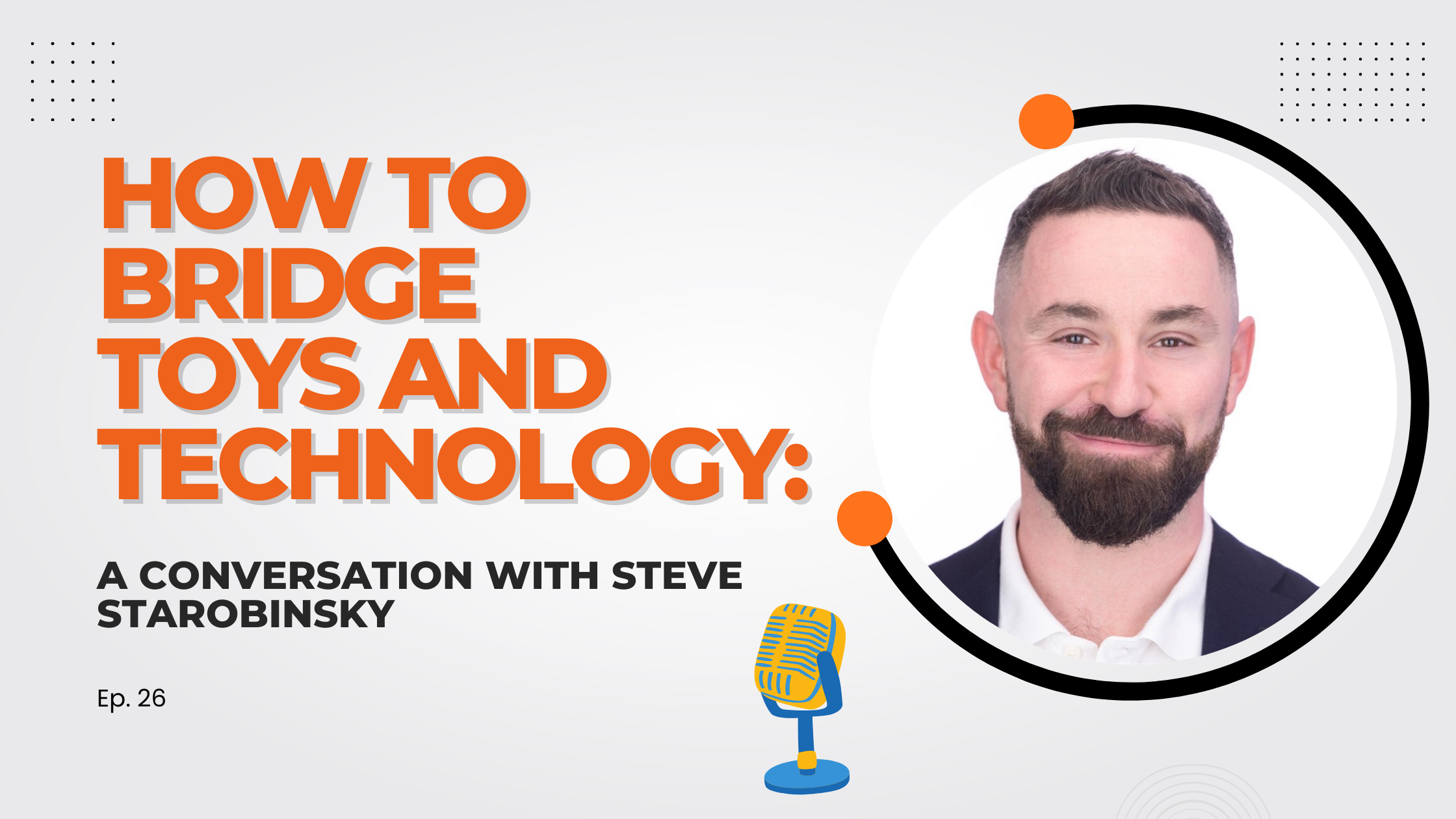
Welcome back to another insightful episode of the Toy Business Unboxed Podcast! we have an exceptional guest who is at the forefront of transforming the toy industry – Steve Starobinsky, VP of Trends and New Markets at Gel Blaster and founder of KidAtHeart. Steve’s innovative approach has not only transformed the industry but also paved the way for the future of play. In this episode, we delve into his toy journey, the magic of merging physical toys with digital experiences, and the groundbreaking concepts behind Gel Blaster Nexus.
Episode Highlight
- 00:00 Introduction to Toy Business Unboxed
- 00:43 Meet Steve: VP of Trends and New Market at Gel Blaster
- 01:33 Steve’s Journey in the Toy Industry
- 04:08 Innovating with Gel Blaster
- 07:07 The Greatest Game Ever Played
- 09:44 Challenges in Creating Toy Attractions
- 20:38 Marketing Strategies and Retail Connections
- 35:34 Future Trends and Industry Insights
- 38:19 Advice for Aspiring Toy Entrepreneurs
- 40:12 Conclusion and Farewell
The Journey into the Toy Industry
Steve’s enthusiasm for the toy industry was sparked early on, thanks to his mentors. “Any successful or pseudo-successful journey begins with mentors,” Steve shared. His journey started with Ryan Logan through the Big Brother program, who introduced him to the fascinating world of toys. Working at Funrise Toys in high school, Steve fell in love with the industry, learning from legends like Arnie Rubin, a toy industry hall-of-famer. This early experience instilled in him a customer-centric approach that he continues to apply in his leadership roles.
Unfolding the Gel Blaster Revolution
Gel Blaster, a company that Steve joined over three years ago, has redefined how we perceive traditional toys. He discovered the potential of Gel Blaster during a Kickstarter campaign and saw it as “the single greatest toy that I had played with in 20 years.” With a vision to turn Gel Blaster into a global sensation, Steve and his team innovated continuously, adapting their strategies to the changing dynamics of marketing and social media. This involved working with influencers, media, and retailers to maximize their reach and impact.
Creating a Real-Life Video Game Experience
Perhaps the most revolutionary concept that Steve discussed in the podcast is the integration of video game principles into physical toys. Gel Blaster Nexus aims to create a real-life Fortnite experience. “The greatest game ever played to me is a video game in real life,” Steve stated. By combining the best aspects of Nerf, Paintball, and Fortnite, Gel Blaster Nexus offers a unique and immersive play experience where the physical and digital worlds merge seamlessly. Players can interact with physical projectiles and digital targets, enhancing engagement and creating lasting memories.
Overcoming Obstacles in the Attraction Industry
One of the key challenges faced by Gel Blaster in developing their attractions was managing throughput, or the number of people they could get through an attraction in a given time. Ensuring a seamless customer experience involved meticulous planning, from gear-up and safety instructions to gameplay and scoring. Additionally, Gel Blaster’s strategy to compete with traditional laser tag facilities by offering a hybrid of physical and digital play elements further exemplifies their innovative approach.
The Broader Vision and Expansion
Gel Blaster’s vision extends beyond home products to immersive attraction centers. Their success in opening a beta location at Dave & Buster’s in Austin and subsequent installations across the U.S. highlights their ambition to scale globally. By integrating features like health bars, ranks, and attributes within their blasters, Gel Blaster offers an unparalleled experience that traditional laser tag cannot match.
Addressing the Social and Sensory Aspects
Steve also touched upon the importance of inclusivity, including potential adaptations for sensory-sensitive individuals. While current attractions may be overwhelming for some, there’s a possibility to incorporate technology that allows remote participation. This inclusivity aligns with their vision to create diverse roles and functionalities within the game, catering to different player preferences and abilities.
Embracing Adult Play and Continuous Innovation
The conversation also explored the concept of “kidult,” demonstrating how adults, too, have a place in the world of toys. Citing Lego’s success with adult-targeted products, Steve emphasized that play is timeless and beneficial for stress relief and community building. This ethos drives Gel Blaster’s commitment to creating engaging and aspirational products for all ages.
Staying Ahead of Trends
Keeping up with industry trends is pivotal for success. Steve recommends tracking developments in fashion, furniture, and the mobile gaming industry, which often pave the way for trends in the toy business. This proactive approach helps align Gel Blaster’s products with current and future consumer interests.
Parting Advice for Toy Industry Newcomers
As we concluded the discussion, Steve shared valuable advice for those entering the toy industry: “Go to as many trade shows as possible, meet as many people as you can, and don’t be afraid to believe in the best in people.” He emphasized the importance of fostering positive energy and momentum, which can attract positive outcomes for one’s business.
Conclusion
Steve Starobinsky’s insights and experiences provide a compelling look into the future of the toy industry. With a blend of tradition and innovation, Gel Blaster is set to revolutionize how we play, connecting the joy of physical toys with the excitement of digital experiences. Stay tuned to see how Steve and his team continue to shape the future of play.
Follow Steve on LinkedIn or Instagram at The Kid @ Heart to stay updated on his latest projects and innovations.
To stay updated with the latest episodes of Toy Business Unboxed and embark on your own journey into the toy business, don’t forget to subscribe and follow the podcast. If you found this episode insightful, please leave a rating and review, and share the podcast with fellow toy enthusiasts. Let’s embrace the world of toys together, staying curious and continuing to innovate.
Transcript
EP026_05-28-24_Steve Starobinsky
Intro: [00:00:00] Welcome to Toy Business Unboxed, your gateway to the secrets of the toy industry. Here, Jason Hsieh, a toy entrepreneur and expert in the field. “Every product we develop is really inspired by some of the real life experience that we have with our son.” “60 percent of all toys last year were sold on Amazon.”
“Be passionate about it. Because it’s a road. It’s a journey.” “Like when you have an idea that you think is gonna somewhat change the world, make things better, I’d say go for it.“
Jason Hsieh: Hello, Welcome back to another episode of Toy Business Unboxed. I’m your host, Jason Hsieh. In today’s episode, I’m thrilled to have some Steve, the VP of Trends and New Market at Gel Blaster and he’s also the founder of KidAtHeart. Steve’s leadership has been instrumental in [00:01:00] creating the greatest game ever played. Transforming the toy industry was his innovative approach. With over three years at Gel Blaster, Steve have honed his skill at new business development, product marketing, and also social networking.
We’ll dive into his toy journey of Turning toys into very interesting attractions and launching groundbreaking new product for Gel Blaster Nexus. Get ready for insightful conversation on the future of play and the magic of merging toys with real world experiences. Thank you so much for joining with us today, Steve.
Steve Starobinsky: Hey man, thanks for having me.
Jason Hsieh: Can you tell the audience a little bit more about your journey in the toy industry? How does everything started for you and all the different toy company you have worked over the years?
Steve Starobinsky: Yeah. Yeah. Look any successful or pseudo successful journey begins with mentors. I’ve had some amazing mentor in my life. My toy journey actually started with my big brother through the big brother, big sister program. His name is [00:02:00] Ryan Logan and he’s in the toy business. He was my mentor before I knew that people made money working in the toy industry.
We met when I was 11 years old and he was a big brother to me, sometimes a father figure and inspiration. He showed me that the world was large and worth going too far away places and got me my first job when I was working at fun rise toys when I was in high school and I fell in love with it. The owner of Fundrise is a toy industry hall of famer named Arnie Rubin, and I learned so much from Arnie. He’s a legend. The whole company was so customer centric. We always did everything to champion our customer and our partners. When we did that, we also won and that felt kind of the foundation of the way I lead teams now. Then I moved to Dallas, Texas and worked with Greg Harden and Wes Harden. They were two of my best friends in the [00:03:00] industry and I learned so much from them, tenacity risk taking,
Jason Hsieh: diverse marketing, right?
Steve Starobinsky: Yeah. Yeah. I was the CMO for diverse. I worked with diverse for 12 years and they really, saw my ability to spot trends and guide our vendor portfolio to ensure we were always on trend. I was able to speak in front of the industry, really help customers understand the changing youth market. Our industry, we age in and we age out the consumer every single Christmas.
It changes so much. I really take a lot of passion in being able to figure out what is a trend, what is a fad, what is an evergreen, how to have soft landings because things are going to get hot and things are going to get not hot of what we do to be able to really help our partners maximize and also not give up all of their profits when they [00:04:00] have to close out a particular trend. I really think that is the name of the game.
Jason Hsieh: How do you translate those experiences to your current position? I think it’s with Gel Blaster, right?
Steve Starobinsky: Very seldomly do we get to create an entirely new category in the business of play. When I discovered this product on Kickstarter and got one in my hands, I immediately knew it was the single greatest toy that I had played with in 20 years of doing this. I saw a vision of this becoming a sport. I saw a vision of this being a global sensation and a TikTok trend occurred very early in our life cycle that blossomed this play pattern into a national headline. Then I saw that those eyeballs, evaporate as the headlines on TikTok switch to something else and had to guide our marketing to [00:05:00] continue the momentum. Working with influencers and national media and event marketing. It was a fascinating experience to go from earned media doing tens of millions of impressions a day to then buying media at millions of dollars a year to now working with our retailers and our distributors all over the world to really hone in on the type of marketing that works. Because marketing has changed so much in the last 12 to 24 months. The explosion of creators has dominated social media. Social media isn’t necessarily the most profitable marketing venture as it was very shortly ago. When it comes to social media, the one size fits all approach is even worse. Like our product [00:06:00] is demonstrable.
Every dollar I can spend on putting a blaster into a person’s hands, having them interact with one of our scorable digital targets. It’s a much higher ROI ultimately than showing them a commercial.
Jason Hsieh: True. Yeah.
Steve Starobinsky: And that has started to pave the road as our nexus strategy has begun to be visible to the public. Because four years ago, our vision was to create a real life Fortnite. And Fortnite is scorable, fortnite has levels and upgrades and power ups and health bars and community. And the arena is every bit or the map is every bit a part of the play pattern. Making a blaster brand that could compete with evergreens like nerf was only the beginning in our [00:07:00] arena strategy.
We want to put you inside the video game. That’s what 2024 is about for us.
Jason Hsieh: I think you also mentioned about in pre interview the greatest game ever played.
Can you describe what this game is and how the idea came about?
Steve Starobinsky: Yeah. Yeah. That’s an internal mantra that we use here. I believe if you really look at what the video game industry has done, I don’t know if you know this. But back in the nineties Nintendo and video game makers, Sega used to be in the toy building in New York. Video games and toys were one industry. And then something happened, where the toy people were like, Ugh, video games, devil and said, you are a different industry. And the toy business, since that decision, has remain basically flat ups and downs, whatever.
Jason Hsieh: But the video game is going like [00:08:00] crazy is it’s growing,
Steve Starobinsky: but the video game industry has grown to almost 200 billion, somewhere between four and eight X what the toy industry is. Arguably, video games are a better play thing than toys. That doesn’t sit well with me because I believe in toys. I believe that it’s in some ways a self fulfilling prophecy because the toy people, toy brands see this phenomenon occurring where kids just, put down the toy and pick up video games about eight years old. Oh my god, they don’t want to play with toys anymore. The blame gets pushed else and therefore, toys aren’t made for teenagers, we just give up on that market. And I don’t think that’s the correct strategy. I think the strategy is to learn and [00:09:00] see the things that drive amazing engagement from video games and yet not lose the magic of toys. Not lose the magic of a physical activity. Not lose the magic of the parameters of play that the toy industry has taught us.
The greatest game ever played to me is a video game in real life. Where you take the best of Nerf, the best of Paintball, the best of Fortnite and bring it into a physical space that is as much a character in the game and I think the combination of physical projectiles and digital gameplay overlaid together is a game.
Jason Hsieh: One of the things I know you guys are working really hard on is to turn the tour into a track attraction almost, which is sounds very challenging. What are some of the biggest obstacles your company has faced so far during this process?
Steve Starobinsky: [00:10:00] Oftentimes you can learn a lot about an industry if you reverse engineer their most important KPIs. So in the toy industry or in retail, you have dollars per square foot. It’s a way to compare Walmart and a specialty toy store. Dollar per square foot. In video games, maybe it’s hours played per user, or frequency of playing a particular mobile game. In the attraction industry, there is the main KPI, which is called throughput. How many total people can you get through an attraction per day, week, month?
Jason Hsieh: I see. Okay. Makes sense. Okay.
Steve Starobinsky: Throughput, right?
Jason Hsieh: Got it. Okay. Okay.
Steve Starobinsky: That throughput can then be looked at as a feeder into two other key frequencies.
Jason Hsieh: Which is?
Steve Starobinsky: Dwell time. How long a customer enters a multi attraction center, how long do they [00:11:00] spend? Two is frequency of visit, how often they come back.
Jason Hsieh: Okay, that’s important.
Steve Starobinsky: So how many people can the attraction get through? How engaging is it so people come back and do people spend more time in the center because of a particular attraction? Meaning that they usually play that attraction or visit that attraction multiple times per visit.
As we started looking at that we had to create a product that was intuitive enough to get people in and through the attraction, they got to put on the gear. They got to watch the safety video. They got to get into the arena. They got to play the game. They got to take off the arena. They got to look at all their scores. They got to take a selfie and they got to get out of there. You have to break down that entire funnel into every step of the way, because it affects your software. It affects how you design your [00:12:00] hardware. That’s your customer service and customer journey. It’s like throughput is made up of another key metric, which is session time.
Most attractions, the session time does not equal to the game time. If you go to an arcade or if you go to a go kart place, you’ve got to go through the thing, you’ve got to put on your helmet, you’ve got to get the instruction video. The race is usually two, three minutes. Then you get up, but you can’t put more people in the next go kart stage until the first one’s clear. So in time is very valuable. It’s been an incredible, learning curve for me personally. And then there’s the sales side of it. In toys, yeah, Walmart, Target, Amazon, about 70 percent of the total business. You got a new toy, you got to worry about three customers. You should sell everybody ahead to get to Walmart and target cause they don’t really want to buy your thing if it’s unproven ways to get to Walmart and target, but like the amount of customers is very small in the toy industry, [00:13:00] in attraction industry, most family entertainment centers are owned by a single operator and there’s 1500 of them in the U S. I basically had to cold call hundreds of people over and over and over to tell them about this new thing. Tell them that we’re not just selling you retail products to put into your attraction that are designed from the house. That instead,
Jason Hsieh: oh yeah, show us some of your product if you have it.
Steve Starobinsky: So for example, this is our blaster that we made for the house. This is the surge. This is the blaster that’s for the enterprise accounts.
Jason Hsieh: Oh, whoa. A lot bigger.
Steve Starobinsky: Yeah just it’s a very different product altogether, and it has a screen on here. It basically has a computer on board.
Jason Hsieh: For the listener that’s listening on the podcast, please visit our YouTube channel to see the video demonstration.
Steve Starobinsky: In this [00:14:00] blaster, they have a different health bar. They can see their rank. They have different attributes for different blasters that they select. So one physical blaster, just like in Fortnite can become an unlimited amount of digitally defined blasters. We can control the rate of fire.
Jason Hsieh: But you’re also competing against the existing laser tag industry right now, right?
Steve Starobinsky: That’s right. That’s, exactly right. In order to know if you have a chance to create a new trend, you very much have to study your history. Poetically, laser tag is celebrating their 40th anniversary this year. Laser tag was created in 1984 in Dallas, Texas. Remained relatively unchanged for that entire time and the good news is that the way we created our technology, we shoot a physical projectile and a laser beam, an IR beam. The Vests co witness the two of [00:15:00] them and basically say, oh, I got hit with a physical projectile because everything is mesh wifi network to each other. It knows that blaster number four shot a quarter of a second ago for a particular angle. Therefore the hit came from that angle. We do have a laser tag type of experience, but we took it a step further in order to de risk the attraction for our potential partners we’ve created a software controlled mechanism for the physical projectile. Meaning that the operator can turn off the physical projectile and run traditional laser tag with our tech.
Jason Hsieh: Oh, I see. So they have a option if they want to turn it off.
Steve Starobinsky: They have an option which allows them to put two attractions in the same physical space.
Jason Hsieh: True, and maybe charge a little bit higher for the one that have a physical projector.
Steve Starobinsky: It’s charged a lot higher. It’s a [00:16:00] much better experience. But when you sell, there’s a bias that supercharges your words and when you buy, that bias is very loud and clear.
Jason Hsieh: So I have a personal question because I played paintball in the past. And every time I got hit by one of those, it hurt a lot. How about for you guys? Does it hurt a lot when you get hit by one of those projectiles?
Steve Starobinsky: No, is the short answer. I would say paintball is a 10. This is like a one and a half. But there is a physical consequence. There is stakes. You feel peril when you enter the gel blaster arena. There is this engagement that you enter your flow state. You are so engaged only by this thing that it creates a lasting memory, not just in your brain, but in your body. That allows you to recall this experience more often.
Jason Hsieh: I was watching the video on the [00:17:00] website. It looked like there’s also a goggle that goes with it. Do they see any data in the goggle?
Steve Starobinsky: The short answer is, no. The goggles are there to protect your eyes from the physical projectile. That’s the only safety necessity to play. You’re a technologist, it seems and know that AR is coming like a freight train. We have some very exciting patents and demos around AR in our play pattern is going to ensure this is an attraction that can continue to upgrade as technology becomes more available.
Jason Hsieh: Yeah, almost like those military style goggle where you can see all the data from like even info rate like, that’d be really cool. As part of the goggle, you see all the data while you’re playing, you just make the experience even more immersive than what it already is.
Steve Starobinsky: Yeah, anytime you’re in Austin, come check it out.
Jason Hsieh: I will. How many locations do you currently have right now? [00:18:00]
Steve Starobinsky: One is open in Austin, our beta location. What’s so cool about that is, the largest entity in location based entertainment, with over 2 billion in revenue a year, is Dave Busters.
We have opened our very first location in the largest location based entertainment company in the world.
Jason Hsieh: Congratulations! Whoa.
Steve Starobinsky: Very different than most people would do it. But it shows that if we could get through the red tape and build something that they have approved, this should be able to be scaled globally. Our team has just landed in Gatlinburg, Tennessee. That’s where our second location is being installed this week. And then we have, four more locations opening in June. Two in California, one in Stanford, Connecticut, and one in Long Island, New York and then we’ll be installing anywhere between 5 and 15 locations a month going into [00:19:00] Christmas.
Jason Hsieh: Oh, wow. Coming to Phoenix anytime soon? I would love to take my son there.
Steve Starobinsky: The short answer is yes. Hopefully its main event in Phoenix.
Jason Hsieh: When the company first started, was this attraction idea is always there in the beginning? Who come up with this attraction idea?
Steve Starobinsky: Yes. We always knew that again, creating Fortnite and getting kids off the couch, we didn’t know exactly every step, but we always thought that converting laser tag centers blaster arenas was a possibility. And then once we saw some of the laser tag, industry data and the plateau of that industry. In fact, the slight decline while still being an over 400 million industry a year in the U S alone, showed us that you just don’t know that something, it’s Uber and taxi. When you add a little bit of technology you can quickly overtake it.
Jason Hsieh: What would you say that’s leading to their decline as [00:20:00] well?
Steve Starobinsky: At the end of the day, when you shoot a photon at each other, there’s just no risk. There’s just no driver, there is nothing at stake. As video games have become so much cooler, so much more immersive, so much more social. Laser tag just can’t stand up to it. Currently, 50 percent of all laser tag sales are from birthday parties. Johnny has a birthday party at me. He invites all his little friends. Laser tag is a part of that package. Not a true reflection on demand.
Jason Hsieh: What is the main strategy you’re using to promote this whole idea of the attractions and all the different toy line you guys have?
Steve Starobinsky: If you look at any attraction in the world, There are few that have any kind of retail connection. So bowling doesn’t have an at home version. Mini [00:21:00] golf doesn’t have an at home version. Go karts doesn’t really have an at home version. Laser tag has an at home version. Laser X has been very popular over the last 10 years. While we’ve been building this attraction, we’ve been selling a lot of product to all sorts of retailers. We’re now in 17, 000 retail doors and with that in mind, in a way, those retail doors become a billboard for the attraction. The attraction becomes a billboard for the at home product. It really becomes this cohesive ecosystem of play where no matter where they enter, they now have a way to stay on this lazy river effect, if you practice at home, they compete in the arena. They compete in the arena, they go and practice at home. A lot of the marketing we can do with our retail partners. Of course, we [00:22:00] have social media and last year we did some national TV advertising, but I think our secret sauce is that we do a lot of demos and we post we have a gel blaster van. We post it up in front of a retailer, set up a blast booth, people get to try it out. They get to talk about it, we also partner with a lot of mobile party operators. So these are the same guys that would bring an inflatable bounce house to your kids’ birthday party. They bring bunkers and they bring gel blasters, and they’re able to host a gel blaster birthday party.
Jason Hsieh: How would you say like the biggest competition you’re facing right now? Which industry are you really trying to take over?
Steve Starobinsky: Video games. We’re trying to connect the dots. We worked with the Microsoft team and are creating the first, this is going to be the first licensed gel blaster. This is our chef’s kiss, our homage to the property that kind of started it [00:23:00] all that really built this first person shooter kind of category. Giving them a replica that can look beautiful on their shelves, but can also be played with or cosplayed with. I’m really excited for that. That’s going to be coming out for this Christmas.
Jason Hsieh: That’s super awesome. I’m also very into first person shooter when I was much younger, I don’t play as much anymore with all the business I operate, but I played Counter Strike, Halo let’s see, like Team Fortress, Fortnite obviously, whole bunch of different first person shooter. I’m dating myself
Steve Starobinsky: no, no. You’re actually doing the opposite. You’re validating something that I think the toy industry forgets. The average video game player in America is 32 years old. 45 percent of all video gamers are women. There is huge opportunities in market segments that the traditional toy industry doesn’t touch.
That’s why I think [00:24:00] the future is really bright. You just can’t dumb down something for an adult. This terrible term, kidult, that has emerged, that’s just, it feels weird rolling off your tongue but it’s necessary to talk about. Look what Lego has done. Lego has basically created an entire aisle of adult. You build the thing, it’s an adult activity. It’s not by display, it’s an adult activity that is so rooted in play. It is in their DNA that they construct and build these things.
It has gotten so many, not just 30 year olds, but 50 and 60 year olds back into the toy category. At target, the adult Lego section is now, I feel the full 40 foot. I don’t know if you’ve noticed this, but their [00:25:00] tagline is adults welcome. Because they’ve unlocked the key insight that adults have been lied to their entire life. They age out of play.
It’s a lie. It’s just a lie. You do not age out of it. Play is not childish. It helps them deal with stress. It helps them form community. It is something that is so necessary. With all the evil shit that’s all over us. Like it’s the thing that we need to come back to
Jason Hsieh: I agree Yeah.
Steve Starobinsky: And it works for business. Over the last four or five years and unlike most companies that boomed in Artificially because of the pandemic and then drop below where they were and basically we’re in this are in this horrible [00:26:00] situation, where they over promised and under delivered. Lego has sustained and growth. Grew because they made a product that addressed the key insights. Adults should be playing more.
Jason Hsieh: Yeah. Yeah. Yeah. I agree. So I have more of a selfish question. I’m a special need advocate myself, my entire toy brand, we design sensory toys. In part of your attraction design, have you also considered design a sensory friendly version of it?
Steve Starobinsky: Great question. I have seen because it’s black lights and it’s loud music and you’re getting blasted with all these gel, it’s like it is a bit of a sensory overload. It is something that I’ve thought about. I don’t have an answer yet, but I do think there’s some technology that we can apply.
For example, let’s say, let’s call them turrets. They are blasters inside the arena that someone can control from a
Jason Hsieh: [00:27:00] remotely. Okay. Remotely. That’d be really cool.
Steve Starobinsky: I think, there are ways to incorporate special sensory needs kids and adults.
Jason Hsieh: It’ll be really cool with that current idea is someone can play like a video game, but instead of shooting virtual people, you’re shooting real people in the arena,
Steve Starobinsky: playing defense or being a healer. Because human beings have different archetypes, like not everybody wants to be the striker. Not everyone wants to be the healer. Not everyone wants to be the defender. And so creating an experience that has different roles, different architects, will allow different kinds of people to work together and really feel like, you know
Jason Hsieh: Have you played a game called Team Fortress? That’s exactly the rule for the game. You can be a sniper. You can be like a scout. You can be like a different rule and you have different weapons, different attributions. Sorry, I’m just geeking out here because I’m also a big gamer myself.
Steve Starobinsky: That’s the architecture that we’re creating [00:28:00] for Nexus. Different roles can exist inside the arena and allow players to really flourish in what speaks to them.
Jason Hsieh: Can the player also level up? As more and more people play, they get a better weapons or better like ability or whichever.
Steve Starobinsky: Yeah. Yeah. So that’s another really cool thing. So we have Nexus, the app for the house. And in that app, you have a profile.
Jason Hsieh: Oh, awesome. Okay.
Steve Starobinsky: It tracks all of your stats. So these are my at home stats and these are all of my arena stats.
Jason Hsieh: And that is attached to your weapon? That sync with your weapon?
Steve Starobinsky: If I walk into main event, I could be Johnny123 off the street. Or I can just scan in and input E as Kit Heart. You can upgrade your avatar and you can unlock advantages inside the arena that you can deploy.
Jason Hsieh: I think that’s one thing that the current laser tag [00:29:00] industry does not have. That’s they have zero personalization actually.
Steve Starobinsky: Because the stats don’t matter. Because there is no risk. The engagement level is only, it lasts from the time you enter the arena until the time you see your scoreboard. That is your only motivation. Versus in Jailblasting, you have a motivation not to go ahead. You’re trying not to be hit, and you’re trying to hit, and you’re trying to level up, and you’re trying to work together, and create strategies, and you’re trying to capture the base, and you’re trying to prevent the zombies from attacking you. Whatever game mode you’re in, you have so many levels of engagement that carry through the physical experience of the round to your entire visit to the center, to your at home experience, to your tournaments. We can now create this future sport.
Jason Hsieh: Yeah, sounds awesome. I would love to visit one with my son. My son’s 14. He’s on the autism spectrum, so we’ll [00:30:00] see if it’s too much for him, but I’d love to take him to one.
Steve Starobinsky: Yeah, for sure. For sure. We’ll keep you posted on our main event expansion, but yeah, we’ve been open now for 14 weeks in main event, Austin and our proof of concept. We built it ourselves from scratch and we’ve now had over 7, 000 people through.
Jason Hsieh: How’s the feedback you’re getting so far?
Steve Starobinsky: We have a 94 percent customer satisfaction rating.
Jason Hsieh: Amazing. Okay.
Steve Starobinsky: 49 to one prefer it over laser tag. Over 90 percent net promoter score. It’s going to market itself. It’s pretty exciting.
Jason Hsieh: Yeah, it sounds like you guys definitely can take over the industry.
I have been in the toy industry, of course, not as long as you, but since 2017. But I feel like that’s not enough new people coming into the industry and trying to change things. They have just been doing the same thing over and over and over again. With the same sales rep, with the same store, with the same everything and try to And they expect their [00:31:00] business is going to go better, but they didn’t do anything to change it.
Steve Starobinsky: The toy industry does a lot of things, right? I just believe that play is so important and it’s an industry that most people you’ve probably experienced this, but if you’re sitting on an airplane and you meet a friendly stranger and you tell them that you’re in the toy industry. The reaction’s always the same. Oh my god, really? That sounds like the coolest job or oh my god.
Jason Hsieh: Yes, that’s the reaction I get. Yes.
Steve Starobinsky: Nobody ever thinks that there’s a big industry for this. Maybe it’s becoming a little more mass market or pop culture now. The Barbie movie did a billion dollars and maybe people can see themselves working in this profession, but we don’t necessarily put out, we don’t tell or make it known
Jason Hsieh: how cool it is to work in industry. Yeah, I think that’s one of the missing component is that we’re not attracting the young [00:32:00] generation. They want to work for it, work for a silicone base. Like SAS company. Those are the dream job, right? Okay. Software engineer is super cool. Very high paying and you get equity from the company and startup and stuff. I feel like the toy industry is just not attracting the right talent into the talent pool.
Steve Starobinsky: Yeah. Yeah. The high paying is another issue because we have a huge burden of profit being sucked up by R and D and by the inability to manage the soft landing. Yes, there are plenty of rich people and big companies in the toy business, but it isn’t like it is difficult to actually take money to the bank, even if you sell something in, you sell it in at wholesale and you got to hope and pray that it sells through, but most of the time you got to really support it. And that comes into your EBITDA pretty aggressively and if it doesn’t sell through, then you’re on the hook for markdowns. There are some problems in the way [00:33:00] that profit is generated. There are ways to solve it.
Jason Hsieh: But I see you guys are correct. I think the trend for the toy brand should be more focusing on D2C and direct the consumer, creating content, creating experience, not just sitting in their office and try to sell through the sales rep group. It worked, but you don’t resonate, you don’t interact with the end consumer that way.
Steve Starobinsky: I think there’s a lot of truth to that. I also think that there’s some amazing sales reps and sales professionals out there that really are a monster asset to their customers.
Jason Hsieh: Yes.
Steve Starobinsky: I do think that there’s a lot to learn about doing D2C business because to me it’s about failing fast or proving your trend and scaling it before the trend is over. To me, there’s a lot of value in [00:34:00] proving that the customer wants something D2C and having your funnel ready to go. The retail can help you drive distribution. Distribution is marketing.
Jason Hsieh: Yes.
Steve Starobinsky: You can’t afford to just constantly dump all your money back into D2C because you just can’t, you can’t,
Jason Hsieh: I think you need to do both. To be honest, you need to do both. You cannot do one or the other. I feel like you need to do a little bit of both.
Steve Starobinsky: And so there are tools in place now that allow that to happen. But yeah, I think sales reps are really a vital cog of the machine. And I think that D2C and digital marketing is even more important now than it ever has been.
Jason Hsieh: Yeah, because for the past eight years, it was my own toys brand since 2017. I started at the end of 2016, I’d be a hundred percent D2C. So this year I’m considering [00:35:00] getting into retail. So I’m like really new on the retail side and really trying to learn, try to observe talking to people like you that have tons of experience.
I’m dealing with the big box retailer, the specialty retailer because everyone have different needs and different scene they’re looking for when they want to carry the brand like us, which is a very small family brand. We only have less than 10 SKU. So I seen those are the same that as a toy entrepreneur, we just need to learn what is working and not working and apply different marketing strategy for different channels and really trying to grow the toy business holistically as a whole. My next question is how do you stay ahead of the trend to make sure your product really can resonate with the market going forward?
Steve Starobinsky: That is accomplishable for most people. The toy industry is inherently aspirational. Kids do what they see other people do. And so there are some very meaningful connections that you just need to track to help you guide what is [00:36:00] trending in other spaces that will trend in the toy space next season. You have to track fashion. You should be reading every single recap from Paris Fashion Week, New York Fashion Week. You should be tracking furniture industry. Because people will buy toys, especially bigger purchases to match their aesthetic of their house . You should be tracking the video game industry. Mobile gaming?
Jason Hsieh: Video game. Definitely.
Steve Starobinsky: Mobile gaming especially. Mobile gaming has created the biggest increase for the video game industry since the first gen consoles came home. The first big peak in video games is the arcade and Atari and Pong, or Pac Man really. And the next big spike was PlayStation 1 and Xbox. The spike that is significantly bigger than all of those is when mobile gaming became a category.
Jason Hsieh: Yeah. Because it’s so [00:37:00] easy to use.
Steve Starobinsky: Just track the top 10 games every single week. Track what’s happening on Steam, what people are downloading, it will give you tremendous insights. Then when a sales rep comes to you and says, I’m pitching you this based on some of the things that are happening, which is what I believe salespeople should pitch from outside in. What is a trend outside of the toy business? That is the reason why I’m showing you this thing right here. Because toys are inherently aspirational. They come from somewhere, they’re not usually created.
Jason Hsieh: I just got back from the licensing expo from Vegas last week, and it’s definitely also another good place to spot trends. See what kind of brand is popular right now and all that.
Steve Starobinsky: I love the licensing expo. It’s a great place to really absorb and really see how the major, I used it for two reasons. I would always go to all the major studio showcases because I [00:38:00] enjoyed how they spoke about things. it was like the apex of communication. Very organized. How everything kinda filtered and funneled down. Brand owners could really find white space in the industry.
Jason Hsieh: That’s a good point. Thank you so much. We have discussed so much different topics. Approaching to the end of today’s interview, the last question I asked all the guests is if you have one piece of advice to share with someone that’s getting started in the toy industry.
Steve Starobinsky: Follow me on LinkedIn. Yeah go to as many trade shows as possible. Just walk. That’s how I learned the industry. Greg Harden one of my mentors at Diverse really gave me an opportunity to shadow him as we went to trade shows from Tokyo Toy Fair to Comic Con to Nuremberg to New York Toy Fair. I got to go everywhere. You just want to meet as many people as possible. And by the way, [00:39:00] You don’t have to be scared. You could believe the best in people. Every once in a while you might get burned, but don’t lose that very important control of creating positive energy and momentum. Don’t be a cynic. Believe the best in this world and you will attract positive outcomes to your business.
Jason Hsieh: 100%. Thank you so much for that piece of advice. That’s actually the exact reason why I launched this podcast earlier this year, is to meet people and talk to people like yourself and just learn from each other and sharing what is working and not working within the toy industry.
Where can our audience find you?
Steve Starobinsky: LinkedIn, I feel like I’m like an OG. I’ve been writing and publishing various things, for what feels like a decade now, but yeah, I like LinkedIn a lot, instagram, I’m The Kid @ Heart.
Jason Hsieh: Sounds good. So thank you so much for being on the podcast again and sharing all [00:40:00] your story. I have an amazing time talk about video game because I was a video game myself. Thank you so much for joining us again. And I’ll talk to you soon.
Steve Starobinsky: Sounds good. Thanks, man. Bye.
Outro: You’ve been listening to Toy Business Unboxed, hosted by Jason Hsieh. Thank you for joining us and exploring the fascinating world of toys and the ingenuity behind them.
To stay updated with the latest episodes and continue your journey into the toy business, remember to subscribe and follow us. If you found today’s episode insightful, please leave a rating and review and share this podcast with others who share your passion for toys. Until next time, stay curious and keep innovating.