
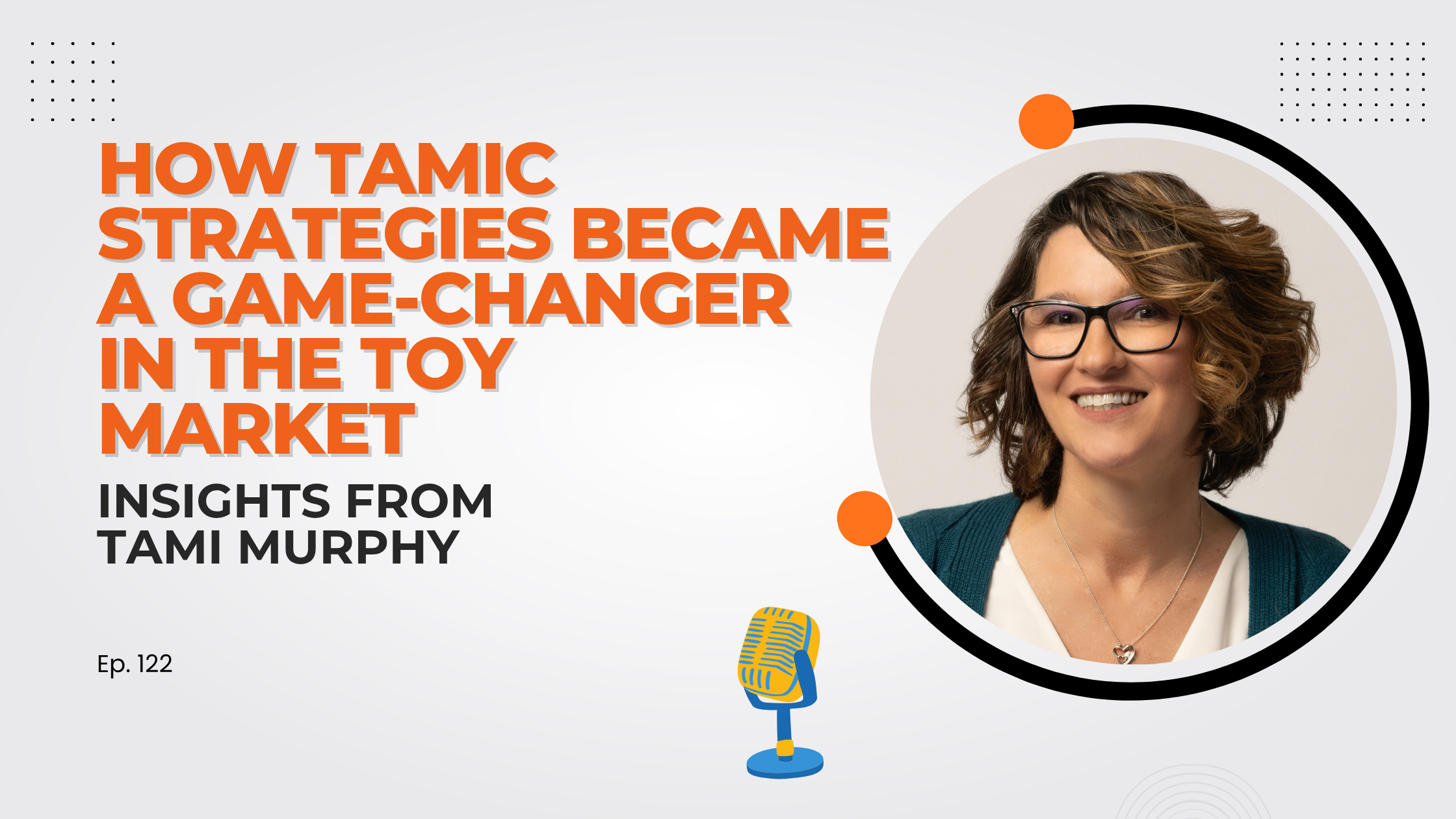
Welcome to the world of building a toy and game company—where creativity meets real challenges in a competitive market. Many founders struggle to find the right path and establish a strong brand early on. In this post, Toy Business Unboxed host Jason Hsieh sits down with Tami Murphy, founder of Tamic Strategies, to share insights from nearly two decades in the toy industry. From choosing between digital and trade show strategies to avoiding common pitfalls, Tami offers practical guidance for every stage. Whether you’re launching or leveling up, this guide helps you shape a business that fits your goals.

#122: Stop Working IN Your Business—Start Working ON It – Toy Business Unboxed
Episode Highlight
- 00:00 Tami’s Journey in the Toy Industry
- 02:46 Challenges in the Toy and Game Industry
- 04:07 Paths to Success: Trade Shows vs. Digital Marketing
- 06:24 The Importance of Packaging
- 09:01 Navigating Brick and Mortar vs. Online Sales
- 11:44 Starting in Brick and Mortar: Trade Shows
- 14:16 Working with Sales Reps
- 16:09 Sample Strategies for Sales Reps
- 19:15 Coaching and Consulting for Toy Entrepreneurs
- 23:16 Advice for Founders: Working On vs. In the Business
- 26:50 Networking in the Toy Industry
The Path to Success in the Toy and Game Industry Is Unique for Every Business
Toy entrepreneurs often wonder whether to focus on trade shows or digital marketing. Tami’s perspective has evolved; she now advocates for a balanced approach that includes digital channels like Amazon or Instagram. Proven concept validation makes your product more attractive for retail placement, but you must understand your skills and capacity. Both paths require capital and strategic effort. Start with online channels to test and validate your product, then leverage those results to approach retail with proven sales data.
Building Visibility: Trade Shows or Digital Marketing?
Zev attributes success to identifying games with strong potential, whether through existing hype, designer reputation, or market demand. Before crowdfunding, he relied on conventions, distributor feedback, and industry relationships to gauge interest. His process combines evaluating themes, community buzz, and intuition developed through experience, helping him consistently select games that resonate with players.
The Importance of Packaging and Logistics
Packaging is often overlooked but crucial for success. Tami highlights that packaging is your product’s billboard—helping it stand out and communicate value. For online sales, packaging should be smart in size and weight to keep shipping costs down. For brick-and-mortar, it must be visually appealing to attract attention. Know how retailers buy your product—whether in units of 4, 6, or 150. Optimizing packaging for the sales channel is key for efficiency and profitability.
Avoiding Common Pitfalls
Entrepreneurs often stumble on packaging, sales strategies, and cost understanding. The most frequent mistake is misaligned packaging with shipping and retail needs. Well-designed packaging boosts desirability and shelf presence. Another pitfall is underestimating sales and margin differences between online and brick-and-mortar. Be clear about profit margins, understand customer buying patterns, and plan accordingly. Proving consumer demand through direct sales before retail can strengthen your pitch.
Getting Started with Brick-and-Mortar and Sales Reps
For those new to brick-and-mortar, Tami recommends attending trade shows as a primary step. These events provide access to buyers and industry contacts. To maximize trade shows, connect with brands and sales reps, and build relationships. Be prepared with samples and supporting materials. When working with sales reps, remember they are your business partners. Start by offering samples to reps and stores, and tailor your approach to their preferences.
Scaling Through Strategic Coaching and Planning
Tami offers coaching focused on profit boosting, sales growth strategies, and data analysis. Her upcoming Small Business Masterclass aims to help brands transform data into insights. She recommends setting clear economic goals, analyzing financials regularly, and crafting compelling brand stories. For those feeling overwhelmed, her advice is to establish a plan with actionable steps and deadlines. Success comes from clarity, strategic planning, and leveraging strengths.
Final Piece of Advice: Network and Prioritize
Tami emphasizes the power of networking. Building relationships with industry peers, attending trade shows, and seeking advice accelerates learning and opens doors. Her words: “Network, network, network—the industry is supportive, and your connections are your greatest asset.” She also advocates for the “Eliminate, Automate, Delegate” strategy, recognizing time as a finite resource. Focus on activities that generate growth, while automating or outsourcing the rest.
At the end of the interview, Tami shared her advice for new entrepreneurs entering the toy industry. She stressed the importance of understanding your market and being adaptable to changes. Building a strong network and seeking mentorship can provide valuable guidance and support. Tami also highlighted the need for continuous learning and staying informed about industry trends. Her final tip was to remain passionate and persistent, as these qualities drive long-term success.
Conclusion
Tami Murphy’s insights provide a comprehensive guide for navigating the toy and game industry. By understanding your unique strengths and market position, you can craft a strategy that aligns with your goals. Emphasizing the importance of networking, packaging, and strategic planning, Tami’s advice equips entrepreneurs with the tools needed for success. As you apply these lessons, remember to stay adaptable and committed to your vision. With the right approach, your toy business can thrive in a competitive market.
Connect with Tami Murphy
If you’re interested in learning more about Tamic Strategies or connecting with Tami Murphy, you can reach out through the following channels:
- Website: Visit Tami Strategies’ Website for more information and updates.
- Email: Email Tami on tami@tamicstrategies.com for inquiries.
Transcript
Jason Hsieh (00:00)
Hi everyone, welcome to another episode of Toy Business Unboxed podcast. Today we’re thrilled to have Tami the founder of Tamic Strategies on the show. With nearly two decades of experience driving growth for toys and game brand, Tami brings a wealth of knowledge on both sales strategy and also importance of building business that really works for you, not the other way around. And we’ll be discussing about why, a success look differently for each of the toys and game companies and also the step to get your business housing orders and also the beauty of mapping out your own business path. So thank you so much for joining me on the podcast today.
Tami Murphy (00:36)
Hi Jason, good to be here.
Jason Hsieh (00:38)
And could you mind just sharing with our audience a little bit about your journey within the toy industry? Because I know you have been doing this for a while now. So what led you to start what you do right now?
Tami Murphy (00:48)
Actually it was, one of those serendipitous things where I grew up in a family who plays, we played a lot of games as a kid. And I happened to be in a play group with my now 29 year old when he was three. And with, someone whose husband, she and her husband decided to launch a game business. And she remembered that I had a sales background. So
They invited me in 2006 to work Toy Fair booth for them. And then several months later, they offered me a job and I began working for a startup game company and we knew nothing. And really just learned by doing, making mistakes and growing, which was actually one of the best experience of my life because being in a startup is exhilarating.
and learning through sitting at the table, whether it was sitting at the marketing table, the sales table, the inventor, you know, the product development table, working in the warehouse, I’ve unloaded containers, I’ve shipped invoice products, I’ve sales rep groups, I’ve set up Facebook pages, you know, the whole thing, you know, and how to do trade shows. And you just, you know, we learned a lot along the years.
Jason Hsieh (02:03)
Yeah, for sure. Yeah, that sounds like a many different aspect of the business that you have you have done over the year and you have helped a lot of different companies grow. Based on your experience, what do you think is like the most challenging part of being successful in the toys and game
Tami Murphy (02:20)
Getting heard over all the other products maybe? are a lot of products out there. Yeah, think really the biggest challenge is getting people to know you. To get to know you to understand you. Set that internal, you know, industry first.
get to know people, be there where people are. It’s expensive. There are a lot of trade shows to be at, play your game with everyone or your product, right? Demo your product, get it in the hands of people within the industry to start your company. And that’s probably the hardest thing is getting going.
Jason Hsieh (02:56)
For sure. And I think everyone seems to have a different path to success. But will you also elaborate, like based on your experience working with different brands over the years, which one do you like, what exactly do people start out first? Do you suggest them to start going to trade shows all of a sudden? do you suggest them to work on more their digital marketing side?
and try to scale that weight or what are some of the different paths of success that you have seen throughout your career?
Tami Murphy (03:24)
Yeah, I think how many years ago, five years ago, seven, even three years ago, I might’ve said, always started to trade shows, always. It’s the way to go. But I think it’s evolving. And I think there’s nothing wrong with starting online direct to consumer because once you prove concept, then it gets easier to sell into retail. so I would say right now there’s no right or wrong answer.
the right or wrong answer is up to the company, which what they prefer. If they have the skill set and the finance, either option, let’s say, be honest, either option, you need capital. is inexpensive. So you can’t just drop a product, sell it on Instagram shop, TikTok shop or Amazon, and think you’re gonna make it. You have to invest in marketing and know what you’re doing.
It’s the same thing if you want to go into brick and mortar, you have to invest in all those trade shows. You have to invest in hiring sales reps and have to show up at all those shows and demo your product and do the work. So I would say it’s neither right nor wrong, but. there is something to be said for proving concept, going direct to consumer first and then approaching brick and mortar and saying, here are my sales numbers. I’ve proven that consumers want my product. It is a very viable option now.
Jason Hsieh (04:42)
Yeah. And I think back to your point is finding the skills that you feel most comfortable with. And you can use it to decide to go with Amazon route, brick and mortar route, or go with your own website, but each require many very different skillset. Let’s just say Amazon, for example, you need inventory management, catalog management, listing optimization with all the images and the graphic and SEO and pay per click. That’s like the five major skillset.
that you really need either on your team or you as a business owner, need to do all five correctly. but it depends on your, your, obviously you’re comfortable and what kind of connection you have and you can choose different paths. And since you also consult with a lot of the startup in the toy kind of space, what would you say are some of the most common like pitfall or mistake that you’ve seen over the year of the entrepreneur like myself that make, of course, I also make a lot of mistakes over the years myself.
Tami Murphy (05:42)
I would say packaging. The first thing is packaging. And those are different too. If you’re online only, your packaging can be a little bit different than if you’re going brick and mortar, but you still have to keep in mind you’re shipping this product. So, I always think your packaging is your billboard for your product. And that’s how I equated.
but you don’t have to necessarily have the glitzy billboard for online, but you do have to have smart size and packaging and weight because you’re shipping all these items. If you’re going into brick and mortar, realize, you know, walk into any store and look at the shelf and see the massive color and the massive choices and know your product, say it’s a four by six box is going to have to show up and stand out to someone.
amongst all those other packages who are also trying to stand out. So your packaging has to be appealing for someone to pull it off the shelf and examine it and then make sure that the person picking it up can understand very quickly what is your product is and what it will do for them.
Jason Hsieh (06:52)
Yeah, I will say that actually that’s a very good point. And that’s also one of my weakness because when I first started eight years ago, my focus is all online. Packaging is almost like a second solid as long as it doesn’t fall apart in transit. I didn’t spend too much time on it because when we’re doing digital marketing, we never show the packaging to the consumer. They just get it, you know, once they know the other video, we don’t really showcase the packaging as much. But if you have excellent.
packaging, can definitely incorporate it in your marketing message and make it look more giftable potentially, especially for the holiday season. But I think there’s different strategy involved. And just like you mentioned, packaging for retail store is going to be very, different than design the packaging for like online marketing,
Tami Murphy (07:41)
Right. And then taking it the next step further, you have to understand that if you’re selling into brick and mortar, you are selling how many units are you selling? So are you selling in units of four or six or eight? You have to know how they buy because you’re shipping the product to a warehouse and sure, it’s efficient to put 2436 in a box because it lowers your shipping costs. But nobody is buying in those units. If you’re shipping to online sales and that’s one thing, but if you’re shipping to retail brick and mortar, they’re not probably buying 36 units at a time. They want to divide it up into four or six, maybe eight.
Jason Hsieh (08:18)
Yeah, that’s a very good point. Actually, some of our product is in 150 units in a box. We’re not designed to do brick and mortar. We’re trying to see how can we optimize our logistics to get it from China to the United States? How can we put the maximum amount of units? For us, or for my brand at least, Amazon is our core focus. So 150 units is actually Amazon’s requirement.
You can now see 150 unit per box. Otherwise I’ll put more. I’ll put more into it if Amazon allowed it. The reason why it’s 150 is because that’s the maximum amount of unit Amazon allowed in their warehouse per box. And that’s how I kind of optimize my business based on all this requirement. it’s really fairly recently since last year, I even consider getting, or at least starting looking into brick and mortar. And that’s how I think we met.
with Astra and trade show I started attending more often. And I’m also trying to learn the different nuances for brick and mortar compared to digital marketing online, because that’s what I’ve been doing this whole time before I even considered gaining into brick and mortar. But just to play devil’s advocate here a little bit, the brick and mortar is also very different because the margin is a lot lower. So when you do advertising and you’re trying to sell to brick and mortar,
you are selling them at like 50 % or keystone pricing usually. Whereas if you are selling to any consumer, you sell it at the full retail price. So that’s another thing I think some of the newer business owner wasn’t considering as much as, I can sell to the brick and mortar 50, 100 unit, but how much margin do you actually get? That’s another potential problem that you can face.
Tami Murphy (10:01)
Now playing devil’s advocate to you when you’re selling on Amazon or any other online, you also have digital marketing and customer acquisition costs, which can be extremely high. So it can level the playing field as far as the margin at the end, you know, or it can make it worse.
Jason Hsieh (10:13)
It could be.
That’s true. Yes, I think from both perspective is different cause like you mentioned earlier It depends on your comfortable and where the business owners kind of strengths are I think playing Each of our strengths is really important And of course, we are always learning so for those like business owner that is listening or watching today’s interview that
maybe someone like me that is really new to brick and mortar, what would you suggest to start if they want to consider doing brick and mortar? Is it going to trade show, contacting sales rep group? Or what exactly is the step there?
Tami Murphy (11:02)
Yeah, it’s trade shows, they need to connect at trade shows, right? And there are so many trade shows to choose from these days. Almost it feels like too many some days to choose from. But definitely you need to go to trade shows. That’s a place where you can meet buyers, you can meet like businesses to you, because I will say this industry is really good at supporting each other. You know, really good at
helping one another and idea sharing. So you meet other like businesses who you can pick up a lot of tips and trade tricks from. You can meet sales reps there. You can meet media from the trade industry. So I would start with trade show because you can also learn so much when you’re talking to buyers at a trade show, asking about their store, asking about their impression of your product.
and different promotions, what they do, what their buying patterns are, how they prefer to do business. So trade shows definitely depends on the size of your product line. We haven’t even talked about that. And you asked earlier, one of the challenges and that is also a challenge, know, depending on the size of your product line, the smaller your product line is, the more challenging your work is in breaking into the industry.
Jason Hsieh (12:12)
Yeah. yeah.
Tami Murphy (12:22)
when you’re talking about sales reps. A lot of times sales reps are traditionally how we sell products. You can use a distributor or you can use sales reps. Distributors typically have their own sales crew. But if you are a one, two, maybe even three SKU company, sometimes sales reps are like, you know, “we want to”.
Jason Hsieh (12:45)
We don’t want to be represented. Yeah.
Tami Murphy (12:48)
It’s a lot of work for them. Think about it from the perspective of a buyer. If you were having a meeting with someone and they could show you in the course of your several hour meeting, you have the option of three, four, 500 products or more, or you have the option of a handful of products. It’s a better use of their time for larger product lines. And reps, there’s a lot of learning curve and you need to use their time efficiently. they tend to go towards lines that are a little bit larger and well established.
Jason Hsieh (13:22)
Yeah, And for the newer entrepreneur in the space that’s looking into finding a self-rep group to work with, what would be some of your recommendations on things to consider and things to look out for?
Tami Murphy (13:33)
you can certainly, find out who they are the Astra list. If you’re a member of Astra, you have access to their membership list and you get a good feel for who the rep groups are in the area. Not all of them belong to Astra, but a good portion of them do. And then talk to stores, you know, talk to the stores you meet and ask who they like, who is your favorite rep who services you well as a sales rep.
Go on to their website, look at the lines they carry and then approach them, but be respectful, right? They’re going to be your business partners. And that is something I think a lot of people forget when we work with reps. They are your business partner. And if you sign them on, their job is to help grow your business. And your job is to support them in helping grow your business. And you are one of 30 plus lines that they may carry. So they have 30 people like you who have the same goals. You all can’t be top
And the other thing to remember when you’re working with sales reps is they are 100 % commission. So they of course want to sell your product. They want to sell product because that is how they earn a I guess my key is make the connections, keep the conversations open, get conversation started. If they tell you no, it might be no for now. It may not be just like a buyer may tell you no on your product
But it’s, you know, take it as a no for now, not necessarily for the future. If they say yes, then you start, getting samples into their hand and supporting them with market collateral, training them on your product and how to use it. And then you have to start the marketing to the end consumer and the shows or the store, sorry. And you have to do your part in pushing your product off the shelf and pulling it off the shelf.
Jason Hsieh (15:26)
I see. And do you usually send out free sample to the rep group and the rep group give out a sample to the store? Or what does the initial requirement usually look like?
Tami Murphy (15:36)
Yeah, you can do one, either one. Both and I will say, just like you’re going to sell to if you sell to 500, 1000 independent stores, they all have their own way of doing business, right? They are independent for a reason. It’s because they’re running the business in the way they want. Just like reps are independent businesses, they work in a certain way, each rep has their own
preferred way of working. So if a rep says, I’d love to walk in and hand the sample over to the potential customer, the buyer, and play with it and leave it behind, then respect that and help them do that. If they prefer you mail samples to the stores, then do it that way. And I know it’s easy for me to say that because
you can’t do it both always do it both ways, but you try to accommodate the greatest number of people you can with the way you’re doing it, you’re not always going to please everybody. But you try to find that path that that makes enough people happy. And you’re running your business their way. A sample program is a great, great way to get into the hands of buyers. If they buy, you know, you say buy 12.
I’ll charge you for 11 and give you the 12th one free. I can say that, you know, it is important to people who walk into specialty shops. have, they have, and we’re talking independent specialty here now, not mass market necessarily. but it is important for them. They’re telling us through research that it’s important for them to see the staff playing with games and playing with toys and having them out. It indicates to them that.
that the people who were working in the stores know what they’re doing and they care about play and they are trusted to give them advice on play products. Now, sales reps, can they have a sample of everything? Probably not. Like think about how many products are in each of the catalogs they have. If they had to have one of every product, that’s a lot of products. So I think that…
Jason Hsieh (17:39)
in a big chunk.
Tami Murphy (17:40)
So you may, you know, find that balancing act between you want them to have your best sellers, you want to know which products are new, and you want to really give that extra push. And profitability is important there. Like, you know, know where your profitability is on all this, when you’re giving out samples, and also find out which samples the reps want which product in the line is talking to them.
Because if they have certain products in your line that they absolutely love, they’re going to sell those products first and best. So make sure. It’s a balancing act, right? Of all those things.
Jason Hsieh (18:16)
Yeah, for sure, So, and I know you do a lot with the brand you advise. Can you talk about if people are looking for some help, they are kind of in the beginning stage of trying to grow their toy and game businesses. How can you help the people that are listening?
Tami Murphy (18:33)
Well, I do several things. First and foremost, I’m, I would say a business coach slash consultant. So I’m really about boosting your profit and setting growth strategies. all about planning and strategies. If you don’t have a plan in check, then you’re kind of just letting things happen. Really, I’m a believer of you running your business, not the business running you.
Right. first and foremost, but I would say to someone specifically businesses at either two stages, young businesses who are in that roller coaster ride of launching their business in the first year, two years, whatever the case. And it feels like their hair’s on fire all the time. They’re just enjoying the thrill of the ride because it is a really fun business, right? You feel crazy and you’re running around
Jason Hsieh (19:26)
I feel like the roller coaster never ends. I’ve been doing this for eight years. I feel like I’m still on a roller coaster.
Tami Murphy (19:31)
It’s a different roller coaster. So, or you do get to that first, that point where you feel like you’ve gone through that first section of the roller coaster. Now you’ve kind of figured the ride out and you’re like, okay, I can fine tune this ride. I can do it a little better. There are things I’m missing on the ride that I can get. So that’s kind of where to call me and say, what can you do to help me? And we can talk about different things like your strategy.
We can talk about analyzing your financials versus your sales and setting a plan in motion so you can both boost profitability, where your cash is coming from, right? And know what products are being a drag on your business and set marketing and sales strategies to that, you know, right? And really look at those numbers and use those numbers to your advantage. And then also the storytelling of your company, right?
the you, you need to be able to talk about your company in a way that’s compelling and puts and talk about your products. Also, that is compelling and really isn’t about you. It’s about it’s about them. It’s about the people who are going to be selling and buying your products. What does your product do for them? And it’s it’s it’s not about well, I’ve been in the business and I wanted this and I it’s about you, you you you I’m just here to make you better.
I’m here to help you, right? And you’re not the main character in the story of your business. The end consumer is the main character. And so it’s about storytelling and using that in your sales and marketing. So I would say reach out, I do one-on-one coaching. I think I had mentioned to you, Jason, that in January I’m launching a small business masterclass where we’re going through those three steps of launching our, you know, analyze.
Jason Hsieh (21:19)
Please share with us more information when that’s ready.
Tami Murphy (21:22)
So, so in January I’m launching, and I’m only taking three P three businesses in the first class. So I only have three slots open and really we’re going to, the idea is we’re going to transform your data into dollars and let your bottom line flourish. we’re really doing a deep dive and now analyzing financials and sales information to set smarter marketing and sales strategy. We’re going to elevate your internal business narrative, meaning
to your inside team, we’re gonna set some economic goals. We’re gonna set not only, know, a mission is great. I’m here because I wanna, you know, expand play or I wanna offer children this. That’s all great and I’m all for it. But if you don’t have economic goals that are gonna drive your business and grow your business as part of your mission, you’re missing out. And then you have to have the how, the when, the what.
So we’re going to, we’re going to drive all that. That’s the second part of the class. And the third part of the class is that science of storytelling and how learning how to tell the story and how to use it to increase your sales and marketing.
Jason Hsieh (22:28)
I see, see, I see. yeah, please definitely send us more information. I would love to help you. All right. Yeah. what other advice will you give brand founders that feel like they feel like they’re working in the business all the time rather than working on the business?
Tami Murphy (22:33)
Thank you.
business. Yeah, even I do that in every to I have to stop myself and say, Wow, I haven’t worked on my business in a while. So my advice is really you you you need to know where you want to go. And you have to figure out what steps you have to take to get there. Set some actionable items. Set deadlines to those items.
and then set some type of accountability up for yourself. Because it’s if you don’t, it’s like if someone said to you, Jason, where do you live? You live in California, right?
Jason Hsieh (23:17)
Phoenix, Arizona.
Tami Murphy (23:19)
Phoenix.
Okay. Someone said to you, you know, I need you to drive to California, but you have no sense of direction. You have no GPS and you have no maps. And someone said, get in your car and drive to California. You would just be driving around randomly hoping you’re going to land in California. you have to have a roadmap and a plan and you have to have, you know, things in motion and deadlines. So I would say
Really sit down, take the time, whether it’s an hour once a week or it’s an hour every morning before your workday starts and start to really map out where you want your business to be at a certain end of a period of time. And then how are you going to get there and then set the accountability in place. Hire someone like me to help you hold your account.
Jason Hsieh (24:05)
Yes, actually, that’s what I was going to share because one of the exercise, a business exercise I have did multiple times over the year is, it’s called delegate and elevate, which you list down all your reincurring tasks, daily, weekly amounts, the task and try to figure out what other tasks you don’t want to do anymore that you can either eliminate automate or delegate to other experts like yourself is because for me as a business owner, the most precious resource is always time.
Everyone has only 24 hours. It doesn’t matter if you are the president of the United States or you are Elon Musk, the richest person on earth, but we all have 24 hours. How do we allocate that 24 hours in the most effective manner is kind of the main thing that we need to strive for as an entrepreneur. working with someone like yourself that has been in the industry for so long.
can really help shortcut some of the mistake and really save a lot of the time and the struggle and try to figure all these different things out yourself. So I think that’s one of the advantages.
Tami Murphy (25:07)
Yeah, and to that point, if you there is only so many hours in the day and we want everyone to have like an outside work life, right? You do need to have the outside life. Most of us have families and friends and things we want to do outside of work. So sometimes it is actually about looking at what is driving your business and the economics of your business and making you money at the end of the day and which are not.
And if you don’t have time to do those ones that are not driving your business, then you need to, to your point, you either need to delegate them or you need to prune them.
Jason Hsieh (25:40)
Yeah, yeah, yeah, yeah. Eliminate, automate, then delegate. If you can eliminate, always eliminate first. Then if you can automate using AI or other tool to do that. and delegate to other people that would really help. and as well, kind of approaching today’s interview.
one of the final question I’d like to ask all the guests is if you have to share just one piece of advice with someone that’s getting started in the toy and game industry, what would that be?
Tami Murphy (26:07)
Wow. I would say network, network, network, network, because you know, I can’t tell you how many times I have, I have come across something and I, I need to ask, you know, someone something or I need opinions or something has stumped me or it’s just something fabulous has happened. I need to share it with someone who understands and you have a network to lean on. So
Really don’t be an island. Get to know people in the industry, support them, they’ll support you. It’s really a terrific industry to be in.
Jason Hsieh (26:40)
Yeah, yeah, yeah, that’s definitely is kind of like a concept of mastermind you learn from each other and right here was working and not working. Because a lot of things like I couldn’t share with my spouse because she doesn’t understand the some of the Yeah, yeah. Another business owner, they will understand exactly what you’re going to that other people wouldn’t understand. Yeah. So
Tami Murphy (27:05)
I talked to my husband or friends who aren’t in the industry and they glaze over. just see it.
Jason Hsieh (27:10)
“What are you talking about? I have no interest.” yeah, that’s a really good piece of advice. So for the listener that’s listening to the podcast, where can people find you online?
Tami Murphy (27:20)
They can find me at my website, tamic T-A-M-I-C, strategies.com. They can find me on LinkedIn, Tami Murphy on LinkedIn. They can email me, tami@tamicstrategies.com.
Jason Hsieh (27:34)
Okay, perfect. We’ll make sure we include that in the show note. And for our listeners, thank you so much for tuning into this episode of Toy Business Unboxed podcast. We hope you have enjoyed the conversation and find it insightful and inspiring. If you like what you have heard, be sure to subscribe to our podcast on your favorite platform so you never miss an episode. We really appreciate your support and would love it if you can leave us a review and share the podcast with your friend and colleague. For more resource tips and the latest update in the toy and game industry,
visit our website at toy-launch.com. Join the conversation and connect with us on social media using #toybusinessunboxed. We’d love to hear your feedback and suggestion for future episodes. Until next time, keep innovating, keep creating, keep bringing joy to toys. This is Jason Hsieh signing off on the Toy Business Unboxed podcast, and I’ll see you in the next episode. Thank you so much, everyone.