
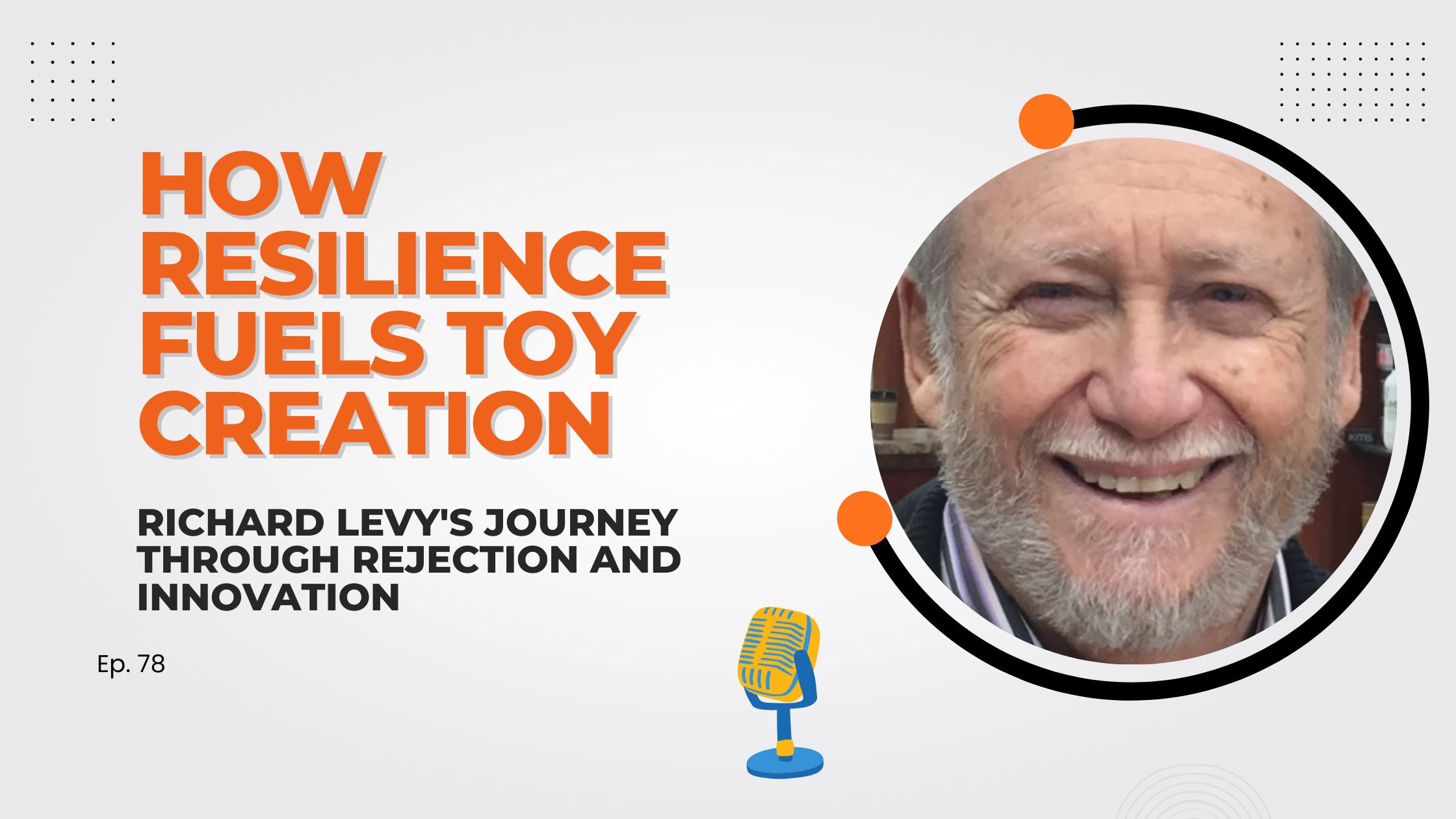
Welcome to another exploration in the world of creativity and innovation on “Toy Business Unboxed.” Today, we’re diving deep into the journey of a prolific toy inventor, Richard Levy, who has crafted over 50 product ideas and faced the exhilarating highs and daunting lows of bringing unique concepts to the toy market. Through this interview, we uncover the persistent challenges and inspiring stories behind his inventive process.
Episode Highlight
- 00:00 Introduction to Toy Business Unboxed
- 01:23 Richard’s Journey from Advertising to Toy Inventing
- 01:37 Early Inventions and Initial Success
- 03:19 Challenges in the Toy Industry
- 04:42 Innovative Ideas and Rejections
- 06:10 Struggles with Toy Companies
- 07:54 Pitching Strategies and Frustrations
- 12:56 Exploring New Avenues and Kickstarter
- 15:48 Market Research and Initial Feedback
- 16:25 Evolution of Toy Ideas
- 16:38 Mechanical Toy Innovations
- 17:38 Hospital Survival Game Concept
- 18:57 Challenges with Toy Companies
- 19:45 Personal Struggles and Persistence
- 20:37 Unique Baby Bottle Invention
- 23:46 Frustrations with the Toy Industry
- 25:07 Concluding Thoughts and Industry Critique
A Leap from Advertising to Toys
Richard Levy began his journey in advertising, where he earned acclaim as a creative director. However, his path took a significant turn when he visited a toy store in West Palm Beach and realized the industry needed more originality. Fueled by this insight, he ventured into toy invention, quickly selling his first product—skydiving frogs. Despite quick success, Richard encountered a recurring challenge that would become a theme in his career: reluctance from toy companies to embrace truly original ideas.
The Stubborn Nature of the Toy Industry
Richard describes the toy industry as resistant to novelty, with a mindset heavily anchored in past successes. One of his notable frustrations is the industry’s firm stance that improvements on existing ideas are not worth pursuing. His novel concepts, like the “Rescue Me Scruffy Dog” and “Space Kids,” met rejection, illustrating how the industry often shies away from fresh innovations.
Richard highlights an archaic mentality stating, “If it was done, it doesn’t matter if it’s a thousand times better.” This attitude keeps potential breakthroughs stagnant, as companies hesitate to break their conventional categories, despite the evident demand for innovative products.
Breaking New Ground
Throughout the interview, one cannot help but admire Richard’s relentless spirit. His ideas, such as a wetsuit sprinkler for kids or a fish with legs toy, push the boundaries of creativity and playfulness. Yet, the challenge remains in finding companies willing to take risks with groundbreaking concepts. Richard believes toy companies lack the marketing sophistication to evaluate new ideas effectively, often missing opportunities that could be captured through simple focus group testing.
Rethinking the Approach to Invention
Richard shares his insights on pitching inventions, emphasizing the critical need for toy companies to adopt a more open-minded approach. He suggests companies should invest in prototyping and research to evaluate genuine consumer interest. This change could ensure that revolutionary ideas aren’t prematurely shelved due to outdated perspectives or category limitations.
Finding Light Amidst Adversity
Despite personal tragedies and ongoing professional hurdles, Richard remains passionate about toy invention. He’s sought alternatives like Kickstarter but remains wary of knock-offs that could emerge. His resolve and buoyant personality represent a beacon of hope for aspiring inventors navigating similarly tumultuous paths.
Conclusion
Richard Levy’s story serves as both an inspiration and a call for the toy industry to evolve. The need for more innovative voices and a willingness to explore new frontiers cannot be understated. As Richard advocates for inventors to be treated with respect and companies to truly listen to creative proposals, it becomes clear that change is not only necessary but possible.
Thank you for embarking on this journey with us. If you’re moved by Richard’s tenacity and wish to explore potential collaborations, we’ll be providing his contact information for a direct connection.
Blessings to Richard Levy for sharing his experiences, and to all inventors, may you find encouragement to pursue your passions with vigor and resilience.
To stay updated with the latest episodes of Toy Business Unboxed and embark on your own journey into the toy business, don’t forget to subscribe and follow the podcast. If you found this episode insightful, please leave a rating and review, and share the podcast with fellow toy enthusiasts. Let’s embrace the world of toys together, staying curious and continuing to innovate.
Transcript
EP078_12-19-24_Richard Levy
Intro: [00:00:00] Welcome to Toy Business Unboxed, your gateway to the secrets of the toy industry. Here, Jason Hsieh, a toy entrepreneur and expert in the field. “Every product we develop is really inspired by some of the real life experience that we have with our son.” “60 percent of all toys last year were sold on Amazon.”
“Be passionate about it. Because it’s a road. It’s a journey.” “Like when you have an idea that you think is gonna somewhat change the world, make things better, I’d say go for it.“
Jason Hsieh: Hello, welcome to another episode, Toy Business Unboxed. I’m your host Jason hsieh, where we uncover stories and insight behind the toys and games industry. Today’s I’m joined by Richard, creative forces with over 50 product ideas and also a very prolific inventor Richard’s journey as the inventor really [00:01:00] highlight the highs and the lows of bringing unique concept to market. Together, we’ll dive into the invention process and explore the challenge of pitching ideas in today’s toy industry and learn how he stayed inspired through despise of all the adversity that he have he have faced over the years. So thank you again for joining me on today’s interview, Richard.
Richard Levy: Thrilled to be here.
Jason Hsieh: I know you have been doing this for quite a while now, and I guess can you go back in time and tell the listener about your journey? Because I know you have some background in advertising, then you become a toy inventor. What inspire you to make that shift?
Richard Levy: I was an award-winning creative director at the majored agencies and one day I was visiting my mother in the hospital in West Palm Beach and she fell asleep in the hospital and I walked outside to kill about an hour. And there was a toys us right outside. So I wandered in, looked around and I said, oh my God, I can do better than this. It was very little [00:02:00] originality, very little. So when I got home, I did some research and I said. I, can do better. So I started inventing and one of my first inventions I sold almost immediately. There were skydiving frogs, just like that I like that when skydives jump out of an airplane holding hands in a circle and they applied.
Yeah. I went to an air show and I pasted six frogs together, and I presented it to play Visions in Seattle. And they, loved it and moved ahead with it immediately. You toss it just like a Frisbee and it flies beautifully. And then I did skydiving pigs.
Jason Hsieh: I like that one too.
Richard Levy: They stopped making them after four years. They put them in aquariums and zoos. But they never put it into the mass market. So now I own all rights and I have the molds. So I’m looking for a toy company to hand it off to. They fly beautifully and they have goggles and backpacks, and I [00:03:00] have the factory. So that inspired me. So then I came up with a slogan. I can see what’s not there. When I would go in and look around the toys. Immediately I’d say, Hey, there’s nothing like so I started inventing things that I you must as an inventor look through the internet to make sure that someone else has not invented it. And one of my biggest problems with the toy industry is if you come up with an idea, let’s say there is an idea, but you do a much better version, a much better one than not interested. They say, oh, that’s been done. They say that, oh, that’s been done. The perfect example is I came up with an idea.
Everyone now has a rescue dog so I came up with this idea rescue me a scruffy dog. A very scruffy dog rescue me. You rescue it you shampoo it and you adopt it. And it comes with adoption papers. I went to Toy Fair with this. Oh, that’s been done. Do you know it was done? Little fluffy little dogs that were a little bit dirty. Not an adult dirty rescue [00:04:00] dog. They were fluffy for little kids, but it doesn’t matter. In the toy industry, there’s a bible, a religious thing. If it was done, it doesn’t matter if it’s a thousand times better, it’s been done. So that’s really terrible because this is everybody has a rescue dog. And this is wonderful because the whole that inspired me. But when I went to Toy Fair, my first toy fair, very little originality, I must tell you. It’s archaic. The marketing people are not the sharpest, the owners of the companies, the smaller ones, they’re not open to fresh new ideas. I had developed some of the most amazing fresh, original ideas. And Booth after booth. It’s was ridiculous. I had this, this is called Space Kids.
Jason Hsieh: Yeah,
Richard Levy: I have capsule made. These are little dolls that come down in these capsules to be adopted. They’re like alien. And it comes with adoption papers and a map of where they came from. They’re called space kids and nothing like it.
Years [00:05:00] ago, cabbage Patch Kids, the greatest hook is adopt them. So with space kids, they would adopt them and when the hatch opens, I have a recording at point of purchase. As this opens, you hear a recording and it’s a little girl. It says, hello, my name is Zena. I come from the planet, Venus, and this Facey music, I had a recording date. So at point of purchase, you open it and she says that, how could you not wanna take her home? Nobody. Oh, girls aren’t interested in space. Morons. A lot of the owners of toy companies, they have blinders. Girl astronauts. This is a new age, there’s no doll like it. It’s been rejected by every toy company. Everyone has rejected it. Absurd, but, so I’m just saying I did plush, almost every plush is the same. Teddy bears I did ncs ncs are, it’s, I don’t know how show showing it.
Jason Hsieh: I can see it,
Richard Levy: but it has four legs. It has four legs. It’s beautiful. It’s a fish [00:06:00] with four legs. It’s ridiculous. I’m silly, and I have a whole line of these. I had beautiful samples made. No one was interested. I went to every plush booth. So I’m just saying, oh, and then they go through the expense of having a prototype made they jerk you around. Oh, is it patented? Do you have a prototype? Inventors can’t afford prototypes, intellectual property. I have an attorney who’s a friend in Dallas. He gets 10% of every invention. He does everything as patent pending.
So the point is, despite this, oh, then occasionally as an inventor, the head of inventions, like something I do a Zoom meeting and he likes it. I go, oh my gosh, I can’t believe it. He has to go back to his committee, the head of marketing, and he has to present it to his head of, and it dies. A committee cannot. Steve Jobs went ahead with the Apple phone. A committee, someone told me, a camel is a horse designed by a committee. You can’t, a committee, you can’t have fi, you need a [00:07:00] tyrant. You need someone like Isaac Zarian who says, I love it. Let’s do it. You can’t ask the head of marketing, the head of sales, the head of this, the head of that. I have a few things under consideration. I’m a very prolific inventor. my kids, I had two boys, they could not catch a ball. It’s very hard for little kids. The first time to catch a ball, the ball is bounced off their chest. So I came up with the flinger ball.
Jason Hsieh: Yeah, you showed me that.
Richard Levy: Eight rubber soft handles. So when it comes to the kid, they grab one of them and to throw it, they throw it like this, rejected by everybody. I have had more rejections than but they say, oh, do you have a prototype? A prototype of this would be expensive. I can’t afford it, but it would be the easiest. Oh, have a video. A dad and a kid having a catch a beautiful video. One of the companies liked it and they said, oh, but we need a video to see it in action.
Jason Hsieh: Yeah. But I understand the struggle and the frustration you are facing too, because I think
Richard Levy: it’s very frustrating. [00:08:00] I’m sorry.
Jason Hsieh: Yeah. ’cause the toy company, they are also worry about the investment and how much what is the return on investment if they do invest in the product. So from my perspective being a toy entrepreneur myself, sometime it might be easier to launch our own company, which I did many years ago. and instead of launching I think you have a lot of wonderful ideas, but sometimes it sounds based on what you have shared with me, is hard for some of the bigger toy company to open to the new ideas a little bit.
Richard Levy: I’ll tell you one, I came out of the advertising business. I was a real, I was on covers of magazines. I won awards. I was pretty famous. And when advertising, when you have a good idea, they do a focus group. They should do a focus group. If they got little girls together, 10 little girls and their moms in the room and presented this to them or any of my ideas and get feedback by the kids, by their moms. They don’t do that. They do it by their gut. They looking at, I don’t know, I’m not saying I don’t [00:09:00] know kids. But focus groups in malls, they would stop people with little kids. And for an hour, take them into a room, give them $20, and they’d videotape a focus group.
There’s no zero research anymore, so there’s nobody making a wise decision. I came up with a bath toy, a four fish that fit into each other called gobble fish. It’s called gobble fish. Four plastic fish that fit into it. I have more failures than you could imagine. Oh, this is very important. Extremely. Toy companies will not break category. if I present this to them, oh no, we don’t do dolls. We don’t do flying toys. They’re like this. if it’s not what they do, they won’t consider it. So I said to them, but if it’s an unusual doll, hire a one person to run a doll division if you love it. And I know a person, a friend of mine, Maggie Bermuda, she was the head of a doll division for a big company and she is freelancing in San Diego. She would love so I, they could just take my friend who’s a doll [00:10:00] expert and have her run the doll division. Even freelance because they’re afraid of dolls. Oh, we don’t know dolls. We don’t know the buyers. So if they’re not into dolls, they don’t know who to call or who to show it to as clients, as customers. But I said, you can get into dolls. Do this one to start, bring in a doll expert that you don’t have to know the company. But no, they won’t do. They say, oh no, we don’t do bath toys. We don’t do flying toys. And then they, oh no, we don’t do plush. I get, that’s the worst thing I, and you can’t convince them to take on a new category. There’s a comfort zone. A doll company won’t take plush or flying toys because their salespeople have a network of people in a specific category.
They won’t go into a new category. So I, for instance, an outdoor toy I came up with, it’s brilliant. It’s called Sprinkler Kids. It’s a kid, it’s a wetsuit with holes in it. Oh, everybody has a hose. The kid puts on the wetsuit. You attach the hose in the back and the kid becomes a sprinkler. [00:11:00] Could you imagine the kid, he would be like Jesus, walking around the lawn. Every kid in the neighborhood would say, oh my God, I want one of those. I pitched this. Yeah, no one was hit, and you know why they’re not interested. They said, great idea, but we don’t do water toys. You understand? This is true a hundred percent. So you have to go to a company that does water toys. But why can’t any company Jazz wears or any of them say, look, we don’t do water toys, but we could sell a million of these. All you have to do is contact the outdoor buyer at Walmart or whatever and present it.
It’s not so hard, but they will not break. You could talk to presidents of toy companies. Everyone will tell you they will not break. This would be so much fun, Jason. Because the kid could, as he walks, he sprays everyone, the car, the people, and everybody has a hose in the backyard. We would have to design a waterproof wetsuit with holes, and once he turned it on, the kid becomes like, Jesus. I’m not kidding. It’s crazy, but I could not.
Jason Hsieh: Yeah so you have [00:12:00] mentioned about how companies are resistant to some of your toy invention. How do you approach pitching to this company differently or do you have any, based on your experience, do you have any tips?
Of course. Thank you for mentioning about finding the right categories of the company.
Richard Levy: I go onto LinkedIn. On LinkedIn, you go to a toy company. Spin master, whatever, and you find the top executives, you send them a nice note telling them what you do. I say, I can see what’s not there. Could you please connect me to your inventor relations person? So I write, so I send, I have to sign an NDA, then I send my inventions. Sometimes they do a Zoom meeting with me. It’s better. I do a zoom meeting with the head of inventions. And if they like something, they take notes and they present it to their people.
Jason Hsieh: Yeah,
Richard Levy: 10 out of 10 times when they present it to their people, it dies. And I’m really good. I was in advertising. I was a very famous creative director. I did memorable commercials. I was on cover of a magazine.
Jason Hsieh: Have you ever considered just to launch your own Kickstarter campaign [00:13:00] instead of relying and at the mercy of the other toy company?
Richard Levy: The pro. Okay. Can’t afford to launch myself. But on Kickstarter, the moment you put it on it could be knocked off. Boom. In a minute. Everything I’ve done let’s say plush, oh, someone could do it animals with four legs. If I do this sprinkler, this would be great. But you realize the moment they put it on a million people see this and they can do it in China. There are companies in China, it’s the only country where they knock things off. I know someone, they knocked this product off and use the name. That’s the nerve that they have. Not everyone, but I think that
Jason Hsieh: i think there’s always gonna be a possibility either if you launch yourself or launch to a bigger toy company. But I think the speed to market is obviously one thing we also need
Richard Levy: do you think that I should pick out one of my toys and do a Kickstarter campaign? But I can’t, I’m not in a position to run a company and deal with manufacturing and sales and marketing. I’m a really good inventor and there really is, I’m a marketing person. That’s the secret. [00:14:00] Inventors sometimes, oh, I’m an invent. Every idea I come up with is based on demographics. I understand demographics. When I looked at sprinklers, I said, what can you do with a sprinkler? And I came up with something that no one’s ever done. I turned the kid into a sprinkler. That’s brilliant. One of my best ideas, even Whammo, I know David Wang, he’s the head of inventions of Whammo. Did you know the hula hoop? And they have water toys. And still he said, it might be dangerous. That was his. It’s perfect for Whamo. And he knows me. He likes me. I met him at Toy Fair.
So even though they do water toys, they have a water slide. That’s their big toy. But it’s not dangerous. It’s an insulated little with holes and you attach the host in the back and it s Brit says it’s a dumb, you could do that and make a million dollars. There’s nobody has it. And at Toy Fair, you take the smallest booth in the world and you put a kid in it in a plastic little cube. So the kid is, could you imagine at Toy Fair, people from all over the world come buyers, there’s nothing like it. And kids love water. [00:15:00] So if people would test my inventions, expose them, there’s a thing you can do at a mall. You could actually stop people. You can hold an item and say, excuse me, could you? And they, and just show it to the little kid. And video. And do they do nothing? They’re unsophisticated. The toy industry is unsophisticated. They have no idea. They fly by the seat of their pants. If they see someone else do something, then they knock it off.
They can’t do something totally original. If you do some research, you’re not taking a risk. There’s a theory If seventh is feasibility study. Seven out of 10 prospects say yes, or maybe you should go ahead. I used to show new products. For advertising agencies, I invented a lot of new products. At the focus group, seven out of 10 have to be enthusiastic. Seven out of 10, that’s a high number, but they feel that is enough. Sometimes they stop people in malls in four parts of the country. 25. 25, they say you have to have a hundred people asked you [00:16:00] stop a hundred kids from their moms. Seven out of 10 of the have to say yes. Or maybe at least you, if you’re gonna spend money, you could even videotape them like, alright, let me just say one thing. I took this a few of my things to a nursery school in the town where I live. I live in has Hastings on Hudson. The kids loved it.
I went to a nursery school and showed it. The kids passed it around. They said, look, fish don’t have legs. But in evolution. In evolution for smart people, fish walked out of the water and became lizards. But no one’s interested in that, right? Then, oh, people say, no, I want a toy that does something. I want a toy that walks. So I presented a mechanical version of this. Where you put it and you just wind it up and the legs walk, you can make it walk. And I still, and they, said, oh but you could make it even a water toy that you put in the water and it walks out of the water. Could you imagine seeing a fish walk out of the water? People would slip out. But I’m too good. Okay. I’m too sophisticated for the [00:17:00] toy industry. That’s what I feel. Because things I do. Like the ball, it’s easy to catch. A toy company should say, oh, we’ll make a prototype. Let’s try it. They can afford to make a prototype. I can say you have exclusive rights. Make a prototype, have some kids have a catch, and that’s it. It’s so simple.
But I struck out, I had people, I did have people like things and I got back to them, but I must say and I did an adult board game. Adults play. Everybody knows that when you go into a hospital check in, they tell you, get out as soon as possible. Don’t stay in the hospital. ’cause you catch things in a hospital and things go wrong in a hospital. So I came up with the hospital survival game. What it is, it’s everything that could go wrong in a hospital goes wrong. What happens? Yeah. You play the game to start, you pick a card and it tells you what disease or medical condition you have the first card. Then you have to go around the board without dying. you pick a card and it says you went into surgery. [00:18:00] They took off the wrong leg, that spot on your chest. It’s not skin cancer. It’s a Krispy Kreme donut and funny things. I had Funny, yeah. All the cards. Let me just show you. I have the board, listen this.
Jason Hsieh: Oh, okay. Yeah.
Richard Levy: I have a surgeon. Going into surgery and he has a seeing eye dog and dark glasses. He’s blind. It’s a surgeon and there are cards that say ailments, survival, and screw up. So the point is this is a fun, lighthearted game. Every hospital has a gift shop there are a hundred, this would be a great thing in a gift shop at a hospital to give someone who’s in the hospital. And I think that doctors, nurses, it’s a fun, I used to write, before I did anything, I was a comedy writer. I wrote full comedy who appeared.
Jason Hsieh: Okay. I see.
Richard Levy: I, wrote and then I went to their performance. I was a good comedy writer. So a lot of these cards are very funny. It’s humorous, lighthearted, hospital survival game. I presented it to three of the [00:19:00] biggest game companies at Toy Fair and they all rejected it. And they didn’t tell me why.
Jason Hsieh: Yeah. That’s frustrating.
Richard Levy: Part of it, I think, is to get to the president or the chairman of the company. If you can get to the right, the top person. The top person, like Steve Jobs. There’s something, there’s a reason. The top guy is the top guy. And I think that, just think of how frustrated this cost me. I got the best illustrator. A friend is a very good illustrator to do the illustration. I wrote the cards, I protected it. I did so much work on it. And then I went to the toy companies. I can tell you who they are. Not one of them jumped at it. It’s
Jason Hsieh: that’s why I have been trying to encourage you just launch yourself. I did.
Richard Levy: Lemme tell you, I’m a senior guy, as I have a lot of energy. I’m a senior guy.
Jason Hsieh: Yeah.
Richard Levy: This past year I lost my son to Fentanyl overdose.
Jason Hsieh: Oh yeah sorry to hear that
Richard Levy: He’s 40 years old. He lived in Berlin, and my life has been a disaster. I spent thousands of dollars in drug rehabs. I can’t afford it, but there are people [00:20:00] and of an invent that gets the most of 5%, the person I’m handing off to takes 95%. And I’m a, I’m dynamic, I’m positive, I’m funny, I’m aggressive. And if I can’t do it, nobody can. There’s also another inventor called Richard Levy. He did the Furby sometimes.
Jason Hsieh: Oh, same name? Same name as you. Okay.
Richard Levy: A lot of the times when I pitch someone they get right back to me thinking it’s him. They, get, I said, no, it’s the other Richard Levy. I once met him at Toy Fair. He’s pretty famous. He has a book. He did the Furby. They’re relaunching it. So it’s a crazy coincidence.
Jason Hsieh: Yeah.
Richard Levy: But I love it. I’m not giving up. I even invented a baby bottle. Let me show you one last thing. Let me show you a baby bottle. No one has ever, I look at things that are ordinary and I made it special. Some they sell millions at point of purchase. A mom goes in to buy a baby bottle. Now babies have to hold onto the bottles. They can’t drop it. Look at this. It’s called a bottle rocket. You know why? ‘ cause kids can [00:21:00] hold the wings and drink it. Just think of this in the store versus the baby bottles as a great name. It’s simple. wouldn’t cost. I got it to a couple of companies that do young kids stuff. Rejected. Rejected. It’s beautiful. It’s fun. And it’s functional because the kid can hold it. Because otherwise I’d say 90% of baby bottles in this world are like this ordinary. That’s it. But isn’t it easier for a baby to hold on? But, this is a marketing idea. Do you know what I mean?
Jason Hsieh: Yeah.
Richard Levy: Just think of this they have a display of baby stuff.
Jason Hsieh: Yeah.
Richard Levy: It’s fun. It’s different. I try so hard to be different. This would be so easy to launch. Very small investment. They could just make a mockup. I don’t have a, real prototype and give it out to moms and let them try it. If this was handed to a baby, a baby, they would know what to do with it. It’s an instinct to hold onto it. So I, this is a perfect example taking the most ordinary thing in the world. It’s a [00:22:00] million years old thousands of years old baby bottles. Nothing has changed in every country yet I took a baby bottle and so simply just modified it a little bit. I made it with a little pink and it would come in pink or blue. I could hand this off to you. Believe me, the baby buyer at Walmart would take this. Everything else is nothing. It’s nothing. They could charge more. A baby bottle might be two 50 or five. I don’t know how much a baby bottle cost. This could get more money because it’s fun. Everything I’m showing you would be exclusively for you if you want it. You have un absolute rights to everything I’ve done. At this point,
Jason Hsieh: of course, we’ll also share that with our listeners. See if there’s anyone that’s listening to our show and watching the show would be interested to reach out
Richard Levy: anything that you would, because at this point I’m not looking forward to the next toy fair because it’s so frustrating to present something you look at first, I do a pass. I go through and see what they have. I go through it the first day to check out what they [00:23:00] have.
Jason Hsieh: Yeah.
Richard Levy: So I know how to position it against what they have. I could say if it’s a doll company. I said, you don’t have anything like this girl little space. Also, I said, they could be this small. You could make them small. They don’t have to be this big. This cost me $2,500 to make. $2,500, beautiful. The best toy designer in the business, Risa Hope did this. And she made me the doll. I was so sure that I would sell this. So I made the investment. So it’s the most frustrating thing in the world because there’s nothing like it, I believe. And has adoption papers, a little map where it came from. It doesn’t matter. And you could even have send for more clothes, more outfits so they could make money. She has a nice spacey outfit, with boots. At this point it’s so frustrating. I know some toy company presidents that won’t break category. Very good, they have toys. Oh we only do puzzles, I said puzzles. They said, we do jigsaw puzzles. So I said, I got an idea for you. Do a jigsaw puzzle of flowers and put a [00:24:00] scent into the pieces. So the flowers smell like the flowers? Oh, that’s been done. The point is, I don’t know, it’s been done, but at least for a kid, if you had a puzzle, let’s say with fried chicken. And you put it together and it smells like fried chicken. I’m just saying it. I bring originality. I met with the president and he’s a great guy.
Jason Hsieh: Yeah.
Richard Levy: And I said, okay, you do puzzles. I’ll come up with puzzles that you’re not doing. And despite that, he doesn’t do it. The worst words is, oh, I think it’s been done.
I have such belief in myself, I have a high self-esteem. Just like with these, when I went into the booth at Play Visions, he took a look at my mockup. It was five frogs taped together, and he said, yeah, immediately. I love it. Send it to me. We’re gonna do it. That’s how easy it is when it works. And he went ahead and made it immediately. It was sold in zoos and aquariums. I own the rights now. And I’m having trouble handing it off to someone for free. I said I have the, molds, it’s sold. And I still can’t, and still now, I don’t know, we don’t do flying toys. Anyway, but [00:25:00] I, love being here. I thank you. I bless you for giving me this opportunity to rent and rave
Jason Hsieh: so well there’s always some positive and negative in all the industry and toy industry is no exception to that. And seeing as an industry, there’s still a lot of things that we still need to change. So from your perspective, as we’re wrapping up today’s interview, if you can just change one thing about the way that the toy industry work for the inventor what would that be?
Richard Levy: I think that the executives of toy companies have to treat inventors better. They treat us like second class citizens like trash. It is very, they don’t have open arms and they’re afraid of new. If they’re going to take something if they like it, say We like it, but we’re not sure, we’ll make a prototype. We’ll test it, we’ll show it to kids, and we’ll get back to you. That’s normal. Yeah. I’m not asking for a lot. The guy I’m presenting it to could go down in his neighborhood to the playground with a mocked up thing and toss it to the kids and say [00:26:00] what they, it’s so easy, but i’m not asking for a lot, but I think that they’re not open-minded to new ideas.
There’s very few things when I walk around Toy Fair where I go, oh my God, I wish I had done that. Just think if you went to Toy Fair and you saw the kid with the sprinkler in a booth spraying everything, you go, oh my God, that’s great. My kids would love that. That would be a simple thing to do with Kickstarter. I could pitch that. I can’t make a prototype. It’s too expensive. That’s the only problem. I could try. And hope that nobody knocks it off. I have a patent attorney who could patent it. And of course once they do Kickstarter, then go to a toy company saying, oh, they’re not the brightest stars in the sky. I wish they were smarter marketing people. I think if they had more women. I found that women in the industry are more receptive than men. Women are more open to new ideas. A breath of fresh air. Too many guys have been in the industry for 20, 30 years. And they’re set in their ways. It needs something [00:27:00] fresh and new.
And you know what the most frustrating thing is? MGA did a line that’s making millions called brats. They’re little dolls. They look like little hookers. Mothers buy them for little girls take a look at brats. They’re wearing cheap outfits. A lot of makeup. They look like little hookers. And yet they sell millions and moms buy them for their little girls. How do you explain that? Oh, Isaac, Larry is so pleased with his book. They’re making a movie now because barbie was just, they’re doing a brats movie, but next time take a closeup look at brats. like that’s not an image for a little girl. I wouldn’t buy it for my little girl. They’re wearing tight fitting, sexy, and they’re called brats. How do you figure that?
Jason Hsieh: Thank you so much for sharing your perspective and we’ll make sure to leave you your contact information on the show.
Richard Levy: Thank you so much for letting me do this. It means so much to me, Jason. Bless you.
Jason Hsieh: for our listeners, thank you for tuning in this episode of Toy [00:28:00] Business Unboxed podcast. We really hope you have enjoyed the conversation and find it insightful and inspiring. If you like what you have heard, be sure to subscribe to our podcast on your favorite platform so you’ll never miss a episode.
We really appreciate your support. We love it. You can leave us a review and share the podcast with your friend and colleague. For more resource tips and the latest update, we the toys and game industry, visit our website at toy-launch.com. Join the conversation and connect with us on social media using the hashtag #ToyBusinessUnboxed.
We’ll love to hear your feedback and suggestion for future episode. Until next time, keep innovating, keep creating, and keep bringing Joyce to toys. This is Jason Hsieh signing off on the Toy Business Unboxed Podcast and we’ll see you in the next episode. Thank you so much everyone.