
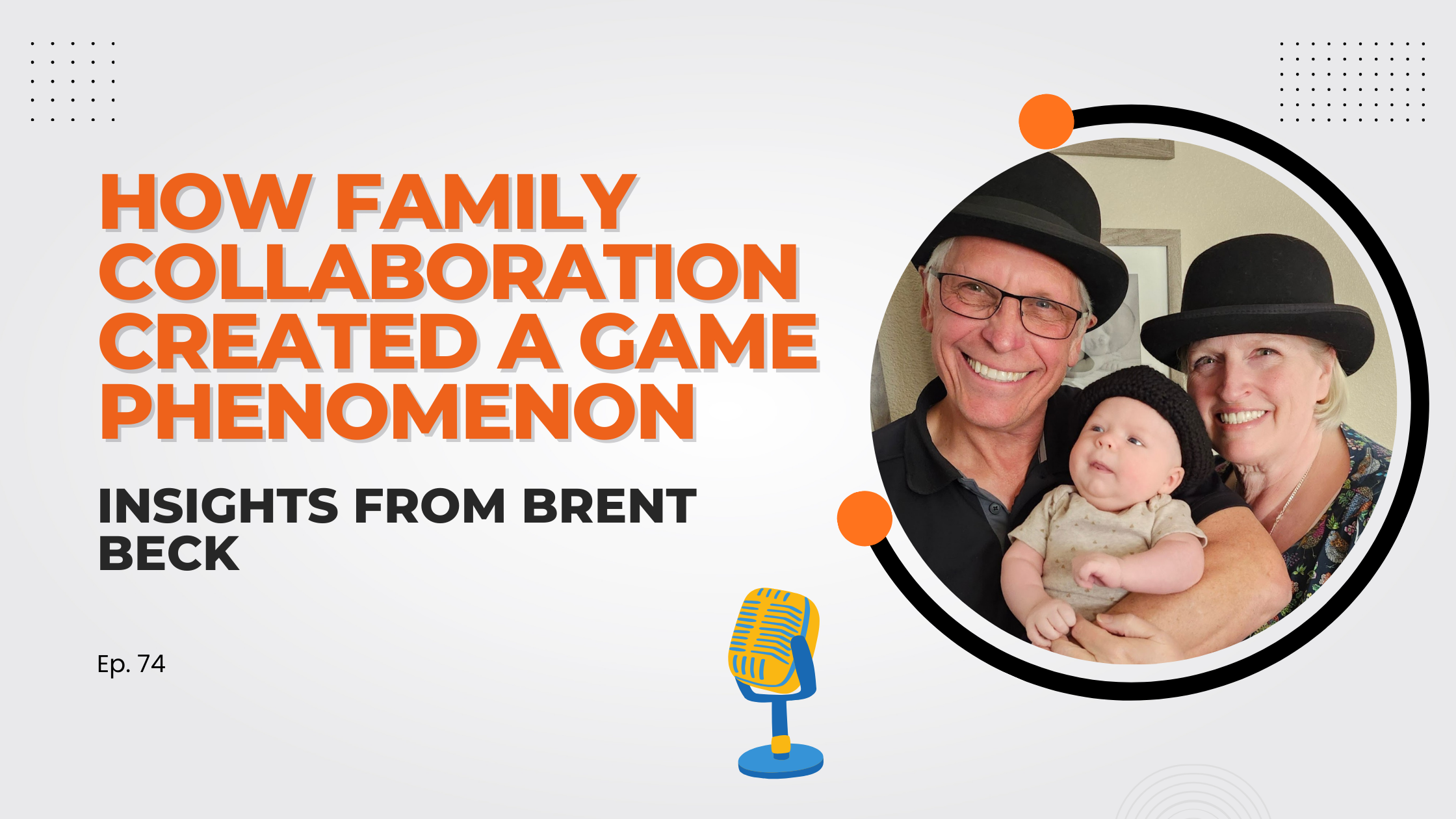
Welcome to another deep dive into the world of entrepreneurship, where passion meets perseverance. In this episode of Toy Business Unboxed, we sits down with Brent Beck of Grandpa Beck’s Games. Brent, alongside his family, transformed a simple love for card games into a thriving business that sells over 500,000 games a year. Through this conversation, we explore the ups and downs of their journey, the role of family in business, and insights from Brent’s unique career path. Below, we delve into the fascinating discussion and unveil the inspiring story behind Grandpa Beck’s Games.
Episode Highlight
- 00:00 Introduction to Toy Business Unboxed
- 00:42 Meet Brent from Grandpa Beck’s Games
- 01:22 The Journey of Starting a Game Company
- 02:59 Balancing a Game Business and a Pilot Career
- 04:14 Family Involvement in the Business
- 08:42 Challenges and Lessons in Game Publishing
- 14:54 Marketing and International Expansion
- 18:42 Future Plans and Advice for Aspiring Entrepreneurs
- 21:06 Conclusion and Where to Find Us
The Early Days: Inspiration and Motivation
Brent Beck’s venture into the gaming industry was born out of necessity and opportunity, sparked during his career as an airline pilot when many airlines faced financial instability. Looking for an additional source of income, Brent envisioned transforming a popular face card game into something more compelling. His goal—to make it better with illustrations, optimized card counts, and improved rules—eventually led to creating Grandpa Beck’s Games in 2008.
Balancing Act: Work, Family, and Business
When asked how he balanced piloting with launching a new business, Brent shared, “The schedules are varied, allowing me to use layover time to contact people and work on the games.” This flexibility, coupled with a family grown up enough to involve their own careers in the business, created a perfect blend of support and hard work that fueled their success.
Brent’s wife and children play pivotal roles in the company. “On the wall there, I’m the skull king,” Brent recalls fondly, referencing family-inspired illustrations on the game Skull King. Each family member contributes uniquely, from game mechanics to social media, highlighting a family’s ability to alter the dynamics of work when they pull together.
Creating Games: A Labor of Love
Discussing game creation, Brent explained that it’s about readiness over volume. “We don’t publish until the game is ready,” quips Brent, expressing their careful dedication to quality over quantity. This philosophy ensures each product meets their standards and resonates with audiences of all ages, from youngsters to seniors.
Challenges and Triumphs
The path to success isn’t without its hurdles. “Problems are part of the business,” Brent openly shares, detailing initial manufacturing woes with a defective game run that resulted in financial losses. Yet, these challenges fostered resilience, teaching invaluable lessons in quality control and business management. It took around six years before the business became profitable, showcasing a story of tenacity and smart business decisions.
Expanding Horizons: Global Growth
From beginnings focused on English-speaking countries, Grandpa Beck’s Games have now reached international shores. By partnering with local distributors, they ensure the games are culturally relevant and properly translated, thus expanding their reach and maintaining the integrity of their products.
Advice for Aspiring Toy Entrepreneurs
Brent’s advice for newcomers to the toy industry is practical yet profound: start small and test your market. “If they have an idea, make a limited number without breaking the bank,” suggests Brent. Coupled with a cautious approach to financial backing and a reliance on self-funding, his advice roots entrepreneurial passion in a realistic framework, emphasizing sustainable growth.
Conclusion
Brent Beck provides an inspiring narrative of how a family’s love for games can evolve into a successful international business. Brent’s story is a testament to the power of perseverance, innovation, and familial support in business.
To stay updated with the latest episodes of Toy Business Unboxed and embark on your own journey into the toy business, don’t forget to subscribe and follow the podcast. If you found this episode insightful, please leave a rating and review, and share the podcast with fellow toy enthusiasts. Let’s embrace the world of toys together, staying curious and continuing to innovate.
Guest Contact Information
If you’re interested in learning more about Grandpa Beck’s Games or connecting with Brent Beck, you can reach out through the following channels:
- Website: grandpabecksgames.com
- Email: Brent’s contact details are available on the product packaging, providing direct access for inquiries and sharing experiences.
- Socials: Follow Grandpa Beck’s Games on social media platforms to stay updated on the latest releases and community events.
Transcript
EP074_11-06-24_Brent Beck
Intro: [00:00:00] Welcome to Toy Business Unboxed, your gateway to the secrets of the toy industry. Here, Jason Hsieh, a toy entrepreneur and expert in the field. “Every product we develop is really inspired by some of the real life experience that we have with our son.” “60 percent of all toys last year were sold on Amazon.”
“Be passionate about it. Because it’s a road. It’s a journey.” “Like when you have an idea that you think is gonna somewhat change the world, make things better, I’d say go for it.“
Jason Hsieh: hi, welcome to another episode of Toy Business Unbox. I’m your host, Jason Hsieh Today we’re thrilled to chat with Brent the heart behind Grandpa Beck’s Games. He and his wife turned their family’s love for car games into a successful game business over the years and bringing families and friends together with every single game they [00:01:00] created. From his year as an airline pilot to running a successful family center business with their children and grandchildren. Brent had a lot of up and down. Of growing the game company that he can share with us today on the episode. And also talk about all the different wonderful board game that he have also created over the years. Thank you so much for joining us on today’s episode.
Brent Beck: My pleasure. It’s great to be with you, Jason.
Jason Hsieh: What inspired you to start the board game company or the card game company to begin with?
Brent Beck: A lot of times necessity is what creates invention. And about 20 years ago, the, when I was flying as an airline pilot, a lot of the airlines were having bankruptcies and losing their pensions and having difficulties. So I was looking for a little something to try and do to possibly add to my retirement or to have a little more stability. So that thought process led me to think of ideas, but I didn’t wanna sell something I didn’t really believe in or do something that I didn’t. Whatever. So we learned of an idea for a game that my daughter’s husband’s uncle taught them. There was a face card game that [00:02:00] we played for a long time. And I thought it’d be so much better if that game was printed where it had illustrations and if that had optimized card counts instead of a standard deck of cards. And the rules were improved upon. And so that we’ve always played lot of card games and enjoyed that kind of luck of the draw and the dynamics of hard game play.
So that’s what the first idea was to improve that one game, which took us years to figure out how to optimize, and then how to find some way to illustrate it and some way to print it and then some way to distribute it. It was all very much a slow learning process with lots of challenges, but we stuck with it. And we started the company in 2008, started selling things in 2012, and so now we’ve sold about oh, I think 2.7 million games and sell about a half a million games a year.
Jason Hsieh: Congratulations on the success.
Brent Beck: Yeah, so it’s been an interesting process and a very interesting life experience, and I gotta meet a lot of interesting people around the world now. We have one of the games in 16 languages and growing. So we are having an interesting experience.
Jason Hsieh: How do you [00:03:00] balance the demand of launching a game company while working as a airline pilot, which is also very busy? You must be like flying around a lot.
Brent Beck: Yeah. The good thing about airline pilot job is you don’t usually work a nine to five job. It’s the schedules are varied and you can adjust schedule. And also when you, fly somewhere, then you have time on the ground before you can fly back. And while I was in a hotel, I could use that time to work on things and to contact people on the phone and on the computer. So instead of playing around just socially or just exercising or something, I was able to use that productive time on the ground. And plus I could, we’d go to like maybe six different conventions a year for different reasons. And I would trade my schedule around to try and work harder for three weeks and then get a week off to do the convention.
Jason Hsieh: Oh, whoa. Okay. Okay. Yeah, that’s definitely a lot of juggling. I remember when I first started my business, I was having meeting while I was commuting to work.
Brent Beck: Yeah. I was always thinking about it, always working on it making notes and could say spent a lot of time on the phone and then [00:04:00] we’d go to all these conventions. But it was able to be flexible. Most of my kids, we have five kids, they were pretty much all grown before we started the business actively. So it wasn’t taking time away from the family as much. ’cause the kids were all out of high school then.
Jason Hsieh: And that actually lead to my question perfectly because I was gonna ask you, I know your company is also really focusing on family values and also a family business.
How does the role of your family member play in the business? And I think the picture behind you can also tell, that Maybe you can also explain the picture behind you with all the cards.
Brent Beck: Yeah. In our most known international games, skull Kings. There’s pirate faces and so when we were making the game, we said, see, we have seven pirates. We need seven faces, and we have five kids, so let’s use our faces. On the wall there, I’m the skull king, my wife is the Tigris, the five pirates are the five kids. Each illustrated as the pirates. And at one point that was like a part of the Tablecloth Road convention
Jason Hsieh: Oh, okay.
Brent Beck: And then I, and so I made it a wall hanging out of it because we changed the [00:05:00] tablecloth to another style. But we, our artist did a really good job of bringing a character into each illustration and our kids, most of them have other careers one’s two of them are stay at home moms. But one of them whose husband is a doctor, she does social media for us in between being the mom of five kids and two sons have different jobs, but they spend some time with us part-time and develop to create some games. And then our youngest son’s wife is like an office manager, does a lot of office duties for us. And my wife, as just spends extra time whenever we have to work on things together and creates a lot of content and a lot of the game mechanics and works with our artists on creating the concepts for the artwork. Just a lot of work all around. The kids are all supportive and involved, and one of the sons basically came up with the mechanics for three of the games and another son, two of the games. So they’re involved in the game creation as well.
Jason Hsieh: and I think a lot of your games are also inspired by different, can we talk about the first game that you created a little bit and also on your website I can also share my screen.
Brent Beck: The game is now called Gnoming A Round, but when we [00:06:00] first started it was called golf and it was a golf themed game taken off from the, golf face card game. And so we that’s the one we improved on. But after a while we decided to make it a little more whimsical and give it a more of a fantasy theme with the little gnomes instead of just a golf.
Jason Hsieh: This one, right? Gnoming A Round
Brent Beck: Yeah, because it was, it wasn’t quite maybe too a golfie enough for golfers, but a little too golfie for moms and kids. Our primary audience is moms and kids and grandmas and, stuff. So we decided to make it a little more whimsical and it did a lot better reviews at that point. And, but we’ve been selling that game since 2012 and it’s always sold through. And so we keep all our games. Keep selling more all the time. They’ve never gone out of stock, I mean out of our line.
Jason Hsieh: So this is one of the very first game that you have?
Brent Beck: Yeah, it’s the improved version of it.
Jason Hsieh: And you have created so many different game over the year as well. Do you have a target on how many new games you are publishing every single year?
Brent Beck: That’s not the prime motivation. The prime motivation is to create the game and have it ready when it’s ready. Like they say with the old saying about [00:07:00] wines, there’s no wine before it’s time. And in this case, we don’t publish the game until we think it’s ready. And we have some games we’ve been working on for nine years and when some games come through together, nine months. It is really a matter of when the game is ready and it’s sometimes frustrating that we work on a game and then we say, oh, we’re not quite ready. So we put it on the sideline a little bit and working on different game. We introduced a couple new games last year. And then we have several others that are in different stages of work. Some of ’em are partly illustrated, still working on Exactly. Nailing down the mechanics a little bit. So it’s a process and we don’t specific goal to put a number of games. It’s more of just making sure they’re all good quality.
Jason Hsieh: I see. Is there a specific kind of age group that you’re trying to hit? I know some board games is more geared toward mature audience, but for your company, do you have a certain group in mind?
Brent Beck: We really try to make all of our games fit a wide demographic. Everything from something that seven, eight, nine year olds can play up through seniors. We really loved seeing when kids and parents and grandparents are all around the table together [00:08:00] or, groups of young adults or just groups of kids or groups of seniors. Our games are all designed for a really wide demographic and also to be instantly replayable. And we have many reports from people with different titles, whichever happens to be their favorite, where they’ll be playing the same game for years every weekend or every evening, or we just get all kinds of fun interactions we get from people. Especially over the Halloween holiday we get a lot of fun interactions with people that dress up as all the pirates in the game and have a game party,
Jason Hsieh: okay. Nice. Yeah.
Brent Beck: Everything from the krakens to mermaids to all the different pirates, specifically like the different pirates. And then they have a game night and maybe they’d make all the recipes as well as a part of the game night. So it’s, people really get into it. It’s fun to see.
Jason Hsieh: And one more thing that I think a lot of the entrepreneur we all face is there’s always gonna be struggle and challenges while we’re growing our businesses. Over your careers of growing the board game companies, what are some of the challenges that you would like to share and like what is your major takeaway from those [00:09:00] challenges?
Brent Beck: Basically problems are part of the business. And like the very first game we had our time finding an artist, and we happened to find an artist who was a something that someone that my wife’s father had known who had made a game and, we started with him and he designed the game. The first order of it. We used a factor that he recommended, and when we got the games back, we ordered 5,000 copies of the game as he designed it, and they were all totally defective.
Jason Hsieh: Oh no. Okay.
Brent Beck: The printing was all splotchy, and so those were a total loss. And then we decided to try printing in the us but that was way too expensive.
Jason Hsieh: Yeah.
Brent Beck: And then when we came up with the second game, cover your assets. We reprinted the box that we printed from the US to make them branded together more as a brand. And so we ended up throwing away all the boxes which cost like $2 each
Jason Hsieh: Oh yeah.
Brent Beck: Back then to rebox them, to make them match the brand. And so they took us like basically three tries to get the first one to go. And that was all money coming out of pocket. And we were making money and then we continued as we kept trying to grow and we decided to be self-publishers instead of trying to sell it off to a publisher.
Jason Hsieh: Yeah.
Brent Beck: [00:10:00] And that was a long-term plan, but it was not, it took a long time to become profitable. So we were losing money for a long time, but luckily I had a good job and I could afford to spend money every month on the business instead of make money so i keep working my job. And so it took a long time of losing money, probably six years or more years after we started the company, before it started paying off the past debt and growing profitable.
Jason Hsieh: Yeah. It’s interesting that you mentioned that because that’s another, a very common like a crossroad decision that as a toy or game designer, we need to make on whether or not to go sell publishing, creating our business, or just license our idea of the game to other bigger company that already have the fund.
When you make that decision, what other thing that’s going through your head like of which way to go and what are the thing you are considering to go either licensing or just do self publishing?
Brent Beck: Yeah. I didn’t really have any good connection to license to initially. So we set the idea to do it on our own because we were naive and we thought we could do it, but we didn’t know how hard it would be.
Jason Hsieh: Yeah. That’s a lot of work. Yes.
Brent Beck: [00:11:00] After the very first we went to Toy Fair in New York in 2012 of February. Introduced the projects there, but we made very few direct sales. We made some connections with different distributors, but one company offered us the next week to buy it and to take over the control of one of our games, at least to cover your assets. That was a game they really believed in. So we could have sold it off to them and just made a little bit of money from him paying us a royalty. But we felt that long term, if we could succeed as self-publishing, that we would have more gain from it.
We didn’t know we would make so many games. We have say our 12th game will be coming out soon, so we didn’t know what we would do over the years. But we didn’t know how hard it would be either. Many of the people we Met early on, they’re still are not in business others have stayed in business, but it’s not an easy thing to do.
Jason Hsieh: Definitely not. That’s a lot of additional step that people didn’t realize. They said, oh, it must be easy. It’s just a box, a whole bunch of paper. But it’s a lot harder than that. It’s a lot of nuances. Just like you mentioned, the manufacturer could mess up and the whole manufacturer batch now need to be [00:12:00] discarded. You need to redo. There’s all kind of other issue, especially dealing with like international businesses, tradings, and a whole bunch of other issues. I think a lot of people, they just don’t know what they don’t know
Brent Beck: we didn’t, we were naive. But my kind of personality is that if I start something I’m really reticent to not follow through with it. And I’m willing to put in the hours and the sacrifice to work towards a goal, whether it’s one career or another career or family or whatever it might be. It was definitely love. Sleepless nights and, difficult long hours and, frustration in losing money and people, people make promises, oh, we can distribute your games and sell a lot, and then it doesn’t work. Or manufacturers, oh we can, do a good job for, and then they come back defective. That wasn’t the only defective run, but we’ve had other ones as well where the the quality wasn’t good. So it’s definitely a lot of process, but that’s how life is when you wanted to accomplish something. If you set a high goal and you keep working towards it, it’s a matter of the chance of success is out there. Not guaranteed, but. If you stick with it, you have more chance than if you quit.
Jason Hsieh: I agree. [00:13:00] I can relate to that myself as well, because I also have been doing this for about eight years. Also went through a lot of different kind of problem along the way going into business. And just like you, when I first started, I also have a corporate career. I was in corporate finance. Thank you so much for sharing your story and your journey on entrepreneurship and growing your businesses, and I know the success does take many years.
Was there a moment when you realized that you finally made it, so to speak? It’s oh, now finally the business is doing where I needed to do.
Brent Beck: I think, maybe six or eight years ago six years ago probably. We made enough that year that I could pay off the rest of the mortgage on our house. And then now we have our kids as shareholders and our artists. And so we’re able to have the money that’s distributed beyond the wages. We’re able to help all the kids, even if they don’t work for us. And we ordered games by 40 foot container and we order eight or so of those 40 foot containers. So like more than half a million games a year. And so it’s just it’s really amazing to us that there’s working, because there’s so much competition in the world the [00:14:00] games and, treat getting the word out there is so difficult. But the advent of Amazon allowed us to be able to get access to people no matter where they lived. First we’re just trying to keep up with them expenses on Amazon. And, then, but someday, like when the, I think the first year we did like a Black Friday sale, we sold thousands and thousands of dollars worth of that one day. Now we, it’s definitely improved since then, but it’s wow we sold more than we did in a year this weekend. It’s just a long process, but it is very satisfying to have it be working. The very first show that we were at, or the first second show there was a mom and a couple kids there that were, along with their parents that were like store owners and the kids were like they, didn’t wanna be there. They were like annoyed. They had an attitude problem and but my wife had ’em sit down to play cover your assets together. And just two or three minutes, all that negative energy in a way they’re laughing together, having a good time. Just seeing that the way that the game could affect their lives in a positive way, just in minutes to improve their day. That was a good little hint and we’ve seen that so many times since then.
Jason Hsieh: And throughout your, I guess the marketing side of the business, is there anything that you do differently [00:15:00] that you would say that really attribute to your success over the long term?
Brent Beck: You have to create the ground game yourself. You can’t expect any distributor or Amazon or anybody to make it happen for you because games are so difficult to understand the value of from the outside of the box.
Jason Hsieh: Yeah,
Brent Beck: it really does rely a lot on personal recommendation and word of mouth growth. And we spent a lot of time out there in the public going to retail shows, but also wholesale shows and giving away a lot of games to store owners so they would play them with their employees. Anything we could do to get someone to play the game so that it would start spread organically ‘ cause that’s really the first show is that it’s wow, it’s so hard to like, to explain the value of this game. ’cause it’s unknown calling. It’s a box with cards. How do they know if it’s gonna be worth playing?
I’d see someone across the aisle selling a toy or a ball, which you could tell what it was and immediately it was easy to tell its value, but in the end even though it’s a hard pickup, it can have a long life, which is our goal.
Jason Hsieh: I see, And you mentioned earlier your game has been translated into 21 different languages. I’ve seen [00:16:00] each countries or different languages have its own nuances.
Do you also run into different interesting story that you have, like for example, selling in different countries and any things that you would like to share ?
Brent Beck: Yeah we, didn’t really put a lot of effort into initially to do international ’cause we’re focused on English speaking languages. But as we’ve started to have those opportunities the model we’ve decided to follow is a localization distribution model where we try and find out the strongest partner we can in that language. And then we have them do the translation and making the adjustments they have to and then let them because they understand their own culture and their own language better than I do. And so instead of me thinking I can impose my language and everybody, or my game on everybody, we let them try and keep the core. Look at the game, but then adjust if there’s a certain name or word or title that needs to be adjusted. We let them use their guidance and wisdom on that.
Jason Hsieh: Okay. Yeah, that makes sense. So you work with the local partner instead of trying to translate into all the languages yourself. ’cause that’s a lot of different local nuances that’s hard to understand.
Brent Beck: Yeah, we, like I say, we had a licensing agreement with a [00:17:00] German company for about nine years for the Skull King game. But as we started to get, companies wanted to go directly, we set up direct relationships, and then we canceled the licensing agreement. And, now it’s really starting to go well, especially in the European languages. They could sell a hundred thousand copies in French this year and 60,000 copies in German or something, so
Jason Hsieh: are you selling in Japan as well now?
Brent Beck: We have a partner in Japan for skull king and, so I think skull king so far. And then in Korea and then also in Chinese. And then we have a new, we’re still working on kind of a southeast Alaska, Southeast Asia, we’ll combined version, which will cover several Southeast Asian versions like Todd.
Jason Hsieh: I see. So you mentioned about the design where you get some of your family kind of role in the design. How long does it usually take on the design process based on your experiences?
Brent Beck: The shortest experiences have been a year. And others have been like, say one game, but one of my nieces have been working on, it’s been like nine years she’s been working with us on it. We keep getting started and then we take a pause to try and work on the mechanics a little more. And I, think we’ll probably get it out in [00:18:00] the next year. But it’s not like we’re in a production system where we say we have to do this in a certain time although certainly when we set a goal we, work towards a certain production run and then it starts having deadlines. But we can have a lot more growth just by wider distribution of the products we have even though we want to add new games and people who enjoy our games a lot of times wanna have the whole collection. And so people are anxiously waiting for the next game. And so we want to satisfy those who are fans of our line but we also know that we are only accessing a small, percentage of the market with the games we have. And growing distribution of our best known games which we just are signing, we’re just in the process of working out details with the biggest game distributor in the world for English language and also in other languages. So we have a lot of, possibilities
Jason Hsieh: What is your vision in 2025? How many more new product are you planning on launching?
Brent Beck: I think we’ll have two new games. We’re gonna add puzzles to our line of some with some of the artwork that we have. Those are we’re negotiating for production and we are gonna have an expansion which we haven’t done before [00:19:00] for the Skull King game. Some with some new cards and some new features in an expansion pack. We’ll have three new puzzles the expansion pack, and probably two new games.
Jason Hsieh: Oh wow. Okay. Okay. That’s a lot of activities and a more thing to anticipate. So as well winding down in today’s interview and thank you again for sharing your story, your journey and the up and down and the struggle that you have faced.
If you had to share just one piece of advice with someone that’s getting started in the toy industry, what would that be?
Brent Beck: For most people I suggest this kind of plan. If they, have an idea for a game or a toy make a limited number that’s not gonna make you go broke. And then do some local events at different, maybe Christmas shows or some local in venues where you could sell the game and see if that creates a demand of people looking for more of it. And then if that happens, you can go into bigger production, but that way you don’t put yourself on the hook really for something that could cause too much of a failure if perhaps you see a need to adjust the game or if you’re not getting the kind of feedback that you think you should [00:20:00] get.
And I would suggest not quitting your day job right away do it part-time and don’t keep yourself where you don’t have to. Like one thing that put our first artist and guide, he was trying to go full-time and that ended up causing him to lose his business because it wasn’t a year round income. It was seasonal.
Jason Hsieh: Yeah. And it might be too much too sudden when it’s not like fully proven yet.
Brent Beck: He had to get the he had to get like financial backers to keep the business going. And then there’s a disagreement because he only controlled a third of it, they could shut him out of the business. And so it had a internal conflict because he couldn’t self-fund it because he tried to grow too fast.
Jason Hsieh: Yeah. That’s definitely, and also it’s a lot harder to borrow money from the bank.
Brent Beck: That’s a lot of pressure. We just grew at a pace we could self-fund. Even though it made me less well off in my normal life because I was spending money to be in business instead of making it. So we sacrificed some kind of delayed gratification of not making money. Not having money now, but we’re working towards something later. And so we did that [00:21:00] and it keeps the pressure off of it. Unless you have a big lot of big bank loans and things that would be risky. You can go easily bankrupt yourself.
Jason Hsieh: For sure. But thank you again for being on the show today. Where can people find you online?
Brent Beck: We’re really well publicized on Amazon, Grandpa Beck’s Games on Amazon, or searching the titles our website, grandpabecksgames.com is shows all the games. We’re in hundreds of stores, hopefully in the few next few years, thousands of stores. And my phone number is in the bottom of every box, and i have people can contact me with questions or send pictures of them playing the games. And we just love to hear that people are spending that time together, building relationships and making memories with family and friends.
Jason Hsieh: And for our listeners, thank you for tuning in to today’s episode of Toy Business Unbox podcast. We hope you have enjoyed the conversation and find it insightful and inspiring. If you like what you have heard, be sure to subscribe to our podcast on your favorite platform so you never miss a episode.
We really appreciate your support and would love it if you can leave us a review and share the podcast with your friends and [00:22:00] coworkers. For more resources tips and the latest update in the toys and game industry. Visit our website at http://www.toy-launch.com. Join the conversation and connect with us on social media using the hashtag #ToyBusinessUnboxed.
And we would love to hear your feedback and suggestion for future episode. Until next time, keep innovating, keep creating, keep bringing joy to toys. This is Jason Hsieh signing off on the Toy Business Unbox podcast. See you in the next episode and thank you everyone for joining.