
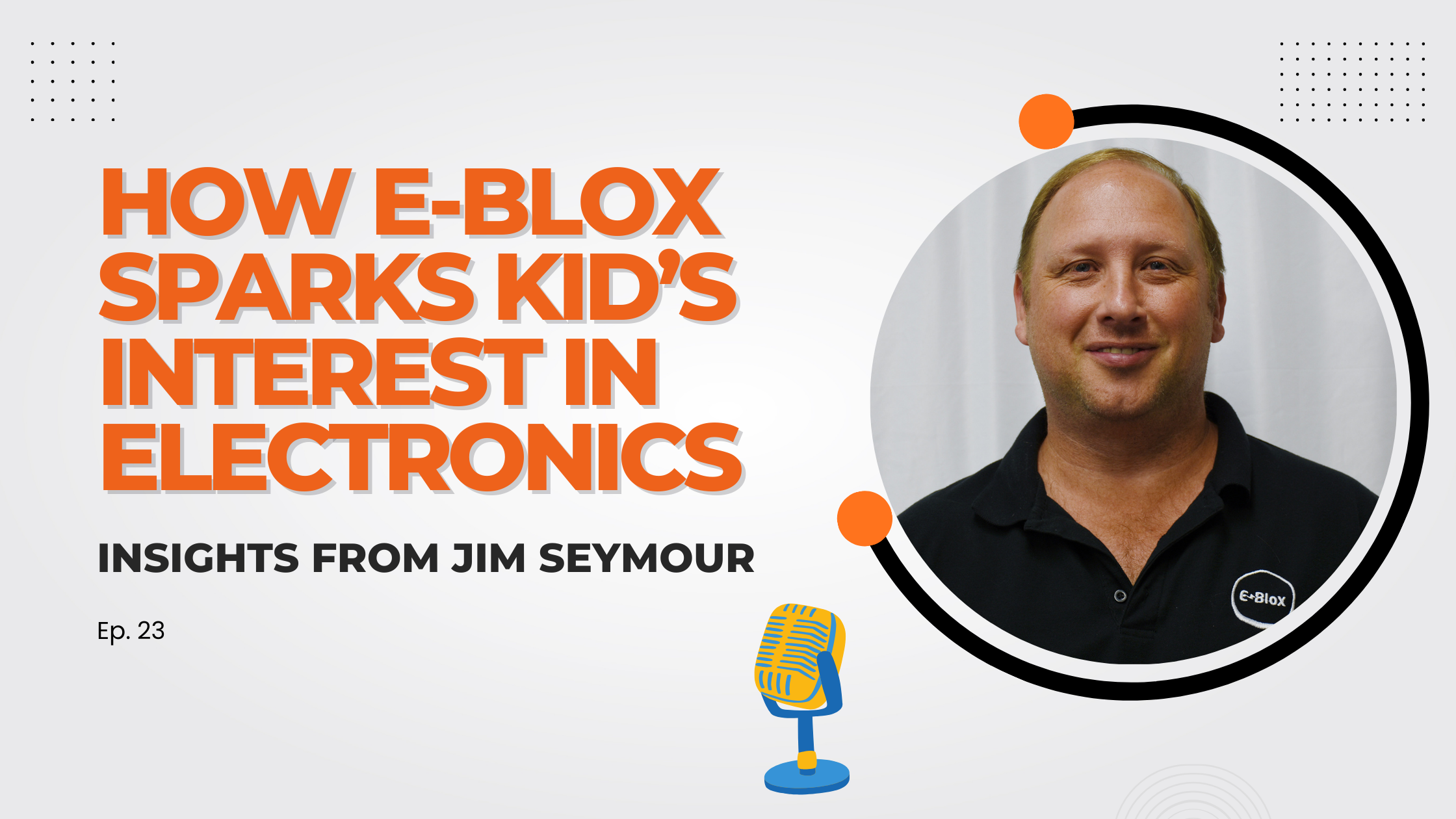
Welcome back to another exciting episode of Toy Business Unboxed, where we delve into the secrets behind successful toy brands and the toy industry. In today’s episode, we had the pleasure of speaking with Jim Seymour, VP and CTO of E-Blox. Our conversation explored the vital role of STEM education, innovative product designs, and the future of educational toys. Here’s a breakdown of our discussion.
Episode Highlight
- 00:00 Introduction to Toy Business Unboxed
- 00:43 Meet Jim from E-Blox
- 02:16 E-Blox Mission and Unique Features
- 08:11 Challenges and Adaptations During COVID
- 10:21 Responsibilities and Strategies for Success
- 15:57 Future Innovations and AI Integration
- 18:11 Impact Stories and Special Needs Focus
- 21:13 Advice for Aspiring Toy Entrepreneurs
- 23:47 Conclusion and Where to Find Us
Introduction to Jim Seymour
Jim began his journey into the toy industry quite unexpectedly. With a strong background in electrical engineering from Purdue University, where he earned his bachelor’s, master’s, and PhD, Jim’s career initially focused on the wireless industry. However, witnessing the fun and potential impact his family was having in the educational toy sector, he decided to apply his expertise to E-Blox, leading to the company’s vision and launch about seven to eight years ago.
E-Blox’s Unique Mission
The mission at E-Blox is crystal clear: to design and develop fun, educational toy products that teach STEM and STEAM principles through a learn-by-building approach. Jim emphasized the importance of getting kids excited about STEM careers, using innovative products that blend the nostalgic charm of Lego bricks with modern electronics. By enhancing traditional building toys with electronic elements, E-Blox transforms playtime into an educational experience.
Target Audience and Age Group
E-Blox caters to a wide age range, from as young as three years old to high school students. Different products are tailored to various age groups, ensuring that the educational value and enjoyment remain relevant. This versatility allows their toys to be used in STEM labs, robotics clubs, and traditional classroom settings.
Overcoming COVID Challenges
The biggest obstacle E-Blox faced was, unsurprisingly, the COVID-19 pandemic. The shutdowns and social distancing measures posed significant challenges, especially for a company selling educational toys often used in group settings. E-Blox adapted by creating student sets for individual use and developing animated online curricula to facilitate remote learning, ensuring that education could continue even in isolation.
Product Design and Engagement
Jim shed light on the research and engineering process at E-Blox. With safety and quality at the forefront, they continuously innovate to keep their products engaging and educational. Their unique appeal lies in their brick-based design, which seamlessly integrates with Lego and is familiar to most children, thus making the learning process intuitive and fun.
Future Innovations
Looking to the future, Jim anticipates incorporating augmented reality (AR) and artificial intelligence (AI) into their products. These technologies could revolutionize how children interact with toys, providing immersive and interactive educational experiences. Imagine a circuit you build that teaches you about electrical engineering as you assemble it, or AR accessories that transform playtime into a magical experience.
Customer Experience and Impact
E-Blox prides itself on exceptional customer service. Jim shared a personal story about how their products help children with special needs, particularly those with autism and ADHD. The sensory and instant gratification aspects of their toys help these children focus and learn in an engaging way.
Advice for Aspiring Toy Entrepreneurs
Jim’s advice to those entering the toy industry is invaluable: take your time. From securing patents and ensuring safety to crafting a well-thought-out marketing strategy, rushing can lead to avoidable mistakes. Making a lasting first impression is crucial, and thorough preparation can set the stage for long-term success.
Finding E-Blox
E-Blox products are available on their website, http://www.myeblox.com, and in numerous retail stores, including Barnes & Noble and Meijer. You can also find them on Amazon.
Conclusion
The conversation with Jim Seymour emphasized the critical role educational toys play in shaping future innovators. E-Blox stands out in the industry with its commitment to quality, educational value, and customer service. As we look ahead, the integration of emerging technologies like AR and AI promises to make learning through play even more exciting.
To stay updated with the latest episodes of Toy Business Unboxed and embark on your own journey into the toy business, don’t forget to subscribe and follow the podcast. If you found this episode insightful, please leave a rating and review, and share the podcast with fellow toy enthusiasts. Let’s embrace the world of toys together, staying curious and continuing to innovate.
Transcript
EP023_05-16-24_Jim Seymour
Intro: [00:00:00] Welcome to Toy Business Unboxed, your gateway to the secrets of the toy industry. Here, Jason Hsieh, a toy entrepreneur and expert in the field. “Every product we develop is really inspired by some of the real life experience that we have with our son.” “60 percent of all toys last year were sold on Amazon.”
“Be passionate about it. Because it’s a road. It’s a journey.” “Like when you have an idea that you think is gonna somewhat change the world, make things better, I’d say go for it.“
Jason Hsieh: Hello, welcome back to another episode of Toy Business Unboxed, where we unwrap the secret behind successful toys brand and the toy industry.
I’m happy to announce that we have Jim, the VP of E-Blox, joining us today. We’ll be talking about the world of educational toy, especially the importance [00:01:00] of STEM education and the innovative toys product that E-Blox offer. Thank you for joining us on the interview today, Jim.
Jim Seymour: Thank you. I’m glad to be here.
Jason Hsieh: Can you first share your background? How do you got into the toys industry? So the audience can learn more about you.
Jim Seymour: Yeah. So I’m Jim, I’m the VP and CTO for E-Blox and I’ll have to admit, I never thought I’d be working in the toy industry. I did always think I’d be an engineer though. I loved math. I loved all the sciences. And growing up, I knew I wanted to be an engineer so I went into electrical engineering at Purdue University. Actually got my bachelor’s, master’s and PhD at Purdue in electrical engineering. And I had a long career first in the wireless industry, designing, developing, 2g, believe it or not, there were 2g wireless all the way up through the 5g that we have today. But while I was doing this my brother and my father were in a family business that was developing [00:02:00] educational toys and they were having a little bit too much fun without me.
About 10 years ago, I decided to use my electrical engineering background to help them in the educational toy business and then we actually launched our vision of E-Blox around seven to eight years ago.
Jason Hsieh: Can you share the E-Blox mission and how is it different than all the other educational toys in the market?
Jim Seymour: Our mission at E-Blox is to design and, and develop fun, educational toy products that teach STEM and STEAM in a learn by building approach. We’re trying to get kids of all ages, but particularly, K through 12 excited about STEM and the possibility of pursuing STEM careers and enabling them, giving them the right background to pursue STEM careers.
So that’s really our mission here and we do that by taking one of the greatest toys ever, Lego, I think everybody knows Lego and making it electronic, making it more [00:03:00] educational and enhancing the fun. So those are the three E’s that become E-Blox, the electronic educational and enhanced fun with E-Blox. I can give you some examples of the kind of things we do. Like here, these are sort of Duplo size. Brick parts, okay, where we embed electronics into them. And so as you’re building, you’re actually building a circuit. In this case, you build a circuit. That’s a wake up alarm where you hide this little photo LED. And then when the sun comes in, it wakes you up.
Jason Hsieh: Oh, okay.
Jim Seymour: Wake up alarm. So you’re always building something fun, but you’re learning about the electronics as you build.
Jason Hsieh: What is the age group that you are usually aiming for the product?
Jim Seymour: We have products that span anywhere from even three years old. With Our products, you never outgrow this, but we have some that are kind of focused for three and up, some that are for five and up and some that are for eight and up. But a lot of our [00:04:00] products are great for even in the high school ages, where you have STEM labs or Lego labs integrating things that enable you to add lights, sounds, and motion to whatever you’re building in your robotics lab.
Jason Hsieh: Does your product also have a coding component to it as well?
Jim Seymour: Not yet. Right now we’re more focused on building the circuits. Learning about how the different components in circuitry work, how you build open closed loop series, parallel circuits. We do get into the LEDs, the motors, resistors, capacitors, transistors. So it’s more about the electronic components and how electronics works and as well, how those things that you build, how those circuits apply to the real world.
Jason Hsieh: What inspired you to create this whole product line?
Jim Seymour: As you can tell, I’m really passionate about STEM and we live in a very technical world. It’s getting more technical every day. The ramifications of that is the job markets in the STEM areas are growing much faster than in the non STEM areas. You can just look on the [00:05:00] Bureau of Labor Statistics, which shows over the last few years STEM jobs have been growing four times faster than non STEM jobs. And that’s actually projected to continue over the next eight to 10 years. Even though the statistics do show that kids these days are twice as likely to pursue STEM careers as their parents. That’s still not enough when jobs are growing four times as fast. There’s actually some worry that two, three years from now, there may be millions of unfulfilled STEM jobs in the world. Particularly in the U S.
What motivated us was really to get kids excited at a young age about STEM, introduce them to STEM, show them that it’s fun, and that look, I’m doing building toys, and hopefully that’ll encourage them to pursue STEM careers.
Jason Hsieh: When you’re designing different product in the current toy line? What is your approach to integrate more and more of the STEM education into the product design itself?
Jim Seymour: So one of the nice things about being a [00:06:00] brick based in a construction set, is that inherently you’re learning. Because with our products, most of them, you have to build the circuit right to get it to work and when it doesn’t work, that’s actually when you’re learning. You put the led in backwards and you’re like, why isn’t this working? And then you figure out, oh, it was in background. Now you’ve learned that leds only let current flow in 1 direction. So the product itself is inherently educational and everything we build is going to have that kind of educational value. But in addition to that, to make it even more educational, particularly for schools and stuff we develop animated online curriculum. It’s like, it’s animated, there’s a character in there who is telling you the educational aspects. And then after we give you a little bit of education, we have you actually build something. So like, maybe we’re giving you a lesson on series versus parallel circuits. We show you, when you put two LEDs, one after the other, that’s series versus when they’re both connected directly to the battery, that’s [00:07:00] parallel. Then we actually have you build something with our products cause that’s when you’re actually hands on building a series circuit and building a parallel circuit, that’s where the learning really comes in.
And then even beyond that, once we introduce you to that, have you build that and show you how to build that. Then we have you do a steam project where maybe we’ll ask you to do three LEDs in series. How would you, you got to now really think through, or maybe how would you do two LEDs in parallel? And then in series with a third one, and you have to think through it and do it. So that’s where the steam aspect comes in and that’s really where the true learning comes in. If you really grasp the idea of series versus parallel circuits. We’re really trying to help the teachers and the students, teach and learn with our products.
Jason Hsieh: That’s also encouraging a lot of creative thinkings and also thinking outside of the box after you master the foundation, how can you apply those foundations?
Jim Seymour: We give you the left side of the brain first, but then we’re exercising the right side of your [00:08:00] brain.
Jason Hsieh: On the business aspect, can you share some of the challenge you have faced over the years as you’re trying to build and also grow E-Blox as a toy company? And how do you overcome them?
Jim Seymour: I feel like it’s always the elephant in the room, the answer to this question, because the biggest challenge we’ve had is the big C O V I D – COVID. Right. I mean, that was, I think in most people’s lives, the biggest challenge for many industries, certainly for us. One of the big things that led to you in the educational industry, because our product, A construction set. We sold a lot to schools, these class sets where kids share the product, they’re all grabbing, building stuff and sharing the parts and everything. And you can imagine what a nightmare that is for COVID, right?
Jason Hsieh: Yeah. I couldn’t really do anything.
Jim Seymour: Trying to get kids away from each other. That was a huge challenge for us. That led to us really saying, okay, we need to design our products. So that they can be individually based too. We came up with, instead of class sets, we also now offer student sets, which is [00:09:00] just one product, but still comes with that extra curriculum and then it also drove us to do this animated online curriculum that could be virtual because a lot during COVID kids were at home.
Jason Hsieh: Virtual. Yes.
Jim Seymour: Now you could actually offer them an individual product. They could have it at home and the teachers could still be streaming this curriculum and working with them. Those were some of the things we did to kind of overcome the challenges of COVID in the educational space. In the retail space the challenge we had was that our stores were closing down and they couldn’t, so they had to go. Strictly online and curbside pickup and things like that. We had to adjust to help them by doing things like drop ship capabilities, offering our products online without having to buy it up front. And then when you get orders, we can either drop ship it to your customers or drop ship it to you. And our local ones, we even would drive it there. We had to adjust to really help our customers get through that. Fortunately, they’ve been able to get back just in store and we mainly do [00:10:00] dropship for just distributors now. During those challenging times, we had to do what, what we had to do to help our customers.
Jason Hsieh: Even for my own toy brand during COVID, it was really bad for us because we are also mainly targeting school with like the sensory toys that we designed. I was actually on the edge of bankruptcy two years ago. It was really bad.
Jim Seymour: That was a challenge for everybody. I’m sure.
Jason Hsieh: As the VP and CTO of E-Blox, what are some of your primary responsibilities? Are you also in charge of designing the product itself as well?
Jim Seymour: We are a small business, so I have a lot of responsibilities. But yeah, one of the main thing is working with through research and engineering team to design and develop new ideas, new products, prototype them, look at how we can cost reduce them, but keep them high quality, make sure they’re safe, they have to pass CP, SIA, safety tests, all of that and then, work with our manufacturing team to then make that into a commercial product. That is definitely one of my main roles.
We are inventors here at E-Blox, so [00:11:00] we’re constantly trying to come out with new products every year that are even more fun and engaging and teaching different areas of STEM. So that is definitely one of my roles. But also because I do that design and development, I really do understand our products the best. I do support a lot of trade shows. I have to support the technical sales aspects of products. And so trade shows, public shows, I’m interacting with the customers a lot. The end customers at public shows, but also at trade shows with our retailers, with the schools, whether it’s through toy fair, in New York City or Astra with the retailers and educational like NSTA I go there. i’m really trying to build those relationships as well as grow our brand. That’s an important responsibility that I have.
Jason Hsieh: What is the strategy that’s working well for your toy brand when you’re trying to get into the school market?
Jim Seymour: One of the things is that there are these requirements, these called the next generation science standards requirements. When we develop our curriculum, we [00:12:00] do actually develop tables that show how the different lesson plans meet those NGSS requirements. And a lot of times the teachers really need that in order to get, let’s say, grants and stuff to need to be able to show what they’re purchasing with that grant. Is meeting the NGSS requirements. And there’s other requirements too. Like there’s ones called T E K S in Texas requirements.
And so we’re working on developing tables for that too. I think that’s a key component because lots of teachers will say, I love this product, but I have to get a grant in order to get it in order to get a grant. I gotta be able to show that it meets the NGSS or text.
Jason Hsieh: I’m not as familiar with those requirements. For the audience or the listener that’s also not familiar with those, can you kind of have a short explanation on that? What is that?
Jim Seymour: If you just search for next generation science standards, it’s a published, you can access it and you don’t have to purchase or anything. And they actually list a set of requirements, Different grade levels, it [00:13:00] goes from K up through like sixth grade and it covers all areas. We only cover part of that. There’s a lot of Aspects where they want kids to learn about forces and motors and gears and stuff and so our stuff’s perfect for that. But there’s a lot about environmental science and biology and all of that. It covers wide area of everything in the sciences. All about the science. But our stuff covers in the areas of physics and electronics and stuff like that, we cover a lot of those requirements that they’re looking for in that standard.
Jason Hsieh: What is the typical school? Is it like elementary school or is it more geared toward middle school that you serve here?
Jim Seymour: I would say our sweet spot is the K through six. That’s really where kids are getting introduced to electronics and our stuff is perfect. But as I said, even up into the middle school and high schools, if you have robotics labs or Lego labs, a lot of them do have just, Lego labs and stuff, all of our stuff integrates with that so seamlessly, so that [00:14:00] you can use the products and use the knowledge you used in K through six to now build 3D circuits with your parts and not have the need for wires anymore, because I’ll show you another one of our products.
What we do is, these are the classic size brick pieces. It’s called like system brick, but they’re shiny because we plate them in tin and the tin plating makes the part conductive. So the parts are actually acting like wires to carry power from the battery below it, up through the LEDs and back to the battery. So now when you turn it on, it’ll up.
Jason Hsieh: Oh, nice.
Jim Seymour: So you’re actually building 3D circuits with your parts, no wires. And now just having these parts, even in a high school robotics lab would be really cool to just add lights to the big robot you’re building.
Jason Hsieh: For your product, I know it’s very unique in this design. What really set it apart from some of your competitor in the market?
Jim Seymour: I’ve mentioned it a few times, but being brick based, that’s one thing, and you know, not only because it [00:15:00] integrates with lego, but also because everybody’s so familiar, all the kids are so familiar with building with bricks. They jump in and start building so fast. So it’s the familiarity aspect that really helps differentiate us. And then also once you’ve done built stuff with our products. It is a nice addition to be able to integrate it with whatever other Lego sets you may have. Another thing I’d say though, because we’re still a small company, our customer service is something we take very seriously and try to differentiate ourselves.
So if you have a question about a product you’ve bought of ours, or maybe you’ve lost a part or something got damaged. I mean, when you call us, we answer the phone and we talk to you. When you email us, we respond within 24 hours. I’ve even responded to emails on the weekend on Saturday. I responded within three hours on a Saturday when they had a question. Think we really want to make sure that when you buy one of our products from E-Blox, you’re getting a great customer experience and you’re getting the product to work and have a really great experience with it.
Jason Hsieh: What do you see the future of [00:16:00] your toy product line goal in 2024 and beyond?
Jim Seymour: Definitely, like the virtual reality, augmented reality. They’ve certainly changed the video game world. I’m thinking down the road now, but I could definitely see the augmented reality being something we could add to our product to make it even cooler as an accessory. Like for instance, one of our products is a build your own bubble making machine. So you build it and then it starts blowing bubbles like crazy. I could imagine an accessory where you put on a augmented reality headset. And instead of bubbles floating in the air, you see your favorite characters coming at you. Easily see something like that, or maybe it’s your brother. So you can pop your brother. So I could see that. And then the other area, obviously is in terms of artificial intelligence, AI, right? That’s definitely changing the world. Certainly from the manufacturing perspectives in doing things like being able to recognize when you’re equipment is maybe starting to fail and get it fixed before it [00:17:00] actually becomes a problem, that kind of stuff in the manufacturing world, AI is huge. But we’re also starting to see it in the toys, right? I mean, I I’ve seen some like robots out there now that will have more intelligent conversations with the kids through an AI, that’s already happening. If I think about our product again, thinking like way out there, something I could use AI for to make our stuff even cooler, wouldn’t it be cool if like, as you’re building a circuit and maybe you built that led in backwards, Maybe part of the circuit was a speaker and it would actually say, why isn’t this working? And it would actually explain what you did. Like, Hey, your led it might, looks like it might be, right? It’s like the circuit you’re building actually is recognizing what you’re doing and helping you along the way. I think that would be amazingly cool.
Jason Hsieh: Oh yeah, that would be really cool. And also almost have a software that you can interact while you’re building and also teaching you at the same time. Yeah.
Jim Seymour: If I look at some of those things in terms of AR and AI, I think that’s the future. It may be down the road a bit, but hey, we [00:18:00] all were there saying, are we ever going to actually have a cell phone? Does anybody ever want to talk on the phone? Does anybody want data? I went through that whole phase and everything seems to happen over time because you just dream.
Jason Hsieh: And is there any specific like story that you’d like to share where E-Blox really make a significant impact on a child’s learning journey?
Jim Seymour: One story I have is my wife is a teacher and actually she teaches special education. Some of them are autistic, some have ADHD, some have anxiety challenges. As you can imagine with a class of those kids, sometimes It can start getting out of control, their attention span doesn’t last and it can get wild. When that starts to happen, she pulls out her E-Blox right away. There’s a lot of focus. She gets their attention. They can start playing for them. They can calm down, start playing. And she says it’s really a way to get them back centered [00:19:00] and get through the day.
Jason Hsieh: System, but it’s educational. Yeah.
Jim Seymour: Right. And and our stuff is really good for special needs. Certainly hand eye coordination because a lot of it is sensory when you build it right, it lights up and you get a set of gratification, instant gratification with some of it. So it really works great for special needs too.
Jason Hsieh: Thank you for sharing that. That’s kind of my area of focus because my entire toy line is designed for kids with special needs with sensory toys, weighted toy that we designed. So I’m definitely really passionate about that particular topic. And for the toy, how do you ensure that your product always remain kind of on the cutting edge of the latest design. How do you make sure that is also remain not just cutting edge, but also engaging for the kids of all ages?
Jim Seymour: So when I mentioned, our mission at E-blox, I said, we design develop fun, educational toys and products and the [00:20:00] fun always comes first. That’s how we make sure kids are engaged because if it’s fun, then they’re going to be engaged and that’s how they’re going to learn the best. People like a lot of times say, you don’t want to have toys in schools. Well, actually, no, I, I think that’s wrong. I think toys are great for schools because toys are fun and tend to be fun. And when they’re having fun, that’s when they really get engaged and when they really learn. And so that’s one of the things, when you look at our stuff, it’s like bubble machines, Dj sets, burp and fart machines. That’s definitely the key. I’m a kid at heart, I’m always going to be engaged in whatever the latest fun thing is and cutting edge things I’m, I’m following that all the time and looking at how we can integrate it into our products here at E-Blox.
Jason Hsieh: Yeah. That’s the fun part about the toy industry. We’re all playing and working at the same time. I like to use my kids as a product tester when we’re putting up new products, see how fast they will break it.
Jim Seymour: [00:21:00] And I’ve had tons of fun with our own stuff. I’ve built White Sox park that all lights up. I’ve built a good Christmas tree. I built the Endeavor space shuttle. I can’t get enough.
Jason Hsieh: Oh, that’s really cool. So we’re kind of winding down in today’s interview, the final question I’d like to ask all the guests is if you had to share just one piece of advice with someone that’s getting started in the toy industry, what would that be?
Jim Seymour: I would say the main thing I would suggest is don’t rush. If you have a good idea, a great idea, something you think you can really turn into something big, take the time to trademarks, get patents, whatever you need to protect yourself. Make sure that you’ve gotten safety approval. It’s going to be a safe toy to go out there. Make sure you try to cost reduce it as much as you can, but as high quality, if you’re going to go and get your strategy. I mean, are you intended for just primarily schools? Are you going to go for retail? Are you going to go [00:22:00] online? You know, brick and mortar, get your strategy in place.
If you’re going in retail for brick and mortar packaging. Make sure you get packed. Get all of that worked out because I know it’s a cliche but you never get a second chance to make a first impression. And when you get out there, if you get it right, then it could really explode and be something good. If you haven’t taken the time to do all those things, then if you get reputation, that’s not selling through, it’s not doing well, that’s going to be hard to overcome. So my advice is don’t rush, take your time, get it right to launch the first time.
Jason Hsieh: Yeah, and there’s definitely a certain sequence of the item that you want to kind of make sure you go through the checklist and that is all that’s up until the launch. But after the launch, you need to have a marketing plan. This is where I specialize in marketing the products. So people actually know your toys exist, which is a whole different ballgame. Like how do we market it? Social media and also I like how you mentioned retail is very different [00:23:00] than online because for my toys brand traditionally for the past seven years, we’re a hundred percent online.
We do zero retail and like I shared with you before the interview is. Packaging is our worst enemy because we never spend time on packaging. It doesn’t really matter to us as long as we can put the toys in the box and ship it out. We are fine.
Jim Seymour: For our retail, we continually update our packaging to make it better. We’re on our third generation already. So it’s a really important thing.
Jason Hsieh: Yeah, because that’s the only thing they see in the retail store is the packaging.
Jim Seymour: That’s right.
Jason Hsieh: Online you’ll see all the images, you’ll see the videos, you’ll see a whole bunch of other stuff. The last thing you’ll care is packaging, usually, in an online experience. So very different scenes. And of course you want to cover all that. So thank you again for being on our podcast. Where can the audience find you?
Jim Seymour: We are E-Blox. You can find us at, on our website at http://www.myeblox, M [00:24:00] Y E B L O X.com and you can find us in retail stores. We’re in many of your local toy stores in your neighborhood. We’re in Barnes and Noble. We’re in Meijer, several of the key accounts. And then of course on Amazon too.
Jason Hsieh: Wonderful. Well, it was amazing to have you on the show and sharing all your experiences and the knowledge. I also learned a few things today during the interview. So I’m always learning.
Jim Seymour: I appreciate you inviting me and it’s been a lot of fun talking to you. Thanks.
Outro: You’ve been listening to Toy Business Unboxed, hosted by Jason Hsieh. Thank you for joining us and exploring the fascinating world of toys and the ingenuity behind them.
To stay updated with the latest episodes and continue your journey into the toy business, remember to subscribe and follow us. If you found today’s episode insightful, please leave a rating and review and share this podcast with others who share your passion for toys. Until next time, stay curious and keep innovating.