
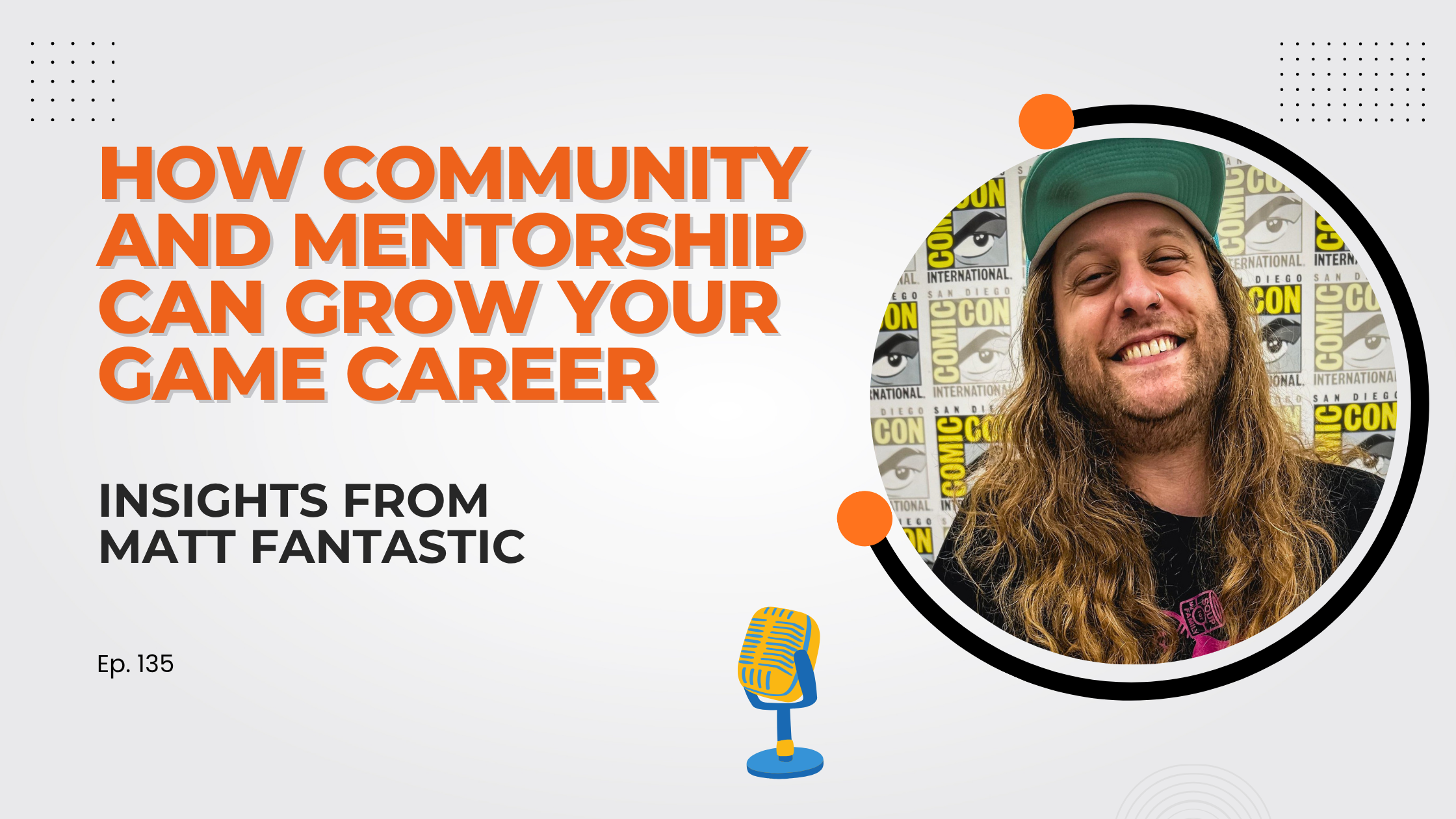
Welcome to this episode of Toy Business Unboxed, where we delve into the creative world of game design with Matt Fantastic, founder of Forever Stoked Creative. Matt’s unique journey from the music industry to game design highlights the blend of creativity and strategic thinking necessary for success. With experience working with both indie creators and major companies like Netflix, Matt shares valuable insights into the dynamics of the game industry. This episode explores the importance of community, mentorship, and balancing creativity with business acumen.

#135: The Mentorship Effect: How the Game Industry Pays It Forward – Toy Business Unboxed
Episode Highlight
- 00:00 Guest introduction and background
- 02:28 Studio’s versatile project approach
- 04:29 Collaborating with big publishers
- 06:36 Community and mentorship roles
- 09:19 Product development challenges
- 13:19 Importance of play testing
- 16:32 Advice for industry newcomers
- 23:56 Conclusion and key takeaways
From Music to Game Design
Matt Fantastic’s career began in the music industry, where he played in bands and ran a record label. His transition to game design was driven by a passion for creativity and community engagement. This diverse background enriched his approach to game development, allowing him to merge artistic expression with strategic business acumen. His story exemplifies how varied experiences can lead to innovative success in the game industry. By embracing his past, Matt has been able to create games that resonate with a wide audience, blending creativity with practicality. His journey serves as an inspiration for those looking to pivot their careers and explore new creative avenues.
Building a Versatile Studio
Forever Stoked Creative is a full-service agency that excels in both game design and gamified marketing. The studio’s versatility allows it to handle projects ranging from tabletop games to experiential museum installations. By working with a wide array of clients, including major retailers like Barnes and Noble, the studio maintains a diverse portfolio that mitigates risk and fosters creativity. This adaptability enables them to thrive in a competitive market, balancing financial viability with creative fulfillment. The studio’s success is a testament to the power of versatility and the ability to adapt to different client needs and market demands.
Collaborating with Big and Small Publishers
Matt’s studio collaborates with both large companies like Asmodee and smaller indie publishers. This flexibility enables them to work on exciting projects regardless of budget constraints. By focusing on projects that ignite their passion, the team balances financial viability with creative fulfillment, ensuring a dynamic and rewarding work environment. This approach allows them to explore a wide range of creative possibilities, from blockbuster games to niche indie projects. The ability to collaborate with diverse partners enriches their creative process and opens doors to new opportunities and challenges.
The Role of Community and Mentorship
Community support and mentorship are pivotal in the game industry. Matt’s involvement in programs like the Unpubbed Tabletop Mentorship Program highlights the importance of collaboration and knowledge sharing. These initiatives foster growth and innovation, creating a supportive ecosystem that benefits both newcomers and seasoned professionals. By actively participating in mentorship, Matt contributes to a thriving community that encourages creativity and collaboration. This commitment to community building strengthens the industry as a whole, providing valuable resources and support for aspiring game designers.
Navigating the Complexities of Product Development
Creating a successful game involves more than just a great idea. Matt emphasizes the importance of considering production costs, distribution channels, and marketability. By viewing games as products, designers can ensure that their creations are both innovative and commercially viable, maximizing their chances of success. This holistic approach to product development requires careful planning and strategic thinking, balancing creativity with practicality. By understanding the complexities of the market, designers can create games that resonate with audiences and achieve commercial success.
The Power of Play Testing
Play testing is a crucial part of game development, allowing designers to refine mechanics and ensure a balanced experience. Matt’s studio conducts extensive testing to identify potential issues and enhance gameplay. This iterative process is essential for creating engaging and successful games that resonate with players. By investing time in play testing, designers can create games that are both fun and functional, meeting the needs of diverse audiences. This commitment to quality and innovation sets successful games apart in a competitive market.
Advice for Newcomers in the Toy and Game Industry
For aspiring game designers, Matt advises becoming an information sponge. Engaging with industry resources, attending events, and joining communities can provide valuable insights and connections. By embracing continuous learning and collaboration, newcomers can navigate the industry’s complexities and find success. Matt emphasizes the importance of networking and seeking mentorship, as these relationships can open doors to new opportunities and support. By staying curious and open to new ideas, aspiring designers can build a strong foundation for a successful career in the game industry.
Conclusion
Success in the game industry requires a blend of creativity, strategic planning, and community involvement. Matt Fantastic’s journey illustrates the importance of adaptability and collaboration in achieving industry breakthroughs. By focusing on both creative excellence and product viability, designers can turn their ideas into successful ventures. This episode highlights the power of creativity and strategic thinking in navigating the complexities of the game industry. By embracing these principles, aspiring designers can create games that resonate with audiences and achieve lasting success.
Connect with Matt Fantastic
If you’re interested in learning more about Forever Stoked Creative or connecting with Matt Fantastic you can reach out through the following channels:
- Website: Visit Forever Stoked Creative’s official website for the product, latest news and more.
- Instagram: Follow Matt Fantastic on Instagram for visual updates and creative inspiration
- BGG: Find Matt Fantastic on BoardGameGeek for reviews, ratings, and community discussions.
- Linkedin: Connect with Matt Fantastic on Linkedin for industry insights and professional updates.
Transcript
Jason Hsieh (00:00)
Welcome back to another episode of Toy Business Unboxed. In today’s episode, we’re joined by Matt, a designer, a publisher, a professor, and the founder of Forever Stoked Creative. Matt’s work have bridged design, activism, community, and also entrepreneurship, with client range from indie creators to all the way to Netflix. And they have built incredible mentorship program and also sit on the board like GAMA and also Unplugged. So thank you so much for joining us on the podcast today, Matt.
Matt Fantastic (00:27)
I’m really happy to be here. Thank you for having me.
Jason Hsieh (00:29)
Yeah. So first of all, if you don’t mind sharing with our listener a little bit about your background before you started the company that you have, that would be great.
Matt Fantastic (00:38)
Yeah, so I mean, believe it or not, I used to play in bands and from that I started doing a record label and put out, you know, a bunch of records, a lot of like, you know, vinyl seven inches. And this was literally 25 plus years ago. So I did that for a while. Then, you know, and I went to I’d gone to art school for a bit. And then, you know, went on tour full time and was booking shows, playing shows, putting out records.
Then I had a career in the climbing gym industry where I was sort of, it worked really well because I could teach climbing in between tours and stuff like that. And then that grew into me running climbing gyms for a while. went back to grad school to be a teacher and then realized that I hate teaching.
or rather that I hate the, I hate everything that goes around teaching. I really love teaching, but it was not, know, teaching high school was not for me. The sort of day in day out. And while a lot of this was going on, I was, you know, interested in games and playing games and being a fan of games. And so I started going to, you know, game conventions. And then I started volunteering to, you know, demo games at booths and teach D and D to people for Wizards of the Coast.
and stuff like that. And there reached a point where I sort of realized that I kind of had a career in games and I wanted to focus on that. I could, and so I did. So I’ve been working in games at this point over 15 years. I would say that I’ve been ⁓ full time in games close
to probably over a decade at this point. So I’ve been full time running a studio for a while. And you know, it just continues to grow from there.
Jason Hsieh (02:28)
Yeah, and talking about your studio, can you also explain what do you do exactly with the client you’re working with with your studio?
Matt Fantastic (02:36)
Yeah, so with Forever Stoked, we’re sort of a full service creative agency focused on making games. We also do sort of like gamified marketing activations, which sounds ridiculous, but is sort of the best description of it. And we do sort of like live action things. We work with museums and Yale and stuff like that to design things that are sort of experiential, I guess, is
cool term to say these days, but basically games you play in museums. you know, our bread and butter is still actual tabletop games that, get published and put out and you find on store shelves. That’s anything from sort of specialty retail, game stores, gift shops, that kind of thing, all the way up to Target, Barnes and Noble. You know, we currently have a Barnes and Noble exclusive edition.
of our game Trash Talk, know, so you can walk into Barnes and Noble and sitting on an end cap right there. But then we also do stuff. just, you know, the gamut runs. I just got a copy of this level one RPG anthology where I wrote a ridiculous hide and seek LARP based on the 60s Batman TV show. So we really, we really run the gamut in terms of doing stuff.
between the partners, know, our skill set is both game systems design as well as graphic design, art direction. I do a lot of freelance art direction for other companies. Right now I’ve been working, the one that I’m most excited about, I would say, is that I’ve been working with Asmodee on their fellowship of the ring and then now two towers. And we’re actually working on return the king now for their trick taking game that has been doing really well. And so that’s just.
great because we get to, you know, I love Lord of the Rings and working with really, really talented, amazing people. We’re doing the art direction graphic design on that stuff. you know, we’re kind of all over the place when it comes to making games.
Jason Hsieh (04:23)
We also like help with the game rules or the game mechanism itself as well.
Matt Fantastic (04:29)
Yeah,
exactly, exactly. So that is probably what we do the most of is that sort of systems design stuff, you know, writing the rules, coming up with the game, that kind of thing. And then we also do, you know, the visual side as well. But, you know, that’s probably about a third of it, while two thirds is more that systems design stuff.
Jason Hsieh (04:46)
I see, see. And obviously Asmodeus is a huge company, but do you also work with some smaller indie publishers as well?
Matt Fantastic (04:52)
Yeah, we work with people that kind of run the gamut, you know, like this, the little RPG thing obviously is not getting put out by, you know, by the biggest, biggest folks. But yeah, so we happily work with smaller companies, all the way up to the big ones, you know, for me, a lot of it is, you know, projects that we find exciting and interesting. And so especially on the more indie side,
Obviously we need to make money to keep the lights on and make payroll and pay the bills and all that. But also, if you’re doing something that is really cool that we wanna be a part of, we’re definitely fine working with indie budgets too. So for us, it’s really kind of a mix of, we need to make enough money, but we also wanna be doing work that we’re excited and interested in.
Jason Hsieh (05:38)
Hmm, I see, see, I see. Yeah, because that sounds like a very different wide spectrum of different work that you’re working with various clients as well. How big is your team with the studio now?
Matt Fantastic (05:49)
Yeah, so there’s five partners in the studio. And then there are a number is sort of a, you know, weird to count because we have some part time people, we have some contractors that we work with a lot, we have sort of a sister studio that we do a ton of work with that does a lot of video content and marketing stuff. And so we work with them a lot. So for example, on you know, that that Lord of the Rings project, you know, we have them
helping us do some of the video content and promotional stuff for that projects we’re doing. you know, five partners and anywhere from five to 10 ish additional, you know, people that we work with, plus a couple other studios that we do a lot of sort of complimentary work with.
Jason Hsieh (06:29)
I see. So besides design and the creation, do you also help them with launching Kickstarter campaigns or crowdfunding campaigns as well?
Matt Fantastic (06:37)
Well, so we will, we definitely will create assets for that sort of stuff. And we can basically advise on it, but we have a couple of friends. One of my actual real life best friends was the former head of games at Kickstarter. So kind of ran that whole division. So typically when Kickstarter strategy stuff comes up, we can get you going on the baby steps, but we usually
pass you along to my friend John Ritter and his team at very creative name. They’re definitely, he’s among the best. He obviously was there for a number of years running it. So it’s hard to do better when it comes to Kickstarter strategy.
Jason Hsieh (07:16)
I see. Thank you so much for sharing that. And I know you have a few different projects you have worked on, like right next to you. Can you also share some of the projects? Yes.
Matt Fantastic (07:24)
So
some stuff so so the one that this is the most recent release, how many what this just came out sort of actually, you know, it’s just available on the website and now it’s making its way into retail. So I haven’t it literally like, you know, I got my designer copies like a week ago. So so how many what this is with the app or usiopoly as they used to be known. And this is just a game of measuring stuff and other stuff. So this is a lighter party game type situation.
And what you’re doing here is the working title was how many giraffes? Because the original idea was how many giraffes tall is the Eiffel Tower? You’re kind of writing down guesses and people are scoring points and yeah, it’s just a lot of measuring things in other things. We also have a dumpster fire party that came out not too long ago and especially for folks that are into toys.
This is a game we did with our friend, Truck, at 100 % Soft. And so you may have seen his toys kicking around. I should have grabbed an example one. Well, here’s the scale. This is a different one than the basic one. But, you know, he does these little dumpster toys. so we made a game with him that made sort of a giant dumpster. And it’s got, you know, magnetic pieces and stuff like that. This is sort of storytelling game about your life.
We this silly game just come out with Cyanide and happiness. You may recognize from their web comics and video games and TV show and all that stuff. And this is a sort of push your luck bluffing kind of game. We have this game Trash Talk that came out pretty recently. And this is one where you are trying to communicate via physical objects. So you have a bunch of stuff and these are actual little things that exist.
the
Jason Hsieh (09:09)
Okay, interesting.
Matt Fantastic (09:19)
That’s just a few things. There’s this one that I didn’t pull out but I like showing off because it’s so big. It’s this game, Aldarra. this is one box then this over here is the expansion actually. And that one is sort of a massive airship, you know, combat game where you have these huge maps and all these crazy minis and you know, you’re running around fighting each other. So, you know, our work, I think really runs, runs the gamut of styles of things.
which is really a function of me just being a huge nerd about games my entire life. I like a lot of stuff and so I want to make a lot of stuff.
Jason Hsieh (09:47)
I see, I see, I see. And can you also tell us a little bit more about the mentorship program that you’re a part of and like what do you offer and do you help the people?
Matt Fantastic (09:57)
So I am I’m actually involved with a couple formal mentorship programs, one of which the main one that I’m the committee chair of and have been involved with for a long time is the unpubbed tabletop mentorship program. And we actually have a cohort going right now. We have about 300 participants. That one is a relatively low touch mentorship program. So it’s just a few meetings over the course of a few months.
and then sort of some support stuff, some larger events, things like that. And that is for basically anyone looking to work in tabletop games. So we have people that are retailers, have people that are systems designers, graphic designers, media folks, sort of any facet of the industry. We are happy to have people, though obviously we’re limited by the people that volunteer to mentor for it. So, you know, if you want to do something particularly esoteric,
We may or may not have a mentor to match you with, but overall, you know, that’s, pretty much all over the place with the industry. Then I am pretty involved with the horizons fellowship, which is hosted and put together by gamma, which is the game manufacturing trade association. So sort of the, the trade association for the tabletop game industry.
And that is a much more intensive program that goes on for, think, eight or nine months. It has a lot more meetings. There’s a financial component. You get brought to a couple of conventions. You have much more demanding program, both for mentor and participant. And that one is a lot more limited. There’s only, I think, retailer and six designer publisher types per session.
But that is one that’s a much more… …brushed program.
Jason Hsieh (11:45)
hands
And I think community does play a very important role in the industry as well. And thank you so much for helping and volunteering in those mentorship program.
Matt Fantastic (11:58)
My entire career is really built on other people being kind enough to help me out and give me advice and mentor me and teach me about things. And so it just feels like the natural order of things. Like I said, with the Unpubb tabletop mentorship program, we have over 300 participants, which includes approximately 120, 130 mentors. And so the industry as a whole is very
excited to help people out. You know, we’re always excited to see new people getting into it, coming up with new things, new ideas. And, you know, especially the nature of games is such that a stronger industry with more cool stuff coming out is better for all of us, right? Nobody buys one game, you know, and so I’m very happy to sell someone else’s game first, if that’s the right game to get those people into games, and then they’re going to maybe buy something that I worked on directly, you know, it’s, it’s a very,
rising tide industry, which is very cool.
Jason Hsieh (12:54)
I see, for sure, for sure. I just got back from origin a few days ago. So definitely it’s a very interesting industry by attending different trade shows and meeting people and talking. Yeah, That’s right. So, and I know you have worked on so many different projects over the years. What would you say are some of the common thread for the product that actually become very successful versus some product might not hit some of the financial target they are shooting for?
Matt Fantastic (13:04)
Exactly, exactly.
Yeah, well, so part of it is expectations, right? So obviously, some of the lighter, weirder stuff is going to have lower expectations. So, you know, part of it is that we have we do stuff that kind of runs the gamut. But ultimately, I think a lot of it is still luck. So there’s a lot of great products out there. There’s some stuff that I’ve worked on that’s done really well, and some stuff I’ve worked on that is definitely underperformed. And I wouldn’t necessarily say that it’s
directly tied to the quality of the product itself. You know, I think that there is, you know, a baseline stuff has to be good or has to be great at this point. but to ultimately just kind of like break out is still, the right place, right time. Someone shoots a video that accidentally goes viral. And now all of a sudden, this thing blew up, you know, obviously something like, the, Lord of the ring stuff has this built in audience in it but the expectations are a lot higher.
But even then, you know, think we’re doing really good with it, but it’s just as easy that it could have slipped through the cracks, right? There’s there’s so much, so much great stuff coming out every year. Plus, you’re dealing with, the back catalog of so many amazing games of the last, decades that it really is not enough to make great stuff. It still hinges on having the right marketing or.
you know, right place, right time when this comes out or that comes out or a particular influencer picking it up and then that, you know, exploding out that way. So, you know, I think it is for me. I mean, maybe some other folks have a different approach, but for us, a lot of it is just keep making stuff, you know, keep doing work, keep making stuff. We’re just always kind of grinding away on new projects. And so, you know, we’re creating better odds.
that we’re going to have one of the one of the projects that sort of like catches and really can take off. Right. two examples that I really love one is this game called Boop and my friend Kurt owns the publishers, Smirk and Dagger, and I’ve known him almost 20 years. He is probably is effectively the first professional industry that I ever met. He’s pretty local to us. And he’s been working, putting out great stuff, doing, OK. And then you have this game Boop.
and it hit a TikTok that went viral and had a million views in a day. And then now he’s this explosive success. And the joke is he’s a 20 year overnight sensation. have something like, think Wingspan is a perfect example where great game, great theme, beautiful art. Elizabeth is a really smart designer. But some writer at New York Times,
thought it was a cool theme to, you know oh, this is a game about birds. How interesting. Let me write an article about it. And, you know, obviously the New York Times has a lot of reach. And so the New York Times picking it up and doing an article on it has led to it just being explosively successful. Right. And it’s, it’s not to say that the game doesn’t deserve that, but there are other games that I would say are just as deserving of that, that have not had that same level of success, you know? So, so it’s still.
that lucky moment that that right person, you know, so the goal is to give yourself as many chances to have that lucky breakout as possible.
Jason Hsieh (16:23)
Mm-hmm. I see, see. And what are some of things that you wish the toys and the games creator and entrepreneurs understood before you start working with them?
Matt Fantastic (16:32)
I mean, I think the biggest thing is that it’s a process. There’s a lot of steps. There’s a lot of people involved in making something, especially making something successful, especially when it comes to making physical goods, right? Toys and games are physical things. So we have to worry about, you know, the price of freight. We have to worry about tariffs. We have to worry about where it’s being made. We have to worry about storage. We have to worry about, you know, so many different things that are…
deeply uninteresting to me as a creative. And so we do our best to kind of like partner with publishers and manufacturers and stuff to do that. But we still have to care about it. We still have to think about it. And so somewhere that I think we really do well and people respond to and is advice that I’d give to other folks is to really think about what you’re making as a product, as well as the game and the experience. There’s a lot of great advice out there about
what it is to design a game, what is sort of experiential design and trying to create moments for people. And that’s all great and amazing. But you also have to think about, is this going to be something that we can sell at a price that feels right? How does this box fit on a shelf? This thing or this guy versus this guy are going to have very different sort of thought processes and things around.
the game as a product, right? So, you know, this is going to end up on a shelf at Target, right? This is not.
Jason Hsieh (17:58)
This is not a mass market product, yeah.
Matt Fantastic (18:00)
Yeah. And so, you know, not that one is better than the other, obviously different people have different goals, of course, but it definitely is really important to think about your game or project or toy or whatever, as a product that has to be sold, right? I’ve seen some amazing prototypes that are just like, well, yeah, this is really cool. But I mean, it’s going to cost $200. And, you know, that’s, that’s maybe not, going to fly on the shelf at Target or Barnes and Noble, for example. So
you know, really thinking about it beyond just the pure creative side. But I think the best product design is also still very creative driven. Right. So it’s it’s you’re still think you’re you’re you’re you’re thinking about it as a product, but you’re also, you know, still filtering that through. How do we be creative? How do we do stuff? Right. You know, again, this one, you can kind of see it a little bit, but it’s you know, it’s cool foil. Right. You know, so stuff like what are we doing to to make it stand out? What are the things that we chose? You know,
So how your game is going to be sold, who the audience is, how you’re going to manufacture it, distribute it, sell it, all that stuff is just really important. And it’s easy to, not think about that when you’re focused on the creative side. But I think they really work hand in hand and the biggest successes are also great products on top of being great games.
Jason Hsieh (19:21)
And as far as your process, do you also help your client with play testing as well to figure out how do you make the game better that way?
Matt Fantastic (19:30)
Yeah,
yeah. So we do we do a lot of play testing, obviously, is something we’re developing in house, you know, we’re running a lot of our own testing as part of that process. But then we also do get hired sometimes by larger publishers and manufacturers to run play testing and development, you know, and product development and systems development on games that they’re doing. So we also do that on a freelance basis. yeah, play testing is a
central core part of what we do.
Jason Hsieh (20:01)
Hmm, I see. see. I see. And how long does your process usually take? guess it depends on the product, but like a few
Matt Fantastic (20:08)
Yeah,
it really, it really depends on the product. Some stuff, you know, obviously, if it’s lighter, it can come together quicker. Although that said, you know, sometimes it is easier to make something bigger in the sense that if you have a game with, five rules, they better all be really good with a 30 page rule book and, you know, 100 cards or 200 cards and all this kind of different stuff. You know, if you mess up.
one or two of them and they’re not quite as perfectly balanced or whatever, you can get away with a little bit, you know, I don’t want to say like you can get away with like totally screwing it up, but you can definitely stand the edges a little bit easier the more that’s going on. And so sometimes a game will just sort of really tumble into place and you know, how many what is a great example of process, right? So the core idea of what you’re doing, measuring stuff and other stuff, and there’s going to be some scoring and people are going to come up with answers.
That all came together really quickly. But then writing the content, deciding what stuff is going to be in there that we’re measuring, we did the research to write all the cards and come up with like, well, yeah, how tall is the Eiffel Tower, right? How much is the average weight of an adult African elephant or whatever? So in that case, know, sort of part of the process was really quick.
and kind of came together. And then another part of the process was this, you know, pretty massive research project on top of, you know, sort of designing the game. So, you know, I would say that the lighter the game, generally quicker. You know, we’ve turned games around in, you know, a few months with playtesting, you know, from start to finish doing this stuff. And then we have other stuff that we’ve worked on for, you know, a couple of years or more, even before.
It releases, but that’s usually something massive with a ton of moving pieces and a lot of balance testing that we really need to do. So, you know, initial ideas are, are, you know, can take a while, but the real sort of grind that takes a lot of time is typically making sure that it works and making sure that you’re testing for edge cases. And what if somebody is there like a abusable strategy somebody could do, right? Like, well, what if I only move here over and over and over again? Right.
You know, stuff like that where you need to make sure that the system as a whole works, not just in the best circumstances, but also in sort of like the worst circumstances. Right. Because ultimately, you know, you you kind of get one shot with people. you did all the work. You got somebody to play the game and then, well, you know, 10 percent of the time, it doesn’t really work.
Well, like that means the 10 % of the time people are never going to play it again. They’re not going to tell their friends and it’s not going to grow. So the goal is to try to reduce that, dud situation or weird edge cases to as little as possible. And really that can take a long time when you have so many different variables. Plus everything is still based around people interacting with what you have. So, people are going to do the.
craziest stuff. And so you kind of need to, think empathy is a huge part of design across the board, but especially when you’re doing play testing, you have to really try to get inside the head of people that are going to play this completely different than you and completely different than the way you intend it. Because with a physical game, here’s the instructions or maybe here’s a video that explains how to play. But
I’m not there to answer questions. I’m not there to sort of make sure you’re doing things correctly or that you are, doing it the right way. You know, you can follow the rules, but there’s like, well, this is the fun way. Well, if that’s not intuitive or if that’s not, apparent in the rules, you can have people do stuff that’s not fun.
Jason Hsieh (23:45)
Thank you so much for sharing that. And as well wrapping up today’s interview here, if you have to share just one piece of advice with someone that’s just getting started within the toys and game industry, what would that be?
Matt Fantastic (23:56)
It would be to listen to stuff like this. I would say that if you’re listening to this, you’re already on the path and that’s great because there is so much info out there. There’s so many smart people like yourself that are excited about helping people make better stuff and do new things. And there’s just a great wealth of information out there to draw on. So some of it is, you know, things like this where it’s interviews and podcasts and stuff like that. There’s also groups you can join.
So, you know, Gamma I’ve already mentioned, there’s the Tabletop Game Designers Association, which is more exclusively focused on, you know, game designers. There’s, you know, just so, so much great information available. So I would say the biggest thing to do is just kind of turn into an information sponge and, and just learn a lot and listen to people. And once you’ve reached a certain point, you know, you can jump into stuff like,
unpub where we, that’s a primarily focused around prototype, play testing and mutual support in that space. It can be a very complicated obtuse industry that seems somewhat impenetrable, but if you dig a little deeper and put a little more effort into finding the things, there’s a huge wealth of information and by and large people in the industry are very excited to help. So
go to events, meet people, talk to people, ask for advice and listen because there is just such a great community of people that are making the stuff and people genuinely want to see other people succeed and genuinely help bring new people into the industry. So take advantage of that.
Jason Hsieh (25:29)
Hmm, yeah, that’s a very good piece of advice. And where can people find you online?
Matt Fantastic (25:33)
Yeah, so our website is foreverstokedcreative.com. And then the best place to connect with me if you want to talk about something specific is to hit me up on LinkedIn. You know, despite being looking like a creative weirdo, you know, we do we do the corporate dance as well. So, you know, LinkedIn, send me a message, add me whatever, happy to chat or if people want to find out more about some of these organizations and programs, happy to, share links and stuff like that as well.
Jason Hsieh (25:57)
I see. Okay. Thank you so much for sharing and thank you so much for being on our podcast today and sharing all your knowledge, your experience and the tips with the rest of the industry.
Matt Fantastic (26:05)
Yeah, thanks so much for having me. It was great.
Jason Hsieh (26:07)
Yeah, and thank you for our listener for tuning in to this episode of Toy Business Unboxed podcast. We hope you have enjoyed today’s conversation and find it insightful and inspiring. If you like what you have heard, be sure to subscribe to our podcast on your favorite platform so you never miss an episode. We really appreciate your support and would love it if you can leave us a review and share the podcast with your friend and colleague. For more resource tips and the latest update within the toys and game industry, visit our website at toy-launch.com.
Join the conversation and connect with us on social media using #toybusinessunboxed. We’d love to hear your feedback and suggestions for future episodes. Until next time, keep innovating, keep creating, keep bringing joy to toys. This is Jason Hsieh signing off on Business Unboxed podcast, and we’ll see you in the next episode. Thank you so much, everyone.
Build the brand behind your game
From Amazon management to content marketing and studio creative — Toy Launch serves toy and game brands at every stage.