
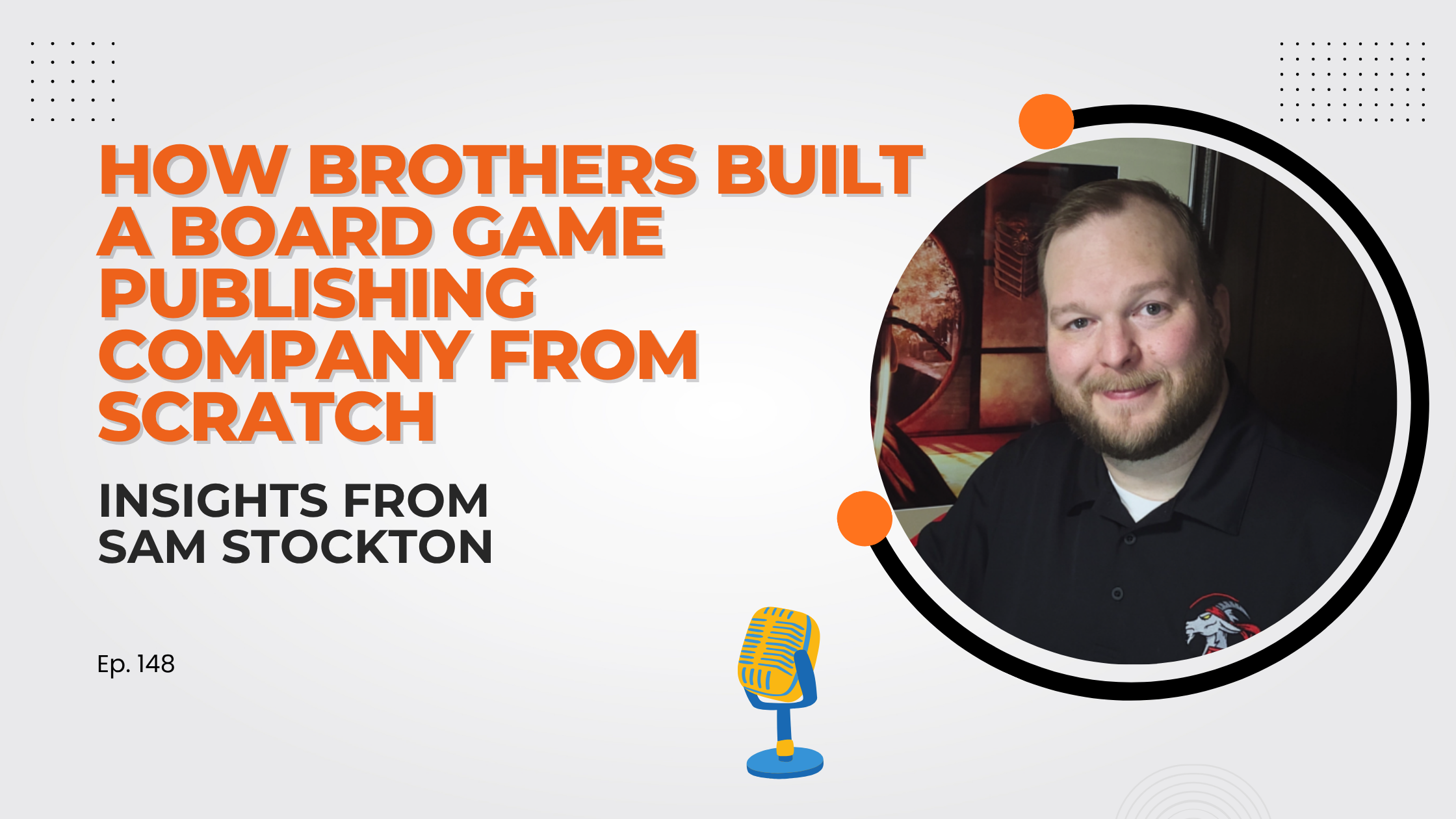
Welcome to a journey into the world of board game publishing, where passion meets strategy. In this episode, we explore the insights of Sam, co-founder of B.A. Games, who shares his experiences in turning a love for tabletop games into a thriving business. From the challenges of game design to the dynamics of family-run operations, Sam offers a transparent look at the industry. Whether you’re an aspiring publisher or a seasoned designer, this episode provides valuable lessons on navigating the complexities of the toy and game market.

#148: From Brotherhood to Business: When Passion Meets the Real World – Toy Business Unboxed
Episode Highlight
- 00:00 – Introduction & Sam’s Background
- 00:25 – Growing Up in a Gaming Family
- 01:20 – Childhood Games That Shaped Their Design Love
- 02:02 – Self-Publishing Decision & Industry Lessons
- 02:55 – The Story Behind Cult of the Deep
- 03:06 – How Social Deduction Mechanics Work
- 04:04 – Crowdfunding Timeline: Conception to Launch
- 04:44 – Game Design vs. Development
- 05:42 – Family Roles at BA Games
- 06:01 – Current Portfolio & Upcoming Releases
The Origins: Why Bro Brothers Started Publishing Games
Sam’s story begins with a shared love for gaming. An unbreakable bond among five brothers, driving their desire to create something in the industry. Early on, it was even a dream of owning a game store, but eventually, they found their calling in publishing. Their journey underscores that a deep passion for games can evolve into a purposeful business, especially when rooted in family and community. Passion alone isn’t enough; understanding the industry and strategic timing are crucial to success.
Designing vs. Developing: The Creative and Technical Balance
Sam highlights two distinct phases in game creation: Design, the creative force where the overall experience, emotional impact, and tension are crafted, and Development, the physical realization, fine-tuning rules, themes, components, and production details. Effective game creation balances creative vision with practical development, which often requires iteration, testing, and refining. This process can take multiple years but is essential for quality and market fit.
The Realities of Market Timing and Shelf Life
One of the harsh truths Sam shares is the short lifespan of most board games, typically just a few months. Most titles are in distribution for around 2-3 months post-launch before being replaced by new releases. Understanding product lifecycle helps in planning production, marketing, and inventory. It also emphasizes the importance of continuous innovation and engagement with your community.
Marketing, Crowdfunding and Community Engagement
Sam emphasizes that in-person marketing through demo events at conventions has been most effective for building loyal, long-term fans. Playing games in person creates memorable experiences that are more impactful than online ads alone. Crowdfunding through Kickstarter has also been vital for funding physical production while revealing key industry realities. A critical insight is that backers are not just customers but partners. Offering exclusive deluxe versions encourages early support and creates a sense of ownership. Invest in live events and demos to cultivate community loyalty, and make sure your crowdfunding rewards feel special enough to justify the wait.
Navigating Family Dynamics in Business
Running a family business can be challenging but rewarding. Sam manages roles within his family where he makes the final decision while brothers focus on specific operational areas including shipping, demos and logistics. Transparent communication and boundaries help family members work harmoniously without personal conflicts spilling into the business.
Future Outlook: Growth and Industry Goals
Sam’s vision is ambitious: to grow BA Games into a full-line publisher comparable to industry giants like Fantasy Flight or Renegade Studios, with a diverse product range, from small filler games to large, complex titles. Strategic planning, consistent product development, and maintaining a long-term vision are vital for scaling a niche business.
Advice for Newcomers in the Toy and Game Industry
From understanding the true costs of production to the unpredictability of market demand, Sam underscores the importance of financial literacy in publishing. He also emphasizes that starting in the industry should come with preparation: knowing where your revenue streams come from, understanding international market differences, and appreciating the time and capital investments required. Patience and realistic expectations are critical attributes for any entrepreneur in the toy and game space.
Conclusion
Building a successful board game business is a marathon, not a sprint. Passion drives the start, but strategic design, responsive development, effective marketing, and strong relationships both family and community are what sustain growth. If you’re considering entering this industry, remember there’s no single formula. Success comes from understanding the market, managing expectations, and continuously innovating your offerings.
Connect with Sam Stockton
If you’re interested in learning more about B.A. Games or connecting with Sam Stockton you can reach out through the following channels:
- Website: Visit B.A. Games’ official website for the product, latest news and more.
- Facebook: Follow B.A. Games on Facebook for updates, discussions, and behind-the-scenes content.
- BGG: Find B.A. Games on BoardGameGeek for reviews, ratings, and community discussions.
Transcript
Jason Hsieh (00:42)
Welcome back to another episode of Toy Business Unboxed podcast. In today’s episode, we’re talking with Sam, the co-founder of B.A. Games, a company that born out of brotherhoods, tabletop adventures, and the deep love for games that bring in people together. Sam will walk us through some of the highs and lows of designing games over the years and also growing a business with families and also building communities who play. So thank you so much for joining us on the podcast today, Sam.
Sam Stockton (01:07)
Yeah, I’m happy to be here.
Jason Hsieh (01:09)
So first, let’s go back. know you run a business with your brother, but let’s go back on like many years ago. What kind of start out with like the business side of the publishing?
Sam Stockton (01:19)
why we decided to this whole thing. Why we decided to subject ourselves to all the torture. So we’ve always been gamers as a family. I mean, growing up, we moved around a lot, but we always had each other. So I’m for those don’t know, I’m one of five brothers. And so no sisters, we don’t believe in them. In terms of
Jason Hsieh (01:20)
Yes!
Sam Stockton (01:38)
brothers, something we always that always connected us was gaming, whether it be RPGs, card games, board games. So we’ve always had something and we always wanted we always talked about doing something in the space this. Originally, it was like a game store, that we’re all going to live in the same area, which is not always possible with family. And so there’s going to say, we’re about we do a board game publishing company.
Jason Hsieh (02:03)
Hmm. Okay, that’s how you kind of started. Oh, wow. I guess going back, what are some of the favorite games that really define your childhood?
Sam Stockton (02:10)
⁓ man. Let’s see here. In terms of like RPGs, it was like Rifts from Palladium was a big one. Robotech from them as well. We also did like, you know, like second edition D&D, you know, that kind of stuff. 3.0. The big one for board gaming for us was like Battle Masters. Okay, it’s a kind of an old school one, as well as Hero Quest.
Jason Hsieh (02:29)
Okay.
Sam Stockton (02:34)
Hero quest was a big one for us. Generally, we’re all into fantasy across the board. I was more into the military stuff, so we used to play Axis and Allies. But that was the bigger stuff for us.
Jason Hsieh (02:43)
I see, I see. And when you first start the publishing company, do you always want to do self-publishing or have you considered going other route, like just licensing game design to bigger publisher instead?
Sam Stockton (02:54)
I wasn’t even thinking about doing publishing, because I actually interned with Fantasy Flight Games as an intern one summer. I said I’d never want to do anything in the board game industry ever.
Jason Hsieh (03:04)
⁓ Yeah.
Sam Stockton (03:05)
Okay.
What ended up happening was I started designing in my free time. And I started being like, you know what, there’s this game that I made, it’s actually pretty good. But part of the thing is, is I have a very specific vision of what I wanted it to be. Yeah, so there was no way I was gonna be able to pitch it to someone else as a game designer and have them do it. So
I said, you know what? We’re going to self-publish this and see how this goes.
Jason Hsieh (03:29)
Okay, okay. Which game was that out of the…
Sam Stockton (03:32)
That was “Cult of the deep.” So that was our first game we did, which is right here.
Jason Hsieh (03:37)
okay. Okay. Can you give a quick, like a one minute version of the rule and how the game is being played?
Sam Stockton (03:43)
Yeah. So what it is, it’s a social deduction game for four to eight players. But what it is, instead of being like werewolf, where it’s just like verbally telling each other, Hey, I’m not a werewolf or, you know, you’re a liar or whatever. it’s focused on the dice mechanic. So you roll dice in order to try and do things, but while you’re like stabbing people or helping people, cause the whole goal, you’re trying to figure out who’s part of which faction in the cult.
So like we’re in the same cult, but yeah, I don’t know if I trust you, man. Like the way you’re looking around is a little shifty, but your dice are telling me that you’re helping me. So I’m going to trust that that you’re doing what’s right for the cause, which you may have lied and use those dice as a way to cover your true intentions. So that’s kind of the mechanic of the game is very social deduction based, but with more like board game mechanics associated with it.
Jason Hsieh (04:33)
okay, okay. Interesting. How long does that took you for the first game to go live? And do you went through the Kickstarter route?
Sam Stockton (04:40)
Yeah, we did Kickstarter, because we didn’t know what we were doing. You go with the route with crowdfunding. So in terms of really doing the game, like start to finish probably is about two, two and a half years from start to finish. Because like, again, like never done one before. Yeah. Did a ton of playtesting, trying to figure out when we went to some smaller conventions, trying to figure out like, what’s good, what’s not. Yeah.
Jason Hsieh (05:04)
Yeah,
Sam Stockton (05:05)
Lot of trial and error and then eventually we got to a game or like this games good. I think we’re ready
Jason Hsieh (05:10)
OK, OK, OK. For you, what is the biggest difference between designing a game versus actually developing one from putting it into the shelf?
Sam Stockton (05:19)
So design is like the creative force that then creates the game. Like getting a game where it’s playable and people can see the vision. And to me, you are starting to get the emotions or the fun from the game that you want from it. So I designed this game to have moments of extreme tension of, do I trust you? Do I hate you? Do I love you? I don’t know. That would be like a creative endeavor.
as creation and development side is then taking that idea and then developing it further, either maybe fine tuning some stuff, adding a theme to it, putting in a developments really focused on the physical product of the game. Yeah, we do that. But do we use dice? Do we change it to cards? do we have special dice? Do we use normal dice? Like, oh, that’s one of the development side of things.
Jason Hsieh (06:10)
I see, see, I see. And out of the five brothers, how many is with you in the company?
Sam Stockton (06:15)
Technically three of them. The other two are lame. The oldest and the youngest.
Jason Hsieh (06:18)
They’re not part of the team?
Sam Stockton (06:21)
I think they are. We want them to be. Yeah. One, maybe one day. They’re busy with their lives. So.
Jason Hsieh (06:27)
I see, I see, I see. Got it, got it, got it. And over your experience, first of all, how many games do you have right now in the catalogue?
Sam Stockton (06:34)
So we currently have two games out right now with a third game we just finished the crowdfunding for. was actually our biggest campaign to date. We are super excited about that one.
Jason Hsieh (06:43)
Okay, okay, okay. You want to talk about the second and the third one really quick?
Sam Stockton (06:48)
Yeah. So the first one was “Cult of the deep.” So we were really smart and we released a social deduction game during COVID. So that was awesome. not a good idea. Don’t do that. our next game was a much more of a beast. So this one, “Forges of Ravenshire.”
Jason Hsieh (06:57)
Okay.
Sam Stockton (07:05)
So this one a dice worker placement game where you’re a blacksmith, a cute animal blacksmith with the goal of making the most money and to become the next guild master. And so what you’re doing is you’re placing dice into the town, getting resources, grabbing stuff from the town, the dice back to get more resources, then running your different workshops associated with a different color of the dice.
And then then running that into the blacksmith, your workshop, then to create items and to contracts. has actually been pretty popular with us actually has done really well for us. And then we decided, know what, instead of being so big, what if we do something the exact opposite size wise?
Jason Hsieh (07:43)
⁓ wow, that’s very different,
Sam Stockton (07:45)
yeah
“Goats and Goblins.” this one just finished the campaign. This plays in like 30 minutes. Okay. Real quick two to six player push your luck game. Real, real fun. We’ve been enjoying this one quite a bit. So much easier to demo at Gen Con.
Jason Hsieh (07:50)
⁓ okay.
lot shorter, a lot easier to learn.
Sam Stockton (08:01)
Yeah, like I could teach you the game in like a minute and like you’re done. Go have at it.
Jason Hsieh (08:05)
Okay, okay, okay. And it’s also maybe geared toward younger players too.
Sam Stockton (08:09)
yes. And that it’s easily accessible, but true to form, we have a little bit of a.
Do I trust you or not?
Jason Hsieh (08:16)
I see, okay,
okay, I see
Sam Stockton (08:19)
Because the game is like your goats have run amok into this deep cave. That’s really unstable. So you got to go get them out. So as you’re doing that, as true to Goblin form, like you start discovering jewels and treasures and things. So maybe if you stay a little longer, what bad thing could possibly happen? So if you stay too long, the cable collapse and you get nothing. So, our little twist to the whole thing is everyone’s going to vote whether they’re in or out. So if you were voting with me,
And you want to come with me if I succeed, then we split the loot. But there’s a third player who is out, they get nothing. However, if we fail, then we get nothing. Then they get everything.
Jason Hsieh (08:48)
I see, okay.
Interesting. OK, OK, OK, OK. And that’s some interesting dynamic that I can create as well.
Sam Stockton (09:02)
Yeah,
so we decided to create cards called the push cards, which means you can shove someone deeper into the cave. you’re trying not to bust you try to get how far can I go without busting?
Jason Hsieh (09:10)
Okay, okay, okay, if you bust then you lose everything.
Sam Stockton (09:13)
Everything. Then there goes the other guy so they might not be your friends
Jason Hsieh (09:16)
Interesting, so you’re actually taking on a similar kind of concept for other games as well.
Sam Stockton (09:22)
Yeah,
so I think I know flip seven does a little bit of this. The whole push your luck mechanic, I find it creates very loud moments and very big moments of joy. Because when you make it, yes. Yeah, and you fail. Your opponents are like, yes.
Jason Hsieh (09:37)
Yeah, definitely a little emotional, I guess. Yeah. the game play, for sure. Absolutely. So, and I guess looking back, how long have you been running the publishing company? Since what year?
Sam Stockton (09:49)
⁓ gosh, it’s been five years now? I think we’ve founded in 2020.
Jason Hsieh (09:54)
okay, okay, okay. And when you first started, do you always envisioned it going to be your full-time kind of geek? it’s like, will assume you started kind of part-time before you kind of…
Sam Stockton (10:04)
The the goal is that one day to be full-time that’s always been the goal we knew it would take a while Being the board game industry. It’s not like an instant overnight Ta-da. I’m done. I’m here. I’m good It takes time when you’re doing the publishing route for sure
Jason Hsieh (10:19)
I see. see. What is like one of the things that I guess that you wish you knew before you start the publishing company?
Sam Stockton (10:26)
I wish I knew more about…
where the money is coming from. Okay, like how much is it retailer? How much is it online? How much is it in person convention sales? How much is it crowdfunding? Like really understanding how that works? And especially with the lifespan of a board game, like what’s the actual lifespan of a board game? And unfortunately, the answer is very short.
Jason Hsieh (10:53)
Hmm. Sadly, I see. What is what is your experience typical lifespan for the book?
Sam Stockton (10:54)
Very, very, very short. They don’t live long.
a board game last three months. in terms of most board games in the industry, card games and things like, you can always continuously sell yourself if you show up to a convention and you have a game to sell, you will sell games. How much can vary. But if you show up with a game and put a price tag on it, you will sell something. There is no way that you don’t because
There’s someone out there who just loves your game. Right. The problem you run into is how many people can you get to love your game where you hit all the right elements that person really likes or loves. So there’s a game out there for everyone, but how many people actually are there was what determines like a viable market in terms of what you can pitch to. so in terms of like lifespan though, like once you have a release of a game,
Jason Hsieh (11:45)
Okay.
Sam Stockton (11:50)
It’ll be in distribution probably for two or three months. And then it’s that’s it. Because I’m not sure what’s happened in the board game industry, but it’s very much what’s new, what’s constantly happening, what’s new all the time. So you’ll have an initial print run, you’re done, move on to the next game, your print run, you’re done and move on to the next game. The only exception would be like the evergreen titles, but that’s like a very special few who make it to the very top who can actually continuously sell over and over and over again.
Jason Hsieh (12:18)
Hmm, okay.
Sam Stockton (12:19)
I would say like 98 % of games are not that.
Jason Hsieh (12:23)
Hmm, that’s an interesting observation. okay. Thank you for sharing that. I guess it also depends on the audience. I feel like some of the more family-facing games tend to last a lot longer than those harder games that kind of geared toward more hardcore gamers.
Sam Stockton (12:38)
Yeah. So like, as I said, like in distribution, generally like the hardcore gamers and stuff like that. Now the small stuff, part of that is going to depend on, you know, you getting access and marketing to those people. Like I said, there’s more people that can play this than can play “Forges of Ravenshire.” Yeah. Five pound behemoth. Right. I love forges it is a beautiful, wonderful game. And we’ve had a lot of good feedback on it, but
I can sell more of these generally to more people than I can afford just game just because people are at different levels. Yeah, they come like a pyramid. The more complicated your game is, the less people can actually end up buying.
Jason Hsieh (13:16)
I end up buying, yeah, yeah, yeah, yeah. That’s very similar to our experience as well. And also, I’m dependent on the marketplace. mean, correct me if you feel otherwise. I feel like a lot of the Kickstarter campaign that’s successful is really for the people more toward the top, the more difficult and more kind of a niche the game is. Whereas some of the more family game tends to see more success on Amazon based on our experience running.
Sam Stockton (13:36)
Yeah, I think you’re absolutely correct in that regard. So for example, like Grandpa Beck’s games, they do a smashing business on Amazon. They’re do so good. They do so well. They know their market and do that. That’s why we’re kind of shocked that we did a “Goats and Goblins” Kickstarter that it did so well, actually did better than forges. We were shocked.
So generally I think that’s generally correct. And even then for the “Goats and Goblins, it’s like a $20 game, but what sold more on Kickstarter was our deluxe version that comes this. with metal coins and you know, gold foiled cards and UV spotting and everything. like this was like a $38 on Kickstarter.
Yeah, and we sold I think three to four times more of these than these
Jason Hsieh (14:26)
⁓ interesting. Okay, okay, okay. Yeah, see the audience looking for something that’s more exclusive.
Sam Stockton (14:32)
exclusive
and big because we think about it like people are open to board games like have you played board games? yeah, I Monopoly. All right, cool. Yeah. Now the next step is if someone who is actively looking for board games, does it the next level? Yeah, not only the actively looking for board games, they’re looking to be like the first to get the board game, or they’re looking for cool projects in board games. That’s like an additional level of someone who’s like investing their time. Yeah.
Jason Hsieh (14:59)
Yeah,
yeah, yeah, for sure.
Sam Stockton (15:00)
⁓
more and more, you’re going to see people want the more deluxe stuff on Kickstarter. They want the exclusivity or the just the coolness of everything going on. Like they’re dedicated. They’re like hardcore fans who want the cool stuff, not just the normal run the mill stuff.
Jason Hsieh (15:18)
For sure, mean that’s why they are willing to wait,
Sam Stockton (15:21)
Yeah, because it makes no sense for most people to be like, hey, I want to buy a game. Can you get to me a year from now?
Jason Hsieh (15:27)
Yeah, it doesn’t make sense if there’s nothing special about it if they’re just buying the regular edition which they might get it on the shelf once the game actually get published later on.
Sam Stockton (15:36)
And that’s kind of, the contract you make, like as a Kickstarter creator, I have to create something special for you. so that it makes sense for you to back us because you’re, taking your harder money and putting your faith in us. And so I need to respect that as a creator that you’re doing that for me. So I’m going to do something in return for you as well. So it’s kind like a partnership, in a lot of ways, backers are partners, when you do these things. And I think that’s something that some people can get a
lose track of sometimes. But because honestly, who buys a game and then waits a year to get it. We appreciate it. We need it as a small indie publisher. I need Kickstarter right now in order to fund print runs and do things because it’s one thing about physical products if you don’t think about is it takes a lot of money to go into a physical product.
Jason Hsieh (16:20)
Yes, and time.
Sam Stockton (16:21)
And then move said product and time for that product before you even sell the product. Like people see the big numbers, but they don’t see as the amount of costs for everything else. Yep. Really makes it so your margins are smaller than you think they would be.
Jason Hsieh (16:35)
Yeah, yeah, yeah, yeah, because there’s a production itself that’s getting a ship over here and getting into actual people’s hand. There’s another cost. So definitely a lot of costs involved that people don’t see when they see those giant number on Kickstarter. we raised half a million, but how much money do you actually get.
Sam Stockton (16:52)
300,000 of that is gone. Just disappears and then you have the other 200,000 to work with depending on what you got. Yeah.
Jason Hsieh (17:00)
That’s true. true. So, also, guess one of the interesting things that you do with your business since you run a business with two other brothers, how do you navigate dynamic in business setting? said, I also run a family business with my sister. So some similarity to yours, I guess.
Sam Stockton (17:17)
So you can tell me what you think on this too. Like I find it’s tough because I’m like, I’m the overall big owner. I do a lot of the daily stuff and the majority of the stuff like these three designs are all are mine. Though my Dave and Ed are also very much part of the development process and sometimes into the design process to a certain extent.
And so like they’re heavily involved, like, when comes to the design and development, I do the majority of the work, but then that’s under me, I do all the work, right? Okay. So on that stuff, but in the end of the day, we all know, and we’ve made it apparent that I’m in the one that makes the final call. And even if you love something, like in the end of day, I have to make a call and make a judgment call on what I’m going to do. So I’m trying to balance listening to them, taking their feedback, and then making a, then making a judgment call on certain things.
Jason Hsieh (17:52)
Okay.
Sam Stockton (18:05)
Sometimes I’m wrong, sometimes right. As long as the end of the day, we’re okay with that. But most of the time, our jobs are actually very isolated from each other. So my brother Ed, for example, he’s back end. Okay, so he does like shipping customer service. He does like logistics, freight, pledge manager stuff, like importing exporting files.
doing all that stuff, making sure things go to Europe where they’re supposed to go with Australia. He’s very much all that stuff. And me is just like, how things going? Need any help? All right, you’re good. Moving on.
Jason Hsieh (18:36)
Yeah, it’s kind of like general manager.
Sam Stockton (18:38)
Yeah, I like he’s I need to trust him to do his thing. And that’s a good thing. My brothers are very good their jobs. So I just need to let them do their thing. David is my younger brother. He’s now my basically demo manager. So he is in charge of teaching people how to demo the way that we want to demo. We have a very specific format that we try to demo with. Which basically means
Jason Hsieh (18:58)
I see, okay.
Sam Stockton (19:03)
get the player playing in two minutes or less. Doesn’t matter how big the game is, get them playing and then teach the game as you go as generally the rule of thumb. That way people are not bored to death as you talk to them for 30 minutes.
So like, so he’s in charge with that. He’s in charge of making sure the quality of demos. And he’s also in charge of training for the demos. And he’s in charge of doing all that stuff and also making sure that everything’s covered at conventions. And then even my wife, she’s now my volunteer coordinator. So she’s in charge of the volunteers, the scheduling, who’s where, all that stuff. And then I have like an overall like
Jason Hsieh (19:34)
Mm-hmm
Sam Stockton (19:46)
thing. like, for example, Gen Con, like I wasn’t in the booth, but maybe two hours in any given day, most time I was gone. Yeah, for meetings and things. And so
Jason Hsieh (19:54)
Mm-hmm.
Sam Stockton (19:55)
It’s actually working, which is nice.
Jason Hsieh (19:57)
Yeah, sounds like you have a really good team that you have built around you as well. And on the marketing side, are some of the things that you tried that was successful or maybe you can share something that you tried that wasn’t as successful as you saw it should
Sam Stockton (20:09)
So successful for marketing is for us has been in person marketing. To get you to sit down and play our game is probably the really only way in my opinion, that a small game company is going to build long-term fans and customers. Because if you never played my games, we never had that deep interaction. Like if you play my game and have a lot of fun,
and you had a lot of fun at GenCon, you now have that. B.A. Games is fun. I play their game. It was fun. Also, you knowing how to play it now means that when you get your game, if you buy one, or you play it, you can actually teach it to other people and also have fun. Because some of the problems with board games is you try and teach a game and sometimes you never get to the fun because you stop and you’re like, this is not, this game sucks.
because you never get to the place you play at, you’re too busy trying to figure out rules and stuff. So for us in person marketing, which so far seems to be working, because this is our biggest campaign yet. Yeah. And we’ve seen a lot of return backers and people come back to us. So I think what’s happening is we’re starting to develop a more long term customer base of the of the game and and us, I think as a whole.
Things that didn’t work so well. We did like art prints for Cult of the deep, because it’s got some gorgeous artwork. So we tried doing art prints and things we tried to dice. We did a dice giveaway. because we were trying to think well, Cult of the Deep is a dice game. So we should get all the dice goblins over into our game because we’re gonna have real pretty dice. So we like custom special dice for the game that are real pretty and real real good looking.
Yeah. So we tried like some giveaways and some raffles and we tried posting and cross posting and doing stuff. no, absolutely. No, we spend way more money than anything we ever got. And we got a few good customers out of it. But when you spend thousands of dollars and get like five customers that are like, I’m not sure if that was worth it.
Jason Hsieh (21:51)
get the interaction. Okay. ⁓
I see. see. On the advertising side, what kind of advertising are you running? Are you doing meta, Google, Amazon ads for the business?
Sam Stockton (22:12)
So we do a mix of so so far, we have not we tried Amazon with forges, but I’m not convinced larger games do as well on Amazon. think Goats and Goblins will probably like you said, I think you mentioned Yeah,
Jason Hsieh (22:26)
That one I see work well for Amazon.
Sam Stockton (22:28)
This is the one I think they’ll work over Amazon. so currently like we, most of our advertising centered around the crowdfunding space. So Facebook, Reddit, Google, YouTube. Yeah pretty much those ones for the most part. Instagram, Instagram’s a good one. So that as most of it is centered around those campaigns in the future, we will probably be expanding that at some point.
Jason Hsieh (22:35)
Well, I found it.
Sam Stockton (22:50)
Really thinking about it for “Goats and Goblins, getting it done for that, for Amazon, see how goes.
Jason Hsieh (22:55)
I see, I see. And I guess looking into the future, what is your vision for the company for the next three to five years? How many more games are you developing? What is the direction you want the company to be heading into?
Sam Stockton (23:07)
So our goal as bad from the beginning is we wanted to be the next fantasy flight games. So we wanted to be large, like fantasy flight at its peak, meaning it had a family line. had small games, medium sized games, really big games. had RPGs. had like, want to like, basically what I want to be like Renegade studios currently.
Where they’re like a big full line publisher that has everything pretty much. So that’s where we want to go in order to attain that. that’s why we have Goats and Goblins. Our next game is going be a little bigger, probably about a $35 game called “Garden Dragons.” That’ll be hitting crowdfunding hopefully February next year. And then “Dungeon Diners” will be our next big game. Like that’s going to be a chonker.
That one’s probably be we’re looking hopefully for Gen Con to have a crowd fame company campaign for that one. So the goal is like two to three games a year.
Jason Hsieh (24:02)
Two to three games a year, okay, okay, okay. How big is your current team right now?
Well you have your family too, right?
Sam Stockton (24:07)
My family. But like said, Ed does mostly backend stuff. He’ll play occasionally, but he’s busy with everything else going on. So he is available basically for backend things. David is kind of my co developer. He actually is the co designer for garden dragons. But he only has a few hours a week that he can dedicate. And then my wife also helps with the volunteer coordination stuff. like
I see. have like, we’re like a four person team or five person also David’s wife, Jessica. She’s a big help, big, huge help on conventions. But like, 89 % of the work is that’s on me.
Jason Hsieh (24:37)
I see.
For now, but you’ll get there. So got it. Got it. Got it. So thank you so much for sharing. And as we’re kind of wrapping up today’s interview, if you have to share just one piece of advice with someone that’s getting started in the toys or game industry, what would that be?
Sam Stockton (24:46)
For now.
First off, don’t do it.
Jason Hsieh (25:03)
Don’t do it, okay? Okay.
Sam Stockton (25:05)
I know it’s a cheesy cliche thing. But no, like, if you’re getting into a toy company, or, you know, board, board games, specifically, I can actually attest to other portions of the toy industry. In terms of like tabletop games, just know what you’re getting into. Just know that the one hit wonder is not the norm. Yeah, generally, it’s
there’s no silver bullet to this. There’s no like, if I do this and this, that’ll lead to the most best product ever. And then I’m good. There is so many different elements from like the market being a certain way. Yeah. The game playing a certain way the price point of the game. When you talk about board games, talk about international stuff, like Europe likes cheaper games. They don’t care about Americans like expensive games, generally like
We like to deluxify it. Europe’s like, no, no, no, has to fit the small box. Japan is like, has to fit even smaller box.
Jason Hsieh (25:59)
Yes,
I actually had a guest recently that’s a Japanese-based publisher. They just shared that as well. And I also used to live in Japan, so very, very different expectation when it comes to working.
Sam Stockton (26:10)
Yeah, because like, it just part of it comes from like how you live, like generally in the US, we have a lot, our houses are a little bigger, generally. And we also have this great tradition of being pack rats and hoarders. So we have all of our stuff. So we like to get lots of stuff, big things. And in Europe, you don’t have that kind of space, you may live in a condo, or a small house, because there’s not a lot of space. And so space is very limiting. Japan even more so.
Yes. And so it’s not something that you can necessarily have like big games. So.
Jason Hsieh (26:42)
For sure, for sure, for sure. Well, thank you so much for sharing all your knowledge and also your wisdom with our listener today. For those of our audience that want to learn a little bit more about you and your company, where is the best place for them to find you online?
Sam Stockton (26:55)
Best place to go is in your website, and all of our and all of our socials like Facebook, Instagram is “B” as in boy, “A” as in apple Games, co or BA Games co. Okay, for everything. So BA games co.com. On Facebook, we’re BA games co on x for BA games co on Instagram, we’re BA games co. Okay.
Jason Hsieh (27:17)
So I make it simple. So yeah, we’ll make sure we put that on the show note. And thank you so much again for your time today, sharing your story and your journey and all your challenges within the toys and game industry.
Sam Stockton (27:30)
⁓ hopefully it was good for someone.
Jason Hsieh (27:32)
It was, it was very helpful. And thank you for our audience for tuning in to this episode of Toy Business Unboxed podcast. We hope you have enjoyed the conversation and find it insightful and inspiring. If you like what you have heard, be sure to subscribe to our podcast on your favorite platform so you never miss an episode. We really appreciate your support and would love it if you can leave us a review and share the podcast with your friend and colleague. For more resource tips and the latest update within the toys end game industry, visit our website at toy-launch.com.
Join the conversation and connect with us on social media using #toybusinessunboxed. We’d love to hear your feedback and suggestions for future episodes. Until next time, keep innovating, keep creating, keep bringing joy through toys. This is Jason Hsieh signing off on the Toy Business Unboxed Podcast. We’ll see you in the next episode. Thank you so much, everyone.
Grow your toy brand’s content reach
From SEO blog content to influencer outreach — we handle the full content engine for toy and game brands.