
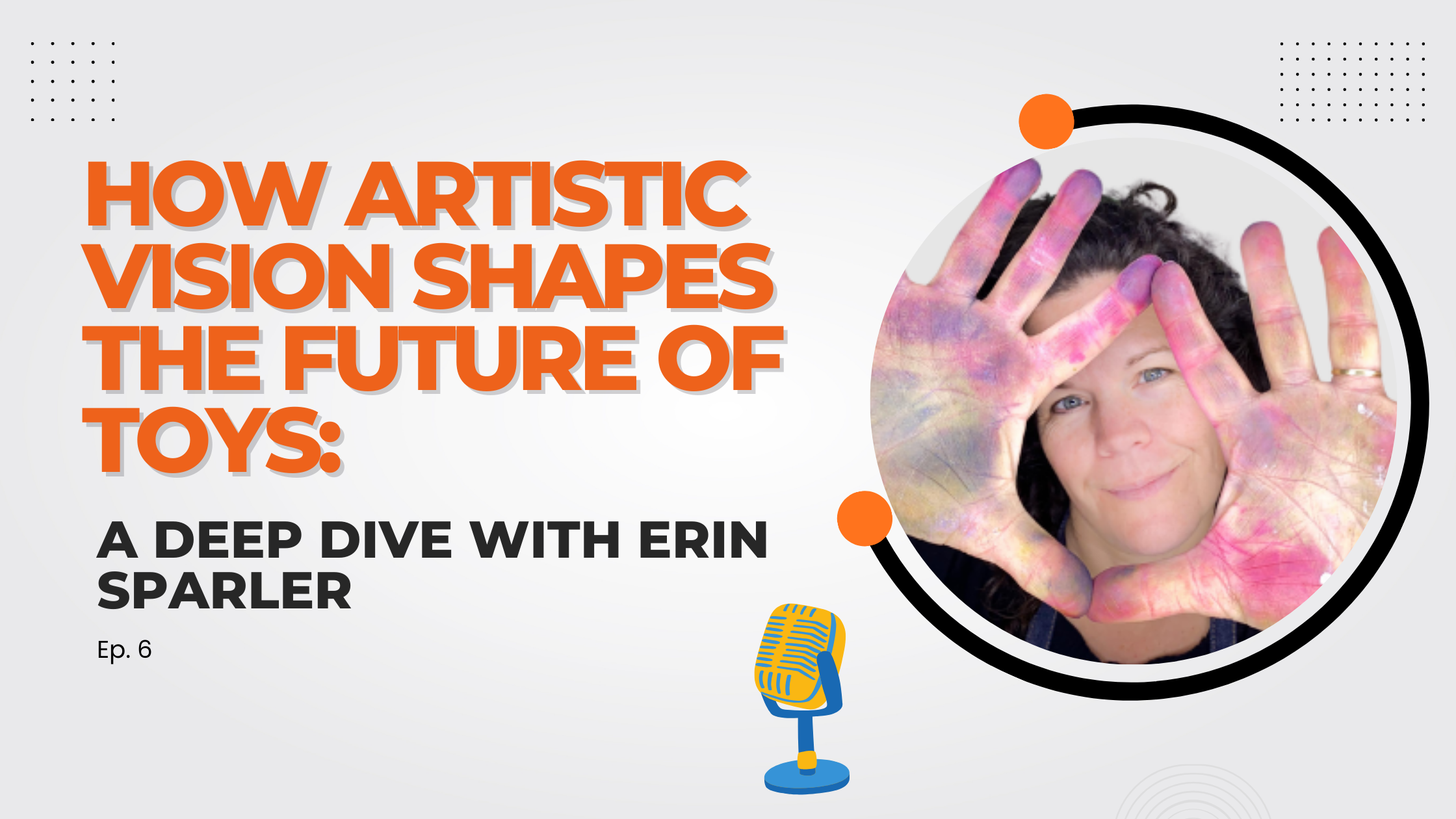
In this episode of Toy Business Unboxed, we had the pleasure of hosting Erin Sparler, a visionary entrepreneur who journeyed from academia as a digital art professor to pioneering the innovative EyeConnect Crafts. Her transformation represents a unique blend of creativity, educational values, and entrepreneurial acumen in the toy industry.
Episode Highlight
- 00:00 Introduction and Guest Background
- 01:13 Erin’s Journey from Academia to Entrepreneurship
- 02:07 The Birth of EyeConnect Crafts and the Artist’s Appeal
- 06:07 Designing Educational Toys with EyeConnect Crafts
- 13:48 Challenges and Lessons in Building EyeConnect Crafts
- 25:46 Navigating Amazon Marketplace for EyeConnect Crafts
- 35:23 Advice for Aspiring Toy Entrepreneurs
- 39:19 Connecting with Erin and Wrapping Up
From Professor to Pioneering Entrepreneur
The inception of Erin’s journey into the entrepreneurial world was marked by the creative development of “little Totem Poppets creatures,” laying the foundational stone for EyeConnect Crafts. This venture was not merely a business idea but a mission to bridge the gap between arts and practical business skills—a gap Erin felt acutely during her academic tenure. Her pursuit led to the birth of “The Artist Appeal,” a book and podcast series dedicated to offering guidance to artists navigating the complexities of entrepreneurship.
The Educational Core of Toy Design
Central to Erin’s design philosophy is a strong educational undercurrent. Through a candid recount of her product development process, including the crowd-pleaser 3D tunnel book, Erin shared how her past as an educator informs her approach to design. Research and development (R&D), crucial in both academia and business, play a pivotal role in the creation of toys that are not only engaging but also educational.
The Journey from Concept to Creation
Erin’s narrative on the development of the 3D tunnel book is a testament to her ingenuity and knack for innovation. Starting from initial sketches and evolving through various prototypes to overcome user experience challenges, the journey showcases the iterative nature of design and the importance of customer feedback. This process not only led to product improvements but also epitomized the dynamic and responsive approach necessary in the toy industry.
Navigating Challenges: Staying Positive and Protecting Intellectual Property
The path of entrepreneurship is fraught with obstacles, and Erin’s experience was no exception. She emphasized the importance of staying positive amidst skepticism and underscored the significance of protecting intellectual property—a lesson learned through tough experiences with contractual letdowns and the pitfalls of inadequate legal protection.
Leveraging Amazon for Visibility
In today’s digital-first marketplace, visibility can significantly impact a brand’s success. Erin shared her initial apprehensions and subsequent success on Amazon, emphasizing the platform’s role in validating EyeConnect Crafts’ market presence and facilitating wider reach. Her experience underlines the importance of adaptability and strategic partnerships in modern retail.
Words of Wisdom for Aspiring Toy Entrepreneurs
Erin’s advice to emerging talents in the toy industry revolved around engaging with industry bodies like the American Specialty Toy Retailing Association (ASTRA) and leveraging platforms for learning and networking. She advocated for attending conferences, staying abreast of trends, and continuously evolving one’s understanding of the business and creative facets of the toy industry.
Conclusion
Erin Sparler’s odyssey from a college professor to the forefront of toy design and entrepreneurship is a testament to the potency of perseverance, creativity, and strategic acumen. Her experiences, laden with trials, triumphs, and invaluable insights, serve as a guiding light for anyone embarking on a similar venture in the labyrinthine yet rewarding toy industry landscape.
Transcript
EP006_02-12-24_Erin Sparler
Intro: [00:00:00] Welcome to Toy Business Unboxed, your gateway to the secrets of the toy industry. Here, Jason Hsieh, a toy entrepreneur and expert in the field, will guide you through the enchanting world of toy design, marketing, and manufacturing. Now let the unboxing begin
Jason Hsieh: Hi, everyone. Welcome to another exciting episode of Toys Business Unboxed. In today’s episode, we’ll do a deep dive into intersections of creativities, business, and transformative powers of educational toys. Today, we are thrilled to have Erin with us, an artist, a designer, and visionary entrepreneur whose journey from academia to the helm of EyeConnect Craft has been nothing short of inspirational.
Erin’s multifaceted career spans from being a adjunct professor to a celebrated author to the host of the Artist’s Appeal podcast and the creative force behind the innovative product behind EyeConnect Craft. Erin’s unique approach to blending arts with play had led to a creation of numerous [00:01:00] product that not only entertain, but also inspire creativity and learning.
Thank you so much for joining with us on the show today, Erin.
Erin Sparler: Hey, how’s it going, Jason? Good to be here.
Jason Hsieh: I’m doing good. I think this will be a very interesting conversation for our audience and because you have a very unique mix of background, so I think it will be good for the audience to start off the today’s interview, talking about how you have transitioned from being a college professor to a business owner.
How did that journey influence your overall perspective on creativity and maybe also education as well?
Erin Sparler: They are definitely tied together and it’s been such an amazing journey. Like you said, I was a college professor for 12 years, I actually taught digital media. So I taught Photoshop, Illustrator, Dreamweaver, HTML, Art history, elements of design, anything and [00:02:00] everything to do with the computer and art.
When I left to have Children, I just couldn’t hold still. I dreamed up these little Totem Poppets creatures and started EyeConnect crafts. That was many years ago, but it’s been such a journey since then, so this really was a different perspective. The entrepreneurial space is, it’s not really out there in textbooks.
As college professors, we have things we have to teach and get in as part of accreditation, and so I was always struggling with this idea of how do you teach them the skills they need as an artist, but also teach them the business skills that they need once you go out into the world. As I navigated these uncharted waters of being an entrepreneur I discovered a lot of things.
I [00:03:00] learned a lot of things through hard knocks by mistakes. So in order to save people The same mistakes that I made, I started recording them. I started dictating them into my phone on the flies they would happen or writing them down. And that actually became the catalyst for this book, the Artist Appeal, which we, you and I talked about a little bit because I ended up with a book worth of knowledge.
As a professor, things have to be really well researched, right? And you’re always telling your kids, now if you write a paper, you’ve got to cite it correctly. You’ve got to use MLA or APA, whatever style, to cite your sources and you’ve got to do your research. Once I discovered that I literally had the makings of a book and frankly of a system, I started organizing it and I said I don’t want it to be just about me.
So I started the podcast the Artist Appeal, [00:04:00] and I started interviewing all these other amazing photographers, illustrators, quilt makers, quilt pattern makers, everybody I could get my hands on, from Larry Elmore to Ashley Longshore to anybody, everybody. And I was asking him the question, how do you make money as an artist?
Jason Hsieh: Yeah, that’s a hard question.
Erin Sparler: It is because it was something that I was really curious about as a professor. I told all these kids to go out and be graphic designers and to get jobs. A lot of them are doing really well. One of my alumni is he was on the podcast and he’s an audio technician. He travels all around filming things like Barnwood reclamation and just amazing shows for discovery and wherever else.
And then other artists I’ve known have given up and have [00:05:00] reached this point. So I put all the knowledge together in the book so that people could see it.I put it together in a system so that it was easily accessible.
These orange pages are learn from these mistakes. This one tells a story about how I got accepted into a gallery in New York City, on women’s feminist identity or self identity. I sent them the piece and they rejected it because of the frame, they said it was too ornate and I have lots and lots of fabulous pictures.
This is the studio, welcome. Everything in the book is original, this is my actual workspace in my home here with my crafting desk. I try to be both a practicing artist and entrepreneur, which basically means discover and have that academia part where I’m sharing what I’m learning as I’m going along, because I think that [00:06:00] information needs to get out there.
Jason Hsieh: I think this is a perfect segue to one of my next question for you as a designer.
How do you approach the challenge of making the product that you’re currently making with EyeConnect craft and how do you make it more fun and more informative for the parents and for the kids that’s using your product?
Erin Sparler: Great question. It really does tie into my former academic identity because I always want to be sharing. Educators like to share what they learn. But I think at the core of that sharing is learning yourself. I often used to say that if you really want to learn something, teach it. You have to research it, you have to build the PowerPoints. So it’s the same thing with developing a product, you have to do the research in entrepreneurship. They call it R and D. You’ve got to look around you, see what’s trending, go to the conferences, and listen to the feedback.
[00:07:00] When I was a Teacher, I had to listen to the feedback of the students telling me which projects they liked, which ones they hated, which ones they learned the most from because oftentimes it was the ones they hated they learned the most. And then you had to change your lessons to help them learn what they needed to learn.
It’s the same with designing a product, but in this case, you’ve got to listen to two audiences. You’ve got to listen to the retailer, the store owner and to the consumer. That really helps you develop a product. I’m going to give you an example, this is hand on example.
Jason Hsieh: Actually, if you can actually walk through the audience, how you create a 3D tunnel book, which is like the very unique product inside your account.
Erin Sparler: I’ve got the original sketches here and I can show you the whole development process. It wasn’t overnight guys, it’s never overnight. You’ve got to be willing to [00:08:00] pivot, willing to change, grow, develop. Here’s the little guy that started it all. The first sketch of one of the Totem Poppets animals that I did way back, you can see down here at the bottom that little frog was drawn in 2001. I created a whole series of animals based on a set of rules. These were round objects, like half half moons and organic shapes and they couldn’t touch each other. These original sketches were just on cream heavyweight, I think it’s hemp paper actually, with just white and black.
They eventually became these Totem Poppets animals. So the Totem Poppets animals, I kept thinking, how would these [00:09:00] shapes interact with each other if they were moving and changing.
Jason Hsieh: For the people that’s listening on the podcast that couldn’t see the images and the actual product that Erin is showing, please feel free to jump on our YouTube channel where you can see the actual drawing and all the wonderful drawing and the initial prototyping that Erin went through as part of the iteration process of the design, which is very important for creating any kind of product.
Erin Sparler: Yes, iteration is so important and iteration basically means change, evolution, growing, developing. I went from a series of artwork like this, 30 or 40 of these sketches to this next step, which was these Totem Poppets. These totem poppets animals explored how those shapes would interact if they were jointed.
I went to a local laser cutter, he helped me test these and prototype them, and play with them to see how the [00:10:00] joints would overlap and interact. I did the research, and I found brass, eyelets, one sixteenth in brass eyelets to put these bad boys together. I found tools and I tested, I think three or four different tools for putting the brass eyelets in.
This is the one I ended up loving, the Fiskars Spring Loaded Eyelet and I have a review of these that I did back in a blog post on my website years and years ago. But all this work, after producing everything and mind you spending quite a bit of money, I had these wonderful little guys and I took them to craft fairs.
So that was the first. Next, so step one, sketch them, come up with a concept, sketch it. Step two, prototype it, test it, figure out how it’s going to work, right? That’s the fun part for us artists. Step [00:11:00] three, is to test how that’s really going to work and play out to the consumer. I used to take this table, still occasionally do to craft fairs and craft shows.
This is a cardboard table, collapses like origami. It it was made by a company called Shiragami. And I would set up my booth, have these available and I would teach kids to make them. We wouldn’t make the monarch butterfly. I’d have all my paints and my pens and brass eyelets.
What I discovered is the brass eyelets were too hard for kids to use. They were too hard for a lot of adults to use. So, we pivoted to mini brads and that became the secret sauce. Once we figured out that these needed to go together with mini brads, I started listening to the retailers. The retailers came and they said, we really like it, but what do you do with the individual animals? [00:12:00] And I said obviously they need a home. They need a house, of course. So I made the 3D tunnel book. The first version was hand cut. I used an exacto knife, I cut it right here on the table in my little basement. I put together a selection of ocean animals and I put them in the 3D tunnel book, the ocean kit.
And then I showed it off. I took it to conferences, I took it to fairs and people were like, Whoa, this is amazing. We want to make one like that. And so I eventually partnered with another company that had experience in the toy industry. Although that wasn’t before a couple of fits and starts. I tried sourcing this on Alibaba myself.
I tried working with another couple of people. You got to find the right fit, but this is what we ended up making, a 3D tunnel book. It [00:13:00] features 12 of the jointed Totem Poppets animals. All ocean ones, that dolphin one I showed you or whatever. There’s 12 different animals in here and 100 mini brads to put them all together, as well as everything you need to make your own 3D book. Because that’s what the stores were telling me, I want everything included. Nobody wants to go out and buy batteries for the toy they just bought anymore. Everybody wants something that’s all included, that they can just give us a gift right off the shelf. So it’s that listening and testing and researching part that is just so integral in developing a product.
Jason Hsieh: For sure. If you don’t mind sharing with the audience.
What are some of the key challenges that you face in both starting and building the EyeConnect craft as a business and maybe some real life story [00:14:00] of how you overcome them?
Erin Sparler: Sure. There’s been a lot of challenges .
One of the most personal challenges, I think for any entrepreneur is staying positive, staying the course, staying focused. These reality shows of making it overnight, that’s not for real. You have to have persistence. And staying positive when you have people around you that don’t understand what you’re trying to do can be very challenging because people will tell you things like, Oh you should give up or are you making money yet? ,
Jason Hsieh: Yeah. Always have the naysayers.
Erin Sparler: Yeah, they really are. That’s one of the personal challenges is just staying positive and I know for me, I do a lot of hiking, I do a lot of outdoors activities. Hence why the animals are animals, is because I wanted [00:15:00] to teach my kids about nature and I couldn’t find the products that I wanted so I made them. The backstory is my kids would find a turtle, a box turtle and they’d say, “mom I want to keep the box turtle,” and I’d say, “no you can’t, he’s protected.” But we’ll go find you one at the craft store. And when I couldn’t find what I wanted, I couldn’t find the crafts that I wanted for my boys. I said I’m an artist, I’ll make them. That’s the easy part, the creativity, that’s fun. It’s rewarding. The hard part is staying the course. Other challenges that I’ve really had, and I will share a very personal story here, is that People will take advantage of small entrepreneurs. And we don’t teach contracts or licensing in the colleges.
Frankly, most professors don’t even know what licensing is. Most people have never heard of the term licensing. I certainly hadn’t and I had a [00:16:00] master’s degree and 12 years of teaching experience and I went out, invented this, I invented the Totem Poppetss, invented the 3D tunnel book. I met a lawyer who was a copyright attorney. She was a great resource, She helped me copyright them and she also connected me to several larger businesses that said, we’d love to license your product. Negotiated contracts with them. You’ve got to really read those contracts because they have a lot of technical jargon in them, a lot of legalese if you will. So it’s really important you have a lawyer. But even with a lawyer, sometimes You still get screwed. We were literally under contract to a much larger company first, what they call an LOI, a letter of intent. It’s a contract that says we want to have a contract. It’s not legally binding and yet in a way it [00:17:00] is. I don’t quite understand the legalities of it, but it’s called a letter of intent. We intend to write a contract with you, but we’re just testing the waters first so we were under that for one year, we negotiated that. And then we did eventually sign a formal contract for two years to build the 3D tunnel book, to make these little guys here. Make them and mass produce them. Produce them on a much larger scale than I was able to as a solopreneur making these in the US with a laser cutter and hand packaging the mini brands. I still hand package the mini brands for individual orders. After two years and a lot of work, a lot of learning about things like pogs, or point of display, or the sales cycle, or a lot of different things. A lot of that’s in the book, they turned around and they said, we changed our mind, we’re going in a different direction sorry, no hard feelings. [00:18:00] But we had been caught up and wrapped up with this company for three years. So we had to go back to square one. We lost three years of time and even worse in the contract was a little clause that said there was a minimum royalties guarantee, which was supposed to be compensate me for my time for those time. It was a pittance, it was $6000 and they flat out refused to pay it. They sent me a check for $1500 and said, we only think your three years was worth $1500. And when I spoke to attorneys about it they said, Erin it will cost you more in legal fees to sue this much larger company and you won’t be able to get anywhere with it and it’s such a small field. It’ll black ball your name. We won’t do it. So, as a small entrepreneur, you need to be very careful. There’s a lot of people that will [00:19:00] suck up your time, suck up your resources. They will copyright your idea, there’s a lot of companies that will steal your idea and make their own version.
That’s my story.
Jason Hsieh: Thank you for sharing. I think that’s a very important very hard lesson learned to your own experience
Erin Sparler: Read the contracts and make sure it’s a good fit.
Jason Hsieh: Yeah, thank you for pointing that out. As a small business myself, there’s always a lot of hidden tripwire that you can step over as a small business owner.
Erin Sparler: And I know you had some experienced with counterfeiting a little bit or,
Jason Hsieh: yeah, just people knocking off the similar product and I think in hindsight, I didn’t really apply or try to get IP for the product because I just want to get a product out there and start selling. But looking back, I should have tried to at least get some kind of protections, especially around the IP. So, when they try to copy [00:20:00] later, you have something to defend. And now, I know.
Erin Sparler: Jason, what’s IP stand for?
Jason Hsieh: Intellectual property.
Erin Sparler: Yeah, in case you don’t know, that is a term that get bandied about in this development field, IP. And unless you understand it, so it’s intellectual property. It basically means your concept, your idea, right? And you can protect it in one of three ways. Either through copyright, trademark or patent. I won’t get into the intricacies of those things, but I do have my work copyrighted. I have the 3D tunnel books trademarked and we do have a provisional patent for the next year on the craft kit, I didn’t think you could patent a craft kit, but apparently you can. So we’re working on that angle or aspect.
Intellectual property is so important. It’s what will make you the money in the long run, because that’s what a company wants to license. Protect it so that you can then [00:21:00] monetize it, you can license it and that’s where the money comes in, is protecting your intellectual property.
Jason Hsieh: For sure. I also want to dive a little bit more of your background being a professor of digital art for 11 years.
How did your teaching experience influence your approach to designing and creating the project that you currently have with EyeConnect Craft?
Erin Sparler: Sure, it influenced it two ways. First of all, my master’s degree was in 3D animation. I went to the Academy of art college, now university out in San Francisco and studied 3D design. I loved the way shapes interplay with each other, like how a bone and a socket interact. I’ve always loved kinesthetic art.
Kinesthetic art is essentially art that moves. Mobiles and sculptures and things that move. I was always fascinated by that, it’s actually what drew me towards the art field in the first place, is seeing [00:22:00] an amazing sculpture exhibit when I was like 18. I got my professor position and I taught the whole gamut of arts. But always in the back was that love of things that move and that interactive quality of being able to move a piece or touch a piece and see it spin. I’ve always loved kinesthetic art and as a professor, you learn, as I said earlier, to listen to the students for feedback. That’s what makes you a better teacher so you have to, once again, iterate every time you teach a class, improve it. You improve the organization, you improve the content, you do more research. And particularly for the visual arts, you’re going to find more examples. I was always looking for examples that would interest the kids that would tie into [00:23:00] modern life and their world, so like Damien Hirst trying to start this conversation with them about, You see the skull covered in diamonds by Damien Hirst called for the love of God. He didn’t make it. He paid a jeweler to make it. What do you think? Is it art? If it’s conceptual and having these deeper conversations.
That aspect of my love of 3D, kinesthetic art, my love and passion for making a better class and constantly iterating and researching what I was teaching and sharing translated into EyeConnect crafts in that. A, the animals move. B, the book has that element of this big circle getting smaller and smaller so you diving into it like a sculpture. It’s essentially like low relief sculpture, the 3D tunnel book, you’re making a cool little sculpture. Then [00:24:00] there were three, the write ups I did with it. Each of the animals when I originally invented them, talk about the symbolism of the creature in Biology, Earth science, Native American culture, Asian culture. I always love symbolism in art. One of the things that makes art powerful is the layered meanings, the symbols embedded in the art. These had that symbolism in it and I carried that over into the 3D tunnel books with little educational prompts. So for example, on the back I have suggestions of ways you can make this 3D tunnel book, this little sculpture with movable animals, kinesthetic animals, and then go into animation and movie [00:25:00] making to make motion animation with these.
The 3D tunnel book is this kind of culmination of all of that, of loving kinesthetic art, of studying 3D animation, of loving symbolism in artwork and learning and that progress of creation. It does all that. You put the animals together, it’s like a little puzzle you’ve got to figure out how to put them together. You paint them, stamp them, add a story, add a poem, add research, and then you can make your own movie with the final product.
Jason Hsieh: That’s a very interesting process and thank you for sharing that background story to the audience as well.
In the next part of our today’s interview, I want to kind of transition to talk a little bit more about sales and marketing a little bit. I know your product is also currently available on Amazon.
How is the Amazon, as a platform contribute to the overall visibilities and the success of the EyeConnect craft so far and what kind of unique challenges you have [00:26:00] encountered in Amazon marketplace?
We always talk about Amazon for the e-commerce entrepreneurs, since they are the biggest. Especially for us, they own more than 50 percent of the overall market marketplace for e-commerce sales.
So if you can share some of your experience on the Amazon marketplace, that’d be great.
Erin Sparler: That’s a really crazy number, Jason. If you think about it, the 50 percent of the marketplace but it’s true. Where do you guys go to buy something? Amazon, right? It’s the first place you go. At first I didn’t want to deal with Amazon. In fact, I had a false start with them as well.
Many years ago, when I first started the Totem Poppetss and EyeConnect craft, I did try and do it myself. I tried to navigate Amazon myself. At the time your upload was through a spreadsheet you had to create a very big spreadsheet with everything, and if you didn’t get it right and didn’t upload it you had to do it all over again from scratch.
I eventually got so [00:27:00] frustrated I gave up. And so I didn’t really want to tackle Amazon with EyeConnect Crafts. But the numbers are such that you have to and I think there’s a legitimacy that also comes from being on Amazon. People when they hear about a product they go straight to Amazon to see if it’s legitimate. If you’re not on Amazon, they’re going to be like.
Jason Hsieh: Actually based on the latest research, the number one place people start doing their search when it’s come to physical product is Amazon. It’s not Google anymore, it’s always Amazon first.
Erin Sparler: Almost become a search engine, you’re absolutely right. And so I decided to tackle it. Now, there are a lot of people and companies that will approach you as a small entrepreneur at any conference you go to, to help you with Amazon. There’s become businesses that their whole business is putting your products online on Amazon for you and charging you a significant amount of money to do it. [00:28:00] And I think it’s once again, one of those things, like you’ve got to find a really good fit.
So frankly for me, I interviewed I think four or five Amazon assistance businesses and I had multiple phone calls, zoom calls. I asked them not just about their pricing, but I tried to get a real vibe for the person behind the company, how big was the company? Were they listing 50 different products on Amazon? 50 different companies? Because I felt like if I went with a really big amazon seller company that I could get lost in the shuffle. I would just be handed to a lackey and maybe somebody even overseas who wouldn’t really understand the product is so new and so different. I really felt like I needed a partner, a company that understood and would take the time to understand. [00:29:00]
What the keywords were going to be for it and how unique those needed to be. I also looked for a company that I liked their data and their communication. So that became very integral in my interviews is talking about, communications, asking them how they tracked the data, and them being open and transparent and showing me their spreadsheets or if they didn’t have any. And then a couple of the companies just phased out of the interview process because they weren’t communicative. So They wouldn’t respond to emails or they wouldn’t respond in the multiple formats that I wanted. So I wanted a company I could really work closely with and just reach out.
Amazon, I think is really important to getting the word out about your product. It’s really important to find a partner that knows what they’re doing and that you feel like you work well with. And then like you [00:30:00] guys have taught me about the Vine program, Amazon has their own new review process. There’s a little fact that maybe people don’t know. I didn’t realize that Amazon basically shows their products based on two things, their algorithm isn’t that complicated it’s based on number of products sold and reviews and Yeah. And you need to have reviews coming in. I’ve read all sorts of books, there’s this great book about how do you have success? It’s called the formula for success and scientists, once again doing the research, a professor doing research into what creates success. One of the key takes aways he says, is that reviews beget more reviews. So it’s like putting your hat out when you’re a street musician. If you put the hat out with no money in it, People aren’t going to throw money in it. But if you put the hat out with a 5, a 10, and 20 already in it and some change, people start to give you more money because they see [00:31:00] other people have led the way. It’s the same thing.
Jason Hsieh: Going back to your experience working with Amazon, if you can elaborate on what make you decide working with the team here at Toy Launch to help you with your Amazon marketing effort based on the few criteria that you were just mentioning earlier.
Erin Sparler: It’s exactly what I was saying, Jason. You guys responded. Not just responded, but showed up with transparency and openness. Like, you were so generous in our first meetings being like, Hey here’s the spreadsheet, here’s how we track margins, how we track keywords. Let’s go ahead and put it in and see if you have the margins for this, that, or the other thing. Oh, you don’t know what margins are let’s talk about what that means.
Margins is a really hard concept. Particularly for an artist or somebody who’s not been in an entrepreneurial space. Margins is this percentage that everybody throws about, what are your margins? Do [00:32:00] you have good margins? Do you have bad margins? The hell is a margin? I know margins from Book layout from TKG Quark and I’m like, Oh margins are the spacing between the outer edge of the page.
. I could get into bleeds and gutters and all of these technical terms for book layout. So margins is a very strange thing. You were very generous with your knowledge and very open. When I would text you guys or call, you pick up the phone and you respond and when we made meetings, we made multiple meetings before I ever hired you guys.
These guys were so great. I kept them on for the line for six months. I’m so sorry. I was like, all right, I’m not ready yet. Call me back in two, three months. Touch base with me in two, three months. And you did, that to me was priceless. That continued contact, [00:33:00] there was another company that I was thinking about and they just weren’t responsive, didn’t respond to emails, didn’t respond to like text messaging or phone calls or slack messaging, really? They just didn’t have enough forms of communication. In this day and age, I want my partners in business that I am spending good money with to respond to me in all of those different formats. I want to be able to get hold of them via email as well as Slack, as well as text message, as well as cell phone, because if we’ve got a meeting and I can’t find the link, I want to be able to pick up the phone and be like, dude, I can’t find the link.
Jason Hsieh: Yeah. Communication is definitely a key especially we all work remote and the communication is the only channel that we can make sure everyone’s on the same page and we’re all moving towards the same goal, which is trying to make sure your brand can be as successful as you can be.
Erin Sparler: You guys are really great at that.
And so if I have an encounter company that won’t give me, if all they’ve got is email. I don’t want to work with [00:34:00] them. I hate that. Think about the help desks that you encounter online. I think Etsy is like this right now cause I’ve been trying to get hold of them. Sorry, Etsy I’m trying to get ahold of Etsy for this nonprofit art gallery that I work for and I want to help build them a website for their 140 artists, I think Etsy is the platform to do that on. I can’t get a live person for the life of me. It’s all email support, it’s two days, three days, four days in between the time you write them an email and then you get like a default copy and paste response. No.
So, those things, being transparent and open with your data, being super communicative on all the different channels that work for you as an entrepreneur and them as a business. And then just that personal connection feeling yeah, I feel like I can trust these people. I literally flew to Las Vegas to meet the owners of the [00:35:00] warehouse that are currently warehousing and distributing the 3D tunnel books. I saw the warehouse, I went out to lunch with them, I met them, their family and so for me, meeting people one on one is worth it. You’re going to spend a little bit of money, but make sure it’s a good fit
Jason Hsieh: For sure. Thank you for sharing that and thank you for sharing your experience.
So as well, Wrapping up today’s interview, the last question I always ask every single guest is for the aspiring toys entrepreneur or the people that’s currently in the toys space.
What advice would you give them in terms of balancing, based on your experience, balancing creativities, business, and also the ever evolving trend in the toys industry?
Erin Sparler: Wow. Good question. Let’s see here. Let’s think. . Okay I would really recommend joining and going to Astra. So it’s A S T R A, it [00:36:00] stands for I believe, the American Specialty Toy Retailing Association or something like that. It’s a great conference, it’s a little bit smaller than some of the other big toy conferences and they offer educational programming.
They are all about innovation and helping entrepreneurs, inventors get their product out into the market. So it changes location every year. I’ve been going now for about three years and I recently joined the educational committee to help them develop curriculum and to just brainstorm and they’ve got this great team of people who are both really experienced within the toy industry, as well as people like me that are fairly new and that’s a great balance because when you have somebody new, we tend to ask questions that a new person would ask what does margins mean? [00:37:00] Let’s define that. Let’s define IP. Let’s make sure that everybody’s on the same page because a lot of times an expert just has been enmeshed in the field so long. They may not remember that they need to stop and define some of these things that are just second nature to them.
I love Astra. I would highly recommend that the balance you need is to go to these conferences because these conferences have the toys that are going to be in the stores. Next year, the stores are going to the conferences to buy the products wholesale that they are going to put on their shelves in the upcoming year and there’s tons of programming. Right when you walk in the door, they have magazines like the toy book and all. There’s four or five different publications that talk about the trends. They have all sorts of articles, they have the newest, latest, greatest products. They have articles about toys that have won different awards.
Like I said, Astra has [00:38:00] programming. It’s like a three day conference and all three days they’ll have class after class where they have panels that you can ask people questions. You can learn about social media. It’s a really great resource and I think that is really the place I would suggest people start is if you can go to Astra, you can even just join their website and their organization virtually, they have a ton of programming online as well.
I think that’s a great start. And I got to mention that these conferences are the way I’ve made any true progress. Through networking. I really feel like going to these conferences, first going to the craft fairs and listening to what the consumer said, and then going to the retail business to business or B to B conferences. That’s where I started meeting other industry professionals, finding out what it would take to do this, learning about the safety testing and the regulations that you have to have on the packaging and [00:39:00] how that works and that’s a industry. So just going over and over to these conferences, you’ll fill in the little gaps, you’ll get your questions answered, and you’ll meet the people you need to meet in order to make progress.
Jason Hsieh: That’s a wonderful tip. Thank you for sharing that. How can people find you online?
Erin Sparler: I’m the only Erin Sparler out there. If you meet another Sparler, they’re probably related to me, but people can find me It’s true, it’s not a common name so that’s me on the internet. I’m not hiding.
I’m very, transparent. I’m the owner and inventor of EyeConnect Crafts so you can find these on Amazon. You can also find the space version at Barnes and Nobles starting here in April. The Artist Appeal is where you can order the book as well as the workbook that comes with this, this is 280 pages. The [00:40:00] workbook has I think 90 pages of checklists and worksheets. All the information I could possibly have stuffed into a college class. Essentially, this book, the Artist Appeal and that website, the Artist Appeal, is the information. It’s the course. I wish I could have taught. When I was a professor.
It’s the capstone course or like the final class. I wish I could have taught my students. Sorry, guys, I made it after I left. But, the book has so much cool stuff and the podcast on The Artist Appeal is all free. You can listen to 200 episodes. So you can find me there. You can find me on The Artist Appeal.
You can find me at EyeConnect Crafts and of course you can find me on social media too. The EyeConnect Crafts social media, Facebook, Instagram, that’s all me. I answer people personally. I’m still that small where I engage and interact with people on social media on a regular basis. And [00:41:00] of course you can find me at conferences, if you do come to Astra or one of the other conferences like Toy Fest West, which I’m doing at the end of the month, or MSA, the Museum Story Association or New York Toy Show or any of the big ones, I’ll have a booth there. You should pop over and say hi if you ever, if you decided to go that route and take the deep dive and really pursue your dreams, which I suggest you do it, be persistent, come to the conferences, come say hi.
Jason Hsieh: Okay. Thank you so much for sharing that and thank you for joining us on today’s podcast interview. It was my honor to have you as a guest.
Erin Sparler: Thank you, it’s my honor to be on. It’s super fun, I love sharing that this is real. This is where the magic happens. We’re real people. I know you’re a real person.
Jason Hsieh: So for the audience we’ll put all the resources in the show notes and you can also find the replay of the podcast on toy-launch.com here shortly in a few weeks after we do [00:42:00] the post editing, and thank you again for the live audience that’s joining us today and thank you so much.
Erin Sparler: Yeah. Thanks guys. Thanks for joining us live. I really, enjoyed it and had a lot of fun. Like Jason said, totally hit me up on social media or shoot me an email just through one of my websites. That’s me, I’d love to talk to you.
Jason Hsieh: Thank you
Erin Sparler: later guys.
Outro: You’ve been listening to Toy Business Unboxed, hosted by Jason Hsieh. Thank you for joining us and exploring the fascinating world of toys and the ingenuity behind them.
To stay updated with the latest episodes and continue your journey into the toy business, remember to subscribe and follow us. If you found today’s episode insightful, please leave a rating and review and share this podcast with others who share your passion for toys. Until next time, stay curious and keep innovating.