
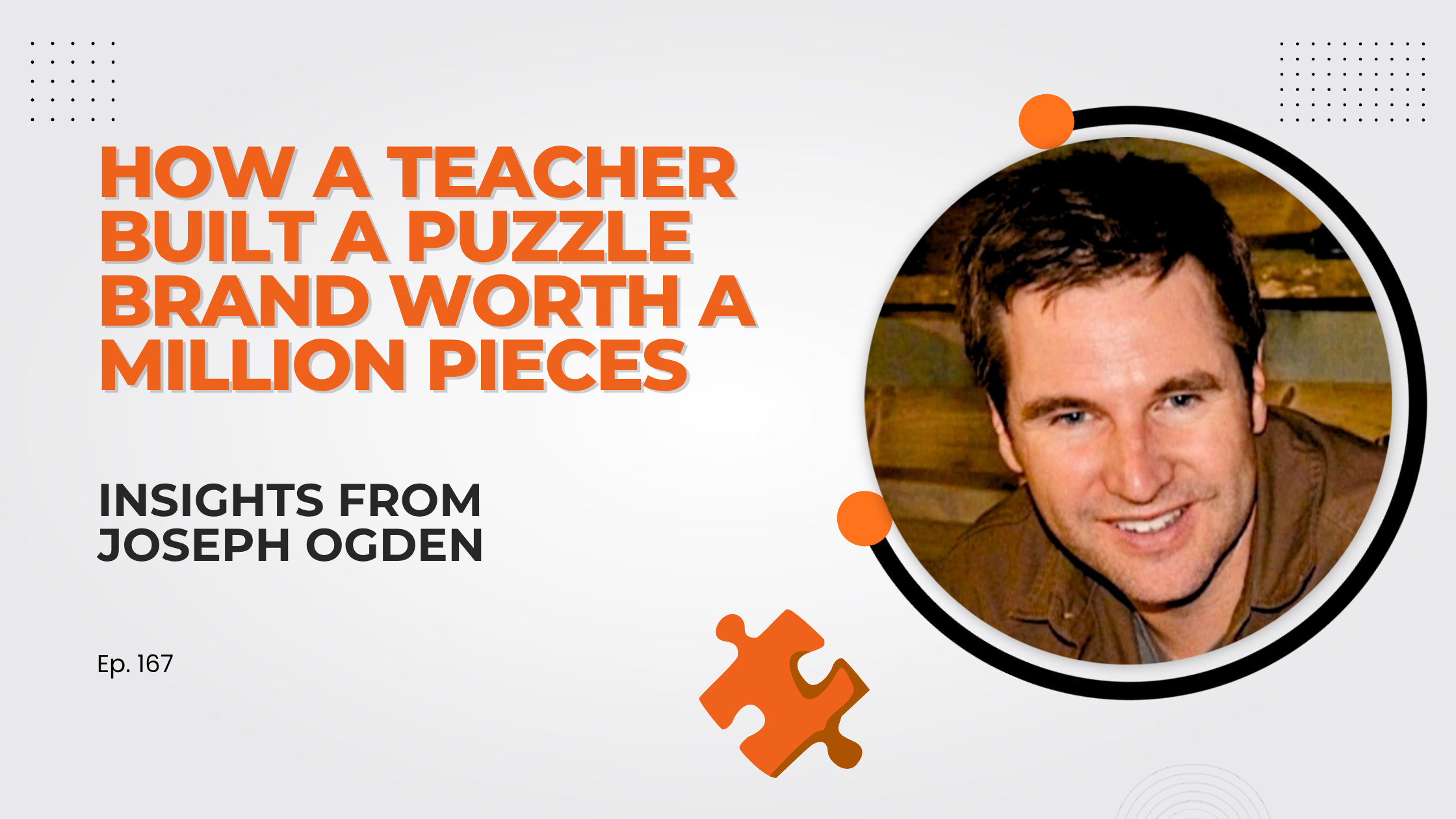
Welcome to the Toy Business Unboxed Podcast, where we go behind the scenes with the entrepreneurs building the toy and game industry’s most creative companies. In this episode, host Jason Hsieh speaks with Joseph Ogden, the founder of Boardwalk Puzzles, a premium US-made puzzle company based in Utah. Joseph’s path from teaching and tech to running a manufacturing operation that produces over a million puzzles a year is unlike anything most founders experience. This conversation covers the pandemic origin story, the Speedmaster brand launch, US manufacturing strategies, and the philosophy that has kept Boardwalk Puzzles growing even in a difficult economy.

#167: From Classroom to Costco: Building a Million-Puzzle Brand – Toy Business Unboxed
Episode Highlight
- 00:00 Guest intro and company overview
- 01:35 Boardwalk Puzzles origin story
- 02:47 Barnes and Noble launch
- 08:14 Premium products and in-house art
- 10:13 Speed puzzling community explained
- 12:32 Speedmaster brand launch
- 18:59 Why manufacture in the US
- 21:20 Factory efficiency and operations
- 23:37 Marketing through community events
- 27:34 Ugly Sweater Calendar preview
From Teaching and Tech to Premium Puzzles: How Joseph Ogden Got Started
Joseph Ogden’s entry into the puzzle world began with a love of art and a belief that a single piece of artwork could tell an entire story. Alongside a few friends, he bought a hand-cut wooden puzzle company in Maine, which gave him a deep foundation in craftsmanship and quality. From there, the team saw an opportunity to use technology to bring that same premium experience to a wider audience at a fraction of the cost. That combination of artisanal roots and modern production thinking became the founding idea behind Boardwalk Puzzles when the company launched in 2020.
The Barnes and Noble Phone Call That Changed Everything
The origin story of Boardwalk Puzzles took a sharp turn when a Barnes and Noble buyer called Joseph early in the pandemic, asking him to show her the coolest puzzles he could find anywhere. At that point, Boardwalk Puzzles existed mostly as an idea, but Joseph pitched the brand concept and she asked for a sample. With no finished products and no production line, Joseph assembled a single puzzle by hand, found a box at a craft store, worked with a graphic designer friend on the packaging, and shipped it off. Two weeks later, she called back to say her entire family had already put it together and Barnes and Noble was all in, making them the company’s first and still-active retail customer.
What Makes Boardwalk Puzzles Different From Every Other Puzzle Brand
Boardwalk Puzzles built its reputation on art and craftsmanship that simply could not be found anywhere else. The company developed what it calls playful pieces, uniquely shaped cuts themed to the artwork, and partnered with artists who created imagery exclusively for the brand. Today, an in-house art studio with more than a dozen trained artists produces all of the company’s original work, and none of it uses AI. Premium packaging details like magnetic closures, resealable bags, and full art inserts reflect the same commitment to quality that started with a single handmade sample sent to a buyer during a pandemic.
Manufacturing in the United States: Why Joseph Chose the Harder Path
When Boardwalk Puzzles began scaling production, Joseph made a deliberate choice to manufacture in the United States rather than overseas. The decision came down to speed, quality control, and the ability to learn fast by seeing problems as they happened rather than weeks after a batch shipped from overseas. Manufacturing in the US is significantly more expensive, with higher costs for power, insurance, equipment, and labor, and the company only makes it work through relentless efficiency. Today, Boardwalk Puzzles produces over a million puzzles a year at its Utah facility, a milestone the team crossed just weeks before this episode aired.
The Speed Puzzling Revolution and the Launch of Speedmaster
Speed puzzling is growing the way pickleball grew, from a niche activity to a structured competitive sport with state-level associations and official rankings tracked by the US Jigsaw Puzzle Association. Joseph’s Utah facility hosted nearly 500 people at the Utah Speed Puzzling Championship just two days before this conversation, where the fastest team finished a 500-piece puzzle in under 29 minutes. That community inspired the launch of Speedmaster, a Boardwalk Puzzles brand built specifically for competitive puzzlers, featuring extra-rigid materials, tight cuts that hold the finished puzzle together, a non-glare surface, and limited edition numbered boxes. A QR code on every Speedmaster box links to a landing page where puzzlers can log their times, share notes, and view official competition results.
Efficiency on the Factory Floor: How Boardwalk Puzzles Stays Competitive
Running a US manufacturing operation profitably requires constant analysis of every step in the production process. One of the biggest gains at Boardwalk Puzzles came from moving the boxing step directly to the die press and bagging area, eliminating the need for puzzles to travel across the floor and reducing staffing by two to three people per shift. The company replaced long 60-foot conveyor belts with short five-foot belts positioned right at the source of each manufacturing step, which also improved quality control by keeping each puzzle contained from production to packaging. Joseph credits his academic background in research and analysis for the habit of measuring every bottleneck and addressing them one at a time.
Community Building, Live Events, and a Marketing Strategy That Works
Boardwalk Puzzles builds its marketing around community rather than paid advertising. The company hosts a recurring event called Puzzles and Bubbles, an evening of flavored sodas, live music jam sessions, and group puzzling designed to show that puzzles are as much a conversation platform as they are a product. The company has also sponsored live jazz date nights in its manufacturing facility, supported speed puzzling events across multiple states, and attracted ESPN coverage that introduced speed puzzling to a national audience. Reaching out to artists already known in specific communities, including illustrators with board game credentials, has opened up niche audiences who buy puzzles because they recognize and love the artist behind the work.
Board Games, New Art Series, and What Comes Next for Boardwalk Puzzles
Boardwalk Puzzles is not slowing down. The company is actively developing new art series designed to appeal to specific communities, including the Ugly Sweater Countdown Calendar, a holiday product with 15 uniquely shaped 100-piece sweater puzzles in individual drawers, each hand-painted and cut from its own dedicated die. Beyond puzzles, Joseph revealed that Boardwalk Puzzles is now working on its next major product category: board games, with details expected in 2026. Joseph describes 2025 as the company’s biggest year on record, a milestone he attributes directly to the team’s obsession with quality and a product philosophy built on helping people connect.
Advice for Newcomers in the Toy and Game Industry
Joseph’s advice for anyone starting a toy or game company is simple: do something that makes you happy. If you are obsessed with the quality of your product, the people who buy it will be obsessed with it too, and that authentic enthusiasm is very difficult to manufacture from a purely commercial mindset. Joseph points to Boardwalk Puzzles’ continued growth during a slow economy as direct evidence that companies built around genuine passion tend to outlast those built around trends. Puzzles bring people together for real conversations, and if you can build something that does the same, you have found your market.
Conclusion
Joseph Ogden’s story is a reminder that a great product made with care, and backed by people who genuinely love what they do, can compete with anyone. From a handmade sample shipped out of desperation to a million-puzzle-a-year manufacturing operation, Boardwalk Puzzles has grown by refusing to cut corners on quality or creativity. Whether you are drawn to the art side, the manufacturing side, or the community side of the toy and game world, this episode of the Toy Business Unboxed Podcast offers an inspiring and practical look at what it takes to build something real. If you have been thinking about starting your own company, Joseph’s advice is as useful as it is direct: lean into what you love, and others will find their way to it.
Connect with Joseph Ogden
If you’re interested in learning more about Boardwalk Puzzles or connecting with Joseph Ogden you can reach out through the following channels:
- Website: Visit Boardwalk Puzzles’ official website for the latest news, game updates, and more
- Instagram: Follow Boardwalk Puzzles on Instagram for visual updates, game previews, and creative inspiration
- Facebook: Follow Boardwalk Puzzles on Facebook for updates, discussions, and behind-the-scenes content.
Transcript
Jason Hsieh (00:00)
Welcome back to another episode of Toy Business Unboxed. Today we’re joined by Joseph, the founder of Boardwalk Puzzles. From teaching and tech to building company that now best known for premium US made puzzle. Joseph have really seen a lot of different aspects of the industry. We’ll dive into how he have the success that he have and his creative approach when it comes to art design and also the challenge of scaling a toy company in the midst of the tariff and all the other challenges that we all face.
As an industry. Thank you so much for joining us on the podcast today.
Joseph Ogden (00:31)
Thank you, Jason. It’s fun to be here.
Jason Hsieh (00:32)
Yeah, you’re welcome. So Joseph, can you kind of first share with our audience what inspired you to leave your teaching and tech career start a puzzle company instead?
Joseph Ogden (00:42)
Well, I think one of the things that inspired me, is that I love art and I think art can do a lot to communicate stories. Just a single piece of art can be a whole story. And so the puzzle industry is really all about art. Like people are buying the puzzles based on the box and the art that they see. They fall in love with a piece of art and then they spend the next five hours with it putting it together. So it’s a little different than if you’re
You know, if you’re going to a museum and appreciating art, it’s great because you can see the originals and everything, but you don’t spend very long, a few minutes with each piece of art. And when you’re doing a puzzle, you might be having a great conversation with a friend or one of your kids, and you’re also immersed in the art. You’re spending maybe three or four hours, five hours with that piece of art.
Jason Hsieh (01:29)
I see. See. See. Like what about your personal journey? how do you started the company way back when?
Joseph Ogden (01:35)
Well, the origins of the company are pretty interesting. We started with wooden puzzles and a couple friends and I bought a hand cut wooden puzzle company in Maine. And part of that transaction was we thought, well, we have to also be able to make really high quality puzzles using technology that we could offer to the masses because a hand cut puzzle might be a thousand or two thousand dollars and that’s just not
affordable for majority of the population. So if we could cut that, you know, to 20% or like even 5% that cost, then we could make it accessible. You know, we could make a really cool wooden puzzle for a hundred bucks. Way different than two thousand dollars. So that was part of it. We thought we could marry technology and the artistry and craftsmanship of hand cut puzzles to start boardwalk puzzles.
The origin story is really funny because I got a call from the buyer at Barnes and Noble shortly after they were acquired by a British company. And the new CEO of the big parent company for Barnes and Noble said, Hey, I want you to go out and find the coolest puzzles you can find anywhere and invest in them because puzzles are gonna be huge. And this is right at the beginning of the pandemic. So
Jason Hsieh (02:46)
Okay.
Joseph Ogden (02:47)
She called me and she said, Hey, I saw that you have this company, Waterford Puzzle Company, which is the hand cut wooden puzzles. Tell me about it. Can we get some puzzles from you? We want to put them in our flagship stores. And I said, sure. Okay. But we also have this other company that we’re just beginning called Boardwalk Puzzles. And she said, I want to know. Tell me everything. So I was telling her about it, showing her the brand and that the vibe was all about.
Craftsmanship and quality and fun and how people spend their summers outdoors on the boardwalk or at the beach and she said send me a sample. That’s when the stress started because we hadn’t made anything yet. So I found a couple yeah I found a company that could hand cut a puzzle. I went to like a Hobby Lobby, tried to find a box. We crafted a box.
Jason Hsieh (03:26)
Seriously?
Joseph Ogden (03:35)
Really great graphic designer friend of mine helped with some of the packaging and the logo. We printed some stickers, we made a box, we made one puzzle and I shipped it to her. Okay. And I thought, here goes. We’ll see what happens. So Jason, I’m just waiting there and two weeks later I hadn’t heard from her and I’m thinking, Well, certainly it had to have arrived by now. So I called her and I said, Hey, did you get that puzzle? And she said
Yeah, I don’t have it. And I said, But did you get it? yeah, I got it. And I put it together, and then my parents put it together, and now my nephew and his wife are putting it together. And I said, But you’ve only had it for like a week. And she’s like, Yeah, everybody wants this. We’re all in. We want to be your launch customer, and tell me what you can provide from boardwalk puzzles. So we were, you know, diving headfirst in.
They placed a huge order at that point we were Steve Jobs-ing it out of the garages of the house. Finishing with buffers and what and packaging. And it was just really intense because friends of mine that were school teachers, doctors, hairstylists, people were over at night after work helping us finish these puzzles. My neighbor loaned us his truck.
I was calling UPS. Can you stay open for you know thirty more minutes while we deliver this shipment? And anyway, that was the launch story. So Barnes Noble was our first big customer, and they’re still a customer today. This was in the summer of 2020 We turned on our website on Thanksgiving Day, 2020 and we sold out of some of our products the very first day. So we knew we had
you know, caught onto something that was gonna grow and that people were really looking for. So that’s kind of the origin story of how we got going. There’s a lot more details and funny things and crazy things happen, but somehow we made it and we got launched in 2020
Jason Hsieh (05:22)
Hmm, I see.
Thank you so much for that amazing story. Would say Barnes and Noble is usually where people work like many, many years to get into instead of starting the company and all of sudden you’re in Barnes and Noble. That’s an incredible journey and very, very, very different story than other companies I have interviewed over the years.
The other question I think that really raised was the challenge you face is I imagine that initial order from Barnes & Noble must be huge, but you don’t even have all the operations facility all figured out yet. How do you get all the order out the door when the company is all new?
Joseph Ogden (05:55)
Well, we basically just started working eighteen hours a day to get it done. Like I said, I roped in a lot of my friends from every different profession possible and they were helping at night. We found a company to cut our puzzles. We ordered special wood for the puzzles. We did a lot of testing initially, so we were kind of ready to get going, but we had no idea how much work it would be to fulfill that initial order ’cause the
Initial order was quite large, even though it was only going into about fifty of the Barnes and Noble stores. But yeah, we were stressed. Let me just tell you, like no sleep for four months.
Jason Hsieh (06:29)
I see, yeah, that’s both a blessing and a curse at the same time almost because you get such a big order early on in the company. Looking back, why would you say that really set the Boardwalk Puzzle Company apart from all the other competitors on the market?
Joseph Ogden (06:45)
I think it was creativity. We really leaned into creating what we called playful pieces, so a little identifiable shapes. We themed all of the cut patterns and even some of the nubs in the puzzles to the art. We got unique art that was you couldn’t get anywhere else. So we partnered with some artists early on. Some of them created stuff expressly for us. So it was really somewhat luck.
A lot of hard work and just really leaning into the creativity so that they were a very unique product that really didn’t exist on the market.
Jason Hsieh (07:18)
I see. And currently, do you still keep most of those are in-house or do you try to get more licensing? What was your strategy right now to get more kind of puzzle design out there?
Joseph Ogden (07:28)
initially we worked with third party artists and now we have our own art studio where we have more than a dozen artists that work with us. We’ve been able to develop and improve our like art standards and the type of art that works well for puzzles, particularly shaped puzzles. So we just did a French Bulldog, it’s in the shape of a bulldog, but it’s wearing kind of an Ed Hardy style sweater that gives the puzzle a lot of fun and interest. So
Jason Hsieh (07:35)
And…
Joseph Ogden (07:53)
we’ve learned a lot even since 2020 But I also learned a lot before 2020 working for the hand cut puzzle company. I was running that company for a short while as well. They had, you know, a forty year history of hand cut wooden puzzles.
Jason Hsieh (08:07)
Hmm. Okay. Okay. I see. And I think you have a few of your product with you today. Will you mind like kind demoing some of
Joseph Ogden (08:14)
Well
we have branched out into traditional puzzles quite a bit, and that’s our biggest market right now because they’re a lot more cost effective for folks. So this is a sample of art that was created in our in-house art studio. This is one is called Safari Expedition. And we really have you know prided ourselves on the craftsmanship, so you can see the box is very nice.
Jason Hsieh (08:28)
Okay.
Joseph Ogden (08:36)
It’s got a magnetic clothes. We use really premium quality board so that the puzzle pieces are you know gonna last if you put it together ten times, twenty times. We do something that’s a little bit unique in the industry. We put in a resillable bag. Once you bust this bag open, your puzzle pieces are gonna be everywhere, right? You can zip them closed in this bag.
Jason Hsieh (08:52)
⁓ okay.
Yeah, yeah.
Joseph Ogden (09:00)
and then we also include a really beautiful art insert.
Jason Hsieh (09:03)
okay, okay, okay.
Joseph Ogden (09:05)
And I think one of the keys is that we never use AI art. This is all art that is crafted by artists that have a lot of training. Most of them all have degrees in art. They’ve been painting collectively for about 200 years. So they’re really experienced artists, and you can only get this type of art through our company. Let me show you one other one that I think is really fun. This is currently the top-selling title at Costco.
Called Roswell. There’s like the artist is paying homage to almost every sci fi Martian related T V series movie that’s ever existed. So all kinds of funny stuff in this painting. You can even see the cow being lifted up.
Jason Hsieh (09:46)
That’s a very fun design,
Joseph Ogden (09:48)
Even a guy eating his cheeseburger and fries is being beamed up to the ship. So yeah, this is a very fun puzzle. This is a thousand piece puzzle, but we make five hundred and a thousand piece puzzles right here in our facility in the US.
Jason Hsieh (10:01)
I see, I see, I see. And I think you’re also very into speed puzzle. Can you also talk a little bit about your speed puzzle line and all the different special function or feature that you’re including in your speed puzzle line?
Joseph Ogden (10:13)
Jason, have you ever timed yourself on a puzzle?
Jason Hsieh (10:15)
I think I’m very slow, it takes me a few days to finish 500 piece.
Joseph Ogden (10:19)
Well, I’m middle of the pack too, so I wouldn’t be s super fast on a team, but I think of speed puzzling kind of like pickleball, you know. Maybe five or six years ago very few people played pickleball and now it seems like everybody plays pickleball. So speed puzzling is kind of the same thing. It’s been around for a little while, but in the last four or five years it’s really popped off and there’s now a speed puzzle
Jason Hsieh (10:33)
Yeah, yeah, yeah.
Joseph Ogden (10:45)
Association for every state in the union.
Jason Hsieh (10:48)
I didn’t know that. Whoa.
Joseph Ogden (10:49)
There is the US Jigsaw Puzzle Association that sanctions the events, they set the rules, they collect the times and you get ranked because you have a score. So for every official event you participate in, like you were like maybe you were a professional golfer or tennis player or something, you know, you get a ranking. So all of these times from official events go into your ranking and it’s really a fun
Jason Hsieh (11:01)
Okay, okay.
Joseph Ogden (11:15)
experience because you get to be with a lot of really great people. The puzzling community is so friendly. Everybody is like collaborative and just likes to have fun and get together and you see, you know, friends from before. If you don’t have enough for your team, other people will join your team and they’ll help. So it’s really something that almost anybody can do. And so speed puzzling really has taken off. Last Saturday, so just two days ago,
we had close to five hundred people at our headquarters here for the Utah Speed Puzzling Championship.
Jason Hsieh (11:45)
Mmm, nice, okay.
Joseph Ogden (11:47)
and I gotta tell you, the fastest puzzlers are just incredible. They’re like a machine just putting the pieces down. See they can almost just from a pile of pieces see where each one goes.
Jason Hsieh (11:56)
Yeah, yeah.
Joseph Ogden (11:58)
Just
crazy fast. We had a group doing a puzzle about this size, five hundred pieces. The fastest pair, two people, working on a five hundred piece puzzle, finished it in twenty eight minutes and like twenty seconds.
Jason Hsieh (12:03)
Yeah.
Woah, that’s incredibly fast, yeah.
Joseph Ogden (12:13)
Uhhuh. And a lot of the solo puzzlers could finish a five hundred piece puzzle in under an hour.
Jason Hsieh (12:18)
Under now, okay.
Joseph Ogden (12:19)
I mean it blows my mind. It would take me four hours to do that. But they’re just so fast.
Jason Hsieh (12:24)
But for your company, when you’re designing puzzle for the speed puzzler, are some of the things you change that’s different than the regular puzzle, I guess?
Joseph Ogden (12:32)
Well, Jason, we actually launched a new brand on Saturday. You know, this the boardwalk brand is our flagship brand and it’s puzzling for everybody, kids, adults, seniors, whatever. The Speedmaster brand was inspired by Speed Puzzlers. Here’s a picture of the box. So some of the differences with this is the type of puzzle material we used is really rigid, super rigid.
Jason Hsieh (12:36)
Okay, yeah, tell me more about that.
Joseph Ogden (12:56)
tight cuts. We cut them differently than the other puzzles so that when you finish the puzzle you can actually swing it like this. It’ll stay together. It’s so tight. We have a different surface. We have a texture and a non-glare surface on all of those puzzles. We even made the insert smaller but on cardstock so that you have a good picture reference. I see. And the box also doubles as a photo reference.
Jason Hsieh (13:05)
Okay, okay.
Okay, okay, okay.
Joseph Ogden (13:23)
Some of the other cool things about this particular brand is you see this limited edition sticker. It’s kind of affordable. Anyway, of this particular puzzle, only twelve hundred are ever made.
Jason Hsieh (13:33)
okay, okay.
Joseph Ogden (13:33)
Every box is numbered. So this is puzzle number one one five six of twelve hundred.
Jason Hsieh (13:38)
well, okay. I see.
Joseph Ogden (13:40)
So
becoming a limited edition is really cool. It also is great for speed puzzling because most of the people haven’t seen these puzzles before. They know that it’s rare. Yeah. And so if you’re doing it, it’s a more fun competition because everything is new.
Jason Hsieh (13:53)
Everything’s new yes, yeah.
Joseph Ogden (13:54)
we also put a speed dial on here so you can see how fast this puzzle should go. It can go quick, faster, or turbo. Turbo is the fastest if it’s turbo. It should go together really quickly. This is kind of a moderate one, so this you can see that this puzzle was painted with different color sections. Yeah. And that allows you to sort your pieces into at least 12 groups. This is the full image on the back.
Jason Hsieh (14:02)
Okay.
Okay, okay.
Joseph Ogden (14:20)
The letter often helps puzzlers too because letters are typically a little easier to put together.
Jason Hsieh (14:25)
yeah, yeah, easy to find, yeah.
Joseph Ogden (14:27)
And then the last thing, which is a thing that I’m most proud of, is this little QR code. The QR code goes to a landing page where you can put your own time in. You can put notes in to compare with other puzzlers, your experience with this puzzle, and you can also see official results from competitions that were sponsored by the or sanctioned by the Utah Jigsaw Puzzle US Jigsaw Puzzle Association. So yeah.
Jason Hsieh (14:49)
Okay.
Joseph Ogden (14:53)
it’s a great way to like help build the community and you know, people can interact and talk about their experiences, et cetera. So we’re really excited about this. Only two titles have launched so far. Here’s the other one that launched.
Jason Hsieh (15:05)
Yeah, yeah, yeah.
Joseph Ogden (15:06)
So the art is also quite contemporary, a bit different than what you see on a lot of puzzles. And again, it’s not AI art. So it’s all hand painted by one of our artisans. One of these artists is from California and one is originally from Mexico, but then Idaho and then now living in Utah.
Jason Hsieh (15:24)
I see. Thank you so much for sharing that. Yeah, that’s a very interesting and very fun product line to definitely work on. So I want to kind of go back a little bit, talk about like, You have been running this company for a few years now. What are some of the biggest surprise about running a puzzle company that you face over the years?
Joseph Ogden (15:42)
Well, the crazy nature of the tariffs, number one, like is there a tariff? Is there not a tariff? Because even though we’re making things in the US, we’re still sourcing materials from all over the world, from Europe, from Asia, etc. So that’s a challenge. The tariffs have also impacted equipment. Getting equipment into the US. So, you know, we’d like to do more in the US, but just getting the equipment
To the country can be prohibitively expensive. I think that’s probably the biggest surprise. The next biggest surprise is how often things break. You know, breaks that you think, okay, this thing has been running just fine for the last 500,000 puzzles, and today it won’t even turn off. You know, like what’s happening? So we have a really good team that does a lot of those repairs.
We get support from the manufacturers too, but just making sure that you account for potential downtime on equipment when you’re trying to fill a big order. You know, I think you I mentioned and you are also know that we sell in Costco. Costco doesn’t order a handful of anything, they order you know a truck after a truck, and we gotta make sure that we deliver that on time because they have a window, a selling season for every product that goes into Costco.
We gotta make sure we hit that that selling season and that we have the best product available.
Jason Hsieh (17:01)
I see, I see. Just one out of curiosity, when is the selling season for Puzzle for Puzzle?
Joseph Ogden (17:07)
Well, puzzles are typically a Q4 you know, fourth quarter, so they are October, November, December. However, because Costco is also where people buy a lot of gifts, we go in about mid Q three. So we our puzzles typically show up about the middle of August. Okay. In Costco and then sell through the end of the year.
Jason Hsieh (17:26)
I see, okay.
Joseph Ogden (17:27)
it might not be obvious on the surface, but once you think about it, a lot more people do puzzles when it’s cold outside. The fall and winter are like high puzzle seasons. And the further north you go, the more puzzles people do.
Jason Hsieh (17:40)
Hmm, that’s true. That’s true. It’s too cold to get outside. Yeah, that make hundred percent sense. So
Joseph Ogden (17:45)
So yeah, there’s a lot of factors with that. And when we sell puzzles to Costco, we have all different assortments because we’re sending stuff to the northwest. So you want puzzles about Oregon and Washington and Northern California and and the national parks in Idaho, stuff like that. So we try to have a good regional assortment mixed in with national titles. Like you know, we could sell Roswell anywhere. Yeah. Because
Everybody’s interested in UFOs and you know stuff. Plus it’s just a super fun image. But yeah, a title like Bend Oregon is really gonna do well in one region and not necessarily in Florida or Ohio.
Jason Hsieh (18:23)
That’s true. Okay. Okay. Got it. So, and I want to go back to your decision in your own entrepreneurial journey when you decided to do everything in US, which is a big decision because I would say 80 % of companies within the toys and game industry manufacture overseas. Can you kind of walk us through on how, why do you make that decision and what are some of the challenges for people that actually is kind of new or early in their entrepreneurial journey in the industry?
while some of the things they should even consider to make that decision that, okay, I should manufacture in US or I should manufacture in overseas.
Joseph Ogden (18:59)
Well, the decision to make things in the US was really driven on the fact that we want to be able to turn things around quickly. So fast turn time is critical for that. Also to be able to oversee the quality ourselves. Be able to have eyes on things as they’re happening, and we thought we could learn a lot faster by doing that. When you’re manufacturing something, you see the problems immediately.
Jason Hsieh (19:21)
Hmm.
Joseph Ogden (19:22)
And then you kind of can also see what’s causing those problems. Is it the design? Is it the dye wasn’t made correctly? Is that the art is difficult? Is it the way it’s laminated? Is it the board? Is it the box? You know. So it allowed us to learn a lot faster than if we were to just work with partners overseas. Well we still make a few limited products with partners overseas, but the majority of what we make is in
our traditional puzzles in the US. So we make a hundred piece puzzles, five hundred piece puzzles, thousand piece puzzles all here in the US. And we’re really happy we make more than a million puzzles a year.
Jason Hsieh (19:57)
wow. Okay. That’s a big volume.
Joseph Ogden (20:00)
So crossing that threshold a few weeks ago was a huge achievement for the company. We’re super excited about that and we want to continue to grow here in the US. But we do have great partners in Europe and in Asia that also help us source materials, parts, components, etc. So it really is a global economy and I hope people really appreciate how interconnected all of us are.
Because even though we make in the things in the US, we do rely heavily on our partners all over the world to help us be successful. So we don’t want to downplay that at all. And there are significant cost challenges for manufacturing in the US. You know, everything costs more in the US. Power costs more, insurance costs more. Things that you don’t think about it. At first, as an entrepreneur, you think, employees are gonna cost more, or you know.
Jason Hsieh (20:43)
Yeah.
Joseph Ogden (20:48)
Maybe the equipment costs more or the building costs more. But when you think about all of the stuff costing more, it’s like, oof, this is a challenge in the US. And we’re only successful because we’re very efficient.
Jason Hsieh (20:59)
Hmm, I see, see, I see.
Joseph Ogden (21:01)
If we weren’t this efficient, we could never compete by make making stuff in the US.
Jason Hsieh (21:06)
I see. See. What are some of the, I guess, strategy that you tried to do with your manufacturing facility here in US to kind of like, just like you mentioned, streamline efficiency and also reduce on some of the costs at the same time.
Joseph Ogden (21:20)
Well, we know that our equipment is a big cost, so we want to run our equipment, you know, as much as possible without it, you know, breaking down. So we try to have multiple shifts going, particularly during our peak season. We might even run three shifts. I think my background as a professor, analyzing every aspect of our business, working with our team to do that. We have some very sharp people in our manufacturing.
Our operations and our production area. Yeah. That we all work together to analyze things. We were, for example, manufacturing everything and then boxing it separately. So we’re counting the time it takes for everything to move from place to place and how many people. And we realized if we boxed it right at the manufacturing location. So like right at the die press and the baggage area.
Jason Hsieh (21:53)
Okay, yeah.
Joseph Ogden (22:07)
we could save a lot of time and we could reduce the number of people on the floor by two or three.
Jason Hsieh (22:12)
okay, okay. That’s a good save, yeah.
Joseph Ogden (22:14)
Yeah, so and every shift and three shifts a day, that really adds up. Yeah. So we got rid of our, you know, sixty foot conveyor belts and we got short five foot conveyor belts that are right at the source of the manufacturing. It also helps with quality control because there’s no chance of things getting mixed up because whatever puzzles being made on that machine is not going to go anywhere else until it’s in the box.
Jason Hsieh (22:38)
true true true yeah yeah yeah yeah so
Joseph Ogden (22:41)
We ended up having to buy a few more small pieces of equipment, you know, labeling equipment for recording the lot number, the manufacturing codes, the die codes, but those were incidental to the cost of employing more people to just move things from place to place. So that’s one of the efficiencies. I think also just analyzing every aspect of what we do, how the box is designed, how the bag is designed, how you know everything just to make sure that.
What we’re doing is no extra work. You know, every step of the process is as tight as possible. And we look for bottlenecks. Once you fix one bottleneck, another one pops up. You know, that’s just operations. So if we can chase down 15 bottlenecks, by the time we get done with that, the next bottleneck doesn’t have much of a gain. We’re really taking all of those gains from on the front end and made it.
More efficient.
Jason Hsieh (23:30)
I see, see. And on the marketing side, are some of the strategies that have been working well for you and your brand?
Joseph Ogden (23:37)
on the marketing side, one of the things that has driven sales both at Costco and on Amazon and in our own showroom and you know website is the fact that we do get involved with these speed puzzling competitions and community events. We’ve got lots of events coming up. One of them is called Puzzles and Bubbles. Our marketing team says, Yeah, it’s like a great puzzles are a great conversation.
Jason Hsieh (23:55)
okay.
Joseph Ogden (24:01)
place. You know, they’re great. They’re like a coffee shop or, you know, place you would a little cafe where you would go to have a conversation with your friends. And so they have this evening where you can come get all kinds of like sodas and dirty sodas with mixed things in, you know, flavors and half and half and cream in your soda. And do a puzzle together and then also have music requests so you can join a jam session that night.
You can request music, have a great conversation with some friends, get a cool puzzle kit, and have some refreshments as you talk.
Jason Hsieh (24:32)
that sounds like a wonderful concept, yeah.
Joseph Ogden (24:34)
we’ve also sponsored a live jazz event, so like a date night for couples and groups that want to come out. We have live jazz band in our manufacturing facility. So in the evening you can pick out your puzzle and you can put it together with a friend or a spouse or somebody. And then just listen to great jazz music. We make contributions to the band because they’re just starting out their career and they’re
really phenomenal musicians. So it’s all kind of community building around the music, around the puzzling community, et cetera. So those events and sponsoring speed puzzling events in Texas and Utah and California and other places, Ohio, have really helped our marketing. We also had ESPN come and film one of our speed puzzling events in Ohio and that also really helped because Yeah.
You know, people didn’t know about speed puzzling and then they see they’re like, Wait, what’s that? I wanna do that. I can do that. Anybody can do that.
Jason Hsieh (25:32)
Yeah, yeah, yeah. I didn’t realize how big the speed puzzling community is before I talk with you actually. It has been pretty like eye opening to understand, there’s a whole industry and a whole community around just speed puzzling itself. So that’s incredible.
Joseph Ogden (25:48)
I think another thing that’s really helped us on the marketing side is being really innovative with new products. Okay. Coming up with art series that are really attractive to people, reaching out to artists and having them join our art studio that appeal to specific niches, like the gaming community. We have some artists that paint for like big board game companies and so people are looking for that name.
You know, someone that they recognize and say, I want that puzzle now because I know that artist. I love that game they did, you know, a couple of years ago. So that’s helped. But yeah, like I said, the innovation on the product development side has probably pushed us forward the most.
Jason Hsieh (26:28)
I see. Thank you so much for sharing that. I guess over the year, what other advice will you give to other founders within the toys and game industry, try to kind of balance both growth and also quality in the product itself?
Joseph Ogden (26:41)
Well, there’s lots of room in any industry for different, you know, levels of quality. But as a company, we’ve never been interested in being anything but the very best. So we’re really driven by that notion that we can never arrest. We always have to get better. Every day we gotta be thinking about how can we make this product better? How can we try new things? what can we do with interactivity?
That will make people enjoy the experience more. How can we help people connect better while doing a puzzle? I mean, it might sound really odd to say, well, how can people like talk to each other more by doing a puzzle? But that’s what we think about. Can we create things in the puzzle that are conversation starters? They’re like discoveries that you would find in the puzzle that you can talk about. Also just unique puzzle concepts.
Jason Hsieh (27:20)
Mm-hmm
Joseph Ogden (27:27)
I think I have one here that’s coming out soon. I’ll give you guys a sneak peek. This is called the Ugly Sweater Countdown Calendar.
Jason Hsieh (27:34)
Okay, that sounds pretty fun.
Joseph Ogden (27:35)
Yeah. So inside it’s pretty cool, you’ve got a little book art booklet. And then you’ve got basically fifteen of your grandma’s funky drawers. Inside each of the drawers is a hundred piece puzzle and it can be anything from this, which is you’ll be sorry, to a Santa student.
Jason Hsieh (27:40)
Okay.
Okay, okay, okay.
Okay.
Joseph Ogden (27:59)
It’s been a rough year.
Jason Hsieh (28:00)
I see, okay.
Joseph Ogden (28:01)
Or slay the day?
Jason Hsieh (28:02)
Mm-hmm.
Joseph Ogden (28:03)
this particular product is designed for people who want to have a fun holiday tradition or who wanna do a fun activity at a party. So at a party you could have individuals or couples all putting together puzzles and then competing with each other or ch exchanging puzzles. It’s just really fun. And those puzzles are all in the shape of a sweater.
Jason Hsieh (28:26)
They’re not square?
Joseph Ogden (28:27)
They’re not rectangular. They’re all cut in the shape of unique sweater and every sweater has a different shape. We don’t spare any expense when it comes to like product development. It would be easy to create one die. Instead, we created fifteen dies for that specific product.
Jason Hsieh (28:43)
I see, I see, I see. Yeah, so I can definitely see the dedication and the time and effort that you put in, you and your team put into the product development processes, for sure.
Joseph Ogden (28:53)
And we really have talented artists, as you could see, that painted each of those sweaters and talented design team that designed this school box that is a sweater texture. And you know, it’s really fun to work here. I know some people kind of dread going to work. And I get excited to come to work every day because I keep thinking, Well, what are we gonna create today? You know? What can we solve today? How can we make this even better?
Jason Hsieh (29:12)
Yeah, that’s good.
Yeah, and also have fun at the same time, right? We’re in the toys and game industry after all.
Joseph Ogden (29:20)
Well
our company are the testers for our products. So every month when we have our town hall meeting, we spend a little bit of time testing a product, having our own competitions, we launched playing cards, we tested the playing cards, we played games, people won prizes, and then we’re back to work.
Jason Hsieh (29:37)
Yeah, that’s fun. That’s a wonderful company culture to be in. So thank you so much for sharing that. And as well wrapping up today’s interview, if you have to share one piece of advice with someone that’s just getting started within the toys and game industry, what would that be?
Joseph Ogden (29:50)
I would say do something that makes you happy. If you like the product you make, others will like the product too. If you’re obsessed with the quality of it, other people will be obsessed with the quality of what you make. So really lean into what as an entrepreneur makes you excited, you know, what makes you happy because chances are there are a lot of people just like you.
There are a lot of people like me that l love art and that love creativity and that love the quality of what we make. And that’s why our company, even during this like slow time in the economy, we’re continuing to grow and this will be our b biggest year yet. You know, we’re gonna have our best year in 2025. And I think it’s because we really do lean into what we love. And that is great art, great quality products, and products.
That really help people connect. You can go to a movie with your family or friends, but you’re not gonna talk much. You sit down and do a puzzle, you got a couple hour conversation that could be really fun and meaningful, as well as putting a creative picture together. So that’s where I think just lean into what you love because others will love it too.
Jason Hsieh (30:54)
I see. Okay. Thank you so much for sharing that. That’s a wonderful piece of advice. And for our audience, I would love to learn a little bit more about you and your company. Where is the best place for people to find you online?
Joseph Ogden (31:03)
boardwalkpuzzles.com is our website and you can find out everything about our company there. You can also find us in lots of retail stores. We’re in all six hundred plus Costcos in the US. We’re on Amazon, we’re on target.com. So you can find us all over.
Jason Hsieh (31:21)
Got it. Got it. We’ll make sure we put that in the show. And thank you so much for your time today, sharing your journey and we in the industry and sharing all your knowledges and experience with the rest of us as well.
Joseph Ogden (31:32)
Well, it was fun to be with you and we love talking about toys and games and we’re even working on our next phase of our company, which is board games. So
Jason Hsieh (31:39)
wow, okay, okay.
Joseph Ogden (31:40)
Have more to come next year.
Jason Hsieh (31:42)
I see. Thank you for sharing that as well. And for our listeners, thank you so much for tuning in to this episode of Toy Business Unboxed Podcast. We hope you have enjoyed today’s conversation and find it insightful and inspiring. If you like what you have heard, be sure to subscribe to our podcast on your favorite platform so you never miss an episode. We really appreciate your support. We’d love it if you can leave us a review and share the podcast with your friend and colleague. For more resource, tips, and the latest update within the toys and game industry, visit our website at toy-launch.com.
Join the conversation and connect with us on social media using #toybusinessunboxed. We’d love to hear your feedback and suggestions for future episodes. Until next time, keep innovating, keep creating, keep bringing joy through toys. This is Jason Hsieh signing off on Toy Business Unbox podcast. We’ll see you in the next episode. Thank you so much, everyone.
Grow your toy brand’s content reach
From SEO blog content to influencer outreach — we handle the full content engine for toy and game brands.