
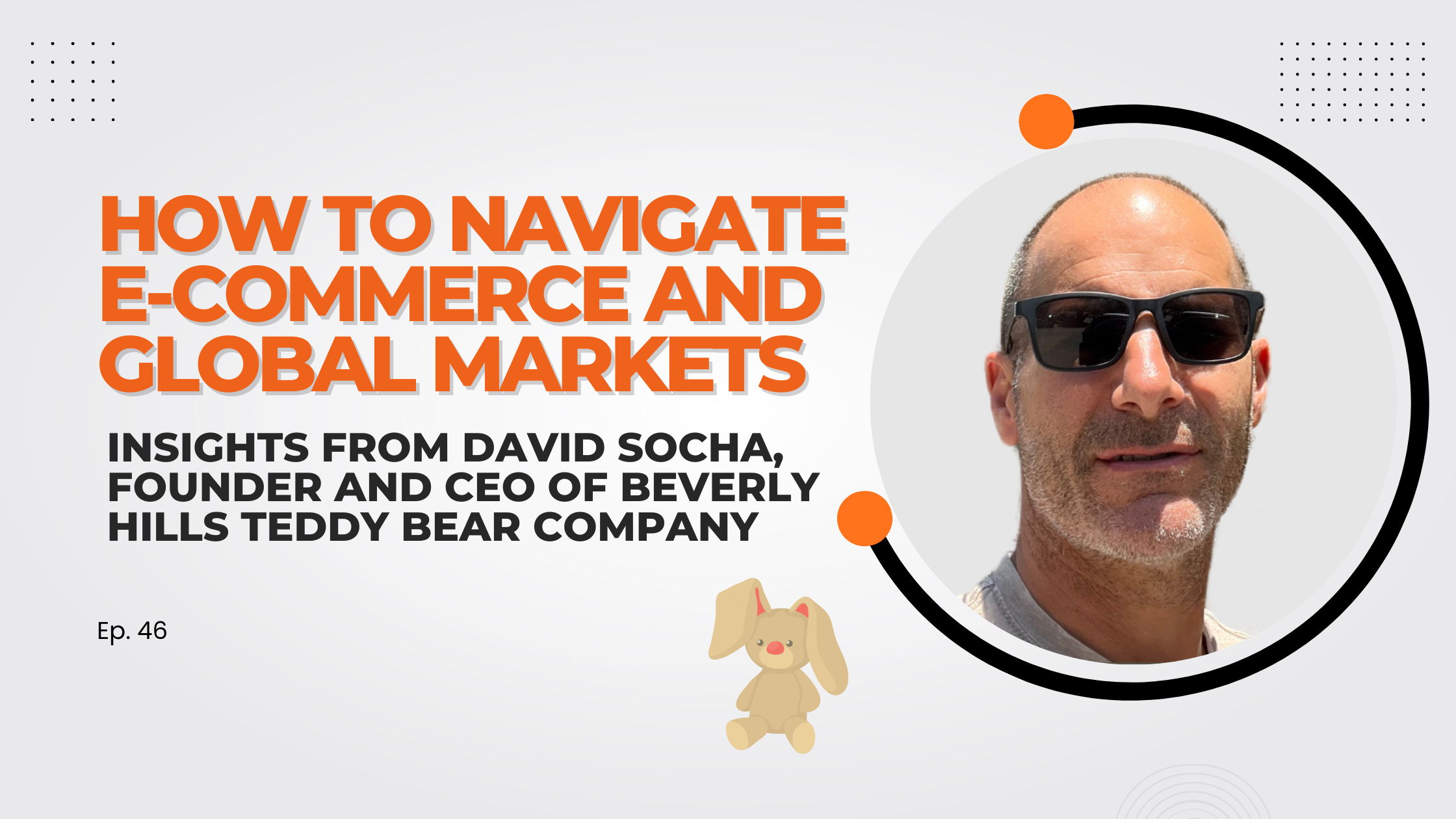
Welcome to another episode of Toy Business Unboxed! In this session, we delves into the plush-filled world of David Socha, the founder and CEO of Beverly Hills Teddy Bear Company. With over two decades of experience in the industry, David shares insights on maintaining business integrity, fostering company culture, and steering global success.
Episode Highlight
- 00:00 Introduction to Toy Business Unboxed
- 00:42 Interview with David: Journey and Insights
- 03:31 Building a Successful Toy Business
- 07:39 Navigating the Toy Industry
- 14:33 Marketing Strategies and Challenges
- 17:19 Amazon and Digital Marketing Insights
- 22:30 International Market Expansion
- 25:48 Final Thoughts and Advice
- 27:42 Conclusion and Farewell
Meet David Socha
David Socha, a name synonymous with innovation in the toy industry, began his journey by founding a mail-order teddy bear enterprise. Over the years, this venture blossomed into a trusted partner for renowned brands worldwide. In today’s interview, David reveals the core values and strategies that propelled his company’s growth, focusing on integrity, quality, and respect for employees and partners alike.
The Journey from Dreams to Reality
David’s career contrasts sharply with his initial ambitions of becoming a stockbroker or professional hockey player. After an unfortunate injury, he pivoted, launching a unique mail-order teddy bear service with his college roommate. They catered to affluent clients with custom teddy bears, a niche that unexpectedly took off.
The Art of Business Relationships
As Beverly Hills Teddy Bear Company matured, nurturing partnerships became crucial. David emphasizes the importance of doing what you promise and maintaining a sterling reputation. Mistakes may happen, but it’s the recovery and commitment to quality that solidifies long-term relationships with big corporations.
Quality and Innovation in Toy Manufacturing
David’s company thrives on producing high-quality, custom plush toys. The secret? A skilled QC team and designers who uphold rigorous standards. Unlike mass-produced items, these hand-sewn plush toys require meticulous attention to detail and collaboration with trusted manufacturers.
The Evolution of a Global Brand
While experimenting with retail stores, David found success in selling products through various global retailers. By balancing the company’s online presence across several domains—such as plush.com and stuffedanimals.com—his business adapts to market shifts and consumer behaviors.
Navigating Digital and Retail Spaces
David’s approach to digital marketing and the Amazon versus retail store debate reveals his expertise. With significant sales funnels through platforms like Amazon, understanding and leveraging each channel’s unique advantages is crucial for growth.
Culture and Faith in Business
Beyond profits, David’s company embeds a rich culture and values. Their line, Bible Toys, integrates faith, aiming to educate and entertain simultaneously. Operating independently across multiple locations—from North Carolina to the Philippines—the company respects diverse perspectives while retaining a cohesive vision.
The Path Forward
David shares a crucial piece of advice for aspiring toy industry professionals: bring something new and needed to the business, not just another copycat product. Innovation and persistence in the face of initial rejections can eventually align stars for success.
Conclusion
David Socha’s journey is a testament to the power of adaptability, innovation, and integrity. He has shown that success in the toy industry involves not only creating products with purpose but also nurturing meaningful business relationships and fostering a supportive company culture. As the toy industry continues to evolve, David’s story serves as an inspiration for future entrepreneurs, emphasizing the importance of perseverance and originality in a competitive market. We look forward to seeing how Beverly Hills Teddy Bear Company continues to lead and innovate, leaving a lasting impact on both the industry and its consumers.
To stay updated with the latest episodes of Toy Business Unboxed and embark on your own journey into the toy business, don’t forget to subscribe and follow the podcast. If you found this episode insightful, please leave a rating and review, and share the podcast with fellow toy enthusiasts. Let’s embrace the world of toys together, staying curious and continuing to innovate.
Contact Information
To discover more Beverly Hills Teddy Bear about you can connect with them through the following channels:
- Website: plush.com
- LinkedIn: Beverly Hills Teddy Bear Company
- Facebook: Beverly Hills Teddy Bear Company
- X: @BHTeddyBear
- Instagram: @BHTeddyBear
Transcript
EP046_09-06-24_David Socha
Intro: [00:00:00] Welcome to Toy Business Unboxed, your gateway to the secrets of the toy industry. Here, Jason Hsieh, a toy entrepreneur and expert in the field. “Every product we develop is really inspired by some of the real life experience that we have with our son.” “60 percent of all toys last year were sold on Amazon.”
“Be passionate about it. Because it’s a road. It’s a journey.” “Like when you have an idea that you think is gonna somewhat change the world, make things better, I’d say go for it.“
Jason Hsieh: Hello, welcome back to another episode of Toy Business Unbox. I’m your host, Jason Hsieh. Today we sit down with David, the founder and CEO of Beverly Hill Teddy Bear Company with over two decades of experience, David shared his journey from starting a mail order teddy bear business to becoming a trust partner [00:01:00] for some of war’s largest brand. Today’s interview, we learn about how David’s commitment to doing business with integrity and making five star products and treating people’s employees and partners alike with respect and cares that has driven his company’s global success. Please join us and welcome David on today’s podcast. Thank you for joining us today, David.
David Socha: Thank you so much, Jason. Great to see you.
Jason Hsieh: Same here. You have such a many years of experience with in the industry, I guess that’s kind of I want to kind of unwrap it one by one. Can we start out with talking about the company that you currently have and what is inspire you to create a company that you currently operate?
David Socha: Sure. Yeah. So we’re a full spectrum toy manufacturer focusing on stuffed animals and stuffed toys. But we do do other things, some action figures and some, and some other products. We make our own proprietary lines of products, some fun stuff. We always try to be first to market in the plush category with whether it be blind plush or sequin plush or [00:02:00] whatever it might be. And and then we also make product for other toy companies and other entrepreneurs in our business that need giveaways or just help along the way figuring out a way to manufacture light electronics or plush or figures.
Jason Hsieh: How do you get into this line of work? Do you always want to be a plushy toy designer?
David Socha: You know. It was a kind of a what’s the what’s the song? God bless the broken road. We went from you know, I wanted to be a stockbroker growing up and then I wanted to be a professional hockey player and when my career ended with with a couple injuries my college roommate and I we started a mail order company where we sent custom teddy bears that could cost well over 500 hours each. More of the wealthy individuals, right. So if Steven Spielberg or someone needed a gift or someone wanted to send him a gift, we would make a Steven Spielberg bear or whatever it was not. [00:03:00] No, we don’t own the trademarks, but
Jason Hsieh: they’re wearing diamond rings is that why
David Socha: it could be, it could be anything. It could be anything. People bought, you know, bride and groom bears, but very specific where it looked just like them. And yeah. Yeah.
Jason Hsieh: That’s why.
David Socha: Yeah. So that’s how we started before the internet really, before anything, we started advertising on radio and it was a lot of fun, very challenging. And as you and I shared before, we have a story about lemons being turned into lemonade. So yeah.
Jason Hsieh: Definitely very, very different. And I think with your long term success in the industry, you have also built a long term relationship with some of the biggest companies in the world. Do you have any secrets and doing businesses with some of the bigger corporation that you also work with right now?
David Socha: Yeah, you know, I think it’s important that you kind of do what you say and say what you do. So if you promise to deliver something and something goes wrong with the factory, it really doesn’t matter. It’s all on you. You [00:04:00] really only have one reputation and a lot of times only one opportunity. Because mistakes are going to happen. There’s no doubt new companies, old companies, the biggest, the baddest, the best companies all make mistakes. It’s as my pastor says, it’s what do you do with those mistakes?
Jason Hsieh: With a particular type of product you create, I think that does require a lot of customization just based on what you just said.
And what go into creating a toy that meet like the high standard of quality? I, I believe you use many different manufacturer over the years. Is there any particular thing you do to ensure the high quality for all the toy product that you provide to the market?
David Socha: I think it’s important to have a good QC team and great designers. I mean, great product starts with great design and we are in the stuffed toy business for the most part. So all those handmade hand sewn, they’re not automated, like a tooled product where it just comes out of the mold. So it’s important to find great partners and great [00:05:00] manufacturers that follow your standards and try to do their very best and live up to those standards.
Jason Hsieh: Yeah. And I think we also talk about it before the actual interview is I’ve seen your company started before Build A Bear, correct? So I think the industry is a little bit different back then, but have you ever think about like building something similar to Build A Bear as far as the business model goes, like going into retail store and having your own store?
David Socha: We did, we’ve had a store here and there cause we own a few domains too. So we own stuffedanimals. com, we own plush. com and we have dabbled in retail a bit. But I don’t know, we really enjoy making product and putting it on the retail shelves, various retailers in the U S Europe and around the world.
Jason Hsieh: I see. I see. I see. Like you mentioned your company has grown globally and you definitely maintain. I guess the hardest part I also struggle with team building and business building is maintain a culture around your team. [00:06:00] I don’t know how many employees do you currently have within your organization right now? David?
David Socha: Yeah. We’re small. I mean, around 20.
Jason Hsieh: Around 20. Yeah. That’s still a decent size.
David Socha: Yeah. Yeah. But we’ve always, you know, the culture has always been balanced. We’re very family oriented. I have a lot of kids, the our company president has a lot of kids. We’re very sensitive to that and look at if you hire the best and hire people who have your integrity, but also your work ethic. You really don’t have to check on them. And that’s what’s beautiful about our team is that they have learned to work independently. I mean, there’s some people I wouldn’t have to talk to for for an entire week or longer who are direct reports. But just because you trust what they’re doing and trust the process and they’re probably better at what they do than you are. So yeah, it’s really important to have great people. People always talk about hiring the Michael Jordans, [00:07:00] but it’s true, right? Like you want to, but you have to have a team that’s very complimentary of one another as well and you need people who will challenge you, but also bring their talents and their gifts. I think that’s what really we’re really good at is letting the people bring their own gifts and talents and fit into our culture and our company.
Jason Hsieh: Yeah, I like, because I know a huge basketball fan, so I like Michael Jordan’s example, because without Scottie Pippen,
David Socha: That’s right, I was going to say that.
Jason Hsieh: The success that he had without a team member that’s supporting him, right? Sure. But if you have everyone being a Michael Jordan running around and never pass the pole around, it’s probably not going to work either.
David Socha: That’s correct.
Jason Hsieh: One thing more very unique about like all the different businesses you run. I know you are also a man of faith and you also designed some faith based product as well.
David Socha: Correct. Yes.
Jason Hsieh: Can you kind of mention to the audience a little bit more about that too?
David Socha: Yeah. So I think about 17, 18 years ago, we wanted to integrate our faith into our company. So [00:08:00] we developed a line of, A product called Bible toys and Bible toys is exactly what it is. It teaches the kids Bible stories from, Adam and Eve, Abraham all the way to Jesus and all the stories and miracles in between. And it just helps supports parents and hopefully kids can have fun playing with the toys and learning while they’re doing it.
Jason Hsieh: That is a whole different business model. How do you structure it? Is it all under one business entity or is each of the brand or domain that you have is a separate business entity? How do you structure that?
David Socha: So they’re all run independently of one another. A Bible toys is actually run out of North Carolina with a key partner distributor and then we have our custom plush business where we make product for entrepreneurs, banks, fortune 100 companies, et cetera. And that’s out of our upstate New York office. And then Los Angeles, our main office where we develop most of the products and have most of our meetings and where [00:09:00] most of us are based.
Jason Hsieh: Do you also hire some people overseas? Was it all us based for your employees?
David Socha: We do we do we have I mean we have a satellite office in in the Philippines for for one of our companies and then we also have have a few people in Hong Kong and You know that the beauty of our business is that it’s built on relationships Yeah, and our manufacturers are like an extension of us and we talk about when we do business with our partners, it’s, we really take the guesswork out of it and our friends and our partners in Asia and the far East are amazing people and we’re really fortunate to have such great support and great partners in them.
Jason Hsieh: How often do you go and visit your supplier in person?
David Socha: Before COVID, I felt like it was a lot more than what it used to be. So cut down quite a bit. I mean, before COVID, we were probably there almost every month from someone from the U. S.
Jason Hsieh: Oh, okay. Okay.
David Socha: [00:10:00] Yeah. And it’s, you know, COVID we were kind of restricted and I think a lot of people have found ways. Because, as the toy business has changed where the hub is, right? Like, Hong Kong’s still a manufacturing hub, but it’s not the sales hub anymore, unless you’re from Asia or Asia Pac. So, Los Angeles has, fortunate for us, has become The hub, we have our toy show starting, but we’ve already had some meetings, but the main thrust of the meeting start next week. And it’ll go for, I think, two and a half, three weeks. And we’ll have, I don’t know, upwards of a hundred appointments. So it’s definitely rotated. Yeah.
Jason Hsieh: Yeah. The LA preview, right?
David Socha: Correct.
Jason Hsieh: You also have been in the industry a lot longer than I am, so you definitely know what you were, you have a lot more connections. And since I see my background is a little bit different, I kind of started in a whole different industry before I got into toys. Right. Yeah. So it definitely I would say it’s like a learning curve as far as understanding the [00:11:00] nuances. And my specialty is really digital marketing, not retail. So retail is a whole deep ball game as far as how to do it correctly. I know I can, I can sell them online, but how do I sell in the store?
That’s definitely a lot of the nuances that you kind of learn over the years. So that kind of lead me to my next questions because of the changes that’s happening in the industry, just like you mentioned about supply chain and different things that changes and also pretty sure the consumer behavior is also changing over the years since you started.
How do you stay on top of all the trend and all the changes and still trying to make sure your company’s, the product you’re creating is still relevant to today’s marketplace?
David Socha: You know, it’s difficult. Obviously it’s very competitive. There are some large companies that keep gobbling up. shelf space and retailers there. Obviously we all know of the consolidation, a lot less retailers out there. I think it’s just important to continue to [00:12:00] create new products, always new things have, always look at fashion and look at different industries. What’s working, what’s not, how can we approach the business differently? And really just kind of having that instinct or, your gut to say, yes, this is what we’re going to do, but then also taking your business and very creating pillars so we have our custom plush where we make product for people that’s under custom plush. com, no plug, just Kind of siloing them for you.
And then we have our plush. com business where that’s really all of our proprietary. Brands where we’re selling our own products to brick and mortar retail and and then our online business. So really trying to balance the company because sometimes one is slow and one’s good. So it kind of balances each other out. My former boss always called it, the Mount Fuji. [00:13:00] Don’t have very few companies at the top because if one of them goes away, you’re in big trouble and don’t sell the very bottom because sometimes it’s difficult. So try and sell everybody in the middle and try and create a base business.
That’s really the goal is to just balance your business. And I think what’s really important too, is that retailers like to have their own things, especially when you compare mass retail to specialty retail. Giving them something different, something special and not just creating product to create product, create product with a purpose or with some feature or something that is a hook for that customer and hopefully the retailer sees it and they put it on their shelf. And then at the end of the day, though, it’s does the consumer like it? If the consumer likes it, all sins are forgiven, is what a wise salesman once told me. We really need to create great product. And [00:14:00] that’s really our goal is to create great product, no matter what we do.
Jason Hsieh: I see. I see. So I know you have so many domains, let me try to keep track of them. So that’s plush. com, that’s customplush. com, and there’s also bibletoys. com, is there any other one I missed?
David Socha: I think you said stuffed animals.com too.
Jason Hsieh: Oh, stuffed animal.com as well. There’s four, yeah. Okay.
David Socha: Yeah, I mean, we have others, but those are the majors
Jason Hsieh: main, the four. Those four are the main.
David Socha: Yeah. I mean, really just trying to be a vertical plush company where if you need one or you need a million pieces. We’re going to be your go to from consumer to corporate.
Jason Hsieh: I want to transition the second part of the interview to talk about more of a marketing piece or marketing component of your business because you have so many different domain.
When you come to digital marketing, like how do you separate it? Do you have like a big digital marketing team that’s doing the ads, optimization, SEO for each of the website on an ongoing basis?
David Socha: It’s a challenge, right? Because there’s always new protocols, new things to do. I think it’s really for us, we build [00:15:00] more brands of product and hopefully they eventually land on our website to find it. But in terms of marketing, it is important to figure out what is the best marketing for that product. And sometimes the best marketing is just the great product on the shelf and they touch it and then it’s word of mouth, right?
Jason Hsieh: Yeah. Yeah. Yeah.
David Socha: Yeah.
Jason Hsieh: So will you say majority of the business coming? It sounds like a majority of the business is coming from B to B not B to C, correct? You don’t really sell directly to consumer as much as you sell into retail store big box stores and big retail like specialty store?
David Socha: Yeah, I would say right now, I mean there is a big shift For, I don’t know what you consider Amazon, but the Amazons of the world and your own.
Jason Hsieh: Amazon I consider is B to C, it’s direct to consumer.
David Socha: Okay. Yeah. So that’s a big growth area for I think anybody in our business because there’s less doors to go.
Jason Hsieh: Amazon also have two different ways to do business on Amazon. For those of [00:16:00] you that’s not selling on Amazon, Amazon have two platforms. Vendor Central, which is kind of like B2B. You’re selling to Amazon and Amazon tried to sell it for you. But nine out of 10, they do a horrible job and try to sell it for you.
They really don’t spend the time and energy because they have so much brand on the Vendor Central. They treat you like one of the million brands they have. So they put a lot of energy into your product description. Pretty much. They don’t, they put minimum effort and just put it, throw it out there. Kind of like throwing spaghetti on the wall and hopefully it sells.
So I usually do not recommend using Vendor Central for the listener that’s listening. For the small brand that usually we recommend is using Seller Central. That’s more B2C because now you have control over the brand. You have control over the listing, the images, the video, and the price. When it comes to selling on Vendor Central, you don’t even have control over the price.
Amazon can lower the price anytime they want when they feel like, Oh, we have a overstock, let’s just reduce it by 90%. Let’s try to get rid of them. And you have [00:17:00] no control and Amazon doesn’t care about your map. That doesn’t care about your retail price. They care about nothing when you do vendor central. And I heard so much horror story of my friends selling through vendor central and they lost so much money through that platform. So I totally do not recommend it. So do not do it unless you have money to burn. Do not do vendor central. So for the listener that is learning about the Amazon platform, because Amazon platform is so complicated. The best analogy I use is like gambling in the casino. So you have to understand the rule and you need to know how to count the cards. If you don’t know how to do both, it’s very hard to be successful on Amazon. Yes. Like, you go into the casino, try to play blackjack, but you don’t understand the rule, you’re going to lose all your money by, at the end of the night. So that’s kind of similar to, to Amazon.
David Socha: Correct. Yes. Yes. Very good to know, jason. Yes. Very good. Yes.
Jason Hsieh: Yeah. And they change their rule all the time too. Amazon will increase the fee, increase the storage fee. That’s now this year, there’s low inventory fee, there’s long term storage fee, there’s Six months [00:18:00] inventory fees, 12 months inventory fee, it go on and on and on and on.
And it is not an easy platform to, to, you know, navigate. But unfortunately they dominate e commerce. What can you do about it? You couldn’t really do about it because you have to be on there. Everyone search Amazon, even, I think that’s a common phenomenon right now. Even when I walk into a retail store, trying to find toys for my kids for Christmas. The first thing I would do is scan the barcode and look for review on Amazon.
David Socha: Correct.
Jason Hsieh: Consumer behavior. Yeah. People do that. I do that myself. Yeah. Yeah. So, because I almost use it as like you know, information, like kind of verification things. So you kind of have to be on there. They, it’s just necessary of I guess you just, it’s a must. I don’t know. Do you feel the same or not, David?
David Socha: And Jason, it’s, it’s not only for the consumer, it’s what retailers look at when they go to buy your stuff.
Jason Hsieh: Yeah, that too.
David Socha: They want to see, well, how’s it doing [00:19:00] on Amazon, right? What are the reviews, which, which is really important because a lot of companies don’t worry about their reviews. And I will say that’s just a little bit of advice. Make sure you get good reviews. It’s really important. And again, that comes from good product, good pricing, all those things have to be in line. But reviews are, are really critical.
Jason Hsieh: A hundred percent. Also the brand consistency for both the branding online and offline should be consistent. And sometimes I’ll work with my clients like what you have online is like totally different because you didn’t create it. Someone just bought it at target and saw it up there and take some random picture. It looked very unprofessional. Like you couldn’t even see what’s inside the box and that’s on Amazon. And when people are looking at it, it’s like, what’s wrong with this company? You know, it doesn’t look, it just looked very fishy.
David Socha: Yeah, exactly. Yeah.
Jason Hsieh: And also supply chain is also a big problem with Amazon because it’s sometimes hard to control who is [00:20:00] selling and who is not selling when you have multiple retail channels. And sometimes, you couldn’t stop Walmart from putting your toys on clearance aisle. Then guess what? People are going to buy it and try to sell it on Amazon as well. So that’s another common issue we see. Yes. When it comes to Amazon.
David Socha: A very good warning to your listeners for sure.
Jason Hsieh: Back to since we’re talking about Amazon Digital marketing for your Amazon strategy, do you have a specific strategy that you do with your team. How do you manage the Amazon platform yourself right now?
David Socha: Yeah. So just to be transparent, we were revamping our Amazon strategy right now. We went through a third party distributor and the business was very successful and then the distributor changed model. So, it made sense for us to make the break and do what we’re doing now. So definitely more of a direct model. And yeah, the whole vendor center, what you mentioned, it’s very true. Unless you’re a behemoth, you really don’t [00:21:00] get the TLC. But we all need to be. I believe on Amazon to in some form and to put our best foot forward there and figure it out without getting too many chargebacks, as you’ve mentioned before.
Jason Hsieh: Yes, yes, profitability is a big problem. And that’s something I review with my team on the monthly basis. Okay. So we did 50, 000, a hundred thousand, but how much profit do we actually make the feeds?
David Socha: Yeah. Yeah. Yeah. Yeah, the fees can be the chargebacks. You have to be box size. I don’t, I’m not telling you anything. Very specific.
Jason Hsieh: Yes. Yes. You need to be very specific. That’s definitely one of the very challenging platform to navigate. Are you also currently selling on Walmart as well? beside Amazon?
David Socha: We do a little bit on walmart. com. We did do a lot more in the past where we had items that were promoted on Amazon, or I mean, I’m sorry, Walmart. But we haven’t, as of late, I think we’ll look at that strategy again. Walmart is growing quite a lot.
Jason Hsieh: [00:22:00] It’s trying to catch up, but they are still kind of behind online income with Amazon, I would say they are about 10 percent of what Amazon is doing online. Of course, their retail sale is huge, but their online sales is only 10 percent of Amazon.
David Socha: Okay. Okay. You, you would know more than I would about that percentage, but yes.
Jason Hsieh: Yeah. That’s a typical, you know, stats when you look at most of the account and that’s how it goes. your sales usually is less than 10 percent of what your Amazon sales is. That’s also true for my brand because we also sell it on Amazon and Walmart as well.
And the other question I have is as far as international marketplaces beside US, what other country are you currently marketing and selling to directly? I mean, of course you, maybe you sell a lot through the distributor, but do you also sell like direct in any of the country as well?
David Socha: We do some direct. It depends really on the opportunity. Obviously Europe’s a little easier with some retailers. We do a little bit in Eastern Europe direct and on occasion in Asia,
Jason Hsieh: have you considered Japan yet?
David Socha: [00:23:00] Japan’s not a really hard market for us to crack. We, we used to do a little bit of business, but we’ve really not been in Japan. So if you want to take it to Japan, Jason,
Jason Hsieh: That’s something im specializing, by the way, I think in Japan, actually. So, because I speak Japanese and my wife’s Japanese, I used to live there for five years. So I did a whole webinar a couple of months ago about amazon Japan and, you know, all the ins and outs about Amazon Japan as well, which is a very different marketplaces and a lot of people is afraid of going into Japan because of the culture barriers, consumers think differently. The expectation is different. One of the funny facts I would like to, I would share is, US consumer like information quick and easy. So when we designed the Amazon product detail page for US consumer, you need to be Big text infographic in their face, so they know in three seconds what it is.
Japanese consumers opposite. They want to see data. They want to see graph. They want to see like all the detailed numbers. Like, okay, how does this toy is going to help my kids in [00:24:00] education? Exactly. What is the, like the trend line? Like they want to see that kind of data. And that’s very different than the U S consumer. And of course that’s the language nuance, but that’s also like an expectation nuance that you need to understand for Japanese culture versus U. S. culture becausevery different. So, so that’s, I think that’s why a lot of the U. S. companies that try to go into Japan, they don’t really make a lot of traction because they didn’t understand the fundamental difference of how the consumer in Japan think versus how the consumer in us, they want to just duplicate what they are doing in us into Japan and just use Google translate and translate their entire listing into Japanese. Usually that never worked. Even with a big brand like Shachibo, they are in Japan as well. I look at their listing before when I did the audit, they only do 10, 000 a month in Japan, but they do 400, 000 a month in U. S. Wow. Yeah, they do a lot in U. S. 400, 000 a month, but they only do 10, 000 a month for the same product. It’s like, yeah, so you kind of know why, why there’s a big gap [00:25:00] because it wasn’t optimized in the correct culture and language context. So, I was actually reviewing the listing with my wife, who is Japanese. She looked at the whole thing and was like, What the heck is this toy? She didn’t understand it. I was like, how do you even play it? It doesn’t understand. Wow. It wasn’t translated correctly. The whole listing was down really poorly, whoever did it, no offense to the marketing company that did it, but based on my experience of being Asian myself, it’s just not convincing to the Japanese like customer, like my wife couldn’t even tell me what the toy is after looking at the product detail page for like five minutes. What is it? Wow. That’s a lot. Wow. Yeah. So that’s a culture differences that’s so hard to know without knowing someone that’s actually native and not understanding the culture.
So as well, wrapping up today’s interview, the final question I always ask every single guest is if you had to share just one piece of advice with someone getting [00:26:00] started in the toy industry. What would that be?
David Socha: You know, I think, think about what you’re going to bring to the business, just with any business, right? And what is the purpose of it? Is it just to throw another piece of product out there and we think it’ll sell? That might be a good reason. I don’t know. You know, a lot of our products are all impulse, but hopefully you bring something that is Thought through and needed in our business and not just a copycat, right? There’s so many copycat our business. I mean we have enough we have enough people doing, you know Copying what we do copying what you do copy whatever bring something new and innovative and then Sometimes the first round the first go round everyone says no. One of our most successful products Everyone said no And then after, I think, I would say 18 months later, it finally, a big retailer gave it a shot, it worked, and now we’re on year nine of that product.
Jason Hsieh: [00:27:00] Oh, whoa, okay.
David Socha: And it’s done really well, but you just never know. You might have, you know, the stars might not align for you, it might be the wrong time, wrong timing. And you might be too early. Maybe it’s a trend that you’re too early on. I would just say, try and think about it and then keep going at it and be focused. Laser focused would be my, my recommendation. Focus is key.
Jason Hsieh: For sure. For sure. Thank you for that piece of advice. So for the listener that’s either listening or watching, how can people find you?
David Socha: Yeah. Our, our main domain is plush. com. And we’re on LinkedIn. We’re on most social media in some way, somehow and the name of the company is Beverly Hills teddy bear.
Jason Hsieh: Thank you for tuning in for today’s episode of toy business unbox. We hope you enjoy the conversation and finding insightful and inspiring. If you like what you hear, be sure to subscribe to our podcast on your favorite platform, so you never miss an episode.
We appreciate your support and love it. If you can leave us a review and share the podcast with your friends and colleagues [00:28:00] within the toy industry for more resource tip and latest updates in the toy industry, visit our website at toy-launch.com. Join the conversation and connect with us on social media using hashtag #ToyBusinessUnboxed.
We would love to hear your feedback and suggestion for future episode. Until next time, keep innovating, keep creating, keep bringing joys to toys. This is Jason Hsieh signing off on toy business on box podcast. I’ll see you in the next episode.