
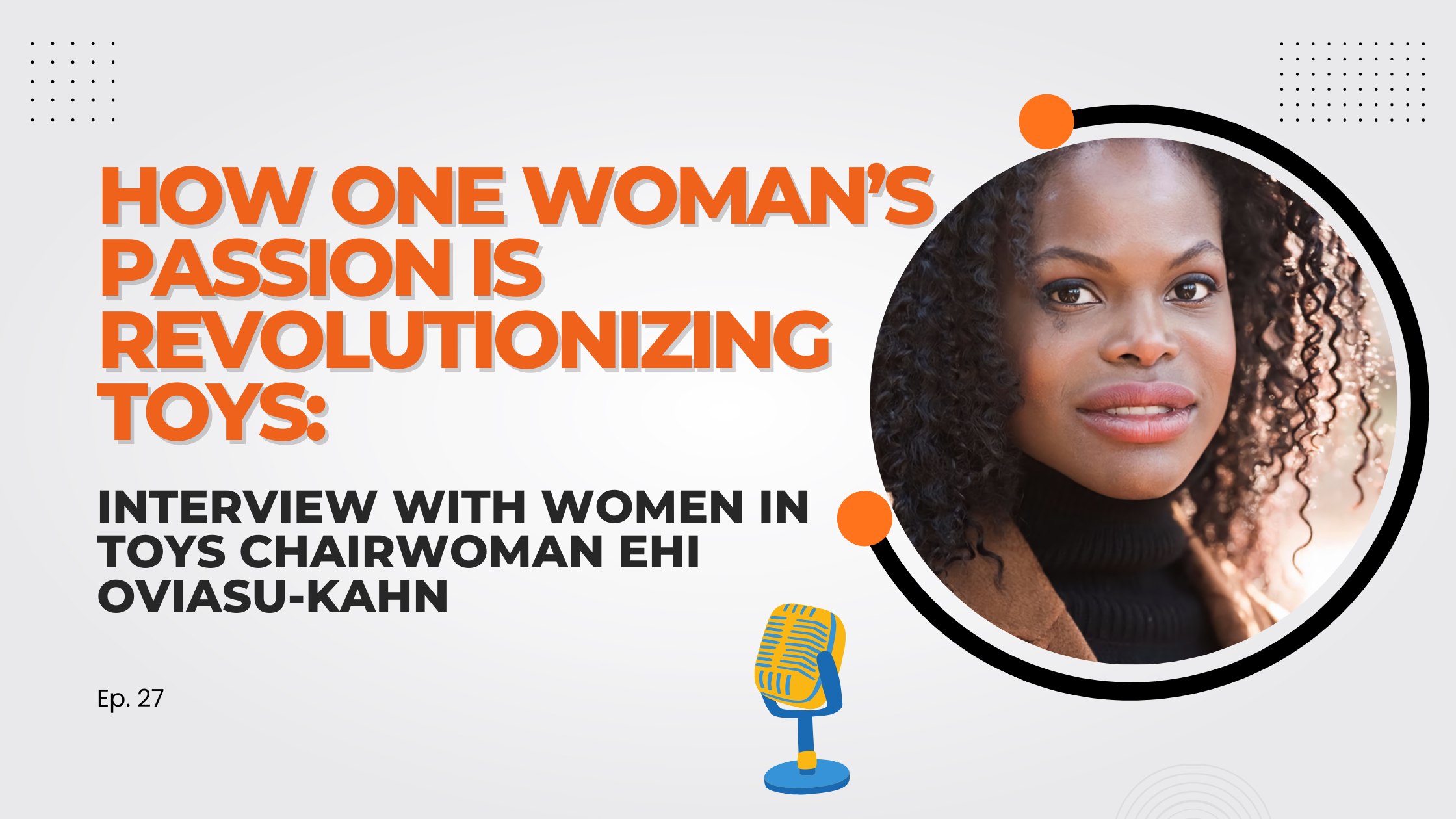
Welcome back to another episode of Toy Business Unboxed, where we delve into the world of toy design and marketing. In this special feature, we sits down with Ehi Oviasu-Kahn, the founder of Little Art and chairwoman of Women in Toys (WIT). With a background as a former attorney and communications consultant, Ehi’s journey in the toy industry is nothing short of remarkable. From her transition from law to toys to her role in empowering women professionals, here’s a glimpse into Ehi’s inspiring story and insights.

Women in Toys: Leadership and Empowerment – Toy Business Unboxed
Episode Highlight
- 00:00 Introduction to Toy Business Unboxed
- 00:43 Meet Steve: VP of Trends and New Market at Gel Blaster
- 01:33 Steve’s Journey in the Toy Industry
- 04:08 Innovating with Gel Blaster
- 07:07 The Greatest Game Ever Played
- 09:44 Challenges in Creating Toy Attractions
- 20:38 Marketing Strategies and Retail Connections
- 35:34 Future Trends and Industry Insights
- 38:19 Advice for Aspiring Toy Entrepreneurs
- 40:12 Conclusion and Farewell
From Law to Toys: A Unique Journey
Ehi’s transition from the legal profession to the toy industry is a compelling story of following one’s passion. After realizing her love for creativity and the importance of engaging her young daughter during the pandemic, Ehi developed her first toy product—abstract art pieces on cards. This venture led to the creation of Little Art, where she focuses on making beautiful, functional toys that aid cognitive development. Her products often emerge from play sessions with her daughter, highlighting the importance of real-life interaction in toy design.
Blending Legal Expertise with Toy Development
Ehi’s experience in law uniquely positions her to excel in the toy industry. Her ability to review contracts confidently and parse through industry trends aids her in creating toys that are both innovative and compliant. She effectively harmonizes competing trends, such as sustainability and novelty, and integrates STEM and STEAM concepts into her designs. This analytical and creative approach enables her to develop toys that not only entertain but also educate and inspire.
Innovations and Upcoming Projects
While Ehi couldn’t disclose specific details about her upcoming products, she emphasized that her innovations will continue to balance sustainability, novelty, and educational value. She believes in the importance of incorporating creativity into STEM education, making complex scientific concepts accessible and engaging for children. By integrating sensory learning and social-emotional development into her toys, Ehi aims to create lasting educational experiences.
Supporting Women in the Toy Industry
Women in Toys (WIT) plays a crucial role in empowering women professionals in the toy industry. The Ruth Handler Mentorship Program, a cornerstone of WIT’s initiatives, pairs mentees with experienced mentors to provide guidance and support at various career stages. WIT also offers extensive networking opportunities, webinars, and a highly active Slack channel for continuous collaboration. The organization supports a wide range of professionals, from engineers and lawyers to marketers and artists, reflecting the diverse nature of the industry.
Major Initiatives and Global Outreach
In 2024, WIT is focused on celebrating the contributions of women who uplift their teams and communities, not just individual achievements. The organization continues to advocate for systemic changes that support women’s advancement in the industry. With active chapters in Hong Kong and London, and ongoing discussions about expanding to other regions, WIT is fostering a global network of support for women in the toy industry.
Balancing Multiple Roles
Balancing her responsibilities as the chairwoman of WIT and a small business owner requires exceptional organizational skills and motivation. Ehi manages her busy schedule by maintaining a master list of tasks and prioritizing her workload. She also considers employing tools like ClickUp for project management and hiring an executive assistant to streamline her operations. Despite the challenges, her passion for her work and her community keeps her motivated.
Conclusion
Ehi Oviasu-Kahn’s journey from law to the toy industry showcases the power of creativity, resilience, and community. Through Women in Toys, she continues to empower and support women professionals, ensuring they have the resources and mentorship needed to succeed. Her story serves as an inspiration for aspiring entrepreneurs and professionals in the toy industry.
Connect with Ehi Oviasu-Kahn and Women in Toys: Email Ehi at ehi@womenintoys.com. Visit the Women in Toys website: womenintoys.com
To stay updated with the latest episodes of Toy Business Unboxed and embark on your own journey into the toy business, don’t forget to subscribe and follow the podcast. If you found this episode insightful, please leave a rating and review, and share the podcast with fellow toy enthusiasts. Let’s embrace the world of toys together, staying curious and continuing to innovate.
Transcript
EP027_06-07-24_Ehi Oviasu-Kahn
Intro: [00:00:00] Welcome to Toy Business Unboxed, your gateway to the secrets of the toy industry. Here, Jason Hsieh, a toy entrepreneur and expert in the field. “Every product we develop is really inspired by some of the real life experience that we have with our son.” “60 percent of all toys last year were sold on Amazon.”
“Be passionate about it. Because it’s a road. It’s a journey.” “Like when you have an idea that you think is gonna somewhat change the world, make things better, I’d say go for it.“
Jason Hsieh: Hello. Welcome back to another episode of Toy Business Unboxed. I’m your host, Jason Hsieh, where we explore the world of toy design and marketing. Today, I’m thrilled to have Ehi the founder of Little Art and the chairwoman of Women in Toys. Her diverse background as a former attorney [00:01:00] and also working with different communications consultant has a very uniquely positioned her to lead in the toy industry.
And she’s here today with us to share her insight. How she’s currently blending creativities with marketing and also the role that she played in the organization Women in Toys. Thank you so much for joining me on the podcast today.
Ehi Oviasu-Kahn: Thank you so much for having me, Jason. I’m thrilled to be here.
Jason Hsieh: First of all, can you tell the audience a little bit more about your transition from law to toy industry?
Ehi Oviasu-Kahn: It’s a really fun it’s a really fun story like a pandemic era project that just kept going. Basically, I’m an attorney by training still a licensed attorney. I’m that kind of little verbal word nerd that likes to look at contracts and put things together. But I have immigrant parents and being an artist, they said, please go. So that’s how I ended up at law school, and I had a really interesting journey in the law. A lot of my peers I went to a [00:02:00] big school a lot of my peers went to a large firm, worked for banks and NGOs, and I had two distinct and specific goals. I wanted to work at the UN, and I wanted to work in entertainment law, and then I did both of those things. And then when I was leaving private practice, working in an entertainment law firm, I realized I’d rather be on the creative side of things. So I was actually producing TV and film projects for a little while. And then I had my daughter and it was press pause on some stuff, that was in October of 2019. And so my maternity leave was ending in March of 2020. The world shuts down and I find myself at home with a four and a half month old daughter and I need to keep her entertained and there’s no parks, there’s no going anywhere, there’s no grandparents visits. I’ve got to keep her occupied. So I basically that’s how I invented my first product. I Made little abstract art pieces. I put them on cards and bound them in silicone and added a T there and a bunch of other elements. It was my mother who was the entrepreneur with family recognized I had actually had done that. And prior to that, I [00:03:00] had no idea this world existed. I’m just, it’s just, it’s true. I’ve been somebody who’s been crafting in her basement for years. I just love to make things. My Instagram handles, he makes stuff and it’s the idea that I just, I like to work with my hands. I like to get creative. So like the story of little art is that I believe everybody deserves beautiful, functional things. And toys are the ultimate functional, beautiful object. They get you, they relax you, that helps their cognitive development from ages zero to 99.
The stories of the toys I develop come out of play with my daughter. So those are real play patterns. I replicate in products. And the story with me joining Women and Toys Licensing Entertainment or WIT as we are known is that as part of discovering that I was now was in this industry, not knowing anything just Googled and tried to find trade groups or women’s organizations that knew something about this world and I became very involved with WIT and then joined the board and I was elected to the chairmanship of the board of directors in January. I served as an [00:04:00] empowerment ambassador, as I call myself. I think to build advocacy for our community developing our tenets around hate transparency, equity, IP protection, small business, entrepreneurship, self actualization and et cetera. Just because what’s a really unique organization in that. We represent everybody from the tiniest one person solo proprietorship like myself all the way up to we have CEOs and C suite level executives and some of the largest toy and entertainment companies in the world. What finds us is that we’re all women advocating for a fair shake, equality and the advancement of both our disciplines and the profession. So that’s me in a nutshell.
Jason Hsieh: How do you feel like your background in law influenced your approach in the toy industry?
Ehi Oviasu-Kahn: In a lot of different ways, actually. Most of the sort of explicit like sort of obvious ways in that when I look at a contract, I I feel really confident reviewing. I’m very comfortable. I don’t know exactly what this is, what to do, and I have questions. I was actually looking at a contract for somebody yesterday. Oh, this is fun. Like I remember why, but [00:05:00] then also in terms of your one’s ability to parse language and trends. We talk about, part of the job of the industrial designer is taking sometimes competing trends and ideas and harmonizing them in one product, and certainly at least when you practice transactional law, you take lots of deal points and lots of priorities that says I’m in a document, right? So you’re trained in that method of creative, but analytical thinking at the same time. I certainly see that reflected in my daily practice, both as an inventor and as a professional. And then also being able to review the large macro trends in the industry, recognizing how those work together and competing priorities. For example we have sustainability as a ongoing priority, particularly from parents perspective. I’m a parent so I’m a buyer. So I care about sustainability. But also kids like novelty. So how do you combine right? How do you keep up with trends and combine novelty with alcohol?
I buying population that’s increasingly concerned with usability, sustainability, etcetera. That’s just one example of sustainability piece. And then there’s obviously the stem and steam argument. How are we want to empower girls toys. So for a [00:06:00] long time things got more gender neutral as we wanted to just empower children. And then there’s this question of are we neglecting what girls toys can do or neglecting what boys toys can do. Again, competing priorities at times. So being able to keep lots of different strains of discussion live at the same time to develop a product or products or processes that work for everybody. That’s certainly why law helps.
Jason Hsieh: I want to transition to your own toy that you mentioned earlier. I know Little Art focusing on like innovative product. Do you have any product like you can show the audience?
Ehi Oviasu-Kahn: No, I can’t. I can’t right now. I would just cause I actually do have something that I’m pretty close to launching. And I might say something to you about it in the future. But the principles there are it is something that is, it combines the competing priorities of sustainability and novelty. STEM and STEAM mesh toy developing that sort of social emotional learning aspect with the sensory aspect of building and taking things apart.
And then also I love to come back to STEAM as a concept because I think STEM is important, but when you’re a child, having the [00:07:00] creativity, working in concert when you’re developing STEM concepts is important because it’s not that you have one chance when you’re a child to impress upon these kids that this is not just rote learning. These are tools that you can use as you get older and engaging them in a creative process while you’re teaching them, I think really helps those lessons stick. If somebody had explained physics to me as to it’s not this sort of this vector dry equations learning high school, but it’s like this is actually why your super soaker is so powerful. This is actually why a slingshot can go in a parabolic arc and what that means. If you could break those things down in a way that kids can appreciate and understand, I think you’ll just have more enduring lessons. And so I’m a very big advocate of that. The concept I’m developing now or concepts I’m developing now are along that sort of, those principles. So more to come.
Jason Hsieh: Yeah, and that remind me of the Certified Play Expert program I just attended. They spent a lot of time discussing about child development and different stages of child development and how can toy and play to be really contributing to [00:08:00] part of that. For those of you that haven’t heard of a certified play expert, please check it out, it’s on the Astra’s website. It’s a certification program that you can take. Me and my sister went through the two day in person. It was very beneficial. We both learned a lot. So I want to transition next to talk a little bit more about your role in the Women in Toys organization.
How does Women in Toys currently support women professionals in the toy industry?
Ehi Oviasu-Kahn: Oh my gosh. So many like implicit and explicit ways. We have our sort of our formal programming. I think the marquee example is the Ruth Handler mentorship program where we have expressed deliberate mentorship network of mentees and mentors. Where you meet your needs at every stage of the career you are. So it’s not just entry level professionals who are seeking that sort of older voice or more established voice. People who are mid level people who are seniors seeking to transition or capitalize on their new strengths and grow. With greatest strength is the authenticity and the durability of its professional network. And that’s rest in the Ruth Handler Mentorship [00:09:00] Program. But then also we have the sort of our formal mentorship and networking opportunities, the wonderful, very active Slack channel. We have many chapter events at our localities across the country and across the world. We have a very active presence in numerous trade shows. We were just at licensing expo. We had a presence, smaller presence at Astra. Obviously, a toy fair every year, BLE, and the list goes on and on will be at Gen Con over the summer. And as we develop we started off as Women’s Toys. I did this licensing and entertainment piece because we’re following the way toys have grown as a sector within the economy. Always there to support women professionals. They provide webinars on explicit job training, resume building all the way up to just emotional professional coaching.
I’ve mentioned mentorship. There’s also just the almost kind of a sisterhood where there’s always a, member who’s willing to just take a moment to share an insight or share a contact or just each other. And then increasingly, we’re moving more into an explicit vein of advocacy where we’re looking at that women’s advancement at a systemic level where their [00:10:00] policies and programs that support business owners and how do we capitalize on those and how do we make those supportive and inclusive of women and their goals? Because as I always like to talk about the business case of women’s empowerment, there’s obviously the Normative value of being inclusive and supportive. But the truth is women, we make the household purchase decisions leadership at every segment.
Jason Hsieh: We all know who’s the real boss in the house.
Ehi Oviasu-Kahn: And so when you include those voices, it just redounds the benefit of the entire industry, both listening to them. And that’s about 300 billion a year. We are a significant driver so it just makes sense for WIT to be part of that discussion.
Jason Hsieh: Of course. Actually, my sister, which is our marketing director, she is also volunteering as a mentor in Women in Voice as well.
Ehi Oviasu-Kahn: Wonderful.
Jason Hsieh: How can men also get involved? Can we also volunteer our time to help?
Ehi Oviasu-Kahn: Of course, men are active allies within wit. We obviously serve the interests of women, but that doesn’t mean that we don’t have men [00:11:00] who come in and serve as mentors in some capacity. We have lots of male volunteers to do our, some webinars, other programming someone like yourself would be really wonderful addition to our, whether our library, or just a one on live event in terms of marketing, because we have a lot of entrepreneurs as WIT members and I think this kind of programming is very useful for them, but we certainly have many male champions and allies across the industry.
Jason Hsieh: Can you share some of the key Initiative that was currently doing this year in 2024 to help women in events in their careers?
Ehi Oviasu-Kahn: Oh, absolutely. So in addition to the sort of the yearly Ruth Hamlin mentorship program. We’re celebrating wonder women everywhere and tapping that off at the wonder women awards our gala in los angeles. Without Toy Fair taking place in New York, we had an opportunity to refocus on the efforts of women across the country, across industries and one thing we’d like to do is that we’re throwing the spotlight on women, not just women as individuals who achieve, but women who involve and pull up whole teams of their colleagues with them, both male [00:12:00] and female, but benefit companies or products or processes. And that’s a unique focus this year. It’s always a wit value to celebrate camaraderie and support, but we’re making that more explicit in 2024.
Jason Hsieh: Do you also have chapter internationally, like Japan as well?
Ehi Oviasu-Kahn: I don’t think we have a Japan chapter. We do have Hong Kong, certainly London, there’s a European, I think usually we meet at Nuremberg, so I think there’s a Nuremberg chapter, but there’s a London chapter. And growing, we’re always accepting interest. We have members, of course, spread out all over the world, and it’s one thing we introduced this year. We’re a working groups. So we have we have a number of Asian Pacific Oceanic members in New Zealand and Australia. We have a sustainability working group as a result, because that’s obviously a very main issue in that part of the world and they participate readily in that.
Jason Hsieh: How about any Asian country? Because I speak Chinese and Japanese myself. I would love to help with the Asian.
Ehi Oviasu-Kahn: We’d love that. Yeah we have a Hong Kong chapter. We had a presence in Japan. It’s not as active as others. It can wax and wane depending on who’s participating, but that’s always [00:13:00] welcome.
Jason Hsieh: Got it. And my next question is, you briefly mentioned about mentor program. How does it work exactly for people that’s interested?
Ehi Oviasu-Kahn: You can either as mentee or as a mentor. So from the perspective of mentee, you sign up as a participant and you enter in what you’re looking to get out of mentorship, whether it’s additional development or direct coaching or career transition, or you’re looking to professionalize your operation. You’re looking to specifically focus on how to become a better marketer or specifically focus on how to become a better leader and you’re in your needs. And then you are matched personally and directly with a mentor who has deep expertise in that area. So from the mentor’s perspective, you sign up and you volunteer your time. You identify what your strengths are, how you participate and you’re paired off with your mentee. I’m a former participant of the Ruth Hale and mentor program. It’s really great. I have a very warm relationship with my mentors to this day. She’s very helpful and very supportive and you get some really warm, genuine connections out of it on both sides, both mentees and mentors.
Jason Hsieh: How often do you typically meet?
Ehi Oviasu-Kahn: Between [00:14:00] four and six formalized. It’s actually really great because it’s very regimented in terms of goals and you hit your introductory section, goal setting, goal targeting. And there’s a really nice rubric that’s already set out for you. That’s a nice advantage of a formal mentorship program cause it’s not diffuse relational thing that sometimes mentorship programs can be. So you have four and six meetings. The duration is about, I want to say between two to three months or so over the course of his meeting. And the idea is to get out of it a tangible goal you started at A, and the idea is you feel like you’re now at point D where you can take on more on your own. You feel more empowered to step in the direction you want to go in.
Jason Hsieh: That’s wonderful. Thank you for offering that as a program and it is free for the members?
Ehi Oviasu-Kahn: Oh yes. Yes.
Jason Hsieh: Okay.
Ehi Oviasu-Kahn: Membership covers the mentorship program. It covers the webinars and some live events, some you do have to pay out of pocket for and register for. Obviously we’re a non profit, so donations are always welcome. Membership does come with a lot of both tangible and intangible benefits.
Jason Hsieh: Talk about live event you just recently wrapped up a huge live event at Licensing Expo. For [00:15:00] the audience that’s listening, or watching, can you tell the audience a little bit more about the event so if they want to participate next year, they know what to expect?
Ehi Oviasu-Kahn: Absolutely. So we normally have a presence at Licensing Expo, which is the sort of the preeminent North American licensing trade show. It’s great with WIT being in both licensing and entertainment, having a presence there for our members. And this is when we typically have a breakfast where we meet with our sponsors, our members who are present at the show, get a chance to network and talk and catch up. This year we did something special. We actually had our Empowerment Day event at Licensing Expo. It was a great and unique opportunity. One from the perspective of a smaller inventor. Someone like me, I don’t have Disney money. I’m not going to a trade show, but it’s important to see the lifecycle of where your concept ends up as a product within the larger marketing plan of a larger company, or even the industry in general, there are certainly trends that will be readily apparent as you’re walking the floor.
So that is invaluable being able to participate in that. And then also the empowerment day itself. I know it’s evolved over the years, but it’s typically it’s [00:16:00] this sort of understanding of an MBA in a day where you can come in concept to pitch. In addition to pitching your concept to actual buyers, getting real feedback in terms of their actual 2025 in this case, 2025 to 2026 product placement, how they could see a concept like that in their product lineup. There are a number of mentorship live immediate mentorship tables as part of the event. So there was a marketing mentor, there’s a product development mentor, there’s an inventor mentor where you get real feedback from professionals who are currently working in this space. It’s immediate insight and the elite capacity of an industry that you get. You start at point zero, you get here and you get this 30, 000 foot view of what’s really going on. And that’s the most emblematic crystallization of what WIT can offer its individual members. We’re really open to give the keys to the kingdom to our members because we’re really trying to lift up each and every one of us.
Jason Hsieh: Are you planning to do that next year as well?
Ehi Oviasu-Kahn: So it’s part of some discussions. We might think of Empowerment Day might take on a flavor of depending on what the trade show is a more licensing focused [00:17:00] Empowerment Day or a general going back to something like Toy Fair where it’s everything and adventure.
Jason Hsieh: I’m actually going to a licensing show in Japan next month. Tokyo.
Ehi Oviasu-Kahn: Oh, great. Great. Yes. And there was a big Japanese pavilion at licensing, as of which I’m sure you’re aware at licensing expo this year because it’s going more and more emergent and more dependent. So certainly we’re looking for that integration in the future.
Jason Hsieh: As a chairwoman for the Women in Toys, how do you juggle everything that you do? You also have your own business too, right?
Ehi Oviasu-Kahn: That’s a really good question. How do I juggle it? It’s like when I go back to when my daughter was born, she was like five years old and I was going to sleep. And at this point I just taught myself to think of going to bed as a nap. Just don’t think of it. It’s a nap. And you feel wonderful. You’re like, oh, a three hour nap? It’s a nap. It’s good. I’m happy to take a nap now. And I was putting my head on the pillow and it occurred to me for the foreseeable future, I’m going to be [00:18:00] tired. And I can either just be tired, or I can be tired and feel good about what I did that day. It’s just a question of pushing into your extra gear. I have wit, I am a dedicated chairwoman, I love this organization, I am very passionate about the work we do, but I’m also a small business owner and attempting to launch new products. Continuously developing new ideas. I’m an artist. I have my creative practice. So it really is you get up in the day, I have 8 million little notebooks. Super ADD. So there’s always some kind of wild mental map. My office is a map. I’m so glad you guys can’t see it. I just keep the balls in play and I put my finger air, feel the wind on my guard. Today is an email day and I just, but I didn’t have a master list. It’s got to get done. So however it’s done, it’s like a Montessori method. Like it just, it’s just gotta get done. However it’s going to get done. I’m really motivated. I am able to take a few steps back and recognize I feel really lucky to be in this way, I feel like this is the strangest mashup of [00:19:00] my particular skill set as a job. It’s eerie how perfect it worked out. From the perspective of an inventor and artist, having a legal background and understanding as I’m making something like, okay, this is protectable, this is not protectable.
Having that constant monologue in the back of my head or when I’m talking to my members and we’re talking about business development, we’re talking about advocacy, being aware of what the dynamics are. I just feel lucky and that just gives me that extra energy. That’s the answer. It’s hard, but will takes you almost all the way there. And then it’s just a little organization. Although I want to say to anybody who’s listening, do you have any tips on organizing. If anybody who’s like a super organizer, a super planner, a super like method person, I’m really interested in learning more about that because it gets to a point where
Jason Hsieh: I have a good advice for you. Hire an executive assistant.
Ehi Oviasu-Kahn: I, oh my gosh. I think I’m getting to a point where I really think I need to, because I’ve got
Jason Hsieh: yeah. My executive assistant have been working for me for, let’s see, two, three years now. She is from the Philippines. She works from home and we pay her a decent amount, about 3 an hour, that’s a decent [00:20:00] wage in the Philippines. She checked all my emails, she coordinated my calendar, she helped with the podcast, getting you on my calendars. That really saved a lot of time because I really don’t like checking email myself. I have too many inboxes.
Ehi Oviasu-Kahn: Managing the inboxes. I’m really good about, I have my sort of janky system. I have my color coded Google profiles. So I have my yellow one. My blue one. And I just keep them on my desktop at any time. So I’m able to just say, okay this came in
Jason Hsieh: second recommendation I will have for you and for the listener is to use ClickUp. We have been using ClickUp for almost two years now is a wonderful project management system. And it can get pretty complicated if you want it to be. For us, for our clickup, we have dashboard for almost everything. We have automation for almost everything too, right? This podcast that we’re doing right now, I have automation in Clickup, the Auto Trigger, the next task based on the stage of the podcast, because podcasts have many different [00:21:00] stages as well. And on average, me myself and my team spend 10 hours per episode on producing this show. Yeah, there’s a lot of juggling, a lot of work, but I think having a strong project management system is a must for any entrepreneur, especially toy entrepreneur.
Ehi Oviasu-Kahn: You’re absolutely right. I use click up when I’ve worked with other people on other projects. I love the visual layout. Colors for instance, I like the way that it looks. That’s something I’m going to consider. Just formalizing some of this.
Jason Hsieh: ClickUp also have free training called ClickUp University. You can take free courses from ClickUp for like beginner that’s using the system. Actually, our project manager actually went through the certification program. There’s three levels, there’s beginner, intermediate, and expert certification. She went through all the certification. I went through the certification until intermediate. I didn’t finish the expert certification yet. But those certifications that’s offered from ClickUp for free, that’s a really good resource to get a foundation and you also learn about how to use a project [00:22:00] management tool correctly. Because you can have the best tool, but if the data is not consistent, it’s not going to work. So for our system, every single task have a due date, have an assignee, have time estimate, and every single task have time track. So we know exactly how much time each team member is spending on every single task, every single day and we can create fancy dashboard because the data integrity is so important.
Ehi Oviasu-Kahn: Oh, I think that’s really critical. Just because if particularly if you’re a creative person, it’s always the tension between one and the task. Having some kind of simple system you can just refer to really quickly, because keeping a lot of, it’s going to sound funny, but keeping a lot of blank space in your head is really important. Like just to have ideas. And so that’s why I end up just picking a day where I’m like, okay, today is just an office day, not a workshop day. Today’s a workshop day. Stay because you need to keep those things.
Jason Hsieh: Yeah, so usually I’ll bring down all the idea into an issue list in our ClickUp system. So then we’ll discuss as a team, do we want to do something about it? Or is it just [00:23:00] another thing we can push off? And that’s different way to organize it.
And like I mentioned to you when we met in person in the dinner, I’m also a huge fan of EOS, Entrepreneur Operating System. It transformed my business three years ago when I implemented that framework. I would love to do a webinar just on that. I can talk.
Ehi Oviasu-Kahn: Is that just like a business methodology? I’ve never, I don’t.
Jason Hsieh: It’s a business methodology invented by Joe Wickman. He is also a serial entrepreneur and he teach small and mid sized business owner on how to operate a business effectively, six core component, there’s a vision, people, there’s processes and data, and also how do you get tractions? I read all seven so far. I still have one more book to go in.
Ehi Oviasu-Kahn: Very cool. I like that. Very cool. I’ll review that because it’s just as I’m pivoting my business into a different direction, that’s something I think I could use because I one method, one works. It’s more passive. I think I’m at a place where I feel more confident. I want to be more.
Jason Hsieh: Yeah and there’s a free resource. I also [00:24:00] recommend to the listener as well and to you as well is organizationalcheckup com. It’s a free assessment tool that’s created by the EOS organization, which you can take this assessment and it’s going to give you a score from one to 100. How well your business is structured. Guess what? Three years ago when I took this school, I got like 50. So I got an F pretty much as a business.
Ehi Oviasu-Kahn: Honestly, I don’t even know. Mine would probably be like a nine. Like it would just be,
Jason Hsieh: but you need to know where you’re at so you can improve. So now we are about 90 right now.
Ehi Oviasu-Kahn: That’s actually a point I want to stress to people who are listening now, part of the difficulty sometimes with being an entrepreneur, and I certainly my members report this a lot is just not knowing where you are and the sense that you don’t know what you don’t know. The most nerve wracking part, and that’s what generates a lot of the self doubt that keeps you stuck. You may be finding yourself filling out or pushing off, putting out paperwork for months at a time because you just feel, lock up and procrastination takes over. Are you focused on [00:25:00] tasks that you feel are manageable that aren’t actually efficient?
So being able to have a direct immediate assessment projected back to you, I think helps you move on because at the end of the day, it’s checklists and get data, get it done and make a plan that makes sense.
Jason Hsieh: Does a woman in toy also facility like small mastermind maybe a group of 10 people get together once a month and just sharing business ideas?
Ehi Oviasu-Kahn: So that’s not actually something do you mean
Jason Hsieh: because I participate in a lot of different business mastermind over the year currently. I have a mastermind for all the different business that I run. So I meet with other business owners once a week.
Ehi Oviasu-Kahn: Can you say more about what that is? Is it just like hypothetical business ideas or people bringing their ideas?
Jason Hsieh: No, it’s real business application. For example, once a week, I’ll meet with other because I also run a digital marketing agency, right? So I’m part of a mastermind, which we meet every single week, and we just share ideas and talk about what is working, what’s not working, and just exchange ideas with other business owners. And [00:26:00] sometimes you’ll be frustrated I’m trying to get something done, but someone else already done it a couple months ago. That’s how you learn from each other. And then you share ideas with other people. That’s how I master my work. You just meet once a week.
Ehi Oviasu-Kahn: It’s like a support group for business owners almost.
Jason Hsieh: Yes.
Ehi Oviasu-Kahn: That’s a wonderful idea. I don’t think it’s something we do, and it’s something that we could certainly incorporate. Just have this sort of a, like a business owner working group or business owner. We do have a very active Slack channel, and I know people who roll their eyes, but it is a sincere, attended effort. You
Jason Hsieh: can’t anything between a Slack channel and a mastermind. You meet the same group of people, like they just say, usually you want to keep it under 10, over and over again, every single week.
For example, I have, I’m in this e commerce mastermind, we have been meeting for the past two years, every single week, same group of people.
Ehi Oviasu-Kahn: I think that’s consistent. It’s like being in a seminar with a bunch of people who are going through similar issues. I think that’s a, that’s the kind of effort that would actually fit in really well with WIT’s ethos and that we really do work to support each other. So that’s something I’d like to explore. Yeah.
Jason Hsieh: [00:27:00] Yeah. And also in another mastermind is. It’s called Special Father Network. It’s a mastermind for a special needs dad. We share about parenting as well. Yeah. If something was not working, we meet once a week as well.
Ehi Oviasu-Kahn: And that’s really important. And in terms of just building the kind of support you need, being in that position. Like my daughter is on the spectrum, and just being able to speak to people who have a sense of what that’s like. With kids like that, you’ve met one, you’ve met exactly one. And so it can alienating, it can be strange there’s so much variation even with neurotypical children and being a parent is already alienating. I think it’s really for people out there who are considering that, please do because you will learn so much about what you actually do know what you’re doing well and hear about it from the perspective of other parents. So that’s the wonderful thing.
Jason Hsieh: Yeah. But going back to women in toy, what kind of professional women’s will you like to encourage people to join? What kind of audience?
Ehi Oviasu-Kahn: It’s really, it’s like anybody in the [00:28:00] it’s going to sound really general, but it’s anybody in this increasingly diverse industry. The difficult, maybe 20 years ago, it was a woman who was working at a toy company and a minor or toy developer. But with these women who are in manufacturing, we have women who are engineers, we have women who are straight up actual just artists who are working in the visual arts, we have women who are associated professional services. We have female lawyers, engineers, project managers, people who are in pure entertainment, vertical people who are coming into sort of consumer product space or in beauty, for example, who are developing in beauty product and the marketing people who are in gift wrap.
I think the commonality is. Women who are passionate about the work that they do and are seeking to join a community of like minded women in that regard who are trying to reach into their best selves, develop their most effective capacity, and share that out with their respective audiences and colleagues.
Jason Hsieh: Thank you for sharing that. Winding down in today’s interview, I asked this final question to all the guests is if you have to share just one piece of advice with [00:29:00] someone that’s getting started in the toy industry, what would that be?
Ehi Oviasu-Kahn: Don’t be afraid. Don’t be afraid. Because the fear is the thing that will keep you back. That is the strongest voice in your head. The voice that is saying doubt. I don’t know. I’m not sure. I don’t know what to do. That keeps your glued back glued to the wall. Don’t be afraid. You’re going to make mistakes. You’re not going to know what you’re doing. You’re going to say the silly thing. You’re going to send the wrong email. You’re going to buy the wrong product. You’re going to talk to the wrong people. Don’t be afraid because the sooner you get started, there’s no replacement for the real world experience.
And so don’t be afraid. Get started. Keep an open mind. And open ears and be ready to talk to people. And also wit is always here. So if you’ve done it and you’re stuck, there’s a wit member who has been through this, please us, please reach out to us. We’re happy to help. Even if it’s just listening, because sometimes over the course of a 20 minute conversation and I’ve done this at a trade show, I’ve just pulled somebody aside on the floor and just spoken to them and said 20 minutes later, I’m like here’s four emails of people to, and sometimes it’s [00:30:00] just particularly for entrepreneurs, that journey is lonely. Especially the more unique your focus and your product is there’s no road book there’s no map, You’re so focused on what you’re doing, it can feel insurmountable, but chances are a lot of us have been there before and we’re always willing to help you.
So please don’t be afraid.
Jason Hsieh: Got it. Thank you for sharing that. And how can people find you?
Ehi Oviasu-Kahn: I am at ehi@womenintoys.com, so you can just reach out to me and it’s womenintoys.com is our website. I’m also at the owner of little art, so littleartdesign.com and ehi@littleartdesign.com I invent, I also consult on designs. If you have something you were working on and you think you want to tweak it, or you want to make it more artistic or more streamlined or however, if you were interested in developing a STEM and STEAM toy, I do that all the time. So please reach out to me and hope to hear from you all soon.
Thank you.
Jason Hsieh: Sounds good. Thank you so much for being on our show and sharing all the wonderful things you’re doing with the Women in Toy organization and all the support you are providing to the members as well.
Ehi Oviasu-Kahn: Thank you. [00:31:00] Thank you very much. It’s real honor to do it. Thank you.
Outro: You’ve been listening to Toy Business Unboxed, hosted by Jason Hsieh. Thank you for joining us and exploring the fascinating world of toys and the ingenuity behind them.
To stay updated with the latest episodes and continue your journey into the toy business, remember to subscribe and follow us. If you found today’s episode insightful, please leave a rating and review and share this podcast with others who share your passion for toys. Until next time, stay curious and keep innovating.